Localization of Eigenvalues in Small Specified Regions of
Complex Plane by State Feedback Matrix
H. Ahsani Tehrani
*Department of Applied Mathematics, Faculty of Mathematical Sciences, Shahrood University, Shahrood, Islamic Republic of Iran
Received: 20 April 2013 / Revised: 24 Febuary 2014 / Accepted: 16 May 2014
Abstract
This paper is concerned with the problem of designing discrete-time control
systems with closed-loop eigenvalues in a prescribed region of stability. First, we
obtain a state feedback matrix which assigns all the eigenvalues to zero, and then
by elementary similarity operations we find a state feedback which assigns the
eigenvalues inside a circle with center and radius. This new algorithm can also be
used for the placement of closed-loop eigenvalues in a specified disc in z-plane for
discrete-time linear systems. Some illustrative examples are presented to show the
advantages of this new technique.
Keywords: Discrete-time systems; State feedback matrix; Localization of eigenvalues; Disc; Closed-loop system.
*Corresponding author: Tel: +982733393505; Fax: +982733396009; Email: [email protected]
Introduction
In many applications, mere stability of the controlled object is not enough, and it is required that the poles of the closed-loop system should lie in a certain restricted region of stability. Several design methods have been reported which utilize the LQ technique to achieve the desired pole allocation. The closed-loop poles can be placed exactly as specified. Kawasaki and Shimemura (1983) have derived a method of allocating all the closed-loop poles in a preferable region rather than exact location. However, the continuous-time results cannot be directly extended to the discrete-time case. Fujinaka and Katayama (1988) describe a method for designing discrete-time optimal control systems with closed-loop poles in a prescribed region, Yuan and Achenie and Jiang (1996) addressed the problem of linear quadratic regulator (LQR) synthesis with regional
closed-loop pole constraints. Benner and Castillo and Quintana-Orti (2001) presented the method for partial stabilization of large-scale discrete-time linear control systems. Grammont and Largillier (2006) employed an approach to localize matrix eigenvalues in the sense that they build a sufficiently small neighborhood for each eigenvalue (or for a cluster). Recently, Ayatollahi (2013) obtained a method for Maximal and minimal eigenvalue assignment for discrete-time periodic systems by state feedback. Zhou, Cai and Duan (2013) obtained a method for Stabilisation of time-varying linear systems via Lyapunov differential equations. Franke (2014) presented the method for Eigenvalue assignment by static output feedback – on a new solvability condition and the computation of low gain feedback matrices.
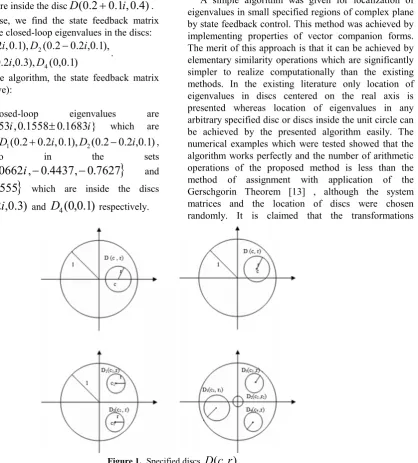
a disc
D
(
c
,
r
)
centered at(
c
,
0
)
with radius r, in which1
r
c
, as shown in Fig. 1. In this paper, the aim is to present a method for localization of eigenvalues in small specified regions of complex plane by state feedback control for discrete-time linear control systems.Materials and Methods
Problem Statement
The problem of localization of eigenvalues in a small specified region has been the subject of many investigators in the last decades [2,6].
Consider a controllable linear time-invariant system defined by the state equation
t Ax
t Bu
tx (1)
or its discrete-time version
t Ax
t Bu
tx 1 (2)
where
x
t
n,u
t
mand the matricesA
andB
are real constant matrices of dimensionsn
n
andn
m
respectively, withrank
(
B
)
m
. The aim of eigenvalue assignment in a specified region is to design a state feedback controller,K
, producing a closed-loop system with a satisfactory response by shifting controllable poles from undesirable to desirable locations. Karbassi and Bell [7,8], have introduced an algorithm for obtaining an explicit parametric controller matrixK
by performing similarity operations on the controllable pair
B
,
A
. In fact,K
is chosen such that the closed-loop system eigenvaluesBK
A
(3)lie in the self conjugate eigenvalue spectrum
1,
2,
,
n
. Recently, Karbassi andTehrani [9] extended the previous results as to obtain an explicit formula involving nonlinear parameters in the control law. The stabilization problem consists in finding a feedback matrix
K
mn such that the inputu
k
K
x
k,
k
0
,
,1
2
,...
, yields a stable closed loop system,...
2
,1
,
0
,
)
(
1
A
BK
x
x
k
x
k k k (4)In case the spectrum (or set of eigenvalues) of the
closed-loop matrix, denoted by
(
)
, is contained in the open unit disk we say that
is (Schur) stable or convergent (in other words,
i
1
for all)
(
i
). The stabilization problem arises in control problems such as, the computation of an initial approximate solution in Newton’s method for solving discrete-time algebraic Riccati equations, simple synthesis methods to design controllers, and many more [3, 11, 12].The stabilization problem can in principal be solved as a pole assignment problem. Pole assignment methods compute a feedback matrix such that the closed-loop matrix of system (3) has a prespecified spectrum. In this paper, we present an efficient approach for localization of eigenvalues in small specified regions for linear discrete-time systems. Our assignment procedure is composed of two stages. We first obtain a primary state feedback matrix
F
p which assigns all the eigenvalues of closed-loop system to zero, then produce a state feedback matrixK
which assigns all the closed-loop system eigenvalues in a small specified disc or discs.Synthesis
Consider the state transformation
t
T
x
t
x
~
(5)where
T
can be obtained by elementary similarity operations as described in [7]. In this way,AT
T
A
~
1 andB
~
T
1B
are in a compactcanonical form known as vector companion form:
m nm m
n
I G A
0 ___ __________
~ 0
mm n
B B
0 _______
~ 0 (6)
Here
G
0is anm
n
matrix andB
0is anm
m
upper triangular matrix. Note that if the Kronecker invariants of the pair
B
,
A
are regular, thenA
~
andB
~
are always in the above form [7]. In the case of irregular Kronecker invariants, some rows ofI
nm inA
~
are displaced [8]. It may also be concluded that if the vector companion form ofA
~
obtained from similarity operations has the above structure, then the Kronecker invariants associated with the pair
B
,
A
are regular [7].eigenvalues to zero, for the transformed pair
B
~
,
A
~
, is then chosen asx
F
x
G
B
u
01 0~
~
~
(7)Which results in the primary state feedback matrix for the pair
B
,
A
defined as1
~
F
T
F
p (8)The transformed closed-loop matrix
F
B
A
~
~
~
~
0
assumes a compact Jordan form with zero eigenvalues
m m n m
n
n m
I
0
___
__________
0
~
0
(9)
Theorem 1: Let
D
be a block diagonal matrix in the form
k
D
D
D
D
0
0
0
0
0
0
2 1
(10)
where each
D
j ,(
j
,1
2
,...,
k
)
is either of the form
j j
j j j
D
(11)( to designate the complex conjugate eigenvalues
j j
i
)or in case of real eigenvalues
]
[
jj
d
D
(12)If such block diagonal matrix
D
with self conjugate eigenvalue spectrum is added to the transformed closed-loop matrix,
~
0, then the eigenvalues of the resulting matrix is the eigenvalues in the spectrum.Proof:The primary compact Jordan form in the case of regular Kronecker invariants is in the form
m m n m
n
n m
I
0
___
__________
0
~
0
(13)
The sum of
~
0 withD
has the form:D
H
~
~
0
(14)
k m
m n m
n
n m
D
D
I
0
0
0
___
__________
0
1(15)
k r
l l
D
I
D
I
D
D
D
0
0
0
0
0
0
0
0
0
0
0
0
0
0
0
0
0
0
0
0
1 1
2 1
(16)
where
I
s,
s
,1
2
,...,
r
is the unit matrix of size 2 in casen
m
is even. In casen
m
is odd only ones
I
takes the form of a unit matrix of size one.By expanding
det(
H
~
I
)
along the first row it is obvious that the eigenvalues ofH
~
are the same as the eigenvalues ofD
. For the case of irregular Kronecker invariants [8] onlysome of the unit columns of
I
nm are displaced, since the unit elements are always below the main diagonal, the proof applies in the same manner.Results
)
(
)
(
j
Column
i
Column
j (17)followed by
)
(
)
(
i
Row
j
Row
j (18)for j= n, n-1, …, m , i=j-m.
Hence, the matrix
H
~
thus obtained will be in primary vector companion form such that:
m n mm n
I
H
H
0
___
__________
~
0
(19)
where
H
0 is anm
n
matrix .Because of similarity operation, the eigenvalues of the matrix
H
~
are the same as the eigenvalues ofH
~
and that of
D
. Now the feedback matrix of the pair)
~
,
~
(
A
B
is defined by:)
(
~
~
0 0 1 0 0 1
0
H
B
G
H
B
F
K
(20)
Theorem 2: The state feedback matrix
K
~
assigns the eigenvalues of closed-loop matrix~
A
~
B
~
K
~
inside a circle with center
c
and radiusr
if in case circle intersects axis of abscissas we suppose
j,
j be in the form:)
Re(
)
1,
0
(
*
)
)
Im(
(
r
2c
2random
c
sqrt
j
(21))
1,
0
(
*
)
)
Im(
)
(
(
sqrt
r
2l
2c
random
j
(22)and in case circle does not intersect axis of abscissas we suppose
)
Re(
)
1,
0
(
*
random
c
r
j
(23))
Im(
)
1,
0
(
)
(
r
2l
2random
c
sqrt
j
(24)where we take l
j Re(c) if
j*
Re(
c
)
0
and otherwise we take
l
j
Re(
c
)
and for assigning real valued eigenvalues in the
circle
c
and radiusr
we choose)
Re(
)
1,
0
(
*
)
)
Im(
(
r
2c
2random
c
sqrt
d
j
(25)Proof:The eigenvalues of matrix
D
defined above fall inside a circle with centerc
and radiusr
.Let (26)
( )
0 0
~ ~ ~ ~
0 0 1 0 , 0
,
0 B B G H
I G K
B A
m m n m m n m
n
(27)
m m n m
n m m n m
n I
H I
H B B G B B G
, 0
, 0 1 0 0 0 1 0 0 0
0 0
~
Clearly
~
H
~
, sinceH
~
is similar to the matrixH
~
and the eigenvalues of matrixH
~
are the same as that of matrixD
and elementary similarity operations do not change the eigenvalues, then the eigenvalues of closed-loop matrix
~
A
~
B
~
K
~
fall inside a circle with centerc
and radiusr
.Remark: Since
K
~
assigns the eigenvalues of the closed-loop matrix
~
A
~
B
~
K
~
inside a circle with centerc
and radiusr
, it is obvious that the statefeedback controller matrix,
1 0 0 1 0
1
(
)
~
K
T
B
G
H
T
K
also assigns theeigenvalues of the closed-loop matrix
A
BK
inside a circle with centerc
and radiusr
too.Note that for assigning the eigenvalues of the closed-loop matrix in spectrum
1,
2,
,
n
we supposen
j
D
j
j
,1
2
,
,
(28)An algorithm for assignment of eigenvalues in a disc
)
,
(
c
r
D
.In this section we first give an algorithm for finding a state feedback matrix which assigns zero eigenvalues to the closed-loop system. Then we determine a gain matrix which assigns the closed-loop eigenvalues in a circle with center
c
and radiusr
.Input: The controllable pair
(
A
,
B
)
, the primary state feedbackF
p,B
01andT
1which are calculated by the algorithm proposed by Karbassi and Bell [7,8], the centerc
and radiusr
of the target circle.the form (10), in which for assigning complex valued eigenvalues in the circle with center
c
and radiusr
if circle intersects axis of abscissas we suppose)
Re(
)
1,
0
(
*
)
)
Im(
(
r
2c
2random
c
sqrt
j
)
1,
0
(
*
)
)
Im(
)
(
(
sqrt
r
2l
2c
random
j
otherwise we choose
)
Re(
)
1,
0
(
*
random
c
r
j
)
Im(
)
1,
0
(
)
)
)
Re(
(
(
r
2c
2random
c
sqrt
jj
where we take lj Re(c) if
j*
Re(
c
)
0
and otherwise we takel
j
Re(
c
)
and for assigning real valued eigenvalues in the circlec
and radiusr
we choose)
Re(
)
1,
0
(
*
)
)
Im(
(
r
2c
2random
c
sqrt
d
j
Step 2. Set
H
~
~
0
D
Step 3. Transform
H
~
to primary vector companion formH
~
as in (19) using elementary similarity operations as specified in corollary of theorem 1 .step 4. Now compute 1 0 1 0
F
B
H
T
K
p therequired state feedback matrix.
Illustrative Examples
Consider a discrete-time system given by
t
Ax
t Bu
t x 1 Where
A
andB
are randomly generated with10
n
andm
6
.
5
5
4
3
4
9
6
5
2
5
3
3
7
6
0
1
8
4
4
6
8
6
2
4
8
0
6
3
0
0
1
0
3
6
8
4
7
4
1
0
0
8
4
9
7
3
4
8
3
6
4
3
2
1
1
9
6
9
3
9
7
7
8
7
6
4
7
4
9
4
0
7
1
3
8
4
9
8
5
2
4
0
9
9
8
4
3
5
3
8
1
7
9
7
6
7
5
4
1
5
A
9
9
3
6
1
0
0
5
4
6
9
6
2
6
4
7
3
1
7
3
2
7
0
5
5
8
3
2
2
9
5
8
9
3
9
5
8
2
5
3
3
9
5
3
6
6
2
7
5
9
4
7
2
3
0
0
8
3
9
6
B
The open loop eigenvalues are
} 5948 . 47 , 2993 . 1 , 9397 . 9 , 2995 . 5 , 3189 . 7 5762 . 0 , 2589 . 4 8866 . 2 , 7729 . 3 3425 . 4 {
i i i
which are widely spread in the complex plane. In order to locate them in small discs inside the unit circle, we employ the above algorithm step by step. First, the primary state feedback matrix which locates all the eigenvalues of the closed-loop system to the origin of the complex plane is found to be:
Now we consider the following different cases: a) It is desired to locate the closed-loop eigenvalues inside the unit circle centered at origin. By using the algorithm, the state feedback matrix obtained is (above): It can be verified that the closed-loop eigenvalues are
,
}
6721
.
0
,
5252
.
0
,
2026
.
0
,
8462
.
0
,
3704
.
0
4660
.
0
,
7467
.
0
0153
.
0
,
8344
.
0
4451
.
0
{
i
i
i
clearly all are inside the unit circle.
b) In this case, we find the state feedback matrix which assigns the closed-loop eigenvalues in the disc
)
3
.
0
,
5
.
0
(
D
. By using the algorithm, the state feedback matrix obtained is (above):The closed-loop eigenvalues are
,
}
3398
.
0
,
6024
.
0
,
0817
.
0
3974
.
0
,
1139
.
0
7454
.
0
,
1103
.
0
2535
.
0
,
2343
.
0
6490
.
0
{
i
i
i
i
all of which are inside the disc
D
(
0
.
5
,
0
.
3
)
.c) In this case, we find the state feedback matrix which assigns the closed-loop eigenvalues in the disc
)
02
.
0
,
5
.
0
(
D
. By using the algorithm, the state feedback matrix obtained is:The closed-loop eigenvalues are in the set
}
5088
.
0
,
4900
.
0
,
5198
.
0
,
4842
.
0
,
0055
.
0
5083
.
0
,
0001
.
0
4825
.
0
,
0124
.
0
5154
.
0
{
i
i
i
,
all of which are inside the disc
D
(
0
.
5
,
0
.
02
)
. Clearly, localization of eigenvalues in small specified regions of complex plane by state feedback control is achieved.d) In this case, we find the state feedback matrix which assigns the closed-loop eigenvalues in the disc
)
4
.
0
,
1
.
0
2
.
0
(
i
D
. By using the algorithm, the state feedback matrix obtained is (above):The closed-loop eigenvalues are in the set
}, 1615 . 0 , 3704 . 0 , 2691 . 0 0761 . 0 , 0759 . 0
4814 . 0 , 0475 . 0 0884 . 0 , 1875 . 0 2829 . 0 {
i i
i i
all of which are inside the disc
D
(
0
.
2
0
.
1
i
,
0
.
4
)
. e) In this case, we find the state feedback matrix which assigns the closed-loop eigenvalues in the discs:)
1
.
0
,
0
(
),
3
.
0
,
2
.
0
6
.
0
(
),
1
.
0
,
2
.
0
2
.
0
(
),
1
.
0
,
2
.
0
2
.
0
(
4 3
2 1
D
i
D
i
D
i
D
.
By using the algorithm, the state feedback matrix obtained is (above):
The closed-loop eigenvalues are
}
1683
.
0
1558
.
0
,
2453
.
0
2084
.
0
{
i
i
which areinside the discs
D
1(
0
.
2
0
.
2
i
,
0
.
1
),
D
2(
0
.
2
0
.
2
i
,
0
.
1
)
,and also in the sets
0
.
5657
0
.
0662
i
,
0
.
4437
,
0
.
7627
and
0
.
0478
,
0
.
0555
which are inside the discs)
3
.
0
,
2
.
0
6
.
0
(
3
i
D
andD
4(
0
,
0
.
1
)
respectively.Discussion
A simple algorithm was given for localization of eigenvalues in small specified regions of complex plane by state feedback control. This method was achieved by implementing properties of vector companion forms. The merit of this approach is that it can be achieved by elementary similarity operations which are significantly simpler to realize computationally than the existing methods. In the existing literature only location of eigenvalues in discs centered on the real axis is presented whereas location of eigenvalues in any arbitrary specified disc or discs inside the unit circle can be achieved by the presented algorithm easily. The numerical examples which were tested showed that the algorithm works perfectly and the number of arithmetic operations of the proposed method is less than the method of assignment with application of the Gerschgorin Theorem [13] , although the system matrices and the location of discs were chosen randomly. It is claimed that the transformations e)
2278 . 1 3592 . 0 6350 . 0 4175 . 0 0419 . 0 4418 . 0 6608 . 0 2148 . 0 2247 . 0 8390 . 0
4281 . 0 3386 . 0 8128 . 0 5913 . 0 4248 . 0 5576 . 0 1535 . 0 5908 . 0 4235 . 0 2601 . 0
2198 . 0 9973 . 0 8110 . 2 8173 . 0 2272 . 2 3166 . 0 2666 . 0 9463 . 0 3724 . 2 9936 . 1
7536 . 0 3282 . 0 4976 . 2 9830 . 1 1608 . 1 7287 . 0 0851 . 0 2602 . 0 0106 . 0 9824 . 0
5421 . 1 5491 . 0 3701 . 2 1543 . 0 5546 . 2 3688 . 0 3533 . 0 8530 . 0 9036 . 2 8658 . 1
4089 . 1 4604 . 0 8894 . 0 5998 . 0 9334 . 0 1762 . 0 3404 . 0 8331 . 0 0043 . 1 4979 . 0
K
obtained by similarity operations reduce accuracy of the computations [2], however, other methods such as LQR methods [10,11,15] and the method presented in [1,13] are more complicated.
References
1. Ayatollahi M. Maximal and minimal eigenvalue assignment for discrete-time periodic systems by state feedback.Optim. Lett,7: 1119-1123 (2013).
2. Benner P., Castillo M., and Quintana-orti E.S. Partial stabilization of large-scale discrete-time linear control systems. in: Technical Report, University of Bremen, Germany (2001).
3. Dragan V., and Halanay A. Stabilization of linear systems. in: Basel, Switzerland (1994).
4. Franke M. Eigenvalue assignment by static output feedback – on a new solvability condition and the computation of low gain feedback matrices.Int. J. Control,87: 64-75 (2014). 5. Fujinaka T., and Katayama T. Discrete-time optimal
regulator with closed-loop poles in a prescribed region.Int. J. Control,47:1307-1321 (1988).
6. Grammont L., and Largillier A. Krylov method revisited with an application to the localization of eigenvalues.
Numer. Func. Anal. Opt,27: 583-618 (2006).
7. Karbassi S.M., and Bell D.J. Parametric time-optimal
control of linear discrete-time systems by state feedback-Part 1: Regular Kronecker invariants. Int. J. Control, 57: 817-830 (1993).
8. Karbassi S.M., and Bell D.J. Parametric time-optimal control of linear discrete-time systems by state feedback-Part 2: Irregular Kronecker invariants. Int. J. Control,57: 831-839 (1993).
9. Karbassi S.M., and Tehrani H.A. Parameterizations of the state feedback controllers for linear multivariable systems.
Comput. Math. Appl,44:1057-1065 (2002).
10. Kawasaki N., and shimemura E. Determining quadratic weighting matrices to locate poles in a specified region.
Automatica,19:557-560 (1983).
11. Mehrmann V. The autonomous linear quadratic control problem. theory and numerical solution, In: Lecture notes in control and information sciences, Springer-verlag, Heidelberg (1991).
12. Sima V. Algorithms for linear quadratic optimization Pure and applied mathematics, New York (1996).
13. Tehrani H.A. Assignment of Eigenvalues in a Disc D(c,r) of Complex Plane with Application of the Gerschgorin Theorem.World Appl. Sci. J,5(5): 576–581 (2008). 14. Yuan L., Achenie L.E.K., and Jiang W. Linear quadratic
optimal output feedback control for systems with poles in a specified region.Int. J. Control,64: 1151-1164 (1996). 15. Zhou B., Cai G., and Duan G. Stabilisation of time-varying