International Journal of Finance and Managerial Accounting, Vol.4, No.15, Autumn 2019
13
With Cooperation of Islamic Azad University – UAE BranchIdentification and Categorization of Effective Factors and
Indices in Measuring the Maturity of Accounting
Information System
Hadi Yazdi
Department of Accounting, Kermanshah Branch, Islamic Azad University, Kermanshah, Iran
Department of Accounting, Kermanshah Science and Research Branch, Islamic Azad University, Kermanshah, Iran [email protected]
Mehrdad Ghanbari
Department of Accounting, Kermanshah Branch, Islamic Azad University, Kermanshah, Iran (Corresponding Author)
Babak Jamshidi Navid
Department of Accounting, Kermanshah Branch, Islamic Azad University, Kermanshah, Iran [email protected]
Habibollah Javanmard
Department of Industrial Management, Arak Branch, Islamic Azad University, Arak, Iran [email protected]
ABSTRACT
Management accounting highlights the use of accounting information for decision making and optimal control and management of executives in organizations. Accounting information is provided comprehensively by the accounting information system (AIS). To develop the AIS, the maturity of the system should be determined. In this regard, the first step is to identify and categorize maturity factors and indices. This research study aimed to identify and categorize the factors and indices effective in measuring the AIS maturity in the large manufacturing industries located at Markazi province. The research method was descriptive and library method and field studies were also used to collect data. The statistical population encompassed two groups: AIS experts whose scientific comments were applied in the selection of indices, and the employees in experienced AIS who determined the impact of the factors. Using Factor Analysis, the factors and indices used to measure the AIS maturity were categorized and 36 effective indices in nine factors were selected. Then their impact was calculated using structural equations. Finally, the factors with effective indices were categorized and the findings and recommendations were provided to the major industries of Markazi province, as special beneficiaries, and other industries.
Keywords:
Maturity of accounting information system, Accounting information system, Maturity indices of1. Introduction
The role and effect of accounting information in management accounting and in making its economic decisions is so broad that the continuity of the economic units without having access to the relevant, comprehensive, and sufficient information about investment and expected returns seems to be impossible. Hence the successful economic units and investors have access to more timely information (Darabi et al., 2016). AIS is a successful system in providing accounting information. The accounting information system is a system that collects and stores financial data through accounting processes. After processing the concerned data, it generates the information used by the organization’s decision makers. Finally, intelligent accounting information system can help decision makers and managers of the organizations in their strategic plans by providing sophisticated financial reports. Making a decision requires the provision of accurate, timely, and reliable information, which necessitates the use of complex financial and non-financial systems. One of the most important systems in decision making is the accounting information system (Hajiha & Nabiyouni., 2014).
The proper accounting information system will have a positive impact on the organization's performance. The system is efficient when it can evolve in line with changes in the environment and organization. According to the contingency theory, in line with changes made in an organization's internal and external conditions, evolution of the accounting
information system in accordance with the
management accounting practices seems to be of essence (Melnyk et al., 2014). The evolution of an information system requires six steps, based on Nolan
model: identification, dissemination, control,
comprehensiveness, data management, and maturity (Javanmard, 2013). The system evolution is also applied to the accounting information systems and can be implemented in two ways. First, the system evolution can be examined in incrementally during a long term. Accounting information systems in organizations grow with the advent of a computer. The second approach to examine the evolution of the accounting information system is performed through a short term and may take only a few years. An AIS evolution project may be used to design and deploy
AIS or to improve AIS in the organization (Trigo et al., 2016).
To benefit from the positive effects and benefits of information management, the organizations must achieve the integrity of the AIS or its progress, and this will not be possible unless the system maturity is measured. To measure the AIS maturity or progress, it is necessary to determine the status of the AIS in its life cycle, and this requires identifying the measurement factors and indices. This is the subject addressed in the present study; therefore, the significance of the research is specified. Furthermore, the previous research has not covered this subject and this is the novelty of this study.
In Iran, different organizations have been concerned with the development and improvement the accounting information system as well as the IT application and progress in finance and accounting, regardless of the fact that their existing system is actually a mechanized financial system, and they have mainly assigned a human task to a machine, i.e.
computer. The system components has not
experienced a same degree of growth in terms of software, hardware, user affairs, and database
documentation (Grossman, 2018). Different
organizations also need to develop both accounting information system and IT; therefore, they should identify the factors necessary for the development (maturity) of the information system to design the system development program in order to reach maturity.
Many indices affect the AIS maturation and improve the performance of this system and its dynamics. Each group of relevant indices forms the AIS maturity factors. In other words, factors consist of multiple indices whose relevant factor and the degree of their impact on the maturity of the accounting information system need to be determined.
proper strategy and plan for its growth and development; therefore, they should first find out their AIS maturity status.
To determine the AIS maturity status, there are two main issues: identifying and categorizing factors and indices affecting the AIS maturity and then developing the AIS maturity measurement model. The study was to identify and categorize the progress factors and indices for the accounting information system in industrial organizations; thus, the effective factors and indices affecting the AIS life cycle assessment were first detected. The research questions raised in this study are as follows:
What are the AIS factors and indices to determine the status of the accounting information system progress? How are identified factors and indices classified?
2. Literature Review
In the theoretical foundations of this research, the theory of information economics and then the AIS history and evolution as well as the AIS maturity are addressed.
2.1. Theory of Information Economics
With the advent of information economy theory, an informational vision emerged in the accounting mindset, which has been adopted in empirical research by some accounting researchers. This information paradigm considers information as scarce resources, just like other resources, which are used to produce or exchange in the economy. The demand (and thus value) of information is the result of improvements in making decision under the conditions of uncertainty. One of the main teachings of information economics is the uncertain nature of the value for each particular information resource. (Rahnamay Roudposhti et al., 2010). The theory of information economics has led accountants focus on the relationship of information and users to detect the determinants of the value of information.2.2. Accounting Information System
AIS is a comprehensive and integrated, computer, and user-machine system, the output of which is to provide information to support accountants and managers in the organizations. In the Basic Concepts of Accounting Statement No.2, the Financial Accounting Standards Board defines accounting as asystem, whose main objective is to provide useful information for decision making. The American Accounting Association first stated in 1996 that
accounting was an information system and
implemented the general theories of information in the field of effective economic activity, which presented information in figures (Trigo et al., 2016). According to this definition, accounting is the general system of information about the economic unit.
To track accounting activities, the AIS is associated with the IT resources and internal management’s decisions, including non-financial transactions directly affecting the processing of financial transactions, and consists of three major subsystems (Trigo et al., 2016): 1. Transaction Processing System; 2. Financial reporting system; and 3. Management reporting system.
The transaction processing system is to support daily transactions, and aims at automating business processes, demonstrating that the AIS is the first information system to support business activities (Hall, 2010). The financial reporting system is an integrated system that summarizes the transactions and reports a form or list on the status of the organization's financial resources (Rom & Rohde, 2007). The management reporting system that is a management information system, connects the internal management to specific financial reports, and provides information for making decisions such as budget.( Vidal Carvalho et al., 2016)
The information provided by the accounting information system to decision makers is accurate and reliable, and decision-makers largely use such information (Alewine et al., 2016). The deployment of
information systems often requires substantial
investment. For such an investment, there can only be one goal, i.e. the end user's satisfaction inside or outside the organization (Ebrahimi, Kord Lor et al., 2013). User’s satisfaction will also be met if the AIS is complete.
2.3. History and Progress of the
Accounting Information System
countries are passing through the maturity and progress stages of their information system. The evolved system contains five hierarchical levels:
elementary, elementary management, model
definition, quantitative management, and optimization (Proença & Borbinha, 2016).
Maturity models are useful tools for evaluating the actual status of an organization and deducing and prioritizing its progress measures. The maturity model consists of a series of maturity levels for a group of purposes. The lowest level indicates the early status of the organization and the highest level represents maturity. Progress on the evolution path involves incremental progress according to the capabilities and facilities of the organization. The maturity model acts as a measure for assessing the status on the evolution path (Wilner, 2016).
Several maturity models have been presented so far, the most famous of which in the field of
information technology evolution in today's
organizations is Nolan model, called the Theory of Nolan’s stages. Nolan and Koot (1992) describe the philosophy of the theory of the stages as follows: The progress of information technology in an organization is carried out through some stages. Each stage has its own specific problems in the field of information systems, users, technology, staff, and management tools. Hence, the management approach to be used should be different for each stage (Wilner, 2016). The Nolan’s development stages are described by four IT
development processes that determine the
development and transformation of information technology in an organization. These processes are as follows:
Existence of applications, including automated
information systems of the organization
Users, including user satisfaction of
information services and their positive perceptions of these technologies
Resources, including the quantity, quality,
experience and knowledge of the staff, as well as the extent of efficiency and effectiveness of existing technology;
Management, including the organization,
measures, and procedures needed to control the supply of information (Matrane et al., 2015).
2.4. Maturity of the Accounting
Information System
Making efforts to improve the indicators of information technology and information systems such as ease of access to hardware and computer, software and the Internet, citizens’ level of software, hardware, and Internet literacy is considered as an important component of programs accelerating economic growth, reducing poverty, and employment at a macro level. Also, the quantitative and qualitative expansion of the presence of the citizens of each country in cyberspace is considered as a representative of their culture and their attempt to influence the international arena (Hashem Khani, 2012). This indicates the global significance of the information systems maturity and evolution. The AIS is also one of the information systems, which is of no exception. In addition, the recent trend of management accounting has changed from short-term planning and control based on historical information to a prospective strategic planning and control (Rahnama Roudposhti et al., 2016). Thus the components of management accounting should be considered for a long term. One of the important components of management accounting is its information system, whose evolution and maturity needs to be considered for long-term planning.
In his research, Hosseini Rad (2014) mentioned that human resources, procedures and instructions, data and software have the greatest impact on the success of the accounting information systems. Abdali Laraki (2017) also counted the other components of the accounting information systems as follows: Staff: Users of accounting information systems; Methods and Instructions: Processes of collecting, managing and storing financial data; Data: Data related to the organization and its business processes; Software:
Software program for data processing; IT
Infrastructure: Information systems and networks that
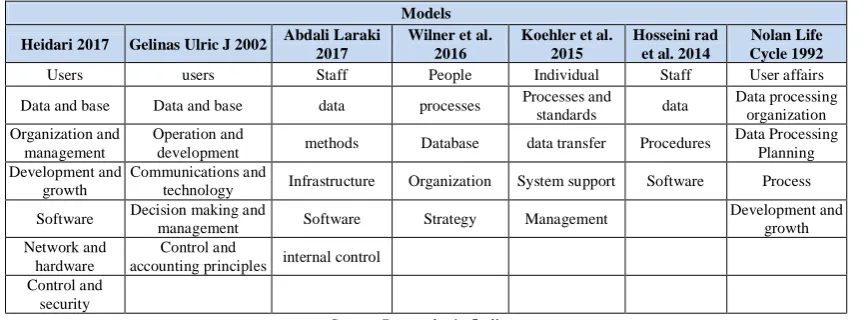
allow the relevant users have access to accounting information system; Internal controls and security measures: system security issues to protect data. According to Gelinas Ulric J (2002), the accounting information system encompasses the components such as technology, databases, reporting and control, event processing, decision making and management, operation and system development, communications, and accounting and auditing principles. Table 1 shows the maturity models of the information system along with their main factors.
Table 1: IS Maturity models and main factors
Models
Nolan Life Cycle 1992 Hosseini rad
et al. 2014 Koehler et al.
2015 Wilner et al.
2016 Abdali Laraki
2017 Gelinas Ulric J 2002
Heidari 2017
User affairs Staff
Individual People
Staff users
Users
Data processing organization data
Processes and standards processes
data Data and base
Data and base
Data Processing Planning Procedures
data transfer Database
methods Operation and
development Organization and
management
Process Software
System support Organization
Infrastructure Communications and
technology Development and
growth
Development and growth Management
Strategy Software
Decision making and management Software
internal control Control and
accounting principles Network and
hardware Control and
security
Source: Researcher’s findings
2.5. Research Questions
1) What factors and indices are effective for the
AIS maturity assessment in large
manufacturing industries?
2) What factors and indices are used for the AIS
maturity assessment in the manufacturing industries of Markazi province?
3) Based on their relationship and impact, how
are the AIS assessment measures classified for manufacturing industries of Markazi province?
3. Methodology
The present research was correlational in terms of its methodology and applied in terms of its objective. The statistical population consisted of two groups: A limited number of professors and scholars in finance and accounting with expertise and experience in AIS (n=45), who determined the preliminary indices
effective in the AIS maturity assessment; and financial, accounting and auditing managers and financial and accounting experts in the manufacturing industries of Markazi province, who were assessed to be 288 persons in the accounting and finance units of large organizations. Using the Cochran formula, the sample size was calculated to be 194.
(1)
At the significance level of 5%, ⁄ is 1.96 and
=0.035.
N shows the population size (N=288) and σ is the standard deviation for the first 30 distributed questionnaires (σ =0.19).
Using regular clustering method, 250 questionnaires were distributed, of which 196 questionnaires were collected. To develop the questionnaire, AIS maturity factors and components were identified and categorized after studying relevant articles, resources, and models. Then, more complete factors and indices were extracted from their aggregation and the questionnaire was prepared by deleting the common points (the questionnaire contains factors and indices of Table A in Appendix). After preparing the questionnaire, the comments of the first statistical group were used and their corrective comments were also considered. The reliability of the questionnaire with regard to the professors and experts’ comments using Cronbach's alpha was estimated to be 0.867, which indicates an acceptable reliability. The revised questionnaire was distributed as the final version of the questionnaire among the second group. Descriptive and inferential statistics were used to describe and identify the effective factors and to classify the indices. Factor analysis method was used to select important variables and correlation test was then run to determine the correlation between the selected indices and the AIS maturity. Finally, factor analysis was run to select more important indices with relevant categories. Statistical analysis was performed using LISREL software version 8.5.
4. Results
Data analysis was carried out based on the answers to the research questions.
First question: What factors and indices are effective
for the AIS maturity assessment in large
manufacturing industries?
Several studies (e.g., Davern & wilkin, 2010; Khajavi & Etemadi, 2010; Nikroe & Salimifard, 2014, Snyder & Halpern, 2010; Koehler et al. 2012; Ghazanfari et al., 2011, Hariri, 2013, Alewine et al. , 2016; and Delak, 2016; Kim et al., 2017, Vidal et al., 2016) were considered to extract the factors and indices for the AIS maturity assessment.
After extracting and classifying the factors and indices from the abovementioned resources, nine factors and 70 indices were identified.
Second question: What factors and indices are used for the AIS maturity assessment in the manufacturing industries of Markazi province?
The AIS maturity assessment factors and indices were selected using factor analysis is performed, which
determines the number of effective factors based on factor loads. To run the factor analysis, KMO and Bartletts tests were first performed to determine the capability of factor analysis. The test results presented in Table 2.
Table 2: KMO and Bartlett test results Kaiser Meyer's Criterion 0.867
Bartlett's statistics 534.455
Degrees of freedom 53
Level of significance 0.000 Source: Researcher’s findings
The KMO test value varies between 0 and 1. If KMO<0.50, the data will not be suitable for factor analysis, and if its value ranges between 0.50 and 0.69, it should be interpreted with caution. On the other hand, if KMO>0.70, the correlations of the data will be appropriate for the factor analysis. As presented in Table 2, this value is 0.867, indicating the data suitability for factor analysis. Bartlett's test examines the hypothesis that the matrix of the observed correlations belongs to a population with uncorrelated variables. If the assumption indicating that the variables are not correlated is rejected, the data are suitable for factor analysis; otherwise, no factor analysis can be run. In this table, sig. < 0.05 (sig = 0.000) so that the hypothesis of correlation between the variables is rejected and factor analysis can be performed.
Third question: Based on their relationship and impact, how are the AIS assessment measures classified for manufacturing industries of Markazi province?
Goodness of fit test for the structural model
Table 3 shows the fit value for the selected indices in the structural model.
Table 3: Fit indices for the study variables
Indices
df RMSEA P-value
GFI AGFI
68.77 27 0.080 0.000
0.87 0.84
Source: Researcher’s findings
: The value of this index should be <3. The smaller
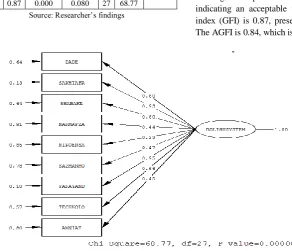
the index is, the fitter the model will be. In this model, the index is 2.54 so that the model is acceptable. The acceptable value of the root mean square error of approximation (RMSEA) ranges from 0.05 to 0.08. In the diagrams depicted in this study, this index is 0.080, indicating an acceptable value. The goodness of fit index (GFI) is 0.87, presenting an appropriate value. The AGFI is 0.84, which is also acceptable.
Figure 1: Relationships among the variables in terms of path coefficient Source: Researcher’s findings
In the structural model, the effect of each independent factor on the dependent variable is shown. According
to the graphs, the effect of independent factors on the dependent variable is depicted in Table 4.
Table 4: Structural model results
Measures of AIS maturity
Structural model relationships Results Dependent
variable Independent variable Path coefficient t-value Result
First AIS maturity data 0.60 9.03 Confirmed
Second AIS maturity Hardware 0.93 16.91 Confirmed
Third AIS maturity Network and server 0.60 9.02 Confirmed
Fourth AIS maturity Software 0.44 6.33 Confirmed
Fifth AIS maturity Human resource 0.39 5.49 Confirmed
Sixth AIS maturity Organization and management 0.47 6.76 Confirmed
Seventh AIS maturity Financial process 0.95 17.46 Confirmed
Eighth AIS maturity Information technology 0.66 10.11 Confirmed
ninth AIS maturity System security 0.45 6.39 Confirmed
Source: Researcher’s findings
4.1. Confirmatory Factor Analysis for
AIS Maturity Indices
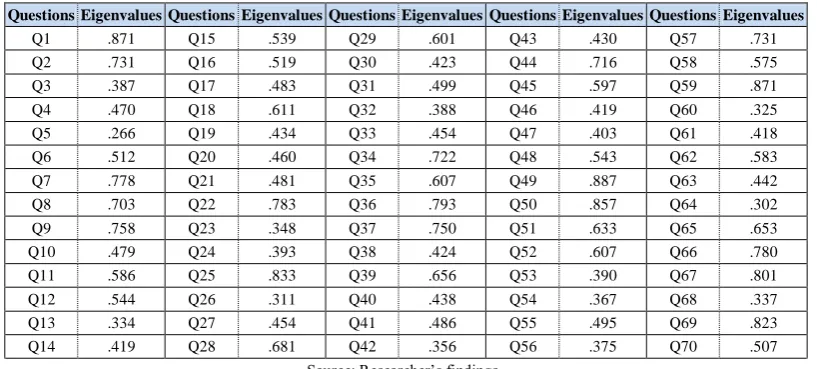
After determining the factors influencing the AIS maturity, it is necessary to determine the effective indices for each factor. Indices in Table A are defined by the questionnaire questions and factor analysis was used to determine the factors with relevant indices. To run factor analysis, the commonality is first determined through examining the commonalities of each question with all of the questionnaire items. In this regard, the variables (items) with a commonality value <0.50 are removed from the analysis,
respectively. Table 5 shows the contribution rate of the indices.
According to Table 5, the following items with a contribution value <0.50 are removed from the questionnaire: 3, 4, 5, 10, 13, 14, 17, 19, 20, 21, 23, 24, 26, 27, 30, 31, 32, 33, 38, 40, 41, 42, 43, 46, 47, 53, 54, 55, 56, 60, 61, 63, 64, and 68. Thus, out of 70 indices, 34 indices were removed and 36 indices were remained, which were included in the questionnaire No.2 and re-numbered 1 to 36 to be used for the second group of the participants.
Table 5: The contribution rate of the indices
Questions Eigenvalues Questions Eigenvalues Questions Eigenvalues Questions Eigenvalues Questions Eigenvalues
Q1 .871 Q15 .539 Q29 .601 Q43 .430 Q57 .731
Q2 .731 Q16 .519 Q30 .423 Q44 .716 Q58 .575
Q3 .387 Q17 .483 Q31 .499 Q45 .597 Q59 .871
Q4 .470 Q18 .611 Q32 .388 Q46 .419 Q60 .325
Q5 .266 Q19 .434 Q33 .454 Q47 .403 Q61 .418
Q6 .512 Q20 .460 Q34 .722 Q48 .543 Q62 .583
Q7 .778 Q21 .481 Q35 .607 Q49 .887 Q63 .442
Q8 .703 Q22 .783 Q36 .793 Q50 .857 Q64 .302
Q9 .758 Q23 .348 Q37 .750 Q51 .633 Q65 .653
Q10 .479 Q24 .393 Q38 .424 Q52 .607 Q66 .780
Q11 .586 Q25 .833 Q39 .656 Q53 .390 Q67 .801
Q12 .544 Q26 .311 Q40 .438 Q54 .367 Q68 .337
Q13 .334 Q27 .454 Q41 .486 Q55 .495 Q69 .823
Q14 .419 Q28 .681 Q42 .356 Q56 .375 Q70 .507
4.2. Determining the Number of
Available Indices for Each of the
Factors
The interpretation of the factor loads without rotation is not simple; therefore, the indices are rotated to enhance their interpretability. This technique aims at simplifying the columns of the factorial matrix; therefore, the variables with a high load factor are reduced to a limited number. In fact, the sum of the changes made to the factor loads is maximized to the extent possible so it is expected to find in extremely
large or small factor loads close to one or zero in each column, respectively. In general, most statisticians prefer this rotation technique to other ones. By referring to the rotated matrix of the indices, the variables (items) associated with each one are identified and each question is linked to its relevant factor in a row. The items of each factors are presented in Table 5.
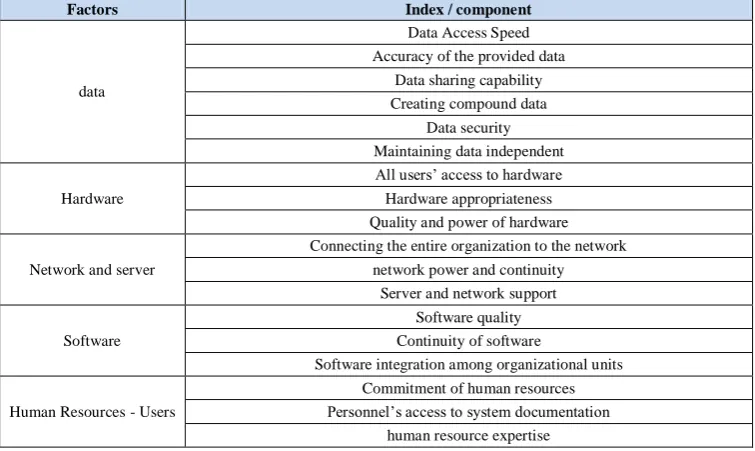
Based on the results obtained in the presented analyses, the model of the AIS maturity factors and indices for manufacturing industries is shown in Table 6.
Table 5: Assigning indices to AIS maturity factors
Components D a ta H a rd w a re N e tw o rk a n d se rv e r S o ft w a re H u m a n Re so u rc e s -U se rs O rg a n iz a tio n a n d m a n a g e m e n t F in a n c ia l a n d a c c o u n tin g p ro c e ss e s In fo rm a tio n te c h n o lo g y S y st e m s e c u ri ty Q1 Q7 Q10 Q13 Q16 Q20 Q23 Q28 Q33 Q u e st io n s o f e a c h fa c to r Q2 Q8 Q11 Q14 Q17 Q21 Q24 Q29 Q34 Q3 Q9 Q12 Q15 Q18 Q22 Q25 Q30 Q35 Q4 Q19 Q26 Q31 Q36 Q5 Q27 Q32 Q6 Source: Researcher’s findings
Table 6: AIS maturity factors and indices for manufacturing industries of Markazi Province
Factors Index / component
data
Data Access Speed Accuracy of the provided data
Data sharing capability Creating compound data
Data security Maintaining data independent
Hardware
All users’ access to hardware Hardware appropriateness Quality and power of hardware
Network and server
Connecting the entire organization to the network network power and continuity
Server and network support
Software
Software quality Continuity of software
Software integration among organizational units
Human Resources - Users
Commitment of human resources Personnel’s access to system documentation
Factors Index / component
Human resource skills
Organization and management
Having regular processes and performing tasks Documentation and standardization of activities
Planning for the management and development of the system
Financial and accounting processes
The quality of accounting processes in data collection The quality of accounting processes in data analysis and processing The quality of accounting processes in the data and information distribution
The quality of accounting processes in data completion and reproduction Quality of accounting processes in data control
Information technology
Internet speed Internet quality Website quality
Appropriate access to the Internet and website IT support
System security
Security standards and policies for the system Security mechanisms such as controlling user access levels
System security in terms of manipulation protection Security against hackers and robots Source: Researcher’s findings
5. Discussion and Conclusions
Management accounting provides the accounting information required by managers to make informed business decisions through connecting to the accounting information systems. Obviously, a mature accounting system can provide timely and relevant information to the management accounting, managers, and other users. Reviewing the research literature in this article, the factors associated with AIS maturity assessment were identified. Then the factors and indices were categorized and provided to the samples in the statistical population and tested by factor analysis. Based on the analyses performed to answer the research questions, the research objectives are as follows:
The factors and indices noted in assessing the AIS maturity were identified from the literature and factor analysis was used to select 36 effective indices for the major manufacturing industries in Markazi province. Using the Eigenvalues and percentage of variance for each factor in the factor analysis, the 36 effective indices were classified into nine factors: Data with 6 indices, hardware with 3 indices, network and server with 3 indices, software with 3 indices, human
resources with 4 indices, organization and
management with 3 indices, financial and accounting processes with 5 indices, information technology with
5 indices, and security with 4 indices (According to Table 6).
Using the structural equations, the effect of each AIS maturity assessment factor and index was determined. The results revealed that the financial and accounting processes had the greatest impact on the AIS maturity assessment.
Out of 70 indices, 34 indices were eliminated, a majority of which have been introduced as the AIS maturity indices; however, they were removed in this study since these indices had no direct effects or were dependent on the other subsystems. For example, in the human resource factor, the indices human resource motivation and human resource productivity were dependent upon human resource management and organizational policies so that they were eliminated.
The research factors and indices were identified based on seven models and carried out in the large manufacturing industries of Markazi Province. Caution is necessary when generalizing the findings to the other settings. Moreover, a questionnaire was used to carry out research, which has its own limitations.
Large manufacturing organizations are
determine and assess the AIS maturity factors and indices based on the procedure and analyses adopted in this research.
References
1) Abdali Laraki, H. (2017). Accounting information
systems in Iran. First Conference on Accounting, Management and Industrial Engineering, August 28, Tehran.
2) Alewine, H. C. D. Allport. CH., Milton, SH.
Wei-Cheng (2016). How measurement framing and accounting information system evaluation mode influence environmental performance judgments. International Journal of Accounting Information Systems, 23 , 28–44
3) Darabi, R., Chenari Boket, H., Mahmoudi
Khatami, M., (2016). Disclosure quality and economic outcome of accounting information. Journal of Management Accounting, 9(31).
4) Davern, M. J. Wilkin, C. L. (2010). Towards an
integrated view of IT value measurement. Int. J. Account. Inf. Syst. (11) 42–60.
5) Delak, B. (2016). Approach for Information
System Maturity Assessment., ITAD, Revizija in svetovanje, d.o.o., Tržaška c. 118, 1000 Ljubljana, Slovenija & Faculty of Information Studies, Ljubljanska c.31a, 8000 Novo mesto, Slovenia.
6) Ebrahimi Kord Lor, A., Seyedi, S. J., Menati, V.
(2013). Effect of accounting information systems on performance and performance appraisal. Accounting Reviews, 1(1), 1-19.
7) Gelinas, U.J. (2002). Accounting Information
Systems (Ed. 4). Sout-Western, Mason, United States, 86.
8) Ghazanfari, M., Fathian, M., Safari, M. (2011).
Measuring the maturity of information technology governance in Iran’s financial services industry: A comparison between private and state banks, Information Technology Management, 3(6), 63-88.
9) Grossman, L. R. (2018). A framework for
evaluating the analytic maturity of an organization. International Journal of Information Management, 38, 45–51.
10)Hajiha, Z., Nabiyouni, SH. (2014). Effect of
accounting information system features on the system performance in the case of duty analyticity. Journal of Management Accounting, 7(21), 47-58.
11)Hall, J. (2010). Accounting Information Systems
(Ed. 7). Cengage Learning 5191 Natorp Boulevard Mason, OH 45040 USA.
12)Hariri, N, (2013). Determining the assessment
indices of information technology maturity in Iran’s academic libraries. Journal of Information Systems and Services, 2(6).
13)Hashemkhani, M. (2012). Information technology
and broad expansion of economy, Journal of Rahavard-e-Noor, 41.
14)Heidari, B. (2017). Presenting the Information
Technology Strategy based on IT Life Cycle
Model in Governmental Organizations,
Dissertation in Strategic Management, Iran University of Industries and Mines, Tehran, Iran, 160-161.
15)Hosseinirad, H., Bayat Tork, A., Falah Shams, M.
(2014). Investigating and ranking the factors affecting the success of the accounting information system and their effect on the indices of utility using the DEMATEL technique. Journal of Management Accounting, 7(23).
16)Javanmard, H. (2013). Management information
system (Ed.2). Scientific Publication of Islamic Azad University (Arak).
17)Khajavi, SH., Etemadi Joryabi, M. (2010). Factors
affecting the effective implementation of
accounting information systems in companies accepted in Tehran Stock Exchange, 2.
18)Kim, R., Gangolly, J., Elsas, PH. (2017). A
framework for analytics and simulation of accounting information systems: A Petri net
modeling primer. International Journal of
Accounting Information Systems, 30-54.
19)Koehler, J. Hofstetter, J. Woodtly, R. (2012),
Capabilities and levels of maturity in IT-based case management. Proceedings 10th Inter-national Conference on Business Process Management (BPM), Lecture Notes in Computer Science, 7481, 49–64.
20)Koehler, J., Woodtly, R., Hofstetter, J. (2015). An
impact-oriented maturity model for IT-based case management, Information Systems, 47, 278–291.
21)Lacerda, T., Wangenheim. C., (2018). Systematic
literature review of usability capability/maturity models, Computer Standards & Interfaces, 55, 95– 105.
22)Matrane, O., Talfa, A., Okar, CH., Talea, M.
information system. International Journal of Computer Science Issues, 275-268.
23)Melnyk, S. A., Bititci, U., Platts, K., Tobias, J.,
Andersen, B. (2014). Is performance measurement and management fit for the future? Management Accounting Research, 25(2), 173-186.
24)24)Nasab Najar, M., Babaei Nejad, T. (2012).
Reviewing the history of accounting systems in Iran. First Regional Conference on New Issues in Accounting, May, Ahwaz.
25)Nikroe, F., Salimi Fard, KH. (2014). Prioritizing
the maturity factors of accounting information systems using analytical hierarchy process, International Management Conference, Tehran, Institute of Cultural Ambassadors.
26)Nolan, R, Koot, W. (1992). Nolan stages theory
today: A framework for senior and IT management to manage information technology. Melbourne, Australia: Nolan Norton And Co.
27)Proença, D., Borbinha, J. (2016). Maturity models
for information systems - a state of the art. Procedia Computer Science, 100, 1042 – 1049.
28)Rahnamay Roud Poshti, F., Homayouni Rad, R.
(2016). Effect of information technology on management accounting and financial accounting convergence. Journal of Management Accounting, 9(30).
29)Rahnamay Roud Poshti, F., Salehi, A. K. (2010).
Schools and theories of finance and accounting (Ed. 1). Islamic Azad University Press, Central Tehran Branch.
30)Rom, A. Rohde, C. (2007). Management
Accounting and Integrated Information Systems: A Literature Review, International Journal of Accounting Information Systems 8(1), 40-68.
31)Snyder-Halpern, R. (2010). Indicators of
organizational readiness for clinical information technology / systems innovation: Adelphi study. International Journal of Medical Informatics, 179-204.
32)Trigo, A., Belfo, F., Estébanez, R. P. (2016).
Accounting Information Systems: evolving
towards a business process oriented accounting. Procedia Computer Science, 100, 987 – 994.
33)Vidal Carvalho, J., Rocha, Á., Abreu, A. (2016).
Maturity Models of Healthcare Information Systems and Technologies: a Literature Review. J Med Syst , 40-131
34)Willner, O., Gosling, J., Schönsleben, P. (2016).
Establishing a maturity model for design automation in sales-delivery, processes of ETO products. Computers in Industry 82, 57–68
35)Yasuda, H., Iijima, J. (2005). Linkage between