1. Background
hysical illness affects biological, psycho-logical, social, and sexual aspects of a patient (Kocaman et al. 2007). Ostomy is a surgery for creating a valve to dis-charge bodily fluids; It leads to bypass-ing the sphincter and loss of voluntary control (Kilic et al. 2007). The incontinence and other related problems make the patients feel abnormal with respect to social norms (Bonill-de-las-Nieves et al. 2014). Most patients who have undergone ostomy are afraid of being ridicule or rejected by others (Noone 2010).
Iranian research on this topic is scant. One Iranian study showed that these patients have higher levels of psycho-social problems compared to similar patients in other countries (Mahjoubi et al. 2005). The same authors in
another study found that patients with ostomy face with a major problem in the sense of physical integrity and self-perception because of changes in their physical role (Mahjoubi et al. 2009). Anaraki et al. (2012) showed that patients with stoma experience high levels of depression and low levels of sexual satisfaction. However, these problems associate with the potency and efficacy of their coping methods and social support (Motl et al. 2009). In other words, problems of people with disabilities do not arise out of their physical and mental disabilities, but tra-ditional attitudes (Akbarian 2007). Furthermore, ignor-ing physical and psychosocial characteristics can affect patients’ mental health and their participation in various aspects of individual and social life (Heidarzadeh et al. 2009).
According to Bahar Mahjoubi et al. (2005), 30000 pa-tients with stoma live in Iran, but a few studies have
ad-Nasrin Sarabi 1, Hasan Navipour 1*, Eesa Mohammadi 1
1. Department of Nursing, Faculty of Medical Sciences, Tarbiat Modares University, Tehran, Iran.
* Corresponding Author: Hasan Navipour, PhD
Address: Department of Nursing, Faculty of Medical Sciences, Tarbiat Modares University, Tehran, Iran.
Tel: +98 (936) 1448149 Fax: +98 (21) 82883856
E-mail: [email protected]
Social Marginalization of Patients with Ostomy: A
Content-Based Analysis
Background: A few studies have addressed the impact of stoma on patients’ social life. This study aimed to understand the problems leading to social isolation of patients undergoing ostomy. Methods: A conventional qualitative content analysis by unstructured interviews was conducted on 27 patients with intestinal or urinary diversion ostomy recruited from the Iranian Ostomy Association (IOA) with purposive sampling since March to October.
Results: The findings showed some concerns after ostomy. These concerns lead to patient’s isolation in 4 main categories of “sense of exclusion”, “helplessness in controlling unpleasant side effects”, “weakness in informing patients”, and “ no support”.
Conclusion: Educational, financial, and cultural support of the patients undergoing ostomy can prevent their social.
A B S T R A C T
Keywords:
Content analysis, Ostomy, Social isolation, Qualitative research Article info: Received: 12 Mar. 2015 Accepted: 05 Jul. 2015
dressed the impact of stoma on patients’ social life. This study aimed to understand the problems leading to social isolation of patients who have undergone ostomy.
2. Materials & Methods
This is a qualitative content analysis. This is a descrip-tive study with a qualitadescrip-tive approach. Qualitadescrip-tive con-tent analysis has three distinct approaches: conventional, directed, or summative (Hsieh & Shannon 2005). In this study we used qualitative conventional content analysis approach with purposive sampling. The inclusion crite-ria comprised having intestinal or urinary ostomy and being over 18 year. The exclusion criteria were consid-ered the patients’ inability to answer the questions, or orientation to participate in the study. Unfavorable con-ditions in terms of physical, mental and cognitive and unwillingness to participate and cooperation in research and recounting their experiences to the researcher. The study included 27 patients with intestinal or urinary di-version ostomy. Unstructured in-depth interviews with open questions took place used at respondents’ homes, ostomy association center, park, airport, and so on and lasted 1-2 hours.
The main question of the interview
Can you tell about your experience after ostomy sur-gery? Probing questions (such as; can you explain what is your intended purpose, can you give an example? and etc.) based on the responses of the participants, asked.
During the interview, respondents were asked to de-scribe their problems of living with a stoma. Interviews carried out since March to October 2015. Interviews, with the respondents’ permission, were recorded with mp3 recorder and transcribed verbatim.
The analysis of collected data began once the first inter-view got completed. Data were analysed using qualita-tive content analysis techniques inspired by Graneheim and Lundman (Esmaeili et al. 2012). The analysis began by reading each interview several times to obtain a sense of participants’ whole experiences. Then, the meaningful units (In the form of words, sentences, or paragraphs, depicting important aspects of participants’ experiences of living with stoma) were highlighted. These units were then condensed to show their content. In the next stage, these condensed meaningful units, abstracted from each interview, were transcripted. Finally, using comparison, reflection, and interpretation, these units were grouped into themes and subthemes. Data collection continued until data saturation was reached i.e. no new
meaning-ful unit emerged from analysis of the data. Descriptive statistics (percent and frequency) was used to describe demographic characteristics of participants.
This article is a part of a PhD thesis in Nursing Educa-tion which was approved by Tarbiat Modares University. This research was developed only after being approved by Research Ethics Committee of Tarbiat Modares Uni-versity (No. d52/6581). The subjects signed an informed consent form. In addition, to keep the subjects’ privacy and anonymity, code names were used for the partici-pants.
3. Results
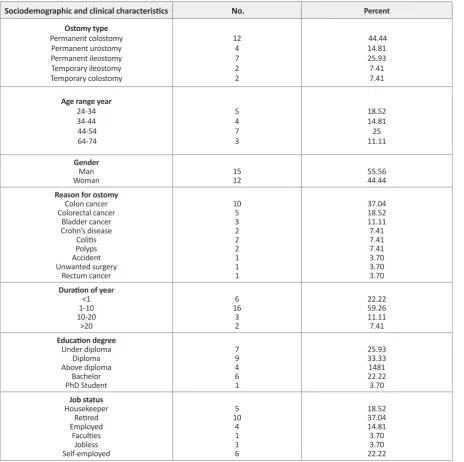
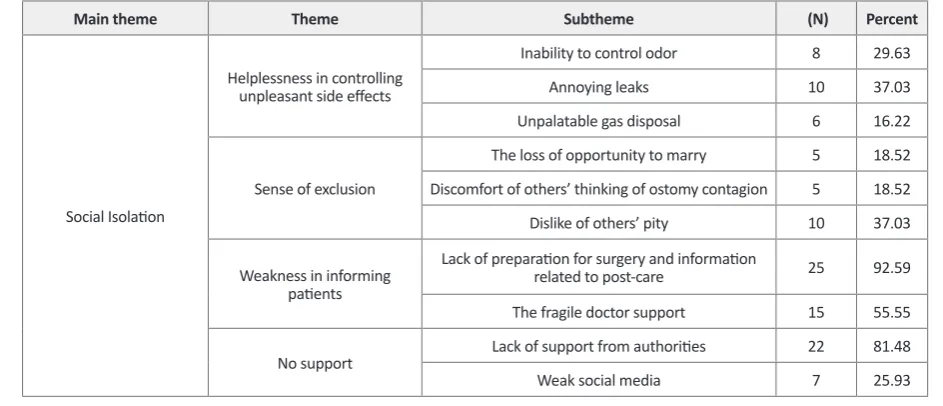
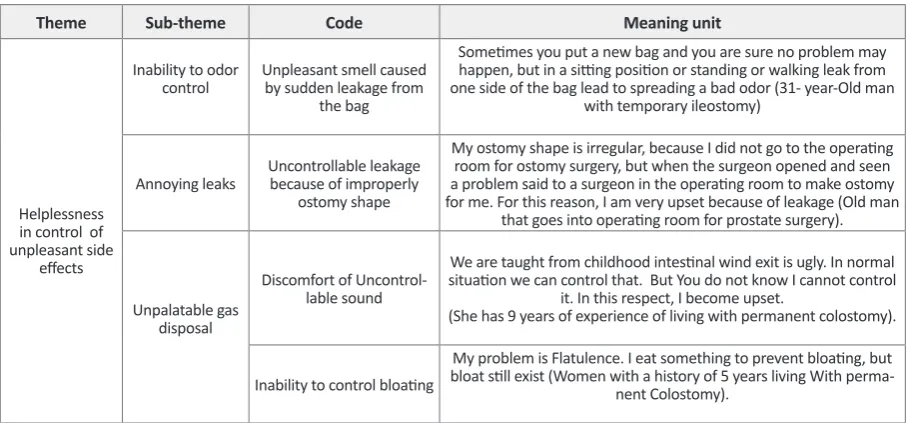
In the end, 27 patients were interviewed. Table 1 pres-ents demographic characteristics of the participants. The findings revealed some concerns after ostomy surgery that led to patient’s isolation due to 4 main themes of “sense of exclusion”, “helplessness in controlling un-pleasant side effects”, “weakness in informing patients”, and “no support” (Table 2). Table 3 presents an example of data analysis.
Helplessness in controlling unpleasant side effects
Factors such as leakage, odor, and gas from the stoma lead to patient’s loneliness. Bad odor is an important complaint of patients regardless of their ostomy type. Some implicate the odor to discharge of large intestine contents into the pouch and other complain of unreli-ability of the bag and its leak. An old man with perma-nent colostomy said: “My only problem is bad odor. Yet, there is no device which can absorb the odor. I tested all kinds of bags, but excretion of feces from the large intestine into the bag does smell”.
Inability to prevent unpleasant smell made patients to avoid others. A 41-year-old man with permanent uros-tomy said that when he smelled, his friends did not know his problem. They thought that his work is deliberate and obscene and mocked him. Then, he got upset and isolated. A 27-year-old man with temporary colostomy told that because of the colostomy malodor, he withdrew himself from others and tries not to be in the society.
45-year-old woman mentioned that the leakage might be due to the bags glue that cannot attach well to the skin.
Another cause of isolation is gas production and its ex-cretion into the bag. This concern is heard in patients’ statements. A woman with colostomy told that after ostomy, she heard the sound of flatulence, and gas pro-duction has made her to stay away from the society. A 27-year-old man said: “In the first phase, the patient is isolated. Gas is expelled from the abdomen and because of its sound and embarrassment in front of the patient separates himself from others”.
Sense of exclusion
Ostomy leads to deviation from social norms. Patients encounter negative reactions of those surrounding them and this leads to a sense of rejection. Because of their physical condition, patients feel that they cannot marry with healthy people. One of the participants whose wife divorced after his colostomy had decided to marry again. He told: “About marriage, I tell you that nobody wants to marry me. I know that, unless someone like me who have colostomy, divorced, or have other problems, want to marry me”.
Table 1. Sociodemographic and clinical characteristics of the patients who have undergone ostomy.
Sociodemographic and clinical characteristics No. Percent
Ostomy type Permanent colostomy
Permanent urostomy Permanent ileostomy Temporary ileostomy Temporary colostomy
12 4 7 2 2
44.44 14.81 25.93 7.41 7.41
Age range year 24-34
34-44 44-54 64-74
5 4 7 3
18.52 14.81 25 11.11
Gender Man
Woman 1512 55.5644.44
Reason for ostomy Colon cancer Colorectal cancer
Bladder cancer Crohn’s disease
Colitis Polyps Accident Unwanted surgery
Rectum cancer
10 5 3 2 2 2 1 1 1
37.04 18.52 11.11 7.41 7.41 7.41 3.70 3.70 3.70 Duration of year
<1 1-10 10-20
>20
6 16
3 2
22.22 59.26 11.11 7.41 Education degree
Under diploma Diploma Above diploma
Bachelor PhD Student
7 9 4 6 1
25.93 33.33 1481 22.22 3.70 Job status
Housekeeper Retired Employed
Faculties Jobless Self-employed
5 10
4 1 1 6
18.52 37.04 14.81 3.70 3.70 22.22
Another patient with the same status said: “One who wants to ask a woman’ hand should have the right con-dition. The main criteria are physical, mental, and psy-chological health. I do not speak of a blind person or a dependent to a wheelchair, in colostomy cases no one can cope. Now she may say yes but when she encoun-ters with the ostomy problems, she cannot. I saw two women, but they failed to understand and accept me”.
Single ostomate exists as long as this problem exists. In this regard, a 38-year-old man said: “I am single. Healthy couples face a thousand problems with each other. I should find a person like me or worse than me”.
Participants stated that they heard that ostomy is conta-gious. Patients in the family and in the larger community are facing with this problem. One of the participants said that most of his family tries to keep distance from him. He explained the reason for this behavior: “I checked and found that they believe that ostomy is contagious but not a contagious disease. Because of this, they do not want to have any contact with me”. A female participant said: “I went to a pool, the pool attendant asked me to remove my swimsuit to see under it, she had seen my ostomy belt. I showed it to her and she asked if it is con-tagious. Afterwards, I did not go to that pool”.
Compassionate behavior with pity had caused great emotional harm in the participants. So, almost all pa-tients were upset and unhappy because of wrong attitude towards their situation. Four months after surgery, a male participant said: “I say to my friends, if your friendship is because of my illness, I do not want it”. Another par-ticipant was upset because of other’s pity and said: “We
have a variety of pities. One kind of a pity is that you see a kid in the street that is selling omen. You become upset and want to help her, this is because of pity. Perhaps you help her for God’s sake. I do not want others to look at me with this eye”.
Weakness in informing patients
The temporary ostomy of some patients had become permanent because of reasons such as unplanned surgery and medical malpractice. Lack of awareness about the surgery leads to some problems. A 60-year-old woman said: “When operated I did not know what my problem was. They did not tell me in order not to fear and lose my hope. I realized later that my anus was closed and feces get out from stoma and I must use a bag. I got sad. I spent a hard time”. Participants complained that after the surgery, they did not receive proper education at the hospital. A 50-year-old man said: “Early at the hospital, there was a nurse who told to wash stoma with normal saline and dry with sterile gauze. I bought much equip-ment. I did not know. Why there is no monitoring at the hospital. Should nurses know of ostomy care?”
Lack of proper education had led to problems for pa-tients. A 34-year-old participant said: “Because I did not know that I can use an adhesive base for 2 bags it was over soon. One adhesive base and 2 bags were enough for 10 days, but I did not know. Every 5 days I throw away both parts”. A 45-year-old man said: “I was ad-mitted to the hospital, but nurses did not change bag or taught anything to me. They call a woman from one of ostomy care companies. Each time for changing the bag she took 1500000 Rails (48.86 United States Dollar)”. Table 2. Four main themes found in the interviews with the patients who have undergone ostomy.
Main theme Theme Subtheme (N) Percent
Social Isolation
Helplessness in controlling unpleasant side effects
Inability to control odor 8 29.63
Annoying leaks 10 37.03
Unpalatable gas disposal 6 16.22
Sense of exclusion
The loss of opportunity to marry 5 18.52 Discomfort of others’ thinking of ostomy contagion 5 18.52
Dislike of others’ pity 10 37.03
Weakness in informing patients
Lack of preparation for surgery and information
related to post-care 25 92.59
The fragile doctor support 15 55.55
No support Lack of support from authorities 22 81.48
Weak social media 7 25.93
Patients consider the doctor responsible for their com-plications. A 56-year-old woman with a temporary ileos-tomy for 4 months said: “I felt pain. I said to my doctor that I was in pain. Instead of giving a positive advice or education, he said you hurt me, I wish I did not operate on you, you have no problem. He did not understand my skin was burnt and I was not at peace. Just look at the stoma appearance!” A 30-year-old woman, with tempo-rary ileostomy said: “Doctors do not know. They must refer the patient to the association from the very begin-ning. If I was familiar with here, my wound was not so bad”.
No support
Lack of support from authorities and the weak role of media have created a sense of inattention to the patients’ needs. Patients undergoing ostomy expect the same pro-tection from the government that it offers to other pa-tients. Lack of any ostomy clinic at the hospital or asso-ciation in the city had created a sense of isolation in these patients. A 38-year-old man said: “Government does not subsidize the bag. Its price is too much. The price of a bag is between 100000 and 300000 Rails (3.32 and 9.97 United States Dollar). Woe, some for 140000 Rails (4.56 United States Dollar) with no quality!” A 50- year-old man said: “Before chemotherapy I came from Gorgan to Ostomy Association in order that the nurse here installs my bag. Because chemotherapy can cause diarrhea, I did not want my skin get wounded. In my city, no one knows how to take care of ostomy”.
Lack of social familiarity with ostomy and weakness of media make people face problems in the community. A 45-year-old woman said: “People think ostomy is conta-gious and avoid me. Media do not produce any orienta-tion program about ostomy.”
4. Discussion
During recovery from life-altering surgeries, patients experience some degrees of social isolation. Ostomy is no exception. The fear of leakage caused by failure of appliances and inappropriate sitting are daily problems. Patients’ main complaints are inability to control odors which leads to others’ discomfort and subsequently stay-ing away from them. Lack of control over gas produc-tion and unwillingness to participate in public areas are other reasons for the isolation of the patients. According to the study of Mitchell and Schmidt (2007), leak, un-pleasant smell, and sound of the bag are the main sources of patients’ embarrassments.
Marriage in every society follows some norms which people act according to them. In Iran, health is a ma-jor criterion for most people who want to get married. Ostomy, due to changes in the route of excretion, can be considered a deviation from the normal health status. Patients with stoma must change their body image per-ception, speak with an ostomy support group, and social-ize with other patients with ostomy. Besides, they need financial support to get married with similar patients. Elahi et al. (2014) reported that single women with mas-tectomy are worried about getting married, while
mar-Table 3. An example of data analysis.
Meaning unit Code
Sub-theme Theme
Sometimes you put a new bag and you are sure no problem may happen, but in a sitting position or standing or walking leak from one side of the bag lead to spreading a bad odor (31- year-Old man
with temporary ileostomy) Unpleasant smell caused
by sudden leakage from the bag Inability to odor
control
Helplessness in control of unpleasant side
effects
My ostomy shape is irregular, because I did not go to the operating room for ostomy surgery, but when the surgeon opened and seen a problem said to a surgeon in the operating room to make ostomy for me. For this reason, I am very upset because of leakage (Old man
that goes into operating room for prostate surgery). Uncontrollable leakage
because of improperly ostomy shape Annoying leaks
We are taught from childhood intestinal wind exit is ugly. In normal situation we can control that. But You do not know I cannot control
it. In this respect, I become upset.
(She has 9 years of experience of living with permanent colostomy). Discomfort of
Uncontrol-lable sound Unpalatable gas
disposal
My problem is Flatulence. I eat something to prevent bloating, but bloat still exist (Women with a history of 5 years living With
perma-nent Colostomy). Inability to control bloating
ried women are afraid of losing their husbands. Most young women see this factor as an obstacle to marriage and fear of not being able to raise a family and remaining alone. As a result, they believe that this problem makes it impossible for them to get married.
Pity is related to having power or control over a situ-ation or environment. Pity is based on the idea that “I am different from you”. So when patients perceive oth-ers’ pity, they feel that they cannot control the situation, which may lead to aggressive reactions. One way to help these people (to achieve peace of mind) is to create this sense in them that “there is no difference between you and me”. Taleghani et al. (2006) study reported that women with breast cancer wanted no compassion and pity of others, but a normal treatment and behavior.
Some individuals suffer from this thought that ostomy is contagious in the family or community. This view to-wards patients causes a sense of separation from others. Stigma word includes both physical ailments and mental health problems. Abachi and Behravan (as cited in Young & Powell 1985) stated that feeling stigmatized leads to decrease in self-concept, loss of confidence, and lack of trust to one’s abilities. Therefore, it is necessary to prevent these problems by social support of these patients.
Lack of knowledge and consent to surgery and care is one of the sources of the patients’ complaints. Several studies examined the effects of getting informed con-sent. In a study, 95% of participants were satisfied with the corresponding explanations to consent (Houghton et al. 1997). Another study evaluated the status of this pro-cess differently (Bhurgri & Qidwai 2014). The conscious satisfaction is one of the principles of medical ethics and effective in reducing stress, and has the essential role of coping with the condition. Therefore, both doctors and reception staff should explain the type of treatment and the contents of the consent form to the patients.
One of the most important rights of the patient is hav-ing complete information about his/her disease and its treatment and providing this information is one of the tasks of health promoting hospitals. Brittle et al. (2008) showed that training, follow-up, and counseling patients with stroke improve their activity, quality of life, and psychological status. According to patients’ complaints, it is a necessary to change attitudes of doctors and hospi-tal managers in this regard, and remove barriers like lack of proper educational environment or teaching materials for patients.
Lack of support from certain organizations and lack of orientation and creation of a cultural context in the community about patients with ostomy by social media are other factors that result in isolation of the patients. The Ministry of Health, Treatment, and Medical Edu-cation (as the responsible authority for health in Iran) should familiarize people with ostomy. Discussing and transmitting the information about ostomy is the respon-sibility of governmental and non-governmental media. Unfortunately, for various reasons we have not been able to enter this stage of our process. Ministry of Health as a member of the International Ostomy Association (IOA) can take an important step towards helping these patients. IOA is a nonprofit federation of more than 60 ostomy associations committed to improve the quality of life of people undergoing ostomy and related opera-tions. Their agendas include providing information and management guidelines to member associations, helping to form a new ostomy association, and representing the interests of all people who have undergone ostomy and the relevant operations (IOA).
In this study, the patients were selected from different parts of Iran who referred to IOA. However, the study results are not generalizable to the larger society because results are limited to patients who were recruited from IOA and they may be different for patients with no ac-cess to the resources of the association. Anyhow, the re-sults provide useful information for health care providers to create a more supportive environment and improve quality of life for patients. Also, interviews and open-ended questions allowed the patients to freely express their concerns about living with a stoma.
The results showed that providing ostomy care and obtaining informed consent by talking about surgery, providing public support by creation of ostomy clinics across the country, training ostomy nurses, providing financial support, promoting culture of understanding, and accepting the patients undergoing ostomy in the community can be a significant help to avoid their social marginalization.
Conflict of interests
The authors declared no conflict of interest.
Acknowledgments
Modares University for support of conducting this re-search.
References
Akbarian, MS 2007, ‘Disability with approach of social welfare’,
Journal of Student Mohaghegh, vol. 1, no. 2, pp. 47–55.
Anaraki, F, Vafaie, M, Behboo, R, Maghsoodi, N, Esmaeilpour, S & Safaee, A 2012, ‘Clinical profile and post-operative life-style changes in cancer and non-cancer patients with ostomy’,
Gastroenterology and Hepatology from Bed to Bench, vol. 5, no. 1, S26–S30.
Bhurgri, H & Qidwai, W 2014, ‘Awareness of the process of in-formed consent among family practice patients in Karachi’,
Journal of Pakistan Medical Association, vol. 54, no. 7, pp. 398-401.
Bonill-de-las-Nieves, C, Celdrán-Mañas, M, Hueso-Montoro, C, Morales-Asencio, JM, Rivas-Marín, C & Fernández-Gallego, MC 2014, ‘Living with digestive stomas: strategies to cope with the new bodily reality’, Revista Latino-Americana de Enfer-magem, vol. 22, no. 3, pp. 394-400.
Brittle, N, Brown, M, Mant, J, McManus, R, Riddoch, J & Sack-ley, C 2008, ‘Short-Term effects on mobility, activities of daily living and health related quality of life of a conductive edu-cation program for adults with multiple sclerosis and stroke’,
Clinical Rehabilitation, vol. 22, no. 4, pp. 329-337.
Elahi, N, Kardaani, M, Alhani, F & Salehi Tali, SH 2015. [‘Trans-plantation living with mastectomy: Explanation he experienc-es adaptation with mastectomy of young women undergoing chemotherapy’ (Persian)]. Journal of Urmia Nursing and Mid-wifery Faculty, vol. 12, no. 10, pp. 908-918.
Esmaeili, R, Ahmadi, F, Mohammadi, E & Tirgary, AH 2012, [‘Life-threatening, the main concerns of patients in the face OF Cancer: A Qualitative Study’ (Persian)], Journal of School of Nursing and Midwifery (Hayat), vol. 18, no. 5, pp. 12-22. Heidarzadeh, MGA, Hagigat, A & Yoosefi, E 2009,
[‘Relation-ship between Quality of Life and Social Support in Stroke Pa-tients’ (Persian)], Iranian Journal of Nursing, 2009, vol. 22, no. 59, pp. 23–32.
Hsieh, H, Shannon, SE 2005. ‘Three approaches to qualitative content analysis’, Qualitative Health Research, vol. 15, no. 9, pp. 1277-1288.
International Ostomy Association 2015, viewed 25 July 2015, http://www.ostomyinternational.org.
Kilic, E, Taycan, O, Korkut Belli, A & Özmen, M 2007, ‘The effect of permanent ostomy on body image, self-esteem, marital ad-justment, and sexual functioning’, Turkish Journal of Psychiatry, vol. 18, no. 4, pp. 1-8.
Kocaman, N, Kutlu, Y, Ozkan, M & Ozkan, S 2007, ‘Predictors of psychosocial adjustment in people with physical disease’,
Journal of Clinical Nursing, vol. 16, no. 3A, pp. 6-16.
Houghton, DJ, Williams, S, Bennett, JD, Back, G & Jones, AS 1997, ‘Informed consent: patients’ and junior doctors’
percep-tions of the consent procedure’, Clinical Otolaryngology and Al-lied Sciences, vol. 22, no. 6, pp. 515-518.
Mahjoubi, B, Moghimi, A, Mirzaei, R & Bijari, A 2005, ‘Evalua-tion of the end colostomy complica‘Evalua-tions and the risk factors influencing them in Iranian patients’, Colorectal Diseases, vol. 7, no. 6, pp. 582-587.
Mahjoubi, B, Mohammadsadeghi, H, Mohammadipour, M, Mirzaei, R & Moini, R 2009, ‘Evaluation of psychiatric illness in Iranian stoma patients’, Journal of Psychosomatic Research, vol. 66, no. 3, pp. 249-253.
Mitchell, KA, Rawl, SM, Schmidt, CM, Grant, M, Ko, CY, Bald-win, CM, & et al 2007, ‘Demographic, clinical, and quality of life variables related to embarrassment in veterans living with an intestinal stoma’, Journal of Wound, Ostomy and Continence Nursing, vol. 34, no. 5, pp. 524-532.
Motl, RW, McAuley, E, Snook, EM & Gliottoni, RC 2009, ‘Physi-cal activity and quality of life in multiple sclerosis: Interme-diary roles of disability, fatigue, mood, pain, self-efficacy and social support’, Psychology, Health & Medicine, vol. 14, no. 1, pp. 111-124.
Noone, P 2010, ‘Pre- and postoperative steps to improve body image following stoma surgery’, Gastrointestinal Nursing, vol. 8, no. 2, pp. 34-39.
Taleghani, F, Parsa-yekta, Z & Nikbakht Nasrabadi, A 2006, [‘Coping with breast cancer in newly Diagnosed women: A qualitative study’ (Persian)], Iranian Journal of Psychiatry and Clinical Psychology, vol. 12, no. 3, pp. 282-288