c
A.P. Bonjeanet al.,Published by EDP Sciences2016 DOI:10.1051/ocl/2016045
Available online at:
www.ocl-journal.org
Oilseeds & fats Crops and Lipids
OCL
R
esearch
A
rticle
– D
ossier
O
pen
A
ccess
O
IL CROPS AND SUPPLY CHAIN IN ASIA
L
a fili
ere ol
`
eagineuse en
´
A
sie
Rapeseed in China
Alain. P. Bonjean
1,, Céline Dequidt
2and Tina Sang
3– Groupe Limagrain
1 Corporate Director of Strategic Information, Groupe Limagrain, Biopôle Clermont-Limagne, Rue Henri Mondor,
63360 Saint-Beauzire, France
2 Strategic Information Officer, Groupe Limagrain, Biopôle Clermont-Limagne, Rue Henri Mondor, 63360 Saint-Beauzire, France 3 Strategic Information Officer, Limagrain China, Beijing, P.R. China
Received 8 June 2016 – Accepted 17 October 2016
Abstract – In 2015, China was the world’s second most important producer of rapeseed after Canada, with 7.59 mil-lion hectares under cultivation and a production of 14.1 milmil-lion tons. It is also a major importer of rapeseed grain, as well as the premier consumer. Currently, its R&D remains mainly public. Its rapeseed seed market is slightly superior to 2.7 billion RMB (362 millione) and concerns partly hybrid varieties Nevertheless, the improvement in living stan-dards and the strong development of animal production in China has brought with it an increasing dependence on oil and protein crops, notably rapeseed but especially soybean and palm.
Keywords: Rapeseed/Brassica/Brassica napus/P.R. of China/production/yield/quality/end-uses/R&D/ breeding/biotechnologies/oil/meal
Résumé – Colza en Chine. En 2015, la Chine était le second producteur mondial de colza après le Canada, avec une surface de 7,59 millions d’hectares et une production de 14,1 million tons. C’est également un importateur majeur de colza grain et le premier consommateur. Aujourd’hui, sa R&D reste essentiellement publique. Son marché de semences de colza dépasse 2,7 milliards de RMB (362 millione) et concerne pour partie des variétés hybrides. Néanmoins, l’amélioration du niveau de vie en Chine et l’essor spectaculaire de ses productions animales s’accompagnent d’une dépendance croissante du pays en oléo-protéagineux, notamment en soja et huile de palme et plus qu’en colza.
Mots clés : Colza /Brassica/Brassica napus/Chine/production/rendement /utilisations/R&D/selection/ biotechnologies/huile/tourteaux
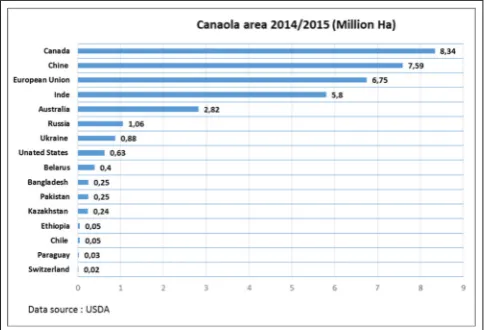
China’s domestic oilseed production growth continues to be restricted by limited arable land and policies favoring cereal, vegetable and fruit production. In 2014/15, according to the Chinese Ministry of Agriculture, China’s total planted area for all oilseed crops had declined to 23.4 million hectares. Among this surface, China is the second world producer of rapeseed after Canada (Fig. 1), with a cultivation area of 7.59 mil-lion hectares accounting for 21% of the world’s total area and producing in 2015 14.1 million tons, which represents 21% of the world’s total rapeseed production (Regnault,2016). Simul-taneously, China imported 3.9 million tons. However, some US experts consider that these governmental data are overesti-mates. By their reckoning, the 2015 Chinese rapeseed acreage was just 6.00 million hectares with imports covering the de-cline in domestic production, without the increases in rapeseed crushing volumes (Jamet,2016).
Correspondence:[email protected]
Fig. 1.Canola area 2014/2015 (Million ha).
D
Fig. 2.Oilseed production in China.
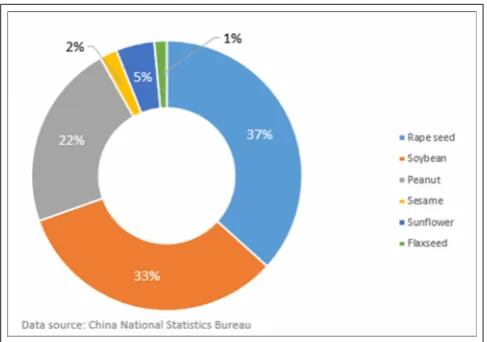
However, rapeseed has become the principal oil crop in China, surpassing soybean in 2014 (Fig.2). Simultaneously, China is a major rapeseed consumer and a significant importer (Cleveret al.,2015).
Crops introduction into China
Rape or yóucài ( ) in Chinese is a very ancient crop in China, like other Brassica oil crops (Needham and Bray,
1984). The oldest archaeological remains of rape found in the country may date back toca.5000 BCE and corresponds to
Brassica juncea. This plant was probably introduced during the Neolithic period from the Middle East or Southern Iran, or from India; if oilseed types ofB. junceawere cultivated by ancient Chinese farmers, it was mostly considered as a leaf vegetable, or as a root-type vegetable (var.napiformis, which is also cultivated for forage), or as a vegetable and a pickle in Sichuan and Yunnan (var.tumida). A Chinese ideogram of rape was first recordedca.2500 years ago (Yan,1990). The
Book of Songs, written during the Spring and Autumn Period (770 toca.476 BCE), records the both cultivation of mustard-type rapes (B. juncea) and cabbage-type rapes (B. campestris, also calledB. rapa), which were spring types and offered low oil yields (Yi et al., 2015). It is believed that B. campestris
was introduced in China through Western Asia or Mongolia and has been cultivated in China for more than 2600 years. Its fleshy roots are used as a vegetable. Varieties includeB. campestrisvar.oleifera cultivated for seed oil and also as a vegetable for its tender stems, B. campestris var. chinensis
(bok choy), cultivated throughout China since the 3rd cen-tury, andB. campestrisvar.glabra(bai cai) cultivated for over 2000 years (Heet al.,2015). Standard rapeseed (B. napus) was introduced into China from Japan only in the early 1930s (Liu,
1985) and European varieties were introduced in 1941 from United Kingdom (Fang and Chang,2007). It was first experi-mented with on a production scale in Sichuan, in 1953. Since then, this new and ‘exotic’ oilseed crop has been quickly ex-tended to cover a large area cultivation and has became a major oilseed crop within the Yangtze basin. This region is now one of the three largestB. napusgrowing regions in the world.
Current situation of the oilseed rape
production and import in the P.R. of China
Officially, the 2015–16 planted area of rapeseed was esti-mated at 7.3 million hectares and the 2015–16 production is forecast at 14.3 million tons.
Among this cultivation area, winter planted rapeseed area in rice-rapeseed systems, located in the Changjiang mid- and low-basin, was estimated at 7.03 million hectares by the Ministry of Agriculture. The rest of the production comes from scattered spring cultivars sown in North China (Cleveret al.,
2015).
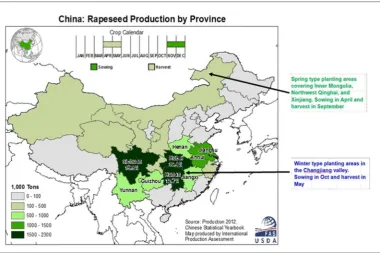
The 10 most important provinces are listed in Figure3and Table1and account for approximately 86% of the total area under rapeseed cultivation in China (source: MoA; Sang and Lessard,2015).
In 2014–15, the national average yield was 1.95 t/ha (ton/hectare), slightly increasing from the previous year and the top yield was 2.73 t/ha in the Jiangsu province (Fig.4).
The Chinese government encourages rapeseed farming as it uses land otherwise idle in winter and lessens the compe-tition for land with other grain crops. This policy includes a ‘minimum price purchase program’ and a direct subsidy. In 2014–15, the government fixed the rapeseed purchase floor at RMB 5100/ton, significantly higher than the price for imported rapeseed. The policy will be the same in 2015–16. In addition, in 2015–16, farmers will continue to receive a seed subsidy of RMB 150/Ha (Cleveret al.,2015).
A 2015 industry survey shows that rapeseed profits of farmers were RMB 1800/Ha (Cleveret al.,2015) (Tab.2).
Rapeseed imports hit a record 5.04 million tons in 2013– 14. This was largely driven by the recent expansion of crush-ing capacity particularly along the coastal provinces of Fujian, Guangdong and Guangxi. 2016–17 rapeseed imports in are forecast to recover to 4.5 million tons from the estimated 4.2 million tons in 2015/16. CNGOIC estimates that China’s current rapeseed crushing capacity surpasses 40 million tons per year (some plants crush both rapeseed and soybean, but technically, a rapeseed crushing factory may be used for soy-bean too but not reversely because the extraction of rapeseed oil needs more energy than soybean oil), with a utilization rate of less than 40%. Guangdong, Guangxi and Fujian provinces own new crush plants; this added 6 million tons of crushing ca-pacity to the country in 2014. These facilities utilize primarily imported rapeseed grains, with custom taxes limited to 9% and account for about one third of the Chinese production (Clever
et al.,2015). Due to this policy, the Chinese government cur-rently has to manage substantial rapeseed oil stocks. Another point to underline is that China imports only rapeseed grain, not oil or cake (Jamet,2016).
Oilseed rape R&D in China
Fig. 3.Rapeseed production by province in China (10 first producers, in surface).
Table 1.Rapeseed production by province in China (10 first producers, in surface).
Million Ha Province 2009 2010 2011 2012 2013 2014
1 Huna 1.02 1.09 1.17 1.20 1.30 1.30
2 Hube 1.17 1.16 1.14 1.17 1.23 1.25
3 Sichua 0.94 0.95 0.96 0.98 0.99 1.01
4 Anhu 0.72 0.69 0.64 0.61 0.57 0.55
5 Jiangx 0.54 0.55 0.54 0.55 0.55 0.55
6 Guizho 0.47 0.48 0.49 0.50 0.51 0.52
7 Jiangs 0.48 0.46 0.44 0.42 0.41 0.40
8 Hena 0.38 0.39 0.38 0.38 0.37 0.36
9 Inner Mongolia 0.22 0.22 0.22 0.27 0.29 0.31
10 Yunnan 0.25 0.27 0.27 0.28 0.29 0.29
Total 10 leading
6.19 6.26 6.25 6.36 6.51 6.54 provinces
1,81 1,79 1,83
1,87 1,84
1,88
1,78 1,83
1,88
1,92 1,95
1,96
1,65 1,7 1,75 1,8 1,85 1,9 1,95 2
Yield
(Ton
/Ha)
Rapeseed Yield (Ton/Ha)
Fig. 4.Rapeseed yield in China (ton/ha) (Source: Foreign Agricultural Service, Official USDA Estimates).
D
Table 2.Oil rapeseed of China (1000 t; 1000 ha).
Years 2014–15 2015–16 2016–17
Market year begin 10/2014 10/1015 10/2016
Area planted 7588 7300 7000
Area harvested 7588 7300 7000
Beginning stocks 1036 1502 1002
Production 14 772 14 300 13 500
MY imports 4594 4200 4500
Total supply 20 402 20 002 19 002
Crush 18 300 18 400 17 500
Feed waste. 600 600 600
Total dom. cons. 18 900 19 000 18 100
Ending stocks 1502 1002 902
Total distribution 20 402 20 002 19 002
CY imports 4470 4200 4250
Source: Gain Report, 2016.
Fig. 5.Market share by released variety acreage in China.
or pet-cai),B.rapavar.purpuraria(hong caitai),B.rapa sub-sps.chinensis(you cai or bok-choy),B.rapasubsps. chinen-sisvar.rosularis(wuta cai),B.rapasubsps.japonica(jinghui cai),B.rapasubsps.parachinensis(cai xin) andB.rapa sub-sps.rapifera(wuqing). At the end of the 1970’s, a set of “00” canola were also introduced to China from Canada, Australia and Europe, which contributed to improving the quality of local varieties. In the 1990’s and 2000’s, molecular marker investigations revealed considerable genetic variation among Chinese and Western accessions. It was found that Chinese landraces lines contain frequently desirable traits, such as maintaining and restoring genes for Polimacmsor Shaancms, which makes production of hybrid seed easier in China with-out genetic manipulation (Bonjean,2011).
Traditionally, semi-winter rapeseed is sown in the Changjiang basin in September-October and harvested in May. The length of the growing season covers 210–230 days. Mod-ern spring sown canola types recently cultivated in North China have shorter cycles of 95–125 days. The main dis-eases are club root, Sclerotinia and blackleg (white rust for
B. juncea). Aphids and few other insects are the other major biotic stresses. Early maturity, wide adaptation, mechanized production adaptation and high oil/meal content are the other key-breeding goals.
In 2015–16, among the market and according to Sang and Lessard (2015):
– 80% is cultivated with hybrids (20% Polima cms, 20% Shaancms, 40%gms);
– 20% remain covered by open-pollinated varieties.
From all cultivars registered during the 201–2010 period, double-low (low erucic and low glucosinolate contents) at-tained 85% of total planting acreage and among them double-low hybrids 70%.
Table 3.Top ten varieties and hybrids in China.
Variet Breede Released province Acreage
(M ha)
Qinyou 10 Shannxi Xianyang AAS Anhui, Fujian, Gansu, Henan, Jiangsu 0.16
Fengyou 737 Crop Research Institute of Hunan province Anhui, Hubei, Hunan, Jiangsu 0.13
Huanyouza 9 Huangzhong Agriultural University Anhui, Hubei, Hunan 0.13
Youyan 10 Guizhou Provincial Oil Research Institute Anhui, Guangxi, Guizhou, Hunan, Sichuan, Chongqing 0.11
Fengyou 730 Crop Research Institute of Hunan province Hunan, Jiangxi 0.10
Zhongshuang 9 Oil Research Institute of CAAS Hubei, Hunan, Jiangxi 0.09
Deyou 8 Lihouying, Wanghua Anhui, Hebei, Hubei, Hunan, Jiangxi, Sichuan 0.09 Zheyou 50 Crop and Unclear Technology Application Institute Zhejiang, Jiangsu 0.09
Huayouza 62 Huangzhong Agriultural University Hubei, Hunan 0.08
Huayouza 13 Huangzhong Agriultural University Hubei, Hunan, Sichuan 0.08
Table 4.China rapeseed market from 2007 to 2013.
Item 2007 2008 2009 2010 2011 2012 2013
Seed (RMB/ha) 157.05 170.55 201.30 221.10 236.25 262.35 276.30 The volume of sown seed (kg/ha) 5.10 5.25 5.10 5.10 5.10 5.10 4.95 Acreage of oil rape seed (M HA) 5.64 6.59 7.28 7.37 7.35 7.43 7.50 Total volume of sown seeds (M kg) 28.78 34.62 37.12 37.59 37.47 37.90 37.13 Total seed market value (Million RMB) 886.11 1124.55 1465.05 1629.43 1735.82 1949.75 2072.25 Source: 2015 Year book of national agricultural product cost and benefit statistics.
Fig. 6.Total market value (million RMB) and seed cost (RMB/ha).
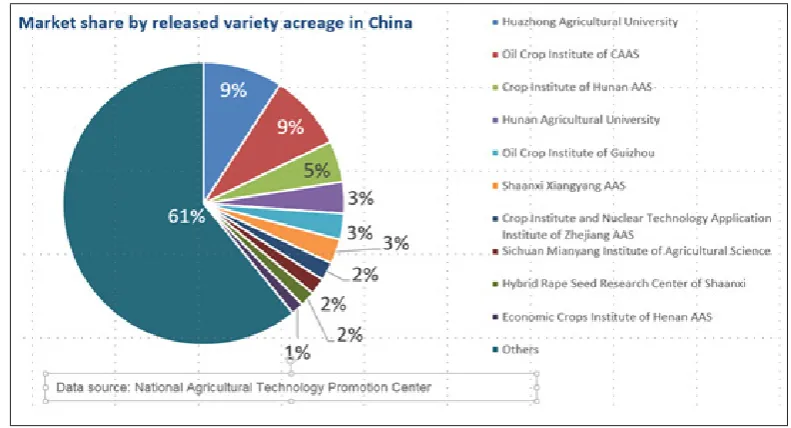
As a consequence, in 2014, more than 282 varieties and hybrids were available in China, but among them the top 10 accounted for only 14% of the market (Tab.3).
The situation is quite similar for the spring market, which accounts for 5% of the total mostly located in Qinhai and Inner Mongolia and included 26 varieties in 2014. There, the main breeder is the Spring Rape Institute of Qinhai AAS occupying 47% of this segment with 9 varieties. The most important are Qingza 5, Qingza 2, Qingza 14 and Qingza 4.
In terms of biotechnologies, two points merit underlining:
– BGI-Shenzen in association with Bayer, Keygene and the University of Queensland announced in 2009 it had se-quenced the entire genome ofB. napusand its constituent genomes present inB. rapaandB. oleracea.
– Until now, China has not officially commercialized any GM rapeseed but is active in this research. The recent ac-quisition of Syngenta by ChemChina should eventually
result in an evolution of the situation towards GM rape-seed cultivation. That said, this is not totally certain due to the fact that Chinese have traditionally consumed a lot of Brassica vegetables which would intercross with GM rape-seed pollen.
Chinese seed market of rapeseed
According to the 2015 yearbook of national agricultural production cost and benefit statistics, China’s rapeseed market was estimated to be worth 370 millione(2.756 billion RMB) in 2014 (Tab.4).
The main market segments are located in Hubei, Hunan and Sichuan provinces (Figs.6a and6b).
China seed exports in volume and value are summarized in Table5.
D
Table 5.China seed exports (in volume and value).
Volume (Mt) Value (Thousand US$)
2012/2013 2013/2014 2014/2015 2012/2013 2013/2014 2014/2015
Tota 28 376 28 847 27 299 247 941 263 931 263 022
Rape/Colza, ne 107 5 1 169 35 43
% total China seed export 0.37% 0.17% 0.04% 0.68% 0.13% 0.02% Source: Yearbooks of national agricultural production cost and benefit statistics.
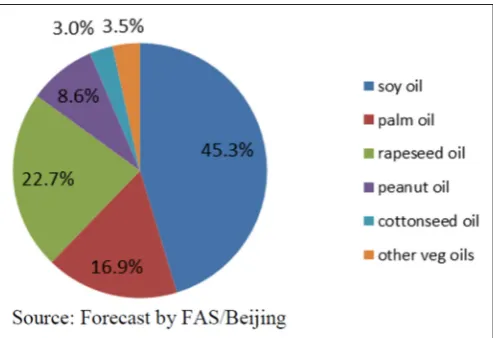
Fig. 7.Chinese vegetable oil consumption forecast for 2016/17.
Uses of oil crops and especially rapeseed
products in China
During the last 20 years, China’s urbanization and its con-tinuing growth in GDP have led to changes in food habits (Bonjeanet al.,2014). In particular, Chinese families consume more vegetable oil than in the past, more animal proteins (meat and milk products, fish) and have diversified their diets in veg-etables and fruits.
Initially, China started to increase its oil crop produc-tion, but now importations are becoming increasingly im-portant: nearly 3/4 of the vegetable oils consumed come to-day from imports, vs. only 37% in 1996/97 (Jamet, 2016). In 2015/16, China continued dominating the world oilseeds market, being the world’s largest soybean importer with more than 86 million tons for feeding its animal sector (Clever and Wu, 2016). This is a result of recent mergers and acquisi-tions. For example, in 2014, the State-Owned-enterprise China National Cereals, Oils and Foodstuff Corporation (COFCO) gained control successively of the Hong Kong-headquartered commodity company Noble Group, then the Dutch agri-trader Niderawhich has important operations in Argentina and Brazil mainly focused on soybean and maize.
For 2016/17 (Fig.7), the forecasted shares of Chinese veg-etable oil consumption places rapeseed oil in 2nd position at 22.7% far behind soy oil with 453% though before palm oil at 16.9% (Clever and Wu,2016).
Rapeseed oil is appreciated by Chinese consumers for its dietary fatty acid profile and its mild taste, but we can think its future consumption will mainly depend more on the compara-tive price ratio with those of soybean oil and palm oil, which will be imported into China in larger volumes.
In the 2000’s, China started to invest in firstgeneration bio-fuel factories, but the Chinese government halted this initia-tive, the stock of available grain being too limited. In 2016, new industrial projects for 2nd generation biofuels have been initiated but it is too early to project their long-term trend (Jamet,2016).
Regarding rapeseed meal, we must note that Chinese farm-ers do not currently use it for feeding animals but instead use it mostly as soil fertilizer.
Conclusion
A structural importer of oilseed and vegetable oils since 2004, China is and will stay at least within the next 10– 20 years an important producer and consumer of rapeseed, probably also a regular importer, but this trend will remain of limited importance compared to its huge import needs of soybean and palm oils. During the same period, Chinese and foreign seed companies will presumably develop private rape-seed breeding programs, and especially 00 hybrids, to replace current public varieties.
Some recent events in the world of business, such as the takeover of Syngenta by ChemChina and the general orienta-tions of the XIIth national plan will furthe open the rapeseed market to private actors, but State control will certainly remain strong in this sector.
References
Bonjean A. 2011. Oil seed rape & Sunflower in China, Limagrain, 55 p.
Bonjean A, Schwoob M-H, Ly C, Boinet D. 2014. Nourrir 1,5 milliard de Chinois en 2030 : Les mutations des agricultures chinoises et leurs conséquences sur les marchés agricoles et alimentaires, DeBoeck, 214 p.
Carré P, Pouzet A. 2014. Rapeseed market, worldwide and in Europe. OCL21(1): D102.
Clever J, Wu X. 2016. China – Oilseeds and product annual – Prospects for China’s oilseed market remain strong. GAIN Report Number: CH16022.
Clever J, Wu X, Schull PA. 2015. China – Oilseeds and product an-nual – Record imports and declining production. GAIN Report Number: CH15008, 1–53.
Fang J, Chang R. 2007. Economic crops. In: Dong Y, Liu X., eds., Crops and Their Wild Relatives in China. Beijing, China: China Agriculture Press.
Hu S, Ovesná J, Kuèera L, Kuèera V, Vyvadilovà M. 2003. Evaluation of genetic diversity ofBrassica napusgermplasm from China and Europe assessed by RAPD markers.Plant Soil Environ.49: 106– 113.
International Production Assessment, 2014. Production 2012, Chinese Statistical Yearbook.
Jamet JP. 2016. Dossier : Nourrir 1,4 milliard de Chinois. Huiles et protéines végétales – une dépendance croissante aux importa-tions. Le Demeter 2017, 23e, Économie et stratégies agricoles,
pp. 199–213.
Jennifer Clever, Wu Xinping. 2016, Gain report. China – Peoples Republic of Oilseeds and Products Annual Prospects for China’s Oilseed Market Remain Strong. USDA.
Liu H-L. 1985. Rapeseed Genetics and Breeding (Chinese), Shanghai Science and Technology Publishing House, 9–43.
Needham J, Bray F. 1984. Science and Civilization in China: Vol. 6, Biology and Biological Technology, Part 2, Agriculture. Cambridge University Press, 1st edn., 768 p.
Regnault X. 2016. Fiche colza. Agence MOMAGRI, 3 p.
Sang T, Lessard P. 2015. Limagrain China. Personal communication. Tian B. 2006. The genetic improvement of rapeseed in China.Life
Science Journal3: 78–80.
Yan Z. 1990. Overview of rapeseed production and research in China. Proceedings of the International Canola Conference Potash and Phosphate Institute, Atlanta, Georgia, 29–35.
Yi T-S, Morell PL, Pei S-J, He S-A. 2015. Major introduced economic plants. In: Hong D-Y, Blackmore S, eds., Plants of China: A com-panion to the Flora of China, SciencePress Beijing – Cambridge University Press.
Cite this article as:Alain. P. Bonjean, Céline Dequidt, Tina Sang– Groupe Limagrain. Rapeseed in China. OCL 2016, 23(6) D605.