R E S E A R C H
Open Access
Long-term changes in body weight and
physical activity in relation to all-cause and
cardiovascular mortality: the HUNT study
Anne Lovise Nordstoga
1†, Ekaterina Zotcheva
1*†, Ellen Rabben Svedahl
1†, Tom I. L. Nilsen
1,2and
Eivind Schjelderup Skarpsno
1,3Abstract
Background:Most previous studies have relied on single measurements of body weight and physical activity and
have not considered the interplay between long-term changes in body weight and physical activity in relation to mortality. The aim of the current study was therefore to examine the joint effect of changes in body weight and leisure-time physical activity over a period of ~ 10 years on all-cause and cardiovascular mortality.
Methods:The study population comprised 34,257 individuals who participated in the first (1984–86) and second (1995–97) waves of the HUNT Study, and were followed up through the Norwegian Cause of Death Registry until December 31st, 2013. We used Cox regression to estimate hazard ratios (HR) with 95% confidence intervals (CI) of death associated with changes in body weight and leisure-time physical activity.
Results:Compared to the reference group with stable weight who were long-term physically active, people who
gained≥5% of their weight had a HR for all-cause mortality of 1.54 (95% CI: 1.28–1.85) if they were long-term physically inactive; a HR of 1.23 (1.09–1.40) if they became physically active, and a HR of 1.00 (95% CI 0.94–1.06) if they were long-term physically active. The corresponding HRs for cardiovascular mortality were 1.57
(95% CI 1.17–2.12), 1.28 (95% CI 1.04–1.58) and 1.06 (95% CI 0.96–1.16), respectively. Long-term physical inactivity was associated with increased all-cause (HR 1.29; 95% CI 1.08–1.53) and cardiovascular (HR 1.37; 95% CI 1.05–1.79) mortality among those who were weight stable.
Conclusions:The risk of all-cause and cardiovascular mortality is particularly evident among people who gain weight while remaining inactive during a ~ 10 year period. However, participants who remained physically active had the lowest risk of premature mortality, regardless of maintenance or increase in weight. These findings suggest that there is an interplay between long-term changes in body weight and physical activity that should receive particular attention in the prevention of premature mortality.
Keywords:Mortality, All-cause mortality, Cardiovascular mortality, Physical activity, Body weight, Weight gain, HUNT study
© The Author(s). 2019Open AccessThis article is distributed under the terms of the Creative Commons Attribution 4.0 International License (http://creativecommons.org/licenses/by/4.0/), which permits unrestricted use, distribution, and reproduction in any medium, provided you give appropriate credit to the original author(s) and the source, provide a link to the Creative Commons license, and indicate if changes were made. The Creative Commons Public Domain Dedication waiver (http://creativecommons.org/publicdomain/zero/1.0/) applies to the data made available in this article, unless otherwise stated.
* Correspondence:[email protected]
Anne Lovise Nordstoga, Ekaterina Zotcheva and Ellen Rabben Svedahl are Shared first authorship
1Department of Public Health and Nursing, Faculty of Medicine and Health
Sciences, Norwegian University of Science and Technology, Håkon Jarls gate, 11, 7030 Trondheim, Norway
Background
Weight gain has repeatedly been associated with an in-creased all-cause and cardiovascular mortality [1, 2]. However, favorable effects of weight gain on mortality have also been reported [3]. The explanation behind these inconsistent findings remains unknown, but may be partially related to the positive influence of leisure-time physical activity on mortality [4, 5]. Pre-vious studies have shown that increasing the level of physical activity may reduce both all-cause and car-diovascular mortality considerably [6, 7].
Increasing evidence points towards a joint effect of body weight and physical activity on mortality, suggest-ing that physical activity can compensate the negative effect of excessive body weight on mortality [8–10]. Results from a large study showed that mortality in overweight and obese individuals was reduced among all physical activity groups when compared to inactive participants [10]. Another study showed that higher levels of physical activity attenuated some of the increased mortality among obese persons over a ten-year follow-up [11], but that the increased risk was not entirely elimi-nated. However, most previous studies have relied on single measurements of weight status and physical activity and have not considered the influence of long-term life-style changes on mortality. Since leisure-time physical activity and body weight may fluctuate throughout an individual’s life course, the effect on mortality may be better reflected by assessing the long-term changes in these factors. One large cohort study found that, irre-spective of change or stability in BMI, men who be-came less fit had higher all-cause and cardiovascular mortality [12]. Although cardiorespiratory fitness is a good measure of physical capacity, it has a strong genetic com-ponent [13] and may be less modifiable than leisure-time physical activity habits. Thus, increased knowledge about the potential interplay between concurrent changes in body weight and leisure-time physical activity are neces-sary to guide public health recommendations aimed at preventing premature mortality.
The aim of this large population-based cohort study was therefore to prospectively investigate the joint asso-ciation of concurrent changes in body weight and leisure-time physical activity with all-cause and cardio-vascular mortality.
Methods
Participants
The HUNT Study is a population-based study per-formed in Nord-Trøndelag County, Norway [14]. All inhabitants aged 20 years and older were invited to par-ticipate in several consecutive surveys. The participation rate was 89% (n= 77,216) at HUNT1 (1984–86), and 66% (n= 65,237) at HUNT2 (1995–97). For the purpose
of the present study, we included 45,925 persons who participated in both waves. The participants attended a clinical examination with measures of body weight and height, and filled in comprehensive questionnaires on lifestyle and health related factors, returned by mail subsequently. We excluded persons with incomplete in-formation on weight (n= 351), and/or leisure-time physical activity (n= 11,317). Thus, the prospective ana-lyses were based on information from 17,700 women and 16,557 men.
Outcome
Participants in the HUNT Study were linked with the Norwegian Cause of Death Registry at Statistics Norway to prospectively assess incident cases of death in the co-hort. Death from cardiovascular disease was classified according to the International Classification of Diseases (ICD-9: 390–459, and ICD-10: I00-I99). Each participant contributed person-years from the date of participation in HUNT2 until the date of death, emigration, or end of follow-up at December 31st, 2013.
Weight change
Standardized measurements of body weight (to the near-est half kg) were performed by trained staff at the clinical examination at HUNT1 and HUNT2. Relative change in body weight was calculated as percentage change from
HUNT1 to HUNT2: 100 x (kg at HUNT2 – kg at
HUNT1)/kg at HUNT1. We classified individuals into three categories based on this change score: ‘loss’ (≥5% weight loss),‘stable’(< 5% weight change), and‘gain’(≥5% weight gain).
Leisure-time physical activity
At HUNT1, leisure-time physical activity was assessed by the question: ‘How often do you exercise? (By exer-cise we mean going for walks, skiing, swimming and working out/sports)’, with the response options: ‘never’, ‘less than once a week’,‘once a week’,‘2-3 times a week’, or ‘almost every day’. The activity level was dichoto-mized into ‘inactive’ (‘never’) and ‘active’ (‘less than once a week’,‘once a week’,‘2-3 times a week’or ‘almost every day’).
‘active’ (‘<1 h’,‘1–2 h’ or ‘≥3 h’ of light and/or hard ac-tivity). Based on this information, change in physical activity was categorized into four groups combining in-formation from HUNT1 and HUNT2:‘remained active’, ‘inactive to active’, ‘active to inactive‘, and ‘remained inactive’.
Other variables
Education was assessed by the question: ‘What is your highest level of education?’, and divided into ‘< 10 years’, ‘10 to 12 years’, and ‘≥13 years’. Smoking status was assessed by questions about past or present use of ciga-rettes/pipe/cigars, and divided into three categories: ‘never smoked’, ‘former smoker’, and ‘current smoker’. Classification of insomnia was based on the two ques-tions: ‘Have you had problems falling asleep during the last month?’, and ‘During the last month, did you ever wake up too early, not being able to fall asleep again?’ with the following response options:‘never’,‘occasionally’, ‘often’, and‘almost every night’. Participants were classi-fied with insomnia if they answered,‘often’ or ‘almost every night’on at least one of the questions. History of cardiovascular disease was assessed by two questions: ‘Have you ever had a myocardial infarction (heart attack)?’ and ‘Have you ever had a stroke/brain haemorrhage?’, with the response options: ‘yes’ and ‘no’. Participants were defined as having a history of cardiovascular dis-ease if they answered ‘yes’ on at least one of the questions. Alcohol consumption was assessed by the question: ‘How many units of beer, wine or spirits do you usually drink in the course of 14 days?’. Partici-pants were then divided into three groups: ‘0 units’, ‘1–4 units’and‘≥5 units’. BMI was calculated as weight divided by height squared (kg/m2), and classified into one of four groups according to the cut-off points sug-gested by the World Health Organization [15]: under-weight (< 18.5 kg/m2), normal weight (18.5–24.9 kg/m2), overweight (25.0–29.9 kg/m2), or obese (≥30.0 kg/m2
). Sedentary behavior was assessed by the question:‘How many hours do you usually spend sitting down during a 24 hour period (work, mealtimes, TV, car, etc.)?’. All po-tential confounders were assessed at HUNT2, with the exception of BMI, which was assessed at HUNT1.
Statistical analyses
Cox regression was used to estimate hazard ratios (HR) of the joint association of changes in weight and leisure-time physical activity with all-cause and cardiovascular mortal-ity. The precision of the HR was assessed by 95% confi-dence intervals (CI). Participants who remained active and had stable weight served as the reference group. All asso-ciations were adjusted for age (using age as the time scale in the model). In the multi-adjusted models we adjusted for potential confounding by sex, education (< 10 years,
10 to 12 years, ≥13 years, unknown), smoking (never, former, current smoker, unknown), insomnia (no, yes, unknown), alcohol consumption (0, 1–4 units,≥5 units, unknown), and history of cardiovascular disease (no, yes, unknown). Potential effect modification between the variables was assessed as departure from additive effects by calculating the relative excess risk due to interaction (RERI) with 95% CI [16].
Sensitivity analyses were conducted to test the robust-ness of the results. First, the physically active category may include participants who performed very low levels of physical activity. Thus, in order to increase the con-trast between inactive and active participants, we ex-cluded participants who reported being physically active less than once a week in HUNT1 and less than one hour a week in HUNT2. Second, as it is likely that the associ-ation between weight change and mortality is influenced by initial BMI, we repeated the main analysis adjusting for BMI at HUNT1. Third, since strong evidence shows that sedentary behavior increases the risk of many ad-verse health conditions [17], we performed sensitivity analyses adjusting for sedentary behavior. Our main ana-lyses were not adjusted for sedentary behavior, as inclu-sion of different domains of physical behavior may cause collinearity problems in multivariate statistical analyses [18]. Fourth, since the weight loss group was substan-tially older than the groups of stable weight and weight gain, we also performed an analysis excluding parti-cipants < 60 years (we did not have enough statistical power to perform this analysis on participants < 60 years). Fifth, to avoid reverse causation, we performed two sensitivity analyses excluding participants with phys-ical impairments or a history of cardiovascular disease at HUNT2.
Test of Schoenfeld residuals and graphical inspection of log-log plots suggested no important violation of the proportional hazard assumption for the variables in-cluded in the regression model. All statistical analyses were performed using Stata for Windows, version 13 (StataCorp LP, College Station, TX, USA).
Results
During a median follow-up period of 17 years (535,359 person years) a total of 8449 deaths occurred in the co-hort. Of these, 3264 died from cardiovascular disease. Characteristics of the study population stratified by weight change categories are presented in Table1.
were weight stable, whereas participants who gained weight and remained active had a HR of 1.00 (95% CI: 0.94–1.06). The RERI-estimate for the joint effect of ‘remained active’ versus ‘remained inactive’ among the ‘stable’versus the‘gain’group was 0.26 (95% CI:−0.13 to 0.66). This suggests a weak synergistic effect of concurrent changes in body weight and physical activity on all-cause mortality. Furthermore, compared to participants with stable weight who remained active, participants who
changed their activity level from inactive to active had a HR of 1.22 (95% CI: 1.08–1.38) if they were weight stable and 1.23 (95% CI: 1.09–1.40) if they gained weight. The corresponding HRs for participants who changed their activity level from active to inactive were 1.35 (95% CI: 1.21–1.50) and 1.26 (95% CI: 1.12– 1.42), respectively. Weight loss was consistently associated with increased all-cause mortality, irrespective of physical activity changes.
Table 1Characteristics of 34,257 participants stratified by change in body weight from HUNT1 to HUNT2
Change in body weight from HUNT1 to HUNT2
Loss (≥5%) Stable (< 5% change) Gain (≥5%) Number of persons,n 2701 11,840 19,716
Female, % (n) 57 (1546) 43 (5091) 56 (11,063) Age, mean (SD) 66.7 (14.6) 58.8 (13.6) 51.0 (11.9) Body Mass Index, mean (SD) 24.6 (4.0) 25.8 (3.7) 27.4 (4.0) Higher educationa, % (n) 8.5 (229) 14.9 (1769) 18.5 (3642)
Current smokers, % (n) 33.3 (898) 28.8 (3407) 25.3 (4992) Alcohol consumption (≥5 units)b, % (n) 5.6 (145) 10.2 (1145) 12.4 (2292)
History of cardiovascular diseasec, % (n) 14.0 (380) 7.2 (849) 3.5 (687)
Insomnia symptoms, % (n) 17.9 (483) 14.3 (1687) 11.9 (2354) Weight change in kilograms, mean (SD) −7.4 (4.0) 0.7 (2.0) 9.0 (4.8)
Remained active −7.2 (3.8) 0.7 (2.0) 8.9 (4.7) Inactive to active −8.1 (5.1) 0.6 (2.1) 9.0 (4.7) Active to inactive −7.8 (4.2) 0.5 (2.1) 9.7 (5.4) Remained inactive −8.3 (5.2) 0.6 (2.1) 9.9 (5.7) Physical activity, % (n)
Remained active 74.4 (2009) 84.5 (10,007) 85.6 (16,885) Inactive to active 8.4 (227) 6.8 (810) 6.8 (1341) Active to inactive 12.4 (335) 6.3 (746) 5.5 (1092) Remained inactive 4.8 (130) 2.3 (277) 2.0 (398)
Abbreviations:SDstandard deviation
a
College or higher
b
Over a 2-week period
c
Myocardial infarction or stroke/cerebral haemorrhage
Table 2Combined effect of concurrent changes in weight and leisure-time physical activity on all-cause mortality
Change in leisure -time physical activity
Change in weighta
Loss (≥5%) Stable (< 5% change) Gain (≥5%) Person
years/death
Adjusted HRb 95% CI Person
years/death
Adjusted HRb 95% CI Person
years/death
Adjusted HRb 95% CI
All-cause mortality
Remained active 25,127/1112 1.47 1.37, 1.57 154,446/2879 1.00 Reference 279,598/2204 1.00 0.94, 1.06 Inactive to active 2763/141 1.51 1.27, 1.79 11,934/298 1.22 1.08, 1.38 21,739/257 1.23 1.09, 1.40 Active to inactive 2850/282 1.70 1.50, 1.93 9558/391 1.35 1.21, 1.50 16,577/305 1.26 1.12, 1.42 Remained inactive 1145/106 2.31 1.90, 2.81 3656/132 1.29 1.08, 1.53 5960/122 1.54 1.28, 1.85
Abbreviations:CIconfidence interval,HRhazard ratio
a
Calculated as change in kilograms between the baseline in HUNT1 and last examination in HUNT2
b
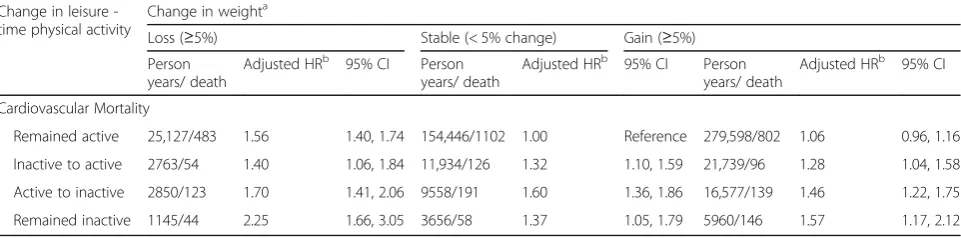
Table 3 shows the joint association of concurrent changes in weight and leisure-time physical activity with cardiovascular mortality. Compared to the reference group of participants with stable weight who remained active, participants who remained inactive had a HR for cardiovascular mortality of 1.57 (95% CI: 1.17–2.12) if they gained weight and 1.37 (95% CI: 1.05–1.79) if they were weight stable, whereas participants who gained weight and remained active had a HR of 1.06 (95% CI: 0.96–1.16). The RERI-estimate for these associations was 0.14 (95% CI: −0.44 to 0.72). Moreover, compared to participants with stable weight who remained active, participants who became active had a HR of 1.32 (95% CI: 1.10–1.59) if they were weight stable and 1.28 (95% CI: 1.04–1.58) if they gained weight, whereas the corresponding HRs for participants who became in-active were 1.60 (95% CI: 1.36–1.86) and 1.46 (95% CI: 1.22–1.75). Weight loss was consistently associated with increased cardiovascular mortality.
Sensitivity analyses
When excluding participants who reported being physic-ally active less than once a week in HUNT1 and less than one hour a week in HUNT2, the HRs for all-cause and cardiovascular mortality became somewhat stronger (Additional file1: Table S1), i.e., compared to active per-sons who had stable weight, inactive participants who gained weight had a HR of 1.60 (95% CI 1.33–1.93) for all-cause mortality and 1.71 (95% CI 1.26–2.31) for car-diovascular mortality. When including BMI at HUNT1 as a covariate in the model, all associations became slightly weaker (Additional file1: Table S2). Inclusion of sedentary behavior as a covariate in the model did not influence the results. Excluding participants < 60 years had negligible influence on the results for weight loss (Additional file 1: Table S3). Likewise, exclusion of par-ticipants with physical impairments had no influences on the results. Finally, exclusion of participants with a
history of cardiovascular disease partly attenuated the unfavorable association with cardiovascular mortality in those who gained weight and remained inactive, com-pared to persons who had stable weight and the same level of physical activity (Additional file1: Table S4).
Discussion
This large prospective study showed that the risk of all-cause and cardiovascular mortality is particularly evi-dent among people who gain weight while remaining inactive during a 10–12 year period. Compared to par-ticipants with a stable weight who remained physically active during leisure-time, participants who gained weight and remained inactive had a substantially higher all-cause and cardiovascular mortality. In contrast, gain-ing weight while remaingain-ing physically active was not associated with higher mortality. Thus, regardless of maintenance or increase in weight, participants who remained physically active had the lowest risk of prema-ture mortality.
Several prospective studies have shown that leisure-time physical activity may compensate for some of the negative effect of excessive body weight on mortality [8–10]. How-ever, a methodological limitation in these studies is that weight status and physical activity were measured at a single time point, whereas our findings provide evi-dence of the benefit of long-term maintenance of physical activity, regardless of concurrent weight gain. To our knowledge, this is the first study investigating concurrent long-term changes in body weight and leisure-time physical activity in relation to all-cause and cardiovascular mortality. Lee and colleagues [12] showed that irrespective of change or stability in BMI, men who became less fit had higher all-cause and cardiovascular mortality. However, the latter study investigated change in fitness, which is only partially modifiable due to the genetic determination in human adaptive capacity in response to training
Table 3Combined effect of concurrent changes in weight and leisure-time physical activity on cardiovascular mortality
Change in leisure -time physical activity
Change in weighta
Loss (≥5%) Stable (< 5% change) Gain (≥5%) Person
years/ death
Adjusted HRb 95% CI Person
years/ death
Adjusted HRb 95% CI Person
years/ death
Adjusted HRb 95% CI
Cardiovascular Mortality
Remained active 25,127/483 1.56 1.40, 1.74 154,446/1102 1.00 Reference 279,598/802 1.06 0.96, 1.16 Inactive to active 2763/54 1.40 1.06, 1.84 11,934/126 1.32 1.10, 1.59 21,739/96 1.28 1.04, 1.58 Active to inactive 2850/123 1.70 1.41, 2.06 9558/191 1.60 1.36, 1.86 16,577/139 1.46 1.22, 1.75 Remained inactive 1145/44 2.25 1.66, 3.05 3656/58 1.37 1.05, 1.79 5960/146 1.57 1.17, 2.12
Abbreviations:CIconfidence interval,HRhazard ratio
a
Calculated as change in kilograms between the baseline in HUNT1 and last examination in HUNT2
b
[13]. Thus, changes in physical activity may serve as a more attainable goal for initiatives aimed at improving public health.
We found a weak synergistic effect of concurrent changes in weight and physical activity on mortality, underlining the finding that individuals who gain weight while remaining inactive are at a particular risk of premature mortality. Further, it should be noted that individuals who became active had a higher mor-tality than individuals who remained active, both among those who gained weight and those who were weight stable. However, this risk was still lower than in individuals who remained inactive and gained weight. This may indicate that the benefit of becoming active is not immediate [6], suggesting that the dur-ation of a physically active lifestyle is an important de-terminant of mortality. Unfortunately, we had no information about when the changes in activity level occurred. Nevertheless, our findings underscore the importance of long-term maintenance of leisure-time physical activity for reducing risk of premature mortal-ity, and suggest that maintenance of an inactive life-style is particularly harmful among individuals who gain weight.
With the exception of participants who remained in-active, our results showed that participants who gained weight did not have a higher mortality than stable weight participants with the same level of activity. It is plausible that initial body mass or the duration of exces-sive body mass may play an important role in the ob-served association. As weight gain may be less harmful in persons with initially low BMI [19], BMI at HUNT1 may have influenced the observed associations between weight gain, physical activity and mortality. Further, a longitudinal study showed that weight gain earlier in life is associated with higher mortality compared to weight gain later in life [20], whereas Janssen and colleagues [21] demonstrated that the odds of obesity-related co-morbidities was increased only among men who had been overweight for ten years or more. However, our re-sults were consistent after adjustment for baseline BMI, suggesting that a weight gain of 5% or more, irrespective of initial BMI, is not detrimental with regards to mortal-ity among individuals who conduct leisure-time physical activity.
In accordance with previous findings [20, 22], our study showed an association between weight loss and higher all-cause and cardiovascular mortality. We found that weight loss was associated with a higher risk of mortality regardless of change in physical activity, as previously found by Østergaard and colleagues [23]. However, our results showed that among individuals who lost weight, individuals who remained inactive had the highest risk of premature mortality. Although our
findings suggest that maintenance of physical activity is beneficial in this group, it does not eliminate the in-creased mortality associated with weight loss. A plaus-ible explanation is reverse causality due to pre-existing or subclinical disease, which may have caused uninten-tional weight loss [24,25]. Unfortunately, we had no in-formation about the reason behind the weight loss, nor did we have information about pre-existing disease or physical disabilities.
The strengths of the current study include the large population, which enables analyses of joint categories of changes in weight and physical activity; the pro-spective design, linking health survey data with data from the Cause of Death Registry that covers all deaths in Norway; and the longitudinal measures of leisure-time physical activity and objectively assessed body weight. We also had detailed information on pos-sible confounders. However, residual confounding by unmeasured or poorly measured factors cannot be ruled out. Another limitation is the assessment of physical activity by questionnaires that is likely subject to measurement error and misclassification. Moreover, physical activity was assessed using different questions at HUNT1 and HUNT2. Although both instruments have shown acceptable validity in terms of objectively assessed measures, the test-retest reliability was higher using HUNT1 [26] than HUNT2 [27] questions. Nevertheless, questionnaire based data are considered adequate to classify people into broad categories, such as inactive/active [28]. This is supported by our sensitivity analysis showing stronger associations with mortality when we increased the contrasts between inactive and ac-tive participants. Furthermore, information on possible changes or fluctuations in body weight and physical activity during the relatively long follow-up period was not available. Study findings may also be limited by the restriction to those who survived until HUNT2. Thus, the current study may represent a healthier group in general. Finally, unmeasured or unknown dis-eases and adverse life events may influence both phys-ical activity and body weight, and thus influence the observed results.
Conclusions
The current study shows that the risk of all-cause and cardiovascular mortality is particularly evident among people who gain weight while remaining inactive during a 10–12 year period. However, individuals who maintain a physically active lifestyle have the lowest risk of all-cause and cardiovascular mortality, regardless of maintenance or increase in weight. Thus, these findings suggest that there is an interplay between weight gain and leisure-time phys-ical activity that should receive particular attention in the prevention of premature mortality.
Additional file
Additional file 1:Sensitivity analyses.Table S1.Excluded persons who reported being physically active less than once a week in HUNT1 and less than one hour a week in HUNT2.Table S2.Included body mass index (BMI) at HUNT1 as a covariate in the model.Table S3.Excluded persons aged <60 years.Table S4.Excluded persons with a history of cardiovascular disease. (DOCX 23 kb)
Abbreviations
CI:Confidence interval; HR: Hazard ratio; RERI: Relative excess risk due to interaction; SD: Standard deviation
Acknowledgements
The Nord-Trøndelag Health Study (The HUNT Study) is a collaboration be-tween HUNT Research Centre (Faculty of Medicine and Health Sciences, Nor-wegian University of Science and Technology), Nord-Trøndelag County Council, Central Norway Regional Health Authority, and the Norwegian Insti-tute of Public Health.
Funding
This work was supported by the Department of Public Health and Nursing at the Faculty of Medicine and Health Sciences, Norwegian University of Science and Technology, and the Norwegian National Research School in Population Based Epidemiology (EPINOR).
Availability of data and materials
Data used for this study were derived from The Nord-Trøndelag Health Study (HUNT),https://www.ntnu.edu/hunt. Any research group with a Principal In-vestigator affiliated with a Norwegian research institute can apply for access to analyze HUNT data. This means that research groups from non-Norwegian countries must find a collaboration partner in Norway to be able to use HUNT material. Each project needs to be approved by the HUNT Data Access Committee (DAC), regional Medical Ethical Committee, in some cases also the Data Inspectorate. Due to participant confidentiality, participant data is not publicly available.
Authors’contributions
ALN, EZ, ERS, TILN and ESS designed the study, and contributed in the analysis and interpretation of the data. ESS performed the statistical analyses. ALN, EZ, ERS, ESS wrote the first draft of the manuscript, and all authors contributed to the critical revision and final manuscript. All authors read and approved the final manuscript.
Ethics approval and consent to participate
All participants in the HUNT Study gave a written informed consent upon participation. This study was approved by the Regional Committee for Ethics and Medical Research (2014/1116/REK midt).
Consent for publication Not applicable.
Competing interests
The authors declare that they have no competing interests.
Publisher’s Note
Springer Nature remains neutral with regard to jurisdictional claims in published maps and institutional affiliations.
Author details
1Department of Public Health and Nursing, Faculty of Medicine and Health
Sciences, Norwegian University of Science and Technology, Håkon Jarls gate, 11, 7030 Trondheim, Norway.2Clinic of Anaesthesia and Intensive Care, St Olavs Hospital, Trondheim University Hospital, Trondheim, Norway.
3Department of Neurology and Clinical Neurophysiology, St. Olavs Hospital,
Trondheim, Norway.
Received: 11 January 2019 Accepted: 10 May 2019
References
1. Shimazu T, Kuriyama S, Ohmori-Matsuda K, Kikuchi N, Nakaya N, Tsuji I. Increase in body mass index category since age 20 years and all-cause mortality: a prospective cohort study (the Ohsaki study). Int J Obes. 2009;33(4):490–6.
2. Zimmermann E, Berentzen TL, Angquist L, Holst C, Sorensen TI. Long-term weight changes in obese young adult men and subsequent all-cause mortality. Int J Obes. 2013;37(7):1020–5.
3. Cho IJ, Chang HJ, Sung JM, Yun YM, Kim HC, Chung N. Associations of changes in body mass index with all-cause and cardiovascular mortality in healthy middle-aged adults. PLoS One. 2017;12(12):e0189180.
4. Arem H, Moore SC, Patel A, Hartge P, Berrington de Gonzalez A, Visvanathan K, et al. Leisure time physical activity and mortality: a detailed pooled analysis of the dose-response relationship. JAMA Intern Med. 2015;175(6):959–67.
5. Lear SA, Hu W, Rangarajan S, Gasevic D, Leong D, Iqbal R, et al. The effect of physical activity on mortality and cardiovascular disease in 130 000 people from 17 high-income, middle-income, and low-income countries: the PURE study. Lancet. 2017;390(10113):2643–54.
6. Byberg L, Melhus H, Gedeborg R, Sundstrom J, Ahlbom A, Zethelius B, et al. Total mortality after changes in leisure time physical activity in 50 year old men: 35 year follow-up of population based cohort. Br J Sports Med. 2009;43(7):482.
7. Schnohr P, O'Keefe JH, Lange P, Jensen GB, Marott JL. Impact of persistence and non-persistence in leisure time physical activity on coronary heart disease and all-cause mortality: the Copenhagen City heart study. Eur J Prev Cardiol. 2017;24(15):1615–23.
8. Lavie CJ, De Schutter A, Milani RV. Healthy obese versus unhealthy lean: the obesity paradox. Nat Rev Endocrinol. 2015;11(1):55–62.
9. Hu FB, Willett WC, Li T, Stampfer MJ, Colditz GA, Manson JE. Adiposity as compared with physical activity in predicting mortality among women. N Engl J Med. 2004;351(26):2694–703.
10. Ekelund U, Ward HA, Norat T, Luan J, May AM, Weiderpass E, et al. Physical activity and all-cause mortality across levels of overall and abdominal adiposity in European men and women: the European prospective investigation into Cancer and nutrition study (EPIC). Am J Clin Nutr. 2015;101(3):613–21.
11. Koster A, Harris TB, Moore SC, Schatzkin A, Hollenbeck AR, van Eijk JT, et al. Joint associations of adiposity and physical activity with mortality: the National Institutes of Health-AARP diet and health study. Am J Epidemiol. 2009;169(11):1344–51.
12. Lee DC, Sui X, Artero EG, Lee IM, Church TS, McAuley PA, et al. Long-term effects of changes in cardiorespiratory fitness and body mass index on all-cause and cardiovascular disease mortality in men: the aerobics center longitudinal study. Circulation. 2011;124(23):2483–90.
13. Bouchard C, Sarzynski MA, Rice TK, Kraus WE, Church TS, Sung YJ, et al. Genomic predictors of the maximal O2 uptake response to standardized exercise training programs. J Appl Physiol. 2011;110(5):1160–70. 14. Krokstad S, Langhammer A, Hveem K, Holmen TL, Midthjell K, Stene TR,
et al. Cohort profile: the HUNT study, Norway. Int J Epidemiol. 2013;42(4):968–77.
16. Andersson T, Alfredsson L, Kallberg H, Zdravkovic S, Ahlbom A. Calculating measures of biological interaction. Eur J Epidemiol. 2005;20(7):575–9. 17. Lee IM, Shiroma EJ, Lobelo F, Puska P, Blair SN, Katzmarzyk PT. Effect of physical inactivity on major non-communicable diseases worldwide: an analysis of burden of disease and life expectancy. Lancet. 2012;380(9838):219–29.
18. Dumuid D, Stanford TE, Martin-Fernandez JA, Pedisic Z, Maher CA, Lewis LK, et al. Compositional data analysis for physical activity, sedentary time and sleep research. Stat Methods Med Res. 2018;27(12):3726–38.
19. Corrada MM, Kawas CH, Mozaffar F, Paganini-Hill A. Association of body mass index and weight change with all-cause mortality in the elderly. Am J Epidemiol. 2006;163(10):938–49.
20. Adams KF, Leitzmann MF, Ballard-Barbash R, Albanes D, Harris TB, Hollenbeck A, et al. Body mass and weight change in adults in relation to mortality risk. Am J Epidemiol. 2014;179(2):135–44.
21. Janssen I, Katzmarzyk PT, Ross R. Duration of overweight and metabolic health risk in American men and women. Ann Epidemiol. 2004;14(8):585–91. 22. Drøyvold WB, Lund Nilsen TI, Lydersen S, Midthjell K, Nilsson PM, Nilsson JA,
et al. Weight change and mortality: the Nord-Trondelag health study. J Intern Med. 2005;257(4):338–45.
23. Østergaard JN, Grønbæk M, Schnohr P, Sørensen TI, Heitmann BL. Combined effects of weight loss and physical activity on all-cause mortality of overweight men and women. Int J Obes. 2010;34(4):760–9.
24. Wannamethee SG, Shaper AG, Walker M. Weight change, body weight and mortality: the impact of smoking and ill health. Int J Epidemiol. 2001;30(4): 777–86.
25. Harrington M, Gibson S, Cottrell RC. A review and meta-analysis of the effect of weight loss on all-cause mortality risk. Nutr Res Rev. 2009;22(1):93–108. 26. Kurtze N, Rangul V, Hustvedt BE, Flanders WD. Reliability and validity of
self-reported physical activity in the Nord-Trondelag health study: HUNT 1. Scand J Public Health. 2008;36(1):52–61.
27. Kurtze N, Rangul V, Hustvedt BE, Flanders WD. Reliability and validity of self-reported physical activity in the Nord-Trondelag health study (HUNT 2). Eur J Epidemiol. 2007;22(6):379–87.
28. Shephard RJ. Limits to the measurement of habitual physical activity by questionnaires. Br J Sports Med. 2003;37(3):197–206.
29. Doherty A, Smith-Byrne K, Ferreira T, Holmes MV, Holmes C, Pulit SL, et al. GWAS identifies 14 loci for device-measured physical activity and sleep duration. Nat Commun. 2018;9(1):5257.
30. Sung YJ, Perusse L, Sarzynski MA, Fornage M, Sidney S, Sternfeld B, et al. Genome-wide association studies suggest sex-specific loci associated with abdominal and visceral fat. Int J Obes. 2016;40(4):662–74.