Taxonomic notes on
Scutellaria taipeiensis
(Lamiaceae)
from morphological and molecular data
Chien-Ti Chao1, Bing-Hong Huang1, Jui-Tse Chang1, Pei-Chun Liao1
1 School of Life Science, National Taiwan Normal University, No. 88, Tingchou Rd. 4 section, Wenshan Di-strict, Taipei City 116, Taiwan
Corresponding author:Chien-Ti Chao ([email protected])
Academic editor:Alan Paton | Received 18 November 2019 | Accepted 25 January 2020 | Published 24 February 2020
Citation: Chao C-T, Huang B-H, Chang J-T, Liao P-C (2020) Taxonomic notes on Scutellaria taipeiensis (Lamiaceae) from morphological and molecular data. PhytoKeys 140: 33–45. https://doi.org/10.3897/phytokeys.140.48578
Abstract
The genus Scutellaria comprises eight species distributed from 50 to 2000 m in Taiwan. Amongst them, S. barbata and S. taipeiensis are very similar on the basis of morphological and plastid DNA sequence information. Therefore, a comprehensive study of the taxonomic status of S. taipeiensis is necessary. We reviewed the herbarium sheets, related literature and protologues and compared morphologies of these two species, as well as their phylogenetic relationships. All evidence, including the diagnostic characters between S. taipeiensis and S. barbata, suggest that they belonged to a single species rather than two. As a result, S. taipeiensis is treated as a synonym of S. barbata.
Keywords
Lamiaceae, Scutellarioideae, plant taxonomy, Taiwan
Introduction
The genus Scutellaria L. is composed of approximately 360 species worldwide (Paton 1990; Li and Hedge 1994; Harley et al. 2004). This genus is characterised by being non-aromatic, having simple leaves with entire to pinnatifid margins, a terminal or ax-illary raceme-like thrysoid inflorescence with single-flowered cymes, a two-lobed calyx with a scutellum on the upper lobe and a two-lobed corolla with an often saccate or spurred base, anterior anthers dimidiate due to aborted development of upper thecae and the ovary being borne on a peg-like gynophore (Paton 1990; Li and Hedge 1994).
http://phytokeys.pensoft.net
Copyright Chien-Ti Chao et al. This is an open access article distributed under the terms of the Creative Commons Attribution License (CC BY 4.0), which permits unrestricted use, distribution, and reproduction in any medium, provided the original author and source are credited.
The Taiwanese Scutellaria were revised in the 1990s, based on morphology and pa-lynology and five species were recognised (Hsieh and Huang 1995). Later, a new species, S. austrotaiwanensis T. H. Hsieh & T. C. Huang was described (Hsieh and Huang 1997), re-sulting in a total of six species recorded in the second edition of the Flora of Taiwan (Huang et al. 1998). Two new species, S. taipeiensis T. C. Huang, A. Hsiao & M. J. Wu and S. hsie-hii T. H. Hsieh, were described subsequently (Huang et al. 2003; Hsieh 2013). A genetic study of S. barbata D. Don and S. taipeiensis was conducted by Hsiung et al. (2017) and the data showed no remarkable divergence between these two species. These results attracted our attention to verify their findings. Therefore, we revised the taxonomic status of S. tai-peiensis after re-evaluating morphological and plastid DNA sequence evidence in this study.
Materials and methods
Morphological comparison
Study materials were obtained from herbarium sheets of the HAST, TAI and TAIF her-baria and from living plants (herbarium acronyms follow Index Herbariorum (Thiers 2019, continuously updated). Type specimens of S. taipeiensis, deposited in the herbar-ium of the National Taiwan University (TAI), were also examined. Voucher specimens were deposited in the herbarium of the Taiwan Forestry Research Institute (TAIF). We examined leaf, floral and fruit morphology from dried and living materials. For living materials, we observed four populations of S. barbata and two of S. taipeiensis, including the type locality. Scutellaria barbata is widespread in Taiwan. Hence, herbarium sheets complement the fresh material gathered so that the variation, present in Taiwan, was rep-resented in the study. For the population of S. taipeiensis, only few populations, including the type, have been recorded. All of these populations were located in Taipei City. Thus, our observation covered all populations in Taiwan. Observation of the nutlet sculpture of Hsiung et al. (2017) was applied here as a reference. The identification of S. barbata, S. taipeiensis and other Taiwanese species was according to the protologues of Huang et al. (2003) and other related literature (Hsieh and Huang 1995; Huang et al. 1998).
Molecular analysis
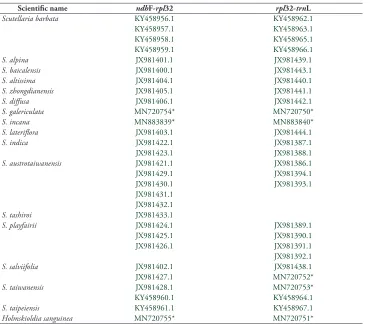
Table 1. Sequences and accession number of sequences applied in this study. Sequences generated for this study are marked *. Other sequences were sourced from Genbank.
Scientific name ndhF-rpl32 rpl32-trnL
Scutellaria barbata KY458956.1 KY458962.1
KY458957.1 KY458963.1
KY458958.1 KY458965.1
KY458959.1 KY458966.1
S. alpina JX981401.1 JX981439.1
S. baicalensis JX981400.1 JX981443.1
S. altissima JX981404.1 JX981440.1
S. zhongdianensis JX981405.1 JX981441.1
S. diffusa JX981406.1 JX981442.1
S. galericulata MN720754* MN720750*
S. incana MN883839* MN883840*
S. lateriflora JX981403.1 JX981444.1
S. indica JX981422.1 JX981387.1
JX981423.1 JX981388.1
S. austrotaiwanensis JX981421.1 JX981386.1
JX981429.1 JX981394.1
JX981430.1 JX981393.1
JX981431.1 JX981432.1
S. tashiroi JX981433.1
S. playfairii JX981424.1 JX981389.1
JX981425.1 JX981390.1
JX981426.1 JX981391.1
JX981392.1
S. salviifolia JX981402.1 JX981438.1
JX981427.1 MN720752*
S. taiwanensis JX981428.1 MN720753*
KY458960.1 KY458964.1
S. taipeiensis KY458961.1 KY458967.1
Holmskioldia sanguinea MN720755* MN720751*
results of model selection. The tree topology search operation was set as the best of NNI and SPR (Guindon et al. 2010). The approximate likelihood ratio test non-parametric branch support was based on a Shimodaira-Hasegawa-like procedure (Guindon et al. 2010). NJ analysis was conducted using MEGA 7, with 1000 bootstrap resamplings. All of the phylogenetic trees were summarised and output by FigTree 1.4.4 (Rambaut 2012).
Results
Diagnostic characters of S. barbata and S. taipeiensis
Leaves
Leaf morphology had been regarded as a diagnostic character for distinguishing S. barbata from S. taipeiensis (Huang et al. 2003). Leaf shape of S. barbata varies from suborbicular to narrowly lanceolate (Fig. 1A–D); in contrast, the leaf shape of S. tai-peiensis varies from ovate to broadly ovate (Fig. 1E, F). The leaves of both species had sparse pubescence on the abaxial surface. The leaves of S. barbata are 1.1−2.8 cm long and 0.9−1.4 cm wide, the length-width-ratio from 1.1 to 2.0, while S. taipeiensis leaves are 1.0−1.7 cm long and 0.5−1.1 cm wide, the length-width-ratio from 1.5 to 2.0. The shapes and sizes of the leaves overlapped between the two species and thus were dif-ficult for use as a diagnostic character to distinguish species.
Inflorescence and flowers
The floral morphology of S. barbata (Fig. 2A, C) was very similar to that of S. taipeien-sis (Fig. 2B, D). They both had terminal inflorescences and bilabiate flowers that were only slightly curved near base (Fig. 3), while other species of Taiwan have geniculate (e.g. S. austrotaiwanensis, S. indica etc.) or a strongly curved corolla (e.g. S. tashiroi). The corolla was bluish-purple, 0.8−1.3 cm long and pubescent on the outer surface.
Nutlets
According to the observations of Hsiung et al. (2017), the sculpture of S. barbata and S. taipeiensis are rounded concentric type and no other difference is found between them.
Table 2. Summary of the sequence information of two plastid region applied in phylogenetic analysis.
ndhF-rpl32 rpl32-trnL
Aligned length (bp) 536 546
No. of variable characters 195 120
No. of parsimony-informative characters 117 58
Figure 2. Flower morphology of S. barbata (A, C)(Chao 4762) and S. taipeiensis (B, D)(Chao 4838).
A, B lateral view C, D front view.
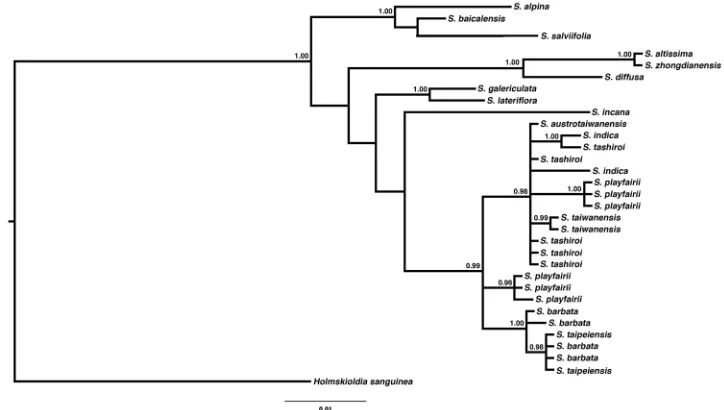
Figure 4. Phylogenetic tree reconstructed by Bayesian inference from chloroplast DNA sequence ndhF-rpl32. Only posterior probability > 0.85 was labelled on the branch. Scale bar represent substitutions.
Molecular phylogeny
The best substitution model for both fragments, ndhF-rpl32 and rpl32-trnL, was HKY+G. The phylogenetic trees, reconstructed by ML, NJ and BI, revealed similar topologies with slight differences in the arrangement of non Taiwanese species (Figs 4, 5; Suppl. materials 1−4). In all analyses, all Taiwanese species formed a clade with moderate to high support (PP = 0.99, bootstrap = 0.65–0.91). Amongst them, S. barbata and S. taipeiensis formed a highly supported monophyletic group (PP = 1.0, bootstrap = 0.87–0.95), but neither S. barbata nor S. taipeiensis formed a single clade. Instead, S. taipeiensis was nested with S. barbata in the phylogenetic tree, i.e. neither species being monophyletic as currently delimited.
Distribution and habitat
Scutellaria barbata grows throughout low altitudes, ca. 50–500 m, in Taiwan, but low-er in southlow-ern parts. Scutellaria taipeiensis is found in Taipei City and New Taipei City. The two species were growing in similar habitats, such as grassland, roadside, riverbank or forest margin and often with high humidity. Some references regarded S. barbata as an aquatic plant in a broad sense (Chen 1990) due to its wetland habitat. This could also be true for S. taipeiensis, according to the field investigation. No apparent differ-entiation was observed in the distribution and habitat types between these two species.
Discussion
The taxonomic status of S. taipeiensis
Scutellaria taipeiensis was first described by Huang et al. (2003), based on the morphol-ogy of the leaves and the nutlets. According to the original description, the leaves of S. taipeiensis were triangular-ovate to broadly ovate and less than twice as long as the width. To confirm the similarity of the leaves, we collected and compared leaf morphol-ogy of the two species amongst several populations. The results showed that the varia-tion within S. barbata was larger than the difference between S. barbata and S. taipeien-sis. Additionally, the length-width-ratio of leaves is the same in both species. Therefore, leaf morphology could not be regarded as a diagnostic character for these two species.
We further looked at other characters to separate them, such as floral morphol-ogy and DNA sequence data. Different sequence data revealed some phylogenet-ic incongruence amongst lineages S. alpina, S. altissima, S. bicalensis, S. diffusa, S. galericulata, S. salviifolia and S. zhongdianensis. Such incongruence may be due to uneven sampling, but the relationship of these species was not a concern in this study. Therefore, we will not discuss the evolutionary relationship between this group of species here. All Taiwanese species formed a highly supported clade in all trees. Scutellaria barbata and S. taipeiensis, which had very similar inflorescences and floral morphology, are phylogenetically nested within a monophyletic clade. Based on this evidence, S. taipeiensis was treated as a synonym of S. barbata, rather than a distinct species or on an intraspecific level.
Taxonomic treatment
According to the results and discussions, we established the following taxonomy:
Scutellaria barbata D. Don in Prodromus Florae Nepalensis 109–110. 1825.
S. taipeiensis T. C. Huang, A. Hsiao & M. J. Wu in Taiwania 48:133. Type: Taiwan. Taipei City, growing on exposed rocks or soils adjacent rocks along sunny roadside between Maukong to Chihnan Temple T. C. Huang and A. Hsiao 18104 (Holo-type: TAI!, Iso(Holo-type: TAI!) syn. nov.
Distribution. Scutellaria barbata is widely distributed in southern and eastern Asia (Li
and Hedge 1994). In Taiwan, this species is found in low altitude from 50 to 500 m, in wet grasslands, riverside and margins of forest.
Specimens examined. Specimens marked with an asterisk (*) denote material S.
taipeiensis following.the concept of Huang et al. (2003) on the labels.
Taiwan. Changhua County: Lukang, at road mileage sign 35 km along
Pro-vincial Highway 17, 18 Apr 1999, K. F. Chung 1147 (HAST). Hsinchu County:
Hengshan, Peiwuo, 245 m a.s.l., 28 Apr 1994, C. M. Wang 763 (HAST). Hualien
County: *Fengping Township, a public cemetery, 0−50 m a.s.l., 1 May 2015, S. W.
Mar 2019, C. T. Chao 4789 (TAIF); Ilan, 100 m a.s.l., 22 Mar 1987, S. Y. Lu 21257 (TAIF); Panomakutao, 350 m a.s.l., 2 Apr 2005, W. F. Ho 1735 (TAIF); Shuanglien Pond, 250−300 m a.s.l., 10 Apr 2009, W. Y. Wang 153 (TAIF); Dongshan river, 50 m a.s.l., 13 Feb 2012, S. W. Chung 10589 (TAIF); Shan-shin, 7 Apr 1982, M. T. Kao 9656 (TAI). Kaohsiung City: Lienhuachih, 30 Aug 1991, L. Y. Tseng 509 (TAIF). Keelung City: *Tienwaitien Landfill Site, 150 m a.s.l., 25 Apr 2014, P. F. Lu 26638 (TAIF); Patu, 9 Jul 2008, M. J. Jung 3055 (TAIF). Miaoli County: Mi-aoli, 17 Apr 1970, T. C. Chuang 5277 (TAI). Nantou County: Chungyuan neigh-bourhood, 24 Jan 1988, S. M. Li 76 (TAIF). New Taipei City: *Mt. Erhke, 8 May 2011, M. J. Jung 5453 (TAIF); *Mt. Chungling, 400−600 m a.s.l., 10 Jan 2015, P. F. Lu 27688 (TAIF); Hsiaokotou-Kankou, 27 Dec 1968, C. C. Hsu 5213 (TAI); Wazihwei, 0−20 m a.s.l., 16 Apr 2004, S. C. Liu 1711 (TAIF); Sanchakang Village, 100 m, 4 Oct 2008, P. F. Lu 16991 (TAIF); Fujen Catholic University, 22 Dec a.s.l. 2002, C. L. Hu s.n. (TAIF); Santiaoling, 60 m a.s.l., 20 Apr 2012, S. W. Chung 10815 (TAIF); Menghu Rd., 26 Mar 2012, C. F. Chen 3306 (TAIF); Sanhsia, 5 Apr 1994, T. H. Hsieh 1194 (TAI); Hsiaokengkou, 50−100 m a.s.l., 19 May 2000, H. Y. Chen 1398 (TAIF); Shihting to Huangtitien, 1 Jun 2003, T. C., L. C. & R. P. Huang 18105 (TAI); Sshlioufennz, 300−370 m a.s.l., 4 Apr 1985, C. I Peng 7551 (HAST); Hsinshang-Menghu, 350−400 m a.s.l., 16 May 1993, C. C. Wang 1363 (HAST); Hsichou Street, 26 Feb 2019, C. T. Chao 4762 (TAIF); Gueishan rd., 15 Mar 2019, C. T. Chao 4768 (TAIF); Hsiunghustien to Peihsinchuang, 100 m a.s.l., 23 Mar 2001, S. M. Kuo 216 (TAIF); Shuangshi, 100 m a.s.l., 12 Jul 2003, P. F. Lu 5134, 6255 (TAIF); Yunhsien garden, 700−800 m a.s.l., 29 Mar 2000, Y. P. Cheng 2911 (TAIF); Gungliau, Waiwenshiouk, 50 m a.s.l., 9 Apr 2000, H. M. Chang 3110 (TAIF); HuangTiTien, 150−250 m a.s.l., 16 Apr 2011, P. F. Lu 21794 (HAST); Ta-li, 20 Apr 1962, C. C. Chuang 2171 (HAST); Chuwei, 26 Feb 1989, T. Y. Yang & C. C. Wang 4474 (TAI); Shihting, 20 Apr 1991, M. J. Wu 1303 (TAI); Yinhoton, 28 Aug 1970, M. T. Kao 7621 (TAI); Pinlin, 1 Apr 1977, C. M. Kuo 8119 (TAI).
Taichung City: Pingting, 18 Jul 1968, C. C. Hsu 9128 (TAI); Fengyuan, along a
steep trail between Panchang and Fengyuan Golf Club, 250−400 m a.s.l., 20 Dec 1985, C. I Peng 12165 (HAST); Ta-chia, 28 Apr 1982, M. T. Kao 9677 (TAI).
Taipei City: *Huajiang Wild Duck Nature Park, 12 Apr 2010, M. J. Jung 4918;
Acknowledgements
We are grateful to Dr. Tsung-Hsin Hsieh for useful suggestions and reviewing the manuscript, Dr. Yao-Moan Huang for technological assistance of SEM photography and Dr. Gary Bentley, an editor with Peerwith, for his scientific editing of the manu-script. We thank the curator and staff of the herbarium of National Taiwan University (TAI) and Taiwan Forestry Research Institute (TAIF) and Dr. Kuo-Fang Chung and Ms. Tsui-Ya Liu of the herbarium of Biodiversity Research Center, Academia Sinica (HAST) for their assistance with specimen examination. This study was supported by the project grants no. MOST-108-2628-B-003-001- to Pei-Chun Liao and no. MOST-107-2811-B-003-501 to Chien-Ti Chao.
References
Bendiksby M, Thorbek L, Scheen AC, Lindqvist C, Ryding O (2011) An updated phylogeny and classification of Lamiaceae subfamily Lamioideae. Taxon 60(2): 471–484. https://doi. org/10.1002/tax.602015
Chen SH (1990) Illustrations of aquatic and wetland plants of eastern Taiwan. Taiwan Provin-cial Hualien Teachers College, 1−214.
Chiang YC, Huang BH, Liao PC (2012) Diversification, biogeographic pattern, and demo-graphic history of Taiwanese Scutellaria species inferred from nuclear and chloroplast DNA. PLoS One 7(11): e50844. https://doi.org/10.1371/journal.pone.0050844
Guindon S, Dufayard JF, Lefort V, Anisimova M, Hordijk W, Gascuel O (2010) New algorithms and methods to estimate maximum-likelihood phylogenies: Assessing the performance of PhyML 3.0. Systematic Biology 59(3): 307–321. https://doi.org/10.1093/sysbio/syq010 Harley RM, Atkins S, Budantsev AL, Cantino PD, Conn BJ, Grayer R, Harley MM, de Kok R,
Krestovskaja T, Morales R, Paton AJ, Ryding O, Upson T (2004) Labiatae. In: Kadereit JW (Ed.) The Families and Genera of Flowering Plants vol. VII. Flowering Plants. Dicotyle-dons: Lamiales (except Acanthaceae including Avicenniaceae). Springer-Verlag, Berlin and Heidelberg, 167−275. https://doi.org/10.1007/978-3-642-18617-2_11
Hsieh TH (2013) Scutellaria hsiehii (Lamiaceae), a new species from Taiwan. Taiwania 58(4): 242–245.
Hsieh TH, Huang TC (1995) Notes on the Flora of Taiwan (20) – Scutellaria (Lamiaceae) in Taiwan. Taiwania 40(1): 35–56.
Hsieh TH, Huang TC (1997) Notes on the Flora of Taiwan (29) – Scutellaria austrotaiwanensis Hsieh & Huang, sp. nov. (Lamiaceae) from Taiwan. Taiwania 42(2): 109–116.
Hsiung HY, Huang BH, Chang JT, Huang YM, Huang CW, Liao PC (2017) Local climate heterogeneity shapes population genetic structure of two undifferentiated insular Scutel-laria species. Frontiers of Plant Science 8: 159. https://doi.org/10.3389/fpls.2017.00159 Huang TC, Hsieh TH, Cheng WT (1998) Labiatae in Editorial Committee of Flora of Taiwan
(Eds) Flora of Taiwan, Vol. 4 (2nd edn). Editorial Committee of Flora of Taiwan,
Huang TC, Hsiao A, Wu MJ (2003) Notes on the Flora of Taiwan (35) – Scutellaria taipeiensis T. C. Huang, A. Hsiao et M. J. Wu sp. nov. (Lamiaceae). Taiwania 48(2): 129–137. Kumar S, Stecher G, Tamura K (2016) MEGA 7: Molecular evolutionary genetics analysis
ver-sion 7.0 for bigger datasets. Molecular Biology and Evolution 33(7): 1870–1874. https:// doi.org/10.1093/molbev/msw054
Li XW, Hedge IC (1994) Lamiaceae. In: Wu ZY, Raven PH (Eds) Flora of China vol. 17. Mis-souri Botanical Garden Press and Science Press, St. Louis and Beijing, 50–299.
Paton A (1990) A global taxonomic investigation of Scutellaria (Labiatae). Kew Bulletin 45(3): 399−450. https://doi.org/10.2307/4110512
Rambaut A (2012) FigTree v. 1.4.0. University of Oxford, Oxford, UK. http://tree.bio.ed.ac. uk/software/figtree/
Ronquist F, Teslenko M, van der Mark P, Ayres DL, Darling A, Höhna S, Larget B, Liu L, Suchard MA, Huelsenbeck JP (2012) MRBAYES 3.2: Efficient Bayesian phylogenetic in-ference and model selection across a large model space. Systematic Biology 61(3): 539– 542. https://doi.org/10.1093/sysbio/sys029
Thiers B (2019, Continuously updated) Index Herbariorum: A global Directory of Public Her-baria and Associated Staff. New York Botanical Garden. http://bluegum.nybg.org/science/ index.php
Supplementary material 1
Phylogenetic tree reconstructed by maximum likelihood analysis from
chloro-plast DNA sequence ndhF-rpl32. Only SH-like support value > 0.85 was labelled
on the branches. Scale bar represent substitution
Authors: Chien-Ti Chao, Bing-Hong Huang, Jui-Tse Chang, Pei-Chun Liao Data type: molecular data.
Copyright notice: This dataset is made available under the Open Database License (http://opendatacommons.org/licenses/odbl/1.0/). The Open Database License (ODbL) is a license agreement intended to allow users to freely share, modify, and use this Dataset while maintaining this same freedom for others, provided that the original source and author(s) are credited.
Supplementary material 2
Phylogenetic tree reconstructed by maximum likelihood analysis from
chloro-plast DNA sequence rpl32-trnL. Only SH-like support value > 0.85 was labelled
on the branches. Scale bar represent substitution
Authors: Chien-Ti Chao, Bing-Hong Huang, Jui-Tse Chang, Pei-Chun Liao Data type: molecular data.
Copyright notice: This dataset is made available under the Open Database License (http://opendatacommons.org/licenses/odbl/1.0/). The Open Database License (ODbL) is a license agreement intended to allow users to freely share, modify, and use this Dataset while maintaining this same freedom for others, provided that the original source and author(s) are credited.
Link: https://doi.org/10.3897/phytokeys.140.48578.suppl2
Supplementary material 3
Phylogenetic tree reconstructed by neighbour-joining analysis from chloroplast
DNA sequence ndhF-rpl32. Only bootstrap support value > 0.85 was labelled on
the branches
Authors: Chien-Ti Chao, Bing-Hong Huang, Jui-Tse Chang, Pei-Chun Liao Data type: molecular data.
Copyright notice: This dataset is made available under the Open Database License (http://opendatacommons.org/licenses/odbl/1.0/). The Open Database License (ODbL) is a license agreement intended to allow users to freely share, modify, and use this Dataset while maintaining this same freedom for others, provided that the original source and author(s) are credited.
Link: https://doi.org/10.3897/phytokeys.140.48578.suppl3
Supplementary material 4
Phylogenetic tree reconstructed by neighbour-joining analysis from chloroplast
DNA sequence rpl32-trnL. Only bootstrap support value > 0.85 was labelled on
the branches
Authors: Chien-Ti Chao, Bing-Hong Huang, Jui-Tse Chang, Pei-Chun Liao Data type: molecular data.
Copyright notice: This dataset is made available under the Open Database License (http://opendatacommons.org/licenses/odbl/1.0/). The Open Database License (ODbL) is a license agreement intended to allow users to freely share, modify, and use this Dataset while maintaining this same freedom for others, provided that the original source and author(s) are credited.