A remarkable new species of
Pamianthe
(Amaryllidaceae) from the Department of Cauca,
Colombia
Alan W. Meerow1, Philip A. Silverstone-Sopkin2, Alejandro Zuluaga-Tróchez2,
Jhon A. Sánchez-Taborda3
1 USDA-ARS-SHRS, National Germplasm Repository, 13601 Old Cutler Road, Miami, Florida 33158, USA
2 Departamento de Biología, Universidad del Valle, Calle 13 # 100-00, Cali, Valle, Colombia 3 Fundación Ecohábitats, Calle 78N # 19-157, Popayán, Cauca, Colombia
Corresponding author:Alan W. Meerow ([email protected])
Academic editor:L. Peruzzi | Received 22 October 2018 | Accepted 4 December 2018 | Published 17 January 2019
Citation: Meerow AW, Silverstone-Sopkin PA, Zuluaga-Tróchez A, Sánchez-Taborda JA (2019) A remarkable new species of Pamianthe (Amaryllidaceae) from the Department of Cauca, Colombia. PhytoKeys 115: 73–82. https://doi. org/10.3897/phytokeys.115.30755
Abstract
A new saxicolous species of Amaryllidaceae tentatively assigned to the tribe Clinantheae, Pamianthe ecollis Silverst., Meerow & Sánchez-Taborda, is described from the western slope of the Cordillera Occidental in the department of Cauca, Colombia. The new species differs from the two hitherto known species of Pamianthe in its yellow flowers and in its nearly obsolete perianth tube. The near loss of the perianth tube may be correlated with a change in pollinator. The new species lacks a bulb; it produces a large number of winged seeds that are wind-dispersed. A key to the species of Pamianthe is provided. This is the first record of the genus Pamianthe for Colombia. The phylogenetic position of the genus Pamianthe is discussed.
Keywords
Amaryllidaceae, biodiversity, Cauca, Clinantheae, Colombia, Pamianthe, Andes
Resumen
Se describe una nueva especie de Amaryllidaceae tentativamente perteneciente a la tribu Clinantheae, Pamianthe ecollis Silverst., Meerow & Sánchez-Taborda, procedente de la vertiente occidental de la cor-dillera Occidental en el departamento del Cauca, Colombia. La nueva especie difiere de las dos especies conocidas de Pamianthe por su perianto amarillo que tiene un tubo casi ausente. La reducción del tubo del http://phytokeys.pensoft.net
Copyright Alan W. Meerow et al. This is an open access article distributed under the terms of the Creative Commons Attribution License (CC BY 4.0), which permits unrestricted use, distribution, and reproduction in any medium, provided the original author and source are credited.
perianto probablemente tiene correlación con un cambio en el polinizador. La nueva especie carece de un bulbo, y produce numerosas semillas aladas que se dispersan por el viento. Se provee una clave a las espe-cies de Pamianthe. Este es el primer registro del género Pamianthe para Colombia. Se discute la posición filogenética del género Pamianthe.
Introduction
Amaryllidaceae J. St.-Hil. is a cosmopolitan family represented in Colombia by nine native genera and 26 native species, including a monotypic endemic genus, Plagiolirion
Baker (Meerow and Silverstone-Sopkin 1995). Some of the Colombian species have restricted ranges and are in danger of extinction or may already be extinct (Silverstone-Sopkin 2011). Recent field work in the Cordillera Occidental of the Andes, in the de-partment of Cauca, has resulted in the discovery of a new species of Amaryllidaceae that also seems to be narrowly distributed. Vegetative and floral morphology and nrDNA ITS sequences indicate that this species represents a novelty in the genus Pamianthe Stapf.
Stapf (1933a, 1933b) published the genus Pamianthe in honor of Major Albert Pam, who cultivated bulbs in England that he received from Peru in 1928. There are five published species names that have been assigned to this genus: P. andreana (Baker) Stapf, P. cardenasii Traub, P. parviflora Meerow, P. peruviana Stapf, and P. quitoensis
(Herb.) Stapf. Pamianthe quitoensis was transferred to the genus Leptochiton Sealy, as
L. quitoensis (Herb.) Sealy, and P. andreana is considered a synonym of this species.
Pamianthe cardenasii has been placed in the synonymy of P. peruviana (Meerow 1984).
Thus, the genus Pamianthe, as previously recognized, includes only two species, P.
parviflora, known only from Ecuador (Meerow 1984), and P. peruviana (the type
spe-cies), known from Perú and Bolivia. The new species described in this paper is the third species of the genus and the first record from Colombia. It is also the first species of the tribe Clinantheae, to which Pamianthe has been assigned (Meerow et al. 2000; Leiva and Meerow 2016), discovered north of Ecuador.
Methods
Photographs of the flower in alcohol and seeds of Pamianthe ecollis were taken with a Nikon model DS-Ri1U3 digital camera, using a Nikon model SMZ-1500 stereo dis-secting microscope at the Laboratorio de Imágenes del Postgrado en Ciencias-Biología de la Universidad del Valle; floral and seed measurements were made with NIS Ele-ments Br, version 4.20 software.
Results
Taxonomic treatment
Pamianthe ecollis Silverst., Meerow & Sánchez-Taborda, sp. nov. urn:lsid:ipni.org:names:77193890-1
Figs 1, 2
Diagnosis. This species differs from both Pamianthe parviflora Meerow and P.
peru-viana Stapf in having a yellow perianth and staminal cup (versus white) and in nearly
lacking a perianth tube. Additionally, it differs from P. parviflora in having shorter pedicels, a longer ovary, and more numerous ovules, and from P. peruviana in having much longer pedicels, more flowers per umbel, much shorter tepals, a shorter staminal cup that is not exserted from the perianth, and a smaller fruit.
Type. COLOMBIA. Cauca: Municipio Argelia, road between Nuevo Horizonte and La Montaña, north of the Serranía El Pinche, Cordillera Occidental, western slope (Fig. 3), 2839 m, 4 Feb 2018, J. A. Sánchez-Taborda 2870 (holotype: CUVC 67719!, 67720!, mounted on two sheets; isotype: CAUP). GPS coordinates are withheld to discourage poaching; they are available to bonafide researchers upon request.
Figure 1. Pamianthe ecollis. A Pamianthe ecollis growing in its native habitat, on a steep, rocky bank B Base of plant C Habit D Inflorescence E Flower, lateral view F Flower, front view A photo by Fredy Gómez-Ortiz
B photo by Laura Clavijo C–F type collection, photographs taken in the field by Jhon A. Sánchez-Taborda.
Distribution and ecology.Pamianthe ecollis is known only from the type locality (Fig. 3). The general habitat is cloud forest. The forest at this site includes the follow-ing genera: trees: Clusia L., Hedyosmum Sw., Ocotea Aubl.; shrubs: Miconia Ruiz & Pav., Palicourea Aubl.; herbs: Anthurium Schott, Besleria L., Kohleria Regel, Peperomia
Figure 2. Pamianthe ecollis. A Androecium, with staminal cup B Tip of outer tepal, showing apex and adaxial protuberance C Adaxial protuberance, showing glandular papillae D Opened ovary with ovules (ovules in two locules are visible) E Infructescence of living plant F Seeds, showing variation in shape
Ruiz & Pav., and Sphaeradenia Harling. Epiphytes were predominantly bromeliads and orchids. The new species is common at this site (Fredy Gómez-Ortiz pers. com.). However, this species does not grow within closed forest. The seeds of P. ecollis, which are adapted for anemochory, and a photograph of the population at the type locality (Fig. 1A), indicate that this species inhabits open areas on steep banks near creeks. Plants from the type collection were growing near a waterfall. Plants from a later col-lection, from which herbarium specimens were not prepared, were growing on an apparently disturbed, open slope on rocky substrate. The roots of the plants are super-ficial, immersed in a thick layer of moss, and grasp the surface of the rock. Thus, this species is a lithophyte.
Phenology. Plants were collected in flower in February and in fruit in August. Etymology. The specific epithet is from Latin, e (without), collum (neck), adjecti-val form collis, referring to the almost absent perianth tube of this species.
Preliminary conservation status. Since nothing is known of the distribution of this species apart from the type locality, it is best to place it in the category Data Defi-cient (IUCN 2012, 2017).
Discussion
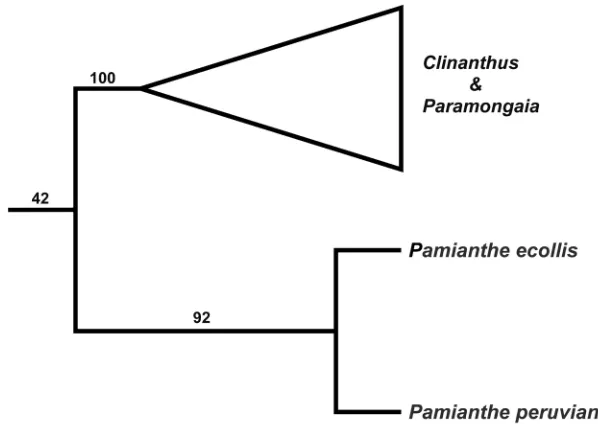
A strict consensus tree cladogram (Fig. 4) based on ITS sequences of the tribe Cli-nantheae places the new species of Pamianthe as sister to P. peruviana with 92% jack-knife support, in a subclade that is sister to a second subclade comprising Clinanthus
Herb. and Paramongaia Velarde. However, with ITS there is no support for Pamianthe
as part of Clinantheae (jackknife support = 42%; Fig. 4). Preliminary super matrix trees from sequence capture with anchored bait enrichment (Meerow, unpublished data) suggest that Pamianthe is in fact sister to the tribes Clinantheae, Eucharideae, and Hymenocallideae, rather than the first branch in Clinantheae.
Pamianthe ecollis resembles the two other species of Pamianthe in its staminal cup
morphology, with the free portion of the staminal filaments attached to the rim of the cup (not below the rim), two lobes or teeth between each two staminal filaments, and the staminal filaments strongly curved inward, as well as numerous, biseriate, winged, wind-dispersed seeds. Leaf width and the conspicuous midvein are similar to that of
P. peruviana. It differs from both of the two hitherto known species in having a
yel-low perianth and staminal cup (versus white in the other two species) and in its nearly obsolete perianth tube. Moreover, P. parviflora has a shorter ovary (10 mm versus 40 mm in P. ecollis) and fewer ovules per locule (about 20 versus about 100 in P. ecollis).
Pamianthe peruviana additionally differs in having fewer flowers (2–4, usually 2, versus
9–10 in P. ecollis), shorter pedicels (1.5–3 cm long versus 7–9 cm long in P. ecollis), free tepals much longer (outer tepals 10–12 cm long, inner tepals 9–11 cm long, versus 3.2 and 2.8 cm long in P. ecollis), staminal cup 8 cm long and long-exserted (versus ca. 0.5 cm long and included in P. ecollis), and larger fruit (8 cm long, 5 cm wide, versus 3.8 cm long, 2.9 cm wide in P. ecollis).
The elongate (12–25 cm long) perianth tube in P. peruviana, which contains three nectar-bearing internal channels (Traub 1972), may be correlated with pollination by sphingid moths. The nearly obsolete perianth tube of P. ecollis may be associated with a change in pollinators; in a tubeless perianth, nectar would be available to short-tongued insects, such as bees. No flower visitors have been observed.
The glandular papillae (Fig. 2C) on the adaxial protuberance of the outer tepals apparently have a secretory function. They probably play a role in pollinator attrac-tion; they may produce a substance that is gathered by insect visitors, or they may function as osmophores. Possible osmophores have been reported in the Chilean al-lioid amaryllid Gilliesia Lindl. (Rudall et al. 2002). The flat, alate seeds are most likely wind-dispersed, suggesting that these plants inhabit open areas within the cloud forest vegetation; seeds of Amaryllidaceae of closed lowland tropical forest, such as Eucharis
Planch. & Lind., are relatively few per locule, subglobose, and wingless, and probably are bird-dispersed, and in one case possibly water-dispersed (Silverstone-Sopkin 2011).
Figure 4. Strict branch and bound parsimony consensus tree of the Clinantheae, based on ITS sequences, with jackknife support values.
rose to their present position, and moist forests contracted on the western slopes. We are confident that rigorous analysis of our next generation sequence data will success-fully resolve the current ambiguous phylogenetic position of the genus.
Key to the species of the genus Pamianthe
1 Perianth and staminal cup yellow, perianth tube nearly obsolete ... ...Pamianthe ecollis Silverst., Meerow & Sánchez-Taborda – Perianth and staminal cup white, perianth with a well-developed tube ...2 2 Pedicels 5–6 cm long; perianth tube less than 2 cm long; outer tepals less than
3 cm long; staminal cup less than 2 cm long ....Pamianthe parviflora Meerow – Pedicels 1.5–3 cm long; perianth tube more than 11 cm long; outer tepals
more than 8 cm long; staminal cup more than 7 cm long ... ...Pamianthe peruviana Stapf
Acknowledgments
Laboratorio de Imágenes del Postgrado en Ciencias-Biología de la Universidad del Valle (Cali, Colombia) for permission to photograph the flower and seeds of the new species; photographs in this lab were taken by Juan Felipe Ortega-Giraldo. Martín Llano-Almario arranged Figures 1 and 2. Fredy Gómez-Ortiz collected a plant in fruit at the type locality. Laura Clavijo photographed the fruiting plant. Thanks to Liliana Paz y Luis Alfonso Ortega from the Fundación Ecohabitats for their work in designing and managing the project that allowed the collection of this new species, and to Asociación Agroambiental Santa Clara-El Pinche for their support during the field work.
References
IUCN (2012) IUCN Red List categories and criteria: Version 3.1, ed. 2. IUCN Species Sur-vival Commission, Gland, Switzerland and Cambridge, UK.
IUCN (2017) Guidelines for using the IUCN red list categories and criteria. Version 13. Pre-pared by the Standards and Petitions Subcommittee. https://www.iucnredlist.org/resourc-es/redlistguidelines [Accessed 3 December 2018]
Katoh K, Standley DM (2013) MAFFT multiple sequence alignment software version 7: Im-provements in performance and usability. Molecular Biology and Evolution 30(4): 772– 780. https://doi.org/10.1093/molbev/mst010
Leiva S, Meerow AW (2016) A new species of Clinanthus from northern Peru (Asparagales, Amaryllidaceae, Amarylloideae, Clinantheae). PhytoKeys 63: 99–106. https://doi. org/10.3897/phytokeys.63.8895
Meerow AW (1984) Two new species of pancratioid Amaryllidaceae from Peru and Ecuador. Brittonia 36(1): 18–25. https://doi.org/10.2307/2806286
Meerow AW (2010) Convergence or reticulation? Mosaic evolution in the canalized American Amaryllidaceae. In: Seberg O, Petersen G, Barfod AS, Davis JI (Eds) Diversity, Phylogeny and Evolution in the Monocotyledons, Aarhus University Press, Aarhus, 145–168. Meerow AW, Silverstone-Sopkin PA (1995) The rediscovery of Plagiolirion horsmannii Baker
(Amaryllidaceae). Brittonia 4(4): 426–431. https://doi.org/10.2307/2807573
Meerow AW, Guy CL, Li Q-B, Yang S-L (2000) Phylogeny of the American Amaryllidace-ae based on nrDNA ITS sequences. Systematic Botany 25(4): 708–726. https://doi. org/10.2307/2666729
Meerow AW, Francisco-Ortega J, Kuhn DN, Schnell RJ (2006) Phylogenetic relationships and biogeography within the Eurasian clade of Amaryllidaceae based on plastid ndhF and nrD-NA ITS sequences: Lineage sorting in a reticulate area? Systematic Botany 31(1): 42–60. https://doi.org/10.1600/036364406775971787
Silverstone-Sopkin PA (2011) Los muertos vivientes, la historia natural de cuatro lirios amazónicos del suroccidente de Colombia (Eucharis y Plagiolirion, Amaryllidaceae). Pro-grama Editorial, Universidad del Valle, Cali, Colombia, 98 pp.
Stapf O (1933a) Pamianthe peruviana. The Gardeners´ Chronicle and Agricultural Gazette ser. 3(93): 106.
Stapf O (1933b) Pamianthe peruviana. Curtis´s Botanical Magazine 156, tab. 9315: 1–4. Swofford DL (2002) PAUP* Phylogenetic analysis using parsimony (*and other methods), v.