PhD Dissertation
International Doctorate School in Information and
Communication Technologies
DIT - University of Trento
A
LARGE SCALE DISTRIBUTED KNOWLEDGE ORGANIZATION SYSTEM
S
HEAK
R
ASHED
H
AIDER
N
OORI
April 2011
Advisor:
Prof. Fausto Giunchiglia
Abstract
The revolution of Internet and the Web takes the computer and information technology into a new age. The information on the web is growing very fast. The progress of information and communication tech-nologies has made accessible a large amount of information, which have provided each of us with access to far more information than we can comprehend or manage. This emphasizes the difficulty with the re-sulting semantic heterogeneity of the diverse sources. Human knowledge is a living organism and as such evolves in time where different people having different viewpoints and using different terminology among people of different cultures and languages, intensify the heterogeneity of the sources even more. These introduce some concrete problems like natural language disambiguation, information retrieval and in-formation integration. Nevertheless, the problem is quite well known in almost every branch of knowledge and has been independently approached by several communities for several decades. To make this huge amount of existing information accessible and manageable while also solving the semantic heterogeneity problem, namely the problem of diversity in knowledge, and therefore support interoperability, it is essen-tial to have a large scale high quality collaborative knowledge base along with a suitable structure as a common ground on which interoperability among people and different systems should be possible. It will play the role of a reference point for communication, assigning clear meaning by accurate disambigua-tion to exchanged informadisambigua-tion, communicadisambigua-tion and automating complex tasks. However, successfully building large scale knowledge bases with maximum coverage is not possible by a single person or a small group of people without collaborative support. It extremely depends on expert community based support. Therefore, it is necessary for experts to work together on knowledge base building. Further-more, it is very natural that these expert users will be geographically distributed. Web 2.0 has the poten-tial to support information sharing, interoperability and collaboration on the Web. Simplicity, flexibility and easy to use services make it an interactive and collaborative platform which allows them to create or edit their content. The exponential expansion of the Web users and the potentials of Web 2.0 make it the natural platform of choice for developing knowledge bases collaboratively. We propose a highly flexible knowledge base system, which takes into account diversity of knowledge and its evolution in time. The work presented in this thesis is part of a larger project.
More specifically the goal of this thesis is to
create a powerful and easy to use knowledge base management system to help people in building, orga-nizing a high quality knowledge base and making accessible their knowledge and to support interopera-bility in real world scenarios.Keywords
Contributions
The material presented in the thesis has been developed in collaboration with Fausto
Giunchig-lia, Ilya Zaihrayeu, Uladzimir Kharkevich, Vincenzo Maltese, Tabin Hasan , Biswanath Dutta.
This dissertation makes the following contributions:
A survey of state of the art knowledge representation and visualization techniques;
Provides an overview of different components of a large scale knowledge organization
system.
Design and development of a tool for the linguistic and ontology knowledge
manage-ment, search and navigation.
Design and development of a tool for the domain knowledge management, search and
navigation.
Design and development of a tool for the entity type management, search and navigation.
User based evaluation of the developed system.
A survey of state of the art p2p information retrieval approaches
A prototype implementation of p2p semantic indexing and search
Acknowledgments
This dissertation would not have been possible without the guidance and the help of several
indi-viduals who in one way or another contributed their valuable assistance and supported in many
ways in the preparation and completion of this study.
First and foremost, sincerest gratitude to my scientific advisor, Prof Fausto Giunchiglia,
who has supported me throughout my PhD with his patience, knowledge and encouragement. I
will never forget these supports. Prof Fausto Giunchiglia has been my inspiration as I hurdle all
the obstacles in the completion this research work. Without his support, inspiration, and
encou-ragement it would have been impossible to finish this thesis.
I am thankful to Ilya Zaihrayeu for the lessons and suggestions he has provided me
dur-ing these years.
I am thankful to Vincenzo Maltese for his contribution, collaboration, and continuous
feedback and meaningful discussions in designing the knowledge base systems.
I also wish to thank Uladzimir Kharkevich for his contribution, collaboration, and
mea-ningful discussions in designing the p2p system.
I am also thankful to Tabin Hasan for all the discussions we had about visualization in
designing User Interface.
I am also thankful to Biswanath Dutta for all the discussions we had about conceptual
analysis in building domain knowledge.
I gratefully thank Elena for her constructive comments on this thesis.
I am tempted to individually thank all of my friends but as the list might be long and for
fear I might omit someone, I will simply and genuinely say: Thank you to you all for your love,
care and trust, as well as expressing my apology that I could not mention personally one by one.
In particular I would like to cite: Tabin Hasan, Quazi Delwar Hossain, Juel Rana, Feroz Farazi,
Ju Qi, Francis Palma for their constant presence and care and instant moral support.
Finally, I thank my parents and family for supporting me throughout all my studies, for
love, the tremendous support and inspiration which they gave me in all these years.
Contents
CHAPTER 1 ... 1
1. INTRODUCTION ... 1
1.1.THE CONTEXT ... 1
1.2.THE PROBLEM ... 4
1.3.THE SOLUTION ... 4
1.4.STRUCTURE OF THE THESIS ... 6
CHAPTER 2 ... 8
2. STATE OF THE ART ... 8
2.1.ONTOLOGY TOOLS ... 8
2.1.1 Protégé ... 8
2.1.2 OntoEdit ... 9
2.1.3 OilEd ... 9
2.1.4 WebOnto ... 9
2.1.5 WebODE ... 9
2.1.6 OntoLingua ... 10
2.1.7 OntoSaurus ... 10
2.1.8 TopBraid Composer ... 10
2.1.9 WordNet ... 10
2.2.ONTOLOGY VISUALIZATION ... 11
2.3.CONCLUSION ... 11
CHAPTER 3 ... 13
3. UNIVERSAL KNOWLEDGE BASE ... 13
3.1.UNIVERSAL KNOWLEDGE ORGANIZATION ... 13
3.2.KNOWLEDGE INTEGRATION, EVOLUTION AND MAINTENANCE ... 15
3.3.KNOWLEDGE MANAGEMENT SYSTEM DESCRIPTION ... 17
3.4.UKMANAGEMENT SYSTEM ... 17
3.5.SYSTEM ARCHITECTURE ... 18
3.6.EVALUATING THE PLATFORM IN REAL WORLD SCENARIOS ... 19
CHAPTER 4 ... 20
4. LINGUISTIC AND CONCEPT KNOWLEDGE ... 20
4.1.ORGANIZATION OF THE LINGUISTICS KNOWLEDGE ... 20
4.1.1 Word ... 21
4.1.2 Synset ... 21
4.2.ORGANIZATION OF THE CONCEPTUAL KNOWLEDGE ... 22
4.2.1 Concept ... 22
4.2.2 Concept hierarchy ... 23
4.3.CONCLUSION ... 24
CHAPTER 5 ... 26
5. DOMAIN KNOWLEDGE... 26
5.1.DERA ... 27
5.1.1 Domain ... 27
5.1.2 Entity ... 28
5.1.3 Relation ... 28
5.1.4 Attribute ... 29
5.2.FACET HIERARCHY ... 30
5.3.CONCLUSION ... 31
CHAPTER 6 ... 32
6.1.FUNDAMENTAL BASIS OF ENTITY AND ETYPE ... 32
6.2.PRIMITIVE NOTION OF ENTITY TYPE ... 32
6.3.OVERALL ASPECTS OF ETYPE MODEL ... 32
6.3.1 Data Types ... 32
6.3.2 Domain Restrictions ... 33
6.3.3 Attribute ... 34
6.3.4 Entity Types ... 35
6.3.5 Entity ... 35
6.4.TYPES OF ATTRIBUTES ... 35
6.5.META ATTRIBUTES ... 36
6.5.1 Necessity Properties:... 36
6.5.2 Permanence Properties: ... 36
6.6.ETYPE ATTRIBUTES CATEGORIES ... 36
6.7.ETYPE SYSTEM DESIGN REQUIREMENTS ... 36
6.8.CONCLUSION ... 37
CHAPTER 7 ... 38
7. VISUALIZATION THEORY ... 38
7.1.INFORMATION VISUALIZATION ... 38
7.2.FROM DATA TO INFORMATION VISUALIZATION ... 38
7.2.1 Data ... 38
7.2.2 Information ... 38
7.2.3 Knowledge ... 38
7.2.4 Wisdom ... 39
7.2.5 Information visualization ... 39
7.3.PERCEPTION ... 39
7.3.1 Gestalt Principals ... 39
7.4.MEMORY... 43
7.4.1 Sensory Memory ... 44
7.4.2 Short-Term Memory (STM) ... 44
7.4.3 Long-Term Memory (LTM) ... 45
7.5.AREFERENCE MODEL ... 45
7.5.1 Raw Data ... 45
7.5.2 Data Structure ... 46
7.5.3 Visual Mapping ... 46
7.5.4 Views ... 47
7.6.CONCLUSION ... 48
CHAPTER 8 ... 49
8. LINGUISTIC AND CONCEPT KNOWLEDGE MANAGEMENT CONSOL ... 49
8.1.FUNCTIONAL OVERVIEW AND REQUIREMENT DESCRIPTION ... 49
8.2.SEARCH AND NAVIGATION ... 51
8.3.SEARCH AND NAVIGATION OF WORDS ... 51
8.4.SEARCH AND NAVIGATION OF SYNSETS ... 52
8.5.SEARCH AND NAVIGATION OF CONCEPTS ... 53
8.6.MANAGEMENT FUNCTIONALITIES (CREATE/UPDATE/DELETE) ... 55
8.7.MANAGING WORDS,SYNSETS AND CONCEPTS ... 56
8.7.2 Managing Relations ... 63
8.8.DEALING WITH MULTIPLE LANGUAGES ... 64
8.8.1 General View ... 65
8.8.2 Spotlight View ... 65
8.9.DESIGN PRINCIPLE AND IMPLEMENTATION OF THE CONSOLE ... 66
8.10.DETAILED DESCRIPTION OF THE SEARCH AND NAVIGATION PANELS ... 67
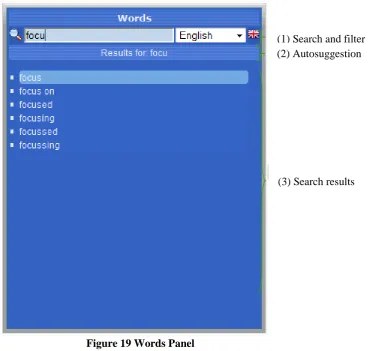
8.10.1 Words panel ... 67
8.10.2 Senses panel ... 68
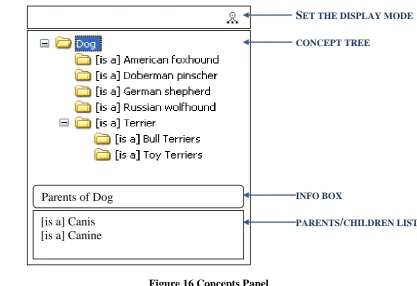
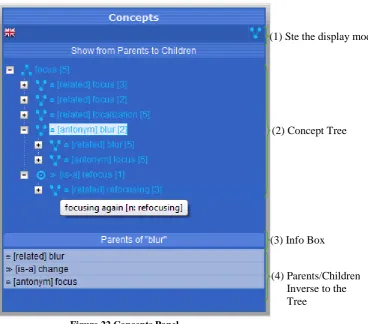
8.10.3 Concepts panel ... 70
8.11.DEALING WITH MULTIPLE LANGUAGES ... 74
8.11.1 General View: ... 74
8.11.2 Spotlight View: ... 74
8.12.1 Manage Word: ... 75
8.12.2 Manage Sense: ... 75
8.12.3 Manage Relation: ... 76
8.13.MANAGING WORDS AND SENSES/SYNSETS ... 76
8.13.1 Create a synset (and corresponding concept) as child of an existing concept ... 76
8.13.2 Create a synset to be associated with a concept with no synset in the language ... 78
8.13.3 Create a synset as a new root concept: ... 78
8.13.4 Update a Synset: ... 78
8.13.5 Delete a Synset ... 80
8.14.MANAGE RANK ... 81
8.14.1 Update Word Rank: ... 81
8.14.2 Update Sense Rank: ... 81
8.15.MANAGING CONCEPTS AND RELATIONS ... 81
8.16.LIST OF ICONS AND THEIR MEANING ... 82
8.17.CONCLUSION ... 82
CHAPTER 9 ... 83
9. DOMAIN MANAGEMENT ... 83
9.1.INTRODUCTION ... 83
9.2.FUNCTIONAL DESCRIPTION OF THE DOMAIN MANAGEMENT SYSTEM ... 83
9.3.SEARCH AND NAVIGATION ... 85
9.3.1 Search and navigation of Domains ... 85
9.3.2 Search and navigation of Facets ... 86
9.3.3 Search and navigation of Facet hierarchy ... 86
9.4.DOMAIN MANAGEMENT FUNCTIONALITIES (CREATE/UPDATE/DELETE) ... 87
9.4.1 Managing Domains, Facets and Facet hierarchy ... 87
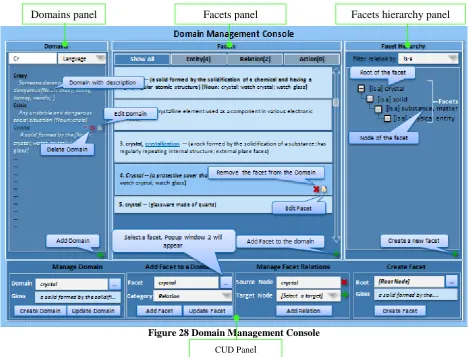
9.5.GENERAL OVERVIEW OF THE CONSOLE... 88
9.6.DETAILED DESCRIPTION OF THE SEARCH AND NAVIGATION PANEL ... 89
9.6.1 Domains Panel ... 89
9.6.2 Facets Panel ... 90
9.6.3 Facets hierarchy Panel ... 92
9.6.4 Pop Up window for concept selection ... 93
9.6.5 Pop Up window for facet selection ... 93
9.7.DETAILED DESCRIPTION OF THE CUDPANEL ... 94
9.7.1 Manage Domain ... 95
9.7.2 Manage Domain facet ... 95
9.7.3 Manage Facet Relation ... 95
9.7.4 Create Facet ... 96
9.8.MANAGING DOMAINS AND FACETS ... 96
9.8.1 Create a Domain ... 96
9.8.2 Update a Domain ... 97
9.8.3 Delete a Domain ... 97
9.8.4 Add a facet to a domain ... 97
9.8.5 Removing a Facet from a Domain ... 98
9.8.6 Updating the category of a facet: ... 98
9.8.7 Create a Facet ... 98
9.8.8 Delete a Facet ... 99
9.8.9 Add a node to a facet hierarchy ... 99
9.8.10 Remove a node from a facet hierarchy ... 100
CHAPTER 10 ... 101
10. ENTITY TYPE MANAGEMENT CONSOL ... 101
10.1.FUNCTIONAL OVERVIEW AND REQUIREMENT DESCRIPTION ... 101
10.2.SEARCH AND NAVIGATION ... 102
10.2.1 Search and navigation of attributes ... 102
10.3.SEARCH AND NAVIGATION OF ETYPES ... 103
10.4.SEARCH AND NAVIGATE ATTRIBUTES OF A ETYPE ... 103
10.5.MANAGEMENT FUNCTIONALITIES (CREATE/UPDATE/DELETE) ... 103
10.6.GENERAL OVERVIEW OF THE CONSOLE... 103
10.6.2 Attribute navigation and management Tab ... 104
10.6.3 Pop Up window for concept selection ... 105
10.6.4 Pop Up window for selecting domain restriction ... 105
10.7.DETAILED DESCRIPTION OF ETYPE NAVIGATION AND MANAGEMENT TAB ... 106
10.7.1 Etypes panel ... 106
10.7.2 Manage Etype panel ... 107
10.7.3 Manage Etype Attribute panel ... 107
10.8.DETAILED DESCRIPTION OF ATTRIBUTE NAVIGATION AND MANAGEMENT TAB ... 108
10.8.1 Attributes search and navigation panel ... 108
10.8.2 Add/Edit Attribute panel ... 110
10.9.MANAGE ATTRIBUTE ... 110
10.9.1 Create an Attribute ... 110
10.9.2 Update an Attribute ... 111
10.9.3 Delete an Attribute ... 111
10.10.MANAGING ETYPES AND THE ATTRIBUTES ASSOCIATED WITH AN ETYPE ... 111
10.10.1 Create an Etype ... 111
10.10.2 Update an Etype ... 112
10.10.3 Delete an Etype ... 112
10.10.4 Add an attribute to an Etype... 113
10.10.5 Update the property of an attribute of an Etype ... 113
10.10.6 Removing an Attribute from an Etype ... 114
CHAPTER 11 ... 115
11. EVALUATION FOR LINGUISTIC AND CONCEPT KNOWLEDGE MANAGEMENT CONSOL .... 115
11.1.EVALUATION METHOD ... 115
11.2.PERFORMANCE EVALUATION ... 116
11.3.EFFECTIVENESS EVALUATION ... 118
11.4.SATISFACTION EVALUATION ... 118
CHAPTER 12 ... 121
12. CANET: A STRUCTURED DISTRIBUTED BACKGROUND KNOWLEDGE INFRASTRUCTURE FOR SUPPORTING SEMANTIC SEARCH ... 121
12.1.INTRODUCTION ... 121
12.2.SEARCH PROBLEMS ... 122
12.2.1 Low Precision ... 122
12.2.2 Low Recall ... 122
12.3.SEMANTIC SEARCH APPROACH ... 122
12.3.1 From natural language to formal language ... 123
12.3.2 From words to phrases ... 123
12.3.3 From string similarity to semantic similarity ... 123
12.4.LIMITATIONS OF CURRENT APPROACHES ... 124
12.5.STRUCTURED P2P ... 124
12.6.CANET ... 125
12.6.1 Distributed Background Knowledge ... 126
12.6.2 Indexing ... 126
12.6.3 Query Answering ... 127
12.7.EXAMPLE SCENARIO ... 128
12.8.RELATED WORK ... 129
12.9.PERFORMANCE EVALUATION ... 130
12.10.CONCLUSION ... 131
CHAPTER 13 ... 132
13. CONCLUSION ... 132
BIBLIOGRAPHY ... 135
APPENDIX A: USABILITY EVALUATION TASKS ... 141
List of Tables
Table 1 List of possible relations maintained by the concept part of our system thus classifying it
according to their hierarchical and associative feature. ... 24
Table 2 List of result for the search token “comput” ... 51
Table 3 Keyboard Navigation ... 72
Table 4: List of domains ... 85
Table 5 Aggregate of task package 1, navigation on words, sense and concepts. ... 116
Table 6Aggregate of task package 2, CRUD on ontology ... 117
Table 7 Satisfaction matrix being used. ... 118
List of Figures
Figure 1 is shown a conceptual view of the UK. The whole structure is built around the concept core
which can be seen as the core which glues all the other components. ... 5
Figure 2 is shown a conceptual view of the UK. The whole structure is built around the concept core which can be seen as the core which glues all the other components. ... 14
Figure 3 High level architecture of knowledge management system ... 18
Figure 4 Language independent concept representation of the synset of Italian word fiore and the English word flower ... 23
Figure 5 Conceptual model of Linguistic and Concept Knowledge ... 24
Figure 6 : Space domain (partial view) ... 30
Figure 7 Principale of Proximity ... 40
Figure 8 Principle of Uniform Connectedness ... 40
Figure 9 Principle of Similarity ... 41
Figure 10 Principle of Continuity ... 41
Figure 11 Principle of clouser ... 42
Figure 12 Principle of Symmetry ... 42
Figure 13 Principle of Figure and Ground ... 43
Figure 14 Memory model explaining some steps involved in sensory, long-term and short-term memory ... 44
Figure 15 Hierarchical tree browser with a horizontal layout for a file system ... 52
Figure 16 Concepts Panel ... 55
Figure 17 Gap in the language ... 59
Figure 18 Linguistic and Conceptual Knowledge management console ... 66
Figure 19 Words Panel ... 68
Figure 20 Senses Panel ... 69
Figure 21 Sense block with multi language ... 70
Figure 22 Concepts Panel ... 71
Figure 23 Concept node details ... 72
Figure 24 Multilanguge Selection ... 75
Figure 25 CUD Panel ... 75
Figure 26 Manage Rank ... 81
Figure 27 CUD panel (Manage relation) ... 81
Figure 28 Domain Management Console ... 88
Figure 29 Domain Palen ... 89
Figure 30Facet Panel ... 91
Figure 31 Facet Hierarchy Panel ... 92
Figure 32 Select concept selection pop up window ... 93
Figure 33 Select facet pop up window ... 94
Figure 34 CUD Panel ... 94
Figure 35 Etype Management Console ... 104
Figure 36 Etype Attribute Management Console ... 105
Figure 37 Domain Select Window ... 105
Figure 38 Etypes Panel ... 106
Figure 39 Manage Etype Panel ... 107
Figure 40 Manage Etype Attribute Panel ... 107
Figure 41 Attribute search and navigation ... 109
Figure 42 Manage Attribute ... 110
Figure 43 Comparison of performance for each task. ... 117
Figure 44 CRUD on ontology. ... 117
Figure 45 Features rated by User 2 ... 119
Figure 46 Features rated by User 1 ... 120
Figure 47 CANet Layers ... 125
Figure 48 An example of the peers index information stored on the peer responsible for a single word canine and for a single atomic concept canine-2 ... 128
Chapter 1
1.
Introduction
1.1.
The Context
The amount of knowledge and information in today‟s world is growing very fast. The progress of infor-mation and communication technologies has given access to this huge amount of inforinfor-mation, which is increasingly becoming difficult to comprehend or manage. Different people having different viewpoints and using different terminology among people of different cultures and languages intensify the interope-rability problem even more. In the current era, especially with the start of the Web and the consequential information explosion people face the concrete problem to retrieve, disambiguate and integrate informa-tion coming from a wide variety of sources. There are many communities which independently try to solve the same problem, namely making information available, and understandable, to those who seek for it. Nevertheless, these problems are very well known in almost every branch of knowledge and have been independently approached by many communities for several decades. Unfortunately, this is not an easy task due to differences among systems and among users which lead to the more general problem of inte-roperability.
Hypertext and hypermedia systems have gathered a discrete success. As known, they provide a way to explore texts, documents and other kinds of media, such as images, videos and music, in a not sequential order. The web is a clear example of the success of this approach, mainly due to its simplicity of use. People can easily add new content and links between pages. Unfortunately, these systems force the user to follow only predefined paths and provide poor semantics for document relations moreover and typical-ly reflects the creator mental model rather than the user model [23]. Therefore, it is extremetypical-ly difficult to locate relevant information [9]. More recently, in the spirit of the Web 2.0, people try to approach the problem collaboratively. An example is represented by social tagging initiatives1. Tags are labels that us-ers can utilize for annotating objects in order to categorize information. These categories can be seen as different orthogonal perspectives in which users can progressively add new objects. Unfortunately, users tend to invent personally meaningful tags not always comprehensible to everyone (this problem is usually referred as the vocabulary problem) and to reuse the same tags over and over. For these and other reasons, many researchers [9][14] claim that these and similar techniques, usually referred as classical Information Retrieval (IR) techniques, are becoming inadequate. Among other things, Soergel observed that in effect there are not substantial differences among them, but their differences are only a matter of degree [16].
However, according to Hjorland [24] IR is just one of the means to Knowledge Organization (KO), which in turn is seen as the set of activities such as document description, indexing and classification. Broughton et al. [25] say that a regular way to distinguish about KO and IR is that the former is more about indexing, while the other is more about searching. According to Vickery, the aim of KO is to make knowledge available to those who seek it [26]. This purpose is achieved by using effective „finding aids‟ such as classifications and search engines.
In the early 1990's, an attempt to make interoperability standards identified a technology stack that called out the ontology layer as a standard constituent of knowledge systems [5]. Different disciplines de-fine ontology in different ways. In philosophy, ontology refers to the subject of existence. In Computer Science it defined as a specification of a conceptualization [3]. A conceptualization is an abstract spec-tacle of the objects, concepts, entities that are assumed to be present in some area of interest and the rela-tionships that hold among them which we aimed to represent for some purpose. In Semantic Web Ontol-ogies are core artifacts for representing information, in which information is prearranged with formal semantics so that computers can use inference rules to perform automatic reasoning on pieces of this
formation [2]. Main constrain of the formal ontology is it often takes tremendous effort to create due to the level of detail and complexity required [7], also required highly trained knowledge engineers with the support of domain specialists. It‟s time-consuming and difficult task. Ontology tools also require users to be trained knowledge representation and predicate logic.
The area of classification has been used for centuries cataloguing and searching large sets of objects , primarily books in the early days and lately becomes very popular in order to provide a structure for or-ganizing and navigating information such as Web objects (e.g., web pages, documents, pictures), com-mercial products. Documents are indexed according to a hierarchical tree structure, under topic nodes. The information base can be trivially used as a browsing structure to inspect all the items classified under a specific node. In the web environment, concrete examples are represented by DMOZ, Yahoo and Google2 web directories. In the field of LIS we can mention traditional enumerative classification sys-tems, like the Dewey Decimal Classification3 (DDC) and the Library of Congress Classification4 (LCC), which tend to exhaustively list all known subjects. However, the resulting structure is too rigid and a seeker generally browses among hundreds of information atoms before locating significant information [13]. Moreover, the contents of the classifications are using natural language labels which has proved very successful in manual classification but show their limitations when one tries to automate the process, as they are not formally defined. Informalities make it almost impossible to reason about classifications and their contents. In LIS domain specific thesauri play a similar role. Their aim is to provide knowledge about a single domain, in terms of basic subjects and relationships between them. Among them a central role is represented by faceted classifications, proposed and formalized at the beginning of the last century by Ranganathan, an Indian librarian, in the theory of facet analysis. This theory is widely recognized as the fundamental methodology that guides in the creation of a faceted classification in a given domain
[9]
. According to his analythico-syntetic approach[11]
, the first step is to examine the field to identify rele-vant terms (analysis). They can be gained consulting domain experts and all sorts of information sources over the domain, taking into account some fundamental categories (originally they were Personality, Mat-ter, Energy, Space and Time). The second step is to group (synthesis) the terms in hierarchies according to their common properties or characteristics, and arranged in a helpful sequence. These hierarchies are known as facets, which represent the distinctive dimensions of knowledge in that domain. The whole process starts in the so called “idea plane”, the language independent conceptual level, where concepts are identified; it is expressed in the “verbal plane” in a given language trying to articulate the idea coexten-sively, namely identifying a term which exactly and unambiguously expresses the concept; and ends in the “notational plane” where a unambiguous notation is used to synthetically attach meaning and provide order to managed objects, typically books on the shelves.Lightweight ontologies [3], tried to bridge the gap between informal classifications and formal ontol-ogies. Lightweight ontologies are simple; therefore it is easy to create. A classification can be converted into Lightweight ontology by converting its natural language node labels into concepts, which are represented in a formal language, using Description Logic languages [22]. Based on their content type
lightweight ontologies can further be classified into two categories: descriptive lightweight ontology and
classification lightweight ontology. Descriptive lightweight ontologies are basically Thesauri, controlled vocabularies, which used to specify the semantics of terms, and the nature and structure of the domain the terms belong to [1]. Web directories, user classifications are the example of classification lightweight on-tologies . They are basically used to describe, categorize, and access collections of documents. One of the main differences is in the later one the ontology includes only high level concepts also called complex concept consist with compound noun phrase. The interpretation of this complex concept is captured as context descriptions outside the ontology whereas the former one usually have a noun word or a simple noun phrase in each of their node labels as an atomic concept. Some key applications of formal lightweight ontologies include (but are not limited to) document classification, semantic search, data inte-gration [8]. However to make use of a lightweight ontology for interoperability purposes requires agree-ments on the same meaning of the concepts between all the parties, which introduce the new challenge.
2 http://dmoz.org/; http://dir.yahoo.com/; http://directory.google.com/ 3 http://www.oclc.org/dewey/
Semantics is going to play a more and more principal role in the future world. The famous vision pa-per by Tim Berners-Lee
[2]
on the Semantic Web underlines the advantages in moving towards this di-rection. Natural language is ambiguous. Before applying any form of automated reasoning it is fundamen-tal to shift to a formal language. Attaching the meaning to each single information item allows automating complex tasks and is the only way to make manageable the huge amount of available infor-mation. In many fields, for instance in KO, this is achieved by providing some authority controlled voca-bularies (e.g. thesauri) and asking users to annotate, index and search information items using standard terms. According to Vickery[26]
, even if there is still controversy, the knowledge of a domain in terms of concepts and relationships between them helps the organization and retrieval of documents mainly be-cause it allows dealing with different levels of specificity, allows linking related terms together, helps in the identification of a semantically meaningful sequence and fixes the controlled vocabulary. On the other hand, he agrees with Soergel that current Knowledge Organization systems (KOS) lack of conceptual ab-straction, there is no distinction between concepts and their lexicalization in words, they use a limited un-differentiated set of relationships, and as a consequence they provide limited support for automated processing (see also [26] for an extensive description). Even if not perfect, they represent very valuable expert knowledge, usually over a restricted domain. In fact, their construction is very costly and attempts on automatically building domain specific thesauri are not so promising[28]
.Matching performs a major task in approaches that rely on ontologies to solve the semantic hetero-geneity problem between information systems [17, 18, 19, 20]. An essential pre-requisite for the accom-plishment of such matchers is the availability of background knowledge sources with a sufficient cover-age of the information. Background knowledge represents a set of true facts that used by semantic tools as an external resource to bridge the semantic gap between the matched ontologies and reach to conclusions. For example it may possibly contain that tiger is an animal or that Venice is a city and it is part of Italy. Latest evaluations of matching systems demonstrate that insufficient background knowledge is one of the major problems of matching systems these days. In particular background knowledge mostly builds for supporting specific domain. In practice many semantic match applications relay on readily available, non-specific resources, such as WordNet, as background knowledge [19]. Unfortunately, despite their broad coverage, they show insufficient coverage for many areas, for example if we consider geo-spatial sys-tems, information like latitude, longitude coordinates are the primary importance.
The knowledge is reproducible and sharable. The reproducible nature of knowledge makes it very dy-namic. Something we know as true today, tomorrow appear as false. It keeps on changing every moment of time, in the same time growing as well. To get the proper benefit of this ever-growing knowledge it be-comes essential to develop efficient and easy to use systems to access and navigate information
[13,14,15,16]
.This in turn requires the building of a high quality but flexible knowledge base
system, which takes into account diversity of knowledge and its evolution in time
. The aspiration of the building of a full agreement universal knowledge schema, describing the reality in an undisputable way, has been cultivating in fields spanning from Philosophy, Library Information Science (LIS), Artifi-cial Intelligence (AI), and more recently in the Semantic Web as we have mentioned already. As an ex-pression of the problem itself they use different terms to name it. In Philosophy it is known as the theory of categories5 which originates from Aristotle two thousand years ago; in LIS this is called Universal Thesaurus 10 or Universal Classification and has been addressing with particular fervor in the last two centuries; in AI it is called Universal Knowledge Base; in the Semantic Web it is named Universal Ontol-ogy or Global/Upper Schema. The universal schema is meant to provide a common ground on which inte-roperability among people and different systems should be possible. It plays the role of a standard for communication, assigning clear meaning to exchange information. Unfortunately, all attempts till now failed because it is practically impossible to reach the full agreement, unless in very limited scope [2]This is the reason why in many fields some criteria to limit the scope are defined, for instance the notion of domain in LIS[11]
and the notion of context and generality in AI[12]
.1.2.
The Problem
From this preliminary analysis we identified some problem areas of current knowledge management sys-tems which need to improve to support the interoperability among different cultures and languages in an unambiguous way.
Lack of background knowledge: As we said in Section 1.1, the applications of formal lightweight on-tologies, semantic matching techniques highly depend upon the reasoning on the axioms extracted from a knowledge base. Due to the insufficiency of the background knowledge all the necessary axioms cannot be extracted. This is also a main reason for the relatively low recall and precision of semantic search ap-plications [21].
Disambiguation accuracy of natural language processing: The creation process of lightweight ontolo-gie from informal classifications requires the processing of natural language labels for the identification of their concepts. NLP tools are basically use for processing natural language labels and disambiguate them. However, even the state of the art NLP‟s disambiguation precision is limited to a certain degree be-cause of the lack of coverage of the lexical knowledge base.
Lack of Entity management tools: Ontology conceptualization process includes also entities i.e., real world objects.
Entities are defined in terms of some meta-properties which characterize the entity
called entity type.
However, there are no tools that can use to define theentity type
.Dynamics : The knowledge is reproducible and sharable. The reproducible nature of knowledge makes it very dynamic. Something we know as true today, tomorrow appear as false. It keeps on changing every moment of time, growing as well. To get the proper benefit of this ever growing knowledge it becomes fundamental to develop efficient and easy to use systems that would enable us to cope up with this dy-namics while ensure the consistency.
Limitation of integrated management environment: There exist many tools to facilitate the knowledge Management but no one comes with the complete support of lexicon, concepts, entity types and ontology as an integrated environment. Most of them come with partial support, many of them are restricted to or-ganizations or domain specific. They are largely based on superimposed models, structures and terminol-ogy. They are not so suitable for managing knowledge in a collaborative way thus
support
interopera-bility.
They lack of semantics, namely users cannot accurately express they needs, annotate their objects nor interpreter information they handle and exchange in an unambiguous way.Lack of support for distributed management: Due to the difficulties and costs involved in building ontologies manually, the adoption and their use is limited. Building large scale knowledge base with max-imum coverage is not possible without collaborative support. The more people will get involve to share the knowledge base will get enriched the more. It also requires distributed management support and knowledge synchronization. Unfortunately, most of the existing systems do not have this support.
1.3.
The Solution
in a decentralized and more open manner, which make it a planet where connectivity plays the key role which makes the users to be an integral part of this planet. Simplicity, flexibility and easy to use services make it an interactive and collaborative platform, which allows them to create or edit their content. Cur-rent statistic shows that there are over 1.9 billion internet users worldwide [29]. The exponential expan-sion of the Web users and the potentials of Web 2.0 make it the natural platform of choice for developing Knowledge base collaboratively.
What we propose is a system with three different levels of knowledge, the universal, background and user knowledge:
- The universal knowledge (UK): it represents the knowledge composed from a wide variety of sources over different domains. It is universal in the sense that
[1] it represents expert validated knowledge over as much domains as possible; [2] it is supposed to be widely shared by the majority of (but not necessarily all) users; [3] it can be used as a starting reference point to construct specialized schemes and can be
further personalized locally;
- The background knowledge (BK): it represents a subset of the knowledge acquired from UK (for example selecting one or two domains) which is customized locally by a user or a restricted com-munity of users;
- The user knowledge: in order to manage their collection of documents, users can build their own classifications. The system will support the construction process and the interpretation of their se-mantics using BK. This is achieved by translating them into lightweight ontologies (see for in-stance [31]
)
.The system will be able to manage knowledge allowing users to personalize and evolve it at different levels, taking into account diversity dimensions and forward customizations back and forth the know-ledge chain providing support for synchronization at different levels. Different users will be able to per-form local and global searches on their and other users‟ classifications, establish unidirectional semantic relations between them, navigate across classifications, and run complex semantic services on top of them.
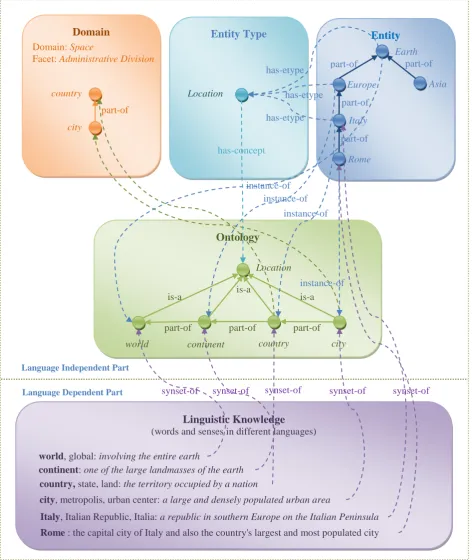
Since this is a huge amount of work, in particular this thesis focused on developing a set of tools for the construction and maintenance of the universal knowledge (UK) part. Precisely, it will not be an iso-lated tool for the development of ontologies, rather would be driven towards the creation of a common integrated environment that provides various knowledge base related services, and gives support to most of the activities involved in the knowledge base construction, evaluation and management. Figure 1
CONCEPTS AND RELATIONS ENTITIES
AND THEIR ATTRIBUTES
DOMAIN KNOWLEDGE
LINGUISTIC KNOWLEDGE (words and senses in different languages)
Language Dependent Part
Language Independent Part
shows a conceptual view of the UK. The whole structure is built around the concept core that can be seen as the core, which glues all the other components. Notice that, UK and BK will have the same structure and the construction of the universal and local background knowledge (i.g., UK and BK) will provide that right amount of flexibility necessary to take into account all dynamics connected to the knowledge man-agement (creation, indexing, browsing and searching, evolution and transfer) taking into account different viewpoints. Domain expert will manage UK whereas BK will be managed and customized locally by any expert or no expert user locally. BK will represent a subset of the knowledge acquired from UK. At the best of our knowledge, no comparable systems have been built till now.
1.4.
Structure of the Thesis
The thesis is organized as follows:
In Chapter 2 we discuss the state-of-the-art ontology editing tools and visualization methods.
In Chapter 3 we discuss the high level architecture of the Universal Knowledge Base , In Section 3.1 we describe the knowledge aacquisition and integration as a part of bootstrapping the UK and the system de-scriptions.
In Chapter 4 we discuss the basic building blocks of linguistic and concept knowledge and finally the re-quirement specification of the linguistic and concept knowledge management system.
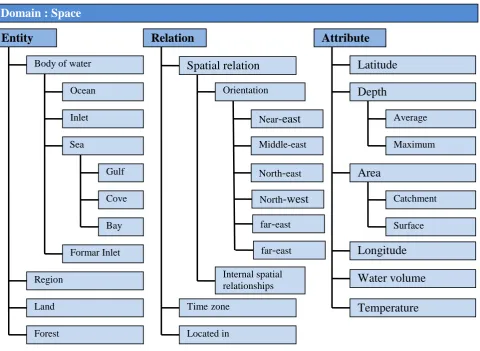
In Chapter 5 we discuss about the domain knowledge. In Section 5.1 we describe the DERA framework, In Section 5.2 we describe the faceted hierarchy build under DERA framework, we also show an example of “Space” domain modeled according to the theory of DERA and domain knowledge management sys-tem.
In Chapter 6 we discuss about the etype theory. In Section 6.1 and 6.2 we describe the fundamental basis and primitive notion of etype. In Section 6.3 we describe the etype model. In Section 6.3 and 6.4 we de-scribe the type of attributes and meta attributes respectively. In Section 6.5 we dede-scribe the etype attrib-ute category and finally the requirement specification of the etype management system.
In Chapter 7 we present the basic visualization theories, which includes gestalt principles, we also dis-cussed about different types of memory from cognitive psychology point of views and a reference model.
In Chapter 8 we present the detail description of the Linguistic and Concept Knowledge Management Consol
In Chapter 9 we present the detail description of the Domain Knowledge Management Consol
In Chapter 10 we present the detail description of the Entity Type Management Consol.
In Chapter 11 we present the
Evaluation for Linguistic and Concept Knowledge Management
Con-sol
In Chapter 12 we describe a model, Distributed Background Knowledge Infrastructure to enable semantic search. This Chepter organized as follows. Section 12.1 expands more on the Search problems. Section 12.3 describes the Semantic search approach, specifically CSearch. Section 12.4 described the limitation current approaches. Section 12.5 describes how syntactic search can be implemented on top of Structured P2P. Section 12.6 describes our solution CANet overlay followed by a example scenario. Section 12.8 we compare our work with other related work. In Section 12.9 we presented an evaluation of our current im-plementation and thus present the conclusion and the future work
Chapter 2
2.
State of the Art
Ontologies describe the concepts and the relationships between concepts which are used to represent a va-riety of domain knowledge, different viewpoints, scopes, and linked heterogeneous information sources, providing a vocabulary for those domain and a specification of the meaning of terms used in the vocabu-lary. Ontologies range from straightforward simple taxonomies, classifications, database schemas, to very complex with rich constructors of Description Logic, highly structured knowledge bases with complex relations, which may differ not only in their content, but also in their way of organization and implemen-tation. In these days ontologies have been taking on not only in the research communities but also in many business communities as a means to share, reuse and process domain knowledge. It has proven to be a useful tool in the area of Knowledge management to build knowledge bases. As a result, there is a growing need for a system that provides various knowledge base related services, effective visualization, search and navigation and gives support to most of the activities involved in the knowledge base con-struction process. Many ontology models support multiple inheritances in the concept and relation hierar-chies, Effective presentations of ontology‟s interlinking concepts and relations with multiple inheritances are challenging. There exist many tools with ontology building methodologies, several visualization me-thods for ontology visualization and navigation and also a number of languages are by now available for knowledge representation. The purpose of this chapter is to present these tools, techniques and their fea-tures in order to understand current trained and future research in the area of Knowledge management.
2.1.
Ontology tools
2.1.1
Protégé
Protégé [32] is a free, open-source platform that provides the system developers and domain experts with a suite of tools to construct domain models and knowledge-based applications with ontologies. Stanford Medical Informatics develops it. It can be extended by way of a plug-in architecture and a Java-based API. For example OntoViz [33] is visualization plug-in which use the GraphViz6 library to create 2D graph visualization. It shows classes and instances grouped with their properties and their information. The relationship between objects is presented by the connected edges of the groups. However, Katifori et al [34] shown by an evaluation using an ontology of approximately 250 nodes that when the number of nodes increases OntoViz becomes cluttered. To browse the ontology another visualization plug-in for the Protégé is Jambalaya7, comes with zooming feature, it shows information of classes grouped by their properties. Instances are showed as nested nodes in their corresponding class in the graph where instances and classes are differentiated with color. Zooming feature helps the user to see details in a convenient way. It also provides keyword search. One good aspect of Protégé is it is possible to customize for creat-ing knowledge models and entercreat-ing data. Hence, it can be easily extended to use knowledge-based em-bedded applications. However [35] found that visualization support in Protégé and its customization models are very complicated which do not reflect users‟ models of what they would usually desire to see. At its core, its support the construction, visualization, and manipulation of ontologies in different repre-sentation formats by a set of knowledge-modeling structures and actions. It provides two different editors namely Protégé-Frames editor and Protégé-OWL editor for modeling ontologies in two different ways. The former one enables users to construct and populate ontologies that are frame-based, in accordance with the Open Knowledge Base Connectivity protocol (OKBC). In this model, ontology consists of a set of classes organized in a subsumption hierarchy to represent a domain's salient concepts, a set of slots as-sociated to classes to describe their properties and relationships, and a set of instances of those classes. The later one, i.e., Protégé-OWL editor, is to build ontologies in the W3C's Web Ontology Language
6 http://graphViz.org
(OWL). There is also a web tool available, WebProtege8, which is a web client for Protégé, a Java-based Web application that allows users to share, browse Protégé ontologies, browse, and do some basic editing of Protege knowledge bases via the internet without having to install the Protégé application locally. Protégé 2.0 has new multi-user capabilities deliberate for experienced users. However, there's no support for multiple users attempting to change the same objects of a knowledge base or notification of changes made by other users that might cause severe problems. It also suffers from lacks of support for collabora-tive ontology engineering except partial methodological and collaboracollabora-tive support. [36] Has conducted a usability evaluation which shows that users in general having difficulties with description logic based formalisms.
2.1.2
OntoEdit
OntoEdit [37] is developed by AIFB in Karlsruhe University that supports the development and mainten-ance of ontologies by graphical means. There are two versions of OntoEdit are available: freeware and professional versions. It is an extensible plugin architecture based environment, which provides supports to browse and edit ontologies. It allows importing and exporting FLogic, XML, DAML+OIL and RDF(S) ontologies. One of its plug-in is Mind2Onto for supporting brainstorming and discussion about ontology Structures. The commercial version use databases for storing ontologies.
2.1.3
OilEd
OilEd [38] is developed as a freeware ontology editor for OIL ontologies as a part of the European IST On-To-Knowledge project. It is an editor that allows a user to create, edit and browse OIL ontologies, but it does not provide a full ontology-development support for large-scale ontologies. In particular, it doesn‟t support activities such as the construction of large-scale ontologies, version control, augmentation, and the integration of ontologies that are involved in ontology building as stated in [39]. Though it was de-signed to be the very simple ontology editor, it has evolved and at the present it is an editor of DAML + OIL ontologies. Additionally it allows the user connect to the Fast Classification of Termi-nologies (FaCT) [40] reasoner which provides ontology consistency checking and automatic concept classification features and export ontologies in a number of formats. Regarding changes of the ontology it gives an ac-tivity log with records connections to the reasoner, but not all ontology modifications.
2.1.4
WebOnto
WebOnto [41] is an ontology editor for ontologies represented in the knowledge modeling language OCML(Operational Conceptual Modelling Language), developed by the Knowledge Media Institute of the Open University, England. The main advantage of WebOnto is that it supports the collaborative browsing using a graphical interface, editing and creation of ontologies. It also provides automatic gener-ation of instance editing forms from class definitions and consistency checking.
2.1.5
WebODE
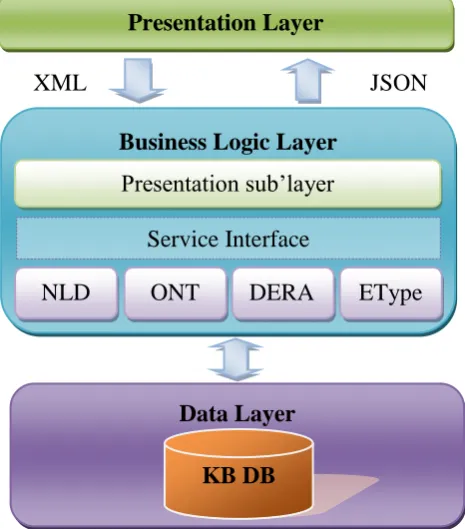
WebODE [42] is developed in the Artificial Intelligence Lab from the Technical University of Madrid, Spain. It was made to use and test the methontology methodology. It is an ontology-engineering suite build with an extensible architecture which supports ontology-development and management; WebODE is used as a Web server with a Web interface which is build on three tiers architecture where the first tier provides the user interface, the second tier provides the business logic, and the third tier consists of the data. WebODE provides exportation and importation services from and into XML for the ontologies build with it [42]. It also provides a set of translation services into and from various ontology specification lan-guages (RDF(S) , OIL , DAML+OIL , X-CARIN and FLogic) [8].
2.1.6
OntoLingua
OntoLingua [43] is developed by the Knowledge Systems Lab at Stanford University.It is an OntoLingua is an ontology library and server , which provides a collaborative environment, ontology-authoring tools, and a library of ontologies. Themain module of the Ontolingua Server is the ontology editor. Some other modules are such as equation solver, Webster, Open Knowledge Based Connectivity server etc. The en-vironment is available as a WWW service. The ontology-authoring tools are to assist authoring ontologies by assembling and extending ontologies obtained from Ontolingua's library. It also provides translators to languages, such as Loom, Prolog, CORBA‟s IDL, CLIPS, etc.
2.1.7
OntoSaurus
OntoSaurus[44] was developed by the Information Sciences Institute (ISI) at the University of South Cal-ifornia. It provides the users to search and annotate HTML documents with ontological information. Search expressions are improved by using domain-specific thesauri , ontologies. It use Loom as its know-ledge representation system and have a web browser
2.1.8
TopBraid Composer
TopBraid Composer [45] is implemented as a standard Eclipse environment plug-in, is a professional modeling environment for developing the W3C's Semantic Web standards RDF Schema, the OWL Web Ontology Language and the SPARQL Query Language. Since Eclipse environment is widely used as a software development tools that makes the TopBraid also to be familiar to the users. There are three ver-sions are available - Free Edition, Standard Edition and Maestro Edition. Free Edition does not include Support and Maintenance The Standard Edition comes with visual editors for RDF graphs and class dia-grams together with SPARQL generator in the graph view. It also provides automated conversion of XML, XSD, Excel and UML. While the Free Edition provides support only to work with RDF/OWL files. Maestro Edition is the most comprehensive version of TopBraid Composer, which is optimized for developing web applications and services based on the TopBraid Live platform.
2.1.9
WordNet
2.2.
Ontology Visualization
For design, management, and browsing of ontology effective visualization is needed. In general, bunches of work in visualization of ontologies exist. IsAViz9 is a standalone application for browsing and author-ing RDF, built on AT&T's Graphviz graph visualization software, is a widely used tool used to visualize RDF metadata. However it has limitations showing overall structure of a set of instances due to their layout. Katifori et al. [34] presented a very comprehensive survey on ontology visualization methods. They tried to review the research that has been done so far on ontology visualization, providing an sum-mary of the existing methods with their pose and cons. They grouped the methods according to the six general categories of visualization types: Indented list, Node–link and tree, Zoomable, Space-filling, Fo-cus+context or distortion and 3D Information landscapes which were further categorized according to the number of space dimensions they employ: 2D or 3D. They investigated how those relate to the special re-quirements of an ontology visualization tool in relation to the tasks a user would like to perform with an ontology visualization tool. 3D methods exploit the third dimension to improve usage of space and/or usability whereas 2D methods don‟t. However they argued, 3D visualization in general requires increased system resources in order for navigation and view-ing to be smooth and without delays and, as a result, is probably not suitable for Web use. Fur-thermore, the 3D methods presented here employs more complex navigation methods and may be a little frustrating and disorienting for a novice user. In their discussion part they have shown according to [52] ontology features like the class hierarchy, the role relations, the properties, and the instances, 3D offers the possibility of a better representation while 2D can be some-what restrictive. As a counter they have said, 3D representations only a little bit improve the screen space problem while increasing the complexity of the interaction [53], further more navigation in a 3D space can be difficult for a novice user, while even simple tasks such as selecting an object can be problematic [54].
Herman et al. [55], presented representations of structured data, in particular the graph visualization techniques were discussed. They categorized graph visualization from the graph drawing or graph layout point of view. They point out the limitation of graph visualization raised due to size of the graph, in par-ticular for big data sets i.e., thousands of nodes, as its makes the graph so dense that interaction with the graph becomes difficult and often make it impossible to navigate. To address the problems with 3D graph visualization techniques they mention inherent cognitive difficulties of 3D navigation in our current systems.
Shneiderman [56] categorizes visualization methods based on the data-type of the elements to be represented in the interface (linear, 2 dimensional, 3 dimensional, temporal, multidimensional, tree, net-work, workspace) and the task characterize based on how users interact with the visualization of a large amount of information: (overview, zoom, filter, details-on-demand, relate, history, extract). If we sum-marize the idea, it would be, users would begin from an overview of the information space, overview ap-proaches include zoomed out views of each data type to view the whole collection. The part of the collec-tion that seemed to be of important, they zoom in the part. Filtering allow the users to control the displayed contents by removing things that are not needed. When filtering has minimized the collection, it is convenient to look through the particular details and further inspect the relationships among items. Dur-ing this progressive refinement it is also important to keep the history of actions so that the users can re-trace their steps. Once users have found the thing they need, they should have a to save it in any conve-nient way. These thoughts are interesting as they present information with user controlled discovery.
2.3.
Conclusion
In the last few years, many ontology-building tools have been developed, some of which we have pre-sented above. A survey that covers very large numbers (more than 50) of tools that have ontology editing capabilities with comparisons can be found in[57], they have reviewed and analyze into a dozen different categories which covered the important functions and features of those tools . Ontology visualization is a particular sub area of graph visualization that still have many implications because of the inherent
Chapter 3
In this chapter we discuss the high level architecture of the Universal Knowledge Base , In Section 3.1 we describe the knowledge aacquisition and integration as a part of bootstrapping the UK and the descrip-tions of the UK management system.
3.
Universal Knowledge Base
The universal schema is meant to provide a common ground on which bases interoperability among people and different systems should be possible. It plays the role of a standard for communication, assign-ing clear meanassign-ing to exchange information. Solvassign-ing the semantic heterogeneity problem, namely the problem of diversity in knowledge, and therefore support interoperability will require the construction of a high quality knowledge base. In fact, the availability of an appropriate amount of knowledge is clearly a fundamental step for any application that deals with semantics.
Many attempts have been made to build huge knowledge bases. One of the most famous is CYC[59], a huge and complex collection of concepts and axioms. Its declared aim is to provide a critical mass of commonsense knowledge serving as a standard universal schema, underlying the web to make more effi-cient the retrieval and the integration of information coming from different sources. However, such huge quantity of knowledge is difficult to manage, maintain in time, access, validate, keep consistent and diffi-cult to use mainly due to the complexity of the formal language and reasoning. For this reason, know-ledge is typically partitioned and reasoning is localized in small contexts by decreasing the level of gene-rality. Our goal is to create an integrated environment to facilitate the development and sharing the universal knowledge base that must also assist the user in the advanced development tasks of creating new knowledge, maintaining, sharing, and using them
.
3.1.
Universal Knowledge Organization
Existing systems tend to internally use heavy representations, for example RDF and OWL, which make reasoning very slow and impractical in real world applications. We think that these formalisms should be used only for knowledge exchange (import/export facilities) while more lightweight representations should be considered for reasoning. We carefully separate UK/BK into four distinctive parts:
- Linguistic part: terms, senses and lexical relations between them in multiple languages; - Ontological part: concept and semantic hierarchical and associative relations between them; - Domain knowledge: concepts and relations between them arranged in facet hierarchies codifying
the knowledge about a specific domain;
- Entity part: the instances of defined concepts and their attributes;
In the language independent part we codify on one side the concepts and semantic intentional relations between them (the ontological part), structured into a set of domains (the domain knowledge), and on the other side their instances, extensional relations between them and corresponding metadata (the entity part), according to their entity type. Notice that each etype corresponds to a concept in the ontological part, and therefore the entities of that kind can be seen as instances of the corresponding concept. The on-tological part corresponds to what in logics is known as the T-Box, while the entity part corresponds to the A-Box. This difference is also stressed in linguistics where the former mainly correspond to common
Ontology
Entity
Entity Type
Linguistic Knowledge
(words and senses in different languages) Domain
world continent country
Earth
part-of
part-of
Europe
Italy
city Location
Location
world, global: involving the entire earth
continent: one of the large landmasses of the earth
country, state, land: the territory occupied by a nation
city, metropolis, urban center: a large and densely populated urban area
Italy, Italian Republic, Italia: a republic in southern Europe on the Italian Peninsula
Rome : the capital city of Italy and also the country's largest and most populated city part-of
part-of
is-a is-a is-a
Rome part-of has-etype
part-of
city
country has-etype
has-etype
has-concept
instance-of instance-of
instance-of Domain: Space
Facet: Administrative Division
Asia
synset-of synset-of synset-of synset-of synset-of part-of part-of
instance-of
Language Independent Part
Language Dependent Part
names (e.g. Country), but also verbs, adverbs and adjectives, while the latter mainly correspond to proper names (e.g. Italy).
However, differently from the classic approach, we split the conceptual part from the specific language used to express it. Each synset from a specific language (in the language dependent part) is connected ei-ther to exactly one concept (in the ontological part of the language independent knowledge) or to exactly one entity (in the entity part of the language independent knowledge). Synsets of the first kind constitute what we could call the linguistic knowledge. It groups all words with the same meaning, including com-mon nouns, verbs, adverbs and adjectives denoting classes of entities. Synsets of the second kind form what we could call the entity vocabulary, which substantially specify entity names, i.e. proper nouns, and their informal description (gloss). Given the symmetry between the two notions, the same data structures (even if not necessarily physically the same) can be used to store both kinds of synsets. However, in this thesis we didn‟t consider the entity management and entity vocabulary but the entity type. We add them here just for the sake of completeness to give a global view. Notice that some concepts/entities may not have a lexical representation for each of the supported languages. This phenomenon is well known in lin-guistics as the problem of gaps between languages.
Entities and e-types are described in Chapter 6. In extreme synthesis, e-types provide constraints about the metadata (i.e., kind of attributes) associated to the entities of that kind. It is important here to under-line that attributes can be used to codify implicit relations between entities (for example to codify a part-of hierarchy) and between an entity and a concept (for example to codify the instance-part-of relation).
Organizing knowledge by domains offers several advantages. First of all, at design time it allows concen-trating on the definition of one domain at a time. Facet Analysis is the well established methodology used for decades in Library and Information Science for this purpose. The result of the analysis is a set of hie-rarchies, called facets, which encode the structure of the domain which is consequently easier to under-stand and maintain in time. Facets are typically grouped according to the DERA pattern, namely a set of fundamental categories, i.e. Domain, Entity, Relation and Attribute. In addition facets in the UK are com-posite objects where nodes represent concepts and arcs represent subsumption between the nodes in clas-sification semantics. This substantially means that both concepts and entities from the UK are facet con-stituents. An example of how a facet can be represented in the UK is given in the picture above which is an exemplification of the Administrative Division facet in the Space domain. The backbone structure of the domain is given by the concepts (which, in this case, are the so called characteristics according to fa-cet terminology) and the intentional relations between them. The fafa-cet is completed by the corresponding entities (their logical instances) and the extensional relations between them.
There are multiple dimensions of diversity. People speak different languages, belong to different cul-tures and communities, have different levels of expertise, purposes and opinions. However, even if they use different terms to name things most of the time they mean the same, or similar, concepts. Our infra-structure will help users to share as much knowledge as possible, helping them to disambiguate and stan-dardize the terms and descriptions they use to annotate objects they handle. This will definitely facilitate communication.
3.2.
Knowledge integration, evolution and maintenance
The process of synthesizing new knowledge, usually referred as the knowledge acquisition process, is very tough and expensive. Acquisition complexity varies from process to process. However, the truth is there is no easy and straightforward way. There have developed several methods for acquiring know-ledge. In below we present three alternative methods for knowledge acquisition process:
moreover some data are difficult or even impossible to obtain, documents that use graphics also a problem [60]. This process is also time-consuming.
b. Using existing sources, corpus: Another method is to create knowledge base from the existing re-sources those are already build as a part of different project manually or automated way and merge them together. The advantage of this method is the data are structured and sometimes ready to use when the source schema is nearly similar to the intended schema. However, merging data from dif-ferent sources are not always straightforward as the difdif-ferent sources have their own way of know-ledge organization and thus different schemas. Often this diversity makes the integration task quite complicated and sometimes impossible where the schemas are very different. Sources could be also very domain specifics and sometimes they just don‟t fit with each other. Thus, the integration requires rigorous analysis of the links between data of every source and source specific import methods. c. Manual : Another way to create knowledgebase is create the content by hand from scratch which is
one of the expensive methods, this also tend to be too small to be of any use in NLP applications or to lend support for theories of lexical organization [58]. Despite the limitations this method has some major advantages over the others. One of the main advantage is one can build the schema the way one deems it. It also allows creating sophisticated high quality knowledgebase that may be richer than the information one can extract automated way. WordNet is an example of this kind of acquisition. Suc-cess and build duration of this method depends on the available expert work force whose are involved in building it. Providing user-friendly smart tools can accelerate the construction time and also reduce the cognitive load. For large scale multi domain knowledgebase building smart tool that supports dis-tributed processing and knowledge synthesize so that expert from different part of the world can con-tribute can be a plus point. However there doesn‟t exist any system that could help to manage and build large scale knowledge system, though in small scale some exists but they are for knowledge management are far from being perfect and inadequate. Knowledge management, however, is com-plex, and therefore should minimize the user‟s cognitive load so that it is usable by average users.
As underlined above creating a knowledgebase from scratch by hand is not just expensive but also huge difficult though it has many advantages. It is fundamental to take advantage of available expert linguistic and domain knowledge (which is typically encoded respectively in linguistic resources such as (Multi-)WordNet, and domain specific KOS, e.g. thesauri such as AGROVOC, NALT, AOD, and HBS) . On the other hand, automatic acquisition is faster but has many restrictions for knowledge modeling. Our strate-gy is to adopt both by taking the advantage of available expert linguistic and domain knowledge which is typically encoded respectively in linguistic resources such as (Multi-)WordNet, and domain specific KOS also by providing the smart easy accessible interface which can be used by different domain expert to contribute manually to synthesizing new knowledge. As it is known, a fundamental step in knowledge in-tegration is alignment, namely finding points of overlap between the two representations and asks domain experts to validate and complete these alignments
[61]
. Semantic and syntactic matching techniques have been proposed as a possible solution to the semantic heterogeneity problem. In the recent years many of them has been offered. Their output is typically a set of (semantic) correspondences to be further refined manually. A good survey is represented by[63]. Therefore, bootstrapping the UK and reaching a critical mass of knowledge is done by collecting, adapting and integrating knowledge from a vast variety of dif-ferent sources about difdif-ferent domains in difdif-ferent languages.3.3.