R E S E A R C H
Open Access
Center-of-pressure total trajectory length is a
complementary measure to maximum excursion
to better differentiate multidirectional standing
limits of stability between individuals with
incomplete spinal cord injury and able-bodied
individuals
Jean-François Lemay
1,2, Dany H Gagnon
1,2*, Sylvie Nadeau
1,2, Murielle Grangeon
1,2, Cindy Gauthier
1,2and Cyril Duclos
1,2Abstract
Background:Sensorimotor impairments secondary to a spinal cord injury affect standing postural balance. While quasi-static postural balance impairments have been documented, little information is known about dynamic postural balance in this population. The aim of this study was to quantify and characterize dynamic postural balance while standing among individuals with a spinal cord injury using the comfortable multidirectional limits of stability test and to explore its association with the quasi-static standing postural balance test.
Methods:Sixteen individuals with an incomplete spinal cord injury and sixteen able-bodied individuals participated in this study. For the comfortable multidirectional limits of stability test, participants were instructed to lean as far as possible in 8 directions, separated by 45° while standing with each foot on a forceplate and real-time COP visual feedback provided. Measures computed using the center of pressure (COP), such as the absolute maximal distance reached (COPmax) and the total length travelled by the COP to reach the maximal distance (COPlength), were used
to characterize performance in each direction. Quasi-static standing postural balance with eyes open was evaluated using time-domain measures of the COP. The difference between the groups and the association between the dynamic and quasi-static test were analyzed.
Results:The COPlengthof individuals with SCI was significantly greater (p≤0.001) than that of able-bodied
individuals in all tested directions except in the anterior and posterior directions (p≤0.039), indicating an increased COP trajectory while progressing towards their maximal distance. The COPmaxin the anterior direction was
significantly smaller for individuals with SCI. Little association was found between the comfortable multidirectional limits of stability test and the quasi-static postural balance test (r≥ −0.658).
(Continued on next page)
* Correspondence:[email protected]
1School of Rehabilitation, Université de Montréal, Montreal, Canada 2
Pathokinesiology Laboratory, Centre for Interdisciplinary Research in Rehabilitation of Greater Montreal, Institut de réadaptation Gingras-Lindsay-de-Montréal, 6300 avenue Darlington Montreal, QC H3S 2J4, Canada
(Continued from previous page)
Conclusion:Standing dynamic postural balance performance in individuals with an incomplete spinal cord injury can be differentiated from that of able-bodied individuals with the comfortable limits of stability test. Performance among individuals with an incomplete spinal cord injury is characterized by lack of precision when reaching. The comfortable limits of stability test provides supplementary information and could serve as an adjunct to the quasi-static test when evaluating postural balance in an incomplete spinal cord injury population.
Keywords:Movement, Outcome assessment, Postural balance, Rehabilitation, Spinal cord injuries
Background
Following an incomplete spinal cord injury (SCI), most in-dividuals will experience sensory and motor impairments at and below the level of the lesion. Due to the neural con-figuration of the spinal cord, an incomplete SCI will gen-erally result in various degrees of lower extremity, trunk and upper extremity impairments depending on the level and the neural structures specifically affected by the le-sion. These impairments often impact the ability to stand safely and execute functional activities in this position (e.g., multidirectional reaching). In fact, recent figures report a high incidence of falls (up to 75%) in individuals with an incomplete SCI, often resulting in physical injuries and decreased social participation [1,2]. Individuals with SCI identified loss of balance as one of the major factors contributing to falls [2]. Unfortunately, only a few studies have investigated how people with SCI control postural balance during quiet standing [3,4] and how it changes when the trunk, head and upper extremities are engaged in dynamic movements over a fixed base of support [4].
Postural balance could be defined as the ability to stabilize the body’s center of mass (COM) over its base of support (BOS) [5]. To preserve a state of balance, the COM position is constantly regulated by the position of the center of pressure (COP), defined as the point loca-tion of the ground reacloca-tion force vector on the surface of a force platform on which a person is standing [6]. Given the stabilizing role of the COP, numerous valid and reliable parameters [6,7] have been recommended to characterize performance during quasi-static stance (i.e., standing with no intended movement [8]. So far, evi-dence of quasi-static postural balance impairments in individuals with SCI has been demonstrated. For instance, these individuals are less stable when standing either with their eyes open or closed than able-bodied individuals [3]. Moreover, their use of visual information to maintain quasi-static stance is greater compared to healthy individ-uals [3]. However, a comprehensive assessment of postural balance should include quasi-static stance and dynamic activities since performance in both conditions does not usually correlate in healthy adults [9,10]; nevertheless, this issue remains controversial [11]. The signs of dynamic instability have been documented during walking in this population and have been mostly expressed by greater
variability in the margin of stability, step length, step width and mediolateral and anteroposterior foot placement as compared to controls [12]. To quantify dynamic balance during functional activities, other comprehensive bio-mechanical models have also been proposed but have yet to be used in individuals with SCI [13-15].
Another method for assessing dynamic postural balance is by exploring the limits of stability, which can be defined as the maximum distance an individual is willing to move his/her centre of pressure (COP) in various directions without changing the configuration of the BOS and while remaining stable [16]. This usually involves the use of a forceplate that records COP displacement and a visual dis-play that serves as feedback to maximize COP movement in specific directions. A multidirectional limits of stability test has recently been used to characterize dynamic sitting postural balance in individuals with SCI [17,18]. Individ-uals having no motor control over their abdominal and low back muscles had distinct ability on this test com-pared to those who had partial or full control, which tends to support its validity in a seated position [17]. However, standing imposes different biomechanical and dynamic constraints on stability compared to a sitting position, provided that, for example, the BOS is smaller and the COM higher. An analysis of the COP while standing in healthy young adults reveals that time-domain measures were larger and frequency-domain measures were smaller compared to sitting, an observation attributed to the body segment that is moving in each position [19]. The multi-directional limits of stability test thus requires further study before it can be recommended for evaluating pos-tural balance while standing.
low level of association with the quasi-static standing postural balance test.
Methods
Participants
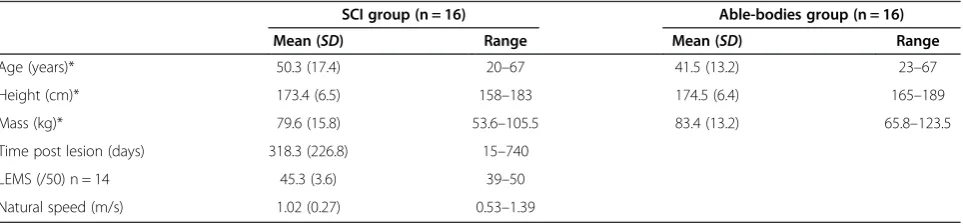
Sixteen individuals with an incomplete traumatic SCI (American Spinal Cord Injury (ASIA) Impairment Scale = D) [20] and 16 able-bodied controls volunteered to partici-pate in this study. Participants with SCI were recruited from both the inpatient and outpatient population of the SCI rehabilitation unit of the Institut de réadaptation Gingras-Lindsay-de-Montréal (IRGLM). All SCI partici-pants could stand for 5 minutes without external support and walk independently for 10 m with or without a walking assistive device. Participants were excluded if they presented other concomitant neurological condi-tions in addition to the SCI or walking or balance difficulties prior to the SCI. None of the able-bodied participants reported having musculoskeletal or neurolo-gical impairments that would interfere with standing postural balance. Ethics approval was obtained from Re-search Ethics Committee of the Center for Interdisciplinary Research in Rehabilitation of Greater Montreal (CRIR-578-0111). Written consent was obtained after participants had read and understood the information about the research (Table 1).
Clinical assessment
Demographic information pertaining to the date and type of accident, ASIA level and the presence of any relevant associated conditions were gathered from each subject’s chart. A physical therapist with 10 years of experience in the field of SCI rehabilitation conducted the lower extremity motor score assessment (LEMS) ac-cording to ASIA standards [20]. Natural walking speed was tested over a distance of 15 m. Participants were asked to walk at their usual walking speed without any walking assistive devices [21]. The middle 10 m section was timed using a stopwatch. The task was repeated three times and the resulting speeds were averaged.
Laboratory assessment
All evaluations were conducted at the Pathokinesiology Laboratory of the Centre for Interdisciplinary Research in Rehabilitation of Greater Montreal (CRIR) located at the IRGLM. During the laboratory assessment, partici-pants stood on two side-by-side forceplates embedded in the floor with their feet in a standardized position (heels 10 cm apart; feet abducted 20°) and their arms resting alongside their trunk.
Comfortable multidirectional limits of stability test
Following a familiarization period, participants were asked to lean from the starting position as far as possible at a comfortable self-selected speed in eight specific directions, each separated by 45° (anterior, right anterolateral, right, right posterolateral, posterior, left posterolateral, left, left anterolateral) and return to the initial position within a 15-second period. Participants were instructed to keep their arms alongside their trunk, to initiate the movement from the ankle instead of bending their trunk or their hips when leaning and to avoid raising their toes or heels [22]. These instructions were given to facilitate COP movement in the indicated direction within a standardized BOS and to limit compensatory movements. A flat screen placed 2 m in front of the participant displayed the real-time pos-ition of their COP as well as the boundaries within which they had to move. Each of the eight directions was tested twice for a total of 16 movements that were displayed in a random order determined by a computer. A research engineer coordinated the computerized data acquisition and storage at all times.
Quasi-static postural stability test
Participants were asked to stand still during two 45-second trials with their eyes open. Participants had to keep their feet in the same standardized position as described above [3].
Data processing
Reaction forces were recorded for each task at a sam-pling frequency of 600 Hz. The resultant COP time
Table 1 Descriptive characteristics of the participants (n = 32), mean (SD) and range
SCI group (n = 16) Able-bodies group (n = 16)
Mean (SD) Range Mean (SD) Range
Age (years)* 50.3 (17.4) 20–67 41.5 (13.2) 23–67
Height (cm)* 173.4 (6.5) 158–183 174.5 (6.4) 165–189
Mass (kg)* 79.6 (15.8) 53.6–105.5 83.4 (13.2) 65.8–123.5
Time post lesion (days) 318.3 (226.8) 15–740
LEMS (/50) n = 14 45.3 (3.6) 39–50
Natural speed (m/s) 1.02 (0.27) 0.53–1.39
series, computed from the tri-axial components of the combined reaction forces, was filtered with a fourth-order Butterworth zero-lag filter with a cut-off frequency of 5 Hz and then down-sampled (300 Hz) before analysis.
Outcome measures
Comfortable multidirectional limits of stability test
Three main outcome measures were taken:
COPmax: represents the linear distance in mm
between the initial and maximal positions of the COP in a given direction. The COPmaxwas
calculated for each trial in the eight directions tested. Greater COPmaxindicates better ability to
move the COP in a specific direction.
COPlength: represents the total trajectory in mm
followed by the COP from its initial position to its maximal position. The COPlengthwas also computed
for each of the eight directions. Lower COPlength
indicates a straighter movement when reaching in a specific direction, possibly indicating better precision of the COP movement.
COParea: represents the area in mm2defined by an
ellipse fitting the COPmaxin each of the 8 tested
directions. Greater COPareaindicates better overall
ability to move the COP in every direction.
The mean COP speed was also calculated for each trial by taking the total distance travelled between the COP starting and maximal (COPmax) positions divided by the
time taken to reach this distance. Each trial was then analyzed to be included in the final analysis. Data from trials where a loss of balance or a foot displacement occurred were also discarded. The angular error (repre-senting the absolute difference in degrees between the targeted direction and the actual COPmaxdirection) was
calculated for each trial. Only trials with an angular error≤25° were included in the analysis to minimize the impact of imprecise COP directions. For each direction, the maximal value of the COPmax was taken as well as
the corresponding COPlength.
Quasi-static postural stability test
The mean values of the root mean square distance (RMS; mm), the mean COP velocity (MV; mm/s), and the COP sway area (SA; mm2/s) were computed for each trial from the COP time series [3,6,7]. Lower RMS, MV and SA values would indicate a better performance in terms of postural balance. The mean of the two trials was calculated for each parameter.
Data analysis
Descriptive statistics (mean, standard deviation, range) were calculated for the participants’characteristics and
all laboratory outcome measures. Normality of the distri-bution was explored using the Shapiro-Wilk test. Among the comfortable multidirectional limits of stability test parameters, the COPlength in the right, right
postero-lateral, posterior and left directions of individuals with SCI, as well as the COPlength in the anterior and right
posterolateral directions of the able-bodied participants were not normally distributed (p≤0.032). The quasi-static postural stability test departed from normality in individuals with SCI for the MV (p≤0.037). Non-parametric statistics were thus used when analyzing these data. Otherwise, all other data were normally distributed among the two groups and analyzed with parametric tests.
Independent t-tests were used to reveal differences in the demographic data of both groups of participants. For the comfortable multidirectional limits of stability test pa-rameters, a two-way repeated measure analysis of variance (ANOVA) with one between factor (individuals with SCI and able-bodied individuals) and one within factor (eight tested directions) was conducted to detect the presence of significant differences. Since there was a significant inter-action between the COPmaxand the groups, independent
t-tests or Mann–Whitney U tests were performed to reveal between-group differences for each direction, using a Bonferonni correction on the alpha value (p = 0.05/8 tested directions). Effect size were calculated for both the COPmaxand the COPlength and were considered as being
small (0.2 to 0.5), moderate (0.5-0.8) or large (>0.8) according to Cohen’s criteria [23]. Difference between the groups on the quasi-static test was quantified using inde-pendent t-test or Mann–WhitneyUtest according to the normality of the data. Further analysis on the COPmax
where individuals with SCI were better than able-bodied controls was done by assessing the level of association with the COPlength in the same direction using Pearson’s
product moment correlation coefficient. The between-group difference of the COPareaand the mean COP speed
was assessed with an independent t-test.
The level of association between the comfortable multidirectional limits of stability test and the quasi-static postural stability test for individuals with SCI was explored using Pearson’s product moment correlation coefficients. Correlation coefficients confirmed good to excellent association when they were greater than 0.75 [24]. A statistical significance threshold was set at 0.05 for all tests unless otherwise specified. All statistical ana-lyses were conducted using SPSS® software (version 20.0) (Chicago, IL).
Results
Between-group and within-group differences
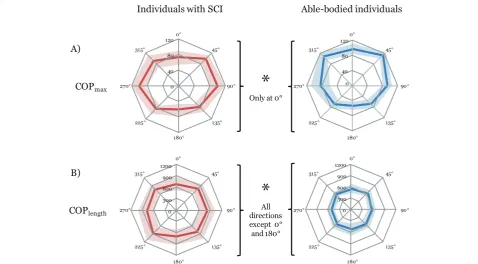
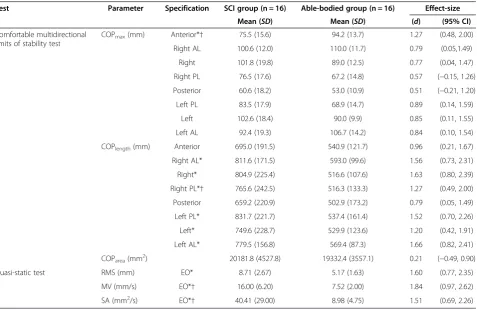
direction for the COPmax between the two groups of
participants at a statistical significance level of 0.00625. However, individuals with SCI tended to have a greater COPmax when reaching laterally and posteriorly (12.1 to
17.5%). Able-bodied individuals had greater COPmaxwhen
reaching in anterior directions (9.3 to 29.5%).
The COPlength for individuals with SCI was 22.2-35.8%
greater than those of able-bodied individuals. This reached the significance level in all directions (p≤0.001), except in the anterior and posterior direction (p≤0.039). Both the COPmax and the COPlength tended to be smaller in the
posterior directions as compared to anterior and lateral directions (Figures 1 and 2). Effect sizes were considered moderate to large.
There was a significant level of association between the COPmax and the COPlength in the posterior, left
posterolateral and left directions for individuals with SCI (0.527≤r≤0.630, p≤0.036).
The COParea was not significantly different between
SCI and able-bodied participants (p = 0.560) (Table 2). No difference was seen on the mean COP speed at the significance level of 0.00625. All COP parameters of the quasi-static postural stability test revealed reduced postural balance in individuals with SCI as compared to able-bodied participants (p≤0.0002).
Correlation between the comfortable multidirectional limits of stability test and the quasi-static postural stability test for individuals with SCI
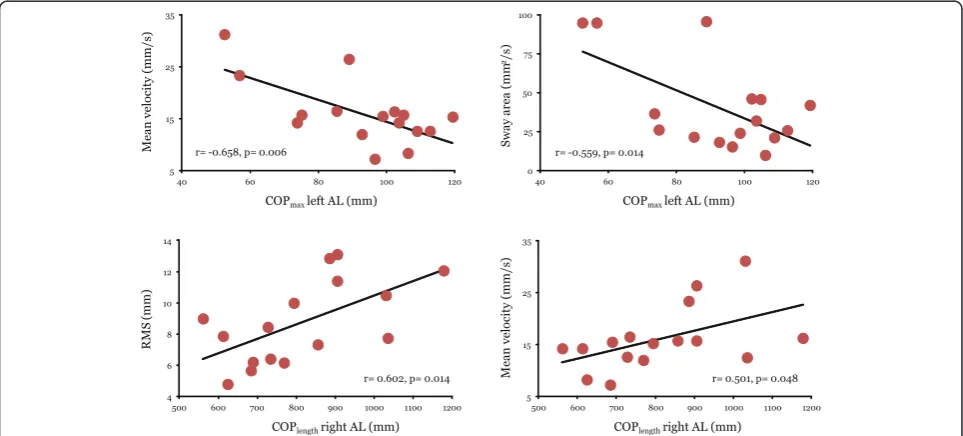
For individuals with SCI, there was a limited number of significant associations (4 out of 48 possible associations) between the parameters of the comfortable multidirec-tional limits of stability test and the quasi-static postural stability test (Table 3). A moderate level of association was present between the COPmaxin a left anterolateral
direc-tion and the MV and SA parameter of the quasi-static postural stability test (−0.658≤r≤ −0.559; p≤0.014), as well as between the COPlength in the right anterolateral
direction and the RMS and MV parameters (0.501≤r≤ 0.602; p≤0.048) (Figure 3).
Discussion
In this study, we have found that a task testing the limits of stability in SCI individuals who are com-munity ambulators, is mainly characterized by an in-crease in the distance travelled by the COP when going to its maximal position rather than by a limita-tion in the absolute distance reached by the COP in the intended direction. Therefore, using COPlength
may better characterize performance of individuals with SCI. When the COPmax is greater in individuals
Figure 1Comparison of performance for two parameters of the comfortable multidirectional limits of stability test between
Figure 2An example of a COP displacement on the comfortable multidirectional limits of stability test performed by two individuals, one with and the other without SCI.AL: anterolateral; PL: posterolateral. The individual with SCI displays less precision when reaching in all directions as compared to the able-bodied individuals, for whom most directions are easier to differentiate. Overall, reaching movements in the posterior direction tended to be smaller and less precise than in the anterior and lateral directions in both groups.
Table 2 Descriptive characteristics of the participants on the dynamic and quasi-static tests
Test Parameter Specification SCI group (n = 16) Able-bodied group (n = 16) Effect-size
Mean (SD) Mean (SD) (d) (95% CI)
Comfortable multidirectional limits of stability test
COPmax(mm) Anterior*† 75.5 (15.6) 94.2 (13.7) 1.27 (0.48, 2.00)
Right AL 100.6 (12.0) 110.0 (11.7) 0.79 (0.05,1.49)
Right 101.8 (19.8) 89.0 (12.5) 0.77 (0.04, 1.47)
Right PL 76.5 (17.6) 67.2 (14.8) 0.57 (−0.15, 1.26)
Posterior 60.6 (18.2) 53.0 (10.9) 0.51 (−0.21, 1.20)
Left PL 83.5 (17.9) 68.9 (14.7) 0.89 (0.14, 1.59)
Left 102.6 (18.4) 90.0 (9.9) 0.85 (0.11, 1.55)
Left AL 92.4 (19.3) 106.7 (14.2) 0.84 (0.10, 1.54)
COPlength(mm) Anterior 695.0 (191.5) 540.9 (121.7) 0.96 (0.21, 1.67)
Right AL* 811.6 (171.5) 593.0 (99.6) 1.56 (0.73, 2.31)
Right* 804.9 (225.4) 516.6 (107.6) 1.63 (0.80, 2.39)
Right PL*† 765.6 (242.5) 516.3 (133.3) 1.27 (0.49, 2.00)
Posterior 659.2 (220.9) 502.9 (173.2) 0.79 (0.05, 1.49)
Left PL* 831.7 (221.7) 537.4 (161.4) 1.52 (0.70, 2.26)
Left* 749.6 (228.7) 529.9 (123.6) 1.20 (0.42, 1.91)
Left AL* 779.5 (156.8) 569.4 (87.3) 1.66 (0.82, 2.41)
COParea(mm2) 20181.8 (4527.8) 19332.4 (3557.1) 0.21 (−0.49, 0.90)
Quasi-static test RMS (mm) EO* 8.71 (2.67) 5.17 (1.63) 1.60 (0.77, 2.35)
MV (mm/s) EO*† 16.00 (6.20) 7.52 (2.00) 1.84 (0.97, 2.62)
SA (mm2/s) EO*† 40.41 (29.00) 8.98 (4.75) 1.51 (0.69, 2.26)
with SCI as compared to able-bodied individuals in some direction, it is associated with the COPlength,
which further support the use of this measure in a SCI population. To our knowledge, this is the first study to report such a finding in this population. In accordance with our second hypothesis, we also found little association between the quasi-static and the dy-namic balance parameters.
Performance of individuals with SCI versus able-bodied individuals on the comfortable limits of stability test
COPlength is calculated from the total excursion of the
COP on its way toward its maximal position in an indi-cated direction. COPlength of individuals with SCI was
greater than that of able-bodied individuals in all direc-tions. This increased COP excursion could be inter-preted as a decrease in movement precision: whereas Table 3 Correlation matrix between the dynamic and the quasi-static test for individuals with SCI
Quasi-static test Comfortable multidirectional limits of stability test
COPmax
Anterior Right AL Right Right PL Posterior Left PL Left Left AL
RMS† −0.194 0.217 −0.006 0.040 0.468 0.475 0.325 −0.275
MV† −0.352 0.277 −0.232 −0.393 −0.080 0.361 0.064 −0.658**
SA† −0.387 0.142 −0.204 −0.239 0.177 0.355 0.167 −0.559*
COPlength
Anterior Right AL Right Right PL Posterior Left PL Left Left AL
RMS† −0.067 0.602* 0.365 0.004 0.441 0.138 0.241 0.366
MV† 0.050 0.501* 0.173 −0.133 0.290 0.190 0.091 0.081
SA† 0.011 0.482 0.120 −0.047 0.292 0.149 0.135 0.143
†Pearson’s product moment correlation coefficient. *: p≤0.05, **: p≤0.01.
RMS: root mean square distance of the COP; MV: mean velocity of the COP; SA: sway area of the COP; COPmax:maximal distance reached by the centre of pressure in the indicated direction. COPlength: length of the COP trajectory from the starting position to the maximal position of the COP; AL: anterolateral; PL: posterolateral.
COP movement of able-bodied individuals tended to move in a straighter manner, individuals with SCI dis-played more extraneous movements on their way to their maximal position, increasing the COPlength. Similar
results have been found in other populations presenting neurological deficits such as Parkinson’s disease. Ondo et al. found that individuals with Parkinson’s disease had a significantly increased path sway on the Smart Balance Master limits of stability test as compared to able-bodied individuals, a test comparable to the one performed in our study [25].
Many factors may be responsible for this decrease in movement precision during the comfortable multidi-rectional limits of stability test in individuals with SCI. Since a SCI generally alters the integrity of the various sensory tracts travelling within the spinal cord, the somatosensory contribution to postural balance may therefore be decreased, which in turn, could explain the less precise movement of the COP. Clinical evaluation of sensory function revealed residual sensory deficits in most of our participants with SCI. In fact, a varying degree of foot anesthesia induced from various techniques causes a proportional increase in COP motion while standing [26,27]. Moreover, an increase in visual contribu-tion to postural balance in people with SCI as compared to able-bodied controls does exist [3]. This may represent a compensatory mechanism for a decreased sensory per-ception in the lower extremity. Future studies could identify to what extent sensory deficits following SCI is a major contributor to observed standing postural balance deficits.
Lower-extremity muscle function is another factor influencing control of standing postural balance in vari-ous populations [28-31]. Although our participants with SCI had sufficient lower extremity strength to assume a standing position, a certain deficit in strength was present in the ankle dorsiflexors and plantarflexors, as indicated by the LEMS evaluation. It is known that the location of lower-extremity muscle strength influences balance capability differently. For example, Horlings et al. demon-strated that distal muscle weakness more significantly influences postural stability than proximal muscle weak-ness [28]. Future studies using a dynamometric evaluation of lower extremities could help identify those muscle groups associated with increased COPlength in each
direction.
Contrary to our initial hypothesis, individuals with SCI had similar COPmax compared to able-bodied controls
as indicated by the lack of significant differences in all but one direction and on the overall measure given by the COParea. Interestingly, these findings correspond to
those of Gauthier et al. who showed that SCI individuals who had partial or full control over their abdominal and lower trunk muscles could bring their COP to a similar
distance from their base of support to that of able-bodied individuals when performing a similar postural balance test while sitting [17]. This may seem surprising considering that standing is inherently less stable than sitting [19,32] and could thus lead to greater differences in performance between impaired and normally func-tioning individuals. However in our study, individuals with SCI had adequate motor recovery in their trunk muscles to be able to assume a standing position and lean in various directions. This may in part explain the lack of difference seen in COPmax. Yet the significant
groups vs. directions interaction indicates that individ-uals with SCI and able-bodied participants differed on how they performed in various directions. More spe-cifically, individuals with SCI had greater COPmax in
lateral directions while able-bodied individuals had greater COPmaxin anterior and antero-lateral directions.
Complementary studies including a larger sample of participants could help to confirm whether or not a dif-ference in COPmax between the groups exists. Greater
COPmaxin some directions cannot be attributed to
differ-ent foot placemdiffer-ents since foot placemdiffer-ents were stan-dardized using a template. This is also supported by the absence of significant difference between the groups on the COPmaxin a posterior, right and left directions.
Ankle plantarflexor muscle groups are known to influence anteroposterior COP excursions [31] and are especially activated when controlling anterior body displacement with respect to the base of support [33]. Since most of our individuals with SCI had residual distal lower-extremity weakness, we could hypothesize that the lower COPmaxin the anterior and anterolateral
directions may be explained by this lack of strength. Individuals with SCI could therefore limit anterior COP displacement in order to take into account their de-creased ability to control the COP using their ankle plantarflexors when reaching the limits of stability in this direction.
On the other hand, individuals with SCI had greater COPmaxin the lateral directions than able-bodied
individ-uals. Body displacements in lateral directions are under the control of hip abductor muscle groups [33], which did not achieve full recovery in our group of individuals with SCI. A possible explanation for this better performance is that those individuals with SCI who outperformed able-bodied individuals in these directions did it at the expense of precision, as indicated by the COPlength. This hypothesis
is partly supported by the significant positive correlation found between the COPmax and the COPlength in the
limited COP displacements. Since the comfortable multi-directional limits of stability test challenges the postural control system and attentional resources, some individuals may have favored moving less precisely in the displayed direction in order to achieve a maximal performance on the COPmax. Therefore, repeating this test while
im-posing no constraint on the movement precision may have yielded different COPmaxresults.
Association between quasi-static and dynamic postural balance tests
This study also yields little association between dynamic and quasi-static postural balance for individuals with SCI. As mentioned earlier, only four of the 48 possible combinations were found to be statistically significant. This limits the inferences that can be drawn from these associations. These results support a previous study reporting a lack of significant correlation between the static eyes open test and the limits of stability test of the Smart Balance Master, the later sharing some similarities with the comfortable limits of stability test [4]. This is also in line with most studies exploring the association between measures of static and dynamic balance among individuals with stroke or able-bodied individuals [9,10,34]. In spite of these remarks, parameters of the COP during quasi-static stance correlated with the comfortable multi-directional limits of stability test in only two directions (left and right anterolateral directions). Further research including more participants with a wider range of balance deficits would be necessary to determine the significance of this specific result.
Study limitations
Our study suffers from a few limitations needing con-sideration when interpreting these results. Firstly, all our participants with SCI were community ambulators. Many participants with SCI had near normal walking ability, as indicated by the mean natural speed of 1.02 m/s, which is close to the 1.06 m/s value required to be considered as a safe community ambulator [35]. It is thus possible that our group of SCI participants was not representative of an actual population of individuals with traumatic incomplete SCI. These results are there-fore not applicable to those individuals who are start-ing to assume a standstart-ing position. This could have limited the possibility to find differences between our two groups. However, although statistical power of the study was in part limited by the small number of participants in each group, effect sizes were at least moderate for the
COPlength in the comfortable multidirectional limits of
stability test. Therefore, this statistic supports the fact that our sample size was sufficient to find differences between the groups.
As is often done in other studies, COP-based measures were not normalized using the dimension of the base of support or foot length [17,18]. However, our two groups did not differ in height. Since foot position was stan-dardized and monitored during the study, we therefore presume that this normalization would not have chan-ged our main conclusions. Although participants were told to initiate the movement from the ankle instead of bending their trunk or their hips when leaning, some degree of trunk and hip compensation of varying degrees was present among participants and directions. We thus suspect that the actual performance may be partially related to the strategies used. Adding a kinematic analysis to our protocol may have helped to identify biomechanical markers associated with the difference in performance seen among both groups.
It is possible that the performance of individuals with SCI is potentiated because of the visual feedback pro-vided during this test. In fact, Sayenko et al. have shown that visual feedback can improve standing balance per-formance in individuals with incomplete SCI [36]. A test performed without visual feedback could have been more reflective of balance capabilities of each participant and could have generated more differences between the groups. Normal dynamic postural balance activities such as walking occur without on-screen visual feedback on actual performance. Therefore, how the results from this study can be generalized to other dynamic balance activ-ities remains to be explored.
Although 15 seconds were given to maximally displace the COP in the indicated direction and come back to the initial position, no actual control on the speed of movement was given. However no difference was seen between the groups in the mean COP speed. Thus this factor could not explain the differences in performance (i.e., COPlength) seen between the groups. We did not
analyze the return from the maximal position to the initial position, which may have provided further insight into dynamic balance performance in individuals with SCI in the comfortable limits of stability test. Reliability and minimal detectable change of the COPmax and the
COPlengthwere not assessed. Since the standard error of
measurement is unknown for these parameters, this limits the inferences that can be drawn from differences in performance seen between the groups of participants. Lastly, we did not apply a correction for multiple com-parisons (e.g., Bonferonni’s) to the correlational analysis. For this reason, the correlation that were significant must be interpreted with caution since a possibility of a type I error exists.
Conclusion
with SCI. More precisely, a measure of movement preci-sion (i.e., COPmax) could differentiate the performance
of SCI individuals from that of able-bodied controls. Although balance during quasi-static standing is im-paired in individuals with SCI, no definitive association was found between this evaluation and the dynamic test under investigation. A comprehensive evaluation of pos-tural balance should therefore include items assessing both its static and dynamic components.
Abbreviations
SCI:Spinal cord injury; COM: Center of mass; BOS: Base of support; COP: Center of pressure; AIS: ASIA impairment scale; IRGLM: Institut de réadaptation Gingras-Lindsay de Montréal; LEMS: Lower extremity motor score; CRIR: Centre for Interdisciplinary Research in Rehabilitation of Greater Montreal; RMS: Root mean square distance; MV: Mean COP velocity; SA: COP sway area; ANOVA: Analysis of variance.
Competing interests
The authors declare that they have no competing interests.
Authors’contributions
JFL: Conception and design, acquisition, analysis and interpretation of data, drafted the article. DG: Conception and design, analysis and interpretation of data, drafted the article. SN: Conception and design, analysis and
interpretation of data, drafted the article. MG: Conception and design, acquisition of data. CG: Conception and design, acquisition of data. CD: Conception and design, acquisition of data. All authors read and approved the final manuscript.
Authors’information
School of Rehabilitation (www.readap.umontreal.ca), Université de Montréal, Montreal, Canada.
Pathokinesiology Laboratory (www.pathokin.ca), Centre for Interdisciplinary Research in Rehabilitation of Greater Montreal—Institut de réadaptation Gingras-Lindsay de Montréal, Montreal, Canada.
Acknowledgements
The authors acknowledge Philippe Gourdou, Youssef El Khamlichi, Carole Miéville, and Audrey Roy, for their assistance during data collection and analysis.
Jean-François Lemay is supported by a doctoral scholarship from the Fonds de la recherche du Québec-Santé (FRQS). Dany Gagnon holds a Junior 1 Career Award from the FRQS. Dany Gagnon, Cyril Duclos and Sylvie Nadeau are members of the Multidisciplinary SensoriMotor Rehabilitation Research Team (www.errsm.ca) supported by the CIHR and of the Quebec-Ontario Spinal Cord Injury Mobility Research Group. The equipment and material required to complete this project at the Pathokinesiology Laboratory was financed in part by the Canada Foundation for Innovation. This project was funded in part by a research grant from the Craig H. Neilson Foundation.
Received: 27 May 2013 Accepted: 3 January 2014 Published: 17 January 2014
References
1. Brotherton SS, Krause JS, Nietert PJ, Brotherton SS, Krause JS, Nietert PJ:
A pilot study of factors associated with falls in individuals with incomplete spinal cord injury.J Spinal Cord Med2007,30:243–250. 2. Brotherton SS, Krause JS, Nietert PJ:Falls in individuals with incomplete
spinal cord injury.Spinal Cord2007,45:37–40.
3. Lemay JF, Gagnon D, Duclos C, Grangeon M, Gauthier C, Nadeau S:
Influence of visual inputs on quasi-static standing postural steadiness in individuals with spinal cord injury.Gait Posture2013,38:357–360. 4. Lemay JF, Nadeau S:Potential of the smart balance master system to
assess the standing balance in people with AIS D spinal cord injury. J Rehabil Med2013,45:55–60.
5. Horak FB:Postural control.InEncyclopedia of Neuroscience.Edited by Binder MD, Hirokawa N, Windhorst U. Berlin Heidelberg: Springer; 2009:3212–3219.
6. Prieto TE, Myklebust JB, Hoffmann RG, Lovett EG, Myklebust BM:Measures of postural steadiness: differences between healthy young and elderly adults.IEEE Trans Biomed Eng1996,43:956–966.
7. Rocchi L, Chiari L, Cappello A:Feature selection of stabilometric parameters based on principal component analysis.Med Biol Eng Comput
2004,42:71–79.
8. Hsiao-Wecksler ET, Katdare K, Matson J, Liu W, Lipsitz LA, Collins JJ:
Predicting the dynamic postural control response from quiet-stance behavior in elderly adults.J Biomech2003,36:1327–1333.
9. Karimi MT, Solomonidis S:The relationship between parameters of static and dynamic stability tests.J Res Med Sci2011,16:530–535.
10. Kang HG, Dingwell JB:A direct comparison of local dynamic stability during unperturbed standing and walking.Exp Brain Res2006,172:35–48. 11. Abe MO, Masani K, Nozaki D, Akai M, Nakazawa K:Temporal correlations in center of body mass fluctuations during standing and walking.Hum Mov Sci2010,29:556–566.
12. Day KV, Kautz SA, Wu SS, Suter SP, Behrman AL:Foot placement variability as a walking balance mechanism post-spinal cord injury.Clin Biomech
2011,13:13.
13. Duclos C, Desjardins P, Nadeau S, Delisle A, Gravel D, Brouwer B, Corriveau H:Destabilizing and stabilizing forces to assess equilibrium during everyday activities.J Biomech2009,42:379–382.
14. Hof AL, Gazendam MG, Sinke WE:The condition for dynamic stability. J Biomech2005,38:1–8.
15. Pai YC, Patton J:Center of mass velocity-position predictions for balance control.J Biomech1997,30:347–354.
16. Holbein-Jenny MA, McDermott K, Shaw C, Demchak J:Validity of functional stability limits as a measure of balance in adults aged 23–73 years.Ergonomics2007,50:631–646.
17. Gauthier C, Gagnon D, Grangeon M, Jacquemin G, Nadeau S, Masani K, Popovic MR:Comparison of multidirectional seated postural stability between individuals with spinal cord injury and able-bodied individuals. J Rehabil Med2013,45:47–54.
18. Gauthier C, Gagnon D, Jacquemin G, Duclos C, Masani K, Popovic MR:
Which trunk inclination directions best predict multidirectional-seated limits of stability among individuals with spinal cord injury?J Spinal Cord Med2012,35:343–350.
19. Vette AH, Masani K, Sin V, Popovic MR:Posturographic measures in healthy young adults during quiet sitting in comparison with quiet standing.Med Eng Phys2010,32:32–38.
20. Kirshblum SC, Burns SP, Biering-Sorensen F, Donovan W, Graves DE, Jha A, Johansen M, Jones L, Krassioukov A, Mulcahey MJ,et al:International standards for neurological classification of spinal cord injury (revised 2011).J Spinal Cord Med2011,34:535–546.
21. Lam T, Noonan VK, Eng JJ, Team SR:A systematic review of functional ambulation outcome measures in spinal cord injury.Spinal Cord2008,
46:246–254.
22. Forth KE, Fiedler MJ, Paloski WH:Estimating functional stability boundaries for bipedal stance.Gait Posture2011,33:715–717.
23. Cohen J:Statistical power analysis for the behavioral sciences.2nd edition. Hillsdale, NJ: L. Erlbaum Associates; 1988.
24. Portney LG, Watkins MP:Foundations of clinical research : applications to practice.3rd edition. Upper Saddle River, N.J: Pearson/Prentice Hall; 2009. 25. Ondo W, Warrior D, Overby A, Calmes J, Hendersen N, Olson S, Jankovic J:
Computerized posturography analysis of progressive supranuclear palsy: a case–control comparison with Parkinson’s disease and healthy controls.Arch Neurol2000,57:1464–1469.
26. Wang TY, Lin SI:Sensitivity of plantar cutaneous sensation and postural stability.Clin Biomech2008,23:493–499.
27. Meyer PF, Oddsson LI, De Luca CJ:The role of plantar cutaneous sensation in unperturbed stance.Exp Brain Res2004,156:505–512. 28. Horlings CG, Kung UM, van Engelen BG, Voermans NC, Hengstman GJ,
van der Kooi AJ, Bloem BR, Allum JH:Balance control in patients with distal versus proximal muscle weakness.Neuroscience2009,
164:1876–1886.
29. Horlings CG, van Engelen BG, Allum JH, Bloem BR:A weak balance: the contribution of muscle weakness to postural instability and falls.Nat Clin Pract Neurol2008,4:504–515.
31. Roerdink M, Hlavackova P, Vuillerme N:Effects of plantar-flexor muscle fatigue on the magnitude and regularity of center-of-pressure fluctuations.Exp Brain Res2011,212:471–476.
32. Forrest GF, Lorenz DJ, Hutchinson K, Vanhiel LR, Basso DM, Datta S, Sisto SA, Harkema SJ:Ambulation and balance outcomes measure different aspects of recovery in individuals with chronic, incomplete spinal cord injury.Arch Phys Med Rehabil2012,93:1553–1564.
33. Torres-Oviedo G, Ting LH:Muscle synergies characterizing human postural responses.J Neurophysiol2007,98:2144–2156.
34. Liston RA, Brouwer BJ:Reliability and validity of measures obtained from stroke patients using the Balance Master.Arch Phys Med Rehabil1996,
77:425–430.
35. Robinett CS, Vondran MA:Functional ambulation velocity and distance requirements in rural and urban communities. A clinical report.Phys Ther
1988,68:1371–1373.
36. Sayenko DG, Alekhina MI, Masani K, Vette AH, Obata H, Popovic MR, Nakazawa K:Positive effect of balance training with visual feedback on standing balance abilities in people with incomplete spinal cord injury. Spinal Cord2010,48:886–893.
doi:10.1186/1743-0003-11-8
Cite this article as:Lemayet al.:Center-of-pressure total trajectory length is a complementary measure to maximum excursion to better differentiate multidirectional standing limits of stability between individuals with incomplete spinal cord injury and able-bodied individ-uals.Journal of NeuroEngineering and Rehabilitation201411:8.
Submit your next manuscript to BioMed Central and take full advantage of:
• Convenient online submission
• Thorough peer review
• No space constraints or color figure charges
• Immediate publication on acceptance
• Inclusion in PubMed, CAS, Scopus and Google Scholar
• Research which is freely available for redistribution