R E S E A R C H
Open Access
Effects of Carpal Tunnel Syndrome on adaptation
of multi-digit forces to object mass distribution
for whole-hand manipulation
Wei Zhang
1,2, Jamie A Johnston
3, Mark A Ross
4, Brandon J Coakley
4, Elizabeth A Gleason
4, Amylou C Dueck
4and Marco Santello
1*Abstract
Background:Carpal tunnel syndrome (CTS) is a compression neuropathy of the median nerve that results in sensorimotor deficits in the hand. Until recently, the effects of CTS on hand function have been studied using mostly two-digit grip tasks. The purpose of this study was to investigate the coordination of multi-digit forces as a function of object center of mass (CM) during whole-hand grasping.
Methods:Fourteen CTS patients and age- and gender-matched controls were instructed to grasp, lift, hold, and release a grip device with five digits for seven consecutive lifts while maintaining its vertical orientation. The object CM was changed by adding a mass at different locations at the base of the object. We measured forces and torques exerted by each digit and object kinematics and analyzed modulation of these variables to object CM at object lift onset and during object hold. Our task requires a modulation of digit forces at and after object lift onset to generate a compensatory moment to counteract the external moment caused by the added mass and to minimize object tilt.
Results:We found that CTS patients learned to generate a compensatory moment and minimized object roll to the same extent as controls. However, controls fully exploited the available degrees of freedom (DoF) in
coordinating their multi-digit forces to generate a compensatory moment, i.e., digit normal forces, tangential forces, and the net center of pressure on the finger side of the device at object lift onset and during object hold. In contrast, patients modulated only one of these DoFs (the net center of pressure) to object CM by modulating individual normal forces at object lift onset. During object hold, however, CTS patients were able to modulate digit tangential force distribution to object CM.
Conclusions:Our findings suggest that, although CTS did not affect patients’ability to perform our manipulation task, it interfered with the modulation of specific grasp control variables. This phenomenon might be indicative of a lower degree of flexibility of the sensorimotor system in CTS to adapt to grasp task conditions.
Keywords:Sensorimotor memories, Grasping, Learning, Center of mass
* Correspondence:[email protected] 1
School of Biological and Health Systems Engineering, Arizona State University, Tempe, AZ 85287, USA
Full list of author information is available at the end of the article
Background
Carpal tunnel syndrome (CTS) is a compression neu-ropathy of the median nerve. Prolonged mechanical compression of the nerve can result in ischemic damage and/or changes in the myelination of the nerve, which in turn leads to slowing of axonal conduction velocity, nerve block, and in severe cases axonal loss [1,2]. CTS is characterized by a constellation of symptoms including aching and burning, tingling, numbness, weakness, and clumsiness in the affected hand. CTS also results in sen-sory deficits in the thumb, index, middle, and radial half of the ring finger (palmar and the most distal dorsal as-pect of these digits). In severe cases, CTS can also cause motor deficits particularly in the thumb. Complications from CTS result in an average of 25 days lost from work per employee per year [3] with an average lifetime cost of $30,000 per individual in the U.S. [4]. Despite the high societal costs of CTS, there is little research done on the impact of CTS on activities of daily living such as grasp-ing and manipulation. A few studies that have quantified the control of two-digit manipulation in CTS patients have revealed an intact ability to modulate grip forces with respect to load forces as a function of texture [5] and the use of excessive grip forces [6]. The former re-sult may suggest a role for residual tactile sensitivity through afferent fibers spared by the median nerve com-pression, whereas the latter finding is reminiscent of compensatory strategies to prevent object slip elicited by anesthesia of the fingertips [7-10]. It should be noted, however, that activities of daily living often require multi-digit manipulation, e.g., grasping and lifting a bot-tle to pour a liquid in a glass or using tools such as a hammer. Furthermore, CTS might affect the control of two-digit grasping differently than five-digit grasping as two-digit grasping involves digits (thumb and index fin-ger) that are both affected by CTS. As long as the two digits employed in a two-digit grasping are at collinear locations on the object, they do not generate a moment in the frontal plane, hence no object tilt, regardless of how much grip force they exert. In contrast, in a five-digit grasp excessive grip forces might have behavioral consequences. Because not all grip forces are collinear, they may cause unwanted moments and object tilt. To prevent these moments, fingertip forces have to be dis-tributed such that the net moment on the object is zero. Being able to do so is important because often multi-digit forces have to be coordinated to prevent net moments while grasping or lifting the object to prevent it from rolling, e.g., spilling a liquid from a glass. There-fore, the execution of whole-hand grasping and manipu-lation might be challenged by CTS differently than in two-digit grasping. Last but not least, in whole-hand grasping not all digits have sensorimotor deficits. Specif-ically, for grasp tasks that involve all digits, CTS patients
have to integrate sensory feedback from the CTS-affected andnon-affected digits (part of the ring finger, little finger). These considerations motivated our recent study on the effects of CTS on modulation of multi-digit forces to object weight for whole-hand manipulation [11]. This work revealed that CTS patients are able to adapt grip force to object weight. Nevertheless, multi-digit force coordination in CTS patients differed from controls in several ways. Specifically, force modulation was more variable across trials in patients and they did not discriminate between lighter object weights. Another distinctive feature of CTS patients was their lower ability to minimize net moments on the object, thus potentially interfering with the task requirement to lift the object while preventing it from rolling. Furthermore, CTS patients consistently used excessively large digit forces across consecutive trials and, most importantly did so with both CTS-affected digits and digits with intact sen-sorimotor capabilities. We interpreted these findings as indicative of an interference of CTS-induced deficits in tactile sensitivity with the formation of accurate sen-sorimotor memories of previous manipulations. Conse-quently, CTS patients might have used compensatory strategies to maximize grasp stability at the expense of exerting consistently larger multi-digit forces than con-trols. The objective of the present study was to determine the effects of CTS on the ability to adapt multi-digit forces as a function of object center of mass (CM) for whole-hand manipulation. The rationale for extending our previous work to multi-digit force coordination as a function of object CM is that this scenario introduces different constraints relative to multi-digit force coor-dination to object weight. As noted above, the ability to manipulate an object (e.g., lifting an object maintaining its vertical orientation) with an asymmetric mass distri-bution requires changing fingertip force distridistri-butions such that the external moment of the object can be coun-teracted by the net moment generated by the digits. The extent to which this ability might be affected by CTS cannot be inferred from our previous work as it requires a significantly higher degree ofdigit force individuation
by higher trial-to-trial variability of compensatory mo-ment than in controls. The rationale underlying expected findings(2)−(4) was that CTS-induced deficits in tactile sensitivity would interfere with both feedback-driven regulation of forces and the formation of accurate sen-sorimotor memories for anticipatory grasp control.
Methods Ethics statement
All participants gave their written informed consent according to the declaration of Helsinki and the proto-cols were approved by the Institutional Review Boards at Arizona State University and Mayo Clinic Hospital.
Subjects
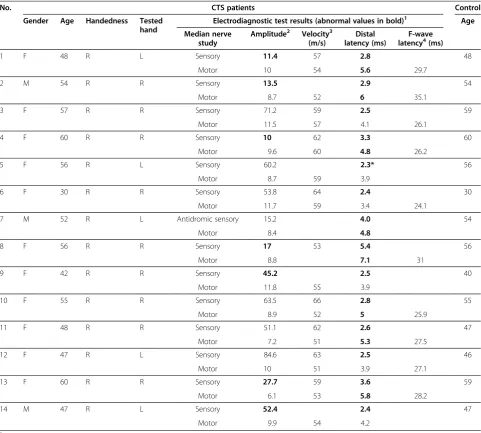
Fourteen Carpal Tunnel Syndrome (CTS) patients (51 ± 2 years old, 3 males and 11 females) and fourteen age-and gender-matched healthy controls participated as subjects in the current study. The weight and height of the subjects averaged 84.8 ± 6.7 kg and 167.4 ± 3.9 cm for CTS patients, and 79.7 ± 3.6 kg and 169.7 ± 3.6 cm for controls, respectively. Patients were diagnosed with CTS by the same neurologist (Mayo Clinic Hospital, Phoenix, AZ) based on clinical symptoms and results of electrodiagnostic tests (Table 1; normative values are shown in Table 2; ulnar motor and sensory tests revealed normal values for all patients and are not shown in Table 1). The inclusion and exclusion criteria for CTS
Table 1 Participant’s descriptive information and CTS patient’s results of electrodiagnostic tests
No. CTS patients Control
Gender Age Handedness Tested
hand
Electrodiagnostic test results (abnormal values in bold)1 Age
Median nerve study
Amplitude2 Velocity3 (m/s)
Distal latency (ms)
F-wave latency4(ms)
1 F 48 R L Sensory 11.4 57 2.8 48
Motor 10 54 5.6 29.7
2 M 54 R R Sensory 13.5 2.9 54
Motor 8.7 52 6 35.1
3 F 57 R R Sensory 71.2 59 2.5 59
Motor 11.5 57 4.1 26.1
4 F 60 R R Sensory 10 62 3.3 60
Motor 9.6 60 4.8 26.2
5 F 56 R L Sensory 60.2 2.3* 56
Motor 8.7 59 3.9
6 F 30 R R Sensory 53.8 64 2.4 30
Motor 11.7 59 3.4 24.1
7 M 52 R L Antidromic sensory 15.2 4.0 54
Motor 8.4 4.8
8 F 56 R R Sensory 17 53 5.4 56
Motor 8.8 7.1 31
9 F 42 R R Sensory 45.2 2.5 40
Motor 11.8 55 3.9
10 F 55 R R Sensory 63.5 66 2.8 55
Motor 8.9 52 5 25.9
11 F 48 R R Sensory 51.1 62 2.6 47
Motor 7.2 51 5.3 27.5
12 F 47 R L Sensory 84.6 63 2.5 46
Motor 10 51 3.9 27.1
13 F 60 R R Sensory 27.7 59 3.6 59
Motor 6.1 53 5.8 28.2
14 M 47 R L Sensory 52.4 2.4 47
Motor 9.9 54 4.2
1
Normative values are listed in Table2. Sensory studies are orthodromic except patient 7, who had an antidromic median sensory study. 2
Amplitude values for sensory studies are microvolts and motor studies are millivolts. 3,4
patients and control subjects have been reported in de-tail in our previous study [11]. Briefly, for inclusion in our study, CTS patients had to exhibit at minimum a prolonged median nerve distal sensory latency (anti-dromic or ortho(anti-dromic, relative or absolute). Eligibility for participation in our study of control subjects included absence of CTS-like symptoms. Detailed clin-ical history of CTS patients and controls was carefully reviewed and we further verified eligibility for participa-tion based on a list of exclusion criteria.aOnly patients with idiopathic CTS were included in the study. All CTS patients and controls were right-handed (self-reported). Five CTS patients were tested on their left hand and nine patients were tested on their right hand. The tested hand of control subjects was matched to the hand tested in CTS patients. All participants were naïve to the pur-pose of the study.
Apparatus
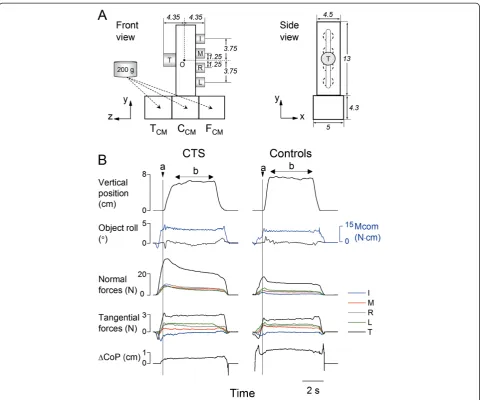
The grip device used for our experiments (Figure 1A) has been described in a previous study [11]. Briefly, one force/torque (F/T) transducer (Nano-25, ATI Industrial Automation, Apex, NC) for the thumb (T) and four F/T transducers (Nano-17), one for each finger (I, index; M, middle; R, ring; L: little), were used to measure three force and three moment-of-force components produced by each digit. The center of the thumb sensor was aligned with the midpoint between the middle and ring finger sensors. The surface of each sensor was covered with insulating circular plates. An electromagnetic pos-ition/orientation tracking sensor (Polhemus Fastrak, Colchester, VT; 0.075 mm and 0.05° resolution) was affixed on the top of the grip device to measure the ob-ject position and angle about the vertical axis in the frontal plane, i.e., object roll. Three compartments underneath the grip device were used for positioning a 200 g load to change the object center of mass (CM) to the thumb side (TCM), center (CCM), or finger side (FCM) (Figure 1A). When the load was placed on the thumb, center, or finger side of the grip device, it generated an
external moment of 12.4 and 0.7 N∙cm in the pronation direction, and 11.1 N∙cm in the supination direction about the origin ‘O’ (the approximate center of gravity of the grip device without load; Figure 1A). The mass of the grip device with the load was 545 g. Note the location of the load was not visible to the subjects during the ex-periment. Force and torque data from each sensor were acquired by five 12-bit A/D converter boards (National Instruments, Austin, TX) at a sampling frequency of 1 kHz. Collection of position data was triggered by the onset of force data acquisition and collected on a separ-ate computer at a sampling frequency of 80 Hz. Force and position data were synchronized offline for analyses. Custom software (LabVIEW 6.1, National Instruments) was used to acquire, display and store force data.
Experimental procedures
Before the experiment, subjects were asked to sit facing the grip device with the shoulder of the tested hand aligned with the grip device to ensure that the object could be comfortably grasped. Subjects were instructed to wait for a‘go’signal, after which they reached, grasped, lifted ~ 10 cm from the table, held for 4 s, and replaced the grip device on the table at a comfortable, self-selected pace. One of the experimenters visually verified that the subject contacted each sensor with the tip of a single digit. The only task requirement was to lift and hold the grip device vertically. When the mass was placed on the thumb or finger side, an external moment could cause the object to roll during the lift if not suffi-ciently compensated for. During the experiment, subjects were instructed to perform object grasping and lifting in three different CM conditions (TCM, CCM, and FCM) for 7 consecutive trials per CM condition. Thus, each sub-ject performed a total of 21 trials. Note that subsub-jects were unaware of the load location on the first trial in each CM condition, but were aware that the load loca-tion would remain the same within each block of 7 trials. The CM conditions were presented in a counterbalanced order across CTS patients. The order of CM presentation
Table 2 Normative median and ulnar nerve conduction values, Mayo Clinic Arizona EMG laboratory
Nerve Age < 60 Age≥602
Median Amplitude1 Wrist latency (ms) Amplitude1 Wrist latency (ms)
Orthodromic sensory ≥50 < 2.3 M≥17.4; F≥40.1 < 2.5
Antidromic sensory ≥15 < 3.5 M≥12.2; F≥15.9 < 3.7
Motor ≥4 < 4.5 ≥4.5 M: < 4.4; F < 3.8
Ulnar
Orthodromic sensory ≥15 ≤2.3 M≥3.4 ; F≥14.4 < 2.3
Antidromic sensory ≥10 < 3.1 M≥3.9; F≥15.9 M < 3.5; F < 3.1
Motor ≥6 < 3.6 ≥4.8 M: < 3.2; F < 2.9
1
Amplitude values for sensory studies are microvolts and motor studies are millivolts. 2
was matched between each CTS patient and his/her con-trol. Subjects were given a minimum of 10-s rest period between trials and experimental conditions to prevent pain, fatigue, or worsening of the CTS symptoms. The entire experiment lasted approximately twenty minutes. None of our subjects reported any of these adverse reactions.
Data processing
Our analysis focused on two epochs: (1) objectlift onset
and (2) objecthold. Object lift onset (“a”, Figure 1B) was
defined as the time at which the vertical position of the grip device crossed and remained above a threshold (mean + 2 SD of the signal baseline) for 200 ms. Object hold (“b”, Figure 1B) was defined as the time period be-tween the end of object lift and the onset of object re-placement on the table. The end of object lift was defined as the instant at which the absolute derivative of the object vertical position dropped less than 3% of its maximal value during object lift. The onset of the object replacement was defined as the instant at which the ab-solute derivative of the object vertical position increased
Figure 1Experimental setup and experimental variables.PanelAshows the front and side views of the grip device used for the
more than 3% of its maximal value during the object downward movement. Object lift onset was used to examine anticipatory scaling of digit forces and moment to object CM based on previous manipulations, whereas object hold was used to evaluate subjects’ability to adapt digit forces as a result of sensory feedback acquired fol-lowing object lift onset. As force transients occur at the onset of object hold, digit forces were averaged over the last 2 s of the object hold. We analyzed the following variables:
1.Digit forces.Digitnormal force(Fn) is the force component perpendicular to the grip surface (Figure1B). Grip force (FG) was defined as the sum
of Fnproduced by all digits. Digittangential force (Ftan) is the vertical force component parallel to the grip surface produced by each digit to lift and hold the object against gravity (Figure1B). The difference between Ftanproduced by the thumb and all fingers (ΔFtan) was used for analysis of moment of forces (see below).
2.Moment of forces.Moment of force (referred as
‘moment’hereafter) was defined as moments exerted in the frontal plane (yzplane) about the origin‘O’ (Figure1A). Moment analysis was used to quantify the extent to which subjects could generate a momentat object lift onsetin the direction opposite to the external moment caused by the additional load [12,13]. The task requirement of lifting the object vertically while preventing it from rolling is fulfilled when the moment generated on the object matches the external moment from lift throughout object hold. The moment generated by the subjects was defined ascompensatory moment(Mcom) and was computed as the resultant moment produced by all the digits’normal forces (normal moment; Mn) and digits tangential forces (tangential moment; Mtan). The magnitude and direction of Mnand Mtanare dependent on the FGcombined with the vertical
distance between thumb and fingers center of pressures (CoPs) applied on each side of the grip device (ΔCoP), andΔFtan, respectively. Hence, Mcomis a function of FG, ΔFtan, and ΔCoP
(for details see [11,13]). The trial-to-trial variability of anticipatory moment production was quantified as standard deviation (SD) of Mcomat object lift onset and during hold (trial 4 to 7) per CM condition.
3.Finger normal force sharing(SFn) was calculated as Fnexerted by each finger expressed as percentage of thumb Fn. SFnjwas used to denote the normalized
individual finger grip force (i= I, M, R, L). SFnis an important variable as it reflects the strategy used by subjects to modulate the resultant center of pressure
on the finger side, hence Mcommagnitude and direction.
4.Object roll.The current task required subjects to minimize object roll during object lift and object hold. Thus,peak object roll[13,14] was used as a performance measure to further quantify the effectiveness of anticipatory grasp control. 5.Object lift velocity.To assess potential group
differences in object lift velocity, we computed the first derivative of the object position from onset to end of lift. We analyzedpeak object lift velocityto determine whether CTS patients lifted the object at different velocities from control subjects.
Statistical analysis
To determine differences between CTS patients and controls in trial-to-trial adaptation of the task perform-ance, we performed 3-way analysis of variance (ANOVA) with repeated measures on(a)Mcomat object lift onset and (b) peak object roll during lift, with CM (three levels: TCM, CCM, and FCM) and Trial (seven levels: 1st through 7th trials) as within-subject factors, and Group
(two levels: CTS and controls) as the between-subject factor. Within the first 2–3 trials, both CTS and control subjects learned to develop Mcomto counteract the ex-ternal torque, and therefore reduced peak roll. Specific-ally, the above statistical analyses on Mcomand peak roll revealed 1) no trial-to-trial difference from 4th to 7th trial, and 2) no significant Group × Trial interaction (these results are described in more detail in the Results section). Therefore, for the following analyses we omit-ted the Trial factor by using the mean of each experi-mental variable averaged across the last 4 trials for each CM (trial 4 through 7). To evaluate potential group dif-ferences in object lift velocity, we performed a 2-way ANOVA with repeated measures on peak object lift ve-locity withGroupas the between-subject factor andCM
as the within-subject factor. To determine the extent to which CTS and controls differed in multi-digit force co-ordination and modulation to object CM, we performed 3-way ANOVA with repeated measures on(a)grip force (FG), (b) ΔFtan,and (c) ΔCoP withCMand Epoch(two
levels: object lift onset and object hold) as within-subject factors, andGroupas the between-subject factor. To de-termine the existence of potential group differences in trial-to-trial variability of anticipatory moment produc-tion as a funcproduc-tion of object CM, we performed 3-way ANOVAs with repeated measures on SD of Mcomwith
CM and Epoch as within-subject factors and Group as the between-subject factor. To quantify group differences in the adaptation of individual finger normal force shar-ing (SFn) to object CM, we performed 4-way ANOVAs with repeated measures with CM, Epoch and Digit
within-subject factors, andGroupas the between-subject factor. Fisher’s z transformation was performed on SFn
before performing statistical analysis. Mauchly’s test was used to test for sphericity. When sphericity assumption was violated, Greenhouse-Geisser correction was used as an alternative method. When appropriate, we performed post-hoc pairwise comparisons with Bonferroni adjust-ments. A significance level of P < 0.05 was used for all comparisons.
Results
Compensatory moment and task performance
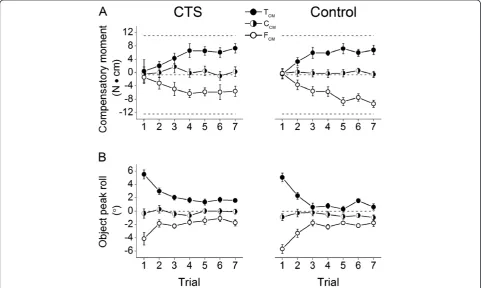
All subjects completed the lifting and holding task suc-cessfully without slipping or dropping the object while attempting to minimize object roll as instructed. CTS patients and controls lifted the object at similar veloci-ties regardless of the object center of mass condition (no significant main effect of Group,CM, or interaction be-tween these two factors; P> 0.05). To prevent object roll during object lift, subjects had to produce a compensa-tory moment cancelling the external moment before the object lift in an anticipatory fashion, i.e., at object lift onset. Figure 2A shows the compensatory moment (Mcom) produced at object lift onset and object peak
roll averaged across subjects within each group from the 1st through 7th lift for each CM condition. As expected, subjects exerted little or no Mcomon the first lift due to lack of knowledge of object mass distribution (Figure 2A), thus resulting in a relatively large object peak roll (~5° for TCM, FCM, Figure 2B). In the subsequent lifts, however, CTS patients showed similar learning ability of Mcomproduction as controls (no main effect ofGroupor
Group × Trial interaction on Mcom or peak object roll,
P > 0.05 for all comparisons) as they increased Mcomin the appropriate direction required to reduce object roll (~ 2°) after the first three lifts (main effect of Trial on object roll: F[6,156] = 52.72, P < 0.001; post-hoc tests showed Trial 1 > Trial 2 to 7 and Trials 2 and 3 > Trial 4 to 7) and especially so for TCMand FCM(main effect of
CM; for Mcom: F[2,52] = 151.451; for peak object roll: F[2,52] = 23.66; < 0.001). Specifically, after experiencing the first lift both groups of subjects learned to produced supination or pronation Mcom (positive or negative values, respectively) to minimize object roll when the mass was added on the thumb or finger side (interaction effect ofTrial×CM; for Mcom: F[12,312]= 11.135; for peak object roll: F[12,312]= 6.86; P < 0.001). These findings do not support one of our hypotheses that CTS would be
less skilled than controls in generating Mcom. Contrary to our hypothesized group-difference in trial-to-trial variability (standard deviation) of Mcom, CTS patients did not differ significantly from controls (no main effect of Group; P > 0.05) at either object lift onset or hold.
Components of compensatory moment
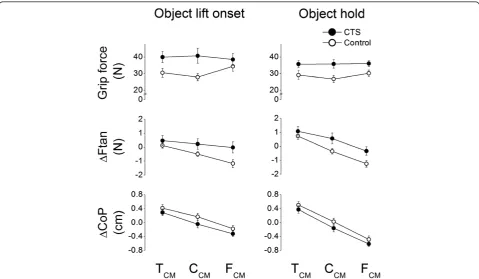
Mcom can be produced using two strategies. One strat-egy consists of changing the point of force application on each side of the grip device such that thumb and fin-ger normal forces are exerted through non-collinear cen-ters of pressure. To modulate CoP on the finger side, subjects have to change the distribution of normal forces among the fingers. A second, non-mutually exclusive strategy consists of generating asymmetrical tangential forces such that vertical forces are larger on one side of the grip device. Therefore, Mcom is dependent on the modulation of grip force, vertical distance between thumb and fingers CoPs, and the difference between thumb and the sum of the fingers tangential forces [12,13]. These variables, averaged over the last four trials of each CM condition, are shown in Figure 3 for each group and CM condition. Both groups exhibited a drop in FGfrom object lift onset to object hold phase (main
effect of Epoch: F[1,26] = 4.344, P < 0.05). However, as expected, in both object lift onset and object hold CTS patients tended to produce larger grip force than con-trols for each CM condition (Figure 3, top row; main ef-fect of Group: F[1,26] = 5.233, P < 0.05). This group difference was stronger for the CCMcondition than lat-eral CM conditions (TCM, FCM; significant interaction
Group × CM: F[2,52] = 5.511, P < 0.01). Post-hoc tests further revealed that controls modulated FG to object
CM at both object lift onset and during hold, whereas CTS patients exerted similar FGregardless of object CM
in both epochs. Both groups exhibited ΔFtan modula-tion to object CM (middle row, Figure 3; main effect of
CM: F[2,52] = 50.796, P < 0.001; post-hoc tests revealed ΔFtan TCM > CCM > FCM). However, we also found a significant interaction Group × CM (F[2,52] = 3.806,
P < 0.05). Post-hoc tests revealed that CTS patients exhibitedΔFtanmodulation (TCM> CCM> FCM) to CM during object hold but not at lift onset, whereas controls modulated ΔFtan in both epochs (middle row, left col-umn, Figure 3). Unlike FGandΔFtan, the modulation of
digit center of pressure (CoP) was similar in CTS patients and controls (bottom row, Figure 3; no main or interaction effect ofGroup) at both object lift onset and hold. Specifically, both groups showedΔCoP modulation
Figure 3Compensatory moment components.Grip force (FG), the difference between thumb and finger tangential forces (ΔFtan), and the
by exhibiting higher thumb CoP (positiveΔCoP) for the TCM condition, collinear CoPs for the CCM condition, but higher fingers’ CoP (negative ΔCoP) for the FCM condition (main effect ofCM: F[2,52]= 127.285,P< 001). Larger separation between CoPs of thumb and fingers was observed during object hold than at object lift onset in both groups and particularly for the FCM condition (bottom row, right column, Figure 3; significant inter-actionEpoch×CM: F[2,52]= 43.825,P< 0.001).
Digit normal force distribution
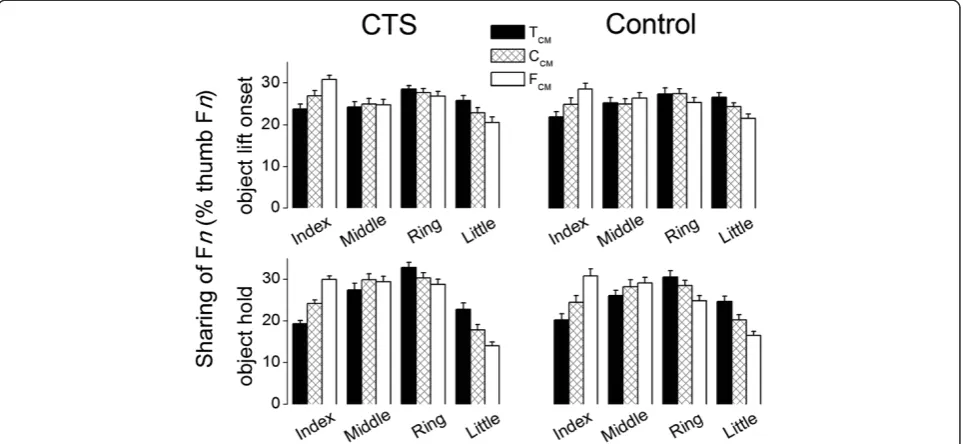
The relative relation of CoPs at thumb and fingers can be altered through 1) variation of digit initial contact position, 2) digit contact rolling along object surface, and 3) changes of normal force (Fn) distribution among fingers. The grip device used in our current study sig-nificantly limits subjects’ use of the first two strategies, therefore the above-described modulation of digit CoP to object CM resulted primarily from changing the nor-mal force distributions among the four fingers. Figure 4 shows the sharing patterns of finger Fnexpressed as per-centage of thumb Fn(SFn) averaged across the last four trials of each CM condition and subjects. At object lift onset, for the CCMcondition all subjects tended to evenly distribute normal forces among the fingers (range: 23.5±1.1% at little finger to 27.6±1% at ring finger). Dur-ing object hold, however, most Fn was exerted by the middle and ring fingers (~60% of thumb Fn). For off-centered object CM conditions, both CTS and control groups modulated the distribution of finger Fnto object CM, which was primarily reflected in the index and little
fingers normal force (main effect of Digit: F[3,78] = 10.032, P < 0.001; significant interaction Digit ×CM: F[3.6,93.61]= 58.386,P < 0.001). Specifically, when object CM was changed from the thumb side (TCM) to the finger side (FCM), both groups increased and decreased the normal force exerted by the index and little finger relative to thumb normal force, respectively, throughout the object lift onset and hold. This resulted in the lowest Fn sharing at the index and little fingers for TCM and FCM conditions, respectively. In contrast, neither group modulated the middle finger SFnas a function of object CM. The only group difference in Fn sharing patterns consisted of an epoch-dependent group difference in fin-ger Fn distribution (significant interaction Digit Epoch Group: F[3,781] = 3.377, P < 0.001). Post-hoc analysis revealed that this interaction was caused by a different pattern of re-distribution of individual finger Fn from object lift onset to object hold in controls than in CTS patients. Specifically, CTS patients significantly increased the Fn share at middle and ring fingers while reducing the share at index and little fingers from lift onset to object hold phase. In controls, however, such variation of individual finger share between two epochs only occurred at middle and little fingers.
Discussion
The present study examined the effects of CTS on an-ticipatory control and adaptation of multi-digit forces to object center of mass in a whole-hand grasping task. CTS patients were able to satisfy the task requirement of minimizing object roll during the lift by learning to exert
a compensatory moment in an anticipatory fashion to the same extent as controls. Further analysis, however, revealed that CTS patients used significantly different control strategies than healthy individuals. Specifically, patients (a) exerted larger grip force than controls throughout the task and regardless of object CM, and
(b) did not modulate the magnitude of normal forces or the distribution of tangential forces to object CM in an-ticipatory fashion as did the controls. Nevertheless, CTS patients’ ability to modulate the distribution of finger normal forces, hence the finger center of pressure, to object CM effectively compensated for the lack of modulation of digit normal and tangential forces, thus resulting in successful modulation of the compensatory moment. These findings are discussed within the frame-work of compensatory strategies associated with sen-sorimotor deficits caused by CTS that selectively affect specific aspects of fine motor control.
Multi-digit force coordination as a function of object properties in CTS
Contrary to two of our hypotheses, CTS patients learned to exert a compensatory moment at object lift onset at a similar rate and exhibited similar across-trial variability as controls (Figure 2A). By coordinating multi-digit forces to produce the required Mcom, albeit by using different strategies, both groups were able to counteract the external moment on the object, thus minimized ob-ject roll during obob-ject lift to a similar extent (Figure 2B; the relation between compensatory moment and object roll is described in our previous studies [12,13]). The ob-servation that CTS patients can modulate Mcomto ob-ject CM is consistent with the finding of a previous study that CTS patients exhibit a residual ability to modulate multi-digit forces to object mass [11]. Al-though both of these tasks shared the same task require-ment (lifting an object straight by minimizing object roll), in healthy individuals multi-digit force modulation to object mass is implemented through different digit force coordination patterns than modulation to object CM. Specifically, multi-digit force modulation to object mass can be attained through scalingall digit forces uni-formly while cancelling the net moment on the object
[15]. In contrast, digit force modulation to object CM requiresnon-uniform scaling of digit forces to generate a net moment [16,17]. Interestingly, in our previous study we found that CTS patients were less able to minimize the net moment when lifting an object with different symmetrical masses than were controls. In contrast, the present findings indicate no group differences in the ability to learn to generate an appropriate compensatory moment. This discrepancy indicates that learning ma-nipulation of objects with different masses may challenge CTS patients’ ability to coordinate multi-digit forces to
a greater extent than objects with different CM. On-going work is addressing the mechanisms underlying these differences.
CTS patients use different multi-digit force coordination strategies from controls
Contrary to what the above findings might lead one to conclude, further analyses showed that the coordination of multi-digit forces as a function of object CM in CTS patients was significantly different from controls. Specif-ically, as described in the Methods, compensatory mo-ment can be modulated through different combinations of grip force, the difference between tangential forces, and the vertical distance between thumb and finger CoP (FG,ΔFtan, andΔCoP, respectively). We found that CTS
patients modulated two of these three variables, FGand
ΔFtan, differently from controls, thus refuting our hy-pothesis that CTS patients would be able to modulate total digit normal and tangential force distribution to object CM.
Grip force
As hypothesized, CTS patients exhibited significantly larger FGthan controls (Figure 3A) both before and after
object lift onset. This finding was expected based on the results of our previous study of CTS patients [11] as well as the effects of reduced tactile sensitivity due to median nerve compression [6,18] or digit anesthesia [7-10]. Zhang et al. [11] suggested that exertion of excessive FG
might be a compensatory strategy to prevent object slip in response to the inability to form accurate sensori-motor memories from previous manipulations. Although this interpretation might also account for the present re-sult, an additional and important finding here is that FG
modulation to object CM observed in controls was not found in CTS patients. Specifically, controls exerted lar-ger FGfor the task condition that required a
compensa-tory moment (TCM and FCM) and smaller FG for the
CCM condition where zero compensatory moment was required (Figure 3A). In contrast, CTS patients did not modulate FGto object CM, even though in our previous
study the same group of patients exhibited FG
modula-tion to object mass [11]. We speculate that the present lack of FG modulation to object CM might originate
from the patients’predominant tendency of using larger than necessary FGto prevent object slip, a tendency that
was also found in our previous study. Even though this strategy is less ‘economical’ than that used by controls, CTS patients exerted the same, but larger than necessary FGacross different object CM locations to ensure
Tangential force difference
Besides FG, CTS patients differed from controls also
with respect toΔFtanmodulation to object CM. Specif-ically, controls learned to exert larger Ftanon the heav-ier side of the object before object lift and throughout object hold (Figure 3B). This observation is consistent with studies of precision grips [12,13,19]. In contrast, CTS patients were able to learn to modulate digit Ftan
to object CM during object hold, but did not use this strategy in an anticipatory fashion, i.e., at object lift onset, despite manipulating the same object across con-secutive lifts. This observation points to a feedback-driven adjustment of ΔFtanin CTS patients, hence to a potentially different strategy from that used for FG. This
behavior is also reminiscent of the reduction in FGfrom
object lift onset to hold recently described in our pre-vious study on multi-digit force modulation to object mass [11].
Vertical distance between thumb and finger CoP
In our task, the net point of force application of the normal forces exerted by each finger is an important variable because it affects the magnitude of the compen-satory moment. Specifically, the vertical distance bet-ween the (overall invariant) center of pressure of the thumb and the (variable) net center of pressure of all fingers is one of the three components, ΔCoP, whose magnitude affects the magnitude of the moment gener-ated by FG. Using the present grip device that constrains
digit placement, the primary way to modulate ΔCoP is to change the sharing of individual digit normal forces on the finger side of the device to match the normal force exerted by the thumb. At object lift onset, we found that ΔCoP was the only component of the com-pensatory moment that CTS modulated to object CM similarly to controls (Figure 3C). As expected from the above considerations and consistent with our previous work [11], CTS and controls exhibited similar normal force sharing patterns (Figure 4). It is therefore clear that, regardless of whether the goal is to scale all digit forces to object mass or share them in a non-uniform fashion to object CM, CTS patients are able to individu-ate normal forces of individual digits to the task’s mech-anical requirements. According to the mechmech-anical advantage principle, i.e., larger force production in the element(s) with longer lever arms in moment of force production [20,21], finger normal force sharing at the index and little fingers were modulated the most to ob-ject CM, this being likely due to the need modulate the net center of pressure on the finger side of the grip de-vice as a function of object CM (Figure 3). In the present study, however, the ability to modulate normal force sharing pattern was instrumental in attaining the necessary compensatory moment through modulation of
ΔCoP which, accompanied by greater FG, effectively
compensated for the above-discussed lack of modulation ofΔFtanand FGto object CM.
Mechanisms underlying modulation of multi-digit forces in CTS
Anticipatory grasp control
Both the present and previous findings reveal that CTS patients exhibit a residual ability to learn anticipatory grasp control, as indicated by the scaling of grip force to mass [11] and compensatory moment to object CM (Figure 2A) before the object is lifted. The mechanisms responsible for this behavior require (1) accurate sensing of object properties, (2) the formation and retrieval of sensorimotor memories, thus leading to (3) an appropri-ate force output modulation (see [11] for further discus-sion). With regard to acquiring feedback about object properties, CTS patients are likely to rely on residual tactile sensation from the CTS-affected digits, intact sensation from digits not affected by CTS, as well as proprioceptive feedback from muscles, tendons, and joints mostly above the wrist, i.e., extrinsic finger mus-cles and wrist musmus-cles. As discussed above, however, the modulation of normal and tangential forces in CTS patients was significantly different from controls, indi-cating that the sources of feedback spared by median nerve compression were not adequate to allow them to choose the multi-digit force coordination strategy that healthy individuals chose to implement. Specifically, un-like controls, at object lift onset patients modulated only one of the three available variables to object CM, i.e., ΔCoP. This finding can be interpreted as solving the problem of redundant degrees of freedom by ‘freezing’ some of them [22-25]. The use of this strategy might have been preferable because the modulation of one variable to CM while keeping two other variables con-stant (FGand ΔFtan) might be easier to implement than
concurrent modulation of three variables as found in controls. The selective modulation of ΔCoP also indi-cates that residual tactile and proprioceptive feedback (above) in CTS can be more effectively integrated with motor commands for generating individuated finger forces than for the fine scaling of finger force magnitude. This might account for patients’ reliance on exploiting finger force sharing pattern modulation to attain the desired compensatory moment.
Online grasp control
modulate ΔFtan to object CM at object lift onset, they did so during object hold. This suggests that the above-discussed ‘freezing of degrees of freedom’strategy used at lift-off was deliberate, as opposed to unavoidable. Spe-cifically, and as we suggested in our previous work [11], CTS patients might be particularly conservative before the dynamic phase of the task than during the static phase – this is because avoidance of object slip or roll during the first 100–150 ms of object lift relies on feed-forward control of the compensatory moment. Following object lift, however, the predictive component of com-pensatory moment control can be replaced by online feedback control. In addition to somatosensory feedback from the hand and the arm, vision of object orientation might have contributed to the modulation of ΔFtan to object CM.
Grasp control strategies in CTS
Our findings indicate that, to attain the required com-pensatory moment, controls fully took advantage of the possibility to modulate all of the three variables asso-ciated with normal and tangential force modulation as well as the vertical distance between centers of pressure. In contrast, CTS patients solved the problem of generat-ing a given compensatory moment at object lift onset by using the same normal and tangential forces regardless
of object CM location while modulating the finger nor-mal force distribution. This important finding suggests that CTS patients narrow the number of available degrees of freedom or force coordination strategies to comply with the mechanical requirement of grasp tasks resulting in a reduced flexibility in the adaptability to task conditions. The extent to which these phenomena might affect CTS patients’adaptability to manipulations that are more similar to those encountered in activities of daily living is currently under investigation.
Endnotes a
Exclusion criteria for both controls and patients were: 1) clinical history or electrodiagnostic test results indicating ulnar, radial or proximal median neuropathy, brachial plexopathy, cervical radiculopathy or polyneur-opathy, 2) orthopaedic, joint degeneration (i.e., arthritis, verified by x-ray) affecting the hand or cervical spine, 3) visual problems that would interfere with our grasp task, 4) co-existing central nervous system disease (e.g., multiple sclerosis, motor neuron disease, myasthenia gravis, Parkinson’s disease, dystonia) revealed in medical history 5) significant rigidity as assessed through range of motion testing, 6) active psychiatric illness, 7) preg-nancy, 8) thyroid disorders, 9) introduction of clinically significant dose change of medication known to affect motor or sensory function within 3 months of enroll-ment, 10) history of hand surgical interventions or
corticosteroid injections for carpal tunnel syndrome and/or other musculoskeletal hand disorder, and 11) older than 60 years.
Abbreviations
CTS: Carpal tunnel syndrome, a compression neuropathy of the median nerve that results in sensorimotor deficits in the hand.; CM: Object center of mass.; T: I, M, R, L, Thumb, index finger, middle finger, ring finger and little finger, respectively.; TCM: Experimental condition with the object center of mass shifted to the thumb side by positioning a 200 g load at the bottom of the object.; CCM: Experimental condition with the object center of mass shifted to the center of the object by positioning a 200 g load at the bottom of the object.; FCM: Experimental condition with the object center of mass shifted to the finger side by positioning a 200 g load at the bottom of the object.; Fn: Digit force component perpendicular to the grip surface (normal force).; FG: Grip force, defined as the sum of normal forces produced
by all digits.; Ftan: Digit force component parallel (vertical) to the grip surface (tangential force).;ΔFtan: The difference between tangential forces produced by thumb and all fingers.;ΔCoP: The vertical distance between center of pressure (force application point) produced by thumb and all fingers.; Mcom: Compensatory moment, defined as the resultant moment produced by all the digits with respect to the origin‘O’of the object in the frontal plane (Figure 1A).; Mn: Normal moment, defined as the component of the compensatory moment resulting from all digits normal forces with respect to the origin‘O’of the object in the frontal plane.; Mtan: Tangential moment, a compensatory moment component produced by all digits tangential forces with respect to the origin‘O’of the object in the frontal plane.; SFn: Finger normal force sharing pattern, defined as normal force exerted by each finger expressed as percentage of thumb normal force.
Competing interests
The authors declare that they have no competing interests.
Authors' contributions
WZ, JAJ, and MS contributed to the design of the study and manuscript preparation. WZ and MS performed data processing and analyses. MR, BJC, and EG contributed to subject recruitment and screening, assisted with data acquisition, and contributed to manuscript preparation. AD contributed to the statistical design and manuscript preparation. All authors read and approved the final manuscript.
Acknowledgments
This publication was made possible by grant number 1R01 HD057152 from the National Institute of Child and Health Development (NICHD) at the National Institutes of Health (NIH). Its contents are solely the responsibility of the authors and do not necessarily represent the official views of NICHD or NIH.
Author details
1School of Biological and Health Systems Engineering, Arizona State University, Tempe, AZ 85287, USA.2Department of Physical Therapy, College of Staten Island, City University of New York, Staten Island, NY 10314, USA. 3
Faculty of Kinesiology and Hotchkiss Brain Institute, University of Calgary, Calgary, AB T2N 1N4, Canada.4Mayo Clinic Hospital, Phoenix, AZ 85054, USA.
Received: 19 April 2012 Accepted: 6 November 2012 Published: 21 November 2012
References
1. Nora DB, Becker J, Ehlers JA, Gomes I:Clinical features of 1039 patients with neurophysiological diagnosis of carpal tunnel syndrome.Clin Neurol Neurosurg2004,107:64–69.
2. Welford AT:Skill learning and performance. The obtaining and processing of information: some basic issues relating to analysing inputs and making decisions.Res Q1972,43:295–311.
3. Wing AM:More grip, less force.Occup Health Saf2006,75:68–72. 4. Carpal tunnel syndrome fact sheet. National Institute of Neurological
5. Thonnard J-L, Saels P, Van den Bergh P, Lejeune T:Effects of chronic median nerve compression at the wrist on sensation and manual skills. Exp Br Res1999,128:61–64.
6. Lowe BD, Freivalds A:Effect of carpal tunnel syndrome on grip force coordination in hand tools.Ergonomics1999,42:550–564.
7. Johansson RS, Westling G:Roles of glabrous skin receptors and sensorimotor memory in automatic control of precision grip when lifting rougher or more slippery objects.Exp Brain Res1984,56:550–564. 8. Johansson RS, Hager C, Backstrom L:Somatosensory control of precision
grip during unpredictable pulling loads. III. Impairments during digital anesthesia.Exp Brain Res1992,89:204–213.
9. Augurelle AS, Smith AM, Lejeune T, Thonnard JL:Importance of cutaneous feedback in maintaining a secure grip during manipulation of hand-held objects.J Neurophysiol2003,89:665–671.
10. Monzée J, Lamarre Y, Smith AM:The effects of digital anesthesia on force control using a precision grip.J Neurophysiol2003,89:672–683. 11. Zhang W, Johnston JA, Ross MA, Smith AA, Coakley BJ, Gleason EA, Dueck
AC, Santello M:Effects of carpal tunnel syndrome on adaptation of multi-digit forces to object weight for whole-hand manipulation.PLoS One 2011,6:e27715.
12. Fu Q, Zhang W, Santello M:Anticipatory planning and control of grasp positions and forces for dexterous two-digit manipulation.J Neurosci 2010,30:9117–9126.
13. Zhang W, Gordon AM, Fu Q, Santello M:Manipulation after object rotation reveals independent sensorimotor memory representations of digit positions and forces.J Neurophysiol2010,103:2953–2964.
14. Lukos JR, Ansuini C, Santello M:Choice of contact points during multidigit grasping: effect of predictability of object center of mass location. J Neurosci2007,27:3894–3903.
15. Kinoshita H, Kawai S, Ikuta K:Contributions and co-ordination of individual fingers in multiple finger prehension.Ergonomics1995, 38:1212–1230.
16. Santello M, Soechting JF:Force synergies for multifingered grasping. Exp Brain Res2000,133:457–467.
17. Zatsiorsky VM, Latash ML:Multi-finger prehension: an overview. J Mot Behav2008,40:446–476.
18. Cole KJ, Steyers CM, Graybill EK:The effects of graded compression of the median nerve in the carpal canal on grip force.Exp Brain Res2003, 148:150–157.
19. Salimi I, Hollender I, Frazier W, Gordon AM:Specificity of internal representations underlying grasping.J Neurophysiol2000,84:2390–2397. 20. Buchanan TS, Rovai GP, Rymer WZ:Strategies for muscle activation during
isometric torque generation at the human elbow.J Neurophysiol1989, 62:1201–1212.
21. Prilutsky BI:Coordination of two- and one-joint muscles: functional consequences and implications for motor control.Motor Control2000, 4:1–44.
22. Bernstein NA:On the construction of movements. Moscow: Medgiz; 1947. 23. Bernstein NA:The co-ordination and regulation of movements. Oxford:
Pergamon Press; 1967.
24. Newell KM:Motor skill acquisition.Annu Rev Psychol1991,42:213–37. 25. Vereijken B, Van Emmerick REA, Writing HTA, Newell KM:Free(z)ing degrees
of freedom in skill acquisition.J Mot Behav1992,24:133–142.
doi:10.1186/1743-0003-9-83
Cite this article as:Zhanget al.:Effects of Carpal Tunnel Syndrome on adaptation of multi-digit forces to object mass distribution for whole-hand manipulation.Journal of NeuroEngineering and Rehabilitation2012
9:83. Submit your next manuscript to BioMed Central
and take full advantage of:
• Convenient online submission
• Thorough peer review
• No space constraints or color figure charges
• Immediate publication on acceptance
• Inclusion in PubMed, CAS, Scopus and Google Scholar
• Research which is freely available for redistribution