108
_______________________________________________________________
_______________________________________________________________
A REVIEW ON ADVANCE TECHNOLOGIES FOR DEVELOPING
TRANSDERMAL DRUG DELIVERY SYSTEMS TRANSDERMAL
PATCHES: AN ADVANCE TECHNOLOGY FOR .TRANSDERMAL
DRUG DELIVERY
Dhiren P. Shah
*1, Jogesh Agraval
2, Chainesh Shah
3*1Principal, 3Assistant Professor, 2Dept. of Pharmaceutics,
Vidyabharti Trust College of Pharmacy, Umrakh- 394345, Bardoli, Gujarat, India.
ABSTRACT
Over the past decades, developing controlled drug delivery has become increasingly important in the pharmaceutical industry. Today about 74% of drugs are taken orally and are found not to be as effective as desired. To improve such characters transdermal drug delivery system was emerged. Transdermal drug delivery represents one of the most rapidly advancing areas of novel drug delivery. Transdermal drug delivery system was introduced to overcome the difficulties of drug delivery through oral route. A transdermal patch is medicated adhesive patch that is placed on the skin to deliver a specific dose of medication through the skin and into the bloodstream. With the advent of new era of pharmaceutical dosage forms, transdermal drug delivery system (TDDS) established itself as an integral part of novel drug delivery systems. The present article reviews the polymers suitable to be formulated as transdermal system, advantages, and disadvantages of formulation design.
Key words: Transdermal drug delivery system, Transdermal patches, Design of transdermal patches.
INTRODUCTION
Transdermal drug delivery systems are defined as self-contained, discrete dosage forms which, when applied to the intact skin, deliver the drug, through the skin, at a controlled rate to the systemic circulation”
At present, the most common form of delivery of drugs is the oral route. While this has the notable advantage of easy administration, it also has significant drawbacks; namely poor bioavailability due to hepatic metabolism (first pass) and the tendency to produce rapid blood level spikes (both high and low), leading to a need for high and/or frequent dosing, which can be both cost prohibitive as well as inconvenient
Formulations on skin can be classified into two categories according to the target site of action of the containing drugs. One has systemic action after drug uptake from the cutaneous micro vascular network, and the other exhibits local effects in the skin [1-8].
TDDS is one of the systems lying under the category of controlled drug delivery, in which the aim is to
deliver the drug through skin in a predetermined and controlled rate. TDDS are adhesive-drug containing device of defined surface area that deliver a predetermined amount of drug to the surface of intact skin at programmed rate to reach the systemic circulation
The main components to a transdermal patch are:
Polymer matrix
Backbone of TDDS, which control the release of the drug. Polymer should be chemically non-reactive, should not decompose on storage, should be non-toxic, cost should not be high. E.g.- cellulose derivatives, zein, gelatin, shellac, waxes, gums, Polybutadiene, hydrin rubber, polyisobutylene, silicon rubber, nitrile, acrylonitrile, neoprene, Polyvinyl alcohol, polyvinylchloride, polyethylene, polypropylene, polyacrylate, polyamide, polyurea, polyvinylpyrrolidone, polymethylmethacrylate.
*
Corresponding Author Dhiren P. Shah E mail: [email protected]
International Journal
of
Pharmacy Review & Research
www.ijprr.com
109 Drug: The transdermal route is an extremely attractive
option for the drugs with appropriate pharmacology and physical chemistry. Transdermal patches offer much to drugs which undergo extensive first pass metabolism, drugs with narrow therapeutic window, or drugs with short half life.eg fenatyl, nitroglyceriene etc.
Permeation enhancers: increase permeability of stratum corneum so as to attain higher therapeutic levels of the drug. These are of three types-lipophilic solvent, surface active agents and two component systems. E.g. DMSO
Adhesive: increase permeability of stratum corneum so as to attain higher therapeutic levels of the drug that increase permeability of stratum corneum so as to attain higher therapeutic levels of the drug.
Backing laminates: should have low modulus or high flexibility. Eg-vinyl, polyethylene.
Release liner: Protects the patch during storage. The liner is removed prior to use. Other excipients like plasticizers and solvents.
VARIOUS METHODS FOR PREPARATION TDDS: Asymmetric TPX membrane method [9]: A prototype patch can be fabricated for this a heat sealable polyester film (type 1009, 3m) with a concave of 1cm diameter will be used as the backing membrane. Drug sample is dispensed into the concave membrane, covered by a TPX {poly(4-methyl-1-pentene)}asymmetric membrane, and sealed by an adhesive. [(Asymmetric TPX membrane preparation): These are fabricated by using the dry/wet inversion process. TPX is dissolved in a mixture of solvent (cyclohexane) and nonsolvent additives at 60°c to form a polymer solution. The polymer solution is kept at 40°C for 24 hrs and cast on a glass plate to a pre-determined thickness with a gardner knife. After that the casting film is evaporated at 50°C for 30 sec, then the glass plate is to be immersed immediately in coagulation bath [maintained the temperature at 25°C]. After 10 minutes of immersion, the membrane can be removed, air dry in a circulation oven at 50°C for 12 hrs].
Circular teflon mould method [10]: Solutions containing polymers in various ratios are used in an organic solvent. Calculated amount of drug is dissolved in half the quantity of same organic solvent. Enhancers in different concentrations are dissolved in the other half of the organic solvent and then added. Di-N-butylphthalate is added as a plasticizer into drug polymer solution. The total contents are to be stirred for 12 hrs and then poured into a circular teflon mould. The moulds are to be placed on a leveled surface and covered with inverted funnel to control solvent vaporization in a laminar flow hood model with an air speed of 0.5 m/s. The solvent is allowed to evaporate for 24 hrs. The dried films are to be stored for another 24 hrs at 25±0.5°C in a desiccators containing silica gel before evaluation to eliminate aging effects. The type films are to be evaluated within one week of their preparation.
Mercury substrate method [11]: In this method drug is dissolved in polymer solution along with plasticizer. The above solution is to be stirred for 10- 15 minutes to produce a homogenous dispersion and poured in to a leveled mercury surface, covered with inverted funnel to control solvent evaporation.
By using “IPM membranes” method: In this method drug is dispersed in a mixture of water and propylene glycol containing carbomer 940 polymer and stirred for 12 hrs in magnetic stirrer. The dispersion is to be neutralized and made viscous by the addition of triethanolamine. Buffer pH 7.4 can be used in order to obtain solution gel, if the drug solubility in aqueous solution is very poor. The formed gel will be incorporated in the IPM membrane.
By using “EVAC membranes” method: In order to prepare the target transdermal therapeutic system, 1% carbopol reservoir gel, polyethelene (PE), ethylene vinyl acetate copolymer (EVAC) membranes can be used as rate control membranes. If the drug is not soluble in water, propylene glycol is used for the preparation of gel. Drug is dissolved in propylene glycol, carbopol resin will be added to the above solution and neutralized by using 5% w/w sodium hydroxide solution. The drug (in gel form) is placed on a sheet of backing layer covering the specified area. A ratecontrolling membrane will be placed over the gel and the edges will be sealed by heat to obtain a leak proof device.
Aluminium backed adhesive film method: Transdermal drug delivery system may produce unstable matrices if the loading dose is greater than 10 mg. Aluminium backed adhesive film method is a suitable one.
APPROACHES USED IN THE DEVELOPMENT OF TDDS
Four different approaches have been utilized to obtain transdermal drug delivery systems:
Matrix diffusion-controlled systems
110 Membrane permeation-controlled systems
In this type of system, the drug reservoir is totally encapsulated in a shallow compartment moulded from a drug-impermeable metallic plastic laminate and a rate controlling membrane, which may be micro porous or non-porous (Figure 1.4). The drug molecules are permitted to release only through the rate-controlling membrane. In the drug reservoir compartment, the drug solids are either dispersed in a solid polymer matrix or suspended in an unleachable, viscous liquid medium such as silicone fluid to form a paste like suspension. A thin layer of drug compatible, adhesive polymer like silicone or polyacrylate adhesive may be applied to the external surface of the rate controlling membrane to achieve an intimate contact of the transdermal system and skin surface. The rate of drug release from this type of system can be tailored by varying the polymer composition, permeability coefficient and thickness of the rate limiting membrane, and adhesive. The major advantage of membrane permeation controlled transdermal system is the constant release of drug. However, a rare risk also exists when an accidental breakage of the rate controlling membrane can result in dose dumping or a rapid release of the entire drug content. An example is Nitroglycerin-releasing transdermal system (Transderm-Nitro/Ciba, USA) for once a day medication in angina pectoris.
Adhesive dispersion-type systems
This system is a simplified form of the membrane permeation-controlled system. Here the drug reservoir is formulated by directly dispersing the drug in an adhesive polymer eg., poly (isobutylene) or poly (acrylate) adhesive and then spreading the medicated adhesive, by solvent casting or hot melt, on to a sheet of drug impermeable metallic plastic backing to form a thin drug reservoir layer (Figure1.5).
Adhesive dispersion-type transdermal drug delivery system On the top of the drug reservoir layer, thin layers of non-medicated, rate controlling adhesive polymer of a specific permeability and constant thickness are applied to produce an adhesive diffusion controlled delivery system. Example of such (Frandol tape/ Yamanouchi, Japan) once-a-day medication of angina pectoris.
Microreservoir type or microsealed dissolution controlled systems
This system is a combination of the reservoir and matrix diffusion type drug delivery systems. The drug reservoir is formed by first suspending the drug solids in an aqueous solution of a water-soluble liquid polymer and then dispersing the drug suspension homogenously in lipophilic polymer viz. silicone elastomers by high energy dispersion technique to form several discrete, unleachable microscopic spheres of drug reservoirs (Figure 1.6).
The quick stabilization of this thermodynamically unstable dispersion is accomplished by immediately cross-linking the polymer chains in-situ, which produces a medicated polymer disc with a constant surface area and fixed thickness. Positioning the medicated disc at the
center and surrounding it with an adhesive produce a transdermal therapeutic system. Example of such delivery system is, Nitroglycerin releasing transdermal therapeutic system (Nitro disc, Searle, USA) for once a day therapy of angina pectoris is a good example of this class.
Advantages
1. It is convenient method and requires only once weekly application. Such a simple dosing regimen can aid in patient adherence to drug therapy.
2. Transdermal drug delivery can be used as an alternative route of administration to accommodate patients who cannot tolerate oral dosage forms.
3. It is of great advantage in patients who are nauseated or unconscious.
4. Drugs that cause gastrointestinal upset can be good candidates for transdermal delivery because this method avoids direct effects on the stomach and intestine.
5. Drugs that are degraded by the enzymes and acids in the gastrointestinal system may also be good targets.
6. First pass metabolism, an additional limitation to oral drug delivery, can be avoided with transdermal administration.
7. Drugs that require relatively consistent plasma levels are very good candidates for transdermal drug delivery.
Disadvantages
1. Possibility of local irritation at the site of application. 2. Erythema, itching, and local edema can be caused by the drug, the adhesive, or other excipients in the patch formulation.
3. May cause allergic reactions.
4. A molecular weight less than 500 Da is essential. 5. Sufficient aqueous and lipid solubility, a log P (octanol/water) between 1 and 3 is required for permeate to transverse SC and underlying aqueous layers.
TYPES OF TRANSDERMAL PATCHES Single-layer Drug-in-Adhesive
The adhesive layer of this system contains the drug. In this type of patch the adhesive layer not only serves to adhere the various layers together, along with the entire system to the skin, but is also responsible for the releasing of the drug. The adhesive layer is surrounded by a temporary liner and a backing.
Multi-layer Drug-in-Adhesive
The multi-layer drug-in adhesive patch is similar to the single-layer system in that both adhesive layers are also responsible for the releasing of the drug. One of the layers is for immediate release of the drug and other layer is for control release of drug from the reservoir. The multi-layer system is different however that it adds another multi-layer of drug-in-adhesive, usually separated by a membrane (but not in all cases). This patch also has a temporary liner-layer and a permanent backing.
Reservoir
111 separate drug layer. The drug layer is a liquid
compartment containing a drug solution or suspension separated by the adhesive layer. This patch is also backed by the backing layer. In this type of system the rate of release is zero order.
Matrix
The Matrix system has a drug layer of a semisolid matrix containing a drug solution or suspension. The adhesive layer in this patch surrounds the drug layer partially overlaying it. Also known as a monolithic device.
EVALUATION PARAMETERS
Thickness of the patch: The thickness of the drug loaded patch is measured in different points by using a digital micrometer and the average thickness and standard deviation is determined to ensure the thickness of the prepared patch. The thickness of transdermal film is determined by traveling microscope dial gauge, screw gauge or micrometer at different points of the film.
Weight uniformity: The prepared patches are dried at 60°c for 4hrs before testing. A specified area of patch is to be cut in different parts of the patch and weigh in digital balance. The average weight and standard deviation values are to be calculated from the individual weights.
Folding endurance: A strip of specific area is to be cut evenly and repeatedly folded at the same place till it breaks. The number of times the film could be folded at the same place without breaking gives the value of the folding endurance.
Percentage Moisture content: The prepared films are to be weighed individually and to be kept in a desiccators containing fused calcium chloride at room temperature for 24 hrs. After 24 hrs the films are to be reweighed and determine the percentage moisture content from the below mentioned formula 2, 13. % Moisture content = Initial weight – Final weight X 100 Final weight 5. Content uniformity test 10 patches are selected and content is determined for individual patches. If 9 out of 10 patches have content between 85% to 115% of the specified value and one has content not less than 75% to 125% of the specified value, then transdermal patches pass the test of content uniformity. But if 3 patches have content in the range of 75% to 125%, then additional 20 patches are tested for drug content. If these 20 patches have range from 85% to 115%, then the transdermal patches pass the test.
Moisture Uptake: Weighed films are kept in desiccators at room temperature for 24 h. These are then taken out and exposed to 84% relative humidity using saturated solution of Potassium chloride in desiccators until a constant weight is achieved. % moisture uptake is calculated as given below 11, 13. % moisture uptake = Final weight – Initial weight X 100 Initial weight
Drug content: A specified area of patch is to be dissolved in a suitable solvent in specific volume. Then the solution
is to be filtered through a filter medium and analyze the drug contain with the suitable method (UV or HPLC technique). Each value represents average of three different samples [14].
Shear Adhesion test: This test is to be performed for the measurement of the cohesive strength of an adhesive polymer. It can be influenced by the molecular weight, the degree of cross linking and the composition of polymer, type and the amount of tackifier added. An adhesive coated tape is applied onto a stainless steel plate; a specified weight is hung from the tape, to affect it pulling in a direction parallel to the plate. Shear adhesion strength is determined by measuring the time it takes to pull the tape off the plate. The longer the time take for removal, greater is the shear strength [15].
Peel Adhesion test: In this test, the force required to remove an adhesive coating form a test substrate is referred to as peel adhesion. Molecular weight of adhesive polymer, the type and amount of additives are the variables that determined the peel adhesion properties. A single tape is applied to a stainless steel plate or a backing membrane of choice and then tape is pulled from the substrate at a 180º angle, and the force required for tape removed is measured.
Water vapor transmission studies (WVT): For the determination of WVT, weigh one gram of calcium chloride and place it in previously dried empty vials having equal diameter. The polymer films are pasted over the brim with the help of adhesive like silicon adhesive grease and the adhesive was allowed to set for 5 minutes. Then, the vials are accurately weighed and placed in humidity chamber maintained at 68 % RH. The vials are again weighed at the end of every 1st day, 2nd day, 3rd day up to 7 consecutive days and an increase in weight was considered as a quantitative measure of moisture transmitted through the patch. In other reported method, desiccators were used to place vials, in which 200 mL of saturated sodium bromide and saturated potassium chloride solution were placed. The desiccators were tightly closed and humidity inside the desiccators was measured by using hygrometer. The weighed vials were then placed in desiccators and procedure was repeated. WVT = W/ ST W is the increase in weight in 24 h; S is area of film exposed (cm2); T is exposure time [16].
Rolling ball tack test: This test measures the softness of a polymer that relates to talk. In this test, stainless steel ball of 7/16 inches in diameter is released on an inclined track so that it rolls down and comes into contact with horizontal, upward facing adhesive. The distance the ball travels along the adhesive provides the measurement of tack, which is expressed in inch [17].
112 Probe Tack test: In this test, the tip of a clean probe with
a defined surface roughness is brought into contact with adhesive, and when a bond is formed between probe and adhesive. The subsequent removal of the probe mechanically breaks it. The force required to pull the probe away from the adhesive at fixed rate is recorded as tack and it is expressed in grams.
In vitro drug release studies
The paddle over disc method (USP apparatus V) is employed for assessment of the release of the drug from the prepared patches. Dry films of known thickness are to be cut into definite shape, weighed, and fixed over a glass plate with an adhesive. The glass plate is then placed in a 500-mL of the dissolution medium or phosphate buffer (pH 7.4), and the apparatus is equilibrated to 32± 0.5°C. The paddle is then set at a distance of 2.5 cm from the glass plate and operated at a speed of 50 rpm. Samples (5- mL aliquots) can be withdrawn at appropriate time intervals up to 24 h and analyzed by UV spectrophotometer or HPLC. The experiment is to be performed in triplicate and the mean value can be calculated.
In vitro skin permeation studies
An in vitro permeation study can be carried out by using diffusion cell. Full thickness abdominal skin of male Westar rats weighing 200 to 250g. Hair from the abdominal region is to be removed carefully by using a electric clipper; the dermal side of the skin is thoroughly cleaned with distilled water to remove any adhering tissues or blood vessels, equilibrated for an hour in dissolution medium or phosphate buffer pH 7.4 before starting the experiment and is placed on a magnetic stirrer with a small
magnetic needle for uniform distribution of the diffusant. The temperature of the cell is maintained at 32 ± 0.5°C using a thermostatically controlled heater. The isolated rat skin piece is to be mounted between the compartments of the diffusion cell, with the epidermis facing upward into the donor compartment. Sample volume of definite volume is to be removed from the receptor compartment at regular intervals, and an equal volume of fresh medium is to be replaced. Samples are to be filtered through filtering medium and can be analyzed spectrophotometrically or HPLC. Flux can be determined directly as the slope of the curve between the steady-state values of the amount of drug permeated (mg cm-2) vs. time in hours and permeability coefficients were deduced by dividing the flux by the initial drug load (mg cm-2).
Skin Irritation study
Skin irritation and sensitization testing can be performed on healthy rabbits (average weight 1.2 to 1.5 kg). The dorsal surface (50cm2) of the rabbit is to be cleaned and remove the hair from the clean dorsal surface by shaving and clean the surface by using rectified spirit and the representative formulations can be applied over the skin. The patch is to be removed after 24 hr and the skin is to be observed and classified into 5 grades on the basis of the severity of skin injury.
Stability studies
Stability studies are to be conducted according to the ICH guidelines by storing the TDDS samples at 40±0.5°c and 75±5% RH for 6 months. The samples are withdrawn at 0, 30, 60, 90 and 180 days and analyze suitably for the drug content.
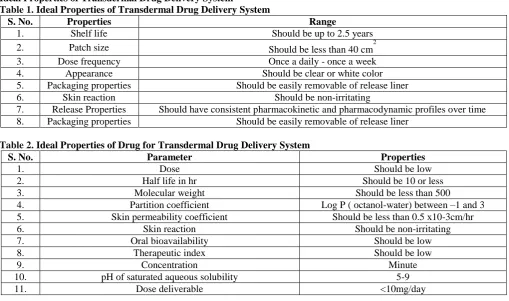
Ideal Properties of Transdermal Drug Delivery System
Table 1. Ideal Properties of Transdermal Drug Delivery System
S. No. Properties Range
1. Shelf life Should be up to 2.5 years
2. Patch size Should be less than 40 cm2
3. Dose frequency Once a daily - once a week
4. Appearance Should be clear or white color
5. Packaging properties Should be easily removable of release liner
6. Skin reaction Should be non-irritating
7. Release Properties Should have consistent pharmacokinetic and pharmacodynamic profiles over time 8. Packaging properties Should be easily removable of release liner
Table 2. Ideal Properties of Drug for Transdermal Drug Delivery System
S. No. Parameter Properties
1. Dose Should be low
2. Half life in hr Should be 10 or less
3. Molecular weight Should be less than 500
4. Partition coefficient Log P ( octanol-water) between –1 and 3
5. Skin permeability coefficient Should be less than 0.5 x10⁻³cm/hr
6. Skin reaction Should be non-irritating
7. Oral bioavailability Should be low
8. Therapeutic index Should be low
9. Concentration Minute
10. pH of saturated aqueous solubility 5-9
113 TRANSDERMAL PATCHES IN PRESENT SCINERIO: MARKETED PRODUCTS
Table 3. List of Marketed and Patented Products using Transdermal Patch
Product name Drug Manufacturer Indication
Alora Estradiol Thera tech/protocal gamble Postmenstral syndrome Andriderm Testesterone Thera tech/glaxsmith kline Hypertension Catapres-tts Clonidine Alza/beingther ingelhein Postmenstral syndrome
Clindara Estradiol Ethical holding/Wyeth-Ayerst Postmenstral syndrome Combi patch Estradiol 3m pharmaceutical/berlex labs Hormone replacement therapy
Depoint Estradiol/nore thin drone Noven , inc. / Aventis Angina pectoris
Figure 1. Matrix controlled drug delivery system Figure 2. Membrane controlled transdermal delivery sytem
Figure 3. Adhesive dispersion-type systems Figure 4. Microreservior type transdermal drug delivery system
REFERENCES
1. Mahavir singh et al. Trasdermal Drug Delivery Adhesion as a Critical parameter. Int J pharm, 4(9), 2013, 16-21.
2. Desai BG et al. Effect of enhancers on permeation kinetics of captopril for transdermal system. Asian J Pharm, 2, 2008, 35-7.
3. Mao Z et al. A new copolymer membrane controlling clonidine linear release in a transdermal drug delivery system. Int J Pharm, 332, 2006, 1-5.
4. Vyas SP et al. Controlled drug delivery concepts and advances; 1st edn; Vallabh Prakashan, New Delhi, 2002, 411-417. 5. Dipen Patel et al, Transdermal Drug Delivery System. A Review. The Pharma Innovation Journal, 1(4), 2012, 1.
6. Singh MC et al, Transdermal Drug Delivery Systems with major emphasis on Transdermal patches. A Review. Journal of Pharmacy Research, 3(2), 2010, 2537-2543.
7. Jain NK. Advances in controlled and novel drug delivery; CBS Publishers and distributors, New Delhi, 2001, 3, 108-110. 8. Sharma N Agarwal et al. A Review: Transdermal drug delivery system: A tool for novel drug delivery system.
International Journal of Drug Development and Research, 3, 2011, 70-84.
9. Rastogi, V et al. Transdermal drug delivery system: An overview. Asian Journal of Pharmaceutics, 6, 2012, 161-170. 10. Tiwary AK et al, Innovations in transdermal drug delivery: formulations and techniques. Recent Patents on Drug Delivery
& Formulation, 1, 2007, 23-36.
11. http://www.drugbank.ca/drugs/DB06725.
12. Sheth SK et al, Formulation and evaluation of taste masked oral disintegrating tablets of lornoxicam. IJPBS, 2, 2010, 1-9 13. Rajesh S et al. Taste masking of lornoxicam by polymer carrier system and formulation of oral disintegrating tablets.
114 14. Julia A et al. Lornoxicam: A Review of its pharmacology and therapeutic potential in the management of painful and
inflammatoryconditions. Drugs, 51(4), 1996, 639-57.
15. Welte SR et al, a new potent NSAID with improvedtolerability profile. Drugs of Today, 36(1), 2000, 55-76.