Research Paper:
A Comparison of Time Use Patterns and
Self-Efficacy Between Mothers of Children With Cerebral
Palsy and Mothers of Typically Developing Children
Azade Riyahi1 , Hosseinali Abdolrazaghi2 , Samira Yazdani Ghadikolaee3 , Zahra Nobakht4, 5* , Fatemeh Rafiei6
1. Department of Occupational Therapy, School of Rehabilitation, Arak University of Medical Sciences, Arak, Iran. 2. Department of Hand and Reconsructive Surgery, Sina Hospital, Tehran University of Medical Science, Tehran, Iran 3. Occupational Therapist in Social Welfare Organization, Mazandaran, Iran.
4. Pediatric Neurorehabilitation Research Center, University of Social Welfare and Rehabilitation Sciences, Tehran, Iran. 5. Department of Occupational Therapy, University of Social Welfare and Rehabilitation Sciences, Tehran, Iran.
6. Department of Biostatistics and Epidemiology, School of Health, Scientific Research Center, Tehran University of Medical Sciences, Tehran, Iran.
* Corresponding Author: Zahra Nobakht, PhD.
Address:Pediatric Neurorehabilitation Research Center, University of Social Welfare and Rehabilitation Sciences, Tehran, Iran. Tel: +98 (912) 4162784
E-mail: [email protected]
Objectives: Comparing time use patterns and self-efficacy in two groups of mothers, including mothers of children with Cerebral Palsy (CP) and mothers of children with typical development, is the main objective of this study.
Methods: This study was carried out in 2017 in Arak, Iran, on 200 mothers. Multiple sources of the evaluation, including Mothers’ Time Use Questionnaire and Sherer General Self-efficacy Questionnaire, were used. SPSS v. 22 software was used to analyze the data.
Results: The Mean±SD age of children was 4.64±1.46 years in the group of children with CP and 4.64±1.47 in the group of children with typical development. Significant differences were found between groups in the amount of time spent in various occupations, including self-care, childcare and household, leisure, rest/sleep, and work. Mothers of children with CP significantly spent a bigger proportion of time on “rest/sleep” and “childcare and household” areas (P<0.001). However, mothers of children with typical development spent significantly more time in “Self-care” (P=0.01), “Leisure” (P<0.001), and “Work” (P<0.001) areas. Also, significant differences were found between groups in the level of satisfaction.
Discussion: Lower total score of the time use questionnaire in the group of mothers of children with CP might be because of the nature of limitations and the negative burden of this type of disease in terms of socio-cultural and fewer health system services.
A B S T R A C T
Article info:
Received: 15 May 2019
Accepted: 13 Nov 2019
Available Online: 01 Dec 2019
Keywords:
Cerebral palsy, Self-efficacy,
Time use patterns
Citation: Riyahi A, Abdolrazaghi H, Yazdani Ghadikolaee S, Nobakht Z, Rafiei F. A Comparison of Time Use Patterns and Self-Efficacy Between Mothers of Children With Cerebral Palsy and Mothers of Typically Developing Children. Iranian Reha
-bilitation Journal. 2019; 17(4):305-312. http://dx.doi.org/10.32598/irj.17.4.305
: http://dx.doi.org/10.32598/irj.17.4.305
Use your device to scan
Highlights
● The occupational areas, where the mothers need to be more active to do them, could be limited to other areas like sleep/rest. This leads to an occupational imbalance in their roles and routines.
● Level of satisfaction of time use and general self-efficacy in mothers of children with CP decreased compared to mothers of typically developing children.
Plain Language Summary
The presence of a child with CP in the family imposes two pressures upon the family. First, the high cost of treatment that the family has to spend more time on employment and income-generating. Second, spending too much time to care for a child with CP may have a negative impact on family employment and income-generating. The mother, as the main caregiver, spends her time and energy for caring and doing her child’s Activity of Daily Living (ADL) and may ignore her occupational balance in ADL.
1. Introduction
erebral Palsy (CP) is the most common cause of permanent disorders in the devel
-opment of movement and posture. These permanent disorders are often accompa
-nied by associated disorders, including the disturbances of sensation and perception, cognition, communication, and or seizure [1]. The prevalence of CP in most developed countries is 2 to 3 per 1000 live births [2]. It was mentioned that children with bilateral spastic CP had the most limitations in their motor func
-tion [3]. Children with CP have lower levels of physi
-cal activity than other children [4]. Having a child with disabilities causes physical and psychological stress on the family member. Parents of children with CP usually report high levels of stress [5]. Children with CP often have delayed motor development, sensory deficits, and cognitive delays, which can bring many challenges for their caregivers [6].
Evidence suggests that mothers are mostly the main caregiver of children [7-9]. Some interventions impact parents’ physical and emotional health [10, 11]. Two studies found that some mothers feel worthless and blame themselves for their children’s problems; thus, they experience higher levels of stress, which can lead to a decrease in their mental health and quality of life [12, 13]. Approximately, 85% of the main caregivers of chil
-dren with CP are mothers [14]. The time required for the care of children with CP can impact mothers’ occupation, including leisure activities and social activities. Dalvand, Rassafiani, and Hosseini found that almost 30% of the mothers reported reduced allocated time in vocational activities because of childcare responsibilities [10].Not
having a balanced time use pattern can lead to mothers’ depression, feelings of incompetence in parenting, poor emotional parent-child relationships, and higher levels of stress in the family [15].
Occupational Therapy Practice Framework introduced 8 occupation areas, in which a person may participate during a day [16]. These domains are playing, ADL, instrumental activities of daily living, education, sleep/ rest, leisure, work, and social participation. Occupational therapy models emphasize the balance among different areas of life (self-care, sleep and rest, productivity, and leisure) [17]. Having balanced time use is defined as a proper and useful organization of everyday activities of
an individual [18].
In some cases, to promote health and quality of life, changing time use patterns is needed [19]. Self-efficacy is one of the health-related variables that may be im
-paired in this group of mothers. Self-efficacy is defined as a person’s judgment of his or her ability in performing activities to achieve specific goals [20]. High self-effica
-cy in mothers enhances their sufficien-cy and flexibility in different situations; while, mothers who have lower levels of self-efficacy often experience more challenges in their life [21]. Mothers of children with disabilities are more likely to have mental health problems than other mothers [13]. Because mothers of children with CP have less time to consider their own affairs such as leisure time and work, they are likely to have low efficacy in their stressful life experiences [22].
However, in assessing mothers with children with at
-tention deficit hyperactivity disorder, there were no sig
and mothers of children with typical development [23]. Time use is heavily influenced by culture [24]. For ex
-ample, Gevir et al. did not find a significant difference in the time allocation of different occupational areas [25]. Whereas, in other studies, time use differences have been reported in mothers of children with autism, children with CP, and mothers of typically developing children [11,14]. Here, we increased the number of participants to achieve a clear picture compared with the previous studies. The main aim of this study was to compare time use patterns and self-efficacy in mothers of children with CP and mothers of children with typical development.
2. Methods
To compare time use patterns and self-efficacy in moth
-ers of children with CP and moth-ers of children with typ
-ical development, a cross-sectional survey with matched controls was designed. It seems that there is limited evidence about the time use patterns of mothers of typi
-cally developing children in Iran compared with moth
-ers of children with CP. As an instance, Rassafiani et al. [14] found that mothers of typically developing children spent a big proportion of time on household activities and a small proportion of time on paid work. But, this evidence is limited; so, we decided to have a group of mothers of typically developing children for comparison.
Participants
The convenient sampling method was used to include 200 mothers (100 with typically developing children and 100 with children with CP) in this cross-sectional study. The inclusion criteria included 1) mothers able to read and write, 2) mothers aged 20 to 50 years, 3) children aged between 2 and 12 years, and 4) mothers with no severe depression. Mothers of children with treatment-resistant seizures and mothers, who lived alone, were excluded from the study. Informed written consent was received from the caregivers. The study was approved by the Ethics Committee for Human Experiments of the Arak University of Medical Sciences (ID: IR.ARAKMU. REC.1396.78).
Instruments
Mother’s Time Use Questionnaire
An authored designed demographic questionnaire was used to collect the participants’ characteristics. Time use patterns of mothers and their satisfaction with time use management was achieved by completing Mother’s Time Use Questionnaire [25]. The questionnaire includes
activities in 6 categories, including self-care, child-relat
-ed activities & housework, sleep/rest, leisure activities, work, and social participation [25]. Time log tables and general questions about time management of the Moth
-ers Time Use Questionnaire are reported in this study. The time log section asked mothers to report typical day activities from morning to midnight. The test-retest reli
-ability coefficient of this questionnaire was between 0.78 and 0.89 [14,25].
Sherer general self-efficacy inventory
The Sherer General Self-efficacy Questionnaire was used to compare self-efficacy in two groups. This ques
-tionnaire consists of 17 items and each item uses a Lik
-ert scale from 1 to 5 points. It includes items like “when I make plans, I am certain I can make them work” or “If I cannot do a job the first time, I keep trying until I can”. The maximum score is 87 and the minimum one is 17. The reliability of this scale in the study of Arabian et al. was 0.91 [20,26,27].
Depression, anxiety, and stress scale
This Depression, Anxiety, and Stress Scale (DASS-21) consists of 42 phrases about symptoms of negative emo
-tions [28]. Depression, Anxiety, and Stress constitute 3
subscales of this scale. The short form (DASS-21) with each subscale consisting of 7 questions was used. The participant was asked to rate the intensity of the symp
-tom in each statement based on what she experienced during the last week from 0 (without the experience of the intended symptom) to 3 (very high experience of the symptom). In the end, the obtained score was multiplied by 2, in which scores from 0 to 9 were normal, 10 to 13 indicated mild depression, 14 to 20 indicated moder
-ate depression, 21 to 27 indic-ated severe depression, and scores more than 28 indicated very severe depression. In this research, a depression subscale was used. This instrument has a reliability coefficient of 0.84 for depres
-sion scale, 0.89 for anxiety, and 0.9 for stress; its Cron
-bach’s alpha coefficient for depression is 93.03 [28-30].
Data collection
Mothers of children with CP were selected from the clients of occupational therapy clinics and mothers of children with typical development were selected from kindergarten or primary schools. Mothers who were eli
were also asked to complete the Sherer General Self-effi
-cacy questionnaire. An occupational therapist (Third au
-thor) helped the mothers to complete the questionnaires.
Data analysis
SPSS V. 22 software was used to analyze the data. Chi-square and Fisher’s exact tests were used to compare the gender of the children in the two groups and the eco
-nomic level of the families, respectively. Independent t-test was used for the age of mothers and children and the number of children in the family. Independent t-test and Mann-Whitney test were used to compare the time use categories. In all cases, the significance level was con
-sidered as P=0.05.
3. Results
The Mean±SD age of the group of children with CP and the group of children with typical development was 4.64±1.46 and 4.64±1.47 years, respectively. In the group of typically developing children, 27 (27%) were male and 73 (73%) were female, but in the group of chil
-dren with CP, 35 (35%) were male and 65 (65%) were female; 85% of children with CP were mostly distributed in levels II, III, and IV of Gross Motor Function Clas
-sification System (GMFCS). Table 1 presents the demo
-graphic characteristics of the participants.
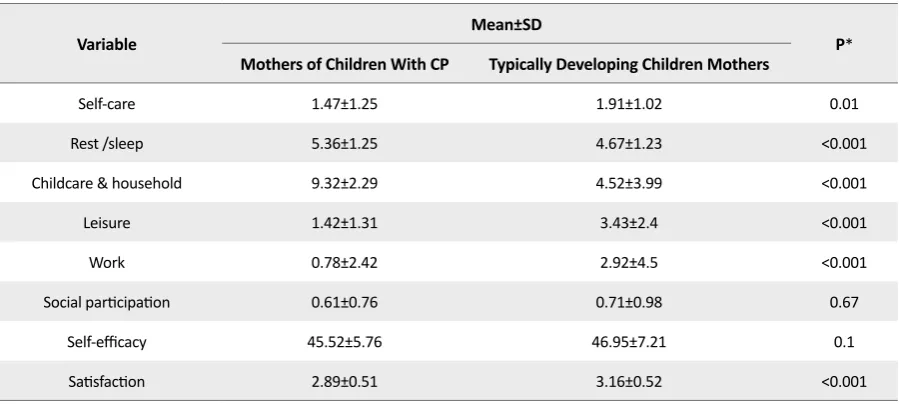
In Table 2, the time allocation, self-efficacy, and satisfac
-tion rate of time management in the mothers of the two
groups have been addressed. In the occupational areas be
-tween the two groups, there was a significant difference in the time spent in each of the 5 areas, except for social participation. There was no significant difference in self-efficacy, but this difference was significant in the level of satisfaction between the two groups (Table 3).
4. Discussion
The occupational balance will be created when the in
-dividual devotes a reasonable amount of time to each as
-pect of her occupations. Mothers who spend a significant amount of their daily time in taking care of a child with a disability are at risk of disruption of this balance [31]. In this study, the results showed that more responsibilities in caring for a child with CP along with ordinary other roles can cause time pressure for the mother. When the mothers are forced to take the role of caregiver in addi
-tion to their other responsibilities, they would inevitably have less time allocating to occupations like taking care of themselves, their work, and leisure time as McCann, Bull, and Winzenberg indicated in their systematic re
-view [32].
The participants in the group of children with CP com
-pared with mothers who had typically developing chil
-dren spent more time on sleep/rest. So, the more care
-giving is needed and the higher the degree of disability of the child is, the more restrictions, pressure, fatigue, and exhaustion are imposed upon them; thus, increasing the hours of sleep and rest can be expected [33]. When
Table 1. Distribution of demographic information in mothers of children with CP and mothers of children with typical development
Item Mothers of Children With CP Mothers of Children With Typical Development P
Education level, n (%)
Primary and middle school 38 8
-High school 41 38
-University degree 21 54
-Job status, n (%)
Full-time 0 9
-Part-time 12 18
-No job 88 73
-Economic level of family
High 2 6
0.31*
Average 90 84
Low 8 10
Age (y), Mean±SD 31.05±6.77 31.83±6.85 0.41**
mothers spend excessive time on one occupation like sleeping causes, other areas are neglected. In other stud
-ies such as Crowe et al. mothers of children with dis
-abilities spent a big proportion of time on taking care of children. Then, they could not consider reasonable time Table 2. Distribution of demographic information in children with CP and children with typical development
Item Children With CP Children With Typical Development P
Sex, n (%) Female 65 73 0.22***
Mail 35 27
GMFCS*, n (%)
I 4 --
-II 33 --
-III 23 --
-IV 29 --
-V 10 --
-Missing 1 --
-MACS**, n (%)
I 17 --
-II 38 --
-III 22 --
-IV 19 --
-V 3 --
-Missing 1 --
-Age (y), Mean±SD 4.64±1.46 4.64±1.47 0.96****
Notes: *Gross Motor Function Classification System; **Manual Ability Classification System *** Chi-Square test, **** independent t-test
Table 3. Comparing allocated time (in hours) spent on six various activities, satisfaction and self-efficacy scores in both groups
Variable Mean±SD P*
Mothers of Children With CP Typically Developing Children Mothers
Self-care 1.47±1.25 1.91±1.02 0.01
Rest /sleep 5.36±1.25 4.67±1.23 <0.001
Childcare & household 9.32±2.29 4.52±3.99 <0.001
Leisure 1.42±1.31 3.43±2.4 <0.001
Work 0.78±2.42 2.92±4.5 <0.001
Social participation 0.61±0.76 0.71±0.98 0.67
Self-efficacy 45.52±5.76 46.95±7.21 0.1
Satisfaction 2.89±0.51 3.16±0.52 <0.001
for their own leisure time [34-36]; similar results were achieved by Rassafiani et al. [14].
According to the findings of the study, the areas of leisure, work, and self-care also differed significantly between mothers in the two groups. This finding was consistent with some of the previous studies and contra
-dictory with others [14,25,34]. One of the reasons for the difference between the findings of this study and the research conducted by Rassafiani et al. can be related to the place of research. A study by Rassafiani et al. was conducted in the capital city with more capabilities and facilities for mothers, while the current study was con
-ducted in one of the provincial centers.
These findings can emphasize the importance of the context of people’s lives as an important factor in spend
-ing time. Failure to pay more attention to refresh-ing oc
-cupational areas such as leisure or areas, where moth
-ers can pay more attention to their interests and needs (work and self-care), has led to a significant difference in terms of satisfaction with time management between the two groups; it contradicted the results of Gevir et al. [25], who used same tools to measure satisfaction. In the present study, in all 3 areas (leisure, self-care, and work) mothers of children with CP spend less time, which could eventually be one of the reasons for their dissatisfaction with spending time on various occupations throughout the day. In the research by Gevir et al., there were no sig
-nificant differences between the two groups in this area. Satisfaction is an internal matter and can, therefore, play an important role in the mental and physical health of individuals.
The second part of the findings of the study was about self-efficacy, in which no significant difference was found between the mothers in the two groups. Some pre
-vious studies believe that caring for children with dis
-abilities, such as CP, can cause psychological problems in addition to placing more time stress on mothers [34, 37]. In this study, mothers of typically developing chil
-dren had better self-efficacy, but this difference was not so obvious. Children’s broad age spectrum may be one of the reasons for this indifference. Mothers, over time, are very likely to learn how to cope with problems.
Children in this study were 2 to 12 years old. Another reason to be noted is that the mothers of typically de
-veloping children also did not score a high self-efficacy score. The maximum score in Sherer’s general self-effi
-cacy questionnaire is 87; the average score of mothers of children without a disability was less than half of the maximum score. It seems that all mothers participating
in this study had a low level of self-efficacy, which re
-quires more examination of mothers, regardless of hav
-ing a child with a disability. The lack of self-efficacy dif
-ference between the two groups of mothers could also be considered as a reason for non-difference in the area of social participation. Social participation is defined as the desired engagement in community and family ac
-tivities [16]. Since the probability of confronting new
conditions in the community is much more than family circumstances and given the low level of self-efficacy, mothers prefer to participate less in social affairs.
The comparison of the two groups was limited to the working days of the week; so, possibly collecting time-use data on weekends and holidays would look different. Other limitations did not consider the level of intelligence and cognition of children in the two groups of children. Having a low cognitive level can provide more burden care for mothers. The results of this study cannot be gen
-eralized to mothers of children with other disabilities. Another limitation of the study was the lack of access to appropriate distribution in some types of population. A suggestion that can be considered for future studies is the investigation of assistance and participation of other family members and their impact on patterns of use of mothers. The use of tools that specifically address mater
-nal self-efficacy can provide more information about the mothers’ maternal role.
The presence of a child with CP in the family imposes two pressures upon the family. First, the high cost of treatment that the family has to spend more time on em
-ployment and income-generating. Second, spending too much time to care for a child with CP may have a nega
-tive impact on family employment and income-generat
-ing. The mother, as the main caregiver, spends her time and energy for caring and doing her child’s ADL and may ignore her occupational balance in ADL.
This study was a prerequisite for paying attention to improve the quality of services for caregivers and in
-crease social support for caregivers; it may ultimately lead to the development and design of efficient and ef
-fective training programs for caregivers to improve their time use patterns and their efficiency. Also, the results of the research can be used to train caregivers to balance their roles and routines.
5. Conclusion
reduces the level of satisfaction of time use and general self-efficacy in mothers of children with CP compared to the mothers of typically developing children.
Ethical Considerations
Compliance with ethical guidelines
All ethical principles were considered in this article. The participants were informed about the purpose of the research and its implementation stages; they were also assured about the confidentiality of their information; Moreover, They were allowed to leave the study when
-ever they wish, and if desired, the results of the research would be available to them.
Funding
This research did not receive any specific grant from funding agencies in the public, commercial, or not-for-profit sectors.
Authors' contributions
All authors contributed in preparing this article.
Conflict of interest
The authors declared no conflict of interest.
Acknowledgments
We would like to acknowledge all participants, includ
-ing mothers of children with CP and mothers of typically developing children.
References
[1] Bax M, Goldstein M, Rosenbaum P, Leviton A, Paneth N,
Dan B, et al. Proposed definition and classification of cerebral
palsy, April 2005. Developmental Medicine and Child Neu
-rology. 2005; 47(8):571-6. [DOI:10.1017/S001216220500112X]
[PMID]
[2] Cans C. Surveillance of cerebral palsy in Europe: A col
-laboration of cerebral palsy surveys and registers.
Develop-mental Medicine & Child Neurology. 2000; 42(12):816-24.
[DOI:10.1111/j.1469-8749.2000.tb00695.x]
[3] Soleimani F, Vameghi R, Rassafiani M, Akbar Fahimi N,
Nobakht Z. Cerebral palsy: Motor types, gross motor func
-tion and associated disorders. Iranian Rehabilita-tion Journal.
2011; 9:21-31.
[4] Zwier JN, Van Schie PE, Becher JG, Smits D-W, Gorter JW,
Dallmeijer AJ. Physical activity in young children with cer
-ebral palsy. Disability and Rehabilitation. 2010; 32(18):1501-8.
[DOI:10.3109/09638288.2010.497017] [PMID]
[5] Ketelaar M, Volman M, Gorter J, Vermeer A. Stress in par
-ents of children with cerebral palsy: What sources of stress
are we talking about? Child: Care, Health and Development.
2008; 34(6):825-9. [DOI:10.1111/j.1365-2214.2008.00876.x]
[PMID]
[6] Riyahi A, Rasafiyani M, Akbar Fahimi N, Karimloo M. Reli
-ability of the Persian Version of Manual Ability Classification System (MACS) Between Parents and Therapists in Children with Cerebral Palsy. Journal of Rehabilitation. 2012; 12(4):14-21.
[7] Craig L, Mullan K. How mothers and fathers share childcare:
A cross-national time-use comparison. American Sociological
Review. 2011; 76(6):834-61. [DOI:10.1177/0003122411427673]
[8] Hess CR, Teti DM, Hussey-Gardner B. Self-efficacy and
parenting of high-risk infants: The moderating role of parent
knowledge of infant development. Journal of Applied Devel
-opmental Psychology. 2004; 25(4):423-37. [DOI:10.1016/j.ap
-pdev.2004.06.002]
[9] Roeters A, Gracia P. Child care time, parents’ well-being,
and gender: Evidence from the American time use survey. Journal of Child and Family Studies. 2016; 25(8):2469-79.
[DOI:10.1007/s10826-016-0416-7] [PMID] [PMCID]
[10] Dalvand H, Rassafiani M, Hosseini SA. Handling in the
Children with Cerebral Palsy: A Review of Ideas and Prac
-tices (A Literature Review). Journal of Rehabilitation. 2013; 13(5):8-17.
[11] Mohammadpour M, Rassafiani M, Ahmadi Khjugh M,
Behnia F, Haghgoo H, Biglarian A. Comparing the time-use
of mothers with autistic children with that of mothers with
healthy ones. Journal of Research in Rehabilitation Sciences. 2014; 10(1):182-92.
[12] Riyahi A, Fatehi F, Rassafiani M, Moradzadeh R. Parenting
Role’s Tasks as Parents of Healthy and Disabled Children. In
-ternational Journal of Pediatrics. 2017; 5(9):5779-87.
[13] Leahy-Warren P, McCarthy G. Maternal parental self-effi
-cacy in the postpartum period. Midwifery. 2011; 27(6):802-10.
[DOI:10.1016/j.midw.2010.07.008] [PMID]
[14] Rassafiani M, Kahjoogh MA, Hosseini A, Sahaf R. Time
Use in Mothers of Children with Cerebral Palsy: A Com
-parison Study. Hong Kong Journal of Occupational Therapy.
2012; 22(2):70-4. [DOI:10.1016/j.hkjot.2012.11.001]
[15] Riyahi A, Yazdani Ghadikolaee S, Kolagar M, Azami Sarukolaii A, Abdolrazaghi H, Rafiei F, et al. Comparing the Parenting Role Tasks in Parents of Children with Mental/ Physical Disabilities. International Journal of Pediatrics. 2017; 5(6):5079-89.
[16] Roley S, Delany JV, Barrows C, Honaker D, Sava D, Tal
-ley V. Occupational therapy practice framework: Domain and process. American Journal of Occupational Therapy. 2008;
62(6):625-83. [DOI:10.5014/ajot.62.6.625] [PMID]
[17] Wagman P, Håkansson C, Jonsson H. Occupational bal
-ance: A scoping review of current research and identified knowledge gaps. Journal of Occupational Science. 2015;
[18] Backman CL. Occupational balance: Exploring the rela
-tionships among daily occupations and their influence on well-being. Canadian Journal of Occupational Therapy. 2004;
71(4):202-9. [DOI:10.1177/000841740407100404] [PMID]
[19] Larson EA. The time of our lives: The experience of tem -porality in occupation. Canadian Journal of Occupational
Therapy. 2004; 71(1):24-35. [DOI:10.1177/0008417404071001
07] [PMID]
[20] Najafi M, Foladjang M. [The relationship between self-effi -cacy and mental health among high school students(Persian)].
Daneshvar Raftar. 2007; 14(22):69-81.
[21] Jones TL, Prinz RJ. Potential roles of parental self-efficacy in parent and child adjustment: A review. Clinical
Psychology Review. 2005; 25(3):341-63. [DOI:10.1016/j.
cpr.2004.12.004] [PMID] [PMCID]
[22] Guillamón N, Nieto R, Pousada M, Redolar D, Muñoz E, Hernández E, et al. Quality of life and mental health among
parents of children with cerebral palsy: The influence of self‐
efficacy and coping strategies. Journal of Clinical Nursing.
2013; 22(11-12):1579-90. [DOI:10.1111/jocn.12124] [PMID]
[23] Gohari Z, Dehghani F, Rajabi G, Mahmoudi-Gharaei J. Par
-enting self efficacy in mothers of children with attention defi
-cit hyperactivity disorder vs. normal children. Iranian Journal
of Psychiatry. 2012; 7(2):57-60.
[24] VanLeit B, Crowe TK. Outcomes of an occupational thera -py program for mothers of children with disabilities: Impact on satisfaction with time use and occupational performance.
American Journal of Occupational Therapy. 2002;
56(4):402-10. [DOI:10.5014/ajot.56.4.402] [PMID]
[25] Gevir D, Goldstand S, Weintraub N, Parush S. A compari -son of time use between mothers of children with and
with-out disabilities. OTJR: Occupation, Participation and Health.
2006; 26(3):117-27. [DOI:10.1177/153944920602600305]
[26] Arabian A, Khodapanahi Mk, Heydari M, Saleh Sb. Re
-lationships between self efficacy beliefs, mental health and
academic achievement in colleagues. Journal of Psychology.
2005; 8(4):360-71.
[27] Asgharnejad T, Ahmadi Dm, Farzad Ve, Khodapanahi Mk. Psychometric properties of Sherer’s general self-efficacy scale. Journal of Psychology. 2006; 10(3):262-74
[28] Asgharimoghadam M, Saed F, Dibajnia P, Zangeneh J.
[Preliminary evaluation of the validity and reliability of the
Depression, Anxiety and Stress Scales (DASS) in non-clinical samples (Persian)]. Daneshvar Raftar. 2008; 1(31):23-38.
[29] Brown TA, Chorpita BF, Korotitsch W, Barlow DH. Psy
-chometric properties of the Depression Anxiety Stress Scales (DASS) in clinical samples. Behaviour Research and Therapy.
1997; 35(1):79-89. [DOI:10.1016/S0005-7967(96)00068-X]
[30] Henry JD, Crawford JR. The short‐form version of the
Depression Anxiety Stress Scales (DASS‐21): Construct va
-lidity and normative data in a large non‐clinical sample.
British Journal of Clinical Psychology. 2005; 44(2):227-39.
[DOI:10.1348/014466505X29657] [PMID]
[31] McCann D, Bull R, Winzenberg T. The daily patterns of
time use for parents of children with complex needs: A sys
-tematic review. Journal of Child Health Care. 2012;
16(1):26-52. [DOI:10.1177/1367493511420186] [PMID]
[32] Leiter V, Krauss MW, Anderson B, Wells N. The conse
-quences of caring: Effects of mothering a child with spe
-cial needs. Journal of Family Issues. 2004; 25(3):379-403.
[DOI:10.1177/0192513X03257415]
[33] Cantekin I, Kavurmacı M, Tan M. An analysis of caregiver
burden of patients with hemodialysis and peritoneal dialysis.
Hemodialysis International. 2016; 20(1):94-7. [DOI:10.1111/
hdi.12311] [PMID]
[34] Crowe TK, Florez SI. Time use of mothers with school-age
children: A continuing impact of a child’s disability. Ameri
-can Journal of Occupational Therapy. 2006; 60(2):194-203.
[DOI:10.5014/ajot.60.2.194] [PMID]
[35] Crowe TK, Michael HJ. Time use of mothers with ado
-lescents: A lasting impact of a child’s disability. OTJR: Oc
-cupation, Participation and Health. 2011; 31(3):118-26.
[DOI:10.3928/15394492-20100722-01]
[36] Curran A, Sharples P, White C, Knapp M. Time costs of
caring for children with severe disabilities compared with caring for children without disabilities. Developmental
Medi-cine and Child Neurology. 2001; 43(8):529-33. [DOI:10.1017/
S0012162201000962] [PMID]
[37] Sawyer MG, Bittman M, La Greca AM, Crettenden AD, Harchak TF, Martin J. Time demands of caring for children
with autism: What are the implications for maternal mental
health? Journal of Autism and Developmental Disorders.