arXiv:1412.8323v8 [quant-ph] 13 Dec 2017
Toolbox for reconstructing quantum theory from
rules on information acquisition
Philipp Andres Höhn
Perimeter Institute for Theoretical Physics, 31 Caroline Street North, Waterloo, Ontario, Canada N2L 2Y5 December 14, 2017
We develop an operational approach for reconstructing the quantum theory of qubit systems from elementary rules on in-formation acquisition. The focus lies on an observer O interrogating a system S with binary questions and S’s state is taken as
O’s ‘catalogue of knowledge’ about S. The mathematical tools of the framework are simple and we attempt to highlight all un-derlying assumptions. Four rules are im-posed, asserting (1) a limit on the amount of information available toO; (2) the mere existence of complementary information; (3) O’s total amount of information to be preserved in-between interrogations; and, (4) O’s ‘catalogue of knowledge’ to change continuously in time in-between interroga-tions and every consistent such evolution to be possible. This approach permits a
constructive derivation of quantum theory, elucidating how the ensuing independence, complementarity and compatibility struc-ture of O’s questions matches that of pro-jective measurements in quantum theory, how entanglement and monogamy of en-tanglement, non-locality and, more gener-ally, how the correlation structure of arbi-trarily many qubits and rebits arises. The rules yield a reversible time evolution and a quadratic measure, quantifyingO’s infor-mation about S. Finally, it is shown that the four rules admit two solutions for the simplest case of a single elementary sys-tem: the Bloch ball and disc as state spaces for a qubit and rebit, respectively, together with their symmetries as time evolution Philipp Andres Höhn: [email protected], Present address: Institute for Quantum Optics & Quantum Information, Aus-trian Academy of Sciences; and Vienna Center for Quan-tum Science and Technology, University of Vienna, Boltz-manngasse 3, 1090 Vienna, Austria
groups. The reconstruction for arbitrarily many qubits is completed in a companion paper [1] where an additional rule elimi-nates the rebit case. This approach is in-spired by (but does not rely on) the re-lational interpretation and yields a novel formulation of quantum theory in terms of questions.
1 Introduction
Tools and concepts from information theory have seen an ever growing number of applications in modern physics, often proving useful for under-standing and interpreting specific physical phe-nomena. Among a vast number of examples, black hole entropy, or more generally space-time horizon entropies, can be understood in terms of entanglement entropy [3–7], thermodynamics naturally adheres to entropic and thus informa-tional perspectives [8–12], and, above all, the en-tire field of quantum information and computa-tion is the natural physical arena for applicacomputa-tions of information theoretic tools [13].
elemen-tary operational postulates – a task which is com-pleted in the companion paper [1]. While neither this question nor the fact that one can recon-struct quantum theory from elementary axioms is new and has been extensively explored before in various contexts [14–25], we shall approach both from a novel constructive perspective and with a stronger emphasis on the conceptual content of the theory. The ultimate goal of this work is therefore very rudimentary: to redo a well estab-lished theory – albeit in a novel way which is es-pecially engineered for exposing its informational and logical structure, physical content and dis-tinctive phenomena more clearly. In other words, we shall attempt to rebuild quantum theory for qubit systems from scratch.
In such an information based context it is nat-ural to follow an operational approach, describing physics from the perspective of an observer. Ac-cordingly, we shall work under the premise that we may only speak about the information an ob-server has access to in an experiment. Our ap-proach will thus be purely operational and epis-temic (i.e. knowledge based) by construction and shall survive without ontic statements (i.e. ref-erences to ‘reality’). We shall thus say nothing about whether or not ‘hidden variables’ could give rise to the experiences of the observer. Under these circumstances we adopt an ‘inside view of physics’, holding properties of systems as being
relationally, rather than absolutely defined.
Indeed, more generally the replacement of ab-solute by relational concepts goes in hand with the establishment of universal (i.e. observer in-dependent) limits. For instance, the crucial step
from Galilean to special relativity is the realiza-tion that the speed of lightcconstitutes a univer-sal limit for information communication among
observers. The fact that all observers agree on this limit is the origin of the relativity of space and time. Similarly, the crucial step from classi-cal to quantum mechanics is the recognition that the Planck constant~establishes auniversal limit on how much simultaneous information is acces-sible to an observer. While less explicit than in the case of special relativity, this simple observa-tion suggests a relaobserva-tional character of a system’s quantum properties. More precisely, the process of information acquisition through measurement establishes an informational relation between the observer and system. Only if there was no limit
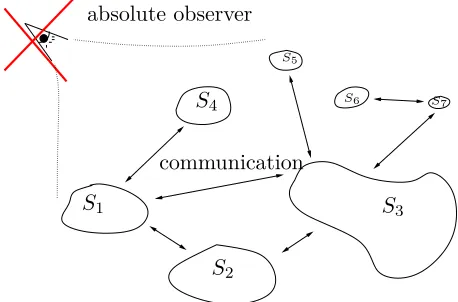
on the acquisition of information would it make sense to speak about an absolute state of a sys-tem within a purely operational approach (unless one accepts the existence of an omniscient and absolute observer as an external standard). But thanks to the existence of complementarity, im-plied by~, an observer may not access all conceiv-able properties of the system at once. Further-more, the observer can choose the experimental setting and thereby which property of the system she would like to reveal (although, clearly, she cannot choose the experimental outcome). Under our purely operational premise, we shall treat the situation as if the system does not have any other properties than those accessible to the observer at any moment of time. In particular, the system’s state is naturally interpreted as representing the observer’s state of information about the system. These ideas are in agreement with earlier propos-als in the literature [26,27] and, most specifically, with therelational interpretation of quantum me-chanics[28,29].
Of course, in order for different observers who may communicate (by physical interaction) to have a basis for agreeing on the description of a system, some of its attributes must be observer independent such as its state space, the set of possible measurements on it and possibly a limit on its information content. But without adhering to an external standard against which measure-ment outcomes and states could be defined, it is as meaningless to assert a system’s physical state to be independent of its relations to other sys-tems as it is to relate a system’s dynamics to an absolute Newtonian background time.
system and the rules governing the observer’s ac-quisition of information. More precisely, our ap-proach will be formulated in terms of the observer interrogating a system with elementary questions. While the present work has been inspired by re-lational ideas, we emphasize that the sequel does
not actually rely on them so this should not
dis-courage a reader unsympathetic with relational interpretations of quantum theory. Our approach will reconstruct and produce a novel formulation of quantum theory, but will clearly not single out the relational interpretation as ‘the right one’. However, it will support a partial interpretation, namely that quantum theory is a law book gov-erning an observer’s acquisition of information about physical systems.
This is clearly not the only physical situation to which such a relational approach applies; it likewise opens up a novel perspective on elemen-tary space-time structure which is encoded in the informational relations among different observers and can be exposed by a communication game. For instance, without presupposing a particular space-time structure – and thus without assuming
an externally given transformation group between different reference frames – one can also derive the Lorentz group as the minimal group trans-lating between different observer’s descriptions of physics from their informational relations, es-tablished by communication with quantum sys-tems [42].
More fundamentally, relational ideas are actu-ally required and commonly employed in the con-text of background independent quantum gravity approaches where the notion of coordinates dis-appears together with a classical notion of space-time within which a dynamics could be defined. Instead, one has to resort to dynamical degrees of freedom to define physical reference frames (i.e., dynamical ‘rods’ and ‘clocks’) relative to which a meaningful dynamics can be formulated in the first place. This constitutes the relational paradigm of dynamics [43–51] but goes beyond a purely informational and operational approach and thus clearly beyond the scope of this work.
The remainder of this manuscript is organized as follows.
Contents
1 Introduction 1
2 Why a(nother) reconstruction of quantum theory? 5
3 Landscape of inference theories 5
3.1 The standard landscape of generalized probabilistic theories . . . 6
3.2 A novel landscape of inference theories . . . 7
3.2.1 Questions and answers . . . 7
3.2.2 From information to probabilities: the state of S relative to O . . . 9
3.2.3 ‘Belief’ updating and ‘collapse’ of the state . . . 10
3.2.4 Elementary structure onΣand Q. . . 11
3.2.5 Logical compositions of questions and rules of inference . . . 14
3.2.6 Parametrization ofS’s state and tomography . . . 16
3.2.7 Composite systems . . . 18
3.2.8 Time evolution ofS’s state . . . 18
3.2.9 The theory landscapeL . . . 20
4 Principles for the quantum theory of qubits as rules on information acquisition 21 4.1 The rules . . . 21
4.2 Strategy for building the necessary tools and proving the claim . . . 25
5 Question structure and correlations 26 5.1 A single gbit . . . 26
5.2 Two gbits . . . 26
5.2.2 Independence, complementarity and entanglement . . . 28
5.2.3 A logical argument for the dimensionality of the Bloch-sphere . . . 31
5.2.4 An informationally complete set forN = 2 qubits . . . 32
5.2.5 An informationally complete set forN = 2 rebits . . . 33
5.2.6 Entanglement and non-local tomography for rebits . . . 34
5.2.7 A Bell scenario with questions: ruling out localhidden variables . . . 36
5.3 Three gbits . . . 38
5.3.1 Three qubits . . . 39
5.3.2 Independence and compatibility for three qubits . . . 40
5.3.3 An informationally complete set for three qubits . . . 42
5.3.4 Entanglement of three qubits and monogamy . . . 43
5.3.5 Maximal entanglement for three qubits . . . 44
5.3.6 Three rebits . . . 45
5.3.7 Independence and compatibility for three rebits . . . 45
5.3.8 An informationally complete set for three rebits . . . 47
5.3.9 Monogamy and maximal entanglement for three rebits . . . 48
5.4 Correlation structure for N = 2 gbits . . . 48
5.4.1 The logical mirror image of an inference theory . . . 49
5.4.2 Collecting the results: odd and even correlation structure for N = 2 . . . 52
5.5 The general case of N >3 gbits . . . 54
5.5.1 An informationally complete set and entanglement forN >3 qubits . . . 54
5.5.2 An informationally complete set and entanglement forN >3 rebits . . . 58
6 Information measure, time evolution and state space 59 6.1 Why the Shannon entropy does not apply here . . . 60
6.2 Elementary conditions on the measure . . . 60
6.3 The state of no information is an interior state . . . 61
6.4 Time evolution of the ‘Bloch vector’ . . . 62
6.5 Time evolution is injective . . . 63
6.6 Time evolution is also reversible . . . 64
6.7 Time evolution defines a group . . . 65
6.8 The squared length of the Bloch vector as information measure . . . 65
6.9 The set of all time evolutions is a subgroup of SO(DN) . . . 67
6.10 Pure and mixed states . . . 67
7 The N = 1 case and the Bloch ball 68 7.1 A single qubit and the Bloch ball . . . 69
7.2 A single rebit and the Bloch disc . . . 70
8 Discussion and outlook 71 8.1 An operational alternative to the wave function of the universe . . . 73
Acknowledgements 74
References 74
The first part of the article up to and including section 4 includes a substantial amount of ceptual elaborations. The second part, by con-trast, will become more technical upon putting the novel postulates to use in sections 5-7. The reconstruction for arbitrarily many qubits is per-formed in the companion article [1] where an
2 Why a(nother) reconstruction of
quantum theory?
Given that we have a beautifully working theory, one may wonder why one should bother to re-construct quantum theory from operational state-ments. There are various motivations for this en-deavour:
1. To equip the standard, physically obscure textbook axioms for quantum theory with an operational sense. In particular, in ad-dition to its empirical success, a derivation from operational statements can conceptu-ally justify the formulation of the theory in terms of Hilbert spaces, complex numbers, tensor product rule for composite systems, etc.
2. To better understand quantum theory within a larger context. By singling out quan-tum theory with operational statements one can answer the question “what makes quan-tum theory special?”, thereby establishing a bird’s-eye perspective on the formalism and conceivable alternatives.
3. It may help to understand why or why not quantum theory in its present form should be fundamental and thus why it should or should not be modified in view of attempt-ing to construct fundamental theories. By dropping or modifying some of its defining physical principles, one obtains a handle for systematic generalizations of quantum the-ory. This may also be interesting in view of quantum gravity phenomenology (away from the deep quantum regime). More fundamen-tally, the question arises whether an infor-mational perspective could be beneficial for quantum gravity in general.
4. The hope has been voiced that a clear inter-pretation of the theory may finally emerge from a successful reconstruction, in analogy to how the interpretation of special and gen-eral relativity follows naturally from its un-derlying principles [28,31,36].
It is fair to say that the hope alluded to un-der point 4 has not been realized thus far because the existing successful reconstructions [14–25] are
fairly neutral as far as an interpretation is con-cerned. While most of them emphasize the op-erational character of the theory, a particular in-terpretation of quantum theory is not strongly suggested.
The language and concepts of the present re-construction are different. It will emphasize and concretize the view (or partial interpretation) that quantum theory is a framework governing an observer’s acquisition of information about the observed system [26,28,30–41]. The new postu-lates are simple and conceptually comprehensible, concerning only the relation between an observer and the system. Due to the simplicity, the ensu-ing derivation is mathematically quite elementary and, in contrast to previous derivations, yields the formalism, state spaces and time evolution groups explicitly and in a more constructive man-ner. The disadvantage, compared to other recon-structions, is that a large number of detailed steps is required. The advantage, on the other hand, is the simplicity of the principles and mathematical tools, and the fact that the reconstruction affords natural explanations for many quantum phenom-ena, including entanglement and monogamy, and elucidates the origin of the unitary group.
3 Landscape of inference theories
The ambition of a (re-)construction of quantum theory is to derive its formalism, state spaces, time evolution groups and permissible operations from physical principles – in some rough analogy to the construction of relativity theory from the principle of relativity and the equivalence prin-ciple. But in order to formulate physical postu-lates, we clearly have to presuppose some mathe-matical structure within which a precise meaning can be given to them. (For example, also the construction of special and general relativity cer-tainly presupposed a substantial amount of me-chanical structure.)
The procedure is thus to firstly define some
landscape of theories, which hopefully contains
quantum theory and classical information theory, but within which theories are generally not
to forget about the usual – mathematically crisp but physically rather obscure – textbook axioms of quantum theory. While different theories will have the mathematical and physical structure of the landscape in common, they may have oth-erwise very different physical and informational properties; e.g., they may admit much stronger correlations than quantum theory [52], or weaker correlations as classical probability theory, they may allow exotic communication and information processing tasks to be accomplished [53,54], and so on. Secondly, given the language of this land-scape, one can attempt to formulate comprehen-sible physical statements which single out quan-tum theory fromwithinit. Going to a larger
the-ory landscape and beyond the language of Hilbert spaces is precisely what allows us to ask the ques-tion “what makes quantum theory special?” and, ultimately, to find an operational and physical justification for the usual textbook axioms and the standard Hilbert space formulations.
The goal of this section is precisely to build such an appropriate landscape of inference theo-ries both conceptually and mathematically from scratch within which we shall subsequently for-mulate those elementary rules, governing an ob-server’s acquisition of information about a sys-tem, that single out qubit quantum theory. This novel landscape of inference theories employs a different language and is conceptually distinct from the by now standard landscape of general-ized probabilistic theories (GPTs) which are com-monly employed for characterizations (or gener-alizations) of quantum theory. For contrast and to put the new tools into a larger perspective, we begin with a brief synopsis of the GPT language before we establish the landscape of inference the-ories underlying this manuscript.
3.1 The standard landscape of generalized probabilistic theories
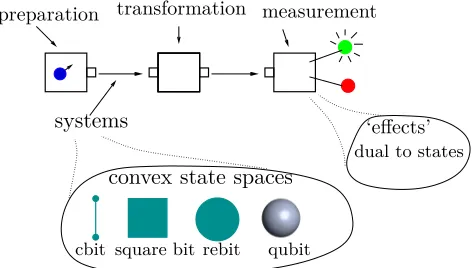
It has become a standard in the literature to employ the formalism of generalized probabilistic theories (GPTs) for operational characterizations or derivations of quantum theory [14–23,55–61]. The setup of GPTs is exclusively operational and one considers three kinds of operation devices (see figure1): (1) a preparation device which can spit out systems in some set of states defined by a vector of probabilities for the outcome of fiducial measurements. The state spaces of the systems
are necessarily required to be convex to permit convex mixtures of states. (2) A transformation device can perform physical operations on the prepared systems (e.g., a rotation) which may change the state of the system (e.g., by some group action on the state vector), but must al-low it to continue its journey to (3), a measure-ment device, which detects certain experimeasure-mental outcomes. The measurement devices are math-ematically described by so-called ‘effects’ which are assumed to be dual to, i.e. linear functionals on, the states. (For the interested reader we note, however, that Holevo has shown how the math-ematical incarnation of measurements as linear functionals on states follows from other simple operational assumptions [62].)
PSfrag replacements
preparation transformation measurement
systems
convex state spaces
cbit square bit rebit qubit
‘effects’
dual to states
Figure 1: The standard operational setup of generalized probabilistic theories with examples of allowed convex state spaces of elementary two-level systems.
Measurements and states are at the heart of
quantum theory reconstructions, employing GPT concepts in one way or another [14–23], most of which, however, are fairly abstract on account of the rather global axioms.
It is perhaps one of the great strengths of GPTs that they constitute a functional and purely op-erational framework which is interpretationally fairly neutral. It is not the ambition of this frame-work to elucidate the measurement problem, to clarify what happens to a state during a mea-surement, what probabilities are or, ultimately, how to interpret quantum mechanics (except that it highlights its operational character). As such, this framework is compatible with most interpre-tations of quantum theory.
3.2 A novel landscape of inference theories
The success of GPTs notwithstanding, we shall now change semantics and perspective to define a new landscape of theories and a novel framework for (re)constructing and understanding quantum theory. Henceforth, we shall fully engage the observer and give primacy to his acquisition of fundamentally limitedinformation from observed
systems. This will include being more explicit about what general sort of information will be available to the observer even in individual exper-imental runs. Probabilities, on the other hand, can be viewed as secondary and as a consequence of the limited information available to the ob-server – although, clearly, probabilities will as-sume a pivotal role too (after all we want to re-construct quantum theory).
3.2.1 Questions and answers
As schematically depicted in figure 2, we shall consider an observerOwho can only interact with
a system S through interrogation via questions Qi from some set of questions Q which we shall further constrain below. (At this stage we make no assumption about whetherQ is continuous or discrete.) The only information which we allow
O to acquire aboutS is by asking questions from
this setQ.
In principle, of course, Ocould conceive of and
ask S all kinds of questions, but S could not
al-ways give a meaningful answer; S may simply
not have the desired properties or carry the in-formation O is inquiring about (e.g., S may not
be complex enough, or S does not interact with
other systems carrying the information in ques-tion), or possibly the question is not a senseful one in the first place. We shall call a question Q
physicallyimplementable onS if Ocan acquire a
‘meaningful’ answer from Sto Q. An elementary
restriction onQis that any questionQi from this set beimplementable onS and that, whenever O
asksQi toS,S will give an answer toO. Clearly, Q depends on S.
But how does O know whether S will give an
answer and how can he judge whether the latter is ‘meaningful’? This requires O, like any
menter, to have developed, from previous experi-ences, a theoretical model by means of which he describes and interprets his interactions with S.
An answer can only be ‘meaningful’ in the con-text of this model such that our notion of imple-mentability is actually dependent on O’s model.
We shall come back to this model frequently. The central ingredients of this framework will thus bequestionsandanswers– andO’s
informa-tion about answer outcomes and their relainforma-tions. This will lead to a novel question calculus from which many crucial quantum properties will be derived. That is, rather than focusing mostly on probabilistic properties as in GPTs, this novel framework will connect more directly to what can be measured in experiments through its empha-sis on questions and their relations. As a conse-quence, this framework will also produce opera-tionally more compelling explanations of typical quantum phenomena.
In the sequel, we shall solely speak about the
information O has about S and, correspondingly,
about the state that O assigns to S based on
this information. Such a state of S is then
de-fined relative to O (whether or not some hidden
variables give rise to this state is a question we shall not address). The act of information ac-quisition establishes a relation between O and S
and this will be the center of our attention. (A priori, a different observer O′ may establish a different relation with S.) Although this
frame-work will also not give rise to a unique interpre-tation, it will support the partial interpretation
informa-PSfrag replacements
Preparation Interrogation
S
O
Qi?
Figure 2: Schematic representation of an observerO interrogating a systemS.
tional [31–35], or QBist [36–39] interpretations of quantum mechanics, we emphasize that this re-construction does not rely on them and should
thus not discourage readers uncomfortable with these specific interpretations.
We shall not explicitly deal with transforma-tion and measurement (‘effect’) devices as in GPTs; instead, these will be replaced more gener-ally by time evolution and questions, respectively. The set of all possible (information preserving) operations that O could perform on S can later
be identified with the set of all possible time evo-lutions of S. However, in analogy to GPTs, we
will assume thatO has access to some method of
preparing S in different ways such that S’s
an-swers toO’s questions depend on the precise way
of preparation. (O could either control himself a
preparation device or have a distinct observerO′
prepare systems for him.)
When constructing the new landscapeLof the-ories describing O’s acquisition of information
aboutS within which we shall later, in section4,
formulate our postulates, we will make a number of restrictions and assumptions. In order to fa-cilitate future generalizations and improvements of the present construction of quantum theory – which constitutes a proof of principle – we shall attempt to be as clear as possible about the as-sumptions made throughout this work.
As a starter, we would like to keep Q as sim-ple as possible, while still having non-trivial ques-tions. In particular, we do not wish to consider trivial propositions which are always true or al-ways false. We shall therefore assume the follow-ing.
Assumption 1. The set of questions Q which
we shall permit O to ask S only contains binary
questions Qi. Any Qi ∈ Q is a non-trivial
ques-tion such that S’s answer (‘yes’ or ‘no’) is not
independent of its preparation. Furthermore, any Qi ∈ Q is repeatable such that O, by asking the
same S the same Qi m times in succession will
receive m times the same answer.
The restriction to elementary ‘yes-no’-questions greatly simplifies the discussion and, ultimately, will give rise to the quantum theory of qubit systems. For instance, in quantum theory, a binary question could be ‘is the spin of the qubit up in x-direction?’ However, it will not
be too difficult to generalize Q to also consist of ternary, quaternary, quinary, etc. questions, but we shall not attempt to do so here. Since trivial questions are not considered, we already see that not even all implementable questions will be taken into account. We shall impose further restrictions on Q such that, ultimately, it will be a strict subset of all possible binary questions which O could, in principle, ask S.
Since this is an operational approach, it is fair to assume that O can record the answers to his
questions asked to any system (e.g., by writing them on a piece of paper) and that he can do statistics over the outcomes (e.g., by counting the frequency of outcomes). We shall require that every possible way of preparing S will give rise
to a particular statistics over the answers to all
Qi ∈ Q; O could test these statistics by interro-gating a large number n of identically prepared
systems1 S
a,a= 1, . . . , n, sufficiently often with
1Given the present structure, two systems S1 and S2
sys-(at least ideally) all Qi ∈ Q. In fact, this is pre-cisely howOwill operationally distinguish
differ-ent preparations of systems.
By having interrogated, in this manner, the
n always identically prepared Sa for all possible ways of preparation, we shall assume O to have
gained a ‘stable’ knowledge of thesetΣof all pos-sible answer statistics for S over Q, i.e., the
an-swer statistics for allQ∈ Qand all possible ways of preparing a systemS.2 While ideallyn→ ∞is
necessary, ‘practically’ n should be large enough
for O to develop a theoretical model of both Q and Σ up to some accuracy which agrees with his observations. It is not our ambition to clarify further what n is nor how precisely O has
de-veloped his theoretical model, instead, we shall henceforth just assume that O has puzzled out
the pair (Q,Σ). As any experimenter in an ac-tual laboratory, O shall interpret the outcomes
of his interrogations by means of his model for (Q,Σ) and he can decide whether a given ques-tion is contained in the setQor not. Henceforth, we assume that O only asks questions from Q.
Our task will be to establish what this model is, based on the ensuing assumptions and postulates.
3.2.2 From information to probabilities: the state of S relative toO
The previous subsection did not refer to the no-tion of probabilities. But it defined two prepa-rations as being identical if they give identical statistics. This permits us to regard Σ
equiva-tems or the totality of answer statistics for all possible preparations were distinct for S1 and S2 (if always the same two S1, S2 are interrogated and thereafter freshly prepared again). IfOcannotdistinguishS1andS2in this way for sufficiently many trials (ideally infinitely many), we shall call them identical. Let S1 and S2 be identi-cal andOprepare both systems with the same procedure (for instance, the setting of the preparation device is the same for both systems). If the answer statistics (frequen-cies) forS1, S2for allQi∈ Qbecome indistinguishable
af-ter sufficiently many trials (of preparing and inaf-terrogating the same systems with the same procedure), we consider these systems as ‘identically prepared’. (After completion of this work, the author was made aware that this notion is similar to the definition of ‘operational equivalence’ put forward in [63].)
2We assume the preparation method to be ideal in the
sense that it accounts for any possible answer statistics whichScan admit inO’s world for questions inQ. That is, there do not exist other methods which can prepareS in ways thatO’s method does not encompass.
lently as the set of all possible answer statistics or as the set of all (distinct) preparations.
Based on this notion, we shall now identify probabilities as degrees of belief. The ‘knowledge’ of whatΣis for a givenS will permitO to assign
probabilities to the outcomes of his questions. It is very natural for O to assign probabilities to
questions because he deals with statistical fluctu-ations and furthermore, as we shall see later, with systems about which he always has incomplete in-formation in the sense that the corresponding Σ is such that he can never know the answers to all
Qi ∈ Qat the same time.
More precisely, for a specificS and anyQi ∈ Q that he may ask the system next, O can assign a
probability yi that the answer will be ‘yes’ (or a probability ni that the answer will be ‘no’), ac-cording to
(i) O’s knowledge of Σ, and
(ii) any prior information thatOmay have about
the specific S.
Given our setup, the only prior information that
O may have about the particular S (apart from
what the associatedΣandQ are) must result ei-ther from having interrogated some ensemble of systems identically prepared to Swith some
sub-set ofQbeforehand3 and from the corresponding
accumulated statistics of the askedQj ∈ Q(e.g., that O may have recorded on a piece of paper),
or from any other prior information about the method of preparation. In particular, this previ-ous ensemble could have been empty.
For instance, if every time that O asked the
specific Qi to any of the identically prepared sys-tems gave a ‘yes’ answer before, he will assign the prior probabilityyi = 1toQiand to the next identically preparedSthat he will interrogate. If,
on the other hand, the number of ‘yes’ and ‘no’ answers to some otherQj was equal for the previ-ously identically prepared systems, Owill assign,
as a best guess, the prior probability yj = 12 to this Qj and to the next S. Similarly, for any other answer statistics, O would assignyi to the next S depending on the recorded frequencies of
‘yes’ answers. But, thanks to his knowledge of Σ and therefore of any possible relations in the
3IfOasks more than one question to anyS, the
answer statistics, O can also assign prior
proba-bilitiesykto questionsQkthat he didnotask the previous set of identically prepared systems. For example, Σ may be such that whenever S gives
a ‘yes’ answer to Qi, it will give a ‘no’ answer to an immediately following Qk. Accordingly, if O assigns a prior probabilityyi = 1 toQi as above, he will also assign a prior yk = 0to Qk without previously having asked Qk. But other relations between questions will be permitted too. In par-ticular, it may be that the information gained from the questions he previously asked the iden-tically prepared systems and the structure of Σ make it equally likely that the answer toQkasked to the next S will be ‘yes’ or ‘no’. In this case, O will assign yk = 12 to Qk that he may ask the next S. This will become more precise along the
way.
We therefore take a broadly4Bayesian perspec-tive on probabilities: O assigns probabilities to
questions according to his ‘degree of belief’ about
S. These probabilities yi are thereby relative to
the observerO. A different observerO′ may have
different information aboutS and thereby assign
different probabilities to the various outcomes of questions posed to S (for a discussion, within
quantum theory, of the consistency of different observers having different information about a system, see [28,29,64,65]). E.g., O′ could be the one preparing S. She could ‘know’ the statistics
for the specific preparation setting (from previous tests) and then send O the specifically prepared S without informing him about her knowledge.
For consistency, we tacitly assume the set Σof all possible answer statistics to coincide with the set of possible ‘beliefs’. That is, to every equiva-lence class of preparations ofS (with ‘identically
prepared’ defining the equivalence relation) there shall correspond a unique ‘belief’ {yi}Qi∈Q and
vice versa. Since the only way forOto acquire
in-formation aboutS is by interrogation with
ques-tions in Q, the prior probabilities yi that O as-signs to every Qi∈ Qencode the entire informa-tion that O has about S. Hence, we shall make
the following identification.
Definition 3.1. (State of S relative to O)
The collection of all probabilities yi ∀Qi ∈ Q is
the state of S relative to O. Accordingly, the set
4We add the qualifier ‘broadly’ here since we also allow
for the typical laboratory situation of ensembles of systems (which may or may not contain more than one element).
Σ of all possible answer statistics on Q which S admits is the state space ofS.
Of course, ultimately not all yi will be inde-pendent such that the full collection of probabili-ties will yield a redundant parametrization of the state. However, this is not important for the mo-ment and we shall come back to this shortly.
This definition of the state of a system S
ex-plicitly identifies it with the ‘state of informa-tion’ that O has acquired about S; O assigns
this state toS according to his information about
the Qi ∈ Q. As such, the state of system S
is epistemic (i.e. a ‘state of knowledge’) and a priori only meaningful relative to the observer O. The interpretation of the quantum state as
a ‘state of information’ is certainly not new and has been proposed in various ways before (see also, e.g., [36–38,40]). However, the above def-inition is closest in spirit to the ideas underly-ing Relational Quantum Mechanics [28,29] and the Zeilinger-Brukner interpretation [15,31–34] and thereby generalizes them to the landscape of theories describing O’s acquisition of information
which we are in the process to establish.
While the state ofSis thus a priori only
mean-ingful relative to O, we emphasize that both the
set of questionsQwhichOmay ask and the state
spaceΣare to be intrinsic to the systemS.
Oth-erwise, it would be difficult for two observers to agree on the description of a givenS.
3.2.3 ‘Belief’ updating and ‘collapse’ of the state
At this stage it is important to distinguish single
from multiple shot interrogations. In a
single shot interrogation O interrogates a
single system S, in some prior state, with
a number of questions from Q without
in-termediate re-preparations of S. The
defi-nite answers to these questions give O def-inite information about this specific S after
the interrogation. Furthermore, his knowl-edge of Σ and any prior knowledge of S
(acquired through previous interrogations of identically prepared systems) give him statis-tical information about any questions he did
not ask S. In conjunction, the new answers
and his prior knowledge thus determine the state of S after the interrogation. This will
constitute a posterior state update rule, and
posterior state for a single system which we
shall turn to shortly (and which clearly de-pends on the specific wayO interrogates S).
Thisposterior state ofS will reflectO’s
defi-nite information about every asked question
Qiby featuring eitheryi = 0oryi = 1due to repeatability, depending on whether the an-swer was ‘no’ or ‘yes’, respectively (assuming for now, of course, that Σ is such that the answers to the selection of questions thatO
asked can be known simultaneously). If thisposterior state does not coincide with
the prior state that O assigned to S before
the interrogation, based on his prior infor-mation about S, then S’s state has
‘col-lapsed’ relative to O during the
interroga-tion. Hence, a state ‘collapse’ only occurs if O’s posterior information about S does
not coincide with his prior information about
S, i.e. if O experienced an information gain
about S via the interrogation. We shall
therefore view a state ‘collapse’ asO’s
infor-mation gain about this specificS rather than
a ‘disturbance’5ofS(we refer the reader also
to [26,60,66,67] for a related discussion).
multiple shot interrogation O interrogates
an ensembleof identically prepared systems Sa, a = 1, . . . , n, where the interrogation of every Sa is a single shot interrogation. O will carry out such a multiple shot
interrogation to do state tomography, i.e.
to estimate the state of the ensemble {Sa} for the specific setting of preparation or, in other words, the state of any of the systems
prior to being interrogated byO.
This will also be a ‘belief’ updating, how-ever, a prior (or ensemble) state updating.
After every interrogation of a system in the ensemble,Owill assign probabilitiesyito the Qi in the manner described above. This will then define the prior state of the next sys-tem in the ensemble to be interrogated. By interrogating more and more systems,Owill
gain more and more information about the
5A ‘disturbance’ of the systemS is only meaningful if
there was an underlyingonticstate (i.e. ‘state of reality’) to which, however,Owould have no access. Here we shall merely speak about the information thatOhas access to and therefore not make any ontic statements, regarding them as excess baggage for our purposes.
ensemble state such that his assignments of theyi will fluctuate less the larger the num-ber of interrogated systems. This process gives rise to an ensemble state updating. In-dependent of this updating, the prior state thatOassigns to any individual system may
experience a ‘collapse’ during the interroga-tion of that specific system because his infor-mation about the specific system may have changed. Accordingly, O will have to
distin-guish the ensemble state from the posterior
state of any system in the ensemble. But the collection of posterior states determines the
ensemble state.
3.2.4 Elementary structure on Σ andQ
The present structure is still too rudimentary for a quantum (re)construction. We therefore need more.
Firstly, as in GPTs we will needO to be able to
assign a single prior state to any pair of identical systems whenever he flips a biased coin in order to decide which of the two systems he will in-terrogate. (Equivalently, the preparation method could involve a biased coin toss, the outcome of which determines the preparation setting.) That is, O will be permitted to build convex
combina-tions of states.
Assumption 2. The state space Σ of S is a closed convex set.
Closure ofΣis assumed because points lying in the boundary ofΣcan be arbitrarily well approx-imated by states in the interior. Perfect prepa-ration and arbitrarily good preparation are
op-erationally indistinguishable and so adding the boundary does not change the physical predic-tions [16].
Next, we need to define some elementary struc-ture on Q in order to meaningfully speak about relations among questions (and answers). To this end, we shall establish additional structure on the pair (Q,Σ). We declared in assumption 1 that there are to be no trivial questions in Qthe answers to which would be independent of S’s
preparation. We also insisted before that O will
distinguish the different ways of preparing a sys-temS– and thus the different states he can assign
that there exists a distinguished state of ‘no infor-mation’, corresponding to the situation that O’s
prior knowledge about S makes it equally likely
for him that the answer toany Q∈ Q is ‘yes’ or ‘no’.6 We note that this assumption is a
restric-tion onO’s model for the pair (Q,Σ).7
Assumption 3. There exists a special state in
Σ, called the state of no information, which is given by yi = 12, ∀Qi∈ Q.
This state shall be the prior state that O
as-signs to S (or an ensemble thereof) in a belief
updating whenever he has ‘no prior information’. For example, a distinct observer O′ may prepare
a system S and send it to O in such a way that
the latter knows only the associated Σ but not the preparation setting. In this case, as a prior,
O will assign the state of no information to S,
i.e. yi = 12, ∀Qi ∈ Q. Similarly, there will exist a special preparation setting which is such that a multiple shot interrogation on an ensemble pre-pared in this setting will give totally random an-swers toOsuch that he will assign the state of no
information to the ensemble. But note that the state of any individual systemafterthe
interroga-tion of that system willnotbe the state of no
in-formation because, through the interrogation, O
will have acquired information about that specific system (see the discussion of the state ‘collapse’ above).
Given the state of no information, we shall pre-liminarily quantify the amount of information αi that the definite answer to anyQi∈ Qdefines as one bit. Similarly, whenever yi = 12, as in the state of no information, we shall say that O has αi = 0 bitsof information aboutQi. In general, under the premise that information can neither be negative nor complex, O’s information about
6We emphasize that GPTs are more general by, in
prin-ciple, permitting state spaces which do not contain such a distinguished state. However, most operationally inter-esting GPTs do possess such a state.
7For instance, we note that on account of the
exis-tence of binary POVMs with an inherent bias, such as (E0 = 2/3·1, E1 = 1/3·1), the pair given by Q = {binary POVMs}and Σ ={unit trace density matrices} cannot satisfy this condition because no unit trace density matrix exists which yields probability 1/2 for (E0, E1). This pair will therefore ultimately not be the solution of this reconstruction. However, a subset of {binary POVMs} together with the full quantum state space will be the solution.
Qi should satisfy
0bit≤αi ≤1bit. (1) We shall not propose an explicit information mea-sure αi (as a function on Σ) here because this must follow from the rules on information acqui-sition postulated below and we shall indeed derive it therefrom later in section6.8. Until then it will be sufficient to work with this implicit notion of quantifying O’s information about any Qi.
But the questionsO can ask, and the
informa-tion that the corresponding answers define, may not be independent. However, a priori the no-tion of independence of quesno-tions, in the sense of stochastic independence, is state dependent. For example, for a pair of qubits in quantum theory the questions Q1, ‘is the spin of qubit 1 up inx
-direction?’, and Q2, ‘is the spin of qubit 2 up in
x-direction?’, are stochastically independent
rel-ative to the completely mixed state, but fully de-pendent relative to an entangled state (with cor-relation in x-direction). As a result of the state
dependence, the independence of questions may also be viewed as observer dependent. For in-stance, in quantum theory an observer O′ could sendO an entangled pure state (with correlation
inx-direction) and refuse to tellO which state it
is. Relative to O′,Q
1 and Q2 will be dependent,
but they will be independent relative to O
be-cause the latter will assign the completely mixed state to the pair prior to measurement.
Since the notion of independence of questions is state dependent, we need a distinguishedstate
in order to unambiguously define it – this is the second purpose of assumption 3and brings us in contact with a state update rule. Indeed, suppose
O acquires S in the state of no information and
poses the question Qi ∈ Q. By assumption 1, any Qi ∈ Qis repeatable such that, upon receiv-ing either the answer ‘yes’ or ‘no’, O will assign yi = 1 or yi = 0, respectively, as the probability for S giving the answer ‘yes’ if posing Qi again. The posterior state update rule, which enables O
to update his information about a specific S in
compliance with the given answers, must respect this repeatability. It depends on the details of this update rule what the probabilitiesyj for all other Qj ∈ Q is after having asked only Qi. Rather than fully specifying at this stage what this rule is, we shall simply assume that O employs one
independent if, after having asked Qi to S in the state of no information, the probability
yj = 12. That is, if the answer to Qi relative to the state of no information tellsO
‘noth-ing’ about the answer toQj. We shall require this relation to be symmetric, i.e., Qi is in-dependent ofQj if and only ifQj is indepen-dent ofQi.8 This is equivalent to saying that Qi, Qj are stochastically independent with respect to the state of no information, i.e. the joint probabilities factorize relative to the latter, p(Qi, Qj) =yi∗·yj∗ = 12 ·12 = 14. Here
p(Qi, Qj) =p(Qj, Qi) denotes the probabil-ity thatQi andQj give ‘yes’ answers if asked in sequence to the same S arriving in the
state of no information and y∗
i, yj∗ are the individual ‘yes’-probabilities in this distin-guished state.9
dependent if, after having asked Qi to S in the state of no information, the probability
yj = 0,1. That is, if the answer to Qi rel-ative to the state of no information implies also the answer toQj. Again, we require this relation to be symmetric. This is equivalent to saying that, relative to the state of no in-formation,Qi, Qj are stochastically fully de-pendent as either p(Qi, Qj) = yi∗ = y∗j =
1
2 =p(¬Qi,¬Qj) orp(Qi,¬Qj) =yi∗=y∗j =
1
2 =p(¬Qi, Qj), where¬Qis the negation of
Q.10
partially dependent if, after having asked Qi toSin the state of no information, the
prob-ability yj 6= 0,12,1. That is, if the answer to Qi relative to the state of no information
8It should be noted that, while this is true for
projec-tive measurements in quantum theory, it does not hold for generalized measurements. I thank Tobias Fritz for pointing this out.
9We emphasize that this is a definition ofmaximal
inde-pendence. For example, for a qubit two linearly indepen-dent directions~n1, ~n2 in the Bloch sphere withn1~ ·~n26= 0 would define two spin observables~n1·~σand~n2·~σwhose corresponding projectors would not be maximally inde-pendent according to this definition. The corresponding questions would be partially dependent (see below) be-cause whenever the observer knows the answer to one question, the probability for a ‘yes’ answer to the other would be distinct from 1
2.
10The most trivial example of a pair of dependent
ques-tions are clearly Q and ¬Q. But there exist less trivial ones. E.g., see theorem5.7below.
givesOpartial information about the answer
to Qj. Again, this relation is required to be symmetric. This is equivalent to saying that the joint probabilities p(Qi, Qj) relative to the state of no information do not factorize
and the answer to one question does not fully imply the answer to the other.
We shall henceforth assume that Σ is such that two questions Qi, Qj which are fully or partially dependent relative to the state of no information are also fully or partially dependent relative to any other state in Σ. These definitions of (in-)dependence depend a priori on the update rule through the joint probabilities. For our purposes it will turn out not to be necessary to fully specify this update rule.
Next, we need a notion of compatibility and complementarity. Qi, Qj are
maximally compatible ifOmay know the
an-swers to both Qi, Qj simultaneously, i.e. if there exists a state in Σsuch that yi, yj can be simultaneously 0or 1.
maximally complementary if maximal infor-mation about the answer to Qi forbids O to haveanyinformation about the answer toQj at the same time (and vice versa). That is, every state inΣwhich featuresyi = 0,1 will necessarily have yj = 12 (and vice versa).
Consequently, complementary questions are in-dependent, but independent questions are not necessarily complementary. Finally, Qi, Qj are partially compatible (or complementary) if max-imal information about one precludes maxmax-imal, but permits non-maximal information about the other.
This permits us to further constrain the up-date rule. Firstly, maximal complementarity has an obvious consequence for an update rule. Sec-ondly, we shall assume the following.
Assumption 4. If Qi, Qj are maximally
com-patible and independent then asking either shall not change O’s information about the other, re-gardless of S’s state. That is, asking Qi must
leave yj invariant – and vice versa for i, j
inter-changed.
This is to preventO from losing or gaining
question which is compatible with but indepen-dent of the first. These constraints on the update rule turn out to be sufficient for our reconstruc-tion.
Assumption 4 leads to a first result which we shall use at times: it implies what sometimes is referred to as ‘Specker’s principle’ [68] (see also [69–72]). We shall call Q1, . . . , Qn ∈ Qmutually
maximally compatible if there exists a state ofS
where the answers to all ofQ1, . . . , Qnare known simultaneously toO.
Theorem 3.2. (‘Specker’s principle’) If Q1, . . . , Qn ∈ Q are pairwise maximally
compat-ible and pairwise independent then they are also mutually maximally compatible.
Proof. Let Q1, . . . , Qn ∈ Q be pairwise
indepen-dent and pairwise maximally compatible. On ac-count of repeatability, after asking S the ques-tion Q1, O will assign the probability y1 to be
either 0 or 1, depending on the answer. O may subsequently ask S the question Q2 upon which
the probability y2 will likewise be either 0 or 1.
According to assumption 4, this will not change
y1 because, by assumption, both are maximally
compatible and independent. By the same ar-gument, upon next asking and receiving an an-swer to Q3, O will assign either y3 = 1 or
y3 = 0, while both y1, y2 are unchanged.
Re-peating this argument recursively, it is clear that
O can thereby generate a state ofS in which all
yi,i= 1, . . . , n, are either 0 or 1 which represents
a state ofS whereO knows the answers to all of
Q1, . . . , Qn.
Notice that this property is satisfied for classi-cal bit theory and in quantum theory for projec-tive, however, not for generalized measurements.
3.2.5 Logical compositions of questions and rules of inference
Given multiple questions, nothing, in principle, stops O from composing them via logical
con-nectives to all kinds of propositions which them-selves constitute questions. The issue is, however, whether he will be able to get an answer fromSto
such a question, i.e. whether it is implementable on S and thus whether it could be contained in
Q(see section3.2.1). For example, given any two questions Qi, Qj ∈ Q, O could consider the cor-relation questionQij, ‘are the answers to Qi, Qj
the same?’. Do we allow Qij to also be imple-mentable on S? Clearly, if Qi, Qj are maximally compatible, thenQij is implementable becauseO can always find the answer to the latter by asking
Qi, Qj. In this case, since Qi, Qj are simultane-ously defined relative to O, we can also write
Qij :=Qi ↔Qj, (2)
where ↔ is the logical biconditional or (XNOR).11 Q
ij will then automatically be maxi-mally compatible with both Qi, Qj.
Let us now contrast this with the situation in whichQi, Qj are (partially or maximally) comple-mentary. The structure introduced thus far does not preclude the ‘correlation question’Qij to also be implementable and, ultimately, contained inQ even ifQi, Qjare complementary. In fact, it isnot possible to decidewithout a theoretical model for describing and interpreting(Q,Σ)whetherQij is implementable onSin the case thatQi, Qjare at least partially complementary. What, however, is unambiguously clear is that for all practical pur-poses Qij will not be implementable in this case. Namely, Qij would be a statement about the cor-relation of two complementary questions Qi, Qj and O could say ‘the answers are the same’, but
he can never directly test them individually and see that they are actually ‘the same’ at the same time. Indeed, Qi, Qj, Qij would need to form a mutually (partially or maximally)
complemen-tary set. Thus, from a purely operational per-spective alone, O could never tell, even in
princi-ple, that Qij was implementable; he simply can-not get an answer to Qij which he could inter-pret, based on operationally accessible informa-tion alone, as a correlainforma-tion of the complementary
Qi, Qj.
It thus depends on the model for (Q,Σ) whether Qij is implementable when Qi, Qj are complementary. Since it is impossible for O to
settle this question operationally, it would re-quire a model which employs hidden and opera-tionally inaccessible ontic information and which is devoid of complementarity at an ontic level to conclude that Qij ∈ Q in this case. For ex-ample, Spekkens’ elegant toy model [40] and the ‘black boxes’ of [54] employ ontic states, satisfy the structure established thus far (at least at the
11That is Q
ij = ‘yes’ if Qi = Qj = ‘yes’ or ‘no’ and
epistemic level and modulo restrictions on the no-tion of convexity), and explicitly feature such a triple of questions.12 However, such a model is
in conflict with our premise of following a purely operational approach which only speaks about in-formation that O has access to via direct
inter-rogation. The model by means of which O
in-terprets the answers that he gets from S – and,
hence, the information he can acquire about S –
shall be based entirely on operational statements thatO can, in principle, check through
interroga-tion, and not on propositions that require hidden and inaccessible ontic information. Accordingly,
O’s theoretical model for Q should not contain
(a question which is logically equivalent to) Qij wheneverQi, Qjare at least partially complemen-tary.
Of course, the ‘correlation’ (represented by the XNOR connective ↔) is only one of many possi-ble logical connectives. More generally, we shall require thatO’s model forQdoes not containany
logical connectives of complementary questions. He can only logically connect questions which are maximally compatible – and thus are simultane-ously defined with respect to him – such that he could meaningfully write down a truth table for the questions to be connected and the connective question. If he cannot connect questions, he can also not ask for the connective.
Assumption 5. Let Qi, Qj ∈ Q and∗ be a
logi-cal connective. According toO’s theoretical model for Q, Qi ∗Qj is implementable if and only if Qi, Qj are maximally compatible.
12The reader familiar with Spekkens’ toy model [40] will
recall the simplest (epistemic) 1-bit system which has four ontic states ‘1’, ‘2’, ‘3’ and ‘4’. An epistemic restriction forbids an observer to know the ontic state. Instead, the epistemic states of maximal knowledge correspond to ei-ther of the following three questions (and their negations)
Q1: “1∨2” , Q2: “2∨3” ,
Q3: “2∨4” ,
where ∨ is to be read as ‘or’. Q1, Q2, Q3 are mutually complementary and it can be easily checked thatQ3 coin-cides with the ‘correlation’Q12ofQ1andQ2: it gives ‘yes’ when the (ontic) answers toQ1, Q2are equal and ‘no’ oth-erwise. This relation is cyclic: Q1 is also the ‘correlation’ Q23 of Q2, Q3 and Q2 is the ‘correlation’ Q13 ofQ1, Q3. Accordingly, there are three complementary questions for this 1-bit system, in principle the correct number for a qubit. Later in section 5.2.3, we will develop a different approach,withoutontic states, in order to reason for the three-dimensionality of the Bloch-sphere.
We recall from section3.2.1thatO’s theoretical
model for Q only contains implementable tions (but not necessarily all implementable ques-tions).
Since ∗ is only applied to connect maximally compatible questions which have also opera-tionally simultaneous truth values relative to O,
we shall allow∗to be any of the 16 binary connec-tives (or binary Boolean functions)¬,∨,∧,↔, . . .
of classical Boolean or propositional logic. We stress that assumption5is a restriction on
O’s model for Q; this assumption clearly does
not rule out that there may exist other (namely, ontic) models which also yield a consistent de-scription of O’s experiences with the systems he
is interrogating, yet which ascribe Qi∗Qj to be (logically equivalent to a question) contained in Q regardless of whether Qi, Qj are compatible or not. However, we shall not worry about such models here.
We note that assumption 5 does not only ap-ply to logical connectives of two questions, but arbitrarily many. For example, if Qi∗Qj is im-plementable (and contained in Q), according to
O’s model, then (Qi∗Qj)∗Qk is implementable too iff Qi∗Qj and Qk ∈ Q are compatible, and so on. It is also important to note that assump-tion 5 is a statement about which questions can be directlyconnected logically. It does not entail
that O, according to this model, can only form
meaningful logical expressions containing exclu-sively questions which are mutually maximally compatible. Namely, questions which are com-patible might be logically further decomposable into other questions for which different compat-ibility relations hold. For instance, it might be that Qk in the expression (Qi∗Qj)∗Qk is only compatible withQi∗Qj, yet not withQiorQj in-dividually. In this case, there is no harm in never-theless forming the expression(Qi∗Qj)∗Qkeven though, say, Qj and Qk might be complemen-tary such thatOcannot write down a truth table
first andQk can only be logically connected with the result. Thus, assumption5does admit logical expressions containing also mutually complemen-tary questions as long as the latter are notdirectly
connected through a logical connective. What as-sumption5entails is that the ordering of the exe-cution of the various logical connectives in a com-position has to respect a hierarchy which ensures that at every step two compatible subexpressions are connected. This will become important later in the reconstruction where we shall encounter concrete such examples.
This brings us to the rules of inference by means of which O may transform or evaluate
logical expressions of questions and derive logi-cal identities, e.g. to establish possible logilogi-cal re-lations among various question outcomes. The state update rules need, in particular, respect these rules of inference. Again, the rules of in-ference which O may employ depend on his
the-oretical model for (Q,Σ). For instance, in ontic models all questions will typically have simultane-ous values, in contrast to purely operational ones, which will require different rules of inference.
In line with our operational premise, we shall require that the rules of inference of O’s model
must not only be consistent withO’s experiences
with the systems he is interrogating, but also testable. In particular, any logical identities de-rived from these rules must be testable through interrogations. It is thus appropriate to call them
operational rules of inference.
Classical rules of inference require that the questions or propositions in a logical expression have truth values simultaneously. In O’s model
any truth value must be operational such that only mutually maximally compatible questions have simultaneous meaning. Nothing stops O
from applying classical rules to such kind of ques-tions. We shall thus require that it is appropri-ate for O to employ classical rules of inference,
according to Boolean logic, – and only those – for any logical expression or subexpression which only contains questions that are mutually maxi-mally compatible. In all other cases (which still must abide by assumption5), any possible rule of inference transforming the composition of ques-tions will directly involve mutually complemen-tary questions whose truth values, however, have no simultaneous operational meaning to O.
Ac-cordingly, classical rules will be operationally
in-appropriate in such cases and we shall demand more precisely the following.
Assumption 6. O’s model for Q allows him to apply exclusively classical rules of inference, ac-cording to the rules of Boolean logic, to (trans-form or evaluate) any logical expression (or subexpression of a larger expression) which is composed purely of mutually maximally compati-ble questions. This holds regardless of whether the mutually compatible questions can be logi-cally decomposed into other questions which fea-ture different compatibility relations. In all other cases, no classical rules of inference (and thus no classical logical identities) are valid.
In consequence,Ocan take any set of mutually
compatible questions and treat them, with clas-sical logic, as a Boolean algebra. The assump-tion states what is possible for composiassump-tions of compatible questions and what isnotpossible for
compositions involving also complementary ques-tions. This will become useful later in section
5.2.7 where we shall also see what ispossible for
compositions of complementary questions. We emphasize that assumption6by itself does
not severely constrain the nature of any
conceiv-able ‘hidden variconceiv-able model’ which could also con-sistently describe O’s world. However, in
con-junction with two of the subsequent quantum principles, it will rule out local ‘hidden variables’
in section 5.2.7.
3.2.6 Parametrization of S’s state and tomogra-phy
Now that we have a notion of independence on Q we can say more about the parametrization and thus representation ofS’s state relative toO. Not
allQi ∈ Qwill be necessary to describe the state; the pairwise independent questions shall be the fundamental building blocks of the landscape L of inference theories.