Original Article http://mjiri.tums.ac.ir
Medical Journal of the Islamic Republic of Iran, Vol. 27, No. 3, Aug 2013, pp. 119- 126
_______________________________________________________________________________________________________ 1. (Corresponding author) Instructor, MSc in psychology, Department of Psychology, Islamic Azad University, Karaj Branch, Karaj, Iran. [email protected]
2. MSc student, Young Researchers Club, Islamic Azad University, Bueenzahra Branch, Bueenzahra, Iran; [email protected]
Development of visual-motor perception in pupils with expressive
writing disorder and pupils without expressive writing disorder: a
comparative statistical analysis
Tahereh Mesrahi1, Mohammadreza Sedighi2
Department of Psychology, Islamic Azad University, Karaj Branch, Karaj, Iran.
Received: 30 June 2012 Revised: 7 Jan 2013 Accepted: 5 April 2013
__________________________________________________________________________________________
Abstract
Background: Learning disability is one of the most noticed subjects for behavioral specialists. Most of the learning difficulties are caused by senso-motor development and neurological organization. The main purpose of the present research is to examine the role of delayed perceptual-motor development and brain damage in origination of expressive writing disorder (EWD).
Methods: The studied sample is 89 pupils divided into two groups, one of which is pupils with expressive writing disorder (n=43) and the other is pupils without expressive writing disorder (n=46), consisted of second and third grade elementary school students. First of all, students with EWD are selected through dictation test and intelligence test, and then the two groups, students with and without EWD, would take the Bender Gestalt test. The average score of perceptual visual-motor development and brain damage of two groups is compared using T test for independent groups and χ2 test.
Results: Results show that there is a significant difference in perceptual visual-motor development between students with EWD and students without EWD (p<0.01). Based on the results, perceptual-motor development of students with EWD is lower than students without EWD. There is no significant difference in brain damage between those with EWD and healthy people, (p> 0.05).
Conclusion: Based on our findings it could be concluded that those who are relatively more developed than their peers, in terms of visual-motor perception, are more successful in education, especially in expressive writ-ing.
Keywords: perceptual disorders, writing, brain injuries, primary schools.
________________________________________________________________________________________
Introduction
Learning disability is one of the most no-ticed subjects for behavioral specialists. UNESCO estimates that about 10-15 % of children around the world are counted un-der the category of children with special needs, and about 8 % of them are those with learning disorder (1). National consul-tancy committee, in the case of disabled children, gives the following definition for learning disabilities:
Children with learning disability show their disability in one or more basic
psy-chological processes related to understand-ing or usunderstand-ing oral or written language. Rep-resentations of this disability may appear in the form of disorders in listening, thinking, speaking, reading, writing, spelling, or cal-culating. These disorders are found to be as consequences of circumstances such as perceptual flaw, brain lesion, minimal brain dysfunction, dyslexia, dysphasia, etc. Their disability in learning is not the one primari-ly related to vision, listening, motor defi-ciencies, mental retardation, affective dis-tress and lack of environmental equipment (2).
Visual motor perception development andexpressive writing disorder
120 MJIRI, Vol. 27, No. 3, Summer, Aug 2013, pp. 119-126 http://mjiri.tums.ac.ir
Considering the above definition, learning disabilities can be divided into three main categories: dyslexia, dyscalculia, dysgraph-ia (3). Students with specific learning disa-bility, from this point of view, are reported to constitute 4 to 12 % of all students (4).
Some students have normal intelligence but are disabled in reading, writing, speak-ing, mathematical perception, etc. and come to a weak overall educational func-tion. Children with learning disability are in middle to top level of intelligence, but face apparent problems in learning some skills. They also have some other abnormal signs including perceptual disorders in one or more sensual dimension, disability in unify-ing received sensual information, and dis-order in sensual-motor coordination. Most of these sensual-motor and perceptual dis-orders are in direct relationship with learn-ing difficulties (5). Accordlearn-ing to D.S.M III R, expressive writing disorder is a disorder in skill learning that is characterized by weak function in writing and composing (spelling) (6). The classification of psycho-logical disorders DSM IV points to the overlap of this disorder with educational affairs that demand composing written texts (e.g. editing and rewriting sentences, and justified paragraphs) and also the signifi-cant lower position of writing skills than assessed intelligence and education which is expected from a certain age (APA, 1994).
One of the well-known theories in clarify-ing learnclarify-ing disabilities is visual-motor model by Getman (7). Getman makes em-phasis on visual development in his model. He focuses on motor development and be-lieves that it's the basis for perceptual and cognitive development. Actually, motor system has a mutual connection with learn-ing. He imagines some levels for learning, which comprise motor and reflexive sys-tem. He believes that a learning program for children could be useful when it moves them to cognitive level after passing motor and perceptual levels successfully. If these programs do not look at those levels as their basis, they would not work and
learn-ing in cognitive level remains volatile (2). Another theoretician in learning problems is Carl Delacato. He related most of the learning difficulties to inappropriate senso-motor development and neurological organ-ization. Delacato theory is generally based on movement and sense. It means that chil-dren who do not correctly sense the world (not to see or hear appropriately), do not have enough efficiency in human properties like intelligence, speech, etc.; and this ap-propriate sensation is highly affected by performing moves such as crawling and creeping in the right time and correctly; and simultaneous and concordant development of these moves with the five senses results in appropriate and perfect development of brain. Therefore whenever stages of nerv-ous development have not been passed cor-rectly and there have not been coordination and cooperation between moves and senses the individual would face learning difficul-ties (8).
Clements discusses a characteristic which is most related to minor brain damage, one of which is special learning disabilities (reading and writing) (1). In Taylor's (9) view damage to motor cortex not only causes average deficiencies in motor con-trol, but may lead to other complications like slow-wittedness and weak learning in children (10). Sherrington has renounced that motor system is the first nervous sys-tem that develops and prepares a basis for later perceptual development (11). Some specialists in learning disorders focus on perceptual development, delicate move-ments and visual-motor coordination and believe that writing is a composition of vis-ual and motor skills in form of an integrat-ed whole. In fact delay in concordant de-velopment of visual-motor aspects leads to writing disability (12). Many researchers have confirmed the important role of per-ceptual- motor skills in child development and announced that senso-motor skills make up the basis for mental development as are indicated in the literature briefly.
In this research, expressive writing disor-der (Farsi dictation) has made the basis for
T. Mesrahi, et al.
121
MJIRI, Vol. 27, No. 3, Summer, Aug 2013, pp. 119-126 http://mjiri.tums.ac.ir
work. EWD or writing disability is one of learning disabilities that students show ap-parent educational weakness in dictation. In this disorder students commit errors by misplacing letters, mistaking punctuations, reversing letters and works, and wrong spelling. Such students also commit gram-matical errors in writing compositions.
Assessing and analyzing the mentioned theories and studies need time and full view. It is simplistic to accept that brain damage is the only cause of learning disor-der. As in many cases a psychological phe-nomenon maybe affected by multiple fac-tors. In other words, maybe interplay of various biological, psychological and so-cio-cultural factors play a role in formation of psychological phenomena. Another analysis is that maybe brain damage has a primary role in occurrence of learning disa-bility and affects the function of cognitive acts, but other peripheral factors aggravate disorder and make more problems in func-tion of psychological activities.
During last century human’s knowledge have been increased about learning ties, but in clarifying causes of this disabili-ties theme remain great shortage of infor-mation, and research in this field is going on. The purpose of present paper is to study on these disorders with emphasis on role of senso-motor aspects and brain damage. Considering present theories and themes, we attempt to find answers to questions of “is there any relationship between delayed visual-motor development and EWD and is brain damage in students with EWD more than students without EWD”
Methods
Participants, Sample, and Sampling: The type of present research is causal-comparative. Population of research is a sample of male and female students in se-cond and third grade elementary school in Karaj city.
This sample consisted of two groups: stu-dents with EWD and stustu-dents without EWD. There were 43 children (26m, 17f) in first group with EWD and second group,
without EWD, had 46 students (27m, 19f). Sampling was generally made in two stag-es. First of all, 4 elementary schools were chosen accidentally, then, by regular sam-pling, students were chosen accidentally form the list of classes (one out of every five student), so that totally 77 students in second and third grade were chosen from those four elementary schools.
In second stage, 43 students were selected who had normal intelligence (according to intelligence tests) and had 1.5 standard de-viations lower than the mean. Considering the other selection criterion which was hav-ing at least 3 mistakes in dictation, they were selected as the sample and underwent visual-motor Bender-Gestalt development test. Another 46 students who had relative-ly letter dictation scores (considering class quizzes) were selected as normal students without dictation problems and also under-went Bender-Gestalt test. For choosing them we used all elementary schools in Ka-raj as sampling. Second and third grade teachers in every school were asked to in-troduce their students who have not dicta-tion problems.
Instruments
a) Visual-motor Gestalt test (13): The most important instrument used in this re-search is visual-motor Gestalt test. This test has been used for diagnosing brain damag-es, selecting children as they are ready to enter school, diagnosing reading and learn-ing difficulties, assesslearn-ing emotional prob-lems, studying developmental disabilities, and also as a nonverbal intelligence test (14). Test reliability through test retest ac-cording to Koppitz (15) system is 0.53 to 0.90. Bender-Gestalt test has been applied for two purposes in this study: first, for in-vestigating visual-motor perception devel-opment and then for diagnosing brain dam-age subjects.
The scores that subjects get in Bender-Gestalt test according to brain damage in-dex is based on number of errors, i.e. if the student shows four or more than four de-termined errors of his/her old layout in
Visual motor perception development andexpressive writing disorder
122 MJIRI, Vol. 27, No. 3, Summer, Aug 2013, pp. 119-126 http://mjiri.tums.ac.ir
Bender-Gestalt test, he/she is brain dam-aged and the score that subject gets in Bender-Gestalt visual-motor test on the ba-sis of 30 criteria of Koppitz shows visual-motor perception development of subject.
b) Raven test: This test is applied in measuring individual’s intelligence in three ability levels. Children's special form is used in present research that is applied for 5-10 years old children. This form can be applied either individually or collectively, but here it is applied individually to the subjects (16).
c) Goodenough test: Goodenough paint-ing test as an intelligence test can be ad-ministered either individually or in a group and here it is administered individually. Goodenough (17) designed this test in 1926 and Heris (18) revised and completed the plan. This test is more valid and accurate in measuring intelligence in children aged 5-10. In present study it is used as on auxilia-ry and complementaauxilia-ry instrument. Integra-tion index of this test with Stanford-Binet test is reported 0.74 (18).
d) Wechsler test (1991): Wechsler intelli-gence test for children is made of two parts: verbal and applied. Each part consists of subtests measuring special abilities.
Gener-ally, Wechsler’s revised children test is
highly valid. The average of internal con-sistency of general intelligence for 11 age groups is reported 0.96 (19), verbal part 0.94 and practical part 0.90 conformity in-dex has been reported to be at least 0.70 and at most 0.86. Validity indices for ver-bal subtests (0.77 to 0.86) were reported to be a bit more than those of practical sub-tests (20). Here it is used as an auxiliary and complementary instrument.
e) Dictation test: Dictation test is a re-searcher made test. In present study, dicta-tion test has helped to separate weak stu-dents form average and excellent stustu-dents. This result has gained through computing integration index between average of class scores, teachers' assumed score, and score of administered dictation test (synchronic validity).
Finally dictation test was administered to
weak students introduced by teachers. The students, who their scores were 1.5 stand-ard deviations below the average, were separated according to have 3 signs of dic-tation errors (considering class dicdic-tation scores and administered dictation test) and underwent the intelligence test.
Formation and administration of dictation test is as follows: first, a text for dictation test is extracted from Farsi text book of se-cond and third grade elementary school, with help of experienced teachers. Numbers of words in texts for second and third grade were 136 and 126 respectively. In each test 4 or 5 words were put exactly like the words in text book, in order that weak stu-dents in dictation can be found more accu-rately. Using similar words in dictation testing was based on two basic hypotheses. First hypothesis was that, if the student has learned well about letters and spelling, he/she should be able to write words, which are similar to his/her text book and of same stems, correctly. Second hypothesis was that, one student may be weak in dictation, but he/she can write the correct spelling due to a big deal of practice, rehearsing, and continually seeing the words, then the test can not exactly indicate his/her weak-ness in dictation. After primary evaluation of scores (assessing level of difficulty, dis-crimination, scores distribution) the test was administered to 77 male and female students in second and third grade elemen-tary school.
Statistical Analysis
First hypothesis: According to Bender-Gestalt test, visual-motor perception of stu-dents with EWD is lower than stustu-dents
without EWD.In order to test the
hypothe-sis, resulted averages of the two groups (with and without disorder) in visual-motor perception development are compared and
examined by use of Student'sT test for
in-dependentgroups.
Second hypothesis: Brain damage in stu-dents with EWD is more than stustu-dents without EWD. In order to compare brain damage in the two groups, with EWD and
T. Mesrahi, et al.
123
MJIRI, Vol. 27, No. 3, Summer, Aug 2013, pp. 119-126 http://mjiri.tums.ac.ir Table 1. Resulted average and Standard Deviation (SD) for Dictation test.
Class Indices N Avg. SD Var. Min. Score Max. Score
2nd grade 35 123.85 11.02 121.59 94 136
3rd grade 42 116.66 7.94 63.15 91 126
Table 2. Statistical indices of Bender-Gestalt visual-motor development scores
Class Indices N Avg. SD Var. Min. Score Max. Score
With EWD 43 55.6 12.69 161.24 38 92
Without EWD 46 44.26 7.11 50.68 33 62
without EWD, Yates correction formula
and χ2 test (chi-square) were used.
In order to compare state of visual-motor development in students with and without EWD, average of raw scores (scores of Bender-Gestalt visual-motor development test) can’t be used, because tested students have various ages. It is possible that two subjects in different ages get equal scores in Bender-Gestalt test while they are differ-ent in developmdiffer-ent. In other words maybe assessment of developmental sample for each of them by considering the norm of his age group indicates an acceptable and normal development or an abnormal and delayed one. Therefore, in order to have an accurate comparison of two group’s devel-opment state, and take into consideration their peers, first, Bender-Gestalt scores should be converted to standard Z scores, then Z scores should be converted to bal-anced T scores, in order to delete negative signs and decimal figures and have a better understanding and interpretation of Z scores. A p-value of < 0.05 was considered statistically significant.
Average and standard deviation of visual-motor development for each group had cal-culated based on balanced T scores and re-sults of statistical calculations are briefed in Table 2.
Results
In present study, diagnosis of EWD is de-termined by a score at least 1.5 standard deviation below the average score in dicta-tion test. As indicated in Table 1, average
dictate score of second grade students is 123.85 and its standard deviation is 11.02, and average dictate score of third grade students is 116.66 and its SD is 7.94. Hence based on Table 1, those with scores 1.5 SD below the average were separated and un-derwent other tests.
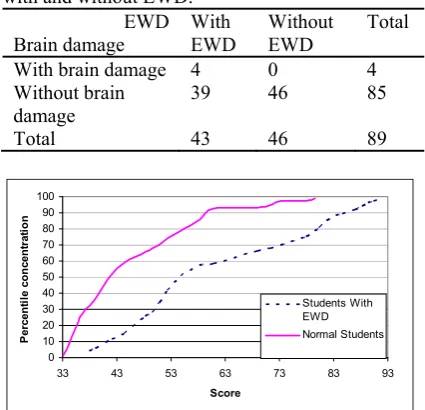
Based on Fig. 1, comparison of the two group’s curves shows that:
• The two groups have different scores in
one percentile point. Scores of disordered group in one percentile point is more than the healthy group in that point.
• Domain of the group with EWD in
Bender-Gestalt test is more than healthy group (38-92).
• Minimum and maximum scores in the
group with EWD are more than min and
Table 3. Distribution of brain damage in students with and without EWD.
EWD
Brain damage With EWD Without EWD Total With brain damage 4 0 4 Without brain
damage 39 46 85
Total 43 46 89
Fig. 1 Percentile concentration curve for healthy subjects and subject with EWD in Bender-Gestalt test.
0 10 20 30 40 50 60 70 80 90 100
33 43 53 63 73 83 93
Score
P
erc
en
ti
le
co
n
cen
tr
at
io
n
Students With EWD Normal Students
Visual motor perception development andexpressive writing disorder
124 MJIRI, Vol. 27, No. 3, Summer, Aug 2013, pp. 119-126 http://mjiri.tums.ac.ir
max scores in healthy group.
•Two groups seem different in
develop-ment. Figure 1 shows the delayed visual-motor development of students with EWD compared with normal students. This can be understood by comparing percentages of two groups compared to the average (score 50 based on T scale):
In healthy group about 78% scored
be-low 50 and 22% scored above 50.
In disordered group 48% scored below
50 and 62% scored above 50.
As the calculated T score (5.15) is bigger than T 1% (2.33) in single domain test, the null hypothesis is rejected and it is con-cluded, with 99% confidence, that there is a significant difference between the com-pared average so it can be concluded that visual-motor perception development of students with EWD is lower than students without EWD (p<0.01).
In order to assess whether the observed frequency distribution (brain damage) is
formed by chance or not, a χ2 text should
be applied. Because the calculated χ2 (2.25)
is smaller than table χ2 (3.84) in 5% level,
the null hypothesis is not rejected and there isn't any significant difference between healthy students and those with EWD in terms of brain damage (p>0.05) (Table 3,4).
Discussion
The first research hypothesis, saying that "students with EWD have a more delayed visual-motor development than healthy stu-dents" was confirmed, and it was concluded with 99% confidence that there is a signifi-cant difference between compared averag-es.
The above conclusion indicates that there is a relationship between visual-motor per-ception and expressive writing ability. In other words, healthy children have higher visual-motor coordination, compared with children with EWD. This confirms that one of the effective factors in learning is quality of development in visual perception, motor activities (general and specific) and the co-herence and coordination between them. It
is to say that those who have passed a nor-mal process in motor development levels and have combined these movements with their perception, in appropriate time and place, are more successful in understanding things. In fact, such individuals, by means of making secured connection between vis-ual perception system and motor perception system and integrating these two, can rely on information received by each one in fu-ture and give meaning to them in for-mation. When the individual can trust per-ceptional or motor system, he/she can pro-cess the information with confidence and represent it as a motor action (like writing) when it is necessary. It is important to no-tice that writing dictation is rather an audio-motor activity than visual-audio-motor one. Therefore, this question is raised that, what kind of relationship there can be between visual-motor development and expressive writing? It seems to be a sophisticated pro-cedure, yet these two are suggested to have similar mechanisms. Actually, combination of perceptional data and motor information is important in adjusting and contrasting these two kinds of received information.
Generally any perceptual (visual or audi-tory) or motor activity has a complemen-tary role in learning functionality. It is very important that the person can attend to two subjects simultaneously and make the re-quired coordination and coherence. A child who can make appropriate connection be-tween vision and movement, and has ap-propriate motor response to external stimuli when required, this ability can also proba-bly be generalized to other skills such as making good connection between auditory stimuli and motor responses. Also in rela-tion with the above menrela-tioned problem of "how to connect two processes, visual-motor or auditory-visual-motor", another im-portant subject can be explained that is "stream of adjusting two phenomena-sound and vision-or how to fit hearings and see-ing" not to imagine and learn one stimulus visually and auditory at the same time can play a role in learning it. This way the con-nection between seeing and hearing breaks
T. Mesrahi, et al.
125
MJIRI, Vol. 27, No. 3, Summer, Aug 2013, pp. 119-126 http://mjiri.tums.ac.ir
and the child writes expressively what he hears. Therefore, there is an indirect rela-tionship between dictation writing and vis-ual-motor development.
Another important point involving re-searcher's mind is absence of relationship between dictation test scores and Bender-Gestalt test scores in children with EWD. A small group of subjects got acceptable scores in Bender-Gestalt test in spite of their disability in dictate writing. This indi-cates that some other factors are involved in creation and formation of the disorder. Hence, maybe one of the factors is type of encoding in individuals. That is, maybe the children who have got normal scores in Bender test but are extremely weak in dic-tation, are more of visual encoding type than auditory, and because it is easier to learn and recall words auditory, children are unable to recall images of words by hearing.
Many researches are carried out about the relationship between visual-motor devel-opment (perceptual-motor) and educational ability. The results show that children, who are motor-visually developed, are more successful in education (15, 21, 22).
Meanwhile, Malinger and Longley (23) carried out a research similar to the present study in 1988. They administered Bender-Gestalt test to 20 normal kids and 20 chil-dren with learning disabilities, which was administered and scored by Koppitz meth-od. Results showed that number of errors in children with learning disability is signifi-cantly more than number of errors in nor-mal kids. In present study, after analyzing collected data, it was found that the number of errors in drawings made by students with EWD (according to 30 criteria of Koppitz) is significantly more than normal students. Similar findings of different researches on this case indicate that there is a direct rela-tionship between learning disability and visual-motor coordination.
The second hypothesis, saying that brain damage in students with EWD is more than healthy students, was rejected and the null hypothesis was confirmed. According to
the conclusion above it is understood that there is no relationship between brain dam-age and disability in expressive writing. In other words, students with expressive writ-ing disability have a healthy neural system and there is no lesion in their brain. This result is on the contrary with some theories and findings and so the research gets some ambiguities, because various theories intro-duce different causes for learning disorder. Some theoreticians have focused and em-phasized on brain damage (24). Others no-tice the attention limitation, ways of infor-mation processing, motor development and so on. Therefore, on one hand the present result is an approval to theories opposing the brain damage view, but on the other hand puts an obvious paradox in research findings. Because some of the conducted researches are indicating neural signs in children with learning difficulties (Refer-ence (25) leads to general acceptance of learning disabilities as a sort of minor brain
damage). Hence, neural overhaulis yet a
part of learning disability diagnosis stage. Hence it is difficult to make a distinct in-terpretation and conclusion of the present study, and the following should be taken into consideration:
Scholars hold various views about diag-nostic ability of Bender-Gestalt test in brain damage. Some believe it an appropriate de-vice for identification of minor brain dam-age. Others believe that Bender-Gestalt visual-motor test does not give detailed in-formation on damages; it is limited to iden-tifying major brain damage in right hemi-sphere and is unable to help diagnose minor brain damage and left hemisphere damages (26). Although Bender considers his test a suitable instrument for diagnosing neural disorders and brain damages and believes that visual-motor perception is an integral action of the individual's whole personality that is controlled by cerebral cortex, he suggests that it should be used with caution when it is taken as a device for diagnosis of brain damage. Things such as answering time, repeated erasing, and long hesitations should be taken into consideration as well
Visual motor perception development andexpressive writing disorder
126 MJIRI, Vol. 27, No. 3, Summer, Aug 2013, pp. 119-126 http://mjiri.tums.ac.ir
as method of administration and marking, individual's background evaluation, and use of neural and other specialized tests (27).
The last point is that sometimes it is diffi-cult to diagnose brain damage exactly as it is because both organic and functional dis-orders lead to mistakes in drawing test im-ages (14).
Conclusion
The present research has tried to shed light on theories of causes of learning disa-bilities and purify previous research find-ings with emphasis on role of senso-motor aspects and brain damage in these disor-ders. Expressive writing disorder (EWD) has made the basis for work. Based on our findings it could be concluded that normal children have higher visual-motor coordi-nation compared with children with EWD. It indicates that those who are relatively more developed than their peers, in terms of visual-motor perception, are more suc-cessful in education, especially in expres-sive writing. But there isn’t any significant relationship between brain damage and EWD.
References
1.Wallace G, McLoughlin J. A. Learning disabili-ties: Concepts and characteristics. Merrill; 1975.
2.Faryar A, Rakhshan F. Learning Disabilities. Tehran: Nima press; 1988.
3.Wilmshurst L. Abnormal child psychology: A Developmental Perspective. Routledge: 2008.
4.Tabrizi M. Psychotherapy for Spelling Disor-ders. Tehran: Fardavan; 1997.
5.Anastasi A. Differential Psychology: Individual and Group Difference in Behavior. New York: Mac-millan Company; 1958.
6.Sadock BJ, Sadock VA. Kaplan and Sadock's synopsis of psychiatry: Behavioral sciences/clinical psychiatry. Philadelphia: Lippincott Williams & Wilkins; 2007.
7. Getman G, Kane E, McKee G. Developing learning readiness: A Visual-Motor Tactile Skills Program. Manchester: McGraw-Hill; 1968.
8.Delacato CH. The Diagnosis and Treatment of Speech and Reading Problems. California: Charles
C Thomas; 1963.
9.Taylor MA. The Neuro-Psychiatric Mental Sta-tus Examination, Jamaica NY: spectrum publica-tions; 1981.
10.Kalat JW. Biological Psychology. Tenth ed. USA: Wadsworth Publishing Company; 2008.
11.Sherington, Charles Scott. The Integrative Ac-tion of the Nervous System, Yale University; 1906. 12.Kass C, Myklebust H. Learning disability: An educational definition. J Learn Disabil. 1969; 2(7): 377-379.
13.Bender L. Use of the visual-motor Gestalt test in the diagnosis of learning disabilities. J Spec Educ. 1970; 4: 29-39.
14.Groth-Marnat G. Handbook of Psychological Assessment. 5th ed. New Jersey: John Wiley &
Sons; 2009.
15.Koppitz EM. The Bender Gestalt test for Young Children. Vol.2: Research and Applications 1963-1973. New York: Grune & Stratton; 1975.
16.Raven J, Raven JC, Court JH. Manual for Raven's Progressive Matrices and Vocabulary Scales. Section 1: General Overview. San Antonio: Harcourt Assessment; 2003.
17.Goodenough FL. The Measurement of Intelli-gence by Drawing. Chicago: World Book Compa-ny; 1926.
18.Herris DB. Children's drawings as measures of intellectual maturity, New York: Harcourt, Brace & World; 1963.
19.Wechsler D. Manual for the Wechsler Intelli-gence Scale for Children. 3rd ed. New York: psy-chological corporation; 1991.
20.Wechsler D. The measure of adult intelli-gence. 3rd ed. Baltimore: Williams & Wilkins; 1994.
21.Lotfabadi H. Psychological Cognitive Chil-dren Test for Child Consultation. Tehran: Astan Ghods; 1993.
22.Baraheni, M. Terminology of Psychology. Tehran: Farhang Moaser; 1989.
23.Mallinger BL, Longley KF. BIP-Bender pro-tocols of learning disabled and regular education students, Percept Mot Skills. 1988 Aug; 67(1):193-4.
24.Johnson DJ, Myklebust HR. Learning Disabil-ities Educational Principles and Practices, New York: Grun & Stratton; 1967.
25.Strauss A, Letinen L. Psychopathology and education of the brain injured child, J Clin Psychol, July 1948; 4 (3): 315.
26.Hirschenfang S, A comparison of bender ge-stalt reproductions of right and left hemiplegic pa-tients, J Clin Psychol, October 1960; 16 (4): 439.
27. Bender L. Specific reading disability as matu-rational lag, Ann Dyslexia, 1963; 13(1): 25-44.