83
Available online at www.ijiere.com
International Journal of Innovative and Emerging
Research in Engineering
e-ISSN: 2394 - 3343 p-ISSN: 2394 - 5494
Age Encounter Based Routing Alogorithm for Delay
Tolerance Network
Chirag Patel
a, Asst. Prof. Nimit Modi
aa Gujarat Technology University, 1345- Deval Faliya, Khara-Abrama-396406, India b Gujarat Technology University, Bakrol, Waghodia, Vadodara-390019, India
Abstract:
DTN provides the network transmission facilities to communicate with the heterogeneous network when there are transmission delay and network disconnection frequently which support a transmission of messages without infrastructure like Internet. Spray and wait routing is improved, which is the representative routing protocol in DTN. This algorithm has two phases for transmission and fulfils a data transmission in the light of condition of network and end device which are the spray and wait phases. For this, we reduce the appropriate number of data transmission and apply the optional number of data transmission respectively based on the network. In first contact routing, give a message copy to first node encountered and delete the message from queue. In my proposed algorithm, we will build up age encounter based algorithm with the above mentions strategies algorithm. In this algorithm, we mention the age, difference between last meeting time and holding time of nodes, both are between Source and destination, consider as age and compare with the existing algorithm such as first contact, spray and wait and epidemic routing.
Keywords: Delay tolerance networks, spray and wait, first contact routing, Epidemic routing
I. INTRODUCTION
A. DTN
In wireless network, there are two mainly categories: those with cellular model and ad-hoc networks. An ad hoc network is known as MANET which can be defined as a collection of mobile entities interconnected by wireless network.
The duration of recent years, there are many problems occur in the ad hoc network. The environment of mobile which provides a great flexibility of use mobility creation without any restriction of the communication location. So, mobility shows enormous problems such as: limited energy source, frequent disconnection, low flow of communication, modest resources. Thus, network topology is not working properly or disconnection and message delivery is available delay in the ad hoc network. In the MANET routing protocols which require a network topology, are connected to route with the messages, if there is not finish route from source to destination when message is sending, routing will fail. Only this problem, the ad hoc routing protocol cannot be used in wireless environment with intermittent connectivity.
84
Figure 1: Laptops communicating with each other and the internet via delay-tolerant network [8]
As an example of where these networks are useful, consider a classroom where each student has a laptop, but there is no network infrastructure. One would like the students to collaborate on projects using the wireless network cards in the laptops, and also to communicate with the Internet. Delay-tolerant networking can make this happen, as illustrated in Figure 1. The laptops communicate with each other to exchange data. If the destination laptop is not present, which may occur if the student has gone home, the network stores the messages until they return. To communicate with the Internet, the school could be serviced via a router attached to a bus travelling between the school and an Internet gateway. This device picks up requests from the school and delivers them to the gateway, and then provides the responses on its next trip. First Mile Solutions sells a system called DakNet that is based on this idea [8], while the Wizzy Digital Courier Project uses a simple one-hop delay tolerant network to provide Internet access to rural South African schools [8].
B. DTN routing algorithm
In This paper, there are mainly two categories in DTN such as Forwarding and flooding protocols. In forwarding protocols, each message only keeps one copy during its transmission in the network like traditional routing protocols. First contact routing is the best example of forwarding protocol in which the message is delivered to the node which is encounter first and to select the best path and messages are forwarded until it reaches to the destination node. In such case, source will generate the message and will encounter first then delete the message from node buffer. Ultimately, one message copy exists in the DTN network [1]. While in flooding protocols, the multiples copy of messages are created to deliver to the destination. Spray and wait protocol is the example of the flooding protocol [5]. In this case, each copies of message are spared in the network. Another example of flooding schema is epidemic protocol.
.
II. RELATED WORK
A. DTN Architecture
Fig.2 DTN Architecture [2]
85
B. Characteristics
There are some characteristics in DTN environment [9].
Intermittent connectivity- The absent of an end-to-end path between source to destination is called network partitioning. In such communication, TCP/IP protocols are not working properly.
Asymmetric data rates- The internet supports moderate asymmetric of bidirectional data rate for users with asymmetric DSL service. If asymmetric are large, they defeat conversational protocols.
High latency- latency which is defined as there is end to end delay between nodes. Latency is high due to number of disconnection between nodes.
Low data rate- Its means that numbers of messages delivered under given time period. It is low because of long delays between transmission of nodes.
High error rates- If error is occurred between links, so they need error corrections. Ultimately, they use more bandwidth then the retransmission of time, it creates more network traffic.
Long queuing delay- Each node has its own buffer size to store the messages and frequent disconnection might reason of ling queuing delay.
Limited resources- DTNs need efficient protocol. That’s means nodes must consume their limited hardware resources such as battery efficiency, memory and CPU [2].
C. Classification of routing protocols
DTN routing protocols are classified into two congeries such as forwarding and flooding schemes.
Fig. 3 classification of DTN routing [5]
In DTN classification, the forwarding schemes are classified into infrastructure-based, prediction-based and social-based strategies, while flooding schemes could be divided as spray-series, social-based, coding based, intentional-oriented and hybrid-based strategies [5].
1. Forwarding Schemes
DTN use network tropology information to select best path and the one copy of message is then forwarded from node to node along this path in forwarding protocols. This protocols are divided into three directions as the below.
Infrastructure-based strategies
This routing can mitigate and compensate the rugged environment by deploying fixed infrastructure. In this strategy, mobile agents as message ferries are provided connectivity through the disconnected parts of the network. It is difficult to implement those special nodes in many DTN scenarios.
Prediction-based strategies
For improving routing performance in opportunistic scenarios, prediction-based strategies have been deployed in DTN routings. These strategies calculate and predict knowledge of future network based on history information.
Social-based forwarding strategies
The common relationships and people’s daily life communication have been investigated and focused on it. That social mobility characteristics are used to help routing decisions and protocols depend on social models such as SimBet and SSAR.
2. Flooding Schemes
In this scheme, source node generate multiple copies of message and relays store the messages until they contact with the destination in which point the messages are delivered.
86
It represents as a few message copies into the network then route each copy independently towards the destination. Spray-wait which consists of two phases. Spray phase: every messages are originated at a source node; L copies of message are spread by the source to L distinct relay nodes. Wait phase: if the destination is not found in the spraying phase, each of the L nodes carrying a message copy performs “Direct transmission”.
Social-based flooding strategies
In social-based flooding routings, social network protocol model as the same as the social-based forwarding routings, while it takes advantage of flooding strategy to increase message delivery rate.
Intention-oriented strategies
For improving the performance of DTN routing characteristics, this strategy is very useful. The example of intentional routing is RAPID.
Coding-based strategies
In this strategies, resource consumption is reduced if we used to take the fragmentation and network coding.
Hybrid-based strategies
Some researchers have proposed hybrid routings applying both forwarding and flooding schemes in one protocol. This technology could be viewed as a balance between increasing delivery rate and reducing resource consumption. The representatives of hybrid routings are routings.
III.IMPLEMENTATIONMETHODOLOGY
In DTN, there are mainly two techniques such as forwarding: first contact routing protocol and flooding: spray and wait routing protocol and epidemic routing protocol in which they have their own advantages and disadvantages. Our goal is to improve the message delivery ratio and to decrease message overhead in compare to existing algorithm.
In the details of DTN routing algorithm.
A. First Contact Routing Protocol
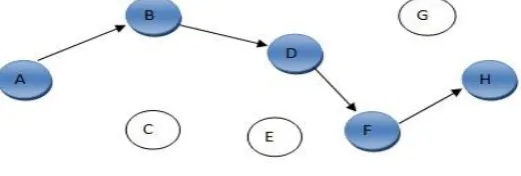
First Contact routing protocol is also single-copy scheme DTN routing protocols. In First Contact, the message is delivered to the node which is encountered first and deleted, being forwarded until it reaches to the destination node [2].
Fig. 4: First Contact Routing
In this protocol the source node and the intermediate nodes forward a message randomly to nearby node which is encounter first. If any node comes first in to the radio range of the source node will be given the message. It doesn’t determine the next best hop moving to the destination. The message is forwarded randomly when two or more nodes come in contact with the source node at the same time. Local copy of the message is eliminated after successful transfer from one node to another node. Thus, a single copy of the message flows in the networks. In single copy scheme, if any intermediate node fails to carry the message then that time the message will be lost [3]. In this protocol delivery ratio is poor because the next hop is selected as randomly.
Advantages:
It has less overhead.
It is very fast delivered message in small network.
B. Spray and Wait Routing Protocol
Developers introduce a new routing scheme, called Spray and Wait [3], that “sprays” a number of copies of single message into the network like one, two or more number of copies depending on network conditions, and then “waits” till one of these nodes meet the destination and it will deliver the message. In this routing approach overall overhead is much lesser then epidemic [2] routing and grater then first contact routing [4], but message delivery ratio is high as compared to both algorithms. It consists of two phases:
Spray phase: For every message originating at a source node, L message copies are initially spread – forwarded
by the source and possibly other nodes receiving a copy – to L distinct “relays”.
Wait phase: If the destination is not found in the spraying phase, each of the L nodes carrying a message copy
performs direct transmission that is it will forward the message only to its destination.
87
and multi-copy schemes. Surprisingly, as we shall shortly see, its performance is better with respect to both number of transmissions and delay than all other practical single and multi-copy schemes, in most scenarios considered.
(a) Phase ‘Spray’ (b) Phase ‘Wait’ Fig.5: Spray and Wait Routing.
Advantages:
Message delivery ratio is high.
Under low load, its result in much fewer transmission or smaller delays.
Under high load, it yields significant better delay and fewer transmission.
It is highly scalable.
It can be easily tuned online to achieve given QoS requirement, even in unknown network.
C. Epidemic Routing Protocol
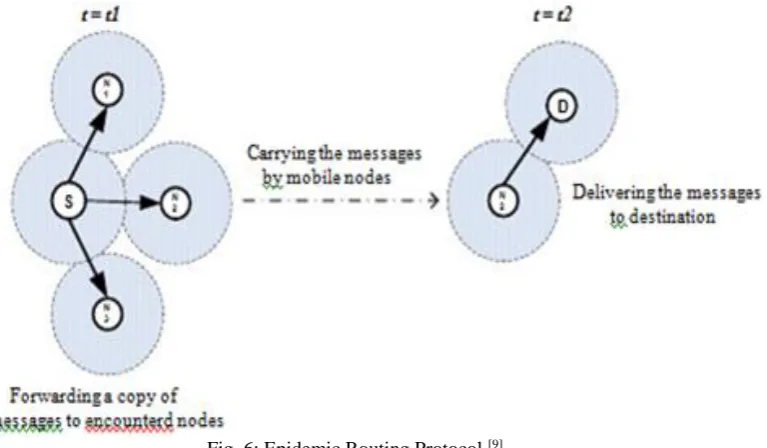
Epidemic router is an algorithm [2] that was firstly introduced by Demers et al. to achieve message delivery in spare networks like DTNs. In this algorithm replication mechanism is used to synchronization of data bases. It was modified by Vahdat et al. [2] and finally proposed as a flooding-based forwarding algorithm for DTNs. In the epidemic routing, all nodes can be source node and all nodes can be destination node. In this algorithm when message is created it will forward that message to all mobile nodes it encounters, hence all the nodes will keep same message so that number of copies of the message in the network will be more and overhead is much greater. To avoid multiple connections between the same nodes, the history of recent contacts is maintained in the nodes caches [1]. In this algorithm there are many buffer management policies in which buffer full condition can be handled efficiently, there are mainly two policies provided that are random and FIFO. In this case random policy is used as default policy. The scheme of message distributions is shown in Figure 4.3.
Fig. 6: Epidemic Routing Protocol [9]
88
The epidemic routing has been suggested to use in those conditions when there are no better algorithms to deliver messages. It is especially useful when there is lack of information regarding network topology and nodes mobility patterns [5].
IV.PROPOSED ALGORITHM
In this algorithm, we describe the approach using two different strategies flooding and forwarding. Our goal is to reduce the overhead and to increase delivery ratio.
Age Encounter based Routing Algorithm: S = Source node,
D = Destination node, R = Stationary relay node, M = Mobile node, i = Message, msgttl(i) = n,
age = Last meeting timestamp with destination.
Step-1. If for each node M is in contact with D update age of M with current time stamp. Step-2. for each mobile node M that comes in contact with S, M will reply age to S.
S will send a message i to the mobile node (M) having lowest age and discard the message i.
Step-3. If age of all connected mobile nodes is 0 (zero) then S will send a message i to any random mobile node M. Step-4. for each message i in M's buffer
if (msgttl(i) < n) {
if (contact_node_id = = destination_node_id) {
send a copy of message to D and discard the message; update age table of M with new time stamp;
}
else if for each node M is in contact with another M {
if (hop_count(i) < 5) {
Send a copy of message to encountered M; }
Else do nothing; }
else if for each node M is in contact with another R Send a copy of message to node R or M;
}
else drop I; }
End
Description of Age Encounter Based Routing Algorithm:
We are creating an Algorithm to reduce an Overhead and Increase Message Delivery Ratio, with using last encounter time of Mobile Node (m) with Destination Node (d). First of all, we need to create a data structure which is used to store age of mobile nodes, then we will use this age to send messages from source to destination.
How Algorithm Works:
When a Mobile Node(M) comes in contact with Destination Node(D), Mobile Node(M) will update its age count (last meeting time of mobile node to the destination node, initially its set to zero (0)) with current timestamp.
Now when source node (S) creates a message (m), Source Node will check all the connections with mobile nodes and Source Node(S) will ask all Mobile Nodes(M) for their respective ages, all mobile nodes will reply their ages to the Source Node(S), now Source node(S) will check the highest age from all replies, Source Node will send a message(m) to the highest aged Mobile Node(M) and Source Node will discard the message after successful delivery, so that message will get the Highest delivery probability.
Now when the Mobile Node meets any Relay Node, Mobile Node will send all packets from its buffer to that Relay Node.
Now when Mobile Node meets an another Mobile Node, Mobile Node will check the hope count of message and if the hope count is less than or equal to 5, Mobile Node will send the message to another connected Mobile Node and if the hope count is grater then 5 the Mobile Node will not transfer that message to another connected Mobile Node.
89
V. EXPEREMENTALRESULTS
A. Performance Metrics
There are many algorithms implemented for routing, but each algorithm has its own advantages and disadvantages by creating new algorithm for history based routing we can perform routing efficiently. This section gives a brief description about the various parameters that are studied.
Delivery Probability –
The delivery probability is a measure of the fraction of the created packets that are delivered to the destination. This is the ratio of the total number of packets that are delivered to their destinations to the total number of packets that are created.
Overhead Ratio –
The overhead ratio is calculated using the following equation:
Overhead ratio = (Number of relayed messages – Number of delivered messages)
Number of delivered messages ………(i)
Here, the term relayed messages refers to the messages that have been forwarded by the source to an intermediate node to be forwarded towards the destination. This number is a measure for the number of packets or copies of packets that have been inducted into the network. The number of delivered messages refers to the total number of created packets that are successfully delivered to the destination.
Latency –
The latency measured here is the time that elapses between the creation of a message and its delivery at its destination. The average of the latency of the packets over the entire simulation time is considered. This is the time as calculated for the delivered packets only.
Buffer time –
This is the average amount of time that packets spend in the buffer of the nodes. This is not the measure of the time spent in the buffer by the delivered packets, but it is an average of the time spent by all the packets, delivered and dropped, in the intermediate nodes' buffers.
B. Result Analysis
Results are based on following Important Metrics-
Message delivery ratio
Overhead ratio
Average latency ratio
C. Scenario Parameters and Results 1. Age Encounter based Router
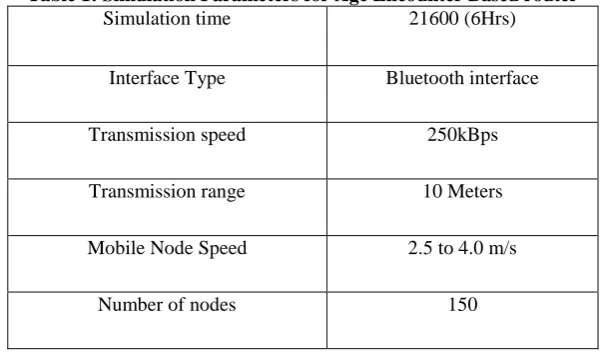
a) Scenario parameters: For age encounter based routing algorithm three types of scenarios will be considered to compare results. This algorithm will use 4500×3400 𝑚2 map size with 95 mobile nodes, 5 Stationary Relay nodes and 2 Stationary nodes one is source node and another is destination node will be used time of simulation is 21600 seconds (12 hours), here each message will be generated in 40 to 60 seconds, size of the message varies from 500KB to 1MB. MapBasedMovement movement model is used due to which mobile node will move randomly in the map. msgttl is 300 minutes. The settings used to run the simulations are summarized in Table 10.
Table 1: Simulation Parameters for Age Encounter Based router
Simulation time 21600 (6Hrs)
Interface Type Bluetooth interface
Transmission speed 250kBps
Transmission range 10 Meters
Mobile Node Speed 2.5 to 4.0 m/s
Number of nodes 150
90
b) Screenshot:
Figure 7: Screenshot for Age Encounter based Router
c) Scenario Results:
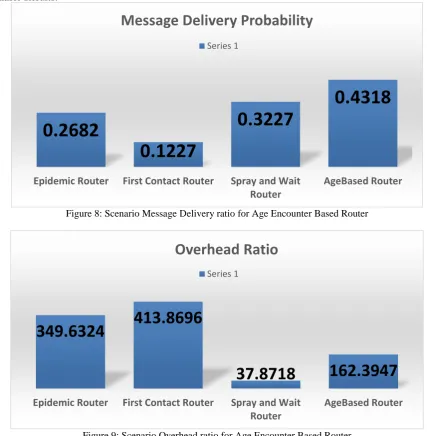
Figure 8: Scenario Message Delivery ratio for Age Encounter Based Router
Figure 9: Scenario Overhead ratio for Age Encounter Based Router
As shown in charts if taking of 150 nodes are in the simulator, Age Encounter Based router has good delivery ratio in compare with Spray and Wait router and First contact router and overhead is decreased as compared to Epidemic and First
0.2682
0.1227
0.3227
0.4318
Epidemic Router
First Contact Router
Spray and Wait
Router
AgeBased Router
Message Delivery Probability
Series 1
349.6324
413.8696
37.8718
162.3947
Epidemic Router
First Contact Router
Spray and Wait
Router
AgeBased Router
Overhead Ratio
91
Contact Router. It creates more network traffic and to influence on the overhead because of dense network. Implementation of Age Encounter Based router is quiet difficult but it gives good results in some specific type of scenarios. Proposed Age Encounter Based router will use last meeting time of node scenario to route messages, there are very few algorithms developed which use last meeting time of nodes, so, it is efficient when consider last meeting time of nodes.
VI. CONCLUSIONS AND FUTURE WORK
DTN is a network where there is no end to end connectivity available from source to destination in which the use of store-carry-forward strategy can increase message delivery ratio. By using Age Encounter algorithm which can minimize the overhead and raise message delivery, also connect disconnect rural area and to complete their communication. With using DTN we can connect rural areas as well as disconnected areas where no connectivity with internet is available. By using VDTN we can multiple packet to the members which are resides in other network using suitable strategies. Create an age based routing algorithm to efficiently deliver messages and to control delay in DTN. Using other routing movement model, performance of delivery ratio will be increased. Message overhead will control using routing mechanisms.
REFERENCES
[1] Ei Arbi Abdellaoui Alaoui, Said agoujil, Moha Hajar, Youssef Qaraai, “The Performance of DTN Routing Protocols: A Comparative Study”, WSEAS Transactions on Communications, ISSN / E-ISSN: 1109-2742 / 2224-2864, Volume 14, 2015, Art. #16, pp. 121-130.
[2] Monika Aneja, Vishal Garg, “Simulation of epidemic, spray and wait and first contact routing protocols in delay tolerant network ”, IOSR journal of electronics and communication engineering, pp. 30-34, January 2015 [JMIT Radaur Yamunanagar]
[3] Vrunda Gamit, Mr. hardik Patel, “Evaluation of DTN Routing Protocols”, International Journal of Engg. Sciences and Research Technology, February 2014
[4] Syed Hassan Ahmed, Hyunwoo Kang and Dongkyun Kim, “Vehicular Delay Tolerant Network (VDTN): Routing Prspectives”, school of computer & engg., January 2015
[5] Joao N. G. Isento, Joel J.P.C. Rodrigues and Joao A. F. F. Dias, “Vehicular Delay-Tolerant Networks- A novel solution for vehicular communications”, IEEE istitude if telicpmmunication, Octomber 2013
[6] Mengjuan Liu, Yan Yang and Zhiguang Qin, “A survey of routing protocols and similation in delay tolerant network”, Department of computer science and technology, pp. 243-253, 2011
[7] P. R. Pereira, A. Casaca, J. J. P. C. Rodrigues, V. N. G. J. Soares, J. Triay, and C. Cervell´o-Pastor, “From delay-tolerant networks to vehicular delay-tolerant networks,” IEEE Communications Surveys and Tutorials, vol. 14, no. 4, pp. 1166– 1182, 2012.
[8] Mengjuan Liu, Yan Yang and Zhiguang Qin, “A survey of routing protocols and simulations in delay tolerant network”, Department of computer and technology, Springer, 2011
[9] Arshad Islam, Marcel Waldvogel, “Reality-Check for DTN routing algorithms”, International Conference on Distributed Computing Systems Workshops, 2008, pp. 204-209.
[10]Evan P. C. Jones, Paul A. S. Ward, “Routing Strategies for Delay-Tolerance Networks”, University of Waterloo 200 University Avenue West, 2008.
[11]F. Warthman, “Delay Tolerant Networks (DTNs) A Tutorial”, Available at websites: http://www.dtnrg.org/docs/tutorials/warthman-1.1.pdf
[12]Gao et al., “Multidimensional Routing Protocol in Human-Associated Delay-Tolerant Networks”,IEEE Transactions On Mobile Computing,Vol. 12, No. 11, pp. 2132-2144, 2013
[13]A. Lindgren et al., “ Probabilistic routing in intermittently connected Networks” , ACMSIGMOBILE CCR, 2003 [14]S. Jain, K. Fall, R. Patra., “Routing in a Delay Tolerant Network”.Proc. of ACM SIGCOMM, pp. 145–2008. [15]Y. Cao et al., “Approach-and-Roam (AaR): A Geographic Routing Scheme for Delay/Disruption Tolerant Networks”,
IEEE Transactions On Vehicular Technology, Vol. 63, No. 1, pp. 266-281, 2014
[16]Anders Lindgren, Avri Doria, and Olov Schelen, “Probabilistic routing in intermittently connected networks”, Proceeding of 1st International Workshop on Service Assurance with Partial and Intermittent Resources , 2004, 239-254.
[17]Anju Rani , Atul Sharma, Dr. Dinesh Singh, Sanjeev Indora “Movement Models based Performance Comparison of Routing Protocols in DTN dProceedings of „Second International Conference on Emerging Research in Computing, Information, Communication and Applications‟(ERCICA-14)2014.
![Figure 1: Laptops communicating with each other and the internet via delay-tolerant network [8]](https://thumb-us.123doks.com/thumbv2/123dok_us/8875014.1816328/2.595.63.534.482.648/figure-laptops-communicating-internet-delay-tolerant-network.webp)
![Fig. 3 classification of DTN routing [5]](https://thumb-us.123doks.com/thumbv2/123dok_us/8875014.1816328/3.595.65.524.318.441/fig-classification-of-dtn-routing.webp)