Comparison of College Students’ Knowledge across Delivery Formats in a
Required Physical Activity and Wellness Course
Cara L. Sidman, PhD Associate Professor
School of Health and Applied Human Sciences University of North Carolina Wilmington
Wilmington, NC 28403 [email protected]
Michelle Lee D'Abundo, PhD, MSH, CHES Associate Professor
Department of Interprofessional Health Sciences and Health Administration School of Health and Medical Science
Seton Hall University South Orange, NJ 07079 [email protected]
Lea Bullard, MA Assistant Director General Education Assessment University of North Carolina Wilmington
Wilmington, NC 28403 [email protected]
Abstract
As online and blended delivery formats in college physical activity and wellness courses gain popularity, assessment of student learning is needed. The purpose of this study was to investigate differences in college students’ knowledge across four delivery formats in a required physical activity and wellness course. A total of 377 students were randomly selected from the following four formats: 1) online lecture/face-to-face lab (n=114); 2) face-to-face lecture/face-to-face lab (n=58); 3) online lecture/online lab (n=117); and 4) online lecture/web-enhanced lab (n=88). Regardless of delivery format, students on average scored an 84% at the end of a 15-week semester. A one-way analysis of variance indicated there were no significant differences between delivery formats on all but four of the 13 questions. Students in the online lecture, face-to-face lab scored significantly higher on concepts related to lifelong adherence to physical activity and wellness, such as intrinsic motivation and process-oriented, long-term healthy behaviors. Keywords: online, assessment, basic studies, university, exercise
Comparison of College Students’ Knowledge
Student learning is a critical component of university courses, regardless of delivery method. As students’ needs continue to change, technology advances, and the demands for training professionals evolve, traditional face-to-face course formats are being supplemented with blended and online formats
Multiple course format options provide benefits for instructors, students, and universities. The benefits of online instruction options for faculty include flexibility in scheduling, reduction of commute and travel, documentation of student work, records of student and instructor interaction, and archival data for assessment. Benefits of online course offerings for students include greater access, variety, flexibility in scheduling, the ability to balance personal and school life (Hollis & Madill, 2006) and reduced graduation time (due to easier access) (Chaney et al., 2009). Hollis and Madill (2006) state, when given the option, students choose a combination of face-to-face and online learning in formal education.
Universities also benefit from offering online course formats. Online learning assists in diversifying student populations, as courses are accessible from any part of the country or world. At the same time, online courses provide opportunities for increased revenue outside of the geographic region. Other economic benefits include reduced printing, lower classroom overhead, and decreased need for physical classroom materials (D’Abundo & Sidman, 2011).
Another less discussed benefit of online learning as a delivery option is the reduction in negative effects to the environment. Many campuses have struggled to resolve parking and air quality issues. Distance education reduces travel to and from campus, which significantly reduces student and faculty costs for travel, and the inevitable environmental effects associated with auto admissions. Finally, the reduction of copying and use of paper can have significant impact on the local and global environment (D’Abundo & Sidman, 2011).
Delivering physical activity and wellness courses online, although becoming quite popular, has created controversy and endured considerable criticism despite documented benefits (Ransdell, Rice, Snelson, & Decola, 2008). There is some resistance to any innovative strategies in education. However, public health statistics indicate the need for effective approaches to chronic disease prevention. Consequently, it seems necessary to consider online learning formats as options in university, public health, and health promotion disciplines due to the potential documented benefits that could contribute to lasting behavior change. In a previous physical activity and wellness course, an online learning module designed to educate students about the negative effects of smoking was found to lead to significant knowledge gains and attitudinal changes (D’Abundo, Fiala, & Marinaro, 2010). Online instruction has been shown to be effective in educating medical students (Pederson, Blumenthal, Dever & McGrady, 2006; Zebrack, Mitchell, Davids, & Simpson, 2005). Williams (2006) conducted a meta-analysis of 25 studies assessing achievement in distance education in allied health, and found that distance education is as effective as face-to face instruction. Online health promotion programs have also been shown to be effective methods of information delivery and health promotion (Parlove, Cowdery & Hoerauf, 2004; Shegog et al., 2005).
Previous researchers reported benefits of the blended (combined) delivery format when examining achievement and satisfaction among undergraduate students taking a wellness course in three different learning environments (Lim, Kim, Chen, & Ryder, 2008). When comparing traditional face-to-face, online, and combined delivery modes after a 15-week semester, higher achievement was found among students in the online learning and combined (blended) learning groups than the students in the traditional learning environment. Their findings supported previous research regarding the benefits of online instruction compared to traditional instruction in general, and the researchers recommended further study in the area of physical education. Furthermore, when reporting satisfaction levels, “regardless of the learning groups, most students indicated that they would like to see an online option when enrolling for the course in the future” (Lim, Kim, Chen, & Ryder, 2008, p. 118).
Many traditional face-to-face courses rely mostly on assessment of knowledge, with little attention to efficacy of the delivery format. The research in this study is unique for multiple reasons. First, several course formats are being assessed by comparing online, blended, and face-to-face delivery formats. Secondly, the course is a physical activity and wellness course, with physical activity a key component of the curriculum, which is typically not the focus of knowledge assessment research. In addition, this study is building on previous course-format research assessing attitudes of students enrolled in a physical activity and wellness course, and therefore is providing a more complete picture of course outcomes. In summary, the purpose of this study was to investigate differences in college students’ knowledge among four delivery formats in a required physical activity and wellness course. Consequently, this research has the potential to inform both the fields of physical activity and wellness and instructional technology. Methods
Participants
A total of 377 students participated in the study as part of their enrollment in PED 101, a subset of the 1515 total students enrolled during the same semester.PED 101, a 2-credit required course entitled, “Physical Activity & Wellness,” is the only course that meets the university studies lifespan wellness component, and serves approximately 3,000 students per year. With a lifetime focus, it involves a health and wellness lecture component and a physical activity lab component.
Participants were selected based on the course section in which they were enrolled; course sections were selected to represent the four different modes of instruction by randomly selecting from within each mode. Students in four different modes of instruction delivery were included in this study: 1) online lecture with face-to-face lab (n=114); 2) face-to-face lecture with face-to-face lab (n=58); 3) online lecture with online lab (n=117); and 4) online lecture with web-enhanced lab (n=88). It is important to note that the online lecture involved students reviewing interactive modules and participating in physical activity on their own. The face-to-face formats included lecture instruction and lab instruction in a variety of physical activities (e.g., tennis, tai chi, total body conditioning, etc.)
Research Design
This descriptive research study investigated differences in the scores of students from the four different course delivery modes of PED 101. Given the data available, it was not possible to follow the
requirements of experimental or quasi-experimental design (Creswell, 2013). Therefore, a pre-experimental, cross-sectional, posttest-only design was used. Groups were based on course delivery method. It should be noted that students self-selected the mode of delivery based on their preferences. Student performance on 13 final exam questions was examined as the variables of interest.
Measures
The lead faculty teaching and coordinating PED 101 developed the 13 multiple-choice and true-false questions on the final exam that were used for the assessment, as they were specifically designed to align with the course’s student learning outcomes. The entire curriculum had been recently redesigned to align with national physical activity and health guidelines, as well as with the university’s strategic goals. In addition, the student learning outcomes were based on accumulating research evidence supporting a positive approach to developing knowledge, skills, attitudes, and behaviors associated with long-term adherence to the priority lifestyles (i.e., physical activity, healthy eating, and stress management) (Corbin, Welk, Corbin, & Welk, 2013). More specifically, course content focused on factors associated with lifelong physical activity and health behaviors such as intrinsic motivation, self-efficacy, self-determination, social support, goal-setting, overcoming barriers, and the importance of balance among the dimensions of wellness (i.e., physical, social, emotional, spiritual, and intellectual) (D’Abundo & Sidman, 2011).
Procedure
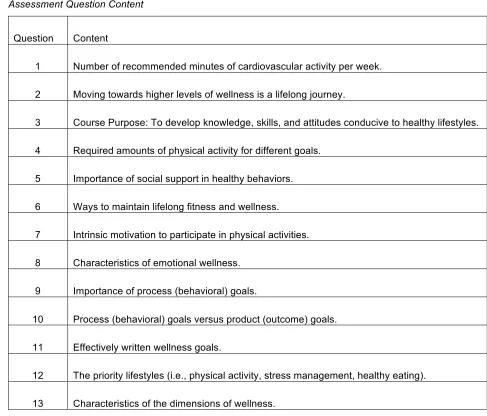
After all students completed the final exam, the research team collected student responses to the 13 course summary questions. These questions were related to the student learning outcome of facilitating long-term adherence to the priority lifestyles as previously described. Table 1 presents the main content for each question, and the following are two sample questions: “People with an internal (intrinsic) motivation to participate in physical activities focus on: a) completion of the task of exercise, b) gaining muscle, c) improving body composition, d) enjoying the activity,” (with d as the answer), and “Ways to maintain lifelong fitness and wellness include all of the following EXCEPT: a) periodically reassessing your fitness and wellness, b) setting goals, c) analyzing wellness issues only when symptoms appear, d) choosing behaviors to target for change” (with c as the answer). These questions were included in the assessment due to their focus on major factors related to a lifetime of physical activity and wellness, the primary purpose of the course.
The data analysis was completed using SPSS statistical software.
Results
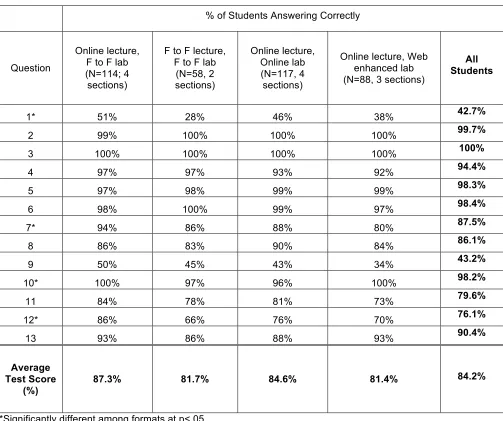
Table 2 provides the results of participant performance on each of the 13 questions, by course delivery method.
Table 1.
Assessment Question Content
Question Content
1 Number of recommended minutes of cardiovascular activity per week.
2 Moving towards higher levels of wellness is a lifelong journey.
3 Course Purpose: To develop knowledge, skills, and attitudes conducive to healthy lifestyles.
4 Required amounts of physical activity for different goals.
5 Importance of social support in healthy behaviors.
6 Ways to maintain lifelong fitness and wellness.
7 Intrinsic motivation to participate in physical activities.
8 Characteristics of emotional wellness.
9 Importance of process (behavioral) goals.
10 Process (behavioral) goals versus product (outcome) goals.
11 Effectively written wellness goals.
12 The priority lifestyles (i.e., physical activity, stress management, healthy eating).
Table 2.
Foundational Knowledge Results
% of Students Answering Correctly
Question
Online lecture, F to F lab (N=114; 4 sections)
F to F lecture, F to F lab
(N=58, 2 sections)
Online lecture, Online lab (N=117, 4
sections)
Online lecture, Web enhanced lab (N=88, 3 sections)
All Students
1* 51% 28% 46% 38% 42.7%
2 99% 100% 100% 100% 99.7%
3 100% 100% 100% 100% 100%
4 97% 97% 93% 92% 94.4%
5 97% 98% 99% 99% 98.3%
6 98% 100% 99% 97% 98.4%
7* 94% 86% 88% 80% 87.5%
8 86% 83% 90% 84% 86.1%
9 50% 45% 43% 34% 43.2%
10* 100% 97% 96% 100% 98.2%
11 84% 78% 81% 73% 79.6%
12* 86% 66% 76% 70% 76.1%
13 93% 86% 88% 93% 90.4%
Average Test Score
(%)
87.3% 81.7% 84.6% 81.4% 84.2%
*Significantly different among formats at p<.05
For all students, the average total score on the 13 questions sampled was 84.2%. The percentage of correct student answers was above 75% for all but two questions.
Comparisons across Delivery Modes
Four different modes of instruction were used to deliver PED 101: online lecture, face lab, face-to-face lecture and lab, online lecture and lab, and online lecture, web-enhanced lab. In this sample, most students were in either online lecture, face-to-face labs (n=114) or online lecture and labs (n=117). There were 88 students in the sample in online lecture and web-enhanced labs and 58 students in face-to-face lecture and labs.
Discussion
The results of this study contribute to the literature on student achievement in varied delivery formats in a university wellness course. College students’ knowledge in this study was quite high at the end of a 15-week semester, with an average total score of 84.2% on the 13 course summary questions. This score was slightly higher than the average posttest score of 75.4% for students self-enrolled in three delivery formats of a college wellness course (Lim et al., 2008). With regards to course format comparisons in student learning (measured as achievement) in the Lim et al. study, there was significantly higher student achievement in the online and combined (blended) learning group than in the traditional face-to-face group, with no significant differences between the combined and online groups. It is interesting to note that their course of interest was described as a “wellness” course, with no mention of a physical activity component. The course examined in this study was a “physical activity and wellness” course, which involved supervised physical activity in the face-to-face lab format, which may play a role in student learning.
In this study, although there were no significant differences in total score among students across the four delivery types, those enrolled in the online lecture, face-to-face lab scored significantly higher than students in the other three delivery types on the following four questions: number of recommended cardiovascular minutes/week for health, the value of intrinsic motivation to lifelong exercise, the difference between process and product for healthy behaviors, and the top three priority lifestyles. It is important to note that the aforementioned questions focused on concepts shown in previous research to be
associated with lifelong adherence to physical activity and wellness. For example, Ryan, Frederick, Lepes, Rubio, and Sheldon (1997) found that individuals more intrinsically motivated to exercise are more likely to sustain physical activity over the long term. In addition, the 150-minute/week cardiovascular physical activity recommendation for health, which was modified from the previous 30-minutes/day for 5 days/week recommendation, promotes more flexibility in achieving the health guidelines for the purpose of improving adherence over the long-term (Corbin, Welk, Corbin, & Welk, 2013). In addition, setting short-term, process-oriented behavioral goals versus product, outcome-based goals has been associated with long-term success; and the priority lifestyles, which are physical activity, healthy eating, and stress management, are the most important behaviors to focus on for a lifetime of wellness (Corbin, Welk, Corbin, & Welk, 2013).
The findings in this study indicate course formats that include online delivery are not inferior to completely face-to-face formats. But in fact, the online lecture, face-to-face lab students scored slightly higher than those in the completely face-to-face format. Previous research has shown online learning modules have been successfully used in a physical activity and wellness course to affect knowledge and attitudes about smoking prevention (D’Abundo, Fiala, & Marinaro, 2010). In research reviewing online health promotion interventions, participants in 16 of 17 web-based interventions showed improved knowledge and behavioral outcomes (Wantland, Portillo, Holzemer, Slaughter, & McGhee, 2004). As stated before, online delivery has been shown to be effective in many health-related disciplines (Parlove, Cowdery & Hoerauf, 2004; Pederson, Blumenthal, Dever, & McGrady, 2006; Shegog et al., 2005; Zebrack et al., 2005), and in fact can be integrated into most education with a well-being component (D’Abundo, Firsing, & Sidman, 2014).
The findings in this study showing higher scores in knowledge for the course format that includes the online lecture makes sense based on previous course format research assessing student attitudes such as motivation. There were no differences by course format in this study, similar to previous research about exercise motivation (Sidman, Fiala, & D’Abundo, 2011), and higher perceived wellness in online and hybrid course formats (Milroy, Orsini, D’Abundo & Sidman, 2013). Our findings provide information about knowledge, which supplements the existing information about student attitudes by course format. The information presented in this article has implications for both physical activity and wellness
college courses that are offered in multiple formats, and this study further supports the value of
integrating online learning formats into college curriculums. Future research could assess course formats, including online learning in non-health related curriculums.
As online and blended courses in physical activity and wellness gain popularity, assessment of student learning outcomes is needed. This study contributes to literature assessing multiple course formats that include online learning. In addition, this information about knowledge outcomes of physical activity and wellness courses contributes to health promotion literature and may provide universities with ideas about how to assess such course formats.
References
Boud, D. & Falchikov, N. (2006). Aligning assessment with long-term learning. Assessment & Evaluation
in Higher Education, 31(4), 399-413.
Chaney, B., Eddy, J., Dorman, S., Glessner, L., Green, B., & Lara-Alecio, R. (2009). A primer on quality indicators of distance education. Health Promotion Practice, 10(2), 222-231.
Corbin, C., Welk, G., Corbin, W., & Welk, K. (2013). Concepts of fitness & wellness: A comprehensive
lifestyle approach. New York, NY: McGraw-Hill.
Creswell, J. W. (2009). Research design, qualitative, quantitative, and mixed methods approaches, 4th Ed. Los Angeles, CA: SAGE Publications.
D’Abundo, M.L., Fiala, K,A. & Marinaro, L. (2010). An online learning module focused on smoking education and prevention for college students: Implications for college health instructors and allied health professionals. Journal of Allied Health, 39(1), 43-48.
D'Abundo, M.L., Firsing S.L., & Sidman, C.L. (2014). Online well-being focused curriculums: A new approach to teaching and learning for K-20 health education. In V.C.X. Wang (Ed.), Handbook of
research on education and technology in a changing society. New York: IGI Global.
D’Abundo, M.L., & Sidman, C.L. (2011). Online learning and instruction in health: Addressing the demands for education and training through computer-based technologies. In V.C.X. Wang (Ed.),
Encyclopedia of information communication technologies and adult education integration (pp.
942-957). New York: IGI Global.
Hollis, V., & Madill, H. (2006). Online learning: The potential for occupational therapy education.
Occupational Therapy International, 13(2), 61-78. doi:10.1002/oti.209
Lim, J., Kim, M., Chen, S.S., & Ryder, C.E. (2008). An empirical investigation of student achievement and satisfaction in different learning environments. Journal of Instructional Psychology, 35(2), 113-119. Milroy, J.J., Orsini., M.M., D’Abundo, M.L. & Sidman, C. (2013). College students perceived wellness
among online, face-to-face, and hybrid formats of a lifetime physical activity and wellness course.
American Journal of Health Education, 44(5), 252-258.
National Research Council (2001). Knowing what students know: The science and design of educational
assessment. Committee on the Foundations of Assessment. Pelligrino, J., Chudowsky, N., & Glaser,
R., editors. Board on Testing and Assessment, Center for Education. Division of Behavioral and Social Sciences and Education. Washington, DC: National Academy Press.
Parlove, A., Cowdery, J., & Hoerauf, S. (2004). Acceptability and appeal of a Web-based smoking prevention intervention for adolescents. International Electronic Journal of Health Education, 7, 1-8. Pederson, L., Blumenthal, D., Dever, A., & McGrady, G. (2006). A web-based smoking cessation and
prevention curriculum for medical students: Why, how, what, and what next. Drug and Alcohol
Review, 25(1), 39-47. doi:10.1080/09595230500459503
Ransdell, L.B., Rice, K., Snelson, C., & Decola, J. (2008). Online health-related fitness courses: A wolf in sheep’s clothing or a solution to some common problems? Journal of Physical Education, Recreation,
Ryan, R.M., Frederick, C.M., Lepes, D., Rubio, N., & Sheldon, K.M. (1997). Intrinsic motivation and exercise adherence. International Journal of Sport Psychology, 28, 335-354.
Shegog, R., McAlister, A., Hu, S., Ford, K., Meshack, A., & Peters, R. (2005). Use of interactive health communication to affect smoking intentions in middle school students: a pilot test of the “Headbutt” risk assessment program. American Journal of Health Promotion, 19(5), 334–338.
Sidman, C.L., Fiala, K.A., & D’Abundo, M. L. (2011). Exercise motivation of college students in online, face-to-face, and blended basic studies physical activity and wellness course delivery formats.
Journal of American College Health, 59(7), 662-664.
Wantland, D., Portillo, C., Holzemer, W., Slaughter, R., & McGhee, E. (2004). The effectiveness of web-based vs. non-web-web-based interventions: A meta-analysis of behavioral change outcomes. Journal of
Medical Internet Research, 6(4). doi:10.2196/jmir.6.4.e40
Williams, S. (2006). The effectiveness of distance education in allied health science programs: A meta-analysis of outcomes. American Journal of Distance Education, 20(3), 127-141.
Zebrack, J., Mitchell, J., Davids, S., & Simpson, D. (2005). Web-based curriculum. JGIM: Journal of
General Internal Medicine, 20(1), 68-74. doi:10.1111/j.1525-1497.2005.40062.x
This work is published under a Creative Commons Attribution-Non-Commercial-Share-Alike License