MASS PERSONALIZATION VS. MASS CUSTOMIZATION:
FINDING VARIANCE IN SEMANTICAL MEANING AND
PRACTICAL IMPLEMENTATION BETWEEN SECTORS
Gedas Baranauskas
Mykolas Romeris University, Lithuania [email protected]
Abstract
During last 3 decades, Mass Personalization and Mass Customization as research domains have been advancedly overlooked and currently are overcoming theoretical boundaries. Ongoing digital transformation, rapidly increasing orientation to customer centric approach, demand-driven supply and value creation via online environment, platforms or tools undoubtedly influence content and development of these two paradigms too (Rungtusanatham and Salvador, 2008; Gandhi et al., 2013; Hu, 2013; KMPG, 2016; Tiihonen and Felfernig, 2017). On the other hand, a number of academic research as well as organization practices still show variances in the semantical meaning of those mentioned concepts, implementation logic and limited interaction with digitalization and value co-creation. Therefore, the research type of scoping review is based on literature analysis. It is followed throughout this article for a quality evaluation of a current standpoint and practical tendencies in the field of understanding Mass Personalization and Mass Customization, as well as defining possibilities in adapting approaches of value co-creation and technology-based attitude.
Purpose – article aims to conceptualize an existing semantical gap between concepts of Mass Personalization and Mass Customization by analyzing recent scientific literature and trends in their practical implementation.
Design / methodology / approach – in this research the author followed a mixed type of quantitative and qualitative methodologies. The first one is related to the method of scoping review, which is used to collect and categorize data of semantical meaning in Mass Personalization and Mass Customization concepts. The qualitative one follows methods of general and comparative scientific literature review and conceptualization of new insights later. Therefore, the design of research is described as a systematic literature review and information systemization.
Finding – results of the present evaluation of the research subject suggest that mismatches in semantical understanding of analyzed concepts as well as their adoption are very common. In addition, it is noticed that approaches of value co-creation and technology-based attitude and their combination are evaluated separately or partly from the research subject.
Research limitations / implications – the present article has limitations both in theoretical and practical fields. From the perspective of scientific research, it is noticed that in different periods, the focus has been switched exclusively on process standardization or Mass Customization, without conducting a multi-dimensional research. In addition, there are also limited research carried out in the field of finding content differences between Mass Personalization and Mass Customization concepts as well as their possible combination for different sectors, with a focus on non-manufacturing organizations, digitalization and data analytics.
content of changes to reach a more customized or personalized service and create an overall more customer-centric approach in an organization; c) as a summary of key points for a better understanding on main differences, requirements, trends of each concept and their practical adoption.
Originality / Value – theoretical analysis created following holistic and multidimensional standpoints not only confirms existing differences between semantical meanings but also reveals possible areas of misunderstanding when applied in practical implementation. In parallel, at this point, a combined approach of value co-creation and technology-based attitude produces valuable insights for future research and might serve as a basis for ongoing process evaluation in practice.
Keywords: Mass Customization, Mass Personalization, Digitalization, Co-creation
Research type: literature review.
Introduction
In recent decades, terms, concepts and practical cases of mass service customization or personalization as well as a technology-based attitude to organizational management processes and systems have been combined and used widely both in development of private and public sectors (Jitpaiboon et al., 2013; Deloitte, 2015; Chatzopoulos, 2017; OECD, 2018). Actually, it has become a multidisciplinary management concept with a focus on applying combined methods and wide-spreading effect to different type of organizations and sectors. To be more specific, it became a dominant element within the content of management at organizations of different levels: a) as a strategic orientation to gain a competitive advantage and a higher level of process excellence in a long term run; b) as a key performance index to evaluate a level of customer satisfaction and value co-creation in a mid term run; c) as a standard to follow in daily management of process, system and employees at operational level (Welborn, 2009; Moon and Lee, 2015; Schlager, 2018). In addition, influence of external factors is also worth mentioning: new ways of correlation among sectors, a raise of global and dynamic tendencies of services and product line automation and digitalization, rapid social changes in the society take a notoriously significant place here (Jitpaiboon et al., 2013; OECD, 2018). All these factors naturally demand a continuous scientific research to discover new ways of aligning best practices and solving both new and old type of problems in the field.
Scientific research of Mass Personalization and Mass Customization: main statistical data, content and trends
Table 1. Main data of scientific research on Mass Personalization and Mass Customization in 2015-2019
Topic Frequency Area Origin
Mass
Personalization 204 (total): 2019 – 8 2018 – 50 2017 – 68 2016 – 39 2015 – 39
1)Engineering (68) 2)Computer Science (61) 3)Business Economics (42) 4)Communication (30)
5)Science Technology other topic (27)
1)USA (44)
2)People’s Republic of China (PRC) (25)
3)Germany (16) 4)Italy (15) 5)England (12) Mass
Customization 1127 (total): 2019 – 54 2018 – 259 2017 – 284 2016 – 271 2015 – 258
1)Engineering (763)
2)Business Economics (516) 3)Computer Science (485) 4)Operations Research Management Science (189) 5)Mathematics (189)
1)People’s Republic of China (PRC) (221)
2)USA (212)
3)Republic of China (ROC) (147)
4)Germany (119) 5)England (87)
Source: Composed by the researcher and based on resources in the Web of Science (WoS) search tool (accessed 2019-05-02)
In reference to the table above, summarized results of the search in Web of Science (WoS) database are exposed under the following conditions: a) Search was implemented in 4 databases in the WoS platform: Web of Science Core Collection, KCI-Korean Journal Database (KJD), Russian Science Citation Index (RSCI), SciELO Citation index. Moreover, none restrictions by languages and document types were made; b) In evaluation categories “Area” and “Origin” results are provided in classification by relevance. Only first 5 data rows are provided under both categories “Area” and “Origin” as they take the biggest part of all findings proportionally, and these subjects are considered as most analyzable in the context of Mass Personalization and Mass Customization respectively. For instance, Engineering appears to be the most analyzable area in terms of Mass Personalization as it covers 33 % of the scope, and Science Technology other topic covers 13 % of the scope. Therefore, this dispersion of research domains ranges between 33 % - 13 % in relation to all identified research domains, in case of Mass Personalization. While in case of Mass Customization, this range deploys from 68 % to 17 % with Engineering and Mathematics respectively. In the category „Origin“, 58 % of all researches in Mass Personalization topic and 70 % of all researches in Mass Customization topic are represented.
Communication and Health Care Sciences Service (under domain Science Technology other topic) while Mass Customization is related to a more general research area Operations Management and Mathematics. At this point, an additional content-based overview confirmed assumption that Mass Personalization is used more in Public Sector organizations and their related activities: 40 % (17) of studies in the period 1990 - 2019 in the domain of Health Care Sciences Service belongs to a subdomain of Public Environmental Occupational Health.
In order to evaluate the development of content and new trends in areas in different periods, 3 periods of data were compared: from the start date of data collection in the WoS database to 2019; last 10 years (2009 - 2019) and last 3 years (2016 - 2019). In the case of Mass Personalization research areas, there are two periods where individual topics are investigated: a) first and second periods – Computer Science, Engineering, Business Economics Communication, and Health Care Sciences Service; b) in the third period same four mentioned areas are analyzed, additionally with an increased attention towards Science Technology (other topics) and Behavioral Sciences. In the case of Mass Customization, main research areas in all periods are Computer Science, Engineering, Business Economics, Mathematics, and Operations Research Management Science. Therefore, it can be stated that Mass Personalization represents customer oriented organizations better, those which focus to customer data, behavioral analysis and results application, communication flow management, while Mass Customization is more related to product driven and oriented organizations and product, process or systems improvements at operational management level.
New form of synergy between analyzed objects, which were recently identified in practice and academic researches should also be mentioned – a combination of concepts, which have evolved to the business model of Mass Customization and Personalization (MCP) (Risdiyono et al., 2016).
Variance in semantical meaning and practical implementation
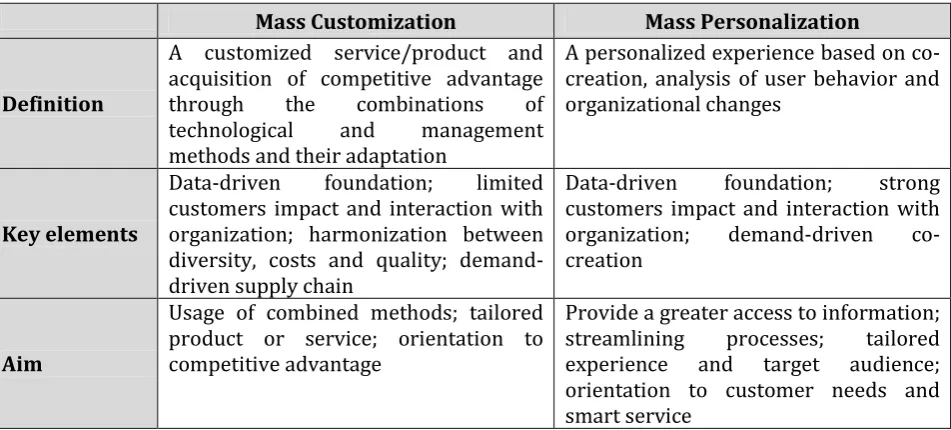
Table 2. Variances in semantical meaning of Mass Customization and Mass Personalization
Mass Customization Mass Personalization
Definition
A customized service/product and acquisition of competitive advantage through the combinations of technological and management methods and their adaptation
A personalized experience based on co-creation, analysis of user behavior and organizational changes
Key elements
Data-driven foundation; limited customers impact and interaction with organization; harmonization between diversity, costs and quality; demand-driven supply chain
Data-driven foundation; strong customers impact and interaction with organization; demand-driven co-creation
Aim
Usage of combined methods; tailored product or service; orientation to competitive advantage
Provide agreater access to information; streamlining processes; tailored experience and target audience; orientation to customer needs and smart service
Source: Composed by the researcher and based on resources: Deloitte LLP, 2015; ; KMPG, 2016; Fels et al., 2017; Tiihonen and Felfernig, 2017; Dreyer et al. 2019
and have clear predeterminations by designers, which unnecessarily satisfy specific requirements of costumers (Tiihonen and Felfernig, 2017; Wang et al., 2017).
b)Second, transition from a standard service or product model (Mass Production concept) to a customization driven by user experience has not been widely discussed (in business management field) in terms of mass confusion taking a role as a side effect, as this solution requires personal assistance with communication of relevant information, constant support and feedback (Huffman and Kahn, 1998; Tiihonen and Felfernig, 2017).
c)Third, another type of approach to Mass Personalization, Mass Customization and Communication domains can be identified in organizations practice. According to Deloitte (2015), in the phase of personalization, organizations analyze existing customer purchase or profile (user model) data and later modify products or service according to results from a recommended system (Tiihonen and Felfernig, 2017). Thus, no active communication or other type of customer engagement is needed here. It should be noted that due to existing assumption of that a two-way communication and customer interaction management is costly and time consuming organizations prefer to implement this concept as a key tool in sales and marketing strategies (Gandhi et al., 2013; Deloitte LLP, 2015). Accordingly, in practice it is illustrated by implementing a different degree of personalized marketing. For instance, campaign personalization, geographical personalization, related content personalization, etc. Besides, modified C2B business model - C2B2M-MP (customer to business to manufactory based on mass personalization) is used (Deloitte LLP, 2015; Zhang et al. 2019). In the customization phase organizations face complex challenges to define a cost effective number of features and options for customizations as well as they properly deal with costumers engagement, experience and communication management. At this point, previously mentioned combinations of technological and management methods are adopted.
In addition, Deloitte (2015) research and analysis also show 2 possible categories of customization: a) Active participation in process. This type is typically related to a customer willingness to be actively involved into the whole customization procedure and noticed in category of a more expensive service or luxury products, for example, fashion accessories, clothing, jewelry, furniture, or holidays. It also might be called as an intermediary stage between Mass Customization and Bespoke service; b) Limited participation in process, which is related to a standard customization concept based on passive users’ actions and their preferred low level of involvement. In this case, products or services are massively produced and customized by using data which organizations already operate or receive, while for costumer limited options for customization are offered. In practice, in this customization category, an account customization feature illustrate data collection and management when service or product content can be personalized after creating account and sharing personal data with organization (Deloitte LLP, 2015). Overall, Mass Customization in practice is defined under a general business model of C2B2M-MC (Customer to business to manufactory based on mass customization) and 5 specific operations models: Customers’ personalized requirements (CPR) based on customization model; Product design (PD) based on customization model; Product manufacturing (PM) based on customization model; Supply chain (SC) based on customization model and Users’ service (US) based on customization model (Zhang et al., 2019). Real examples of passive customization can be found in food and beverage market segments as well as in the field of entertainment relating books, music, etc.
features, however, customization appears to become dominant. In opposition, strong preferences to Mass Personalization concept are recognized in the pubic sector (Needham, 2011; Dvoriak and Savickaitė, 2018). In addition, it should to be mentioned that the selection of Mass Personalization is based not only on the role of the Communication domain in the public administration context, but on two side needs too. To be more specific, public organizations aim to adapt good practices in digital and tailored customer experience management so as to improve service quality and a cost ratio (Homburg and Dijkshoorn, 2013). On the other side, looking from the customer perspective, a clear need for this type of service model as well as an increasingly raising expectation to receive a high level of interaction possibilities, service content transparency and digital environment simplicity from government is identified. A personalized e-government service delivery in public health, safety, communication and tax administration fields is defined as a good practical example where this concept implication helps to manage such public sector service management issues as reducing information overload and asymmetry, improving waiting time, decentralizing service provider network by delivering an equitable access to public goods without any specific time and location limitations (Homburg and Dijkshoorn, 2013; Christensen and Pilling, 2014; Kant, 2014, Schwarz, 2016). Examples of personalized e-government service are found in cases of Canada, Netherlands, England (Homburg and Dijkshoorn, 2013; Dvoriak and Savickaitė, 2018). At this point, relevant insights from Deloitte LLP research are outlined as bringing an importance where it is stated that there are general obstacles in environment which are affecting customized product orientated private sector organizations, but also influence customer engagement and preferences in the public service area. Rapidly evolving technologies, economic uncertainty defined by low growth and margin compression numbers, customers demographic shifts are identified as impacting organizations by a significant scope (Deloitte LLP, 2016).
Conclusions
In summarizing semantical meaning and practical implementation of analyzed concepts, main points are clarified: a) In scientific research, Mass Personalization is evaluated as a pre-stage of Mass Customization, while in practice it is understood as a pre-stage coming after or combined with Mass Customization; the main mismatch area is a role of Communication domain; b) When increasing digitalization and development of Information and Communication Technologies (ICT), new forms of customers engagement in product or service individualization procedure is revealed as well as a set of new requirements for value co-creation and co-design activities and systems are outlined. Therefore, organizations should focus to an application of combined, technology and management synergy based methods, qualitative and quantitative process measurement indicators; c) Practical implementation between sectors features differences and tendencies – private sector organizations are tended to adapt combined Mass Customization and Personalization (MCP) concept or base their strategy on process oriented customization methods while the public sector prefers Mass Personalization concept more (Gandhi et al., 2013; Fels et al., 2017; Risdiyono et al., 2016).
a) Mass Personalization paradigm has a strong content relation to the Communication domain. It is based on management of customer engagement, experience and satisfaction; also it features in building customer loyalty as well as ensuring a streamlined information flow and access to smart service. Due to mentioned elements of content, Mass Personalization is more acceptable to adapt to Public Service as this is confirmed by numerous researches under the Public Heath Care subdomain of the analyzed period. But at this point an open question has been left unanswered on how properly in time and location aspects and in which framework personalization technologies should be switched from the product oriented Mass Customization based C2B2M-MC business model to the customer orientated C2B2M-MP (customer to business to manufactory based on mass personalization) model?
b) Mass Customization paradigm is defined as an operational technology oriented to product manufacturing. This approach is mostly influenced by historical reasons and overall practical implementation tendencies: a misleading correlation to the Mass Production paradigm and application via advanced manufacturing operations technology. It is illustrated by dominant scientific research origin countries USA, Germany, United Kingdom, and this correlates with statistics of product configurators offered by companies based on country of origin: leading countries are Germany, USA, Austria, United Kingdom and Switzerland (Risdiyono, 2016). In practice, it is also evaluated as a multidimensional, intermediary procedure stage between Mass Personalization and Bespoke service. In this case, both practical and theoretical type of questions for future research arise: how organizations should transit from personal marketing to personal experience and find a right proportion between a level of involvement and customization? How to incorporate a value co-creation approach and tools into already customized systems, services or products?
c) As recommended guidelines for practical analysis in both sectors organizations can be adapted and combined: 1) At operational level, for AS-IS type, multidimensional status identification – Customization index (Welborn, 2009), classification of 5 customization models (Zhang et al., 2019) and a matrix of workers competencies and skills evaluation (Gross et al., 2018). 2) At strategic level, to define TO-BE situation and future actions direction – 3-level matrix of goals (of the manufacturing paradigms) (Hu, 2013), evolution and characteristics of C2B model diagram (Zhang et al., 2019) and an extension to Mass Customization and Personalization (MCP) concept. It is important to notice – comparative analysis and research about combination of these methods and their application possibilities in organizations of different types and sectors are missing.
References
Chatzopoulos, C. G. 2017. Monitoring “Mass Customization” and “Open Innovation” on the world wide web: a usage analysis 2012-2016. Annals of the Faculty of Engineering Hunedoara - International Journal of Engineering, 15(1): 133-141.
Christensen, K., Pilling, D. 2014. Policies of Personalisation in Norway and England: On the Impact of Political Context. Journal Of Social Policy, 43(3): 479-496.
Deloitte. [interactive]. 2015. The Deloitte Consumer Review Made-to-order: The rise of mass personalization. [accessed 2019-05-01]. https://www2.deloitte.com/content/dam/Deloitte/ch/Documents/consumer-business/ch-en-consumer-business-made-to-order-consumer-review.pdf
Deloitte. [interactive]. 2016. Consumer product trends Navigating 2020 [accessed 2019-06-10]. https://www2.deloitte.com/content/dam/Deloitte/uk/Documents/consumer-business/deloitte-uk-cpg-trends-2016.pdf
Dvoriak, J., Savickaitė, S. 2018. Psichosocialinių paslaugų onkologiniams ligoniams personalizavimas: lietuvos ir anglijos lyginamoji analizė. Regional Formation and Development Studies, 1(24): 133-144.
Fels, A., Falka, B., Schmitt, R. 2017. User-driven customization and customer loyalty: A survey. Procedia CIRP 60: 410-415.
Forbes, H., Schaefer, D. 2017. Social Product Development: The Democratization of Design, Manufacture and Innovation. Procedia CIRP 60: 404-409.
Gandhi, A., Magar, A., Roberts, R. [interactive]. 2013. How technology can drive the next wave of mass customization. McKinsey on Business Technology, 32: 1-9. [accessed 2019-05-06].
https://www.mckinsey.com/~/media/mckinsey/dotcom/client_service/bto/pdf/mobt32_02-09_masscustom_r4.ashx
Gross, E., Siegert, J., Bauernhansl, T. 2018. Different competence areas of workers in combination with technical assistance as an enabler for mass personalization products. 8th Conference on Learning Factories 2018 - Advanced Engineering Education & Training for Manufacturing Innovation,195-200.
Homburg, V., Dijkshoorn, A. 2013. Diffusion of Personalized E-Government Services among Dutch Municipalities (An Empirical Investigation and Explanation). Tékhne, 11(2): 83-91.
Hu, S. J. (2013). Evolving Paradigms of Manufacturing: From Mass Production to Mass Customization and Personalization. Procedia CIRP 7:3-8.
Huffman, C., Kahn, B. 1998. Variety for Sale Mass Customization or Mass Confusion. Journal of Retailing, 74(4), 491–513.
Jitpaiboon, T., Dobrzykowskib, D. D., Ragu-Nathanb, T.S. and Vonderembse, M. A. 2013.Unpacking IT use and integration for mass customisation: a service-dominant logic view. International Journal of Production Research, 51(8): 2527–2547.
Kant, T. 2014. Giving the "Viewser" a Voice? Situating the Individual in Relation to Personalization, Narrowcasting, and Public Service Broadcasting. Journal of Broadcasting & Electronic Media, 58(3): 381-399.
KMPG International Cooperative [interactive] 2016. Demand-driven supply chain. [accessed 2019-05-06]. https://assets.kpmg/content/dam/kpmg/pdf/2016/05/demand-driven-supply-chain.pdf
Moon, H. and Lee, H. H. 2015. The effect of intangibility on the perceived risk of online Mass Customization: utilitarian and hedonic perspectives. Social Behavior and Personality, 43(3): 457-466.
Needham, C. 2011. Personalization: From Story-line to Practice. Social Policy & Administration, 45(1): 54-68.
OECD. [interactive]. 2018. Embracing Innovation in Government Global Trends 2018. United Arab Emirates: OECD Observatory of Public Sector Innovation (OPSI) partnered with the Government of the United Arab Emirates (UAE) and its Mohammed Bin Rashid Centre for Government Innovation (MBRCGI). [accessed 2019-03-23]. http://www.oecd.org/gov/innovative-government/embracing-innovation-in-government-global-trends-2019.htm
Park, M., Yoo, J. 2016. E-mass customization: effects of self-congruity and functional congruity on consumer responses. Social Behavior and Personality, 44(8): 1379-1394.
Pieterson, W., Ebbers, W., Van Dijk, J.A.G.M. 2007. Personalization in the public sector: An inventory of organizational and user obstacles towards personalization of electronic services in the public sector. Government Information Quarterly, 24(1): 148-164.
Risdiyono, R., Widodo, I. D., Mahtarami, A. 2016. Mass Customization and Personalization Prospects in Developing Country: Indonesian Context. IOP Conference Series: Materials Science and Engineering,105: 1-5.
Rødseth, H., Schjølberg, P., Marhau, A. 2017. Deep digital maintenance. Advance Manufacturing, 4: 299-310.
Rungtusanatham, M. J., Salvador, F. 2008. From Mass Production to Mass Customization: Hindrance Factors, Structural Inertia, and Transition Hazard. Production and Operations Management, 17(3): 385-396.
Schlager, T., Hildebrand, C., Häubl, G., Franke, N. and Herrmann, A. 2018. Social Product-Customization Systems: Peer Input, Conformity, and Consumers’ Evaluation of Customized Products. Journal of Management Information Systems,35(1): 319-349.
Schwarz, JA. 2016. Public Service Broadcasting and Data-Driven Personalization: A View from Sweden. Television & New Media, 17(2): 124-141.
Skačkauskienė, I., Davidavičius, S. 2015. Masinio individualizavimo koncepto ypatumai. Business: Theory and Practice,16(2): 132-139.
Wang, Y., Ma, H-S, Yang, J-H, Wang, K-S. 2017. Industry 4.0: a way from mass customization to mass personalization production. Advance Manufacturing, 4: 310-321.
Welborn, C. 2009. Customization Index: Evaluating the Flexibility of Operations in a Mass Customization Environment. ICFAI Journal of Operations Management, 6-11.
Zhang, X., Ming, X., Liu, Z., Zheng, M., Qu, Y. 2019. A new customization model for enterprises based on improved framework of customer to business: A case study in automobile industry. Advances in Mechanical Engineering, 11(3): 1-17.
Zheng, P., Yua, S., Wanga, Y., Zhonga, R.Y., Xun X. 2017. User-experience based product development for mass personalization: a case study. Procedia CIRP 63: 2-7.
This work is licensed under a Creative Commons