Iran University of Medical Sciences
____________________________________________________________________________________________________________________
1. Psychiatrist, Mental Health Research Center, Tehran Institute of Psychiatry, School of Behavioral Sciences and Mental Health, Iran
Universi-ty of Medical Sciences, Tehran, Iran. [email protected]
2. Psychiatrist, Mental Health Research Center, Tehran Institute of Psychiatry, School of Behavioral Sciences and Mental Health, Iran
Universi-ty of Medical Sciences, Tehran, Iran. [email protected]
3. Associate Professor of Psychiatry, Mental Health Research Center, Tehran Institute of Psychiatry, School of Behavioral Sciences and Mental
Health, Iran University of Medical Sciences, Tehran, Iran. [email protected]
4. (Corresponding author) Assistant Professor of Psychiatry, Mental Health Research Center, Tehran Institute of Psychiatry, School of
Behav-ioral Sciences and Mental Health, Iran University of Medical Sciences, Tehran, Iran. [email protected]
Predictors of physical restraint in a psychiatric emergency setting
Fatemeh Hadi1, Termeh Khosravi2, Seyed Vahid Shariat3
Amir Hossein Jalali Nadoushan*4
Received:8 May 2015 Accepted:27 July 2015 Published:17 November 2015
Abstract
Background: Considering the negative consequences of using physical restraints, we conducted this study to identify patients who are more frequently restrained in a psychiatric emergency ward as an initial step to limit the use of restraint to the minimum possible.
Methods: This was a retrospective case control study conducted in Iran Psychiatric Hospital in Tehran, Iran. We reviewed the files of 607 patients who were admitted during a one year period us-ing convenience samplus-ing; of them, 186 were in the restrained group and 421 in the unrestrained group.
Results: Surprisingly, no significant difference was found between the restrained and unrestrained groups in demographic characteristics. The patients who were referred because of violence were di-agnosed as having methamphetamine induced psychotic disorder or bipolar I disorder in manic 1episode and had a higher odds of being restrained (OR=2.51, OR=1.61, and OR=1.57 respectively). Being restrained was also associated with a longer duration of hospitalization and duration of staying in the emergency ward. Moreover, patients in their first admission were more frequently restrained.
Conclusion: Medical and nursing staff should consider special measures for the patients who are at a higher risk for being restrained. More frequent visits and education for both patients and staff may be effective in reducing the number of physical restraints for these groups of patients.
Keywords: Physical Restraint, Psychiatric Emergency Settings, Case-Control Studies.
Cite this article as:Hadi F, Khosravi T, Shariat SV, Jalali Nadoushan AH. Predictors of physical restraint in a psychiatric emergency setting.Med J Islam Repub Iran2015 (17 November). Vol. 29:296.
Introduction
Physical restraint is a coercive interven-tion that is sometimes used in psychiatric emergency wards (1,2).Although highly disputed, physical restraint is inevitable in some situations in order to prevent patients from harming themselves or others. How-ever, it may result in complications and problems for both the staff and patients (3,4) such as assaults to staff that might lead to absence from work(5)or soft tissue injuries, fractures or delirium in patients (6). In the most extreme cases, it has even been reported to cause patients’ death (7,8).
Therefore, it is desirable to limit the use of restraint to the minimum possible. It is es-timated that 75% of the physical restraints and seclusion could be prevented by im-plementing appropriate mechanisms like sharing the treatment plan with patients, remodeling the emergency environment, training staff how to perform de-escalating techniques and less forceful interventions and how to recognize factors which lead to violation, and giving regular feedback to staff and so on (9).
Little evidence exists about the rate of re-straints in mental hospitals of the
ing countries. Only anecdotal reports about the occasional cases of injuries or fractures demonstrate a possible existing problem. Local experts estimate that a large number of restraints are performed without alerting the physicians, and sometimes the staff use restraints as a punishment for the misbe-havior or even excessive talkativeness of the patients.
In order to recognize the extent of and prevent the unnecessary use of force in psychiatric emergencies, we need to distin-guish those patients who are most likely to be restrained, and the situations which may increase the probability of restraint. There-fore, we decided to study the characteristics of restrained patients as well as the process of restraining in a large psychiatric hospi-tal. To our knowledge, only two studies conducted in Brazil has evaluated the char-acteristics of the restrained patients in a de-veloping country (10,11). The purpose of this study was to assess the demographic and clinical characteristics of the restrained and unrestrained patients in one of the larg-est mental hospitals in Iran.
Methods
This was a retrospective case control study conducted in Iran psychiatric hospital in Tehran. This study was performed from March 20, 2010 to March 19, 2011.Review board of Iran University of Medical Sci-ences approved this study. Iran psychiatric hospital, the educational center of psychia-try in Iran University of Medical Sciences, is one of the largest public referral psychi-atric centers in Tehran. We reviewed all of the files of the 607 patients who were ad-mitted in the psychiatric emergency ward during the study period. Generally, in the hospital, patients were first visited by psy-chiatric residents, their medical history was taken and diagnosis was made; then the di-agnosis was authenticated by the attending psychiatrists based on the Diagnostic and Statistical Manual of Mental Disor-ders, Fourth Edition, Text Revision (DSM-IVTR)(12).
Out of the 607 patients, 186 were
re-strained at least once during their stay (re-strained group) and 421 were not re(re-strained (unrestrained group). Data were collected from the patient's files according to the re-searcher’s designed format. The restrained group included patients who experienced at least one physical restraint during their hospitalization period and the unrestrained group included patients who did not experi-ence any physical restraint in this period. Patients who were hospitalized for less than 48 hours and patients under 18 years of age were excluded. The following data were collected for both restrained and unre-strained groups: Age, gender, marital sta-tus, occupation, type of admission (coer-cive vs. voluntary), chief complaint at ad-mission, past psychiatric admission history, history of physical restraint (previous phys-ical restraint), duration of staying in the emergency ward, and duration of admission in hospital (if the patient was transferred from the emergency ward to a general psy-chiatric ward).
For the restrained group, we investigated the number of physical restraint(s) for each patient and the nursing shift was registered as well. We also checked the records in the patients’ files to find the reason for the physical restraint, the duration of physical restraint, and whether caring of extremities and watching the vital signs were recorded. Then we analyzed the data and the relation between them using IBM SPSS Statistics 20, t-test and Chi square. Due to the low number of patients in some diagnostic sub-groups, we combined the smaller groups. Taking this approach, we combined Bipolar I Disorder (BID) manic episode with mixed episode, and MDD with BID depressive episode. P<0.05 was considered as signifi-cant.
Results
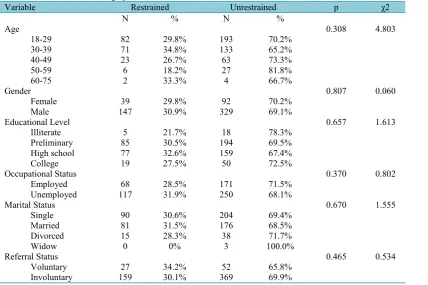
Table 1 shows no significant difference between the restrained and unrestrained groups in demographic characteristics. Most of the patients were male, and within the age range of 18−29, with a preliminary educational level. Moreover, most of the
patients were single, unemployed and ad-mitted involuntarily (Table 1).
Although violence was the most frequent reason for referral in both groups, it was significantly higher in the restrained group (p0.001) with an odds ratio (OR) of 2.51 (95%CI1.72 to 3.65) (Table 2). Axis I di-agnosis was also different between the re-strained and unrere-strained groups (Table 3) (p=0.006).Patients with methamphetamine induced psychotic disorder (MIP) were more frequently restrained (OR relative to any other Axis I disorder= 1.61, 95%CI
1.05 to 2.46), followed by the patients with BID/manic episode (OR relative to Axis I disorders other than MIP= 1.57, 95%CI 1.05 to 2.33), and the patients with a de-pressive episode were less frequently re-strained than other patients (OR= 0.29, 95% CI 0.13 to 0.65).
There was a marginally significant differ-ence in Axis II diagnosis between the two groups (p= 0.055). Most patients did not have an axis II diagnosis, and those with a diagnosis of cluster B personality disorder were more frequently restrained than the Table 1. Demographic Characteristics of Restrained and Not Restrained Patients
Variable Restrained Unrestrained p χ2
N % N %
Age 0.308 4.803
18-29 82 29.8% 193 70.2%
30-39 71 34.8% 133 65.2%
40-49 23 26.7% 63 73.3%
50-59 6 18.2% 27 81.8%
60-75 2 33.3% 4 66.7%
Gender 0.807 0.060
Female 39 29.8% 92 70.2%
Male 147 30.9% 329 69.1%
Educational Level 0.657 1.613
Illiterate 5 21.7% 18 78.3%
Preliminary 85 30.5% 194 69.5%
High school 77 32.6% 159 67.4%
College 19 27.5% 50 72.5%
Occupational Status 0.370 0.802
Employed 68 28.5% 171 71.5%
Unemployed 117 31.9% 250 68.1%
Marital Status 0.670 1.555
Single 90 30.6% 204 69.4%
Married 81 31.5% 176 68.5%
Divorced 15 28.3% 38 71.7%
Widow 0 0% 3 100.0%
Referral Status 0.465 0.534
Voluntary 27 34.2% 52 65.8%
Involuntary 159 30.1% 369 69.9%
Table 2. Referral Characteristics of Restrained and Not Restrained Patients
Characteristics Restrained Unrestrained p χ
2
N % N %
Reason for Referral 0.001 28.585
Violence 136 73.1% 219 52.1%
Delusion & Hallucination 16 8.6% 60 14.2%
Suicide 3 1.6% 41 9.8%
Depression/Crying 6 3.2% 27 6.4%
Others 25 13.4% 73 17.4%
Total* 186 100.0% 420 100.0%
Admission History 0.213 5.814
No Admission History 116 62.4% 260 61.8%
Once 35 18.8% 96 22.8%
Twice 9 4.8% 28 6.7%
Three Times &More 26 14.0% 37 8.7%
Total 186 100.0% 421 100.0%
*1 missing
patients with other Axis II diagnoses (Table 3). Due to the large number of diagnosis of borderline personality disorder, this disor-der was reported separately from other cluster B personality disorders.
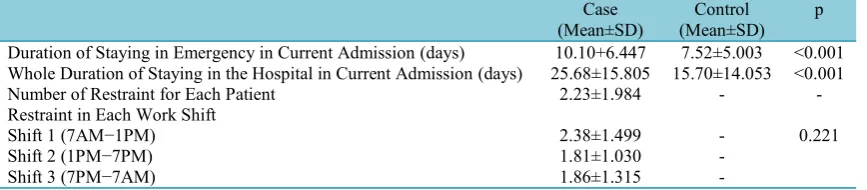
Most patients did not have hospitalization history (Table 2). We measured both the total duration of admission in hospital and duration of staying in the emergency ward to find out whether there was a difference between the restrained and unrestrained patients on these measures. Both the mean of duration of hospitalization and duration of emergency stay were significantly higher in the restrained group than the unre-strained group (Total hospitalization: 25.6 vs. 15.7 days, p< 0.001; emergency stay: 10.1 vs. 7.5 days, p< 0.001).
Most restraint patients were restrained on-ly once, but the mean number of restraints for each patient was 2.23 times. We did not find a significant difference in the number of restraints between morning, afternoon, or evening and night shifts (Table 4). None-theless, we expected a lower number of re-straints in the evening and night shift when patients are mainly asleep. Physicians’
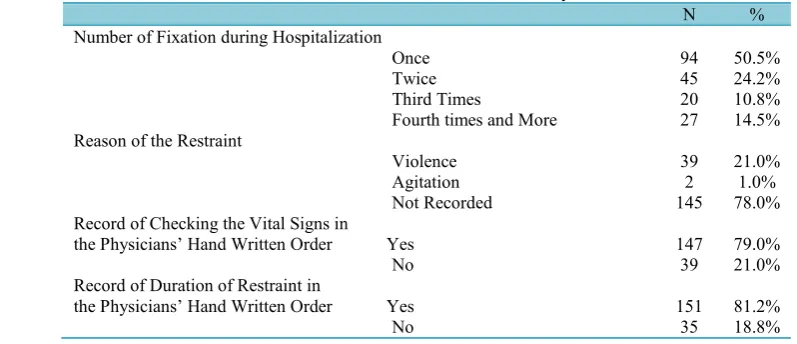
or-ders for restraint were not carefully written, and there were no records of the reason for the restraint in most patients' files (78% of cases). Patients’ violence was the most common reason for the restraint in those orders that mentioned the reason. In most orders, however, checking the vital signs and circulation of extremities and duration of restraint episode were recorded (Table 5).
Discussion
This study showed that compared to unre-strained patients, reunre-strained patients were more commonly admitted with a reason for referral of violence, had an Axis I diagnosis of methamphetamine induced psychotic disorder, had an Axis II diagnosis of cluster B personality disorder and stayed for a longer duration in the emergency ward and other wards of the hospital.
In this study, the demographic character-istics of the two groups were identical. However, male and young patients were more often restrained in some other studies (1,7). On the other hand, Bergket al. 2011did not find a difference in the em-Table 3. Patients’ Axis I and Axis II Diagnoses
Diagnosis Restrained Unrestrained Total p χ2
N % N % N
Axis I Diagnosis 0.006 17.961
No Diagnosis 4 40.0% 6 60.0% 10
Schizophrenia and Schizoaffective Disorder 38 28.1% 97 71.9% 135
MIP 44 39.3% 68 60.7% 112
Substance Induced Psychotic Disorder 15 28.3% 38 71.7% 53
BID Manic or Mixed Episode 63 34.6% 119 65.4% 182
MDD or BID Depressive Episode 7 10.9% 57 89.1% 64
Others 15 29.4% 36 70.6% 51
Axis II Diagnosis 0.055 7.602
No Diagnosis 130 33.2% 261 66.8% 391
Borderline Personality Disorder 15 31.9% 32 68.1% 47 Other Cluster B Personality Disorders 11 37.9% 18 62.1% 29
Others 30 21.4% 110 78.6% 140
MIP, Methamphetamine Induced Psychosis
Table 4. Measures of Restraint Duration and Episodes Case
(Mean±SD) (Mean±SD)Control p Duration of Staying in Emergency in Current Admission (days) 10.10+6.447 7.52±5.003 <0.001 Whole Duration of Staying in the Hospital in Current Admission (days) 25.68±15.805 15.70±14.053 <0.001
Number of Restraint for Each Patient 2.23±1.984 -
-Restraint in Each Work Shift
Shift 1 (7AM−1PM) 2.38±1.499 - 0.221
Shift 2 (1PM−7PM) 1.81±1.030
-Shift 3 (7PM−7AM) 1.86±1.315
ployment status of the restrained vs. unre-strained patients (13). The lack of differ-ence in demographic characteristics of re-strained and unrere-strained patients might be due to the fact that our center is a referral center that receives the most severe cases. Therefore, the severity of the disorders might have covered any possible effect of the demographic characteristics.
In our study, no difference was found in the number of restraining patients who were admitted voluntarily or involuntarily; this is not in line with Knutzen 2011 who showed that involuntary referral to hospital was significantly higher in the restrained group (1). This difference could be related to the fact that only a small minority of the patients in our study was admitted voluntar-ily, and their diagnoses were not very dif-ferent from those in the involuntary group. It confirms that in this study the type of admission did not distinguish the two dif-ferent subgroups of patients; and this is counterintuitive, because we expect that the patients with intact insight be admitted vol-untarily compared with those with impaired insight that are admitted coercively. How-ever, this might not happen in an over-crowded emergency ward where nearly all of the admissions are for severe and com-plicated cases. In such a setting, not enough room remains for “real” voluntary admis-sions.
In this study, previous admission history had no association with being restrained.
However, Knutzen 2011found that having a history of several admissions was more common in restrained patients and con-cluded that this group probably had poor insight, poor treatment, and negative expe-rience with mental health (1). The observed difference might be due to unnecessary re-straining of the patients during their first admission when they are not yet familiar with the ward’s rules and routines.
In this study, duration of hospitalization and time of staying in the emergency ward were significantly higher in the restrained group; and this is consistent with the find-ings of several studies (1,7,14); for exam-ple, in the study of Goldbloom et al., the duration of hospitalization in restrained and unrestrained patients were42.140.5 and 18.118 days, respectively (7); this indi-cates that either restrained patients need more time for inpatient management and preparing themselves for discharge from the hospital, or the staff have decided that they need a longer hospitalization.
As it could have been predicted, the rea-son for referral of violence was associated with a higher chance of being restrained in this study. Although this finding seems ob-vious at the first glance, it shows that the staff should pay special attention to these patients that have a 2.5 fold increase in the chance of being restrained during their hos-pitalization. Therefore, the reason for refer-ral of patients with aggression or violence could be considered an alarming sign for Table 5. Characteristics of Restrained Patients and Physicians’ Orders
N %
Number of Fixation during Hospitalization
Once 94 50.5%
Twice 45 24.2%
Third Times 20 10.8%
Fourth times and More 27 14.5% Reason of the Restraint
Violence 39 21.0%
Agitation 2 1.0%
Not Recorded 145 78.0%
Record of Checking the Vital Signs in
the Physicians’ Hand Written Order Yes 147 79.0%
No 39 21.0%
Record of Duration of Restraint in
the Physicians’ Hand Written Order Yes 151 81.2%
No 35 18.8%
the emergency staff at the beginning of the admission that merits a more aggressive treatment plan.
The patients with MIP and BID manic or mixed episode had higher odds of being restrained than other patients. This is par-ticularly important in emergency settings where the patients with BID have the most prevalent diagnosis, and a large number of patients with MIP are visited every day. In the study of Knutzen et al., in which the diagnoses were based on ICD-10, the most common diagnosis in the restrained group was schizophrenia (1). The higher rate of restraint for the patients with BID in our study may be due to over- activity, talka-tiveness, and disturbing behaviors that are common in these patients, which may result in unnecessary restraining of the patients. It has been anecdotally reported that some patients have been restrained even for their intrusive behavior or excessive questions.
The patients with MIP were also more frequently restrained than the patients with other Axis I disorder except for BID manic or mixed episode. This finding is consistent with our expectations because of the high rate of aggression observed in the patients with MIP (15). Agitation and violent be-haviors are common in methamphetamine users (16), and it may be necessary to se-date or restraint them in the emergency ward (17).
Considering Axis I diagnosis, only a marginally significant association with be-ing restrained was observed with cluster B personality disorders. Personality disorders are one of the risk factors for violent behav-iors (18). Borderline personality disorder poses major management problems includ-ing beinclud-ing more often restrained (19). Re-straints occur more frequently following micro psychotic episodes or impulsive be-haviors in these patients (20).
There was a physician hand written order for patient restraint in all files, but there were deficits in recording the reason for the restraint, the time and its duration. Surpris-ingly, the reason for restraint was not rec-orded in most of the patients' files. This
suggests that restraints were often done be-fore the physician visited the patients and even without the physician’s permission, which is not in line with the emergency protocols. Although it is acceptable that the staff could restrain the patient without in-forming the physician in some emergency situations, it is very unusual that this would happen in most of the cases, particularly in those cases that were done in the morning shifts when the physicians are present in the emergency ward.
In most orders, checking the vital signs and the blood supply of the extremities and duration of the restraint were recorded. This shows that the physicians have been considerate about the possible adverse ef-fects of restraining and have limited the duration of restraint as well. However, it is also possible that the restraint orders were not individualized for each patient and only were “stereotypically” copied regardless of each patient’s unique condition; the orders included checking the vital signs and ex-tremity with a fixed duration, but the reason for intervention was not included.
The findings of this study revealed that restraint was not used according to the pre-determined indications or as a standard medical intervention in a significant num-ber of the cases. This is especially im-portant because the medical protocols and guidelines suggest limiting the use of re-straints to the minimum possible (8,21). With implementing the suggested protocols to control agitation in emergency settings, we could expect to reduce the number of unnecessary restraint (22,23). However, correct implementation of the protocols will not succeed without paying adequate attention to the workload and mental health of the emergency staff. The followings are some of the issues that should be addressed before observing an enduring positive change in the situation: Exhausting work-load and inadequate number of emergency staff, sense of insecurity, psychosocial and financial problems, and inadequate training, debriefing techniques, verbal de-escalation, and crisis management (8,24-27).
One limitation of this study was that we only studied one referral hospital that gen-erally admits very severe cases that might not be typical of other mental hospitals. The large capacity of the hospital allows it to receive most of the patients of the West of Tehran and Karaj, although it also has cases from all over the country.
Conclusion
The patients admitted in the psychiatric emergency wards with a chief complaint of aggression who are diagnosed with MIP or BID in manic episode are more probably restrained during their hospitalization. In-completeness of restraint orders (especially not mentioning the reason for the restraints) suggests that the majority of the restraints were done in the absence of physicians and after the patient had been restrained.
Important measures should be considered to decrease the number and adverse effects of unnecessary restraints including periodi-cal educational programs for staff on de-briefing techniques, verbal de-escalation, and crisis intervention as well as to de-crease the workload of the staff to a reason-able amount.
References
1. Knutzen M, Mjosund NH, Eidhammer G, Lorentzen S, Opjordsmoen S, Sandvik L, et al. Characteristics of psychiatric inpatients who experienced restraint and those who did not: a case-control study. Psychiatric Services 2011;62(5):492-7.
2. Cannon ME, Sprivulis P, Mccarthy J. Restraint practices in Australasian emergency departments. Australian and New Zealand Journal of Psychiatry 2001;35(4):464-7.
3. Fisher WA. Restraint and seclusion: a review of the literature. American Journal of Psychiatry 1994;151(11):1584-91.
4. Knutzen M, Bjørkly S, Eidhammer G, Lorentzen S, Helen Mjøsund N, Opjordsmoen S, et al. Mechanical and pharmacological restraints in acute psychiatric wards-Why and how are they used? Psychiatry research 2013;209(1):91-7.
5. Allen MH, Currier GW. Use of restraints and pharmacotherapy in academic psychiatric emergency services. General hospital psychiatry 2004;26(1):42-9.
6. Sandhu SK, Mion LC, Khan RH, Ludwick R, Claridge J, Pile JC, et al. Likelihood of ordering physical restraints: influence of physician characteristics. Journal of the American Geriatrics Society 2010;58(7):1272-8.
7. Goldbloom DL, Mojtabai R, Serby M. Weekend prescribing practices and subsequent seclusion and restraint in a psychiatric inpatient setting. Psychiatric Services 2010;61(2):193-5.
8. Jonikas JA, Cook JA, Rosen C, Laris A, Kim J-B. Brief reports: a program to reduce use of physical restraint in psychiatric inpatient facilities. Psychiatric Services 2004;55(7):818-20.
9. Knox DK, Holloman Jr GH. Use and avoidance of seclusion and restraint: consensus statement of the American Association for Emergency Psychiatry Project BETA Seclusion and Restraint Workgroup. Western Journal of Emergency Medicine 2012; 13(1):35.
10. Migon MN, Coutinho ES, Huf G, Adams CE, Cunha GM, Allen MH. Factors associated with the use of physical restraints for agitated patients in psychiatric emergency rooms. General hospital psychiatry 2008;30(3):263-8.
11. Huf G, Coutinho EdSF, Fagundes HM, Oliveira ES, Lopez JRR, Gewandszajder M, et al. Current practices in managing acutely disturbed patients at three hospitals in Rio de Janeiro-Brazil: a prevalence study. BMC psychiatry 2002;2(1):4.
12. Association AP. DSM-IV-TR: Diagnostic and statistical manual of mental disorders, text revision: American Psychiatric Association; 2000.
13. Bergk J, Einsiedler B, Flammer E, Steinert T. A randomized controlled comparison of seclusion and mechanical restraint in inpatient settings. Psychiatric Services 2011;62(11):1310-7.
14. Way BB. Public Psychiatric Hospitals: Patient. Hospital and community Psychiatry 1990;41(1):75.
15. Eronen M, Hakola P, Tiihonen J. Mental disorders and homicidal behavior in Finland. Archives of general psychiatry 1996;53(6):497-501.
16. Toles M, Jiang CS, Goebert D, Lettich L. Methamphetamine in emergency psychiatry. Addictive Disorders & Their Treatment 2006; 5(4):191-9.
17. Lineberry TW, Bostwick JM, editors. Methamphetamine abuse: a perfect storm of complications. Mayo Clinic Proceedings; 2006: Elsevier.
18. Raja M, Azzoni A, Lubich L. Aggressive and violent behavior in a population of psychiatric inpatients. Social Psychiatry and Psychiatric Epidemiology 1997;32(7):428-34.
19. Leontieva L, Gregory R. Characteristics of patients with borderline personality disorder in a state psychiatric hospital. Journal of personality disorders 2013;27(2):222-32.
20. Soloff PH. Physical restraint and the nonpsychotic patient: Clinical and legal perspectives. Journal of Clinical Psychiatry. 1979.
21. Donat DC. An analysis of successful efforts to reduce the use of seclusion and restraint at a public psychiatric hospital. Psychiatric Services 2003; 54(8):1119-23.
22. Allen M, Currier G, Carpenter D, Ross R, Docherty J. The expert consensus guideline series. Treatment of behavioral emergencies 2005. Journal of psychiatric practice 2005;11:5-108; quiz 10-2.
23. Downey LVA, Zun LS, Gonzales SJ. Frequency of alternative to restraints and seclusion and uses of agitation reduction techniques in the emergency department. General hospital psychiatry 2007;29(6):470-4.
24. Curie CG. Special section on seclusion and restraint: Commentary: SAMHSA's commitment to
eliminating the use of seclusion and restraint. Psychiatric Services 2005;56(9):1139-40.
25. D'Orio BM, Purselle D, Stevens D, Garlow SJ. Reduction of episodes of seclusion and restraint in a psychiatric emergency service. Psychiatric Services 2004;55(5):581-3.
26. Recupero PR, Price M, Garvey KA, Daly B, Xavier SL. Restraint and seclusion in psychiatric treatment settings: regulation, case law, and risk management. Journal of the American Academy of Psychiatry and the Law Online 2011;39(4):465-76.
27. Zun LS. Pitfalls in the care of the psychiatric patient in the emergency department. The Journal of emergency medicine 2012;43(5):829-35.