OPEN A
CCE
SS
JZ
AR R
esearch article
OPEN A
CCE
SS
Birth sex ratio, infant mortality and rearing type in captive western
lowland gorillas
Jan Vermeer and Lieven Devreese
Parc Animalier de Sainte-Croix, 57810 Rhodes, France Correspondence: Jan Vermeer; e-mail: [email protected]
Keywords:
captive management, hand rearing, husbandry, maternal age, mother rearing
Article history:
Received: 21 October 2014 Accepted: 12 January 2015 Published online: 31 January 2015
Abstract
One of the main challenges for the successful captive breeding programme for the western lowland gorilla is the management of males surplus to the population. In addition, infant mortality and rearing type can have a large effect on the development of the population. A better understanding of factors influencing sex ratio, infant mortality and rearing could be advantageous for the management of the captive population. We analysed 1286 births from 378 different dams living in zoos participating in the international breeding programme. Our results show that there is a trend for a male-biased sex ratio with increasing maternal age, but the relationship is not significant and we conclude that limiting reproduction in older females would not sufficiently reduce the surplus of males to warrant the possible negative effects on population genetics and social development. None of the following factors had a significant effect on infant mortality within 30 days after birth: maternal age at conception, birth order, rearing type of the mother, sex of the offspring, survivorship of the previous offspring or population. However, there was a significant decrease in infant mortality over the years, probably reflecting improved captive husbandry practices. Infants born to a hand-reared female had to be hand reared significantly more often as opposed to those of parent-reared and wild-caught females. The ratio of hand-reared offspring showed a significant decrease throughout the study period, showing again the positive results of current management strategies. The study confirms that over the years the management of gorillas in captivity has been considerably improved. Selective breeding with young females will not resolve the problem of surplus males and other solutions will have to be investigated.
Introduction
The captive breeding programme for western lowland gorillas
(Gorilla gorilla gorilla) is one of the best examples of modern
zoo cooperation for ex-situ management of an endangered animal species. A recent analysis of the European captive population showed that breeding is very successful and that the population’s development is healthy (Vermeer et al. 2014).
One of the major challenges for captive gorilla husbandry is the management of surplus males (Stoinski et al. 2001, 2004a, b; Vermeer and Carroll 2012; Grand et al. 2013). Captive gorillas are kept in harem groups containing one adult male and on average three adult females (Vermeer et al. 2014). With an equal sex ratio at birth and equal mortality rates, the unavoidable result is a surplus of males. One management strategy is to keep these males in bachelor groups (Stoinski et al. 2001, 2004a, b; Grand et al. 2013), but the long-term stability of many of these groups is questioned (Nitsch 2004;
Stoinski et al. 2004a; Vermeer and Carroll 2012). One of the solutions to prevent the male surplus would be a manipulation of the sex ratio at birth. An analysis of the sex ratio of captive gorillas born before 1986 showed a general tendency for the sex ratio to become more strongly male-biased with increasing age of the mother (Mace 1990). If this were the case, then a limitation on breeding with older females would have a positive effect on the sex ratio of the population. However, at the time of the analysis only some 300 births had been recorded and few were from dams aged over 23 years, while it is known that gorillas can breed up to the age of 40 years (Wilms and Bender 2012). Before using these data in the management of the captive population, it is therefore important to analyse a larger number of births from dams with a better representation of older ages.
high in wild populations (Robbins et al. 2004), but its frequency in the captive population and the factors influencing mortality have not been analysed in detail in recent years. For different reasons hand rearing has always been a common part of breeding gorillas in captivity (Meder 1990; Ryan et al. 2002), and as there are possible negative effects of hand rearing on the social behaviour and breeding success of gorillas (Beck and Power 1988; Meder 1989; Ryan et al. 2002; Abelló and Colell 2006b),it is important to investigate the factors that may influence the rearing performance of females. Here we analyse the sex ratio at birth, infant mortality and rearing type of the captive western lowland gorilla population by using the information provided by the international studbook (Wilms and Bender 2012). Our goal is to provide the EEP and SSP coordinators with information that can be used to optimise the management of the captive western lowland gorilla population.
Methods
Source of data
Data from the 2012 International Studbook for the Gorilla (Wilms and Bender 2012) were extracted from SPARKS (International Species Information System, ISIS). Only data from the managed SSP (USA, Canada) and EEP (Europe, Russia, Israel, South Korea, Australia, Brazil and South Africa) populations were used for the analysis. The data were updated to 31 December 2011.
The rearing types of the mothers were categorised as wild caught, mother reared or hand reared. We deliberately separated wild caught, as wild-caught females must have spent a considerable amount of months with their mother to be strong enough to survive the separation from the mother and the long voyage. Their time with their mother, no matter how short, might have had an effect on their maternal capabilities.
The accuracy of the data on infant mortality depends on the information provided by zoos and registered in the studbook. Without direct observations and autopsies it is not always possible to distinguish between premature birth, stillbirth and death on the first day. Based on the studbook data we separated these mortality categories, but this information should be handled with care.
Statistical analyses
All statistical analyses were performed in R (version 2.8.1). We constructed three generalised linear mixed models to investigate the effect of several factors on sex ratio at birth, infant mortality
and rearing type of the offspring. We examined the impacts of birth year, birth order, maternal age at conception, population (EEP or SSP), rearing type of the mother (hand, mother or wild), sex of the offspring, survivorship of the previous offspring and sex of the previous offspring using the three models. We included the identity of the mother as a random factor to take the dependence of data into account. We conducted model simplification by stepwise removal of non-significant factors.
Results
Summary of data analysed
A total of 1286 births are recorded in the studbook, from 378 different gorilla females. A total of 711 (343.338.30) births were recorded in the EEP population, while during the same period 575 (267.272.36) gorillas were born in the SSP population. The sex of 1220 offspring was recorded. It should be noted that not all zoos report perinatal deaths (number of stillbirths and deaths in the first week of life), so the actual number of births might have been higher. A good record of these deaths is important for the management of the population, and we would like to urge zoos to report all events to the studbook keeper.
Figure 1. Age of dams for births analysed (n=1286). Figure 2. Number of births (solid line) and mean age of breeding females (dotted line) during the study period.
Table 1. Results of the generalised linear mixed models analysing sex ratio, infant mortality and rearing type in relation to various factors. **P<0.01; ***P<0.001.
Sex ratio mortalityInfant Rearing type
Factor P P P
Birth year Rearing type dam
hand reared – parent reared hand reared – wild caught parent reared – wild caught Survivorship previous offspring Maternal age
Population Birth order Sex of offspring Sex of previous offspring
0.59 0.52
– – –
0.89 0.08 0.95 0.36
–
0.13
0.004** 0.58
– – –
0.46 0.99 0.44 0.89 0.20
–
<0.001*** 0.004** 0.007** 0.002** 0.67 0.11 0.18 0.27 0.51 0.77
There is considerable variation in the number of offspring per female. 26% of the females had only one offspring, while one female had 17 offspring, of which seven did not survive (perinatal or dead at less than 30 days) and ten had to be hand reared. We also noted considerable variation in the number of births per age-year of the dams (Figure 1). The youngest female to give birth was reported to be approximately five years old, while the oldest was 41. However, as both dams were wild caught we must consider their ages as estimates. The youngest age for a captive-born female to give birth was six years and one month, the oldest 36 years and eight months.
In the 56 years of the breeding history of captive gorillas, the number of births has increased steadily, as has the mean age of the dams (Figure 2).
Sex ratio of offspring
Of the 1220 births for which the sex of the offspring was recorded, exactly 50% were male (n=610) and 50% were female (n=610). None of the factors included in the model had a significant effect on sex ratio at birth (Table 1). There was a trend for a male-biased sex ratio with increasing maternal age that approached significance (P = 0.08). The chance of having male offspring increased from 46.6% at the age of six years to 58.7% at the age of 40 years (Figure 3).
Mortality of offspring
A total of 285 (23%) of all reported offspring were stillborn or did not survive the first 30 days of life. Perinatal mortality (number of stillbirths and deaths in the first week of life) accounted for most of the deaths (Table 2). The infants reported to be premature were probably not viable or were stillborn. Only seven times was the death reported to be caused by an injury from a cage mate; six of these events happened on the first day.
Figure 3. Sex ratio of offspring in relation to maternal age. The solid line represents the estimates of the model; the open circles are the means of raw data grouped into five-year intervals.
Table 2. Perinatal and neonatal mortality.
Age at death Total (Sex ratio) Premature
Stillbirth Dead on first day Dead >1 day and ≤ 7 days Dead >7 days and ≤ 30 days
82 (20.17.45) 69 (29.27.13) 53 (25.20.08) 43 (24.19.00) 38 (19.19.00)
Total 285 (117.102.66)
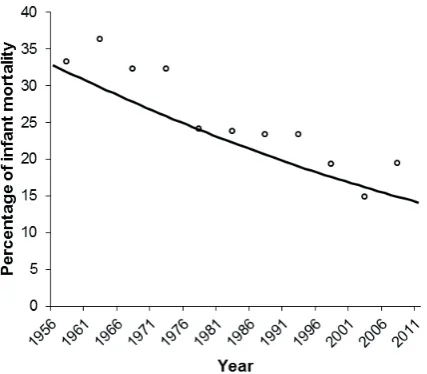
Figure 4. Percentage of infant mortality during the study period. The solid line represents the estimates of the model; the open circles are the means of raw data grouped into five-year intervals.
None of the following factors had a significant effect on infant mortality within 30 days after birth: maternal age at conception, birth order, rearing type of the mother, sex of the offspring, survivorship of the previous offspring or population (Table 1). The only predictive factor that contributed significantly to the model was birth year (P = 0.004). The probability of infant mortality decreased from around 33% at the beginning of the study period to approximately 14% at the end of the study period (Figure 4).
Rearing type of offspring
Of the 1001 infants surviving more than 30 days and for whom the rearing type was known, 357 (173.184) were hand reared. Among the factors included in the model, only birth year and rearing type of the mother had a significant effect on the rearing type of the offspring (Table 1). The ratio of hand-reared offspring showed a significant decrease throughout the study period (figure 5). Infants born to a hand-reared female had to be hand reared significantly more often as opposed to those of parent-reared and wild-caught females. However, we did not find a significant difference in the odds of hand rearing between infants born to parent-reared compared to wild-caught females.
Discussion
Sex ratio and the management of the gorilla population For the future management of the captive breeding programme of the western lowland gorilla, it is important to determine potential demographic developments that may complicate the management of the population, or even the well-being of the animals. An example of such a development is the growing proportion of males in the captive population, mainly caused by a higher number of female deaths in past decades (Vermeer et al. 2014). This higher number of deaths is, in turn, caused by a higher proportion of old females in the population that were imported from the wild in the early 1970s.
The analysis showed that during the study period the sex ratio at birth has been exactly equal in the population. As a result, there is a surplus of males required for the breeding programme, just as for other species living in a social structure comparable to that of western lowland gorillas. Several possible solutions for dealing with this surplus have been suggested, including keeping the males solitary or in bachelor groups, castration to avoid aggression, or even euthanasia (Vermeer et al. 2014). Besides the ethical and legal obstacles for some of the solutions suggested, it has proved difficult to find enough zoos willing to keep bachelor groups for the long term. It is therefore important to examine if it is possible to avoid a surplus, for instance by limiting the birth of too many males. Sex-selective abortion is hindered by legal and ethical objections in many zoos and countries, while the techniques for artificial insemination with female-selected semen do not seem to be sufficiently developed to be employed in gorillas. The impact of the procedures will also have a considerable impact on the life of the animals involved.
An earlier analysis of the sex ratio of captive gorillas born before 1986 suggested a male bias among offspring of females aged above 15 years and a female bias among offspring of younger females (Mace 1990). Since 1986 the gorilla population has shown a steady development and we were able to analyse 1216 births, of which 183 (15%) were to dams aged more than 23 years. Our results show that sex ratio at birth is not significantly related to the age of the dam. There is a trend for a male-biased sex ratio with increasing maternal age, but we do not consider this effect to be strong enough to be useful for management decisions. Additionally, reducing births would not only affect the number of males born into the population, but would also influence the social behaviour of groups and the social development of the infants allowed to be born, as well as the genetics of the population. It is questionable whether a reduction of a very small percentage of male births would warrant these negative side-effects. However, if the breeding programme were to decide to limit breeding in the population, then it may be advisable to focus on the older, genetically over-represented females.
For this study we only tested data available from the studbook, while there may be many factors influencing the birth sex ratio of gorillas, including nutrition and social status (Faust and Thompson 2000; Margulis et al. 2011).
Mortality of offspring
Of the 1286 reported infants born, 22% were stillborn or did not survive the first 30 days of life. First-year infant mortality for wild western lowland gorillas has been reported to vary between 8.3 and 42.9% (Robbins et al. 2004). However, it should be noted that these populations were not observed daily and, as a result, early infant mortality was probably underestimated. Comparisons are therefore difficult. It is reassuring to see infant mortality has decreased through the years, probably due to better management of captive gorillas. For some reason, male infant mortality has been slightly higher than female infant mortality.
Rearing type of offspring
A large percentage of gorilla infants have been hand reared, but it is encouraging that hand-rearing frequency has significantly decreased over the years. In the early years of gorilla keeping, zoos were probably overprotective, and took away infants at the first sign of something going wrong. At that time gorilla births were still very rare and surviving gorilla infants were very valuable, both for the zoo and for the population. The result was a population with a high number of hand-reared gorillas, with possible social and reproductive deficiencies. Although research on other primates has shown that being reared by or with conspecifics is important for the necessary development of species-specific social behaviour (Arling and Harlow 1967), the negative effects of hand rearing on social behaviour have been poorly investigated for gorillas. A comparison of 19 hand-reared and seven mother-reared infants showed that almost all hand-reared infants exhibited stereotypic behaviours, had more solitary and less social play, and showed more aggression (Meder 1989). However, most stereotypic behaviours disappeared after a few years. The author advised rearing infants that have to be removed from the mother in peer groups, with a variety of social contacts, and to introduce them at a young age into a social group with adults (Meder 1989). In the SSP population (data through 1998), hand-reared females were reproductively less successful than mother-reared females, but there was no difference for males (Beck and Power 1988; Ryan et al. 2002). For the EEP population (data from animals transferred between 2002 and 2011), the situation is the same for females: mother-reared dams had a much higher breeding success than hand-reared dams. Mother-reared males were also more successful than hand-reared males, but this was based on a rather small number of individuals (Vermeer et al. 2014). The reproductive failure of the hand-reared females is probably due to behavioural deficits (Beck and Power 1988). Social conditions during growth and development, as well as the quality of available breeding partners, could improve breeding success of hand-reared animals (Abelló et al. 2010; 2011). Despite differences in reproductive success between mother and hand-reared gorillas, earlier research has shown that almost 70% of hand-reared gorillas in the EEP population breed successfully and make an important contribution to the growth of the population (Abelló et al. 2010).
Our analysis shows a significant relationship between the background of the mother and the rearing type of the infant, with infants of hand-reared mothers being more likely to be hand reared. These results confirm other studies (Ryanet al. 2002; Abelló and Colell 2006a). It is interesting to see that wild-caught females reared their infants as successfully as captive-born mother-reared females, demonstrating the importance of maternal experience at a young age.
The management of hand-reared infants has gradually changed over time, with the aim of maximising the social development of infants (Porton and Niebruegge 2006). Besides rearing infants in peer groups (Holtkötter and Scharpf 1992, 2005), zoos have also started to introduce hand-reared infants at a very young age into a social group, sometimes making use of surrogate mothers (Jendry 1996; Vermeer 2005; Abelló and Colell 2009). The opportunity to observe maternal behaviour has proved to have a significant positive effect on the rearing capabilities of captive-born females (Abelló and Colell 2006b). The EEP husbandry guidelines supply ample information on how to avoid hand rearing and how to handle infants that need to be hand reared (Abelló et al. 2005). The increased attention to the avoidance of hand rearing, with accompanying management strategies, has resulted in a large decrease in hand-rearing rates (Vermeer et al. 2014).
Conclusion
balanced (610.610.0). There is a trend for older females to have more male offspring, but this trend is not significant and probably not strong enough to use this factor for captive management measures aimed at limiting the number of males in the population. The mean perinatal and infant mortality (<30 days) is relatively high, but it is encouraging that it has significantly decreased since the population was first established. The same decrease has been observed for hand-rearing rates. These figures confirm that, over the years, zoos have considerably improved the captive management of western lowland gorillas, probably through sharing experiences and improving daily husbandry.
Acknowledgements
We want to thank Thomas Wilms and Undine Bender, international studbook keepers at Frankfurt Zoo, for keeping such excellent records of the gorilla population. We want to thank Stefan Van Dongen for advice on statistics and Jorge Crespo for confirming the results of our analyses. We also want to thank the EEP and SSP coordinators and members for their commitment to the gorillas in our care.
References
Abelló M.T., Alonso Aguirre A., Bemment N., de Jongh T., de Vries S., Dörnath Aguirre Alvarez K.A., Glatston A., Holtkötter M., Kaumanns W., Krebs E., Lewis J.C.M., Meder A., Pullen K., Rietkerk F., Rietschel W., Schmidt C., Vermeer J., Vidakovtis I. (2005) EEP Gorilla Husbandry
Guidelines. Amsterdam: European Association of Zoos and Aquaria.
Abelló M.T., Blasco A., Colell M. (2011) Could sexually experienced gorillas Gorilla gorilla gorilla help hand-reared gorillas to breed successfully?
International Zoo Yearbook 45: 237–249.
Abelló M.T., Colell M. (2006a) Analysis of factors that affect maternal behaviour and breeding success in great apes in captivity. International
Zoo Yearbook 40: 323–340.
Abelló M.T., Colell M. (2006b) The influence of maternal background on breeding success in gorillas. International Zoo News 53: 144–153. Abelló M.T., Colell M. (2009) Early introduction of hand-reared gorillas
Gorilla gorilla to conspecifics at Barcelona Zoo: general procedures and three case studies. International Zoo Yearbook 43: 159–175. Abelló M.T., Holtkötter M., Vermeer J., Colell M. (2010) An analysis of
breeding results for hand-reared gorillas Gorilla gorilla born over a 25 year period in the European Endangered Species Programme (EEP) population. International Zoo Yearbook 44: 232–237.
Arling G.L., Harlow H.G. (1967) Effects of social deprivation on maternal behavior of rhesus monkeys. Journal of Comparative and Physiological
Psychology 64: 371–377.
Beck B.B., Power M.L. (1988) Correlates of sexual and maternal competence in captive gorillas. Zoo Biology 7: 339–350.
Faust L.J., Thompson S.D. (2000) Birth sex ratio in captive mammals: patterns, biases and the implications for management and conservation. Zoo Biology 19: 11–25.
Grand A.P., Leighty K.A., Cory L.J., Maloney M.A., Phillips R.S., Bettinger
T.L. (2013) The neighbour effect in bachelor and breeding groups of western lowland gorillas (Gorilla gorilla gorilla). International Journal
of Comparative Psychology 26: 26–36.
Holtkötter M., Scharpf G. (1992) Twenty years of experience with hand-reared gorillas (Gorilla g. gorilla) at Stuttgart’s Wilhelma-Zoo. In: Kirchshofer R. (ed.). International Studbook of the Gorilla. Frankfurt: Frankfurt Zoologischer Garten, 218–233.
Holtkötter M., Scharpf G. (2005) Rearing gorillas in peer groups at the nursery of Stuttgart’s Wilhelma Zoo. Gorilla Gazette 18: 47–53. Jendry J. (1996) Utilization of surrogates to integrate hand-reared infant
gorillas into an age/sex diversified group of conspecifics. Applied
Animal Behaviour Science 48: 173–186.
Mace G.M. (1990) Birth sex ration and infant mortality rates in captive western lowland gorillas. Folia Primatologica 55: 156–165.
Margulis S.W., Nurns F., Rothernberg A. (2011) Sex ratio bias in managed populations of hylobatids. Folia Primatologica 82: 224–235. Meder A. (1989) Effects of hand-rearing on the behavioral development
of infant and juvenile gorillas (Gorilla g. gorilla). Developmental
Psychobiology 22: 357–376.
Meder A. (1990) Integration of hand-reared gorillas into breeding groups.
Zoo Biology 9: 157–164.
Nitsch M. (2004) Social Behavioral Dynamics and Captive Management of
All-male Groups of Western Lowland Gorillas (Gorilla gorilla gorilla) in
European Zoos. Doctoral thesis. Berlin: Freien Universität Berlin.
Porton I., Niebruegge K. (2006) The changing role of hand rearing in zoo-based primate breeding programs. Nursery Rearing of Nonhuman
Primates in the 21st Century. Sacket G.P., Rupperthal G.C., Elias K. (eds). New York: Springer.
Robbins M.M., Bermejo M., Cipolletta C., Magliocca F., Parnell R.J., Stokes E. (2004) Social structure and life-history patterns in western gorillas
(Gorilla gorilla gorilla). American Journal of Primatology 64: 145–159. Ryan S., Thompson S.D., Roth A.M., Gold K.C. (2002) Effects of hand-rearing on the reproductive success of western lowland gorillas in North America. Zoo Biology 21: 389–401.
Stoinski T.S., Hoff M.P., Lukas K.E., Maple T.L. (2001) A preliminary behavioral comparison of two captive all-male gorilla groups. Zoo
Biology 20: 27–40.
Stoinski T.S., Kuhar C.W., Lukas K.E., Maple T.L. (2004a) Social dynamics of captive western lowland gorillas living in all-male groups. Behaviour
141:169–195.
Stoinski T.S., Lukas K.E., Kuhar C.W., Maple T.L. (2004b) Factors influencing the formation and maintenance of all-male gorilla groups in captivity.
Zoo Biology 23: 189–203.
Vermeer J. (2005) Hand rearing and early introduction of a gorilla at La Vallée des Singes. International Zoo News 52: 146–151.
Vermeer J., Abelló M.T., Holtkötter M. (2014) Progress in the western lowland gorilla Gorilla gorilla gorilla European Endangered Species Programme: a review of the decade 2002–2011. International Zoo
Yearbook 48: 234–249.
Vermeer J., Carroll B. (2012) The great debate: should castration be used as a management tool for captive gorillas? Zooquaria 77: 26–28. Wilms T., Bender U. (2012) International Western Lowland Gorilla Studbook.