VOLUME 40, ARTICLE 42, PAGES 1211
-
1248
PUBLISHED 14 MAY 2019
https://www.demographic-research.org/Volumes/Vol40/42/ DOI: 10.4054/DemRes.2019.40.42
Research Article
The changing pattern of cohabitation:
A sequence analysis approach
Paola Di Giulio
Roberto Impicciatore
Maria Sironi
© 2019 Paola Di Giulio, Roberto Impicciatore & Maria Sironi.
This open-access work is published under the terms of the Creative Commons Attribution 3.0 Germany (CC BY 3.0 DE), which permits use, reproduction, and distribution in any medium, provided the original author(s) and source are given credit.
1 Introduction 1212
2 Background and research hypotheses 1214
3 Searching for a cohabitation taxonomy 1218
4 Data and methods 1219
4.1 Data 1219
4.2 Methods 1221
5 Results: Patterns of cohabitation 1224
5.1 Descriptive findings 1224
5.2 Clustering data 1225
5.3 Multivariate analysis 1228
6 Discussion 1232
7 Acknowledgements 1234
References 1235
The changing pattern of cohabitation:
A sequence analysis approach
Paola Di Giulio1 Roberto Impicciatore2
Maria Sironi3
Abstract
BACKGROUND
During the last decades, nonmarital cohabitation has diffused throughout the industrialised world, although not uniformly. The Second Demographic Transition (SDT) predicts a convergence of cohabitation patterns towards a final stage in which cohabitation and marriage will be almost indistinguishable.
OBJECTIVE
This paper contributes to the literature on the convergence of cohabitation patterns across countries by testing whether countries are becoming more similar over time, as suggested by the SDT.
METHODS
We use sequence analysis and cluster analysis techniques to classify different patterns of cohabitation in France, Italy, Norway, Bulgaria, and the United States. Using data mainly stemming from the Gender and Generations Surveys (GGS), we analyse women’s patterns of behaviour during the five years following the start of their first cohabitation, over a time span of three decades (1970s–2000s).
RESULTS
On the basis of sequencing the events of childbirth, marriage, and separation we are able to identify five different clusters corresponding to different ways of going through the cohabitation experience.
1 Wittgenstein Centre for Demography and Global Human Capital (IIASA, VID/ÖAW, WU), Vienna Institute
of Demography/Austrian Academy of Sciences, Vienna, Austria. Email:[email protected].
2 University of Bologna, Italy. Email:[email protected].
CONCLUSIONS
Our results suggest that there is a general decreasing trend of cohabitation as a pre-marital experience and an increasing trend of cohabitation as an alternative to marriage or as a free union. However, within this homogeneous trend, persistent peculiarities at the country level suggest that the selected countries are not simply at different stages of the same trajectory.
CONTRIBUTION
The classification that emerges from the data-driven approach combines several features of already existing typologies of cohabitation experience. Analysis of the data highlights country peculiarities in the development of the cohabitation experience, rather than the existence of a common path as predicted by the SDT.
1. Introduction
That the prevalence of nonmarital cohabitation has increased during the last thirty years is one of the most striking aspects of wider social changes that have taken place throughout the industrialised world. According to Prinz (1995), the spread of consensual unions is the main indicator of the global social change named “partnership transition”, i.e., a transition from relationships based on traditional gender roles to relationships based on equal rights and more egalitarian positions of the two partners. Moreover, the diffusion of cohabitation is an essential component of the Second Demographic Transition theory (SDT) (Lesthaeghe 1995). Within this framework, the pluralisation of family life, driven by a shift in values and attitudes during the last decades, has spread from Northern Europe to the rest of the developed world (Lesthaeghe 2010; Lesthaeghe and Neidert 2006). In the long run, the SDT posits a convergence of cohabitation patterns towards a final stage in which cohabitation and marriage will be almost indistinguishable (Kiernan 2001). Nevertheless, cohabitation has not spread uniformly across European and North American countries (Heuveline and Timberlake 2004; Kiernan 2001; Perelli-Harris et al. 2012; Prinz 1995; Sobotka and Toulemon 2008), which suggests that the heterogeneity observed at the country level is not only the effect of being at different stages of the SDT: Rather, persistent cultural differences, peculiar welfare policies, and the institutional setting may prevent convergence across countries.
European countries have not experienced the same diffusion of cohabitation and the percentages of cohabiting couples remain among the lowest in Europe. On the other hand, most Eastern European countries experienced a very sharp increase in the proportion of cohabiting couples (and nonmarital births), but only after 1990 (Potârcă, Mills, and Lesnard 2013).
In addition to the prevalence of cohabitation, both the patterns and the connotations of cohabitation vary by country (Hiekel and Castro-Martín 2014; Klüsener et al. 2013; Perelli-Harris 2014; Potârcă, Mills, and Lesnard 2013) and evolve over time. Even within a country, people may attribute different meanings to cohabitation (Hiekel, Liefbroer, and Poortman 2014; Manting 1996; Perelli-Harris and Bernardi 2015; Perelli-Harris et al. 2014).
This paper aims to contribute to the literature on the convergence of cohabitation patterns across countries. Our goal is to test whether countries are becoming more similar over time, as suggested by the Second Demographic Transition, or whether differences persist. In order to do so we need to condense the great diversity of cohabitation characteristics in industrialised countries into a suitable schema. Several authors have already undertaken this task (for a review see Hiekel 2014; Heuveline and Timberlake 2004; Sobotka and Toulemon 2008), mainly by fitting predefined categories to the data, stimulating empirical research, and using a comparative strategy (‘typology approach’). In this work we adopt a data-driven approach, accounting for the complexity of trajectories without using an a priori classification. Our research strategy is to implement sequence analysis (Abbott 1995) and cluster analysis techniques in order to arrive at a taxonomy, considering the timing and sequencing of the main events (childbirth, marriage, separation) that can happen in the life course trajectory of a nonmarital union. We then use the resulting clusters to evaluate pattern variation over time and across countries.
We consider five countries, representing different contexts and different diffusion patterns of nonmarital cohabitation: France, Italy, Norway, Bulgaria, and the United States. Using retrospective data, we analyse behaviour over more than three decades (1970s–2000s) and study the level of cohabitation diffusion achieved in the different selected countries.
2. Background and research hypotheses
Before the 1970s the experience of a nonmarital cohabitation was largely limited to couples who, for different reasons, did not have access to marriage (Kiernan 2004; Trost 1978). Since the beginning of the 1970s, the popularity of cohabitation has increased in several contexts together with other changes in cultural elements, such as rising individualism and secularism, and in economic aspects, such as changes resulting from industrialisation, changes in gender roles, and rising female labour-market participation (for a review, see Cherlin 2010; Kasearu and Kutsar 2011; Seltzer 2000, 2004; Smock 2000). At the same time, the sexual revolution contributed to removing the stigma surrounding premarital sex (Bumpass 1990) and promoted the use of modern and highly effective contraceptive methods that, may, in turn, have fuelled the diffusion of cohabitation (Sweeney, Castro-Martín, and Mills 2015).
The spread of cohabitation has been integrated into the framework of the Second Demographic Transition (Lesthaeghe 1995, 2010; Van de Kaa 1987). The SDT posits that cultural shifts and changes in the economic structure trigger individualisation in demographic behaviour, implying an eventual diffusion of informal cohabitation as an alternative to marriage in all industrialised countries. Differences in the timing of the onset of the SDT and in the speed of its diffusion are expected to be the primary cause of observed differences across countries in the patterns of family formation and the percentage of people cohabiting. Indeed, all populations will, sooner or later, experience the cumulative consequences of the processes of secularisation, individualisation, weakening dependence on the family of origin, and increasing emphasis on self-realisation (Lesthaeghe 2010; Lesthaeghe and Neidert 2006), implying a diffusion of cohabitation also. Specifically, the new demographic behaviours should spread from Northern Europe to the rest of the developed world, and countries in Southern and Eastern Europe will also undergo the SDT but with a certain delay, lagging behind Northern and Western European countries and the United States. According to this theoretical framework, countries are at different stages of the transition, and a convergence across countries in the level of unmarried cohabitation and relative patterns of cohabitation can be expected in the long run, with increasing similarity between cohabiting and married couples (McGinnis 2003; Manning and Smock 2005; Rindfuss and VandenHeuvel 1990) and acceptance of nonmarital unions and births (Kasearu and Kutsar 2011; Manting 1996).
marriage opportunities and the meaning of marriage for the different ethnic groups (Seltzer 2004).
Despite cohabitation widely sharing some features across countries, such as increasing diffusion among young adults, lower propensity to convert cohabitation into marriage, and increase of childbearing among cohabiters (Sobotka and Toulemon 2008), the examples above also suggest the persistence of differences between countries. In particular, the heterogeneity in the pace and magnitude of changes calls for a rethinking of the idea of unidirectional development posited by the SDT.
been interpreted as a “pattern of disadvantage” (Perelli-Harris et al. 2010), as it involves mainly less-educated and deprived groups. Based on the long-term cultural traits, institutional changes, economic conditions, public policies, or legislation at play, we can expect that each country will follow a specific evolution and that differences in the pattern of nonmarital unions will persist over time.
In this work we adopt a descriptive approach in order to investigate whether the differences in cohabitation patterns across countries are because countries are at different stages of the SDT (and so will eventually converge) or because cohabitation patterns remain distinct between countries over time. In more detail, we want to test the following hypotheses predicted by the SDT theory:
Hypothesis 1: Cohabitation is increasingly becoming an alternative to marriage in
Europe and North America, i.e., cohabitation and marriage are becoming indistinguishable.
Hypothesis 2: Cohabitation patterns become more similar over time across
countries, and Southern and Eastern European countries are converging towards Northern European and North American countries.
3. Searching for a cohabitation taxonomy
The starting point of our research strategy is the classification of cohabitation patterns. In the literature, several attempts have been made to grasp the heterogeneity of the cohabiting population, and the proposed schemas share common traits (Sobotka and Toulemon 2008). Villeneuve-Gokalp (1991) is one of the first authors to classify cohabitation in the European context. Her strategy focuses on marriage, birth of a child, and separation that happen in the first three years of cohabitation. She distinguishes four different types of cohabitation: cohabitation as a temporary situation preceding marriage (either as a ‘prelude to marriage’ or as a ‘trial marriage’ allowing for a period of testing); cohabitation without strong commitment leading to a ‘temporary union’ with separation after a short period of time; cohabitation as a ‘stable union without commitment’, a long-lasting coresidence without children or marriage; and cohabitation as a ‘free union’ in which couples behave as if they are married, having children but without caring about marrying.
For the United States, Heuveline and Timberlake (2004) point to the presence of children as a key factor in defining the meaning and commitment of a union. Their broad comparative perspective integrates the social acceptability of cohabitation and provides six ideal types: (a) ‘marginal’, if society discourages cohabitation; (b) ‘prelude to marriage’, if it involves a marriage in a short time but not a birth before marriage; (c) ‘stage in marriage process’, if children tend to be born during the cohabitation but this is soon transformed into a marriage; (d) ‘alternative to single’, if the cohabiting partners want to postpone forming a family and prefer cohabiting rather than living separately during courtship; (e) ‘alternative to marriage’, if children are born in the nonmarital union but the cohabitation usually is not transformed into a marriage; (f) ‘indistinguishable from marriage’, if there is little social distinction between cohabitation and marriage because of the general acceptability of unmarried cohabitations (for example, if institutional support for parents essentially ignores marital status). In the context of the United States, Bianchi and Casper (2000) and Willoughby, Carroll, and Busby (2012) suggest similar classifications based on cohabiters’ plans to marry and their engagement status. Hiekel, Liefbroer, and Poortman (2014) develop a typology of different meanings of cohabitation based on marriage attitudes, future intentions, and feelings of economic deprivation, resulting in six types: ‘prelude to marriage’, ‘trial marriage’, ‘cohabiters for economic reasons’, ‘intend to marry’, ‘refusal of marriage’, and ‘marriage is irrelevant’.
Europe and North America, and their persistently different roles in the childbearing process (Perelli-Harris and Bernardi 2015).
Unlike previous research, we use sequence analysis and cluster analysis to classify different patterns of events following the start of a (first) informal union. The result is an empirically based analysis that does not depend on categories previously chosen by the researcher. The existing literature assists us in the interpretation of patterns, keeping in mind that the resulting clusters of trajectories may overlap with the categories proposed in the literature, but may also highlight specific features that might have been overlooked by previous classifications. In other words, by following an empirical strategy rather than a conceptual classification, we are looking for a “taxonomy” (Bailey 1994) of patterns.
4. Data and methods
4.1 Data
We focus our analysis on cohabitation patterns in the following countries: France, Italy, Norway, Bulgaria, and the United States. We select these countries based on two criteria: (a) the selected countries should represent different institutional and cultural settings in modern developed societies and display different levels of cohabitation diffusion and different prevalence of nonmarital fertility, and (b) no specific welfare regime or national economic conditions should be over-represented.
We use mainly data from the Gender and Generation Survey (GGS), a comparative set of surveys carried out in several European countries, in the version harmonised by participants in the Nonmarital Childbearing Network4 (Perelli-Harris, Kreyenfeld, and Kubisch 2011). In the comparative harmonised histories dataset,5 special attention is devoted to the harmonisation of information regarding the timing of demographic events (leaving the parental home, union formation and dissolution, birth of a child)
4 Karolin Kubisch at the Max Planck Institute for Demographic Research, Rostock managed the
standardization and cleaning process of the surveys.
5 The Italian data comes from the Indagine Multiscopo Famiglia e Soggetti Sociali (FSS) conducted by Istat
with the selection of other information regarding family background, socioeconomic status, values, and opinions.
The focus is on first informal unions. In this way we select a homogeneous group of cohabitants whose union and family choices depend mainly on the acceptability of cohabitation in a certain setting. Moreover, the proportion of women who start their first union by cohabiting instead of marrying increases in all countries over time (Figure 1), whereas the prevalence of cohabitation following a separation did not show a similar dynamic trend.6 Therefore, we exclude from the analysis those cohabitations
following a separation or a divorce, given that they are influenced by the level of divorce in a specific country and have less relevance for the study of the social acceptability of cohabitation. For each country we select women whose experience of a first coresidential union was a nonmarital cohabitation. We select women born between 1950 and 1984 who started their first cohabitation during the period 1970–2005, i.e., a range of observations that is available for all countries.7 The analysis is restricted to
women because not all the surveys include complete male union histories. We also exclude from the analysis women with a child at the beginning of the first union.
Figure 1: Proportion of women whose first union was a nonmarital cohabitation, selected countries, 1970–2005
Source: GGS (Bulgaria, France, Norway), FSS (Italy) and NSFG (USA).
6 In the selected countries the proportion of women starting a second union as a cohabitation after the first
marriage is dissolved remains constantly under 30%, with a slight increase from the 1970s onwards. Only Italy presents higher values, but with a very low number of second unions.
7 In this paper we focus on unions formed in the years 1975–2005, in a period perspective. In this way we can
analyse the most recent experiences of women entering a cohabitation. The alternative analysis following a cohort perspective provided similar results (data not shown).
0 10 20 30 40 50 60 70 80 90 100
We analyse the sequence of events happening monthly in the first five years (60 months) after the start of the informal union.8 The decision to focus on the first five
years is driven by the fact that cohabiting unions tend to be short-lived, as they either convert into marriages or break up. Only few continue for extended periods of time (Kiernan 2004; Murphy 2000). First unmarried cohabitations last for no longer than three years for the majority of women (from 50% in Norway and Italy to 76% in the United States), and no longer than five years for two out of three women (from 67% in Norway to 88% in the United States). In particular, we focus on the following events: the transformation of a nonmarital union into a marriage (if any), the birth of the first child (if any), and the separation from the first partner (if any).
4.2 Methods
We use a sequence analysis approach, originally proposed by Abbott (1995) (for a review, see Abbott and Tsay (2000) and Billari (2001)). This method can be employed to describe the quantum (what and how many transitions happened) and the timing (at what age different life transitions happened) of interrelated events together with their sequencing (in what order the transitions happened). This allows researchers to describe different patterns of life course trajectories taking into account several events simultaneously, and then to identify a cohabitation taxonomy. By focusing on the analysis of entire trajectories rather than the occurrence of single events, sequence analysis overcomes the limitations of event history analysis and takes into account the interrelation between multiple events (Barban and Sironi 2018). Specifically, by clustering trajectories we can reduce the complexity9 while at the same time preserving
information about the duration of stay within each state.
After representing a life course trajectory (or part of it) as a sequence of characters indicating the status in a specific unit of time (month, in our case), a matrix of dissimilarities between pairs of sequences is computed. One sequence can differ from another in terms of quantum, timing, and sequencing. However, a sequence may be shorter in the case of right censoring, i.e., if the interview occurs before the 60th month
8 Focusing on the first five years of cohabitation allows us to both highlight the patterns of cohabitation and
avoid comparing sequences with a very different length. However, in order to test the robustness of our results, we also developed our analyses using sequences up to 8 years (96 months), obtaining robust results (data not shown).
9 Even though we basically consider only three events (marriage, first birth, and separation between
after the start of cohabitation. We consider six possible states: unmarried cohabiting with no children (Cohabiting), unmarried cohabiting parent (Cohabiting Parent), separated without children (Separated), separated with children (Separated Parent), married without children (Married), and married with children (Married Parent).
The dissimilarity measure between pairs of sequences is based on the length of common subsequences between life course trajectories (or the LCS metric proposed by Elzinga 2006) that can be used with sequences of different lengths. The matrix of dissimilarities is computed with Rpackage TraMineR (Gabadinho et al. 2011), considering pooled data for all countries. Similar sequences are subsequently grouped in a limited number of patterns through a hierarchical cluster analysis using the Ward linkage (Aassve, Billari, and Piccarreta 2007). A hierarchical tree diagram illustrating the clustering process – also known as a dendrogram – suggests the number of clusters. Through cluster analysis the complexity is partially reduced while maintaining differences between clusters in timing, tempo, and ordering of events.
Additionally, we compute the Shannon entropy of the observed state distribution and the measure of turbulence10 (Elzinga 2003; Elzinga and Liefbroer 2007) by year of
union for the pooled sample and separately by country. In this way we can evaluate the evolution of the heterogeneity of patterns across time and space. After we define the clusters, our first step is to implement multinomial logistic regression models using the developed taxonomy as a dependent variable and estimate the probability of experiencing a specific pattern of cohabitation. To that end we construct a random indicator variable , which we index1, 2, … , , and which takes the value of1 when individual ’s cluster falls into thej-th cluster, and 0 otherwise. The multinomial logits are estimated in −1 = 4 equations as follows:
= ,
where is a vector of covariates associated with the -th individual, and is a vector of regression coefficients for = 1, 2, … , −1.
The vector includes the country of birth, the year of union (1970–1974, 1975– 1979, 1980–1984, 1985–1989, 1990–1994, 1995–1999, 2000–2005), and the interaction between the two. In this way we can study the probability of belonging to different cohabitation patterns over time and across countries and test our research hypotheses
10 Entropy can be interpreted as the uncertainty of state prediction in a given sequence. Entropy is 0 if all
(i.e., whether more cohabitations are becoming an alternative to marriage and whether there is convergence across countries).
Previous research underlines the role of age at coresidence in the subsequent progress of the partnership and its marital success (Kuperberg 2014) and the relevance of education and parents’ characteristics to family formation patterns (Elzinga and Liefbroer 2007; Furstenberg, Rumbaut, and Settersten 2005; Rijken and Liefbroer 2009; Wiik 2009; Sironi, Barban, and Impicciatore 2015). Therefore, the vector also includes the following control factors: age at first union (–19, 20–24, 25–29, 30–34, 35+), respondent’s education at interview (low, medium, high, corresponding to ISCED 0–2, ISCED 3 and ISCED 4 and above) and parents’ education (low, medium, high, or ISCED 0–2, ISCED 3 and ISCED 4 and above).
A similar research strategy has been developed by Potârcă, Mills, and Lesnard (2013) for Romania, the Russian Federation, and France, by Fulda (2016) for Germany, by Kleinepier and de Valk (2016) for the Netherlands, by Hart and Lyngstad (2016) for Norway, and by Jalovaara and Fasang (2015) for Finland. However, these studies focus on broader life course trajectories where cohabitation is only one among several choices and where all the different kinds of cohabitation would collapse into one or very few clusters, making it hard to detect heterogeneity within the cohabitation experience. In other words, in a broader perspective that considers a larger number of possible trajectories that do not include cohabitation, the different clusters cannot account for the variability within cohabitation.
This research strategy is similar to that used by Nazio and Blossfeld (2003) in their study of the diffusion of cohabitation among different cohorts, by Liefbroer and Dourleijn (2006) in their analysis of the influence of cohabitation diffusion on the risk of union dissolution, and by Perelli-Harris (2014), who referred to the percentage of first births in cohabitation to study the prevalence of second births.
5. Results: Patterns of cohabitation
5.1 Descriptive findings
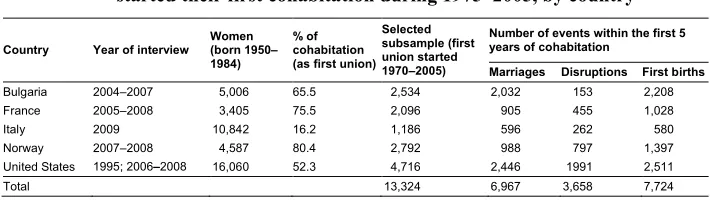
The cohabitation experience is strongly heterogeneous across the countries in our sample. Three out of four women born between 1950 and 1984 started their first union as a nonmarital cohabitation in France (75.5%) and Norway (80.4%), 65.5% in Bulgaria, 52.3% in the United States, and only 16.2% in Italy (Table 1). In Bulgaria the prevalence of cohabitation was already very high before 1991 (Di Giulio and Koytcheva 2007), even though it was largely experienced as a premarital episode (93% of cohabitations begun before 1991 eventually moved into marriage). Italy persistently showed lower percentages up to the mid-1990s, when some convergence with the other countries started to emerge, helped by the fact that the diffusion of cohabitation reached a plateau in France and Norway.
Table 1: Description of the selected surveys, women born 1950–1984 who started their first cohabitation during 1975–2005, by country
Country Year of interview Women(born 1950– 1984)
% of cohabitation (as first union)
Selected subsample (first union started 1970–2005)
Number of events within the first 5 years of cohabitation
Marriages Disruptions First births
Bulgaria 2004–2007 5,006 65.5 2,534 2,032 153 2,208
France 2005–2008 3,405 75.5 2,096 905 455 1,028
Italy 2009 10,842 16.2 1,186 596 262 580
Norway 2007–2008 4,587 80.4 2,792 988 797 1,397
United States 1995; 2006–2008 16,060 52.3 4,716 2,446 1991 2,511
Total 13,324 6,967 3,658 7,724
5.2 Clustering data
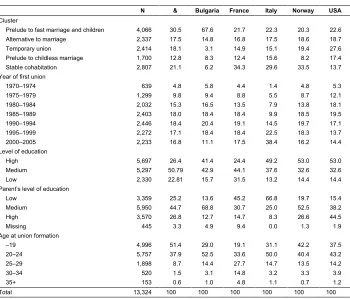
In this section we present the main results of the sequence analysis. First, we show the typical patterns that emerged in terms of sequence of states and time spent in each state, identified by the cluster analysis. Second, we evaluate the propensity to follow a specific cohabitation pattern according to cohort and country, taking into account other control factors (level of education, parent’s level of education, age at union formation). The descriptive statistics of all variables used in the regression analysis are shown in Table 2. Figure 2 shows the different cohabitation patterns.11 Each graph is a specific
cluster and represents, month by month, the distribution of the respondents according to the different stages of their life (the states used in the sequence analysis).
The first cluster (the most frequent, comprising 30.5% of the pooled sample) represents women in premarital cohabitation leading to fast marriage and childbearing: After three years almost all of them have married and eight out of ten already have a child. We name this cluster ‘Prelude to fast marriage and children’. In the second cluster (17.5% of the sample) only a residual quota of cohabitations moves into marriage within five years and the vast majority of women enter motherhood within nonmarital cohabitation, suggesting that couples behave as if they were married. Recalling Heuveline and Timberlake’s (2004) classification, we call this cluster ‘Alternative to marriage’. The third cluster (18.1% of the sample) comprises mainly disrupted unions without children and thus is called ‘Temporary union’. The fourth cluster (representing 12.8% of the sample) comprises women who cohabit and then move on to marriage, but only rarely have a child within the observation window. Given that separation is rare, women in this cluster might consider unmarried cohabitation as a testing ground, which results in a positive evaluation of the relationship. We call this cluster ‘Prelude to childless marriage’. Finally, in the fifth cluster we see a prevalence of stable unions with no events, at least in the first 40 months. Moreover, almost 60% of the women in this cluster remain in this state at least until the end of their fifth year of cohabitation. This cluster (21.1% of women) is called ‘Stable cohabitation’.
11 The dendrogram from the cluster analysis (not shown, available on request) suggests that the best solution
Table 2: Descriptive statistics of pooled sample used in the regression analysis N & Bulgaria France Italy Norway USA Cluster
Prelude to fast marriage and children 4,066 30.5 67.6 21.7 22.3 20.3 22.6
Alternative to marriage 2,337 17.5 14.8 16.8 17.5 18.6 18.7
Temporary union 2,414 18.1 3.1 14.9 15.1 19.4 27.6
Prelude to childless marriage 1,700 12.8 8.3 12.4 15.6 8.2 17.4
Stable cohabitation 2,807 21.1 6.2 34.3 29.6 33.5 13.7
Year of first union
1970–1974 639 4.8 5.8 4.4 1.4 4.8 5.3
1975–1979 1,299 9.8 9.4 8.8 5.5 8.7 12.1
1980–1984 2,032 15.3 16.5 13.5 7.9 13.8 18.1
1985–1989 2,403 18.0 18.4 18.4 9.9 18.5 19.5
1990–1994 2,446 18.4 20.4 19.1 14.5 19.7 17.1
1995–1999 2,272 17.1 18.4 18.4 22.5 18.3 13.7
2000–2005 2,233 16.8 11.1 17.5 38.4 16.2 14.4
Level of education
High 5,697 26.4 41.4 24.4 49.2 53.0 53.0
Medium 5,297 50.79 42.9 44.1 37.6 32.6 32.6
Low 2,330 22.81 15.7 31.5 13.2 14.4 14.4
Parent’s level of education
Low 3,359 25.2 13.6 45.2 66.8 19.7 15.4
Medium 5,950 44.7 68.8 30.7 25.0 52.5 38.2
High 3,570 26.8 12.7 14.7 8.3 26.6 44.5
Missing 445 3.3 4.9 9.4 0.0 1.3 1.9
Age at union formation
–19 4,996 51.4 29.0 19.1 31.1 42.2 37.5
20–24 5,757 37.9 52.5 33.6 50.0 40.4 43.2
25–29 1,898 8.7 14.4 27.7 14.7 13.5 14.2
30–34 520 1.5 3.1 14.8 3.2 3.3 3.9
35+ 153 0.6 1.0 4.8 1.1 0.7 1.2
Total 13,324 100 100 100 100 100 100
Figure 2: Distribution of states by duration for each cluster (time in months on the horizontal axis)
Table 2 shows the distribution of women belonging to each cluster by country, year of union, respondent’s level of education, parents’ level of education, and age at union formation. Most informal unions started in the 1980s, except for Italy where the diffusion of cohabitation is more recent. The resulting clusters overlap with several traits in the V‒G (Villeneuve-Gokalp 1991) and H‒T (Heuveline and Timberlake 2004) classifications while introducing additional relevant features to the theoretical classifications in the literature. Specifically, the resulting clusters fall somewhere in between the two theoretical schemes, borrowing features from both of them. This also means that both V‒G and H‒T classifications reveal some shortcomings when tested empirically. As far as the H‒T typology is concerned, excluding the groups ‘marginal’ and ‘indistinguishable from marriage’, which focus on contextual settings more than individual patterns, we notice that the pattern ‘stage in the marriage process’ (i.e., childbirth in the consensual union and then marriage) does not emerge as a relevant trajectory in the selected countries. On the other hand, the pattern with a stable cohabitation with no marriage or childbirth, the second most common in our data, is not explicitly considered. Regarding the V‒G scheme, the cluster analysis does not distinguish between trajectories with an early marriage (i.e., within the first year of cohabitation, called ‘prelude to marriage’) and those with a marriage occurring later (called ‘trial marriage’). Moreover, our results suggest the need for a greater emphasis on the role of children in the different patterns, as proposed by Heuveline and Timberlake in their schema.
5.3 Multivariate analysis
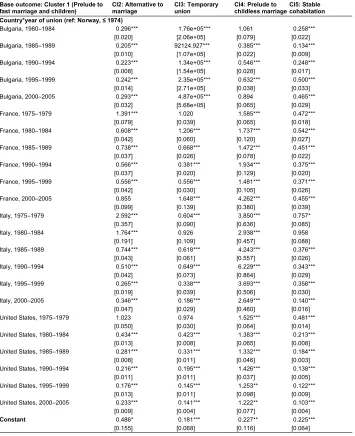
The variables in Table 2 are those used in the multinomial logistic regressions. Key results of the multivariate models are shown in Figure 3, where the predicted probability of being in each cluster is plotted by country and starting year of the union together with the confidence interval (at the 95% level).
Cohabitation as a temporary union (Cluster 3) increases over the whole period considered for Norway and more recently for France and Bulgaria, suggesting higher instability of cohabitation in the more recent past. This increasing trend is less evident for Italy, whereas it is roughly stable for the United States, which shows higher levels than the rest of the countries for unions started before 1990. The probability of belonging to Cluster 4 (Prelude to childless marriage) tends to decrease slightly for all countries, except for Italy where the probability fluctuates between 10% and 20% but is relatively constant over time.
Finally, the propensity to be part of Cluster 5 (Stable cohabitation) increases during the 1970s in Norway and in France (as well as in Italy, but differences are not statistically significant) and tends to be stable in the following years. The probability is lower in the United States and Bulgaria for the whole range of time, even though the latter country shows an increasing trend after 1985.
In summary, we can see how the probability of experiencing cohabitation as a prelude to marriage, whether or not followed by childbirth, has been decreasing over time in all countries. This behaviour has been partly replaced by entry into a stable cohabitation with no children or temporary unions. However, the main increase involves cohabitation as an alternative to marriage, which suggests a growing acceptance of cohabitation as a stable union and of childbearing inside cohabitation.
Figure 3: Multinomial logistic regression models: Predicted probability of being part of a specific cluster by country and year of union
Note:See Table A-1 in Appendix for the complete set of regression estimates. Standard errors clustered by country.
Source: GGS (Bulgaria, France, Norway), FSS (Italy), and NSFG (USA).
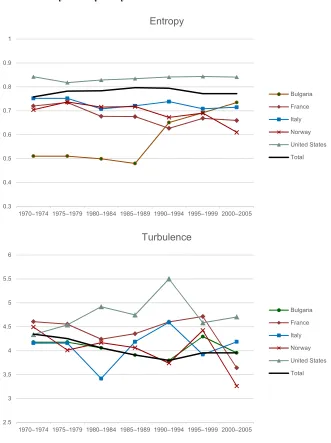
Overall, the level of heterogeneity of cohabitation patterns, measured through entropy and turbulence, does not increase over time (Figure A-1 in the Appendix). However, sequence heterogeneity shows differences by country that tend to persist over
0 .2 .4 .6 .8 P robabil it y
1970–1974 1975–1979 1980–1984 1985–1989 1990–1994 1995–1999 2000–2005
Year of union Bulgaria France Italy Norway United States
Cluster 1: Prelude to fast marriage and children
0 .1 .2 .3 .4 P robabil it y
1970–1974 1975–1979 1980–1984 1985–1989 1990–1994 1995–1999 2000–2005
Year of union Bulgaria France Italy Norway United States
Cluster 2: Alternative to marriage
0 .1 .2 .3 P robabil it y
1970–1974 1975–1979 1980–1984 1985–1989 1990–1994 1995–1999 2000–2005
Year of union Bulgaria France Italy Norway United States
Cluster 3: Temporary union
.05 .1 .1 5 .2 .25 P robabil it y
1970–1974 1975–1979 1980–1984 1985–1989 1990–1994 1995–1999 2000–2005
Year of union Bulgaria France Italy Norway United States
Cluster 4: Prelude to childless marriage
0 .1 .2 .3 .4 .5 P robabil it y
1970–1974 1975–1979 1980–1984 1985–1989 1990–1994 1995–1999 2000–2005
Year of union Bulgaria France Italy Norway United States
time, the only exception being Bulgaria, which shows a rapid increase in entropy after the fall of the Iron Curtain.
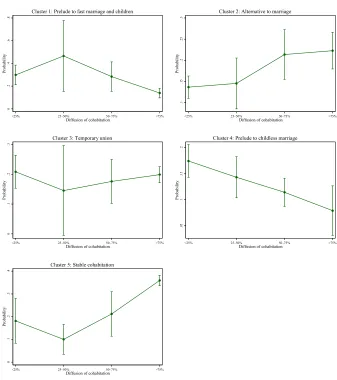
Figure 4: Multinomial logistic regression models: Predicted probability of being part of a specific cluster by diffusion of cohabitation (quartiles)
Note:See Table A-2 in Appendix for the complete set of regression estimates. Standard errors clustered by country.
Source: GGS (Bulgaria, France, Norway), FSS (Italy), and NSFG (USA).
0 .2 .4 .6 .8 P roba bi lity
<25% 25–50% 50–75% >75%
Diffusion of cohabitation
Cluster 1: Prelude to fast marriage and children
.1 .1 5 .2 .25 .3 P roba bi lity
<25% 25–50% 50–75% >75%
Diffusion of cohabitation
Cluster 2: Alternative to marriage
0 .1 .2 .3 P roba bi lity
<25% 25–50% 50–75% >75%
Diffusion of cohabitation
Cluster 3: Temporary union
.05 .1 .15 .2 P roba bi lity
<25% 25–50% 50–75% >75%
Diffusion of cohabitation
Cluster 4: Prelude to childless marriage
0 .1 .2 .3 .4 Pro ba bility
<25% 25–50% 50–75% >75%
Diffusion of cohabitation
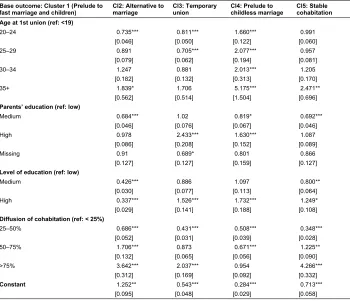
As a further step in our analysis, we replicate the multinomial logistic models taking into account the level of diffusion of cohabitation in each country. We replace the indicators of the macro-level context (country of residence and year at the beginning of the union) with a single variable that summarises the average level of cohabitation diffusion that women faced at the beginning of their informal union. Figure 4 shows results that are consistent with those of the previous analyses. In fact, cohabitation as a prelude to marriage (Clusters 1 and 4) becomes less likely with the spread of cohabitation as a first union, although not always in a linear way. On the contrary, when cohabitation diffusion increases it becomes more likely to be cohabiting as an ‘Alternative to marriage’ or in a ‘Stable cohabitation without children’. The only type of cohabitation that does not seem to change as cohabitation diffusion increases is cohabitation as a ‘Temporary union’ (Cluster 3).
Thus, observing all countries as if they were at the same stage (taking into account that they start from different levels of cohabitation diffusion and that the speed of the diffusion is different over time in different contexts), we find a consistent pattern: cohabitation as a prelude to marriage is on the wane but is increasing as an alternative to marriage or as a stable union without children.
6. Discussion
Applying sequence analysis and cluster analysis techniques to retrospective and comparative data for five countries, we obtained a data-driven classification of patterns in order to investigate convergence across countries. Our results suggest that patterns of cohabitation are evolving in a similar way in different countries in Europe and North America. We found a generalised decreasing trend of cohabitation as a pre-marital experience and an increasing trend of cohabitation as an alternative to marriage, or as a stable union but with no other commitments such as marriage or children. This result emerges even more clearly when looking at the experiences of women when characterised solely by the level of cohabitation diffusion in their country at the beginning of their first union. Our analysis shows that as the level of diffusion increases, cohabitation as a prelude to marriage becomes consistently less common, while the prevalence of both cohabitation as alternative to marriage – confirming our first hypothesis – and as a stable union increases.
are increasing rapidly. High levels of cohabitation are reported in Bulgaria, together with a very traditional pattern of cohabitation. Generally speaking, we found little evidence of an overall clear convergence, contrary to what we had assumed in our second hypothesis. In Norway and France, cohabitation has become a real alternative to marriage. This is not the case for Italy, where cohabitation is rather one of the possible ways to delay lifetime events, in particular marriage and childbirth. The United States is in line with France and Norway but is also characterised by cohabitation as a temporary union with high levels of instability and the high probability of a union with children being disrupted. These findings are consistent with previous results in the literature (see, among others, Cherlin 2010; Heuveline, Timberlake, and Furstenberg 2003; Kennedy and Ruggles 2014). Finally, in Bulgaria, cohabiting women tend to marry and have a child early; a fast transition that is still evident even among recently initiated unions. However, this country shows the largest change over time, with a clear sign of convergence with other countries since the 1990s. Cohabitation in Eastern European countries increased as a result of changes in the political regime, and to a certain extent this diffusion is due to the influence of the Western lifestyle (Koytcheva 2006; Thornton and Philipov 2009). These results are in line with those of Perelli-Harris and Amos (2015), which highlight that although unions are changing, “they are not changing in the same way in different countries, nor following universal trajectories of change” (Perelli-Harris and Amos 2015: 171).
Overall, evidence suggests that the selected countries are not simply at different stages of a similar trajectory. On one hand, the prevalence of some patterns consistently decreases (Prelude to marriage) or increases (Stable cohabitation and Alternative to marriage) as cohabitation spreads, while on the other hand, not all features of the existing schemas are adopted by different countries when they are at similar stages of diffusion. Italy and Bulgaria are not simply lagging behind Norway, the United States, and France, as each country is following a distinct and peculiar trajectory. In particular, the most recent behaviours reported for Italy and Bulgaria are only partially similar to those experienced by the other countries decades ago, suggesting that these countries are not at a different stage of the same trajectory. Thus, our results indicate that the diffusion of a common system of norms and values throughout industrialised countries does not shape the patterns of union formation, as predicted by the SDT, but that other cultural factors or different institutional settings are more relevant in determining cohabitation patterns.
cohabitation, this could be a significant deficiency. Second, we focused only on the first informal union and the first childbirth, leaving aside second unions and subsequent births. This choice was dictated by the need to consider a homogeneous group of cohabitants whose union and family choices depended mainly on the acceptability of cohabitation in a certain setting. A focus on first unions may not allow us to fully understand the role of cohabitation in the (marital) life course of adults when cohabitation has largely diffused. For example, the ‘Prelude to marriage’ trajectory may shift towards second and higher-order unions. Further research should focus on the second and subsequent unions of unmarried people.
Despite these limitations, our analysis sheds light on patterns of cohabitation over more than three decades in a comparative perspective for a geographically and culturally heterogeneous set of nations and accounts for complex union trajectories.
7. Acknowledgements
This research was partly funded by the Austrian Science Fund (FWF): Z171-G11. The Harmonized Histories data file was created by the Non-Marital Childbearing Network (www.nonmarital.org) (see Perelli-Harris, B.; Kreyenfeld, M.; Kubisch, K.: Harmonized histories: manual for the preparation of comparative fertility and union histories (2011) Rostock, MPIDR Working Paper WP-2010-011). It harmonises childbearing and marital histories from 14 countries in the Generations and Gender Programme (GGP) with data from Spain (Spanish Fertility Survey), the United Kingdom (British Household Panel Study), and the United States (National Survey for Family Growth). Thanks to everyone who helped collect, clean, and harmonise the Harmonized Histories data, especially Karolin Kubisch at MPIDR.
References
Aassve, A., Billari, F.C., and Piccarreta, R. (2007). Strings of adulthood: A sequence analysis of young British women’s work-family trajectories.European Journal
of Population 23(3–4): 369–388.doi:10.1007/s10680-007-9134-6.
Abbott, A. (1995). Sequence analysis: New methods for old ideas. Annual Review of
Sociology 21: 93–113.doi:10.1146/annurev.so.21.080195.000521.
Abbott, A. and Tsay, A. (2000). Sequence analysis and optimal matching methods in sociology. Sociological Methods and Research 29(1): 3–33. doi:10.1177/ 0049124100029001001.
Bailey, K.D. (1994). Typologies and taxonomies: An introduction to classification
techniques. Thousand Oaks: Sage.doi:10.4135/9781412986397.
Barban, N. and Sironi, M. (2018). Sequence analysis as a tool for family demography. In: Schoen, R. (ed.).Analytical family demography. Cham: Springer: 101–123.
doi:10.1007/978-3-319-93227-9_5.
Bernhardt, E. and Hoem, B. (1985). Cohabitation and social background: Trends observed for Swedish women born between 1936 and 1960.European Journal
of Population1(4): 375–395.doi:10.1007/BF01797149.
Bianchi, S.M. and Casper, L.M. (2000). American families. Population Bulletin55(4): 3–42.
Billari, F.C. (2001). Sequence analysis in demographic research. Canadian Studies in
Population28(2): 439–458.
Blom, S. (1994). Marriage and cohabitation in a changing society: Experience of Norwegian men and women born in 1945 and 1960. European Journal of
Population 10(2): 143–173.doi:10.1007/BF01264896.
Blossfeld, H.-P., Klijzing, E., Mills, M., and Kurz, K. (2005). Globalization,
uncertainty and youth in society. London: Routledge.
Buchmann, M. (1989).The script of life in modern society: Entry into adulthood in a
changing world. Chicago: University of Chicago Press.
Bumpass, L.L. (1990). What’s happening to the family? Interaction between demographic and institutional change. Demography 27(4): 483–498.
Castiglioni, M. and Dalla-Zuanna, G. (2014). Spread of cohabitation and proximity between kin in contemporary Italy. Journal of Family History 39(4): 422–444.
doi:10.1177/0363199014548391.
Cherlin, A.J. (2004). The deinstitutionalization of American marriage. Journal of
Marriage and Family 66(4): 848–861.doi:10.1111/j.0022-2445.2004.00058.x.
Cherlin, A.J. (2009).The marriage-go-round: The state of marriage and the family in
America today. New York: Knopf.
Cherlin, A.J. (2010). Demographic trends in the United States: A review of research in the 2000s.Journal of Marriage and Family 72(3): 403–419. doi:10.1111/j.1741-3737.2010.00710.x.
Dalla-Zuanna, G. (2001). The banquet of Aeolus: A familistic interpretation of Italy’s lowest low fertility. Demographic Research 4(5): 133–162. doi:10.4054/ DemRes.2001.4.5.
Di Giulio, P. and Koytcheva, E. (2007). The changing meaning of cohabitation: An
analysis of selected European countries. Poster presented at the Annual
Conference of the Population Association of America, New York, USA, March 29–31, 2007.
Di Giulio, P. and Rosina, A. (2007). Intergenerational family ties and the diffusion of cohabitation in Italy. Demographic Research 16(14): 441–468. doi:10.4054/ DemRes.2007.16.14.
Domínguez-Folgueras, M. and Castro-Martín, T. (2013). Cohabitation in Spain: No longer a marginal path to family formation. Journal of Marriage and Family
75(2): 422–437.doi:10.1111/jomf.12013.
Ekert-Jaffe, O. and Solaz, A. (2001). Unemployment, marriage, and cohabitation in France. The Journal of Socio-Economics 30(1): 75–98. doi:10.1016/S1053-5357(01)00088-9.
Elzinga, C.H. (2003). Sequence similarity: A non-aligning technique. Sociological
Methods and Research32(1): 3–29.doi:10.1177/0049124103253373.
Elzinga, C.H. (2006). Sequence analysis: Metric representation of categorical time series. Sociological Methods and Research 38(3): 463–481. doi:10.1177/ 0049124109357535.
Elzinga, C.H. and Liefbroer, A. (2007). De-standardization of family-life trajectories of young adults: A cross-national comparison using sequence analysis. European
Eriksen, J. (2001). Unmarried cohabitation and family policy in Norway. International
Review of Sociology 11(1): 63–74.doi:10.1080/03906700020031009.
Esping-Andersen, G. (1990). Three worlds of welfare capitalism. Cambridge: Policy Press.
Fulda, B.E. (2016). The diversity in longitudinal partnership trajectories during the transition to adulthood: How is it related to individual characteristics and regional living conditions? Demographic Research 35(37): 1101–1134.
doi:10.4054/DemRes.2016.35.37.
Furstenberg, F.F. Jr., Rumbaut, R.C., and Settersten, R.A. Jr. (2005). On the frontier of adulthood: Emerging themes and new directions. In: Settersten, R.A. Jr., Furstenberg, F.F. Jr., and Rumbaut, R.G. (eds.). On the frontier of adulthood:
Theory, research, and public policy.Chicago: University of Chicago Press: 3–
25.doi:10.7208/chicago/9780226748924.003.0001.
Gabadinho, A., Ritschard, G., Müller, N.S., and Studer, M. (2011). Analyzing and visualizing state sequences in R with TraMineR.Journal of Statistical Software
40(4): 1–37.doi:10.18637/jss.v040.i04.
Gabrielli, G. and Hoem, J.M. (2010). Italy’s non-negligible cohabitational unions.
European Journal of Population 26(1): 33–46.doi:10.1007/s10680-009-9193-y.
Gauthier, A.H. (2002). Family policies in industrialized countries: Is there a convergence?Population 57(3): 447–474.doi:10.3917/pope.203.0447.
Gauthier, A.H. (2007). The impact of family policies on fertility in industrialized countries: A review of the literature. Population Research and Policy Review 26(3): 323–346.doi:10.1007/s11113-007-9033-x.
Gauthier, J.-A., Widmer, E.D., Bucher, P., and Notredame, C. (2010). Multichannel sequence analysis applied to social science data. Sociological Methodology
40(1): 1–38.doi:10.1111/j.1467-9531.2010.01227.x.
Guetto, R., Mancosu, M., Scherer, S., and Torricelli, G. (2016). The spreading of cohabitation as a diffusion process: Evidence from Italy. European Journal of
Population 32(5): 661–686.doi:10.1007/s10680-016-9380-6.
Heuveline, P. and Timberlake, J.M. (2004). The role of cohabitation in family formation: The United States in comparative perspective. Journal of Marriage
and the Family 66(5): 1214–1230.doi:10.1111/j.0022-2445.2004.00088.x.
Heuveline, P., Timberlake, J.M., and Furstenberg, F.F. Jr. (2003). Shifting childrearing to single mothers: Results from 17 Western countries. Population and
Development Review29(1): 47–71.doi:10.1111/j.1728-4457.2003.00047.x.
Hiekel, N. (2014).The different meanings of cohabitation across Europe. Amsterdam: Amsterdam University Press.
Hiekel, N. and Castro-Martín, T. (2014). Grasping the diversity of cohabitation: Fertility intentions among cohabiters across Europe. Journal of Marriage and
the Family 76(3): 489–505.doi:10.1111/jomf.12112.
Hiekel, N., Liefbroer, A.C., and Poortman, A. (2014). Understanding diversity in the meaning of cohabitation across Europe.European Journal of Population 30(4): 391–410.doi:10.1007/s10680-014-9321-1.
Hoem, J.M. and Kostova, D. (2007). Early traces of the second demographic transition in Bulgaria: A joint analysis of marital and non-marital union formation, 1960– 2004.Population Studies 62(3): 259–271.doi:10.1080/00324720802313256. Impicciatore, R. (2015). The transition to adulthood of the Italian second generation in
France. European Journal of Population 31(5): 529–560. doi:10.1007/s10680-015-9354-0.
Jalovaara, M. and Fasang, A.E. (2015). Are there gender differences in family trajectories by education in Finland? Demographic Research 33(44): 1241– 1256.doi:10.4054/DemRes.2015.33.44.
Kalmijn, M. (2011). The influence of men’s income and employment on marriage and cohabitation: Testing Oppenheimer’s theory in Europe. European Journal of
Population 27(3): 269–293.doi:10.1007/s10680-011-9238-x.
Kasearu, K. and Kutsar, D. (2011). Patterns behind unmarried cohabitation trends in Europe. European Societies 13(2): 307–325. doi:10.1080/14616696.2010. 493586.
Kiernan, K. (2001). The rise of cohabitation and childbearing outside marriage in western Europe.International Journal of Law, Policy and the Family 15(1): 1– 21.doi:10.1093/lawfam/15.1.1.
Kiernan, K. (2004). Unmarried cohabitation and parenthood in Britain and Europe.Law
and Policy 26(1): 33–55.doi:10.1111/j.0265-8240.2004.00162.x.
Kiernan, K. (2006). Unmarried cohabitation and parenthood: Here to stay? European perspectives. In: Moynihan, D.P., Seeding, T.M., and Rainwater, L. (eds.).The
future of the family. New York: Russell Sage Foundation: 66–95.
Kleinepier, T. and de Valk, H.A.G. (2016). Ethnic differences in family trajectories of young adult women in the Netherlands: Timing and sequencing of events.
Demographic Research 35(24): 671–710.doi:10.4054/DemRes.2016.35.24.
Klüsener, S., Perelli-Harris, B., Sanchez Gassen, N.G., and Nora, E. (2013). Spatial aspects of the rise of nonmarital fertility across Europe since 1960: The role of states and regions in shaping patterns of change. European Journal of
Population 29(2): 137–165.doi:10.1007/s10680-012-9278-x.
Koytcheva, E. (2006). Social-demographic differences of fertility and union formation in Bulgaria before and after the start of the societal transition [PhD thesis]. Rostock: University of Rostock.
Kuperberg, A. (2014). Age at coresidence, premarital cohabitation, and marital dissolution: 1985–2009. Journal of Marriage and Family 76(2): 352–369.
doi:10.1111/jomf.12092.
Lesthaeghe, R. (1995). The second demographic transition in Western countries: An interpretation. In: Oppenheim Mason, K. and Jensen, A.-M. (eds.).Gender and
family changes in industrialized countries.Oxford: Clarendon Press: 17–62.
Lesthaeghe, R. (2010). The unfolding story of the second demographic transition.
Population and Development Review 36(2): 211–251.doi:10.1111/j.1728-4457.
2010.00328.x.
Lesthaeghe, R. and Neidert, L. (2006). The second demographic transition in the United States: Exception or textbook example? Population and Development Review
32(4): 669–698.doi:10.1111/j.1728-4457.2006.00146.x.
Liefbroer, A.C. and Dourlejin, E. (2006). Unmarried cohabitation and union stability: Testing the role of diffusion using data from 16 European countries.
Liefbroer, A.C. and Elzinga, C.H. (2012). Intergenerational transmission of behavioural patterns: How similar are parents’ and children’s demographic trajectories?
Advances in Life Course Research 17(1): 1–10.doi:10.1016/j.alcr.2012.01.002.
Manning, W.D. and Smock, P.J. (2005). Measuring and modeling cohabitation: New perspectives from qualitative data. Journal of Marriage and the Family 67(4): 989–1002.doi:10.1111/j.1741-3737.2005.00189.x.
Manting, D. (1996). The changing meaning of cohabitation and marriage. European
Sociological Review 12(1): 53–65.doi:10.1093/oxfordjournals.esr.a018177.
McDonald, P. (2006). Low fertility and the state: The efficacy of policy.Population
and Development Review 32(3): 485–510. doi:10.1111/j.1728-4457.2006.
00134.x.
McGinnis, S. (2003). Cohabiting, dating and perceived cost of marriage: A model of marriage entry. Journal of Marriage and the Family 65(1): 105–116.
doi:10.1111/j.1741-3737.2003.00105.x.
Micheli, G. (2000). Kinship, family and social network: The anthropological embedment of fertility change in Southern Europe. Demographic Research
3(13).doi:10.4054/DemRes.2000.3.13.
Mureşan, C., Hărăguş, P.T., Hărăguş, M., and Schröder, C. (2008). Romania: Childbearing metamorphosis within a changing context.Demographic Research
19(23): 855–906.doi:10.4054/DemRes.2008.19.23.
Murphy, M. (2000). The evolution of cohabitation in Britain, 1960–1995. Population
Studies 54(1): 43–56.doi:10.1080/713779062.
Mynarska, M. and Bernardi, L. (2007). Meanings and attitudes attached to cohabitation in Poland: Qualitative analyses of the slow diffusion of cohabitation among the young generation. Demographic Research 16(17): 519–554. doi:10.4054/ DemRes.2007.16.17.
Naldini, M. (2003). The family in the Mediterranean welfare states. London: Frank Cass.
Nazio, T. and Blossfeld, H.-P. (2003). The diffusion of cohabitation among young women in West Germany, East Germany and Italy. European Journal of
Population 19(1): 47–82.doi:10.1023/A:1022192608963.
Perelli-Harris, B. (2014). How similar are cohabiting and married parents? Second conception risks by union type in the United States and across Europe.European
Perelli-Harris, B. and Amos, M. (2015). Changes in partnership patterns across the life course: An examination of 14 countries in Europe and the United States.
Demographic Research 33(6): 145–178.doi:10.4054/DemRes.2015.33.6.
Perelli-Harris, B. and Bernardi, L. (2015). Exploring social norms around cohabitation: The life course, individualization, and culture. Introduction to Special Collection: ‘Focus on partnerships: Discourses on cohabitation and marriage throughout Europe and Australia.’ Demographic Research 33(25): 701–732.
doi:10.4054/DemRes.2015.33.25.
Perelli-Harris, B. and Gerber, T.P. (2011). Nonmarital childbearing in Russia: Second Demographic Transition or pattern of disadvantage? Demography 48(1): 317– 342.doi:10.1007/s13524-010-0001-4.
Perelli-Harris, B. and Sánchez Gassen, N. (2012). How similar are cohabitation and marriage? Legal approaches to cohabitation across Western Europe.Population
and Development Review 38(3): 435–467. doi:10.1111/j.1728-4457.2012.
00511.x.
Perelli-Harris, B., Isupova, O., Mynarska, M., Keizer, R., Berrington, A., Klärner, A., Berghammer, C., Evans, A., Lappegård, T., and Vignoli, D. (2014). Towards a new understanding of cohabitation: Insights from focus group research across Europe and Australia.Demographic Research 31(34): 1043–1078.doi:10.4054/ DemRes.2014.31.34.
Perelli-Harris, B., Kreyenfeld, M., and Kubisch, K. (2011). Harmonized histories: Manual for the preparation of comparative fertility and union histories. Rostock: Max Planck Institute for Demographic Research (Working Paper WP-2010-011).
Perelli-Harris, B., Kreyenfeld, M., Sigle-Rushton, W., Keizer, R., Lappegård, T., Jasilioniene, A., and Di Giulio, P. (2012). Changes in union status during the transition to parenthood: An examination of 11 European countries.Population
Studies 66(2): 167–182.doi:10.1080/00324728.2012.673004.
Perelli-Harris, B., Sigle-Rushton, W., Lappegård, T., Keizer, R., Berghammer, C., and Kreyenfeld, M. (2010). The educational gradient of non-marital childbearing in Europe. Population and Development Review 36(4): 775–801. doi:10.1111/j. 1728-4457.2010.00357.x.
Pirani, E. and Vignoli, D. (2016). Changes in the satisfaction of cohabitors relative to spouses over time. Journal of Marriage and Family 78(3): 598–609.
Pollock, G. (2007). Holistic trajectories: A study of combined employment, housing and family careers by using multiple-sequence analysis. Journal of the Royal
Statistical Society Series A: Statistics in Society 170(1): 167–183.doi:10.1111/
j.1467-985X.2006.00450.x.
Potârcă, G., Mills, M., and Lesnard, L. (2013). Trajectoires de formation de la famille en Roumanie, en Fédération de Russie et en France: En direction de la seconde transition démographique? [Family formation trajectories in Romania, the Russian Federation and France: Towards the second demographic transition?].
European Journal of Population 29(1): 69–101.
doi:10.1007/s10680-012-9279-9.
Prinz, C. (1995).Cohabiting, married, or single: Portraying, analyzing and modeling
new living arrangements in the changing societies of Europe. Aldershot:
Avebury.
Reher, D.S. (1998). Family ties in Western Europe: persistent contrasts.Population and
Development Review 24(2): 203–234.doi:10.2307/2807972.
Rijken, A.J. and Liefbroer, A.C. (2009). Influences of the family of origin on the timing and quantum of fertility in the Netherlands. Population Studies 63(1): 71–85.
doi:10.1080/00324720802621575.
Rindfuss, R.R. and VandenHeuvel, A. (1990). Cohabitation: A precursor to marriage or an alternative to being single?Population and Development Review 16(4): 703– 726.doi:10.2307/1972963.
Rosina, A. and Fraboni, R. (2004). Is marriage losing its centrality in Italy?
Demographic Research 11(6): 149–172.doi:10.4054/DemRes.2004.11.6.
Seltzer, J.A. (2000). Families formed outside of marriage.Journal of Marriage and the
Family 62(4): 1247–1268.doi:10.1111/j.1741-3737.2000.01247.x.
Seltzer, J.A. (2004). Cohabitation in the United States and Britain: Demography, kinship, and the future. Journal of Marriage and the Family 66(4): 921–928.
doi:10.1111/j.0022-2445.2004.00062.x.
Sironi, M., Barban, N., and Impicciatore, R. (2015). Parental social class and the transition to adulthood in Italy and the United States.Advances in Life Course
Research 26: 89–104.doi:10.1016/j.alcr.2015.09.004.
Sobotka, T. and Toulemon, L. (2008). Overview Chapter 4: Changing family and partnership behaviour: Common trends and persistent diversity across Europe.
Demographic Research 19(6): 85–138.doi:10.4054/DemRes.2008.19.6.
Sobotka, T., Zeman, K., and Kantorová, V. (2003). Demographic shifts in the Czech Republic after 1989: A second demographic transition view.European Journal
of Population 19(3): 249–277.doi:10.1023/A:1024913321935.
Spéder, Z. (2005). The rise of cohabitation as first union and some neglected factors of recent demographic developments in Hungary.Demográfia49(5): 77–103. Sweeney, M., Castro-Martín, T., and Mills, M. (2015). The reproductive context of
cohabitation in comparative perspective: Contraceptive use in United States, Spain, and France. Demographic Research 32(5): 147–182. doi:10.4054/ DemRes.2015.32.5.
Syltevik, L.J. (2010). Sense and sensibility: Cohabitation in ‘cohabitation land.’
Sociological Review 58(3): 444–462.doi:10.1111/j.1467-954X.2010.01932.x.
Thornton, A. and Philipov, D. (2009). Sweeping changes in marriage, cohabitation and childbearing in Central and Eastern Europe: New insights from the developmental idealism framework. European Journal of Population 25(2): 123–156.doi:10.1007/s10680-009-9181-2.
Tobío, C. (2001). Marriage, cohabitation and the residential independence of young people in Spain. International Journal of Law, Policy and the Family 15(1): 68– 87.doi:10.1093/lawfam/15.1.68.
Trost, J.E. (1978). A renewed social institution: Non-marital cohabitation. Acta
Sociologica 29(4): 303–315.doi:10.1177/000169938602900402.
Van de Kaa, D. J. (1987). Europe’s second demographic transition.Population Bulletin
42(1): 1–59.
Vignoli, D., Tocchioni, V., and Salvini, S. (2016). Uncertain lives: Insights into the role of job precariousness in union formation in Italy. Demographic Research
35(10): 253–282.doi:10.4054/DemRes.2016.35.10.
Villeneuve-Gokalp, C. (1991). From marriage to informal union: Recent changes in the behaviour of French couples.Population3: 81–111.
Vogel, J. (2002). European welfare regimes and the transition to adulthood: A comparative and longitudinal perspective. Social Indicators Research 59(3): 275–299.doi:10.1023/A:1019627604669.
Wiik, K.A. (2009). ‘You’d better wait!’ Socio-economic background and timing of first marriage versus first cohabitation. European Sociological Review 25(2): 139– 153.doi:10.1093/esr/jcn045.
Willoughby, B.J., Carroll, J.S., and Busby, D.M. (2012). The different effects of ‘living together’: Determining and comparing types of cohabiting couples. Journal of
Social and Personal Relationships 29(3): 397–419. doi:10.1177/
Appendix
Table A-1: Multinomial logistic regression models: Predicted probability of being part of a specific cluster by country and year of union, complete set of regression estimates
Base outcome: Cluster 1 (Prelude to
fast marriage and children) Cl2: Alternative tomarriage Cl3: Temporaryunion Cl4: Prelude tochildless marriageCl5: Stablecohabitation Age at 1st union (ref: <19)
20–24 0.650*** 0.693 1.521 0.767
[0.043] [0.194] [0.400] [0.149]
25–29 0.625*** 0.474* 1.653 0.566
[0.072] [0.166] [0.645] [0.169]
30–34 0.764 0.513* 1.489 0.581*
[0.257] [0.156] [0.528] [0.146]
35+ 1.111 1.064 4.221*** 1.234
[0.567] [0.482] [0.910] [0.576]
Parents’ education (ref: low)
Medium 0.711** 1.177 1.044 0.956
[0.075] [0.152] [0.194] [0.137]
High 0.660*** 1.657*** 1.435 1.115
[0.076] [0.136] [0.354] [0.121]
Missing 1.254 1.025 1.002 1.341
[0.169] [0.335] [0.277] [0.362]
Level of education (ref: low)
Medium 0.408* 0.811 1.018 0.773
[0.151] [0.238] [0.359] [0.220]
High 0.286** 1.21 1.448 1.136
[0.113] [0.406] [0.568] [0.351]
Country (ref: Norway)
Bulgaria 0.556*** 0.000*** 0.465*** 0.138***
[0.072] [0.000] [0.043] [0.009]
France 0.93 0.945 0.836 2.099***
[0.097] [0.079] [0.084] [0.159]
Italy 0.67 1.539 0.458** 1.861**
[0.164] [0.395] [0.135] [0.369]
United States 2.707*** 3.843*** 1.308*** 1.794***
[0.063] [0.122] [0.064] [0.032]
Year of union (ref:≤ 1974)
1975–1979 1.382*** 1.684*** 0.853* 2.971***
[0.024] [0.078] [0.054] [0.152]
1980–1984 4.185*** 3.009*** 0.871 6.346***
[0.177] [0.231] [0.103] [0.508]
1985–1989 6.938*** 4.923*** 0.923 8.960***
[0.522] [0.453] [0.123] [0.760]
1990–1994 14.917*** 9.508*** 0.996 15.716***
[1.382] [1.125] [0.170] [1.619]
1995–1999 20.949*** 11.076*** 0.896 15.058***
[2.291] [1.625] [0.193] [1.911]
2000–2005 25.001*** 21.040*** 1.398 39.163***
[2.374] [3.131] [0.320] [5.109]
Country*year of union (ref: Norway, ≤ 1974)
Bulgaria, 1975–1979 0.511*** 5.66e+05*** 1.554*** 0.296***