Introduction
Multiple lines of evidence favor a genetic predisposition to schizophrenia [1]. Several kinds of studies, including brain imaging and neuropathology suggest abnormalities in schiz-ophrenic and cerebral cortical development that might reflect cytoskeletal disturbances [2]. Ge-netic studies have linked schizophrenia to mul-tiple loci, suggesting the involvement of certain candidate genes as susceptibility factors [3,4].
Subsequent genetic studies in several inde-pendent populations, including association and linkage studies have also suggested that the Disrupted-In-Schizophrenia gene (DISC1) may be implicated in both schizophrenia and bipolar disorder [5,6,7,8].
The DISC1 was identified as the sole gene in which a mutant truncation by a balanced translocation, t (1; 11) (p42.1;q14.3) is co seg-regated with schizophrenia in a large Scottish family [9]. Ekelund and colleagues found a mi-Original Research
1. Associated Professor, Dept of Genetics, College of Sciences, Shahid Chamran University, Ahvaz,Iran. 2&4&5&7. MSc Student, Dept of Genetics, College of Sciences, Shahid Chamran University, Ahvaz,Iran.
3.Corresponding author, Associated Professor, Dept of Genetics, College of Sciences, Shahid Chamran University, Ahvaz-Iran; Email:
Medical Journal of the Islamic Republic of Iran.Vol. 24, No. 1, May, 2010. pp. 29-34
Association study between schizophrenia and the
DISC1
gene
polymorphism.
Ali Mohammad Foroughmand,1
PhD, Maryam Haidari,2MSc, Hamid Galehdari,3PhD
Atefeh Pooryasin,4
MSc.Seyed Reza Kazeminejad,5PhD, Shiva Hosseini,6MSc
Nahid Khajeh-Mogehi,7
MSc
Dept. of Genetics, Shahid Chamran University & Dept. of Psychiatrics, Jondishapour Medical University of Ahwaz.Ahvaz, Iran.
Abstract
Background: The disrupted-in-schizophrenia 1 (DISC1) gene, on the chromo-some position 1q42, was initially identified at the breakpoint of a balanced transloca-tion, t(1,11)(q42.1;q14.3), which segregated with major mental disorders in a large Scottish family.
Methods:Our samples included 200 unrelated patients diagnosed with Schizo-phrenia on the basis of DSM-IV criteria and 200 normal controls, which were gath-ered from Iran. The allele and genotype frequencies of the polymorphism were deter-mined using Polymerase Chain Reaction-Restricted Fragment Length Polymor-phism (PCR-RFLP) and the data were analyzed by Logistic Regression test.
Results:In this study we genotyped the rs821616 polymorphism (Serin704Cys-tein) located within exon 11 of the DISC1 gene. The samples were matched on the ba-sis of sex and ethnicity. We used the case control study to determine the possible asso-ciation between the ser704cys (rs821616) polymorphism and Schizophrenia. Analy-sis of data in the samples, revealed no association between the rs821616 polymor-phism and Schizophrenia (OR= 0.697, 95% CI= 0.47-1.033, P=0.072).
Conclusion: In this study we did not find any association between the rs821616 SNP and schizophrenia.
Keywords:association study, schizophrenia, DISC1 gene, rs821616, single nu-cleotide polymorphism.
crosatellite maker in DISC1 provided strong evidence for linkage to schizophrenia in a Finnish family [10] Using another set of sam-ples of 70 Finnish families with multiple indi-viduals affected with schizophrenia, they also found that a polymorphic marker and haplo-types in DISC1 showed evidence of association with schizophrenia[11]. Furthermore, a marker located near the breakpoint of a balanced translocation t (1; 11) (q42.1; q14.3) in DISC1 showed linkage to schizophrenia in Taiwanese families [12]. Recently, Cannon et al. found a haplotype incorporating 3 single-nucleotides polymorphic markers near the translocation break point of DISC1 associated with schizo-phrenia in their population-based twin cohort study [13]. Positive associations between DISC1 and both bipolar disorder and schizo-phrenia were reported in a Scottish population and a North American white population [8, 14]. Data from biochemical and cellular assays also provided evidences to support the important role of DISC1 in schizophrenia pathogenesis [15].
The DISC1 protein consists of 854 amino acids. The translocation that may cause the dis-ease involves the deletion of the C-terminal 257 amino acids [9]. The DISC1 is developmentally regulated with highest levels in the late embry-onic development of rats at the time of maximal cerebral cortical neuronal migration [16]. DISC1 gene is localized in particulate fractions and has structural characteristics resembling a cytoskeletal protein. Yeast 2-hybrid analysis re-veals interactions of The DISC1 with several cytoskeletal proteins. Detailed analysis of these proteins, such as nuclear distribution gene E ho-molog (NUDEL) suggested a putative role of DISC1 in neuronal migration and neurite out-growth. Currently, the functions ascribed to DISC1 are largely inferred from the known functions of the proteins that interact with the DISC1. It is therefore suggested to play a role in neuronal migration [17], neurite outgrowth [18], signal transduction, cyclic adenosine
monophosphate (cAMP) signaling [19], cy-toskeleton modulation, and translational regu-lation [17].
The evidence for DISC1 being a causal factor in major mental illness is strongly supported by a raft of independent genetic studies and by the growing evidence from biological studies. With exception of the t (1; 11), the data for explanato-ry functional variants in the gene and protein are still lacking. Much still needs to be under-stood about the biology of DISC1 and of DISC1 interacting partners, in human and other species. However, the DISC1 pathway current-ly offers avenues for exploring the molecular etiology of both normal and abnormal brain de-velopment. Such studies have the potential to produce new levels of understanding and possi-bly more effective interventions for disorders that are among the most common and debilitat-ing of human conditions, major mental illness [17]. Our aim in the present study was to exam-ine the association between Schizophrenia and the DISC1 gene in an Iranian population. We analyzed the rs821616 polymorphism in the DISC1 gene in a case-control study.
Methods
Subjects
In this case-control study, our samples in-cluded 200 unrelated patients with Schizophre-nia (mean age 43.34±SD=11.353) diagnosed based on DSM-IV criteria. The samples were gathered from hospitals of Fars and Khuzestan provinces which are located in south and south-west of Iran, respectively. Of these, 117 were men (63 from Fars and 54 from Khuzestan) and 83 were women (48 from Fars and 35 from Khuzestan). From all participants informed consent was obtained. Also, 200 normal con-trols were gathered from Khuzestan and Fars blood donors from blood transfusion centers and matched on the basis of sex and ethnicity with patients. The socio-demographic charac-teristics of the case and control samples are pre-sented in Table 1.
DNA Extraction and genotyping analysis Blood samples were collected from patient and control groups. Genomic DNA was extract-ed from peripheral blood leukocytes using Di-atom Prep 100 DNA extraction kit (Gen-fanavaran, Tehran, Iran). The rs821616 poly-morphism in exon 11 of the DISC1 gene was screened using PCR-RFLP method. The primers with the sequences 5´GCAGACCAT-GTATTTGAAAAGC 3´for forward primer and 5´ GCCAGTTTCCTCAAAATTCC 3´ for re-verse primer were designed by primer3out (www.primer3.com) program and have been used to amplify the region containing the rs821616 polymorphism.
The PCR reactions were carried out in final volume of 25 ȝl, containing 10 ng of genomic DNA, 10 mM Tris-HCl (PH:8.3), 50Mm KCL, 2Mm MgCl2, 200 ȝM dNTP (Sigma Co), 0.5 Pmol of each primer (Genfanavaran, Tehran, Iran) and 0.25 unit of Taq DNA polymerase (Genfanavaran, Tehran, Iran).
The amplification thermal conditions were as following: denaturation at 94°C for 3´´, fol-lowed by 35 cycles at 95°C for 30´´, 57°C for
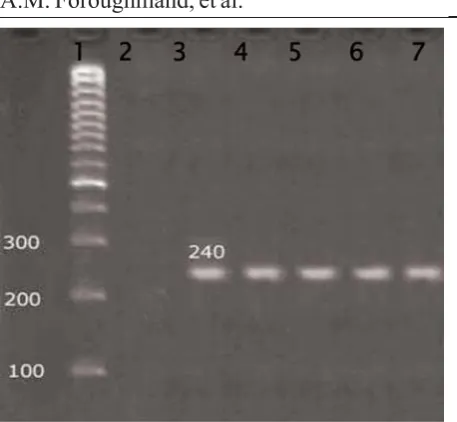
30´´, 72°C for 30´´, and a final extension at 72°C for 5 minutes (Fig.1).
Subsequently the PCR products, (240 bp long) were digested with 0.5 units of the TspR1 restriction endonuclease (Bio Labs, UK) overnight at 65oC and analyzed on a 12% poly Acryl amid gel (Fig.2)
Statistical analysis
Statistical differences in genotype and allele frequencies between Schizophrenics and con-trols were evaluated using the F2test in Fars and
Khuzestan provinces samples. Odd ratios (ORs) and their 95% confidence intervals (CIs) were calculated by statistical software package SPSS 13 to evaluate the effects of different genotypes.
Results
The rs821616 allelic and genotypic frequen-cies in cases and controls are presented in Table 2.
Comparison of Genotype frequencies be-tween Khuzestan and Fars samples presented no differences and therefore samples from two regions were grouped together in analyses
Fig. 2. Digested PCR products with the restriction en-zyme TspR1 yielded 4 bands in the case of AT allele (line 1) and 3 bands in the case of AA allele (line 2), in compari-son to undigested PCR product (line 3). Line 4 shows the 50 bp DNA ladder (Fermentase; Denmark).
Fig. 1. The primer specific PCR yielded a 240 bp prod-uct. Lines: 1: 100 bp DNA ladder (Fermentase; Den-mark); 2: negative PCR; 3 to 7: PCR products generated by sample's DNA.
(OR= 0.697, 95% CI= 0.47-1.033, P<0.072) and as well as association between schizophre-nia and the rs821616 polymorphism was not observed.
Discussion
We studied the possible association of the rs821616 SNP in the DISC1 gene with schizo-phrenia. In the recent years, many polymor-phisms have been reported on the human chro-mosome one as susceptible loci for schizophre-nia.
Positive results of linkage or association studies were found at 1q21-23 [22, 23, 24], 1q22 [25, 26], 1q31-32[27], 1q32.2-q41 [28, 29] or 1q42 [10]. However, other studies did not detect any polymorphism that was associated with the increased risk for schizophrenia [30, 31, 32]. Initially, the position 1q42 was identi-fied as a susceptible site for schizophrenia due to a balanced translocation (1; 11) (q42.1; q14.3). The DISC1 gene was also found to be co-ssegregated with schizophrenia [10]. After-ward, linkage and association findings of DISC1 at 1q42 could be replicated in Finnish and Taiwanese families [10, 11, 12]. This find-ing is consistent with other evidence accordfind-ing
a recent report that the peneterance of gene ef-fects related to psychiatric disorders is greater at the level of brain information processing than at the level of behavior [32]. These data con-firmed the DISC1 gene as a strong candidate that is considering to be closely related to schiz-ophrenia. The observations that Serine to Cys-tein substitution at position 704 is a non-conser-vative polymorphism residing within or near an alternative splicing domain in exon 11 makes it
MJIRI.Vol. 24, No.1, May, 2010. pp. 29-34
32
Table 1. Socio-demographic characteristics of the case and control groups.
Table 2. Allelic frequencies and genotypic distribution of the rs821616 polymorphism in DISC1 gene in Fars and Khuzestan provinces.
a particularly attractive candidate as a function-al polymorphism of relevance to the function of this gene.
The present case control study, which is the first to be conducted in an Iranian population, did not support any association between the rs821616 SNP gene and schizophrenia. The rs821616, a non-synonymous SNP in exon 11, is associated with schizophrenia in Caucasian population according to a recent report [5] and did not associate with schizophrenia in Han Chinese samples [15]. Also, earlier studies that reported evidence for association schizophre-nia to the DISC1 gene were negative for this SNP [14, 20, 21]. The conflicting results be-tween different investigations may be due to genetic heterogeneity, which different loci may be involved. According to reports schizophre-nia is a complex and multifactorial disorder with complicated etiology which can supposed different loci may have a small and additive ef-fects on age of onset and severity of the disor-der.
Our results did not provide any evidence that can support the importance and association of rs821616 polymorphism in the DISC1 gene in etiology of schizophrenia at least in Iranian population. We suppose more investigations are needed to evaluate the role of DISC1 gene in the schizophrenia.
References
1. Kirov G, O'Donovan MC, Owen MJ. Finding schiz-ophrenia genes. J Clin Invest 2005; 115:1440-45.
2. Sawa A, Snyder SH. Schizophrenia: diverse ap-proaches to a complex disease. Science 2002; 296:692-95.
3. Berrettini WH. Are schizophrenic and bipolar disor-ders related: Review of family and molecular studies. Bi-ol Psychiatry 2000; 48: 531-38.
4. Karayiorgou M, Gogos JA. A turning point in
schiz-ophrenia genetics. Neuron 1997; 967-979.
5. Callicott, JH, Straub RE, Pezawas L, Egan MF, Mattay VS, Hariri AR, et al. Variation in DISC1 affects hippocampal structure and function and increases risk for schizophrenia. Proc. Natl Acad Sci 2005 ; 102: 8627-32. 6. Hamshere ML, Bennett P, Williams N, Segurado R, Cardno A, Norton N, et al: Genome wide linkage scan in schizoaffective disorder: significant evidence for linkage at 1q42 close to DISC1, and suggestive evidence at 22q11 and 19p13. Arch. Gen. Psychiatry 2005; 62: 1081-88.
7. Sachs NA, Sawa A, Holmes SE, Ross CA, De Lisi LE, Margolis RL. A frame shift mutation in Disrupted in Schizophrenia 1 in an American family with schizophre-nia and schizoaffective disorder. Mol. Psychiatry 2005; 10:758-64.
8. Thomson PA, Wray NR, Millar JK, Evans KL, Hel-lard SL, Condie A, et al. Association between the TRAX/DISC locus and both bipolar disorder and schizo-phrenia in the Scottish population. Mol Psychiatry 2005; 10: 657-68.
9. Millar JK, Wilson-Annan JC, Anderson S, Christie S, Taylor MS, Semple CA, et al. Disruption of two novel genes by a translocation co-segregating with schizophre-nia. Hum Mol Genet 2000; 9:1415-23.
10. Ekelund J, Hovatta I, Parker A, Paunio T, Varilo T, Martin R,et al. Chromosome 1 loci in Finnish schizo-phrenia families. Hum Mol Genet 2001; 10:1611-17.
11. Ekelund J, Hennah W, Hiekkalinna T, Parker A, Meyer J, L.nnqvist J, et al. Replication of 1q42 linkage in Finnish schizophrenia pedigrees. Mol Psychiatry 2004; 9:1037-41.
12. Hwu HG, Liu CM, Fann CS, Ou-Yang WC, Lee SF. Linkage of schizophrenia with chromosome 1q loci in Taiwanese families. Mol Psychiatry 2003; 8: 445-52.
13. Cannon T.D., Hennah W., van Erp T.G. Thompson PM, Lonnqvist J, Huttunen M, et al. Association of DISC1/TRAX haplotypes with schizophrenia, reduced prefrontal gray matter, and impaired short and long-term memory. Arch Gen Psychiatry 2005; 62:1205-13.
14. Hodgkinson, CA, Goldman D, Jaeger J, Persaud S, Kane JM, Lipsky RH, et al. Disrupted in schizophrenia 1 (DISC1): association with schizophrenia, schizoaffec-tive disorder, and bipolar disorder. Am. J. Hum. Genet 2004; 75:862-72.
15. Chen QY, Chen Q, Feng GY, Lindpaintner K, Wang LJ, Chen ZX, et al. Case-control association study of Disrupted-in-Schizophrenia-1 (DISC1) gene and schizophrenia in the Chinese population. J Psychiatr Res 2007; 41: 428-434.
16. Ozeki Y, Tomoda T, Kleiderlein J, Kamiya A, Bord L, Fujii K, et al. Disrupted-In-Schizophrenia-1 (DISC-1): Mutant truncation prevents binding to NUDEL and inhabits neurite outgrowth. Proc. Natl. Acad. Sci. 2003;
100:289-94.
17. Hennah W, Thomson P, Peltonen L, Porteous D. Genes and schizophrenia: beyond schizophrenia: the role of DISC1 in major mental illness. Schizophr. Bull 2006; 32 (3): 409-416.
18. Yamada K, Nakamura K, Minabe Y, Iwayama-Shigeno Y, Takao H, Toyota T, et al. Association analysis of FEZ1 variants with schizophrenia in Japanese cohorts. Biol Psychiatry 2004; 56:683-690.
19. Millar JK, Pickard BS, Mackie S, James R, Christie S, Buchanan SR, et al. DISC1 and PDE4B are in-teracting genetic factors in schizophrenia that regulate cAMP signaling. Science 2005; 310: 1187-1191.
20. Devon RS, Anderson S, Teague PW, Burgess P, Kipari TM, Semple CA, et al. Identification of polymor-phisms within Disrupted in Schizophrenia 1 and Disrupt-ed in Schizophrenia 2, and an investigation of their asso-ciation with schizophrenia and bipolar affective disorder. Psychiatr Genet 2001; 11:71-78.
21. Hennah W, Varilo T, Kestila M, Paunio T, Araj?rvi R, Haukka J, et al. Haplotype transmission analysis pro-vides evidence of association for DISC1 to schizophrenia and suggests sex-dependent effects. Hum Mol. Genet 2003; 12 (3): 3151-59.
22. Chowdari KV, Mirnics K, Semwal P, Wood J, Lawrence E, Bhatia T, et al. Association and linkage analyses of RGS4 polymorphisms in schizophrenia. Hum Mol Genet 2002; 11: 1373-80.
23. Wittekindt O, Jauch A, Burgert E, Sch?rer L, Holt-greve-Grez H, Yvert G, et al. The human small conduc-tance calcium-regulated potassium channel gene (hSKCa3) contains two CAG repeats in exon 1, is on chromosome 1q21.3, and shows a possible association with schizophrenia. Neurogenetics 1998; 1:259-65.
24. Brzustowicz LM, Hodgkinson KA, Chow EW, Honer WG, Bassett AS. Location of a major susceptibili-ty locus for familial schizophrenia on chromosome 1q21-q22. Science 2000; 288: 678-82.
25. Brzustowicz LM, Hayter JE, Hodgkinson KA, Chow EW, Bassett AS. Fine mapping of the schizophre-nia susceptibility locus on chromosome 1q22. Hum Hered 2002; 54:199-209.
26. Yu L, Yang MS, Zhao J, Shi YY, Zhao XZ, Yang JD, et al. An association between polymorphisms of the interleukin-10 gene promoter and schizophrenia in the Chinese population. Schizophr Res 2004; 71:179-83.
27. Hovatta I, Varilo T, Suvisaari J, Terwilliger JD, Ol-likainen V, Araj?rvi R, et al. A genome wide screen for schizophrenia genes in an isolated Finnish subpopula-tion, suggesting multiple susceptibility loci. Am J Hum Genet 1999; 65:1114-24.
28. Gurling HM, Kalsi G, Brynjolfson J, Sigmundsson T, Sherrington R, Mankoo BS, et al. Genomewide genet-ic linkage analysis confirms the presence of
susceptibili-ty loci for schizophrenia, on chromosomes 1q32.2, 5q33.2, and 8p21-22 and provides support for linkage to schizophrenia, on chromosomes 11q23.3-24 and 20q12.1-11.23. Am J Hum Genet 2001; 68: 661-73.
29. Laurent C, Niehaus D, Bauche S, Levinson DF, Soubigou S, et al. CAG repeat polymorphisms in KC-NN3 (HSKCa3) and PPP2R2B show no association or linkage to schizophrenia. Am J Med Genet (Part B Neu-ropsychiatric) 2003; 116:45-50.
30. Levinson DF, Holmans PA, Laurent C, Riley B, Pulver AE, Gejman PV, et al. No major schizophrenia lo-cus detected on chromosome 1q in a large multicenter sample. Science 2002; 296:739-41.
31. Maziade M, Fournier A, Phaneuf D, Cliche D, Fournier JP, Roy MA, et al. Chromosome 1q12-q22 link-age results in eastern Quebec families affected by schizo-phrenia. Am J Med Genet 2002; 114:51-5.
32. St. Clair D, Blackwood D, Muir W, Carothers A, Walker M, Spowart G, et al. Association within a family of a balanced autosomal translocation with major mental illness. Lancet 1990; 336:13-16.
34