VOLUME 41, ARTICLE 47, PAGES 1315-1346
PUBLISHED 29 NOVEMBER 2019
https://www.demographic-research.org/Volumes/Vol41/47/ DOI: 10.4054/DemRes.2019.41.47
Research Article
Parental childcare support, sibship status, and
mothers’ second-child plans in urban China
Menghan Zhao
Yang Zhang
© 2019 Menghan Zhao & Yang Zhang.
This open-access work is published under the terms of the Creative Commons Attribution 3.0 Germany (CC BY 3.0 DE), which permits use, reproduction, and distribution in any medium, provided the original author(s) and source are given credit.
1 Introduction 1316
2 Literature review 1317
2.1 Sibship status and resource dilution 1317
2.2 Intergenerational childcare support and childbearing decisions 1318
2.3 Chinese context and hypotheses 1319
3 Data and methods 1322
3.1 Data 1322
3.2 Measures 1323
3.3 Analytical strategy 1327
4 Results 1328
4.1 Sibship status and intergenerational childcare support 1328 4.2 Influence of intergenerational childcare support on a mother’s plan
for a second child
1332
5 Conclusions and discussion 1335
6 Acknowledgments 1337
References 1338
Parental childcare support, sibship status, and mothers’ second-child
plans in urban China
Menghan Zhao1
Yang Zhang2
Abstract
BACKGROUND
Most previous research on intergenerational impacts on childbearing behaviors has overlooked the interrelation between having siblings and the availability of childcare assistance provided by grandparents.
OBJECTIVE
This study examines how the siblings of young couples dilute the resources of grandparental childcare assistance and thus influence a mother’s plans to have a second child in urban China.
METHOD
We use data from the survey on Fertility Decision-Making Processes in Chinese Families conducted in 2016 and focus on the subsample of mothers who have only one child and live in urban areas.
RESULTS
The husband’s parents are less likely to take care of grandchildren if the husband has male siblings, while the probability will be higher if the wife has male siblings. The chance of receiving childcare support from the wife’s parents is also associated with the sibship status of both wife and husband. The results suggest that the decision regarding primary childcare providers might be made collectively within extended families. Under the two-child policy, childcare support from parents or in-laws in raising the first child increases the probability of a mother planning a second child. Furthermore, the positive effect of childcare support from the husband’s parents is lessened if the husband has siblings.
1 Center for Population and Development Studies, Renmin University of China, Beijing, China.
Email:[email protected].
2 Department of Sociology, Population Studies Center, University of Michigan, Ann Arbor, USA.
CONTRIBUTION
This article tests the resource-dilution model in adulthood by examining the association between grandparental childcare assistance and young couples’ sibship status. Siblings may compete for grandparental childcare support and thus reduce the positive influence of grandparental childcare assistance on a mother’s plans for another child.
1. Introduction
There is a large body of literature portraying how siblings interact and exert their influences on one another’s development and adjustment during childhood. Although early research suggests that siblings promote socio-emotional development and serve as social partners or role models, most empirical studies provide evidence that the number of siblings is negatively related to their development outcomes and well-being (Conley and Glauber 2006; Davis 1997; Öberg 2015). This can be explained by the resource
dilution model ‒ the larger the sibship size, “the more the resources are divided and
hence, the lower the quality of the output” (Blake 1981: 422).
Intergenerational support (e.g., financial transfers and free grandparenting), which is deemed a source of social capital in sociological literature, shapes adult children’s childbearing behaviors (Boca 2002; Bühler and Philipov 2005). However, the interrelation between sibship status and the availability of childcare assistance provided by grandparents, and its influence on adult children’s fertility decisions, remain less studied. As argued by Aassve and his colleagues (2012), the childcare services that parents can offer to each adult child depend on their own characteristics and whether they need to assist other adult children. This competition among adult children (i.e., siblings) might be even more salient when public childcare services are less prevalent.
In contemporary China, where public childcare services are limited, women’s parents and in-laws are important childcare providers (Chen, Liu, and Mair 2011; Chen, Short, and Entwisle 2000). Nevertheless, the impact of grandparental childcare assistance on women’s fertility decisions has received less academic interest in Chinese studies. This is because the stringently enforced birth control in the past decades resulted in little variation in family size (Gu et al. 2007), and thus the influence of various family characteristics on the number of children was less likely to be observed.
becomes one of the main determinants in a family’s plans for a second child. In addition, sibship status might influence young couples’ possibility of getting parental childcare support: Because all couples have been allowed to have a second child since the same time point, siblings may compete directly for free grandparental childcare assistance. Consequently, the siblings of both husband and wife might dilute the resources of grandparental childcare assistance.
Using survey data collected in 2016 in twelve cities across six provinces, this study tests the resource-dilution model on siblings’ sharing of grandparental childcare assistance. Specifically, in the analyses we distinguish the wife’s sibship status from her husband’s and discuss how the extended families of both husband and wife make decisions collectively in the face of external constraints. Thus, this study extends the general literature on siblings by examining the resource-dilution model in China’s sociocultural context, where siblings interact and exert their impact on the larger family system. We then examine the influence of intergenerational childcare support on urban Chinese women’s second-child plans in the era of the two-child policy, providing insights into factors influencing future fertility trends in China.
We begin by reviewing previous literature about sibship status and the dilution of parental resources among siblings. We then discuss the influence of grandparental childcare assistance, viewed as an important parental resource for young couples, on adult children’s fertility behavior. Based on this literature, we sketch the Chinese context and introduce our hypotheses. Next, we describe our data, measures, and analytical strategy. We then present the results of our models testing the proposed hypotheses. In the last section we discuss our findings and their societal relevance.
2. Literature review
2.1 Sibship status and resource dilution
to a trade-off between children’s quantity and quality within budget constraints. A body of empirical studies supports this prediction, revealing that investments in one offspring generally detract from resources available for other children under parental care, including families’ unpaid time (Vargha and Donehower 2019). The negative impacts of having siblings have been observed in various aspects of child outcomes, including height, years of education, intellectual development, adult earnings, and employment (Black, Devereux, and Salvanes 2005; Blau and Duncan 1967; Downey 2001; Öberg 2015; Steelman et al. 2002).
Other studies further emphasize the variation of sibship effects in different social contexts (Downey 2001; Maralani 2008). Using twin births as an instrument for family size, Rosenzweig and Wolpin (1980) find that exogenous increases in fertility lead to lower levels of schooling in rural India. Studies in mainland China, where no comprehensive welfare system has been built to support families’ childbearing and childcare, also find evidence that family size is negatively correlated with children’s education after controlling for parental characteristics in rural areas (Li, Zhang, and Zhu 2008). Using data in 20 OECD countries, Park (2008) uses hierarchical linear models to show that strong family-supportive policies mediate the relationship between sibship size and educational achievement. Gibbs and colleagues (2016) also argue that expansion of state-sponsored investment in education has weakened the linkage between family background and educational opportunity in the United States.
Yet, the dilution of parental resources among siblings in adulthood remains less studied. Using longitudinal data on sibling samples in the United State, Siennick (2013) finds that the adolescent siblings who are emotionally closer to their parents get more material support from their parents after the transition to adulthood, suggesting a continuity of resource dilution over the family life course. In this study we look at how sibship status relates to the young couple’s resources of grandparental childcare assistance, and thus affects their decisions regarding having a second child in the era of China’s two-child policy. Before that, we review the literature on the relationship between grandparental childcare support and adult children’s childbearing decisions.
2.2 Intergenerational childcare support and childbearing decisions
Tanskanen and Rotkirch 2014) and can reduce women’s opportunity costs of reproduction. This sharing of childrearing costs thus enables mothers to better balance paid work and family life (Hoppmann and Klumb 2010), encouraging fertility.
There are many recent empirical studies on childcare by grandparents, especially in the context of European countries, but conclusions regarding its impact on adult couples’ childbearing decisions are mixed and elusive. In the Netherlands, childcare support from grandparents is an important factor shaping people’s fertility decisions and increases the probability of having children (Kaptijn et al. 2010). One study using data from Bulgaria, as a case from Central and Eastern Europe, documents the effects of grandparents’ support on the intention to have a first or second child (Bühler and Philipov 2005). Using data from the Generations and Gender Surveys in four European countries with different levels of wealth, public childcare services, and fertility, Tanskanen and Rotkirch (2014) find that childcare help from a maternal father is positively correlated with a woman’s intention to have a second or third child. Nevertheless, grandparental childcare help is found to be negatively associated with women’s fertility intentions in Lithuania. Drawing on longitudinal data for the 1970 British birth cohort, Waynforth (2012) argues that it is the physical presence of grandparents rather than grandparents’ childcare help that increases the chance of having a child.
Historically, the extended family has dominated in East Asian societies, where patriarchal and patrilineal norms derived from Confucian doctrine are prevalent. Typically, adult sons, their wives, and their descendants live under the same roof as their parents. Yet, literature on the relationship between grandparental childcare and young adults’ fertility behavior is rather limited. Prior research in Taiwan reveals that the spacing between the first and the second birth is shorter when coresiding parents-in-laws act as free childcare providers (Chi and Hsin 1996). Data from South Korea suggests that women with childcare assistance from coresiding parents or in-laws have 2.7 times odds of having a second child compared to women not living with parents or in-laws and not receiving childcare support from them (Yoon 2017).
2.3 Chinese context and hypotheses
After reviewing the resource-dilution model and the previously discussed associations between grandparental childcare support and adult children’s childbearing behavior, in this section we provide an overview of the Chinese setting on which our hypotheses are based.
intergenerational coresidence, in traditional Chinese culture it was not a formal obligation for young adults’ parents to take care of grandchildren (Chen, Liu, and Mair 2011). However, the founding of the People’s Republic of China and the implementation of the 1950 Marriage Law expanded the rights of women and increased the autonomy of the conjugal pair. The passage of the 1980 Marriage Law further accelerated the privatization of marriage in post-socialist China (Davis 2014). In contrast to the simple obedience to older generations of the past, it is now more common for adults’ parents to provide assistance to their children, such as care for grandchildren. As argued by Croll (2006), parental care for adult children’s offspring is both part of a reciprocal cycle of care and a bargaining strategy that guarantees support from adult children as the parents age.
More importantly, grandparental childcare support serves as a family adaptive strategy to maximize the well-being of the extended family in contemporary urban China. During the last several decades, mainland China has transitioned from a socialist to a market-oriented economy. In the socialist era, support which previously had come from
the family was provided by thedanwei (state-owned enterprise work-unit) system, which
helped organize social production and supplied publicly subsidized facilities, including dining halls and childcare centers in urban areas. During the transition to a market
economy the danwei system gradually collapsed, and its publicly subsidized services
were not replaced by a well-established welfare system to support families and individuals (Ji et al. 2017). Because of these constraining institutional and social realities, “family members (thus) have to stick together as a safety net, to some degree through their obligations towards each other as defined by Confucian tradition” (Ji 2017: 3). Typically, with rising living expenses and housing prices, the young generations of Chinese, especially those living in urban areas, have become more dependent on their parents in recent years than in the socialist times (Yan 2013). As a result, decisions made within Chinese families are affected by resource demands and power relations among family members (Chen and Korinek 2010).
Hypothesis Ia: The husband’s parents are less likely to take care of very young children if the husband has siblings.
Hypothesis Ib: The husband’s parents are more likely to take care of very young children if the wife has siblings.
Hypothesis IIa: The wife’s parents are less likely to take care of very young children if the wife has siblings.
Hypothesis IIb: The wife’s parents are more likely to take care of very young children if the husband has siblings.
As pointed out in previous literature, grandparental childcare is likely to encourage young couples’ fertility intentions, especially in societies with limited public support (e.g., mainland China). However, diluted grandparental childcare assistance in extended families might lead to a mother’s lower intention of having a second child in the era of China’s two-child policy. Thus, based on recent socioeconomic changes, we develop further hypotheses regarding grandparental childcare support, the sibling status of wives and husbands, and mothers’ second-child plans in urban China.
Recent studies have pointed to the deteriorating position of Chinese women in the urban labor market during the economic transition (He and Wu 2018; Zhang and Hannum
2015; Zhao 2018). With the collapse of thedanwei system the protections and assistance
Hypothesis III: A mother with childcare support from parents or in-laws is more likely to plan a second child.
As proposed by previous literature, adult children’s sibship status might affect their possibility of getting childcare support from their parents. The introduction of China’s two-child policy, which can be seen as a shock in the life course trajectory of Chinese families, allowed all couples to have a second child at the same time point. As a result, siblings of childbearing age, regardless of the age difference between them, became potential competitors for childcare assistance from their parents, thus affecting young adults’ childbearing behavior. Aassve and colleagues (2012) argue that women’s probability of having a child is lower if their parents are looking after the young children of siblings, because their parents’ time and energy for taking care of all grandchildren is limited. In the Netherlands, parents who frequently care for the children of childless adults’ siblings also negatively (although not significantly) affect the likelihood of the childless adults entering into parenthood (Kaptijn et al. 2010). Based on this new context and on findings from other societies, we further develop a fourth set of hypotheses:
Hypothesis IVa: The influence of parental childcare support on a mother’s plan to have a second child will be smaller if she has siblings.
Hypothesis IVb: The influence of childcare support from parents-in-law on a mother’s plan to have a second child will be smaller if her husband has siblings.
3. Data and methods
3.1 Data
This study used survey data from the Fertility Decision-Making Processes in Chinese
Families project conducted by Renmin University of China in 2016.3 This survey
samples twelve cities in six provinces (Zhejiang, Sichuan, Shandong, Guangdong, Liaoning, and Hubei) in mainland China, covering diverse geographical locations with different levels of economic development, fertility, sex ratio at birth, and population size. In each city about 500 households were sampled using a multistage probability sampling design. First, three counties were randomly selected from each city. Second, two
subdistricts (jiedao) in urban areas or townships (xiangzhen) in rural areas were sampled
from each county. Third, from subdistricts or townships, four to ten communities
3 China’s National Social Science Foundation [15BRK010, 15ZDC036, 16CRK003] funded the collection of
(juweihui) or administrative villages (cunweihui) were selected. Finally, eight to ten households were sampled from each community or administrative village. Because urban people are the primary target group of the two-child policy, households living in urban areas were oversampled in the sampling process. The original sample size was 6,013, with 86% coming from the urban areas.
Because we focused on the target group of the two-child policy, we limited our
sample to Han4 (the main ethnic group in mainland China) women aged 20 to 45 living in
urban areas (N = 4,820). To examine the association between childcare support from parents or in-laws for the first child under age 3, and the probability of having plans for a second child, we further limited the analytical sample to those who had one child, deleting 1,651 observations. Because of our focus on intergenerational influence, we only kept women who had at least one parent or parent-in-law, dropping 295 observations, and excluded 80 observations whose first child was primarily taken care of by someone other than the couple, their parents, or in-laws. Finally, we dropped observations with missing values in the variables of interest, excluding 196
observations.5 The final analytical sample size was 2,598.
3.2 Measures
Corresponding to the hypotheses, there were two dependent variables in this study: main childcare providers for the first child under age 3 and whether a mother planned to have a second child.
To test the first two sets of hypotheses, the dependent variable was the primary childcare providers for the first child under age 3, because childcare demand is most intensive when a child is very young (Du and Dong 2013; Zhao 2018). This variable had three categories: the young couple (reference group), the wife’s parents, and the husband’s parents (i.e., wife’s parents-in-law). About 61% of the respondents reported that the couple was the primary childcare provider for their first child when the child was
4 This is because, even before the implementation of the universal two-child policy, there were exceptions for a
second or even a third child (Gu et al. 2007). Specifically, Han people were the ones most affected by the one-child policy, while other ethnic minorities (except for Man and Zhuang) could have two children. The minority in Xinjiang and Qinghai province could have three children. Therefore, in this study we only focused on Han people, who are most likely to have been affected by the policy change.
5 About 90 observations had missing values in dependent variables and 106 observations had missing values in
under age 3. The wives’ parents were the primary childcare provider for 13% of the respondents, and the parents-in-law for 27%.
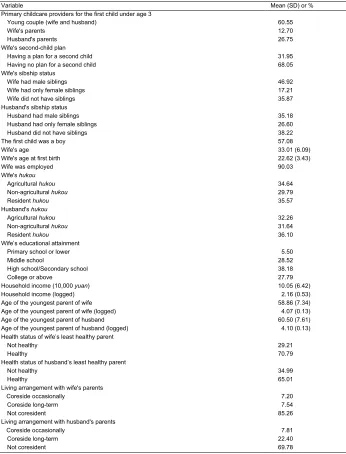
To test the third and fourth sets of hypotheses, the main childcare providers for the first child were treated as one of the independent variables, and a mother’s plan for a second child was the dependent variable. To simplify the interpretation of the results, two dummy variables indicating the main childcare providers were used in this part of the analyses (i.e., the wife’s parents were the main childcare providers versus the wife’s parents were not the main childcare providers, and the husband’s parents were the main childcare providers versus the husband’s parents were not the main childcare providers). The dependent variable regarding a mother’s second-child plan was constructed from responses to the following question: “How many children are you planning to have?” A mother who planned two or more children was considered as planning a second child. We used fertility plans rather than fertility intentions in this study because a fertility plan is a better proxy for individual fertility behavior in the near future. Although some early studies propose fertility intentions as the most proximate proxy of actual fertility behavior (Ajzen 1991; Barber 2001; Bongaarts 1992), Bongaarts (2001) argues that there are multiple mediating factors that result in the gap between fertility intention and fertility behavior. Compared to fertility intentions, the question about fertility plans asked respondents to think about a specific agenda for having another child when answering the question. Thus, mothers’ fertility plans were adopted in the analyses. As shown in Table 1, about one-third of the mothers in our analytical sample had planned a second child.
Table 1: Descriptive statistics
Variable Mean (SD) or %
Primary childcare providers for the first child under age 3
Young couple (wife and husband) 60.55
Wife's parents 12.70
Husband's parents 26.75
Wife's second-child plan
Having a plan for a second child 31.95
Having no plan for a second child 68.05
Wife's sibship status
Wife had male siblings 46.92
Wife had only female siblings 17.21
Wife did not have siblings 35.87
Husband's sibship status
Husband had male siblings 35.18
Husband had only female siblings 26.60
Husband did not have siblings 38.22
The first child was a boy 57.08
Wife's age 33.01 (6.09)
Wife's age at first birth 22.62 (3.43)
Wife was employed 90.03
Wife'shukou
Agriculturalhukou 34.64
Non-agriculturalhukou 29.79
Residenthukou 35.57
Husband'shukou
Agriculturalhukou 32.26
Non-agriculturalhukou 31.64
Residenthukou 36.10
Wife’s educational attainment
Primary school or lower 5.50
Middle school 28.52
High school/Secondary school 38.18
College or above 27.79
Household income (10,000yuan) 10.05 (6.42)
Household income (logged) 2.16 (0.53)
Age of the youngest parent of wife 58.86 (7.34)
Age of the youngest parent of wife (logged) 4.07 (0.13)
Age of the youngest parent of husband 60.50 (7.61)
Age of the youngest parent of husband (logged) 4.10 (0.13)
Health status of wife’s least healthy parent
Not healthy 29.21
Healthy 70.79
Health status of husband’s least healthy parent
Not healthy 34.99
Healthy 65.01
Living arrangement with wife's parents
Coreside occasionally 7.20
Coreside long-term 7.54
Not coresident 85.26
Living arrangement with husband's parents
Coreside occasionally 7.81
Coreside long-term 22.40
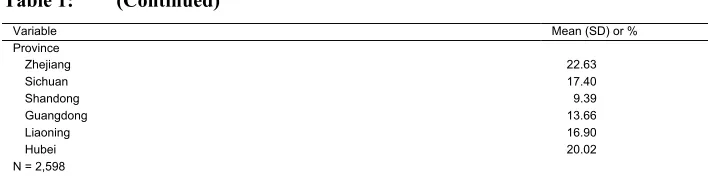
Table 1: (Continued)
Variable Mean (SD) or %
Province
Zhejiang 22.63
Sichuan 17.40
Shandong 9.39
Guangdong 13.66
Liaoning 16.90
Hubei 20.02
N = 2,598
In all the statistical models we controlled for respondents’ characteristics, including
age, educational attainment, age at first birth, employment status, andhukoustatus. Age,
measured in years, was included because older women are less likely to plan a second child, due to biological constraints. Educational attainment has been found to be negatively related to fertility intentions (Axinn and Barber 2001). We measured education through a set of dummy variables: primary school or lower, middle school (reference group), high school or secondary school, and college or above. Previous studies suggest that women’s younger age at first birth is associated with rapid subsequent fertility (Bumpass, Rindfuss, and Jamosik 1978), so we also controlled for women’s age at first birth. We also included mothers’ employment status in the model because it is an indicator of women’s empowerment, negatively associated with fertility intentions (Jin, Song, and Chen 2016; Upadhyay et al. 2014). This variable had two categories: not employed (reference group) and employed (including wage earners, the self-employed, and farmers). In our sample almost 90% of women were employed.
Thehukou status6 of women and their husbands was also included in our models.
Hukou status is the status of each person registered in the Household Registration System in mainland China, mainly agriculture or non-agriculture. Recently, a third category of
resident hukou was introduced into the system.7 Thus, this variable had three categories:
agricultural hukou (reference group), non-agriculturalhukou, and resident hukou. We
included this variable in our analyses becausehukou status is closely related to the social
benefits that individuals can receive, and previous fertility policies were designed based onhukou type (Gu et al. 2007),.
Several household characteristics were also controlled for, including the gender of the first child, annual household income, age of the youngest parent (logged), and the health status of the least healthy parent. We included the first child’s gender, with girl as
6 Some respondents’hukoustatus changed after marriage. As a robustness check, we also tried models with the hukou status of women and their husbands before marriage. The results remained consistent (available upon request).
7 In July 2014 the central government of China announced Opinions on Further Promoting the Reform of the
the reference group, because the gender of the first child is closely related to second-child intention (Jin, Song, and Chen 2016). Household income is an indicator of financial capacity to support a second birth (Bao, Chen, and Zheng 2017). Because the distribution of household income was highly skewed, we took the logarithm of annual household income. Because both age and the health status of parents and in-laws reflects their ability to provide childcare support, we used the age (measured in years) of the youngest parent, and the health status of the least healthy parent reported by the respondents (i.e., whether they had parents who were not healthy and might need care), to capture their capacity to take care of children.
We also controlled for living with parents or in-laws in both parts of the analyses. We included living with parents in the first part of analyses because it may be associated with both parental childcare support and the sibship status of the young couple. However, due to data limitations we did not have information about spatial proximity, as used in previous studies (Chen, Liu, and Mair 2011; Zhao and Ji 2019). Instead, we used three-category dummy variables: coreside occasionally, coreside long-term, and not
coresident (reference group).8
For the second part of the analyses ‒ examining the impact of parental childcare
support on mothers’ second-child plans – we also included living with parents or in-laws to control for intergenerational effects on women’s childbearing plans other than providing childcare support (Bernardi 2003), such as women’s exposure to parents’ or in-laws’ traditional ideas and expectations of large family size during the period of co-residence (Chi and Hsin 1996). Furthermore, recent studies using longitudinal data suggest that, compared to not living with parents, Chinese women’s motherhood penalty was nonexistent for women living with their own parents and largest for those living with parents-in-law (Yu and Xie 2018). Thus, in the models we distinguished living with wife’s parents from living with husband’s parents.
Finally, we controlled for heterogeneity across provinces by including a set of dummy variables of provinces, with Zhejiang as the reference category.
3.3 Analytical strategy
In this study we adopted multinomial and binary logistic regression models with robust standard errors clustering at provincial level.
8 Because we only have cross-sectional data, we do not know the exact living arrangement at the time of the
We used multinomial logistic regression to test the first two sets of hypotheses regarding the relationship between the main childcare providers for the first child under age 3 and the sibship status of young couples. In this model the young couples as the primary childcare providers were treated as the reference category (z = 1):
( ( = 2)
( = 1)) = + ℎ + ℎ ℎ
+ , = 1 …
( ( = 3)
( = 1)) = + ℎ + ℎ ℎ
+ , = 1 …
P(z = 2)is the probability of the wife’s parents being the primary childcare providers for
the first child. P(z = 3) is the probability of the husband’s parents being the primary
childcare providers for the first child.
To test the third and fourth hypotheses we used binary logistic regression models with second-child plan as the dependent variable, and conducted our analyses in progressive stages. First, we tested the effects of parents’ or in-laws’ childcare for the first child on mothers’ plan for a second child (Hypothesis III), controlling for other variables. Next, we included the variables of wives’ and their husbands’ sibship status in the second model. Finally, to test the last set of hypotheses, we included the interaction terms between having siblings and parental childcare support. In the last two stages of the analyses we also tried dummy variables of sibship status that did not differentiate the siblings’ gender.
4. Results
4.1 Sibship status and intergenerational childcare support
We conducted multinomial logistic regressions to examine how couples’ sibship status is associated with childcare support from their parents, with the primary childcare providers for the first child under age 3 as the dependent variable. The young couple providing the childcare was the reference group.
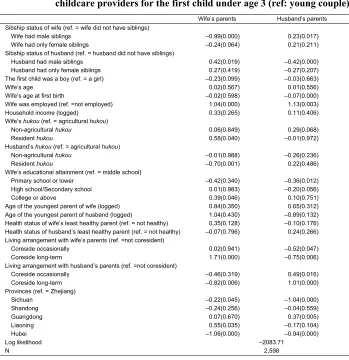
risks of the wife’s parents being the main childcare providers rather than the reference group were 63% (1-exp(‒0.99)) lower for a wife with male siblings than for a wife without siblings (p<0.000), while the relative risks were only 21% lower for a wife with only female siblings (p = 0.064). Compared to the couple where the husband came from a one-child family, the relative risks of having the husband’s parents as the main childcare providers rather than the couple raising the child were 34% lower for the husband with male siblings (p<0.000). Also, if the wife had male siblings, the relative risks of having her husband’s parents take care of the first child were 26% (exp(0.23)‒1) higher than the reference group. Similarly, if the husband had male siblings, the relative risks of the wife’s parents taking care of the first child were 52% higher than the reference group.
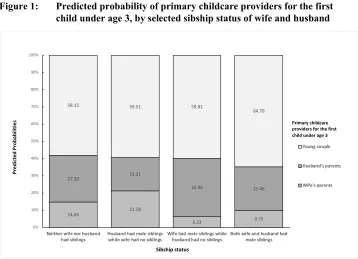
To facilitate interpretation, Figure 1 displays the predicted probabilities of primary childcare providers for the first child under age 3, by combined sibship status of wife and husband. We selected four key scenarios in this comparison: neither wife nor husband had siblings; husband had male siblings while wife had no siblings; wife had male siblings while husband had no siblings; both wife and husband had male siblings. The predicted probabilities were derived from the estimates of the multinomial regression model and calculated with covariates other than sibship status held at means. As shown in Figure 1, the different scenarios showed clear differences in primary childcare providers for the first child under age 3. Specifically, the predicted probability of the couple taking care of the first child was highest (64.79%) if both wife and husband had male siblings, and lowest when neither of them had siblings. If the husband had male siblings but the wife had no siblings, the probability of getting childcare assistance from the husband’s parents was lowest (19.21%) among all the scenarios, while the chance of getting help from the wife’s parents was highest (almost 21.28%). By contrast, for couples where the wives had male siblings but their husbands had no siblings, the probability of having childcare support from the husbands’ parents was highest (33.96%), while the chance of getting childcare services from wives’ parents was lowest (about 6%) among all the scenarios.
couple) were 53% lower for a wife with male siblings than for a wife with only female
siblings (p<0.000).9
Table 2: Parameter estimates from multinomial logistic models of the primary
childcare providers for the first child under age 3 (ref: young couple)
Wife’s parents Husband’s parents
Sibship status of wife (ref. = wife did not have siblings)
Wife had male siblings ‒0.99(0.000) 0.23(0.017)
Wife had only female siblings ‒0.24(0.064) 0.21(0.211)
Sibship status of husband (ref. = husband did not have siblings)
Husband had male siblings 0.42(0.019) ‒0.42(0.000)
Husband had only female siblings 0.27(0.419) ‒0.27(0.207)
The first child was a boy (ref. = a girl) ‒0.23(0.099) ‒0.03(0.663)
Wife’s age 0.02(0.567) 0.01(0.556)
Wife’s age at first birth ‒0.02(0.598) ‒0.07(0.000)
Wife was employed (ref. =not employed) 1.04(0.000) 1.13(0.003)
Household income (logged) 0.33(0.265) 0.11(0.406)
Wife’shukou (ref. = agriculturalhukou)
Non-agriculturalhukou 0.06(0.849) 0.29(0.068)
Residenthukou 0.58(0.040) ‒0.01(0.972)
Husband’shukou (ref. = agriculturalhukou)
Non-agriculturalhukou ‒0.01(0.988) ‒0.26(0.236)
Residenthukou ‒0.70(0.001) 0.22(0.486)
Wife’s educational attainment (ref. = middle school)
Primary school or lower ‒0.42(0.340) ‒0.36(0.012)
High school/Secondary school 0.01(0.983) ‒0.20(0.056)
College or above 0.39(0.046) 0.10(0.751)
Age of the youngest parent of wife (logged) 0.84(0.350) 0.65(0.312)
Age of the youngest parent of husband (logged) 1.04(0.430) ‒0.89(0.132)
Health status of wife’s least healthy parent (ref. = not healthy) 0.35(0.128) ‒0.10(0.176) Health status of husband’s least healthy parent (ref. = not healthy) ‒0.07(0.796) 0.24(0.266) Living arrangement with wife’s parents (ref. =not coresident)
Coreside occasionally 0.02(0.941) ‒0.52(0.047)
Coreside long-term 1.71(0.000) ‒0.75(0.006)
Living arrangement with husband’s parents (ref. =not coresident)
Coreside occasionally ‒0.46(0.319) 0.49(0.016)
Coreside long-term ‒0.82(0.006) 1.01(0.000)
Provinces (ref. = Zhejiang)
Sichuan ‒0.22(0.045) ‒1.04(0.000)
Shandong ‒0.24(0.256) ‒0.04(0.559)
Guangdong 0.07(0.670) 0.37(0.005)
Liaoning 0.55(0.035) ‒0.17(0.104)
Hubei ‒1.06(0.000) ‒0.94(0.000)
Log likelihood ‒2083.71
N 2,598
Note: P-values (two-tailed tests) derived from the estimates of coefficients and robust standard errors are in parentheses. Ref. = reference group.
9 The estimate of the coefficient of wife had male siblings is ‒0.75 when the reference group is wife had only
The results in Table 2 also suggested that a mother’s economic activity was positively associated with the relative risks of getting intergenerational childcare assistance. This was expected, because previous studies indicated that parents or in-laws are an important source of social capital that reduces women’s family–work conflicts. The living arrangement was also found to be associated with the availability of intergenerational childcare support. That is, the relative risks of getting childcare help from the wife’s parents were higher if coresiding with the wife’s parents long-term, but lower if coresiding with the husband’s parents long-term. The counterpart also held true for the husband. Occasional coresidence with the wife’s parents or in-laws was also associated with getting childcare support from parents-in-law.
Figure 1: Predicted probability of primary childcare providers for the first
child under age 3, by selected sibship status of wife and husband
To sum up, the results support our main argument that women or their husbands having siblings reduces the chance of receiving childcare support from parents or in-laws, and intergenerational childcare assistance is allocated collectively in the extended families of both husband and wife. Male siblings are the main competitors for parental childcare assistance.
14.65 21.28
6.23 9.75
27.20 19.21
33.96 25.46
58.15 59.51 59.81
64.79
0% 10% 20% 30% 40% 50% 60% 70% 80% 90% 100%
Neither wife nor husband had siblings
Husband had male siblings while wife had no siblings
Wife had male siblings while husband had no siblings
Both wife and husband had male siblings
Young couple
Husband's parents
Wife's parents Primary childcare providers for the first child under age 3
Predicted
Probabilities
4.2 Influence of intergenerational childcare support on a mother’s plan for a second child
We next adopted logistic regression with mothers’ plan for a second child as the dependent variable to explore the association between intergenerational childcare support and mothers’ second-child plans. The results are shown in Table 3. The first model specification (Model A1) included only the primary childcare providers for the first child under age 3 and other control variables. Parents’ or in-laws’ childcare assistance greatly increased mothers’ chances of planning a second child. Compared to women whose parents were not the primary childcare providers for the first child under age 3, the odds of planning a second child were 62% (exp(0.48) ‒1) higher for those with wife’s parents as the primary childcare providers. The odds were 40% higher among mothers whose parents-in-law were the primary childcare providers, compared to those whose parents-in-law were not, supporting the third hypothesis. The results are consistent with previous findings that childcare assistance from parents or in-laws contributes to higher fertility intentions in contemporary China, where high-quality public childcare is scarce (Ji et al. 2015; Jin, Zhao, and Song 2018; Wang and Yang 2017).
To test the fourth set of hypotheses, we measured the sibship status of wives and husbands differently in Models A2 and B2, and also their interaction terms with primary childcare providers for the first child in Models A3 and B3. The sibship status did not show strong effects on mothers’ second-child plans in any model specification. However, the p-value of the interaction term between husband’s sibship status and husband’s parents as the first child’s main childcare providers in Model B3 is as low as 0.018. Specifically, controlling for other variables, when a husband did not have siblings, the odds of having a second-child plan increased by 67% if the husband’s parents were the first child’s main childcare providers. Nevertheless, if the husband had siblings, childcare support from husband’s parents for the first child only increased the odds of planning a second child by 23% (exp(0.51‒0.30) ‒1). Thus, only Hypothesis IVb is supported.
Table 3: Parameter estimates from logit models of a mother’s second-child plan (ref: having no plan for a second child)
Model A 1 Model A 2 Model A 3 Model B2 Model B3 W
ife’s parents are primary childcare p
rov
iders
for the first child under age 3 (ref. = no)
0.48(0.032)
0.48(0.041)
0.59(0.031)
0.47(0.036)
0.58(0.032)
Husband’s parents are primary childcare providers for the first
child under age 3 (ref. = no)
0.34(0.008)
0.35(0.010)
0.51(0.000)
0.35(0.011)
0.51(0.000)
Sibship status of wife (ref. = wife did not have siblings) W
ife had male sibling
s
0.01(0.972)
0.06(0.667)
W
ife had only
fema le siblings ‒ 0.08(0.695) ‒ 0.08(0.673) Sibship statu
s of husb
and (ref. = husband did not have
siblings) Husband had ma
le s
iblings
0.10(0.593)
0.17(0.360)
Husband had only female siblings
0.05(0.867)
0.17(0.551)
W
ife had siblings*wife’s parents Wife had male sibling
s*wife
’s parents
‒
0.36(0.154)
W
ife had only
fema
le siblings*w
ife's
parents
0.01(0.973)
Husband had sib
lings*
husbands’ parents
Husband had ma
le s
iblings*husband's parents
‒
0.23(0.276)
Husband had only female siblings*husband's parents
‒
0.41(0.149)
W
ife had siblings (ref. = wife did not have siblings)
‒
0.02(0.880)
0.01(0.929)
Husband had sib
lings (
ref. = husband d
id not hav
e
siblings)
0.08(0.722)
0.17(0.443)
W
ife had siblings*
W
ife
’s parent
s are primary
childcare
providers for the first child
‒
.22(0.342)
Husband had sib
lings* H
usband’s parent
s are primary
childcare p
rov
iders for the f
irst child
‒
0.30(0.018)
The first child was a boy (ref
. = a girl ) ‒ 0.27(0.024) ‒ 0.27(0.020) ‒ 0.27(0.060) ‒ 0.27(0.021) ‒ 0.27(0.022) W ife's age ‒ 0.14(0.000) ‒ 0.14(0.000) ‒ 0.14(0.000) ‒ 0.14(0.000) ‒ 0.14(0.000) W
ife's age at first birth
0.04(0.037) 0.04(0.031) 0.04(0.033) 0.04(0.033) 0.04(0.041) W
ife was employed (ref.
=not employed) ‒ 0.03(0.895) ‒ 0.03(0.909) ‒ 0.02(0.943) ‒ 0.03(0.903) ‒ 0.02(0.927)
Household income (logged)
0.36(0.116)
0.36(0.123)
0.36(0.l19)
0.36(0.120)
Table 3: (Continued) . Model A 1 Model A 2 M odel A 3 Model B2 M odel B3 W ife's hukou
(ref. = agri
cultural hukou ) Non -agricultural hukou ‒ 0.43(0.059) ‒ 0.42(0.045) ‒ 0.41(0.060) ‒ 0.43(0.033) ‒ 0.42(0.047) Resident hukou 0.22(0.408) 0.20(0.373) 0.19(0.407) 0.21(0.388) 0.21(0.409) Husband's hukou
(ref. = agri
cultural hukou ) Non -agricultural hukou 0.33(0.165) 0.33(0.170) 0.31(0.199) 0.33(0.149) 0.33(0.158) Resident hukou ‒ 0.33(0.168) ‒ 0.31(0.193) ‒ 0.30(0.213) ‒ 0.31(0.203) ‒ 0.31(0.219) W
ife's educational attainment (ref. = middle school) Primary school or lower
0.30(0.005) 0.28(0.005) 0.28(0.006) 0.29(0.009) 0.29(0.010) High school/Se cond ary school ‒ 0.09(0.383) ‒ 0.08(0.466) ‒ 0.07(0.500) ‒ 0.08(0.457) ‒ 0.08(0.477)
College or above
‒ 0.24(0.142) ‒ 0.23(0.126) ‒ 0.23(0.125) ‒ 0.24(0.103) ‒ 0.23(0.097)
Age of the youn
gest parent o
f wife (logged)
‒ 0.25(0.649) ‒ 0.22(0.662) ‒ 0.24(0.630) ‒ 0.23(0.657) ‒ 0.23(0.648)
Age of the youn
gest parent o
f husband (logged
) ‒ 0.07(0.914) ‒ 0.16(0.752) ‒ 0.16(0.757) ‒ 0.14(0.778) ‒ 0.16(0.760)
Health status of wife’s
least healthy parent
0.23(0.237)
0.23(0.261)
0.22(0.282)
0.23(0.243)
0.23(0.258)
Health status of husband’s least healthy parent
0.02(0.833)
0.03(0.815)
0.03(0.779)
0.03(0.812)
0.03(0.769)
Living arrangement with wife's parent
s (re f. =not coresident) Co reside occasionally 0.24(0.001) 0.23(0.001) 0.23(0.001) 0.23(0.001) 0.23(0.000) Coreside long -term 0.06(0.780) 0.05(0.791) 0.05(0.790) 0.05(0.788) 0.05(0.787)
Living arrangement with hu
sband's parents (re
f. =not coresident) Co reside occasionally ‒ 0.17(0.289) ‒ 0.18(0.259) ‒ 0.18(0.254) ‒ 0.18(0.255) ‒ 0.18(0.240) Coreside long -term ‒ 0.06(0.764) ‒ 0.07(0.732) ‒ 0.06(0.739) ‒ 0.07(0.733) ‒ 0.07(0.728)
Provinces (ref. = Zhejiang) Sichuan
0.24(0.000) 0.25(0.000) 0.26(0.000) 0.24(0.001) 0.24(0.001) Shandong 0.81(0.000) 0.81(0.000) 0.81(0.000) 0.81(0.000) 0.80(0.000) Guangdong 0.65(0.000) 0.65(0.000) 0.65(0.000) 0.65(0.000) 0.65(0.000) Liaoning 0.55(0.001) 0.57(0.002) 0.57(0.001) 0.56(0.004) 0.55(0.004) Hubei ‒ 0.43(0.000) ‒ 0.43(0.000) ‒ 0.44(0.000) ‒ 0.43(0.000) ‒ 0.44(0.000) Log likelihood ‒ 1401.27 ‒ 1400.71 ‒ 1398.83 ‒ 1401.01 ‒ 1399.79 N 2,598 2,598 2,598 2,598 2,598 Note : P-v
alues (two-tailed te
sts) deriv
ed from the estimates of coeff
icients and robust standard errors are in parentheses. ref. = reference gr
Additionally, as shown in all three models, a mother was less likely to plan a second child if the first child was a boy. This is consistent with prior evidence in mainland China regarding the impact of prevalent son preference on Chinese fertility (Poston, Jr 2002). Also, we did not find living with in-laws or coresiding with wife’s parents long-term as important factors in a mother’s plans for a second child. This lack of significance might also be related to the strong association between living arrangement and the main childcare providers for the first child. Nevertheless, the model results consistently revealed that those who occasionally lived with the wife’s parents were more likely to plan a second child than those who were not coresident with the wife’s parents. Although in China it is more common for young couples to coreside with the husband’s parents than with the wife’s parents, the wife’s parents may occasionally live with young couples when the latter need extra assistance (e.g., childcare support), thus leading to a strong association with the wife’s plans to have a second child. Across the three models, wives with at most primary education were more likely to have second-child plans than those with middle-school education.
Overall, the results supported the third hypothesis regarding the influence of intergenerational childcare support on mothers’ plans for a second child. In the tests of the moderating effect of sibship status we found some evidence for Hypothesis IVb: the influence of childcare support from the husband’s parents on the mother’s second-child plans was smaller if the husband had siblings, whereas the wife’s sibship status had no moderating effect.
5. Conclusions and discussion
Extensive literature has shown that, given finite parental resources, having more siblings leads to lowered family investments in each child and thus negatively affects children’s development outcomes. However, research on siblings’ resource dilution during adulthood is scarce, especially in non-Western contexts. Capitalizing on recently collected survey data, this study tests the resource-dilution model in adulthood by examining how grandparental childcare support is shared and allocated among siblings and how primary childcare providers are decided collectively within the extended families of both husband and wife. In the era of China’s two-child policy, this research further evaluates intergenerational influence on a mother’s plan for a second child in urban China, where public childcare services are limited.
husband’s/wife’s parental childcare support, suggesting that decisions regarding childcare providers might be made collectively within extended families, including the original families of husband and wife. Further, using multivariate analyses, we find that grandparental childcare assistance for the first child is an important contributor to the mother planning a second child. Results also show that the influence of the husband’s parents being the main childcare providers for the first child is much smaller if the husband has siblings.
Grandparents’ childcare support is normative in contemporary East Asian societies. Given the relatively high female labor force participation in contemporary China, free intergenerational childcare assistance helps families reduce the opportunity costs of raising children and thus encourages young couples to have more children. However, our analysis suggests that this intergenerational effect on Chinese fertility may not be universal. This is because the two-child policy mainly targets couples that do not come from one-child families (i.e., who have siblings), while siblings are competitors for limited parental resources. Consequently, the sibship status of the target group of people might moderate the positive impact of intergenerational childcare support on fertility.
To avoid Chinese fertility decreasing further in the future, more high-quality public childcare services should be developed, because intergenerational childcare support might be diluted for couples with siblings, who are the main target group of the two-child policy. As argued by Attané (2016), Chinese low fertility is not a policy issue per se, but an economic and family tradeoff. In China, women’s labor activity is widely accepted and expected after schooling, but their traditional roles within the household have remained. This inconsistency in gender equity levels in individual-oriented and family-oriented institutions can lead to low fertility (Ji and Zheng 2018; McDonald 2000; Zhao 2019). Thus, the promotion of gender equity, especially within households, would go a long way towards achieving the desired, stable fertility trend in China in the long run.
The following caveats should be noted when interpreting the results. The estimates of our statistical models might suffer from a plausible selection problem: Before the one-child policy was completely removed in mainland China in 2015, birth control regulations and second child exceptions varied substantially between different localities (Gu et al. 2007). Before the early 1990s, most provinces allowed couples to have a second child if both partners came from one-child families (i.e., had no siblings). Since 2013, parents have been allowed a second child if one of them came from a one-child family. Thus, those who choose to have another child might have already had a second child before the 2015 policy change, while this study focuses on those who have only one child.
information about the timing of parental support, coresidence with parents or in-laws, and giving birth, which might yield endogeneity problems in the analyses. Family fertility ideology, and its possible variation with the policy change, could also be an omitted confounder, influencing both intergenerational childcare support and the
couple’s willingness to have a second child.10 Future studies with a panel design that
collect information about life-course events, living arrangements, family ideology regarding fertility, and parents’ actual childbearing behavior at a later stage can provide more evidence on how extended families function in determining fertility.
Despite the mentioned limitations, this study contributes to the literature on the roles of both siblings and parents in shaping young adults’ childbearing behaviors. Specifically, by studying the correlation between the sibship status of both husbands and wives and the primary childcare providers for very young children, this research tests the resource-dilution model of siblings in adulthood, which has received less attention in existing sibling literature. In addition, by focusing on extended families in contemporary China, this study also complements the literature on the interplay between sibling structure characteristics, relationship processes, and larger family and sociocultural contextual conditions in Western societies. We also extend previous research by examining the influence of grandparental childcare support on women’s fertility plans in a society with prevalent patriarchal norms and limited public childcare services, demonstrating how this effect varies by the structure of extended families.
6. Acknowledgments
This work was supported by the China’s National Social Science Foundation [19CRK015]. We thank the editor and anonymous reviewers for their comments and suggestions. An earlier version of this paper was presented at the 2019 annual meeting of the Population Association of America. We also gratefully acknowledge the helpful comments received at the conference.
10 We also conducted models by adding variables of grandparents’ preferences regarding number of
References
Aassve, A., Meroni, E., and Pronzato, C. (2012). Grandparenting and childbearing in the
extended family.European Journal of Population 28(4): 499–518.doi:10.1007/
s10680-012-9273-2.
Ajzen, I. (1991). The theory of planned behavior.Organizational Behavior and Human
Decision Processes 50(2): 179–211.doi:10.1016/0749-5978(91)90020-T.
Attané, I. (2016). Second child decisions in China.Population and Development Review
42(3): 519–536.doi:10.1111/j.1728-4457.2016.00151.x.
Axinn, W.G. and Barber, J.S. (2001). Mass education and fertility transition.American
Sociological Review 66(4): 481–505.doi:10.2307/3088919.
Bao, L., Chen, F., and Zheng, Z. (2017). Transition in second birth intention in a low
fertility context: The case of Jiangsu, China.Asian Population Studies 13(2): 198–
222.doi:10.1080/17441730.2017.1291125.
Barber, J.S. (2001). Ideational influences on the transition to parenthood: Attitudes
toward childbearing and competing alternatives. Social Psychology Quarterly
64(2): 101–127.doi:10.2307/3090128.
Becker, G.S. (1960). An economic analysis of fertility. In: Universities-National Bureau
(eds.).Demographic and economic change in developed countries. New York
City: Columbia University Press: 209–240.
Becker, G.S. (1991).A treatise on the family. Cambridge: Harvard University Press.
Becker, G.S. and Lewis, H.G. (1973). On the interaction between the quantity and quality
of children.Journal of Political Economy 81(2): S279–S288.doi:10.1086/2601
66.
Bernardi, L. (2003). Channels of social influence on reproduction.Population Research
and Policy Review 22(5–6): 427–555.doi:10.1023/B:POPU.0000020892.15221. 44.
Black, S.E., Devereux, P.J., and Salvanes, K.G. (2005). The more the merrier? The effect
of family size and birth order on children’s education.The Quarterly Journal of
Economics 120(2): 669–700.doi:10.1162/0033553053970179.
Blake, J. (1981). Family size and the quality of children.Demography 18(4): 421–442.
doi:10.2307/2060941.
Blau, P.M. and Duncan, O.D. (1967). The American occupational structure (First Edition). New York, NY: John Wiley and Sons Inc.
Boca, D.D. (2002). The effect of child care and part time opportunities on participation
and fertility decisions in Italy.Journal of Population Economics 15(3): 549–573.
doi:10.1007/s001480100089.
Bongaarts, J. (1992). Do reproductive intentions matter?International Family Planning
Perspectives 18(3): 102–108.doi:10.2307/2133409.
Bongaarts, J. (2001). Fertility and reproductive preferences in post-transitional societies.
Population and Development Review 27(Supplement): 260–281.
Bühler, C. and Philipov, D. (2005). Social capital related to fertility: Theoretical
foundations and empirical evidence from Bulgaria. Vienna Yearbook of
Population Research 3: 53–81.doi:10.1553/populationyearbook2005s53. Bumpass, L.L., Rindfuss, R.R., and Jamosik, R.B. (1978). Age and marital status at first
birth and the pace of subsequent fertility.Demography 15(1): 75–86.doi:10.2307/
2060491.
Chen, F. and Korinek, K. (2010). Family life course transitions and rural household
economy during China’s market reform. Demography 47(4): 963–987.
doi:10.1007/BF03213735.
Chen, F., Liu, G., and Mair, C.A. (2011). Intergenerational ties in context: Grandparents
caring for grandchildren in China.Social Forces 90(2): 571–594.doi:10.1093/
sf/sor012.
Chen, F., Short, S.E., and Entwisle, B. (2000). The impact of grandparental proximity on
maternal childcare in China.Population Research and Policy Review 19(6): 571–
590.doi:10.1023/A:1010618302144.
Chi, P.S.K. and Hsin, P.-L. (1996). Family structure and fertility behavior in Taiwan.
Population Research and Policy Review 15(4): 327–339.doi:10.1007/BF001284 28.
Conley, D. and Glauber, R. (2006). Parental educational investment and children’s academic risk: Estimates of the impact of sibship size and birth order from
exogenous variation in fertility.The Journal of Human Resources 41(4): 722–
737.doi:10.3368/jhr.XLI.4.722.
Croll, E. (2000). Endangered daughters: Discrimination and development in Asia.
Croll, E.J. (2006). The intergenerational contract in the changing Asian family.Oxford Development Studies 34(4): 473–491.doi:10.1080/13600810601045833.
Davis, D.S. (2014). Privatization of marriage in post-socialist China. Modern China
40(6): 551–577.doi:10.1177/0097700414536528.
Davis, J.N. (1997). Birth order, sibship size, and status in modern Canada.Human Nature
8(3): 205–230.doi:10.1007/BF02912492.
Downey, D.B. (2001). Number of siblings and intellectual development: The resource
dilution explanation.American Psychologist 56(6‒7): 497–504.doi:10.1037//00
03-066X.56.6-7.497.
Du, F. and Dong, X. (2013). Women’s employment and child care choices in urban
China during the economic transition. Economic Development and Cultural
Change 62(1): 131–155.doi:10.1086/671714.
Gibbs, B.G., Workman, J., and Downey, D.B. (2016). The (conditional) resource dilution
model: State- and community-level modifications.Demography 53(3): 723–748.
doi:10.1007/s13524-016-0471-0.
Gu, B., Wang, F., Guo, Z., and Zhang, E. (2007). China’s local and national fertility
policies at the end of the twentieth century.Population and Development Review
33(1): 129–147.doi:10.1111/j.1728-4457.2007.00161.x.
He, G. and Wu, X. (2018). Dynamics of the gender earnings inequality in reform-era
urban China.Work, Employment and Society 32(4): 726–746.doi:10.1177/09500
17017746907.
Hertwig, R., Davis, J.N., and Sullnwav, F.J. (2002). Parental investment: How an equity
motive can produce inequality. Psychological Bulletin 128(5): 728–745.
doi:10.1037//0033-2909.128.5.728.
Hoppmann, C.A. and Klumb, P.L. (2010). Grandparental investment facilitates harmonization of work and family in employed parents: A lifespan psychological
perspective.Behavioral and Brain Sciences 33(1): 27–28.doi:10.1017/S0140525
X09991658.
Ji, Y. (2017). A mosaic temporality: New dynamics of the gender and marriage system in
contemporary urban China. Temporalités. Revue de Sciences Sociales et
Humaines 26.doi:10.4000/temporalites.3773.
Ji, Y., Chen, F., Cai, Y., and Zheng, Z. (2015). Do parents matter? Intergenerational ties
and fertility preferences in a low-fertility context.Chinese Journal of Sociology
Ji, Y., Wu, X., Sun, S., and He, G. (2017). Unequal care, unequal work: Toward a more comprehensive understanding of gender inequality in post-reform urban China.
Sex Roles 77(11–12): 765–778.doi:10.1007/s11199-017-0751-1.
Ji, Y. and Zheng, Z. (2018). China’s low fertility rate from the perspective of gender and
development.Social Sciences in China 8: 143–161. (in Chinese)
Jin, Y., Song, J., and Chen, W. (2016). Women’s fertility preference and intention in
urban China: An empirical study on the nationwide two-child policy.Population
Research 40(6): 22–37. (in Chinese)
Jin, Y., Zhao, M., and Song, J. (2018). Parental influence on women’s second-birth plan
in urban China.Population Research 42(5): 17–29. (in Chinese)
Kaptijn, R., Thomese, F., van Tilburg, T.G., and Liefbroer, A.C. (2010). How
grandparents matter.Human Nature 21(4): 393–405.doi:10.1007/s12110-010-90
98-9.
Li, H., Zhang, J., and Zhu, Y. (2008). The quantity-quality trade-off of children in a
developing country: Identification using Chinese twins.Demography 45(1): 223–
243.doi:10.1353/dem.2008.0006.
Maralani, V. (2008). The changing relationship between family size and educational attainment over the course of socioeconomic development: Evidence from
Indonesia.Demography 45(3): 693–717.doi:10.1353/dem.0.0013.
McDonald, P. (2000). Gender equity in theories of fertility transition. Population and
Development Review 26(3): 427–439.doi:10.1111/j.1728-4457.2000.00427.x.
Moen, P. and Wethington, E. (1992). The concept of family adaptive strategies.Annual
Review of Sociology 18: 233–251.doi:10.1146/annurev.so.18.080192.001313. Öberg, S. (2015). Sibship size and height before, during, and after the fertility decline: A
test of the resource dilution hypothesis. Demographic Research 32(2): 29–74.
doi:10.4054/DemRes.2015.32.2.
Park, H. (2008). Public policy and the effect of sibship size on educational achievement:
A comparative study of 20 countries.Social Science Research 37(3): 874–887.
doi:10.1016/j.ssresearch.2008.03.002.
Poston Jr, D.L. (2002). Son preference and fertility in China. Journal of Biosocial
Rosenzweig, M.R. and Wolpin, K.I. (1980). Testing the quantity-quality fertility model:
The use of twins as a natural experiment. Econometrica 48(1): 227–240.
doi:10.2307/1912026.
Siennick, S.E. (2013). Still the favorite? Parents’ differential treatment of siblings
entering young adulthood. Journal of Marriage and Family 75(4): 981–994.
doi:10.1111/jomf.12048.
Steelman, L.C., Powell, B., Werum, R., and Carter, S. (2002). Reconsidering the effects
of sibling configuration: Recent advances and challenges. Annual Review of
Sociology 28: 243–269.doi:10.1146/annurev.soc.28.111301.093304.
Tanskanen, A. and Rotkirch, A. (2014). The impact of grandparental investment on
mothers’ fertility intentions in four European countries.Demographic Research
31(1): 1–26.doi:10.4054/DemRes.2014.31.1.
Tao, T. (2012). Analysis of rural women’s expectation on children and gender
preference.Population and Economics 2: 25–32. (in Chinese)
Upadhyay, U.D., Gipson, J.D., Withers, M., Lewis, S., Ciaraldi, E.J., Fraser, A., Huchko, M., Prata, N. (2014). Women’s empowerment and fertility: A review of the
literature.Social Science and Medicine 115: 111–120.doi:10.1016/j.socscimed.2
014.06.014.
Vargha, L. and Donehower, G. (2019). The quantity-quality tradeoff: A cross-country comparison of market and nonmarket investments per child in relation to fertility.
Population and Development Review 45(2): 321–350.doi:10.1111/padr.12245. Wang, J. and Yang, X. (2017). A study of the division of family care and the willingness
to have the second child in the process of urbanization. Journal of Public
Administration 10(2): 140–155. (in Chinese)
Waynforth, D. (2012). Grandparental investment and reproductive decisions in the
longitudinal 1970 British cohort study. Proceedings of the Royal Society B
279(1731): 1155–1160.doi:10.1098/rspb.2011.1424.
Yan, Y. (2013). Parent-driven divorce and individualisation among urban Chinese youth.
International Social Science Journal 64(213–214): 317–330.doi:10.1111/issj.12 048.
Yeung, W.-J. J. and Hu, S. (2013). Coming of age in times of change: The transition to
adulthood in China.The Annals of the American Academy of Political and Social
Yoon, S.-Y. (2017). The influence of a supportive environment for families on women’s
fertility intentions and behavior in South Korea.Demographic Research 36(7):
227–254.doi:10.4054/DemRes.2017.36.7.
Yu, J. and Xie, Y. (2018). Motherhood penalties and living arrangements in China.
Journal of Marriage and Family 80(5): 1067–1086.doi:10.1111/jomf.12496. Zhang, Y. and Hannum, E. (2015). Diverging fortunes: The evolution of gender wage
gaps for singles, couples, and parents in China, 1989–2009.Chinese Journal of
Sociology 1(1): 15–55.doi:10.1177/2057150X14568769.
Zhao, M. (2016). Gender equity should be promoted by public policies under the
two-child policy.Population Research 40(6): 38–48. (in Chinese)
Zhao, M. (2018). From motherhood premium to motherhood penalty? Heterogeneous effects of motherhood stages on women’s economic outcomes in urban China.
Population Research and Policy Review 37(6): 967–1002.doi:10.1007/s11113-0 18-9494-0.
Zhao, M. (2019). Fertility intentions for a second child in China: Female educational
attainment and assortative marriage. Population Journal 41(3): 16–27. (in
Chinese)
Zhao, M. and Ji, Y. (2019). Husbands’ housework share and women’s hazards of
Appendix
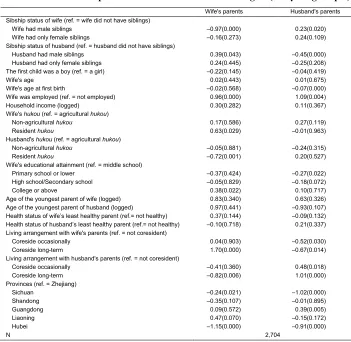
Table A-1: Parameter estimates from multinomial logistic models of primary childcare providers for the first child under age 3 (ref: young couple)
Wife's parents Husband's parents
Sibship status of wife (ref. = wife did not have siblings)
Wife had male siblings ‒0.97(0.000) 0.23(0.020)
Wife had only female siblings ‒0.16(0.273) 0.24(0.109)
Sibship status of husband (ref. = husband did not have siblings)
Husband had male siblings 0.39(0.043) ‒0.45(0.000)
Husband had only female siblings 0.24(0.445) ‒0.25(0.208)
The first child was a boy (ref. = a girl) ‒0.22(0.145) ‒0.04(0.419)
Wife's age 0.02(0.443) 0.01(0.675)
Wife's age at first birth ‒0.02(0.568) ‒0.07(0.000)
Wife was employed (ref. = not employed) 0.96(0.000) 1.09(0.004)
Household income (logged) 0.30(0.282) 0.11(0.367)
Wife'shukou (ref. = agriculturalhukou)
Non-agriculturalhukou 0.17(0.586) 0.27(0.119)
Residenthukou 0.63(0.029) ‒0.01(0.963)
Husband'shukou (ref. = agriculturalhukou)
Non-agriculturalhukou ‒0.05(0.881) ‒0.24(0.315)
Residenthukou ‒0.72(0.001) 0.20(0.527)
Wife's educational attainment (ref. = middle school)
Primary school or lower ‒0.37(0.424) ‒0.27(0.022)
High school/Secondary school ‒0.05(0.829) ‒0.18(0.072)
College or above 0.38(0.022) 0.10(0.717)
Age of the youngest parent of wife (logged) 0.83(0.340) 0.63(0.326)
Age of the youngest parent of husband (logged) 0.97(0.441) ‒0.93(0.107)
Health status of wife’s least healthy parent (ref.= not healthy) 0.37(0.144) ‒0.09(0.132)
Health status of husband’s least healthy parent (ref.= not healthy) ‒0.10(0.718) 0.21(0.337) Living arrangement with wife's parents (ref. = not coresident)
Coreside occasionally 0.04(0.903) ‒0.52(0.030)
Coreside long-term 1.70(0.000) ‒0.67(0.014)
Living arrangement with husband's parents (ref. = not coresident)
Coreside occasionally ‒0.41(0.360) 0.48(0.018)
Coreside long-term ‒0.82(0.006) 1.01(0.000)
Provinces (ref. = Zhejiang)
Sichuan ‒0.24(0.021) ‒1.02(0.000)
Shandong ‒0.35(0.107) ‒0.01(0.895)
Guangdong 0.09(0.572) 0.39(0.005)
Liaoning 0.47(0.070) ‒0.15(0.172)
Hubei ‒1.15(0.000) ‒0.91(0.000)
N 2,704
Note: Multiple imputation by chained equations was used to deal with missing data. P-values (two-tailed tests) derived from the estimates of coefficients and robust standard errors are in parentheses. The log likelihood is not reported because we imputed missing data in the analyses.