Summer 1379 August 2000
RUPTURE OF URINARY BLADDER: AN EXPERI
ENCE WITH 55 CASES IN SHIRAZ
M.R. FATTAHI, M.D.,
ANDA.A. KHEZRI, M.D.
From the Department o/Urology,
Shiraz University 0/ Medical Sciences, Shiraz,
I.R.Iran.
ABSTRACT
We reviewed 55 cases with trauma to the urinary bladder. Blunt trauma was
the cause of injury in 78 percent of cases and associated pelvic fracture was present
in 75 percent. Eighty percent of extraperitoneal ruptures were associated with
fracture of the pelvis. The most common cause of trauma was car accident (63%),
followed by war injury (20%).
Nearly two-thirds of patients (63 %) had extraperitoneal rupture.
The most common presentation was gross hematuria (49%), followed by
abdominal pain and tenderness (38%). In 24 patients, diagnosis was made by
retrograde cystography, in 9 patients by intravenous pyelography and the re
maining patients were diagnosed by physical examination and diagnostic lap
arotomy. All of the patients were treated by surgical repair. Mortality rate was
two percent.
MJIRL Vol. 14, No.2; 127-131,2000.
Keywords:
Bladder, Rupture, Extraperitoneal, Intraperitoneal, Trauma, Pelvic fracture.
INTRODUCTION
The urinary bladder in the adult male lies in the anterior pelvis just behind the symphysis pubis. The dome and up per posterior aspect of the bladder are covered by perito neum. Inferiorly, the bladder and prostate are firmly attached to the pubis by the puboprostatic ligaments. In the female the neck of the bladder lies directly on the pelvic fascia, surrounding the short urethra. The extraperitoneal part of the bladder is surrounded by loose areolar connective tissue which anteriorly is known as "the space of Retzius".5
In children up to the age of about three years, the pelvis is relatively small and the bladder is
in
fact intraabdominal, although still extraperitoneal. 6 The location of an empty adult urinary bladder in the pelvis usually provides significant pro tection from blunt or penetrating trauma.' However, when the bladder is distended or the pelvis is fractured, the nor mal protective effect of the intact pelvic ring is lost and blad der injury is relatively common. Difficulty in urination fol lowing a blow to the lower abdomen or pelvis in any subject should arouse the suspicion of a ruptured ·bladder. 7Bladder injuries are surgical emergencies. Appropriate early therapy usually results in a favorable outcome, but delayed treatment causes a significant increase in morbidity
and mortality.
Up to
1890
the mortality rate of ruptured bladder, what ever the cause, was86.7%.2
After instituting proper surgical intervention and repair it declined to48%;2
recently this has reached11 %3
and in a study in Shiraz a decade ago it was reported to be2%.4
Some important points in successfully managing these patients are knowledge of the mechanism of injury, accurate uroradiologic investigation, diagnosis and finally prompt surgical repair. The aim of the current study is to evaluate patients who referred to our clinic in different aspects in cluding cause, signs and symptoms, sex, age, diagnostic modality, treatment and finally comparing the results with those of other studies.
PATIENTS AND METHODS
In this study
55
cases of rupture of the bladder admitted to our hospitals (Nemazee and Shahid Faghihi) during a19
year period were reviewed. Each record was reviewed with respect to age, sex, cause and type of injury, its site, signs and symptoms, associated injuries including fracture of pel vis or femur, hollow viscus, urethral and ureteral injuries, diagnostic procedures, type of repair and mortality. FromRupture of Urinary Bladder
1976 to 1 994,55 patients (47 male and 8 female) with rup
tured bladder were admitted to Nemazee hospital.
Six pa
tients were in the first decade of life, 34 in the second and
third decade and 1 5 were above the age of30 years (Table
I).
Table I. Distribution of patients by age and sex ..
�
<J{) 10-30 30-50 >50Sex (No.)
Male (47)
I33
9
4
Female (8)
5
I
2
0
Type of trauma
Blunt trauma was responsible for rupturing the bladder
in 43 cases,
of which 35 subjects were victims of car acci
dent, five due to a fall,
two had direct blows and one case
was due to war injury.
Penetrating trauma induced 1 2 inju
ries which were comprised of 1 0 war injuries and two cases
of �tab wound (Table II) .
Table II.
Type of bladder trauma.
1}';pe
No(%)
Blunt
43 (78)
Car accident
35 (63)
Falling down
5 (9)
Direct blow
2 (4)
War injury
I(2)
Penetrating
12 (22)
War injury
10 ( 18)
Stab wound
2 (4)
Presenting signs and symptoms were variable; 27
cases
presented with gross hematuria, 14 had lower abdominal
pain, 9 were in shock on arrival,
2 1 had abdominal tender
ness and eight patients had no record concerning the clini
cal presentation (Table III) .
Table III. Clinical presentation.
Item
No. of Patients (%)
Gross hematuria
27 (49)
Lower abdominal pain
14 (25)
Shock
9 (16)
Abdominal tenderness
21 (38)
No information
8 (14)
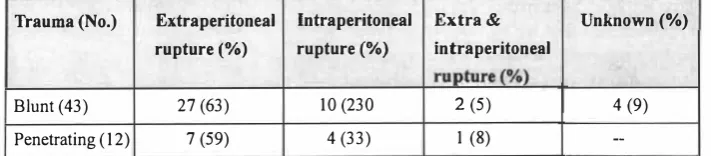
Thirty- four cases (62%) had extraperitoneal rupture from
which twelve had anterior wall rupture and four had lateral
wall rupture of the bladder.
Unfortunately in the remaining
cases,
the location of injuries were not recorded. Fourteen
cases (25%) had intraperitoneal rupture and in 3 cases (6%)
both extra and intraperitoneal ruptures were detected. In the
remaining four (7%) the site of perforation was not pointed
out in their records (Table IV) .
Associated injuries
As a whole, pelvic fracture was seen in 4 1 cases (75%) ,
consisting of
27extraperitoneal,
8 intraperitoneal, 3 com
bined and 3 unidentified ruptures.
Eighty percent of patients
with extraperitoneal rupture of bladder had pelvic fracture,
while in 57%
of patients intraperitoneal rupture was associated with pelvic fracture (Table V) .
Diagnosis
Diagnosis was made by physical examination,
retrograde
Table IV. Type of trauma in relation to bladder injury.
Trauma (No.)
Extraperitoneal
Intraperitoneal
Extra
&Unknown(%)
rupture
(%)
rupture
(%)
intraperitoneal
rupture (%)
Blunt (43)
27 (63)
10 (230
2(5)
4 (9)
Penetrating (12)
7 (59)
4 (33)
I(8)
--Table V. Relation of type of bladder rupture and pelvic fracture.
Bladder rupture
NQ.(%)
No. with associated pelvic
'.
fractu·re(%)
Extraperitoneal
34 (62%)
27 (80%)
Intraperitoneal
14 (25%)
8 (57%)
Extra and Intraperitoneal
3 (5.5%)
3 (100%)
Unidentified
4 (7.5%)
3 (75%)
Other concomitant injuries are shown in Table IV.
Table
VI. Associated organ injuries in patients with ruptureof bladder.
Type of injury
No.
Percent
Injury to hollow viscus
13
24
Urethral injury
10
18
Fracture of femur
6
II
Ureteral injury
24
Vascular injury in pelvis (rupture)
24
Sciatic nerve damage
24
Rupture of diaphragm
1
2
Anoxic brain damage
I
2Fat embolism
I
2Table VII.
Methods of evaluation of patients with bladder injury.
Method
No. of patients
Retrograde
cystography
25
Intravenous
pyelography (IV P)
14
cystography, intravenous pyelography and laparotomy. Ret rograde cystography was done in 25 patients where extrava sation was noted in
24 and a normal finding in one case,
which was diagnosed later during laparotomy as a case of extraperitoneal bladder rupture. In two cases a tear-drop shaped bladder was reported, and in one case complete dis ruption of the bladder was noted. Intravenous pyelography was performed in14
patients which showed extravasation of the bladder in 9 cases, and in the remaining 5 the diagno sis was made by retrograde cystography (Table VII).RESULTS
In this record review, extraperitoneal as well as intrap eritoneal and combined ruptures of bladder were treated by repair of the defect, drainage of the perivesical space and suprapubic cystostomy.
In
3
patients a urethral catheter was inserted instead of cystostomy. Due to associated injuries, it was impossible to determine the exact period of the hospital course. There were three cases of urinary incontinence in patients with associated urethral injury in a 6-month follow-up. Also, there was one case of peritonitis as a result of intraperitoneal rup ture of the bladder which was treated by appropriate antibi otic therapy and one patient died due to associated brain damage. Therefore we had a2%
mortality rate.DISCUSSION
Rupture of the urinary bladder may occur following blunt or penetrating trauma. Penetrating injuries represented
10-No. diagnosed
Diagnostic percent
24
96
9
64
20%
and blunt trauma comprises80-90%
of cases of rup ture of the bladder in the most recent studies.8 In a review by A.A Khezri4 penetrating and blunt trauma were respon sible for30%
&70%
of ruptured bladders respectively. In the current review of55
cases of bladder rupture, we had12
patients
(22%)
with penetrating trauma and43
cases(78%)
with blunt trauma, of which
35
subjects were victims of car accident and the remaining cases were due to falling down, direct blow, etc ... , representing that the incidence of blunt bladder injuries is significantly more than the penetrating type (Table II). It must be emphasized that because of war time conditions the majority of our penetrating bladder in juries were due to bullet or shell fragments, which is differ ent from those studies in other centers. There were no cases of iatrogenic rupture of the urinary bladder. Traumatic blad der irDuries are classified either as contusion, extraperitoneal, intraperitoneal and combined extra- and intraperitoneal rup tures. In the current review we didn't have any cases of blad der contusion which may be due to either misdiagnosis or association with other injuries such that the records were labelled with other diagnoses. Bladder contusion is usually self-limiting and requires no specific therapy.5 Extraperitoneal rupture most commonly occurs when the bladder is lacerated by a sharp bony prominence in a patient with a fracture of the anterior pelvic arch. It is uncommon with isolated fractures of the sacrum, coccyx, ilium, or ac etabulum. The anterolateral wall, especially around the vesi cal neck, is the site of the majority of extraperitoneal blad der injuries.9In the current review the site of rupture was not delin eated except in
12
extraperitoneal ruptures that were in theRupture of Urinary Bladder
anterolateral area of the bladder. In extraperitoneal rupture urine extravasates to the perivesical space ofRetzius and if left untreated may gradually invade via facial planes to re
gions as high as the umbilicus or as low as the thighs. It may
also follow facial planes in the pelvis and ultimately reach the perinephric areas.IO None of these complications were seen in our patients. Extraperitoneal rupture of the bladder is reported to account for 58% of all traumatic bladder inju
ries
II and is in accordance with Hayes et al.
's report. 12 In ourreview
34
cases(62%)
of bladder injuries wereextra peritoneal ruptures (Table V). The incidence of associ
ated pelvic fracture in extraperitoneal rupture is reported to be as high as 95%11 and in our patients it amounted to 80% which is nearly equal to that reported in a previous study in Shiraz4 (Table V).
Intraperitoneal rupture of the bladder occurs when there is a sudden rise in intravesical pressure secondary to a blow
to the pelvis or lower abdomen. The increased pressure re
sults in rupture of the weakest portion of the bladder. Com monly it occurs as a result of steering wheel or seat belt injuries and without associated pelvic fracture,5 but in the current review
57%
of intraperitoneal ruptures were associ ated with pelvic fracture (Table V), and in a review by Rambeaud et al.27%
of intraperitoneal bladder ruptures were associated with a fractured pelvis.II
Conversely in two stud ies the incidence of bladder rupture was reported to be1.6%
and
10%.IJ,14
Peritonitis is a complication of bladder rupture if infec tion is introduced into the peritoneum. The presence of ster ile urine in the peritoneal cavity will not cause signs of peri
tonitis,15 Bourdeau reported a case of intraperitoneal uri
nary extravasation that was tolerated for three months with
out any clinical or chemical abnormalities.13 One case of
peritonitis is recorded in our patients, The incidences of
various bladder injuries are different in the literature. Cass
reported an equal incidence of intra- and extraperitoneal rup ture.2J Sandler et aL however reported that the intraperito neal variety accounts for only
20%
of all bladder injuries.5 In another study by Khezri32%
of bladder injuries wereintraperitoneal.4 In our study
25%
of ruptured bladders wereintraperitoneal, just equal to that reported by Rambeaud et aLII Combined extra- and intraperitoneal ruptures are re ported to occur in
9%
in a studyS and5%
in Khezri's report4 In this review we had3
cases(5.5%)
of combined ruptures (Table V).While bloody urine is a dramatic indicator of trauma of the urinary tract, hematuria does not localize the site or de lineate the type or extent of injury nor does the amount of bleeding necessarily correlate with the severity of the trauma.
While intraperitoneal lacerations may be associated with microscopic hematuria, a simple contusion may produce gross hematuria. In two reviews of 5 1 and 2 1 cases of rup ture of the bladder, all patients had hematuria (microscopic
or macroscopic).16,1 7 In another series 98% of patients had
gross hematuria.7 In the current review, we found 27 cases
(49%) of gross hematuria (Table III). Intraperitoneal rup
ture of the bladder can exist in the presence of grossly clear urine and conversely hematuria may occurin
the absence ofsignificant injury to the urinary bladder.18 The low incidence
in this review may be due to the fact that out records were incomplete.
Abdominal pain and tenderness were present
in 25%
and38%
respectively (TabldII). Frequently pain from a fractured pelvis is so severe that the pain of an injured bladder is overlooked. While generalized abdominal pain & tender ness was present most commonly in intraperitoneal ruptures, limited lower abdominal pain and tenderness were noted in subjects with extraperitoneal rupture of the bladder. In a re port sixty percent of patients with bladder rupture were in shock, but after excluding associated extra-urinary causes,
it dropped to 3 %.10 In a review study in this center
19%
ofpatients presented in shock, in whom
5
cases had associated injuries. In the current study we had9
patients( 16%)
who were in shock o n arrival while 6 of them had pelvic fracture or hollow viscus injuries (Table III).After initial assessment, evaluation of the urinary sys tem proceeds as follows. A plain abdominal film is taken and the presence of pelvic or other fractures sought. Calcifi cations and foreign bodies (missiles) should be noted. 15 Uri nary flow after introduction of a catheter does not exclude vesical rupture, since urine may be drained from the perito
neal cavity. For the same reason, recovery of measured quan
tities of fluid introduced into the bladder through the cath eter does not permit exclusion of vesical injuries.
The value o f cystoscopy in trauma of the lower urinary
tract is the subject of much controversy,18,19 The diagnosis
of rupture of the bladder is confirmed by roentgenologic studies including cystography and excretory urography, Pneumocystography is apparently feared because of the dan ger of air embolism. This procedure was not performed for any patient in this study. For evaluation of the upper part of the urinary tract, an excretory urogram is performed, but this procedure alone is not adequate to rule out the possibil ity of injury to the bladder, because of incomplete disten sion of the bladder and insufficient density of the contrast within it. Brosman and Paul were able to diagnose success fully only
15%
of98
cases of bladder injury solely on the basis of the excretory urogram20 Intravenous pyelography was performed in14
patients with bladder rupture in the current review, and the diagnosis was made in9
cases(64%)
(Table VII),In the present study retrograde cystogram was done for
25
patients, in which only one false-negative was found(96
percent accuracy) (Table VII). In a study by Khezri the sen sitivities of intravenous pyelography and retrograde cystog raphy were54%
and94%
respectively: Treatment of rup ture of the bladder depends on the type of injury. Those pa tients who are immobilized and are unable to void whilelying in bed will need catheter drainage. Also occasional patients who have an extensive hematoma of the pelvis may develop urinary retention on an obstructive or neuropathic basis and need catheter drainage.2o This type of injury was not found in out patients. Early surgical intervention is nec essary when a dia�osis of intraperitoneal rupture has been made.
Treatment of this type of injury in the current review consisted of exploration of the peritoneal cavity with repair of the site of rupture and drainage of the bladder and'perivesi cal space by suprapubic cystostomy. Extraperitoneal rup ture of the bladdet has also been treated by a surgical ap proach (repair of the defect and drainage of the prevesical space and bladder, either with suprapubic cystostomy or tran surethral catheter). Recently a non-operative approach for extraperitoneal rupture of the bladder has been advocated and tried in multiple studies.S,II,21,22 This approach was not performed in our patients. Intra- and extraperitoneal rup ture ot:the bladder are occasionally complicated by perito nitis and pelvic cellulitis respectively. In the present study only one patient with intraperitoneal rupture of the bladder developed peritonitis who was treated successfully.
The mortality rate of bladder rupture has been reported from
1 1-60%.6,19
Actually the multiple injuries associated with ruptured bladder are mainly responsible for this mor tality rate. However, delayin
diagnosis and treatment of more than24
hours greatly increases mortality. Therefore imme diate diagnosis and treatment of the ruptured bladder are important in an effort to reduce this significant mortality rate.] The mortality rate reported by Khezri was2
percent.4 In the current review we had only one mortality. who died due to associated anoxic brain damage.REFERENCES
I. Tuchschmid
Y,Rohner S: Rupture of the bladder, surgical or
conservative treatment. I Chir Paris 130(8-9): 343-8, 1993.
2. George C, Kaiser TF: The bladder in fracture of the bony
pelvis, the significance of a "tear-drop bladder" as shown by
cystogram. I UroI 63(6): 1019, 1950.
3. Cass AS: Bladder trauma in the multiple injured patient.
IUro1115: 667-9,1976.
4. Khezri
AA:Experience with 41 cases of rupture of urinary
bladder in Shiraz. Medical 10urnal of the Islamic Republic of
Iran 3(1,2): 31-36,1989.
5. Sandler CM, Phillips 1M, Harris JD, Toombs BD: Radiology
of the bladder and urethra in blunt plevic trauma, Radiol Clin
North Am 19: 195-211,1981.
6, Ellis H: The bladder, In: Ellis H, (ed), Clinical Anatomy,
Oxford: Blackwell, pp, 119-21, 1977.
7, Corriere
INJr, Harris ID: The management of urologic inju�
ries in blunt pelvic trauma. Radiol Clin North Am 19(1):
187-93,1981.
8, Wessel N, Medby PC, Hoffmann L: Bladder rupture: diagno
sis, etiology and treatment. Tidsskr Nor Laegeforen Sep 20,
115(22): 2784-5, 1995.
9, Morehouse DD, Mackinnon KJ: Urological injuries associ
ated with pelvic fractures, J Trauma 9(6): 479-96, 1969.
10, Reiser C, Nicholas E: Rupture of blildder, umisual features,
JUroI90(l ): 53,1963.
I I,