VOLUME 38, ARTICLE 52, PAGES 1605
,
1618
PUBLISHED 15 MAY 2018
http://www.demographic-research.org/Volumes/Vol38/52/ DOI: 10.4054/DemRes.2018.38.52
Descriptive Finding
Sociocultural variability in the Latino
population: Age patterns and differences in
morbidity among older US adults
Catherine Garcia
Marc A. Garcia
Jennifer A. Ailshire
© 2018 Catherine Garcia, Marc A. Garcia & Jennifer A. Ailshire.
This open-access work is published under the terms of the Creative Commons Attribution 3.0 Germany (CC BY 3.0 DE), which permits use, reproduction, and distribution in any medium, provided the original author(s) and source are given credit.
1 Introduction 1606
2 Data and methods 1607
2.1 Measures 1607
2.2 Analytic strategy 1608
3 Results 1608
4 Discussion 1611
Sociocultural variability in the Latino population:
Age patterns and differences in morbidity among older US adults
Catherine Garcia1 Marc A. Garcia2 Jennifer A. Ailshire3
Abstract
BACKGROUND
The US Latino population is rapidly aging and becoming increasingly diverse with respect to nativity and national origin. Increased longevity along with medical advancements in treatment have resulted in a higher number of older Latinos living with morbidity. Therefore, there is a need to understand variability in Latino health among older adults.
OBJECTIVE
This paper documents mid- and late-life health differences in morbidity by race/ethnicity, nativity, and country of origin among adults aged 50 and older.
METHOD
We use data from the 2000–2015 National Health Interview Survey to calculate age-and gender-specific proportions based on reports of five morbidity measures: hypertension, heart disease, stroke, cancer, and diabetes among non-Latino Whites and seven Latino subgroups.
RESULTS
The foreign-born from Mexico, Cuba, and Central/South America, regardless of gender, exhibit an immigrant advantage for heart disease and cancer in comparison to non-Latino Whites across all age categories. Conversely, island-born Puerto Ricans are generally characterized with higher levels of morbidity. Similarly, US-born Puerto Ricans and Mexicans exhibit morbidity patterns indicative of their minority status. Latinos, regardless of gender, were more likely to report diabetes than non-Latino Whites. Hypertension and stroke have significant variability in age patterns among US-and foreign-born Latinos.
CONCLUSION
Recognizing the importance of within-Latino heterogeneity in health is imperative if researchers are to implement social services and health policies aimed at ameliorating the risk of disease.
CONTRIBUTION
Considering intersectional ethnic, nativity, and country-of-origin characteristics among older Latinos is important to better understand the underlying causes of racial/ethnic disparities in morbidity across the life course.
1. Introduction
The older US population has experienced unprecedented growth, with aging Latinos constituting a significant part of this increase (West et al. 2014). Despite their low socioeconomic status, older Latinos, particularly the foreign-born, have longer life expectancies and lower mortality than non-Latino Whites (Fenelon, Chinn, and Anderson 2017; Garcia et al. 2017). The combination of a poor socioeconomic profile with increased longevity may present key challenges for the health of older Latinos. For instance, decreases in mortality without subsequent improvements in morbidity leads to a higher proportion of the population living with diabetes, hypertension, heart disease, and other chronic illnesses.
However, Latinos are not a monolithic group, and their health in later life may vary depending on sociocultural factors such as nativity and country of origin. Research shows nativity status to be a crucial factor for determining individual health. In general, US-born Latinos have a health profile more indicative of their minority status, exhibiting higher rates of morbidity (Garcia and Reyes 2017; Zhang, Hayward, and Lu 2012) and spending more of their later-life years with a chronic condition than foreign-born Latinos (Cantu et al. 2013; Garcia et al. 2017).
For instance, older Puerto Rican and foreign-born Cuban adults experience different sociopolitical circumstances related to migration relative to other foreign-born Latino groups. Island-born Puerto Ricans are natural-born US citizens, thus allowing them to migrate to the US mainland more easily than other Latino subgroups (Duany 2011). Internal migration from Puerto Rico to the US mainland distinctly differs from international migration from Mexico, the Caribbean, or other Latin America countries; as such, migration selectivity may play less of a role for island-born Puerto Ricans. Conversely, many foreign-born Cubans entered the United States as political refugees and were granted a pathway toward citizenship along with social and economic services (Saenz and Morales 2015) that may be protective of late-life health.
Recent research suggests substantial variability in morbidity among Latino subgroups by nativity and country of origin relative to non-Latino Whites. However, the extant literature exploring morbidity among Latinos by nativity and country of origin has largely been limited to regional studies and has not focused specifically on older adults (Lin et al. 2002; Sacco et al. 2001; Borrell et al. 2011; Zsembik and Fennell 2005). Thus, this paper builds on previous research by providing a comprehensive analysis of five measures of morbidity for seven Latino subgroups, stratified by gender and three age categories that encompass mid- and late-life stages of the life course.
2. Data and methods
We used data from the National Health Interview Survey (NHIS), an annual household survey of the noninstitutionalized civilian population to estimate morbidity differences among adults aged 50 and older (Parsons et al. 2014). Data is pooled across 16 years (2000–2015) to obtain a large sample of Latino subgroups by nativity and country of origin. The annual response rate of the NHIS is approximately 80%. After excluding respondents with missing data on health (n = 615), our final analytical sample was 164,616.
2.1 Measures
Sociodemographic variables include race/ethnicity, nativity, gender, and age. In the NHIS, respondents were asked to identify their race, regardless of ethnic identification. For the purpose of this study, we classify Latinos as individuals who self-identify as Latino-origin regardless of racial identification. Respondents were categorized as US-born if they were born in one of the 50 states and foreign-born if they were born outside the United States, including its territories. Self-reported race/ethnicity, birthplace, and country of origin were used to classify respondents. They include US-born Mexicans, foreign-born Mexicans, US-born Puerto Ricans, island-born Puerto Ricans, foreign-born Cubans, foreign-born Dominicans, foreign-born Central/South Americans, and US-born non-Latino Whites. US-born Cubans, Dominicans, and Central/South Americans are excluded due to small sample sizes. We include three age categories that allow for reasonable sample sizes and encompass distinct stages of life – 50–59, 60–69, and 70+ – to assess how morbidity patterns vary by age.
2.2 Analytic strategy
We document the proportion of individuals with morbidity by race/ethnicity, nativity, country of origin, and age group. We compare differences between non-Latino Whites and Latino subgroups using chi-squared tests. Estimates are done separately for women and men to account for well-known gender differences in morbidity (Vlassoff 2007). Sample weights were used to correct for differential selection and nonresponse bias and include a poststratification adjustment to make the sample representative of the US population. We account for the complex survey design of the NHIS by using Stata’ssvy
commands, which adjust for population stratification, primary sampling unit, and sample weights.
3. Results
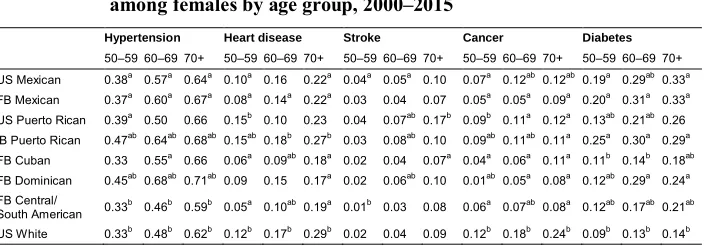
and foreign-born Dominicans have a significantly higher prevalence of hypertension than foreign-born Mexicans across age categories.
Table 1: Proportion reporting a chronic condition, by race/ethnicity/nativity among females by age group, 2000–2015
Hypertension Heart disease Stroke Cancer Diabetes
50–59 60–69 70+ 50–59 60–69 70+ 50–59 60–69 70+ 50–59 60–69 70+ 50–59 60–69 70+ US Mexican 0.38a 0.57a 0.64a 0.10a 0.16 0.22a 0.04a 0.05a 0.10 0.07a 0.12ab 0.12ab 0.19a 0.29ab0.33a
FB Mexican 0.37a 0.60a 0.67a 0.08a 0.14a 0.22a 0.03 0.04 0.07 0.05a 0.05a 0.09a 0.20a 0.31a 0.33a
US Puerto Rican 0.39a 0.50 0.66 0.15b 0.10 0.23 0.04 0.07ab0.17b 0.09b 0.11a 0.12a 0.13ab0.21ab0.26
IB Puerto Rican 0.47ab0.64ab 0.68ab 0.15ab0.18b 0.27b 0.03 0.08ab0.10 0.09ab0.11ab 0.11a 0.25a 0.30a 0.29a
FB Cuban 0.33 0.55a 0.66 0.06a 0.09ab0.18a 0.02 0.04 0.07a 0.04a 0.06a 0.11a 0.11b 0.14b 0.18ab
FB Dominican 0.45ab0.68ab 0.71ab 0.09 0.15 0.17a 0.02 0.06ab0.10 0.01ab0.05a 0.08a 0.12ab0.29a 0.24a
FB Central/
South American 0.33
b 0.46b 0.59b 0.05a 0.10ab0.19a 0.01b 0.03 0.08 0.06a 0.07ab 0.08a 0.12ab0.17ab0.21ab
US White 0.33b 0.48b 0.62b 0.12b 0.17b 0.29b 0.02 0.04 0.09 0.12b 0.18b 0.24b 0.09b 0.13b 0.14b
Note: US = US-born; FB = foreign-born; IB = island-born.
aindicates that the proportion differs from U.S.-born Whites (p<.05). bindicates that the proportion differs from foreign-born Mexicans (p<.05).
In contrast, all Latina subgroups reported comparable or lower levels of heart disease than non-Latina White women across age categories, except for island-born Puerto Rican women, who report a significantly higher prevalence of heart disease at ages 50–59. For stroke, US-born Mexicans (4%) were more likely to report stroke at ages 50–59 than non-Latina Whites (2%). At ages 60–69 born Mexican (5%), US-born Puerto Rican (7%), island-US-born Puerto Rican (8%), and foreign-US-born Dominican (6%) women had a significantly higher proportion of stroke than non-Latina Whites (4%). This pattern of disadvantage among Latina subgroups converges at ages 70 and older to that of non-Latina Whites. However, foreign-born Cubans exhibited a significantly lower prevalence of stroke at ages 70 and older. In addition, all Latina women, regardless of nativity or country of origin, reported a significantly lower prevalence of cancer relative to non-Latina Whites across age categories, with foreign-born Dominicans exhibiting the lowest proportions among Latina subgroups.
50–59. These patterns largely remain consistent across age categories, though disparities between foreign-born Mexicans and foreign-born Dominicans in diabetes converge at ages 60–69, while disparities between foreign-born Mexicans and US-born Puerto Ricans converge at ages 70 and older.
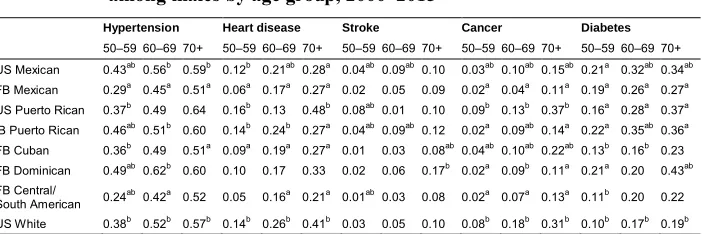
Table 2 shows the prevalence of chronic conditions among men. Foreign-born Mexicans and foreign-born Central/South Americans exhibited a significantly lower prevalence of hypertension than non-Latino Whites across age groups, except for foreign-born Central/South Americans at ages 70 and older. Conversely, US-born Mexican, island-born Puerto Rican, and foreign-born Dominican men exhibited significantly higher proportions of hypertension than non-Latino Whites at ages 50–59. However, the observed patterns of disadvantage converge at ages 60 and older to those of non-Latino Whites. For heart disease, Latino men exhibited comparable or significantly lower rates compared to non-Latino Whites across age categories. Overall, foreign-born migrants from Mexico, Cuba, and Central/South America exhibited an immigrant advantage (selectivity) in the proportion reporting heart disease relative to US-born Latinos.
Table 2: Proportion reporting a chronic condition, by race/ethnicity/nativity among males by age group, 2000–2015
Hypertension Heart disease Stroke Cancer Diabetes
50–59 60–69 70+ 50–59 60–69 70+ 50–59 60–69 70+ 50–59 60–69 70+ 50–59 60–69 70+ US Mexican 0.43ab0.56b 0.59b 0.12b 0.21ab0.28a 0.04ab0.09ab0.10 0.03ab0.10ab 0.15ab 0.21a 0.32ab0.34ab
FB Mexican 0.29a 0.45a 0.51a 0.06a 0.17a 0.27a 0.02 0.05 0.09 0.02a 0.04a 0.11a 0.19a 0.26a 0.27a
US Puerto Rican 0.37b 0.49 0.64 0.16b 0.13 0.48b 0.08ab0.01 0.10 0.09b 0.13b 0.37b 0.16a 0.28a 0.37a
IB Puerto Rican 0.46ab0.51b 0.60 0.14b 0.24b 0.27a 0.04ab0.09ab0.12 0.02a 0.09ab 0.14a 0.22a 0.35ab0.36a
FB Cuban 0.36b 0.49 0.51a 0.09a 0.19a 0.27a 0.01 0.03 0.08ab0.04ab0.10ab 0.22ab 0.13b 0.16b 0.23
FB Dominican 0.49ab0.62b 0.60 0.10 0.17 0.33 0.02 0.06 0.17b 0.02a 0.09b 0.11a 0.21a 0.20 0.43ab
FB Central/
South American 0.24
ab0.42a 0.52 0.05 0.16a 0.21a 0.01ab0.03 0.08 0.02a 0.07a 0.13a 0.11b 0.20 0.22
US White 0.38b 0.52b 0.57b 0.14b 0.26b 0.41b 0.03 0.05 0.10 0.08b 0.18b 0.31b 0.10b 0.17b 0.19b
Note: US = US-born; FB = foreign-born; IB = island-born.
aindicates that the proportion differs from US-born Whites (p<.05). bindicates that the proportion differs from foreign-born Mexicans
(p<.05).
experienced by US-born Mexicans and island-born Puerto Ricans converges to that of non-Latino Whites. In addition, all Latino men, regardless of nativity or country of origin, report a comparable or significantly lower prevalence of cancer than non-Latino Whites across age categories. Foreign-born Mexicans exhibit the lowest proportions among Latino subgroups.
Finally, all Latino subgroups, with the exception of foreign-born Cubans and foreign-born Central/South Americans, report a significant disadvantage in the prevalence of diabetes relative to non-Latino Whites. However, significant variability exists within Latino subgroups. In general, US-born Mexicans, island-born Puerto Ricans, and, to a lesser extent, foreign-born Dominicans exhibited a higher prevalence of diabetes than other Latino subgroups.
4. Discussion
Racial/ethnic, nativity, and country-of-origin differences in morbidity among older adults are of crucial importance because they highlight the consequences of social inequality in US society. These inequalities result in differing health trajectories across population subgroups in late life. The rationale underlying our study is that the Latino population is heterogeneous in nativity and country of origin, which is often overlooked in health research. Mexican-origin individuals make up approximately two-thirds of the Latino population, and as a result, many statistics on the health of Latinos are disproportionately impacted by their numbers.
health profiles across the life course through increased access to goods, services, and health care. In contrast, immigrants from Mexico are more likely to be selected on health despite their low socioeconomic status. Evidence shows Mexican migrants have a lower prevalence of chronic conditions relative to nonmigrants, which provides support for migration selection (Bostean 2013; Riosmena, Wong, and Palloni 2013).
Third, island-born Puerto Ricans are generally characterized by higher levels of morbidity than non-Latino Whites. Island-born Puerto Ricans are US citizens and can travel freely to the US mainland without a visa, making them less selected for health as they do not have to deal with obstacles related to the migration process encountered by other migrants (Duany 2011). Similarly, US-born Puerto Ricans and US-born Mexicans exhibit morbidity patterns indicative of their minority status. Previous research shows Puerto Ricans in the United States live in segregated neighborhoods characterized by social and economic isolation, which is linked to an increased risk of poor health. Santiago and Galster (1995) provide a thorough analysis of the deteriorating economic status of Puerto Ricans, which selects them into segregated neighborhoods with inadequate access to health care facilities, limited options for nutritious food, lack of recreational activities, and the absence of generational socioeconomic upward mobility. Conversely, US-born Mexicans may be at greater risk for morbidity due to experiencing greater stress related to their low socioeconomic status (Gallo et al. 2013). Among Mexican American women, financial stress has been found to be associated with elevated levels of allostatic load – an indicator of physiological dysregulation across multiple systems that predicts greater morbidity (Gallo et al. 2011).
it is not surprising that they have elevated levels of stroke in midlife since diabetes and hypertension are established risk factors for stroke.
This study has several limitations. First, we pooled data over 16 years to obtain a large sample of Latino subgroups by nativity and country of origin. The benefit of a pooled sample lies in the increase of the reliability and precision of estimates that would be difficult to achieve otherwise using cross-sectional data with small cell sizes. However, in pooling data we make the assumption that population differences are stable across survey years. Although socioeconomic, cultural, and health profiles may vary across cohorts, the amount of variation is likely small over the study period. Second, recent evidence suggests third-generation adults are less likely to identify as Latino compared to their first- and second-generation counterparts (Lopez, Gonzalez-Barrera, and Lopez 2017). The likelihood of a person’s identifying as Latino in subsequent generations is also reduced with higher levels of education, ethnic intermarriage, and living in non-Latino neighborhoods (Antman, Duncan, and Trejo 2016; Duncan and Trejo 2011; Lopez, Gonzalez-Barrera, and Lopez 2017). These factors can lead to a downward bias in estimates of health for US-born Latinos, which may make them appear in worse health than they actually are. Third, the use of the Central/South American ethnic grouping is problematic given that two different and diverse regions of Latin America are combined. The Central/South American region encompasses over 20 countries that represent 25% of the total Latino population in the United States. The NHIS does not provide detailed information on Latinos from Central/South America. Nevertheless, we included this category to demonstrate the heterogeneity within the Latino population. Finally, data for this study is obtained from self-reports of doctor-diagnosed conditions, which may introduce bias due to differential reporting between groups. Research suggests Latinos are less likely to be diagnosed with chronic conditions due to lower rates of health insurance coverage, reduced health care access, differences in utilization/source of care, and language/cultural barriers (Tienda and Mitchell 2006).
References
Antman, F., Duncan, B., and Trejo, S.J. (2016). Ethnic attrition and the observed health of later-generation Mexican Americans.The American Economic Review 106(5): 467–471.doi:10.1257/aer.p20161111.
Borrell, L.N., Menendez, B.S., and Joseph, S.P. (2011). Racial/ethnic disparities on self-reported hypertension in New York City: Examining disparities among Hispanic subgroups.Ethnicity and Disease 21(4): 429.
Bostean, G. (2013). Does selective migration explain the hispanic paradox? A comparative analysis of Mexicans in the US and Mexico. Journal of Immigrant and Minority Health15(3): 624–635.doi:10.1007/s10903-012-9646-y.
Cantu, P.A., Hayward, M.D., Hummer, R.A., and Chiu, C. (2013). New estimates of racial/ethnic differences in life expectancy with chronic morbidity and functional loss: Evidence from the National Health Interview Survey. Journal of Cross-Cultural Gerontology28(3): 283–297.doi:10.1007/s10823-013-9206-5.
Duany, J. (2011). Blurred borders: Transnational migration between the Hispanic Caribbean and the United States. Chapel Hill: University of North Carolina Press.doi:10.5149/9780807869376_duany.
Duncan, B. and Trejo, S.J. (2011). Intermarriage and the intergenerational transmission of ethnic identity and human capital for Mexican Americans. Journal of Labor Economics 29(2): 195–227.doi:10.1086/658088.
Fenelon, A., Chinn, J.J., and Anderson, R.N. (2017). A comprehensive analysis of the mortality experience of Hispanic subgroups in the United States: Variation by age, country of origin, and nativity. SSM – Population Health 3: 245–254.
doi:10.1016/j.ssmph.2017.01.011.
Gallo, L.C., Jimenez, J.A., Shivpuri, S., Espinosa de los Monteros, K., and Mills, P.J. (2011). Domains of chronic stress, lifestyle factors, and allostatic load in middle-aged Mexican-American women. Annals of Behavioral Medicine 41: 21–31.
doi:10.1007/s12160-010-9233-1.
Gallo, L.C., Shivpuri, S., Gonzalez, P., Fortmann, A.L., Espinosa de los Monteros, K., Roesch, S.C., Talavera, G.A., and Matthews, K.A. (2013). Socioeconomic status and stress among Mexican-American women: A multi-method perspective.
Garcia, M.A., Downer, B., Chiu, C., Saenz, J.L., Rote, S., and Wong, R. (2017). Racial/ethnic and nativity differences in cognitive life expectancies among older adults in the United States.The Gerontologist.doi:10.1093/geront/gnx142. Garcia, M.A. and Reyes, A.M. (2017). Prevalence and trends in morbidity and
disability among older Mexican Americans in the southwestern United States, 1993–2013. Research on Aging 40(4): 311–339. doi:10.1177/0164027517 697800.
Garcia, M.A., Valderrama-Hinds, L.M., Chiu, C.T., Mutambudzi, M.S., Chen, N.W., and Raji, M. (2017). Age of migration life expectancy with functional limitations and morbidity in Mexican Americans. Journal of the American Geriatrics Society 65(7): 1591‒1596. https://doi.org/10.1111/jgs.14875.
Heiss, G., Snyder, M.L., Teng, Y., Schneiderman, N., Llabre, M.M., Cowie, C., Carnethon, M., Kaplan, R., Giachello, A., Gallo, L., Loehr, L., and Avilés-Santa, L. (2014). Prevalence of metabolic syndrome among Hispanics/Latinos of diverse background: The Hispanic community health study/study of Latinos.
Diabetes Care37(8): 2391–2399.doi:10.2337/dc13-2505.
Hummer, R.A., Benjamins, M.R., and Rogers, R.G. (2004). Racial and ethnic disparities in health and mortality among the US elderly population. In: Anderson, N.B., Bulatao, R.A., Cohen, B., and the National Research Council Panel on Race, Ethnicity, and Health in Later Life (eds.). Critical perspectives on racial and ethnic differences in health in late life. Washington, D.C.: National Academies Press: 53–94.
Johnson, N.B., Hayes, L.D., Brown, K., Hoo, E.C., and Ethier, K.A. (2014). Leading causes of morbidity andmortality and associated behavioral risk and protective factors: United States, 2005–2013. Morbidity and Mortality Weekly Report
63(4): 3–27.
Lesser, G. and Batalova, J. (2017). Central American immigrants in the United States [electronic resource]. Washington, D.C.: Migration Policy Institute.
https://www.migrationpolicy.org/article/central-american-immigrants-united-states.
Lin, H., Bermudez, O.I., Falcon, L.M., and Tucker, K.L. (2002). Hypertension among Hispanic elders of a Caribbean origin in Massachusetts. Ethnicity and Disease
12(4): 499–507.
Washington, D.C.: Pew Research Center.http://www.pewhispanic.org/2017/12/ 20/hispanic-identity-fades-across-generations-as-immigrant-connections-fall-away.
Manini, T. (2011). Development of physical disability in older adults. Current Aging Science 4(3): 184–191.doi:10.2174/1874609811104030184.
Mozzafarian, D., Benjamin, E.J., Go, A.S., Arnett, D.K., Blaha, M.J., Cushman, M., de Ferranti, S., Després, J.-P., Fullerton, H.J., Howard, V.J., Huffman, M.D., Judd, S.E., Kissela, B.M., Lackland, D.T., Lichtman, J.H., Lisabeth, L.D., Liu, S., Mackey, R.H., Matchar, D.B., McGuire, D.K., Mohler, E.R., Moy, C.S., Muntner, P., Mussolino, M.E., Nasir, K., Neumar, R.W., Nichol, G., Palaniappan, L., Pandey, D.K., Reeves, M.J., Ridriguez, C.J., Sorlie, P.D., Stein, J., Towfighi, A., Turan, T.N., Virani, S.S., Willey, J.Z., Woo, D., Yeh, R.W., and Turner, M.B. (2015). Heart disease and stroke statistics, 2015 update: A report from the American Heart Association. Circulation 127(1): 143–152.
doi:10.1161/CIR.0000000000000152.
Palloni, A. and Arias, E. (2004). Paradox lost: Explaining the Hispanic adult mortality advantage.Demography41(3): 385–415.doi:10.1353/dem.2004.0024.
Parsons, V.L., Moriarity, C., Jonas, K., Moore, T.F., Davis, K.E., and Tompkins, L. (2014). Design and estimation for the National Health Interview Survey, 2006– 2015.Vital Health Statistics 2(165).
Portes, A. and Stepick, A. (1994). City on the edge: The transformation of Miami. Berkeley: University of California Press.
Riosmena, F., Wong, R., and Palloni, A. (2013). Migration selection, protection, and acculturation in health: A binational perspective on older adults. Demography
50(3): 1039–1064.doi:10.1007/s13524-012-0178-9.
Sacco, R.L., Boden-Albala, B., Abel, G., Lin, I., Elkind, M., Hauser, W. A., Paik, M.C., and Shea, S. (2001). Race-ethnic disparities in the impact of stroke risk factors: The Northern Manhattan stroke study. Stroke 32(8): 1725–1731. doi:10.1161/ 01.str.32.8.1725.
Saenz, R. and Morales, M.C. (2015). Latinos in the United States: Diversity and change. Hoboken: John Wiley and Sons.
Santiago, A.M. and Galster, G. (1995). Puerto Rican segregation in the United States: Cause or consequence of economic status? Social Problems 42(3): 361–389.
Tienda, M. and Mitchell, F. (2006).Hispanics and the future of America. Washington, D.C.: National Academies Press.
Vlassoff, C. (2007). Gender differences in determinants and consequences of health and illness.Journal of Health, Population, and Nutrition 25(1): 47–61.
West, L.A., Cole, S., Goodkind, D., and He, W. (2014). 65+ in the United States: 2010. Washington, D.C.: US Census Bureau (Current Population Reports P23-212). Zhang, Z., Hayward, M.D., and Lu, C. (2012). Is there a Hispanic epidemiologic
paradox in later life? A closer look at chronic morbidity. Research on Aging
34(5): 548–571.doi:10.1177/0164027511429807.
Zong, J. and Batalova, J. (2016). South American immigrants in the United States [electronic resource]. Washington, D.C.: Migration Policy Institute.
https://www.migrationpolicy.org/article/south-american-immigrants-united-states.
Zsembik, B.A. and Fennell, D. (2005). Ethnic variation in health and the determinants of health among Latinos. Social Science and Medicine 61(1): 53–63.