DEMOGRAPHIC RESEARCH
VOLUME 40, ARTICLE 52, PAGES 1529
-
1536
PUBLISHED 19 JUNE 2019
https://www.demographic-research.org/Volumes/Vol40/52/ DOI: 10.4054/DemRes.2019.40.52
Descriptive Finding
Incidence of first-marriage divorce among
women in the 1979 panel of the National
Longitudinal Survey of Youth
Lowell L. Hargens
© 2019 Lowell L. Hargens.
This open-access work is published under the terms of the Creative Commons Attribution 3.0 Germany (CC BY 3.0 DE), which permits use, reproduction, and distribution in any medium, provided the original author(s) and source are given credit.
Contents
1 Introduction 1530
2 Data and methods 1531
3 Results 1532
4 Discussion 1534
5 Acknowledgments 1534
Demographic Research: Volume 40, Article 52
Descriptive Finding
Incidence of first-marriage divorce among women in the 1979 panel
of the National Longitudinal Survey of Youth
Lowell L. Hargens1
Abstract
OBJECTIVE
This study seeks to determine whether the likelihood of first-marriage divorce among a cohort of women who have been adults during the years of the US ‘divorce plateau’ matches the level implied by period rates of first-marriage divorce during those years.
METHODS
I use marital histories for women in the 1979 National Longitudinal Survey of Youth (NLSY79) to examine the current status of their first marriages and also carry out a survival analysis that takes into account right censoring and the competing risks of death and widowhood.
RESULTS
It is likely that at least half of the first marriages of the women in the NLSY79 sample have already ended in divorce, a level notably higher than those implied by analyses based on period rates.
CONTRIBUTION
This is the first study to examine the marital histories of a cohort US women who are now in their late 50s and the first to show a level of first-marriage divorce exceeding 50%. It also suggests that the pattern of change in US age-specific divorce rates over that past four decades accounts for the higher than expected level of first-marriage divorce shown by the NLSY79 women.
Hargens: Incidence of first-marriage divorce among women in the 1979 panel of the NLSY
1. Introduction
Analyses of divorce based on period data indicate that the prevalence of divorce in the United States rose until the early 1980s, then reached a plateau of around 44%, where it has remained (Goldstein 1999; Raley and Bumpass 2003). For example, in a series of papers using multistate life tables to analyze period data, Schoen and his coauthors show that the proportion of marriages ending in divorce rose to approximately 43% in 1980 and has subsequently stayed near that level (Schoen 1987; Schoen and Weinick 1993; Schoen and Standish 2001; Schoen 2016). Although divorce rates derived from period data tell us only what would occur if the age-specific rates at a given time point remained constant for many years, the long-term stability in period-rate based estimates of divorce suggests that divorce among contemporary cohorts of Americans should also be attaining a level somewhere around 43% to 45%. To date, however, no one has attempted to determine if this is true by examining data for such a cohort.
We know that period and cohort measures of divorce can differ substantially when the period rates show major fluctuations. This is due to the fact that a cohort divorce rate tells us the level of divorce experienced by an actual cohort of people during their lifetimes whereas, as noted above, a period divorce rate tells us the level of divorce that would be experienced by a hypothetical cohort subject to the age-specific divorce rates present at a given time point. For example, US age-specific divorce rates temporarily surged after WWII, producing a few period divorce rates far greater than the divorce rates shown by any of the cohorts alive at that time (Preston and McDonald 1979: 12– 13). In contrast, when divorce rates based on period data have been relatively constant for many years, it seems plausible that cohorts who lived their adult lives during those years will show a divorce rate that closely matches the relatively constant period divorce rates. Below I show that despite its plausibility, this expectation may not be met.
Our knowledge about the levels of divorce shown by the US birth cohorts that have experienced the high rates of divorce since 1980 is quite limited. This is partly due to the fact that the cohorts that have entered adulthood since the late 1970s and early 1980s still have large proportions of their lives ahead of them, so major portions of their marital histories have not yet taken place. In addition, studies reporting data on divorce for birth cohorts in their later adult lives (e.g., Stevenson and Wolfers 2007: 31–34) are based on cross-sectional surveys and are therefore hampered both by reporting errors and the fact that they are necessarily restricted to survivors, who may not accurately reflect the level of divorce of their cohort because of the association between marital status and longevity.
Demographic Research: Volume 40, Article 52
now in their late 50s and have lived their adult years during the time that divorce rates have been at their high plateau. I show both the statuses of their first marriages as of 2014 and also the results of a survival analysis of those marriages.
2. Data and methods
My analysis is based on data from the National Longitudinal Study of Youth (NLSY79), which since 1979 has collected data on a sample of US residents who were 15 to 22 years old in 1979. Funded by the US Bureau of Labor Statistics and conducted by the Center for Human Resource Research (CHRR) at the Ohio State University and the National Opinion Research Center at the University of Chicago, NLSY79 collects extensive data about sample members, including their marital histories. Members of the sample were contacted annually from 1979 through 1994 and have been contacted biennially since then. For my analysis of the data I used the basic cross-sectional NLSY79 sample and used ‘custom weights’ provided by the CHRR. Because of the unreliability of men’s reports of their marital histories (Bumpass, Martin, and Sweet 1991), I restricted my study to women who have been married at least once in the NLSY79 sample. The most recent available wave of the survey, fielded in 2014, gathered data from 77% of the women in the original cross-sectional sample, excluding those whom the NLSY79 knew to be deceased at that time.
Among the 3,108 women in the cross-sectional NLSY79 sample, there are 2,741 women who have been married at least once. I dropped 29 cases in which those women reported inconsistent information or information that was too incomplete to construct a marital history, and therefore have data for 2,712 cases. The CHRR reports that the multistage sampling design used to collect the 2014 wave of the NLSY79 had a design effect of 1.2 for sample proportions (see www.nlsinfo.org/content/cohorts/nlsy79/using-and-understanding-the-data/standard-errors-design-effects), resulting in a standard error of 1.15 percentage points for sample percentages close to 50%.
Hargens: Incidence of first-marriage divorce among women in the 1979 panel of the NLSY
died, allowing researchers to determine whether a marriage ended because of the death of the sample member. Using all three kinds of information, I constructed the dates of first marriages and first marriage dissolutions for each woman in the NLSY79 sample as well as the censoring dates of right-censored cases. For the women whose first marriages have ended, I coded whether their marriages were ended by divorce, widowhood, or by their own death. Finally, I also coded whether the women who reported being still married to their first husbands also reported being separated from them.
3. Results
Table 1 presents the statuses of the women’s first marriages at the time that they last reported information to NLSY79. As of 2014 these women were in their early and mid-50s and only small proportions of their first marriages had been ended by either their own or their husband’s death. Table 1 also shows that the proportion of women’s first marriages that have ended in divorce (48.4%) is slightly larger than the proportion whose marriages were still intact when the NLSY79 last contacted them (46.5%). Note, however, that 12.9% of the women in the sample reported being in their first marriage when they were last interviewed by the survey but were not respondents in the 2014 wave of the survey. Sample attrition of the NLSY79 women has been occurring since the second wave of the study, but because it has been greater in recent years the median year of attrition is 2002. Thus, about 6.5% of the women in the sample analyzed here are coded as being still married to their first husbands even though they have not provided information to the NLSY79 for over a decade.
Demographic Research: Volume 40, Article 52
Table 1: Statuses of first marriages of women in the NLSY79
Status of marriages for Percent
2014 respondents and 2014 nonrespondents whose marriages are known to have ended:
Intact, couple together 31.7
Intact, couple separated 1.9
Ended by divorce 48.4
Ended by husband’s death 3.5
Ended by respondent’s death 1.6
2014 nonrespondents reported as still married when last interviewed:
Intact, couple together 12.5
Intact, couple separated 0.4
Total 100.0%
(N) 2,712
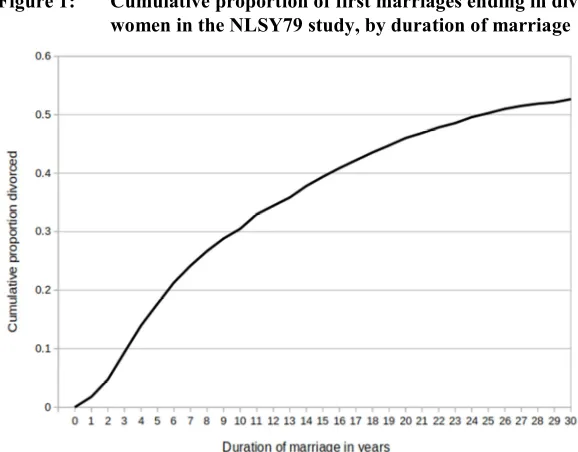
Figure 1: Cumulative proportion of first marriages ending in divorce for women in the NLSY79 study, by duration of marriage
Hargens: Incidence of first-marriage divorce among women in the 1979 panel of the NLSY
them were married by 1988, 26 years before 2014. Thus, the estimates presented in Figure 1 imply that if nonrespondents to the 2014 wave of NLSY79 had been included in the study, Table 1 would have shown that over half of the first marriages of the NLSY79 women have ended in divorce.
4. Discussion
The estimates reported above suggest that the likelihood of divorce among US women born around 1960 is notably higher than one would expect given the period divorce rates that have prevailed during their adult years. Because there is no consistent age-specific divorce-rate series covering the entire period (Kennedy and Ruggles 2014) we cannot give a conclusive explanation of this inconsistency, but it is likely that changes in the age pattern of divorce are responsible for it. Specifically, women born around 1960 became young adults when divorce rates were historically high for young adults, and they have spent their later years during a period when divorce rates for older adults have risen to historically high levels (Brown and Lin 2012) while declining for those at younger ages (Kennedy and Ruggles 2014: 594). As a cohort then, these women have experienced historically high age-specific divorce rates throughout their adult lives. In fact, if the NLSY79 women experience the divorce rate reported by Brown and Lin (2012: 737) for women 50–64 years old, the first-marriage divorce rate for the NLSY79 women will reach 55% sometime in the next five years.
Although no one can reliably predict the future course of US age-specific divorce rates, some have speculated that recent declines in divorce rates for those in their teens and early 20s foreshadow lower levels of first-marriage divorce among the birth cohorts that are younger than those examined here (e.g., Stevenson and Wolfers 2007). If so, the high level of first-marriage divorce shown above will be confined to the birth cohorts of the 1960s and early 1970s. Another possibility, however, is that continued increases in the age-specific rates at later ages may result in levels of divorce that are just as high as those shown above for the NLSY79 women. In that case the results shown above herald the establishment of a long-term pattern wherein over half of US first marriages end in divorce.
5. Acknowledgments
Demographic Research: Volume 40, Article 52
References
Allison, P.D. (2014). Event history and survival analysis. Thousand Oaks: Sage.
doi:10.4135/9781452270029.
Brown, S.L. and Lin, I.-F. (2012). The gray divorce revolution: Rising divorce among middle-aged and older adults, 1990–2010. Journals of Gerontology Series B
67(6): 731–741.doi:10.1093/geronb/gbs089.
Bumpass, L.L., Martin, T.C., and Sweet, J.A. (1991). The impact of family background and early marital factors on marital disruption.Journal of Family Issues 12(1): 22–42.doi:10.1177/019251391012001003.
Coviello, V. and Boggess, M. (2004). Cumulative incidence estimation in the presence of competing risks. The Stata Journal 4(2): 103–112. doi:10.1177/1536867X 0400400201.
Goldstein, J.R. (1999). The leveling of divorce in the United States.Demography 36(3): 409–414.doi:10.2307/2648063.
Kennedy, S. and Ruggles, S. (2014). Breaking up is hard to count: The rise of divorce in the United States 1980–2010. Demography 51(2): 587–598. doi:10.1007/ s13524-013-0270-9.
Preston, S.H. and McDonald, J. (1979). The incidence of divorce within cohorts of American marriages contracted since the Civil War. Demography 16(1): 1–25.
doi:10.2307/2061075.
Raley, R.K. and Bumpass, L. (2003). The topography of the divorce plateau: Levels and trends in union stability in the United States after 1980. Demographic Research 8(8): 245–259.doi:10.4054/DemRes.2003.8.8.
Schoen, R. (1987). The continuing retreat from marriage: Figures from 1983 US marital status life tables.Sociology and Social Research 71(2): 108–109.
Schoen, R. (2016). The continuing retreat from marriage: Figures from marital status life tables for United States females, 2000–2005 and 2005–2010. In: Schoen, R. (ed.). Dynamic demographic analysis. Dordrecht: Springer: 203–215.
doi:10.1007/978-3-319-26603-9_10.
Hargens: Incidence of first-marriage divorce among women in the 1979 panel of the NLSY
Schoen, R. and Weinick, R.M. (1993). The slowing metabolism of marriage: Figures from 1988 US marital status life tables. Demography 30(4): 737–745.
doi:10.2307/2061816.