43 Journal of Organization Design JOD, 3(2): 43-47 (2014)
DEMANDS FOR FRANCHISOR
ACCOUNTABILITY
CarOlyn M. PluMP • DaviD J. KetChen, Jr.
abstract: Franchising is a relationship wherein one organization (i.e., the franchisor) allows other organizations (i.e., franchisees) to use its brand name, products, and processes in exchange for fees. Because franchising offers franchisors the opportunity to build their brands quickly, it is perhaps not surprising that many firms rely on franchising as a key tool for organization design. One caution about franchising is that its use brings a complex array of legal issues into play. As franchising increases in popularity, so too does the scrutiny paid to this organizational form by the legal system. Indeed, the courts appear to be demanding increased accountability from franchisors. The goal of this Point of View article is to explain how organizations can avoid problems associated with increased accountability and even benefit from it.
Keywords: Franchising, franchise law, accountability, brand protection, transaction costs
Franchising is a business relationship involving two types of organizations: a franchisor and franchisees. The franchisor is a company such as McDonalds or 7-Eleven that has created a valuable brand and an effective business model. Rather than owning all of the outlets that operate under its brand, the franchisor allows independent organizations (franchisees) to own some or all of these outlets. In exchange, the franchisees pay the franchisor both a franchisee fee (an upfront fixed sum) and ongoing royalties (usually a percentage of the franchisee’s sales over time).
Many executives rely on franchising as a means to design their organizations. Indeed, franchising plays a huge role in the modern economy. According to the International Franchise Association (2013), there are approximately 825,000 franchised outlets in the United States alone. These organizations are directly and indirectly responsible for nearly 18 million jobs and they generate more than $2 trillion of economic output. The use of franchising as an organizational design tool is on the rise. Franchisees in the U.S. opened 11,000 new establishments in 2013, for example, and the total sales enjoyed by franchises increased by 4.3 percent from 2012 levels (Duncan, 2013).
The relative success of a franchised system depends in part on how well the franchisor and its franchisees work together. If the relationship is cooperative and collaborative, both the franchisor and the franchisees are more likely to enjoy strong performance. Unfortunately, the two sides do not always work in concert, and the resulting disputes sometimes lead to legal wrangling. As franchising grows in popularity, the courts are paying increased attention to this organizational form (Ward, 2011). In particular, there appears to be a trend toward raised expectations about how franchisors deal with their franchisees. Our goal in this article is to explain how organizations can avoid problems associated with increased accountability as well as actually benefit from it.
FranChiSinG anD the laW
international brands. Unfortunately, franchising also attracted some dubious franchisors that would exploit their franchisees. The U.S. Supreme Court took major steps toward defining acceptable franchisor behavior in two cases: Susser v. Carvel Corporation (1962) and Seigel v. Chicken Delight, Inc. (1971). In the former case, the court deemed “exclusive dealing” – preventing a distributor of a firm’s offerings from also distributing competitors’ offerings – to be legal in the franchising context. In the latter case, the court judged that “tying” – forcing franchisees to buy commodity products such as napkins from the franchisor – was illegal. By the end of the 1970s, the federal government began regulating franchising in an additional effort to ensure that franchisees are treated fairly. Four decades later, recent legal developments appear to indicate that the courts are demanding greater accountability from franchisors in terms of how they treat their franchisees.
Franchise Contracts: the Conscionable is now unconscionable
A contract is a legally binding agreement between two or more parties for which the law provides a remedy if one of the parties fails to fulfill one’s promise or perform one’s duty. Many franchisors assert that franchise agreements need to be more one-sided than other business contracts because franchisors must protect the health and integrity of the franchise system as a whole. Such tight control is vital because if the system fails, all of the franchisees lose too (Kreutzer, 2013).
While this is a valid point – and one that has previously carried the day in court – today the courts are taking a closer look at franchise agreements to determine if they are “unconscionable” (i.e., whether they are oppressive or grossly unfair to franchisees) on procedural or substantive grounds. Procedural unconscionability may involve inconspicuous print, unintelligible language, or failure to provide an opportunity to read a contract or ask questions (Clarkson, Miller, & Cross, 2012). It can also be present when there is a vast disparity in bargaining power between the two parties such that one party’s consent cannot be considered voluntary. Typically, this happens when a contract is written exclusively by one party and presented to the other party on a take-it-or-leave-it basis.
Substantive unconscionability exists when a contract is so oppressive as to “shock the conscience” of the court (Clarkson et al., 2012: 266). For instance, a contract that requires a franchisee to arbitrate any dispute resulting from the franchise agreement, but allows a franchisor to proceed directly to court, may be unconscionable. Further, a franchise agreement could be substantively unconscionable if it provides unfair penalties for early termination or limits a franchisee’s remedies in an unfair manner.
The case of Bridge Fund Capital Corp. v. Fastbucks Franchise Corp. (Bridge Fund, 2010) involved a franchisee (Bridge Fund) that entered into franchise agreements with Fastbucks for the operation of payday loan stores in California. The franchise agreement included an arbitration clause that stated:
(1) the arbitrator shall hear the dispute in Dallas County, Texas; (2) the claims subject to arbitration shall not be arbitrated on a class-wide basis; (3) while the franchisor may institute an action for temporary, preliminary, or permanent injunctive relief, the franchisee is not afforded the same remedy; (4) there is a one year statute of limitations for all claims; and (5) the parties are limited to recovery of actual damages and waive any right to consequential, punitive, or exemplary damages (Bridge Fund, 2010: 999).
The absence of any real negotiation between the parties led the court to conclude the agreement was procedurally unconscionable (Bridge Fund, 2010). The court also held that the arbitration clause was substantively unconscionable for several reasons. First, the contract’s mandatory waiver of non-waivable statutory rights (e.g., class action rights) was the type of one-sided and overly harsh term that made the arbitration provision unenforceable. Further, the arbitration clause allowed the party with greater bargaining power to seek injunctive relief in court and denied such relief to the weaker party, and did so without any valid business justification for such non-mutuality. Finally, the arbitration clause was unduly oppressive because it allowed Fastbucks to evade liability (Bridge Fund, 2010).
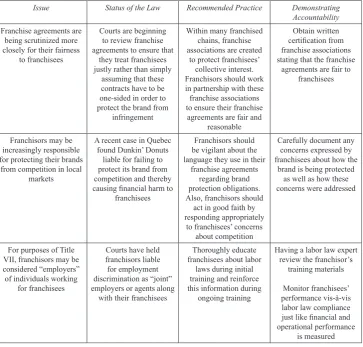
their brand on the one hand and treating franchisees more as partners on the other. As shown in Table 1, franchisors can pursue this balance by working more closely with franchise associations to revisit the franchise contract. Within many franchised systems, franchisees band together to resolve issues with the franchisor as a group rather than as individuals. Similarly, franchisees can look to outside standards from independent organizations. Although some franchisors initially may balk at this notion – in part because such a practice may increase franchisees’ bargaining power – it could be beneficial to franchisors, too. If an association deems a franchise contract to be fair and equitable, the franchise agreement stands an excellent chance of being judged conscionable if taken to court.
table 1. Possible responses to increased demands for accountability
Issue Status of the Law Recommended Practice Demonstrating Accountability Franchise agreements are
being scrutinized more closely for their fairness
to franchisees
Courts are beginning to review franchise agreements to ensure that
they treat franchisees justly rather than simply
assuming that these contracts have to be one-sided in order to protect the brand from
infringement
Within many franchised chains, franchise associations are created
to protect franchisees’ collective interest. Franchisors should work in partnership with these franchise associations to ensure their franchise agreements are fair and
reasonable
Obtain written certification from franchise associations stating that the franchise
agreements are fair to franchisees
Franchisors may be increasingly responsible for protecting their brands
from competition in local markets
A recent case in Quebec found Dunkin’ Donuts
liable for failing to protect its brand from competition and thereby causing financial harm to
franchisees
Franchisors should be vigilant about the language they use in their
franchise agreements regarding brand protection obligations. Also, franchisors should
act in good faith by responding appropriately
to franchisees’ concerns about competition
Carefully document any concerns expressed by franchisees about how the
brand is being protected as well as how these concerns were addressed
For purposes of Title VII, franchisors may be considered “employers” of individuals working
for franchisees
Courts have held franchisors liable for employment discrimination as “joint” employers or agents along
with their franchisees
Thoroughly educate franchisees about labor
laws during initial training and reinforce this information during
ongoing training
Having a labor law expert review the franchisor’s
training materials
Monitor franchisees’ performance vis-à-vis labor law compliance just like financial and operational performance
is measured
The American Association of Franchise Dealers (AAFD) is an example of an organization that has an accreditation process for franchisors and develops standards relating to the franchisor/franchisee relationship. As expressed in the AAFD’s web site, “Over the past 16 years the AAFD has promulgated over 140 Fair Franchising Standards and commentary to give guidance to fair and balanced franchise agreements and relationships” (American Association of Franchise Dealers, 2014). Forward thinking franchisors and franchisees may benefit from such independent assessment. Documenting the outcome of such assessments can be very valuable. Specifically, to maximize its own legal protection, a franchisor should attempt to obtain written certification from any relevant franchise association stating that the franchise agreement appears to be fair to its franchisees.
raising the Bar on Brand Protection
relates to the protection of a franchisor’s brand from competition (as opposed to protection of a franchisor’s brand from infringement). In Quebec’s largest franchise litigation over the past twenty years, a group of 21 former Dunkin’ Donut franchisees sued Dunkin’ for lost profits and value (Bertico v. Dunkin’ Brands Canada, Ltd., 2012). The franchisees claimed that the franchisor was unresponsive to their concerns regarding market infiltration by another donut chain (Bertico, 2012).
The number of Dunkin’ Donuts stores in Quebec shrunk from 210 in 1998 to 13 in 2012 – a decline of 94 percent. In contrast, competitor Tim Hortons grew more than 500 percent from sixty Quebec stores in 1995 to 308 in 2005. In an unprecedented decision, the Quebec Superior Court held that Dunkin’ Donuts breached its franchise agreements by failing to protect its brand against competition from Tim Hortons in that province. In justifying its award to franchisees of $16 million in damages plus legal fees, the court stated that brand protection is “an ongoing, continuing and successive obligation” of the franchisor (Bertico, 2012).
Although the outcome should concern franchisors, some caveats apply. The decision is not binding outside of Quebec, and it could be overturned by an appeal that Dunkin’ Donuts plans to pursue. Also, the court explicitly recognized that a franchisor is not a guarantor of success or an insurance policy for franchisees. Indeed, the court noted some franchises may fail due to poor management by franchisees or changes in market conditions beyond the franchisor’s or franchisees’ control (Bertico, 2012). Nonetheless, the case makes clear that courts may be willing to hold franchisors accountable for a pattern of failure.
This may in essence redefine franchisors’ obligations by requiring them not only to develop and support a viable business model, but also to make decisions about the overall design of their organizations – as such decisions relate to franchisees’ interests – a central concern. In response, franchisors should be vigilant about the language they include in franchise agreements regarding their brand protection obligations. Also, franchisors should act in good faith by responding appropriately to franchisees’ concerns about competition. To maximize its legal protection, a franchisor should carefully document any concerns expressed by franchisees about how the brand is being protected as well as how these concerns were addressed.
Who exactly is an employer?
Title VII of the Civil Rights Act of 1964 (Title VII) prohibits employment discrimination based on race, color, religion, sex (including pregnancy), or national origin.1 The
franchisor-franchisee relationship is not an employment relationship governed by Title VII (42 U.S.C. § 2000e). Nonetheless, the courts appear open to viewing franchisors as vicariously liable for employment discrimination committed under Title VII by their franchisees.
This is precisely what happened in Myers v. Garfield & Johnson (2010). Rebecca Myers brought an action against Jackson Hewitt and Garfield and Johnson (G&J) – a franchisee of Jackson Hewitt. She alleged that a G&J partner and a G&J manager repeatedly sexually harassed, assaulted, and threatened her when she was a G&J tax preparer. Jackson Hewitt filed a motion to dismiss itself from the lawsuit because it argued that it was not Ms. Myers’ employer and, therefore, not a proper party to the lawsuit.
In an unconventional ruling, the court denied Jackson Hewitt’s motion. The court reasoned that two distinct entities may be liable for the same Title VII violation not only when they constitute a single employer but also when they are joint employers of the plaintiff or when one entity acted as the agent of the other. Ms. Myers’ case against Jackson Hewitt was allowed to proceed because she alleged sufficient facts from which to conclude that either Jackson Hewitt was her joint employer or that Jackson Hewitt was plaintiff’s employer by virtue of its actual or apparent authority over G&J’s employment practices (Garfield & Johnson, 2010).
This creates a dilemma for franchisors. The more tightly a franchisor controls its franchisees, the more likely the franchisor is to be judged liable for illegal behavior among
its franchisees. To the extent that the franchisor relinquishes control over its franchisees, however, this increases the odds that franchisees will deviate from the franchisor’s procedures. This in turn can harm the brand. One possible solution for franchisors that wish to maintain tight control of their brand is to train franchisees rigorously about discrimination laws and to monitor franchisees’ performance in this realm on an ongoing basis just as they already monitor financial and operational results. Having a labor law expert review the franchisor’s training materials can also be beneficial.
a Final thOuGht
It is natural for any organization that appears to be facing increased legal demands for accountability to view such demands as threatening. However, an important positive of this trend for franchisors is that increased scrutiny should enhance franchisees’ confidence that they will not be exploited by franchisors. In Williamson’s (1985) terms, opportunism by franchisors should become less likely as a result of the court’s increased expectations about franchisors’ accountability. One possible result is that economic exchanges between franchisors and franchisees will become more efficient as the need for franchisees to be suspicious of – and closely monitor – franchisors’ behavior is reduced. By having increased accountability imposed on them legally, franchisors become less risky – and more attractive – business partners for potential franchisees.
reFerenCeS
American Association of Franchise Dealers (AAFD). Retrieved from the AAFD webs site on April 20, 2014 from http://www.aafd.org/fairness-initiatives/fair-franchising-standards/
Bertico Inc. v. Dunkin’ Brands Canada Ltd., Q.J. No. 4996 (Superior Court Ruling, June 22, 2012) (pp. 1-43).
Bridge Fund Capital Corp. v. Fastbucks Franchise Corp., 622 F.3d 996 (9th Cir. 2010). Clarkson KW, Miller RL, Cross FB. 2011. Business Law Text and Cases (12th ed.)
South-Western, Mason, OH.
Duncan K. 2013. Despite challenges, franchising continues to rebound in 2014. Entrepreneur. Retrieved April 26, 2014 from http://www.entrepreneur.com/article/230288
International Franchise Association. 2013. The state of the franchise economy in 2013. Retrieved on February 8, 2014. http://franchiseeconomy.com/the-state-of-the-franchise-economy/
Kreutzer M. November 24, 2013. Why you cannot hope to negotiate your franchise agreement. Retrieved on December 7, 2013 from http://www.franchise-info.ca/cooperative_ relations/2013/11/beware-of-dabbling-franchise-attorneys-part-1-franchisee-counsel. html?goback=%2Egde_4095296_member_5814452948461170690#%21
Myers v. Garfield & Johnson Enterprises, Inc., 679 F. Supp. 2d 598 (E.D. Pa 2010).
The Civil Rights Act of 1964 (Title VII), as amended, 42 U.S.C. § 2000e et seq.
Ward C. 2011. As franchising increases in popularity, so do legal issues. Denver Business
Journal. Retrieved on April 26, 2014 from
http://www.bizjournals.com/denver/print-edition/2011/10/07/as-franchising-increases-in.html
Williamson OE. 1985. The Economic Institutions of Capitalism. Free Press, New York, NY.
CarOlyn M. PluMP, eSq.
Assistant Professor of Management and Leadership School of Business, La Salle University
E-mail: [email protected]