Entry Points to the Health System: a review
of the emerging community models for
management of non-life threatening urgent
conditions relevant to Australia
J Adie, W Graham and M Wallis
John Adie BA, BHB, MbChB, Dips Obs/Med Gyn, Paed & CED, FRNZCGP, FRACGP, FACRRM, FRNZCUC
Adjunct Associate Professor Ochre Health Medical Centre,
Sunshine Coast, Queensland, Australia. University of the Sunshine Coast, Sippy Downs, Queensland, Australia. Dr Wayne GrahamBBus (Hons), PhD, FAIM University of the Sunshine Coast,
Sippy Downs, Queensland, Australia. School of Business
University of the Sunshine Coast, Queensland, Australia.
community healthcare is presented including emerging initiatives, cost implications, subsequent admission to hospital, satisfaction, mortality, care, treatment time, subsequent referrals, testing and health outcomes.
Conclusion: These emerging models of community healthcare need to be trialed and studied in the Australian context to evaluate whether they provide patients with NLTUC with a safe cost-effective option with similar outcomes to EDs. Implementation of these models can be examined further to determine their effectiveness in potentially reducing the increasing rate of presentation to EDs.
Abbreviations: APCN – Advanced Primary Care Nurse; ECP – Emergency Care Practitioners; ED – Emergency Department; GP – General Practitioner;
IPCC – Integrated Primary Care Centre; PP – Paramedic Practitioners; NLTUC – Non-Life Threatening Urgent Conditions; UCC – Urgent Care Clinics; UCCP – Urgent Care Community Pharmacy.
Abstract
Problem: The number of presentations to Emergency Departments (EDs) is increasing at levels above population growth rates and these increases are becoming unsustainable.
Objective: To review evidence for emerging entry points to the health system for patients with non-life threatening urgent conditions (NLTUC) in order to consider more effective healthcare services in Australia.
Methods: An in-depth review of the Emerald, Medline, CINAHL, Web of Science, Proquest Business and Medical databases from January 2005 to April 2016 matching ‘acute care’ or ‘urgent care’ with general practice and other health providers found thirteen entry point models with five currently relevant to Australia.
Results: Studies examining five emerging entry points were found including urgent care community pharmacy, new prehospital practitioner community care, advanced nurse enhancement of primary care, designated urgent care clinics and integrated primary care centers. Evidence for these emerging models of
Marianne WallisRN, BSc (Hons), PhD, FACN Professor
University of the Sunshine Coast, Sippy Downs, Queensland, Australia. NURTURE Research Cluster
University of the Sunshine Coast, Sippy Downs, Queensland, Australia. Correspondence:
introduction
Emergency Department (ED) presentations in Australia are increasing. The absolute volume of presentations has increased by as much as 55% in ten years, which is above expectations when compared to the population growth rate. [1] This increase suggests that current models for managing patients with non-life threatening urgent conditions (NLTUC) need to be more effective to meet community needs. Cases presenting to EDs that could be managed in primary care contribute to this problem. Studies over the last ten years have found that these cases can range from 8.4% [2] up to 50% of the ED workload [3] and 58-82% of the paediatric ED workload. [4] Despite the high percentage of cases that could be seen outside hospital, 7.6% of those considered ‘non-urgent’ are admitted [5] suggesting difficulties and dangers in deciding which patients to refer ‘off-site’. Reports from both patient surveys [6] and policy makers [7] indicate that the decision on whether a condition needs urgent advice, care, treatment or diagnosis belongs to patients.
One solution to the problem of ED overcrowding is the provision of integrated care for better management of chronic disease. [8] Integrated care is associated with higher quality of care, lower acute care utilisation and lower costs. [9] For patients with or without chronic conditions, different models of care may be required to reduce ED presentations for non-life threatening urgent conditions. It is these alternatives that will be explored in this paper.
In the Western world, since the 1980s, models of care that are not General Practice or ED-based have been emerging. Some integrate horizontally with services such as Radiology and Pharmacy [10] whereas others integrate vertically upstream with hospitals to provide services traditionally accessed at hospital EDs and refer presentations that they are unable to manage. [11]
Favourable legislation, funding and private-public partnerships have an influence on which models are developed. [10] Australia is an example, having a fragmented funding mechanism for health. Public hospital systems are funded by the state and territory governments whereas primary care is funded by the Federal Government. Both systems also have private components, such as private hospitals and primary healthcare. [12] The same patients with NLTUC who present to public hospital EDs, but could be also managed by a General Practitioner (GP), can attract nearly ten times more funding to the hospital [13,14] (see Table 3). These funding mechanisms limit the extent to which integrated models can be developed in Australia. This article seeks to identify emerging models of community
healthcare around the world in order to provide alternative models of care for Australia’s current health system.
Method
A search limited to January 2005 to April 2016 of the Emerald, Medline, CINAHL, Web of Science, Proquest Business and Proquest Medical databases was conducted. It sought models for treatment that could be expanded for patients with NLTUC and that were not based in general practice or hospital ED in urban communities. ‘Acute care’ or ‘urgent care’ was matched with each of: Nurs* or ‘nurse practitioner’; Pharm; Paramedic or ‘paramedic practitioner’ or ‘Extended Care Paramedic’; ‘general pract*’ or ‘primary care’ or ‘primary health’; Telehealth or telemedicine; ‘integrated primary care centre’ or superclinic or polyclinic; ‘walk-in clinic’ or ‘retail clinic’ or ‘convenient care clinic’ or ‘after-hours clinic’; ‘house-call*’; ‘urgent care clinics’; ‘public health’; ‘general medicine’; and ‘emergency medicine’. In addition, discussions with healthcare experts revealed additional sources, which further complemented the results of search, described above. Articles were selected for review if they were derived from meta-analyses, literature reviews, systematic reviews, randomised controlled trials, cohort studies, case control studies, Government reports or analyses of records of meetings relevant to treating NLTUC in urban communities.
Results
Thirteen emerging models of community healthcare for patients with NLTUC were identified in the published literature. These are summarised in Table 1.
expensive hospital ED model to potentially more cost effective community models. The following table identified the type of care, service, providers, benefits and implications of each model.
The five models of community healthcare derived from the literature have potential to enhance the ability of primary care institutions to manage patients with NLTUC in Australia. This will give the 8.4 – 50% of patients who present to ED
and the 58 – 82% of patients who present to paediatric ED with NLTUC a safe, cost-effective alternative for treatment. [2-4] Each model is described below:
New Prehospital Practitioner Community Care
By safely treating patients in the community, new Prehospital Practitioners, including Paramedic Practitioners (PPs) and Emergency Care Practitioners (ECPs), are reversing the trend in the Western world where ambulance transfers Table 1: Emerging Models of Community Health care
CATEGory DESCrIPTIoN of MoDELS
Telemedicine – virtual, most limited access to resources 1. Non-clinical call handler managed 2. Nurse managed
3. GP managed
House calls – face to face 4. New Prehospital Practitioner Community Care interaction with limited access 5. Nurse practitioner led
to resources 6. GP led
Location based - face to face with access to more resources 7. Urgent Care Community Pharmacy
8. Advanced Nurse Enhancement of Primary Care 9. Nurse Practitioner in nurse led clinics
10. On-site employer clinic 11. Urgent Care Clinic
12. Freestanding Emergency Department 13. Integrated Primary Care Centre
Table 2: Models of Non-Life Threatening Urgent Care
Type of care pracTiTioners examples of services provided BenefiTs/implicaTions examples
locaTions in of sTudies
The ciTed
liTeraTure
New pre-hospital Paramedic UK, Canada Treatment of falls, PPs c.f. standard care result in 28% less ED (25, 28, 54) practitioner Practitioners (PPs) Australia, NZ. lacerations, epistaxis, attendance, 13% less admissions at 28 days,
community care. Emergency Care minor burns, removal 15% less total episodes time, 16% more Practitioners (ECPs). of foreign bodies, satisfaction and similar 28 day mortality/
suturing, ordering suboptimal care.
of investigations, CPs c.f. usual providers results in less prescribing and ability investigations, more treatments, more to discharge. discharges home, 74% less transfers
to hospital and 66% cost reduction compared to the cost of seeing patients
in ED.
Urgent Care Pharmacists. US, UK, Point of care testing, Pharmacy interventions (43.5% avert (30-32, 55) Community Australia, NZ. diagnosing, dispensing, medical attention), reduced GP visits
Pharmacies (UCCP). treating and ‘pharmacy and ED visits (especially bank holidays/ interventions’. weekends for scripts), fewer
to hospital are increasing by up to 20% per year. [21] PPs are paramedics with extended skillsets who manage patients in their own environment. ECPs are nurses or paramedics with extended skillsets who work in various settings such as ambulance services, ED, Minor Injuries Units, primary care and Walk-In Clinics. [22] In examining eleven studies, a Canadian Systematic Review highlighted initiatives, including promising programmes in the United Kingdom, Australia and Canada. The review also included one randomised controlled trial showing paramedics can safely practise with an expanded scope, improving system performance and patient outcomes. [23] New models of community care are being trialled in different Australian states. [24] These programmes build on and expand existing scope of practice to treating conditions such as falls, lacerations, epistaxis, minor burns, removing foreign bodies [25] simple wound suturing, ordering investigations such as x-rays, prescribing medicines and discharging patients at the scene. [19]
Comparisons of both emerging models over traditional models are favourable in terms of effectiveness, patient satisfaction and cost. Three cluster randomised controlled trials from the United Kingdom show that PPs’ care of patients with mild illness or injury reduces admission to ED and admissions with favourable outcomes (see table 2). Studies showed ECPs had a higher rate of managing patients in their own home over transfer to hospital compared to
usual care (59% c.f. 26% by usual paramedics in a rural town inNew Zealand) [26] and 64% c.f. 24% by 999 ambulances in metropolitan England for elderly patients with falls and breathing difficulties. [27] In contrast, an English study found ECPs were not as effective as usual health providers in discharging children after assessment of urgent healthcare problems in a metropolitan city thus transferring more children to hospital. [28] Satisfaction with ECPs was high in a rural New Zealand study where patients wished to be treated at home if possible. [29] The mean cost of ECP patient contacts in one study was 44% of the cost of patients being seen in ED. [22] ECPs like PPs keep more patients in their own homes with better outcomes than traditional service methods. Also helping to keep patients with NLTUC in the community is the UCCP model.
Urgent Care Community Pharmacies
Urgent Care Community Pharmacies (UCCPs) manage some NLTUC in the community through their sharing of pharmaceutical knowledge and accessibility. [30] They have the potential to impact the management of patients with NLTUC in four ways. They respond to over the counter requests to identify and resolve actual or potential drug symptoms and avert the need for emergency medical attention and potential for harm (see Table 2). [30]
Secondly, they dispense emergency supplies of repeat medications without the need for a prescription. A United Kingdom study found dispensing emergency supplies Table 2: Models of Non-Life Threatening Urgent Care continued
Type of care pracTiTioners examples of services provided BenefiTs/implicaTions examples
locaTions in of sTudies
The ciTed
liTeraTure
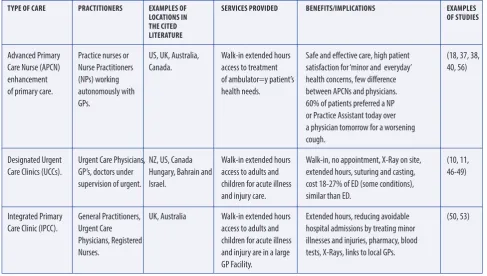
Advanced Primary Practice nurses or US, UK, Australia, Walk-in extended hours Safe and effective care, high patient (18, 37, 38, Care Nurse (APCN) Nurse Practitioners Canada. access to treatment satisfaction for ‘minor and everyday’ 40, 56) enhancement (NPs) working of ambulator=y patient’s health concerns, few difference
of primary care. autonomously with health needs. between APCNs and physicians. GPs. 60% of patients preferred a NP
or Practice Assistant today over a physician tomorrow for a worsening
cough.
Designated Urgent Urgent Care Physicians, NZ, US, Canada Walk-in extended hours Walk-in, no appointment, X-Ray on site, (10, 11, Care Clinics (UCCs). GP’s, doctors under Hungary, Bahrain and access to adults and extended hours, suturing and casting, 46-49)
supervision of urgent. Israel. children for acute illness cost 18-27% of ED (some conditions), and injury care. similar than ED.
Integrated Primary General Practitioners, UK, Australia Walk-in extended hours Extended hours, reducing avoidable (50, 53) Care Clinic (IPCC). Urgent Care access to adults and hospital admissions by treating minor
Physicians, Registered children for acute illness illnesses and injuries, pharmacy, blood Nurses. and injury are in a large tests, X-Rays, links to local GPs.
of medications removed the need to access urgent care (see Table 2). [31] Thirdly, they can diagnose and dispense medications for conditions traditionally managed by a doctor. This has been expedited by legislation switching medications from prescription to non-prescription or pharmacy-only. [32] Lastly, pilot cases of point of care testing in the United States have found cost savings when testing and treating Group A Streptococcus. [33] Also in the United States, examination, testing and treating, giving results and working collaboratively with a physician for treatment of sexually transmitted infections has been successfully trialled. [34] In Australia, pharmacists have found screening for chlamydia in asymptomatic women presenting for emergency contraception was regarded by consumers as highly convenient and highly appropriate. [35] In addition to the aforementioned interventions, the Pharmacy Guild in Australia is currently seeking to follow other countries in making pharmacy the first port of call for minor ailments such as coughs and colds, urinary tract infections and sexually transmitted infections, vaccinations, prescriptions for stable chronic conditions like diabetes, hypertension and hypercholesterolemia as well as referral of mental health patients who are deteriorating. [36] For those requiring more than basic treatment, the next healthcare model to be considered is the Advanced Primary Care Nurses (APCN).
Advanced nurse enhancement of primary care
ACPNs working alongside doctors assist with or undertake the care of ‘minor’ and ‘everyday’ health concerns. Various registered nurses work to enhance primary care, including practice nurses and nurse practitioners (NPs). [37] Patient satisfaction with APCNs is high. [18,37] Three studies showed APCN quality comparable with physicians. [37-39] Another study showed similar impact for APCNs and GPs for up to 90% of health needs of ambulatory patients. [37] A subtype of APCN is the NP whose role is relatively new to Australia. From 2010, Medicare provider rights and Pharmaceutical Benefits Scheme rights have been provided for NPs to work in private practice to independently diagnose and treat some health conditions but in collaboration with a GP. [40] Consumers from Australia and the United States are open to accepting a greater role for NPs if it means sooner treatment (see Table 2). [41] Australian consumers are also open to a greater role from NPs for minor and everyday health concerns if they have appropriate training. [40] A systematic review showed that NPs could provide levels of care that are at least equivalent to that provided by physicians. [38] A federally funded randomised controlled trial by nurse and physician researchers of primary care patients found comparable outcomes when NPs and physicians function
equally as primary care providers in the same medical centre with identical elements of care. [39] Thus APCNs under a doctor’s supervision have become an acceptable alternative to doctors for more minor conditions. The next model operates like an ED treating more urgent conditions than the GP but in the community and run by GPs or Urgent Care Physicians.
Designated Urgent Care Clinics
Designated Urgent Care Clinics (UCCs) provide ‘walk-in, extended hour access to adults and children for acute illness and injury care’. [42] They are common in New Zealand, United States, Hungary, Bahrain, Israel and Canada. [10, 43] A New Zealand study of 12 clinics found they predominantly provide episodic treatment for relatively young patients primarily related to a new or shortterm problem. New Zealand UCCs provide X-Ray on site, extended hours (a minimum of twelve hours per days and at least from 0800 – 2000, seven days per week) and are community rather than hospital-based. [11,44] They are required to be staffed by at least one Urgent Care Physician (or Urgent Care Physician undergoing vocational training in Urgent Care) who is the Medical Director [44] as well as GPs [11] and doctors with general registration both supervised by an Urgent Care Physician. [45]
A United States study of 436 clinics found UCCs are open beyond typical office hours with a broader scope of services than many primary care offices. They have characteristics similar to EDs but employ significant numbers of family physicians at lower cost. [46]
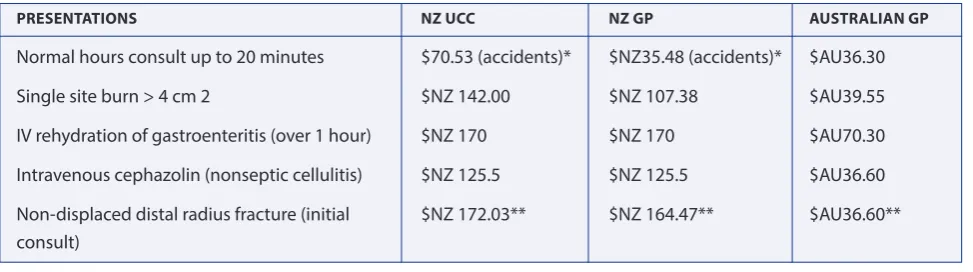
Studies assessing quality of care and costs of UCC compared to ED were favourable towards UCCs. Two studies assessed quality of care at UCCs. Both rated UCC higher in quality than ED. [47,48] Two studies found cost of attending UCC significantly less than ED. The first found costs of 18%, [46] the second found the cost of attending an UCC for treatment of otitis media, pharyngitis and urinary tract infection was 27%. [49] Comparing the costs of managing five conditions treatable at UCCs and by GPs in Australia and New Zealand also show savings compared to the remuneration low acuity cases receive in Australian ED. One unpublished calculation of the cost of nonurgent patients treated in ED based on the number of after-hours and nonadmitted ED attendances at $AU360 (range $240 - $480). Table 3 depicts the cost differences between New Zealand and Australia.
of their success. The last new model potentially combines aspects of traditional GP and UCCs.
Integrated Primary Care Centres
An alternative model, which is able to treat patients with NLTUC, is the Integrated Primary Care Centre (IPCC). Still developing, it combines horizontal integration with Radiology and Pharmacy and vertical integration with hospitals to treat minor injuries and illnesses that would otherwise require ED treatment. [50] Studies are emerging showing an association between higher continuity of care in GP and fewer hospital admissions for ambulatory care sensitive conditions even with larger practices. [51] However, the benefits of treatment of NLTUC in an IPCC or situating an UCC in an IPCC are not known.
The five newer models of community healthcare described above are potentially more effective and efficient than EDs for management of patients with NLTUC. The applicability of these models to the Australian context requires further studies.
Discussion
This narrative review shows the strengths of five models capable of treating patients with NLTUC in Australia. Some of these reviews are from countries outside Australia including rural contexts but present examples of successful initiatives showing promise for management of NLTUC in Australia. A proposed next step in establishing these models is to create pilots in Australia to enable Health Economic Analysis, assess the gaps and improve on the weaknesses.
Community pharmacists offer a wide range of services. These services include providing advice, dispensing emergency supplies of medications, diagnosing and treating conditions with medications that have been changed from
prescription to non-prescription, dispensing targeted repeat prescriptions and performing limited point of care testing and treatment of conditions. These services have been well received by patients. Weaknesses highlighted by patients and easily remedied include lack of privacy and lack of access to medical records by the pharmacist. [52] Still unknown are the morbidity and mortality outcomes as a result of this initiative.
NPPs including PP and ECP treat more people in their own homes with high rates of satisfaction, less cost and no significant difference in mortality. However, further investigation is required in order to quantify numbers of unplanned presentations to GPs, repeat standard ambulance callouts and presentation to other hospitals.
Advanced nurse enhancement of primary care helps doctors treat every day and minor health concerns, especially when an appointment with the GP is not available. The weaknesses of this model are that APCN consultations are longer with more investigations, higher recall rates and referrals. Studies on costs were inconclusive with a United Kingdom literature review showing increased costs [37] and a United States systematic review finding APCN care less expensive compared with physician provided care. [18] The United Kingdom literature review found evidence of shorter waiting times and effective substitution for doctors in some areas by APCNs but a slower throughput and higher referral rate. [37] Working with an APCN meant family doctors were more likely to see patients with more serious or complex conditions. [37] Regardless of whether or not workloads and costs reduce, APCNs treating patients with NLTUC are a solution to workforce shortages. [38] Yet to be ascertained for the Australian healthcare system is how nurses can best work with GPs to efficiently and cost effectively complement Table 3: Costing of 5 lower acuity presentations in Australian and NZ UCC and GP
PRESEntAtionS nZ Ucc nZ GP AUStRAliAn GP
Normal hours consult up to 20 minutes $70.53 (accidents)* $NZ35.48 (accidents)* $AU36.30
Single site burn > 4 cm 2 $NZ 142.00 $NZ 107.38 $AU39.55
IV rehydration of gastroenteritis (over 1 hour) $NZ 170 $NZ 170 $AU70.30
Intravenous cephazolin (nonseptic cellulitis) $NZ 125.5 $NZ 125.5 $AU36.60
Non-displaced distal radius fracture (initial $NZ 172.03** $NZ 164.47** $AU36.60** consult)
Source: (14, 57)
*In NZ non-accident related presentations are funded under a complicated capitation model requiring patients to attend their normal General Practice or an Urgent Care Clinic associated with their practice in order to assess government subsidized care.
the doctor’s role in treating NLUC when the clinic is open or closed. It is not known to what extent nurse prescribing rights, level of experience or maturity of the service affect the length and quality of consultations. [37] There is also little known about long term outcomes such as nurse failure to diagnose certain conditions. [37]
Comparisons of costs to treat similar conditions in UCC and EDs show that significant savings can be made should this model be initiated. Table 3 shows that New Zealand UCCs are paid significantly more than Australian GPs but still significantly less than in EDs. The lack of availability of funding limits the potential impact the Urgent Care Model could have in Australia to UCCs that are publicly funded.
IPCCs could combine the continuity of care from nurses, doctors and having patients’ notes with UCC services. Like many western countries, Australia has invested in IPCCs [53] but as yet there is no drive to empower this model to take its place as a model of primary care for management of patients with NLTUC. This highlights the need for further study to gain more knowledge about the effectiveness of the new models of community healthcare and factors that will ensure the viability of such models in the Australian context.
conclusion
A review of the literature found that ED presentations are increasing at an unsustainable rate. The investigation found thirteen non-traditional entry points to the health system for patients with NLTUC currently in use in the western world. Of these, five were identified as having potential to contribute to the management of NLTUC in Australia.
To progress with the introduction of these models, it is suggested that the common NLTUC presenting to primary care can be identified, studied and assessed in order to scope intervention studies which involve teaching protocol-driven management of a limited range of conditions to suitably qualified health professionals other than doctors. The models could be piloted with special effort given to assessing proportions of patients representing and complications. Then, economic cost benefit analysis can be undertaken for the models to better equip health sector managers to make important strategic decisions about appropriateness of each of the models in various contexts. Consumer participation in developing these models is vital and future research should include a study of consumer preferences and model acceptability.
Finally, GPs could be interviewed to ascertain how these emerging entry points could co-exist within the existing framework to manage patients with NLTUC.
competing interests
The authors declare that they have no competing interests.
References
1. Lowthian JA, et al. Demand at the emergency department front door: 10-year trends in presentations. Med J Aust. 2012;196(2):128. 2. Johnson PJ, et al. Disparities in potentially avoidable Emergency
Department (ED) care ED visits for ambulatory care sensitive conditions. Medical Care. 2012;50(12):1020-1028.
3. McCreedy P, et al. Transforming your care - a Review of Health and Social Care in Northern Ireland. 2011.
4. Berry A, Brousseau D, Brotanek JM, Tomany-Korman S, Flores G. Why do parents bring children to the emergency department for nonurgent conditions? A qualitative study. 2008. Amulatory Pediatrics. 2008;8(6):360-7):360-7.
5. Canadian Health Services Research Foundation. Myth: Emergency room overcrowding is caused by non-urgent cases. J Health Serv Res Policy. 2010;15(3):188-189.
6. The Royal College of Emergency Medicine. Time to Act - Urgent Care and A & E: the patient perspective. 2015.
7. Knowles E, O’Cathain A, Nicholl J. Patients’ experiences and views of an emergency and urgent care system. Health Expectations. 2012;15(1):78-86.
8. Mitchell GK, et al. Systematic review of integrated models of healthcare delivered at the primary–secondary interface: how effective is it and what determines effectiveness? Aust J Prim Health. 2015;21(4):391-408.
9. Reiss-Brennan B, et al. Association of integrated team-based care With healthcare quality, utilization, and cost. JAMA. 2016;316(8): 826-834.
10. Zimmerman DR. Community-based urgent care in Israel and worldwide. Isr J Health Policy Res. 2013;2(1):38.
11. Hider P, Lay-Yee R, Davis P. Practitioners, patients, and their visits: a description of accident and medical (A & M) clinics in New Zealand, 2001/2. 2007:40-51.
12. Australian Institute of Health and Welfare. Australia’s Health 2014 The 14th biennial health report of the Australian Institute of Health and Welfare. 2014. Canberra: AIHW; 2014.
13. National Association for Medical Deputising, After Hours Medical Care Services in Australia NAMDS After Hours Primary Medical Care Summary Paper 2014. 2014.
14. Australian Government Department of Health. MBS Online Medical Benefits Schedule. 2016.
15. Turner J, et al. Impact of the urgent care telephone service NHS 111 pilot sites: a controlled before and after study. BMJ Open. 2013; 3(11):8.
16. McCaskill S, et al. Effectiveness of an on-site health clinic at a self- Insured university: a cost-benefit analysis. Workplace Health and Safety. 2014; 62(4):162-9; quiz 170.
17. Edwards M, Bobb C, Robinson SI. Nurse practitioner management of acute in-hours home visit or assessment requests: a pilot study. Br J Gen Pract. 2009;59(558):7-11.
19. Tohira H, et al. The impact of new prehospital practitioners on ambulance transportation to the emergency department: a systematic review and metaanalysis. Emerg Med J. 2014; 31(e1):e88-e94.
20. Gauld NJ, et al. Widening consumer access to medicines: a comparison of prescription to non-prescription medicine switch in Australia and New Zealand. PLoS One. 2015;10(3):e0119011. 21. Lowthian JA, et al. Increasing utilisation of emergency ambulances.
Aust Health Rev. 2011;35(1):63-9.
22. Mason S, et al. The evolution of the emergency care practitioner role in England: experiences and impact. Emerg Med J. 2006; 23(6):435-439.
23. Bigham BL, et al. Expanding paramedic scope of practice in the community: a systematic review of the Llterature. Prehospital Emergency Care. 2013;17(3):361-372.
24. Blacker N, Pearson L, Walker A. Redesigning paramedic models of care to meet rural and remote community needs, in 10th National Rural Health Conference. NRHA: Canberra; 2009. 25. Mason S, et al. Effectiveness of paramedic practitioners in attending
999 calls from elderly people in the community: cluster randomised controlled trial. BMJ. 2007;335(7626):919-919.
26. Hoyle S, et al. Introduction of an extended care paramedic model in New Zealand. Emerg Med Australas. 2012;24(6):652-656. 27. Gray JT, Walker A. Avoiding admissions from the ambulance
service: a review of elderly patients with falls and patients with breathing difficulties seen by emergency care practitioners in South Yorkshire. Emerg Med J. 2008;25(3):168-171.
28. O’Keeffe C, et al. A community intervention trial to evaluate emergency care practitioners in the management of children. Arch Dis Child. 2011;96(7):658-663.
29. Swain AH, et al. Patient satisfaction and outcome using emergency care practitioners in New Zealand. Emerg Med Australas. 2012; 24(2):175-180.
30. Williams KA, et al. Non-prescription medicines and Australian community pharmacy interventions: rates and clinical significance. Int J Pharm Pract. 2011;19(3):156-65.
31. Morecroft CW, et al. Emergency supply of prescription-only medicines to patients by community pharmacists: a mixed methods evaluation incorporating patient, pharmacist and GP perspectives. BMJ Open. 2015;5(7):10.
32. Gauld N, et al. Innovations from ‘Down-Under’: A focus on prescription to non-prescription medicine reclassification in New Zealand and Australia. SelfCare. 2012;(3(5)):88-107.
33. Klepser DG, Bisanz SE, Klepser ME. Cost-effectiveness of pharmacist provided treatment of adult pharyngitis. Am J Manag Care. 2012;18(4):E145-E150.
34. Deppe SJ, et al. Expanding the role of a pharmacist as a sexually transmitted infection provider in the setting of an urban free health clinic. Sex Transm Dis. 2013;40(9):685-8.
35. Gudka S, et al. To develop and measure the effectiveness and acceptability of a pharmacy-based chlamydia screening intervention in Australia. BMJ Open. 2013;3(8).
36. Tambassis G. Pharmacy guild of Australia: Expanding the role of pharmacists. Australas J Pharm. 2015;96(1137):58.
37. Bonsall K, Cheater FM. What is the impact of advanced primary care nursing roles on patients, nurses and their colleagues? A literature review. Int J Nurs Stud. 2008;45(7):1090-1102. 38. Elsom S, Happell B, Manias E. Nurse Practitioners and medical
practice: opposing forces or complementary contributions? Perspect in Psychiatr Care. 2009;45(1):9-16.
39. Hansen-Turton T, et al. Convenient care clinics: the future of accessible healthcare. Disease Management. 2007;10(2):61-73.
40. Parker R, et al. How acceptable are primary healthcare nurse practitioners to Australian consumers? Collegian. 2013;20(1):35-41. 41. Dill MJ, et al. Survey Shows Consumers Open To A Greater Role For
Physician Assistants And Nurse Practitioners. Health Affairs. 2013; 32(6):1135-42.
42. Urgent Care Association of America. Urgent Care Association of America Urgent Care Industry Information Kit. 2013. P.1. 43. Sibbald B. The ER alternative: urgent care clinics coming of age.
CMAJ. 2000;162(7):1037-1038.
44. Urgent Care Standard 2015. Royal New Zealand College of Urgent Care. Auckland; 2015.
45. Medical Council of New Zealand. Vocational Registration. 2017 [cited] 2017 11/02/2017]. Available from: https://www.mcnz.org. nz/get-registered/scopes-of-practice/vocational-registration/. 46. Weinick R, Bristol S, DesRoches C. Urgent care centers in the U.S.:
findings from a national survey. Bio Med Central Health Services Research. 2009;9(1):79.
47. Mehrotra A, et al. Comparing costs and quality of care at retail clinics with that of other medical settings for 3 common illnesses. Annals Intern Med. 2009;151(5):321-328.
48. Qin H, et al. Quantitative comparisons of urgent care service providers. Int J Healthcare Qual Assur. 2015;28(6):574-594. 49. Mehrotra A, et al. Retail clinics, primary care physicians, and
emergency departments: a comparison of patients’ visits. Health Aff. 2008;27:1272-1282.
50. National Health Service London Health Programmes. Pioneering polyclinics to transform patient care across London. 2009. 51. Barker I, Steventon A, Deeny SR. Association between continuity
of care in general practice and hospital admissions for ambulatory care sensitive conditions: cross sectional study of routinely collected, person level data. BMJ. 2017;356.
52. Abukres SH, Hoti K, Hughes JD. Patient attitudes towards a new role for pharmacists: continued dispensing. Patient Preference and Adherence. 2014; 8:1143-1151.
53. Australian Government Department of Health. GP Super Clinics: National Program Guide 2010 - Information about national arrangements for the GP Super Clinics Program. 2010. Available from: http://www.health.gov.au/ internet/main/publishing.nsf/ Content/pacd-gpsuperclinics-ProgramGuide2010
54. Dixon S, et al. Is it cost effective to introduce paramedic practitioners for older people to the ambulance service? Results of a cluster
randomised controlled trial. Emerg Med J. 2009;26(6):446-51. 55. Gauld N, et al. Innovations from ‘down-under’: a focus on
prescription to non-prescription medicine reclassification in New Zealand and Australia. SelfCare. 2012;(3(5)):88-107.
56. Parker R, et al. What primary health-care services are Australian consumers willing to accept from nurse practitioners? A National Survey. Health Expectations, 2014;17(5):733-740.