The
1Faculty of Ed Corresponden Received: Dec doi:10.11114/j *This Project project (Projec Abstract The objective concepts of e research, the consecutively. change proces point. Concep was found tha examined, it w of the words concepts in pr associated in t and emergenc keywords eme creating conce Keywords: ge 1. Introductio The extensive cycle signific threatens hum human being it clean and g definition in 1
requirements
quality of hum environment a quality life sty important. Wh 2010; Kaya& on the level o well-converte In his study ex (2009) discove attitude. He fo that the curric environmental
e Effect o
ducation, Ahi E nce: Cagri Oztu
cember 14, 20 jets.v5i2.2077
was supported ct Number: AE
of this study environmental
students parti . The data of th ss was examin ptual network w
at there is a p was observed t associated to re-test emerge the post-test. F ce of the conn erged in upper eptual structur eography educ on
e usage of tech antly harm to man health, pro
started using t green. Accord 1987, it is said
without endan
man beings an and all living yle in harmony hen different c
Tomal, 2011) of knowledge d into an opera xamining the c ered that learni ocused that the culums were d l education. W
of Out-of
En
Evran Univers urk Demirbas,
16 Acc U
d by the Ahi E EÜ- SBA-11-1
is to determin problems. Th cipated in out he research we ned in collecte was constituted positive shift in that there is an the keywords d in post-test w Finally, when
nection shows r tabs out of p
e.
cation, cognitiv
hnology and v the human it otecting the ha the concept of ding to Brundt d “the human k ngering his ab
nd economic d beings on ear y with the natu curriculums of
, it is observed related to fam ational level th current middle ing outcomes in ey are inadequa designed by ai Within this cont
f School A
nvironme
Cagri O sity, Kirsehir, 4 Faculty of Ed
epted: January URL: http://dx.
Evran Univers 19).
ing the change here were 21t tdoor activitie ere collected v ed data, and th d by using cut-n studecut-nts’ co n upturn in the s in pre-test w which shows t pre-test and p s that qualitat post-test results
ve structure, co
volatile environ tself. Along w armony of nat sustainability tland (1987),
kind has the ab ility to respon
evelopment, ta rth has a role ure and increa f different lesso
d that it is aim miliarizing and hat will offer s
school curricu n primary scho ate in terms of iming to prote text, this resear
232
Activities
ental Edu
Ozturk Demirba40100, Turkey ducation, Ahi E
y 23, 2017 doi.org/10.111
sity Scientific R
e in secondary th grades stud s on environm via word assoc heir pre-test an -off points. Wh onceptual chan e number of an were limited. B that students’ i post-test are co tive change ac s. This specifi
onceptual chan
nment’s trade-with the fact i ture and main after the scien United Nation
bility to ensure nd to the next g
aking into con in sustainable asing environm ons are examin m to raise envir
d protecting en ocial participa ulums in terms ool curriculums f developing sk ecting the envi
rch was design
Jo I
s on Conc
ucation*
as1 y Evran Universi Online Pub 114/jets.v5i2.2 Research Projy school studen dents of two mental educati
iation test as p nd post-test res hen pre-test an nge. In additio nswered words Besides, the c
independent k ompared, both ccompanies to es that the out
nge, word asso
-off with the p s that, the des ntaining its sus ntific work beg ns Environme
e a maintainab generations’ re
nsideration the e development mental awarene ned (Tanriverd ronmental susta nvironment. H ation when the of sustainable s mostly have t kill, understand ironment wher ned to emphasi
ournal of Educa Vol. 5 SSN 2324-805X
Published URL
ceptual C
ity, Kirsehir, 4
blished: Januar 077
ects Coordinat
nts’ cognitive middle schoo ion programm pre-test and po sults were ana nd post-test res on, when their s in post-test. H onnections no knowledge rela are the increa o quantitative t-of school act
ociation test
problems of pr struction of th stainability be gins to protect ent and Develo
ble developmen equirements.”
e life quality an t. In this persp ess to protectin di, 2009; Cebe
ainability awa However, the i literature is re e environmenta the aim of deve ding and value re we live, rat ize the using o
ation and Trainin , No. 2; Febru X E-ISSN 2 by Redfame P L: http://jets.redf
Change in
40100, Turkey.
ry 23, 2017
tion Unit supp
structure relate ls in Kirsehir mes during 5 w
ost-test. The co alysed by using
sults were com r concept netw However, the ot provided am ated to the key ased in respons change. Furth tivities is succ
roduction-cons he life chain i ecame necessar
environment a opment Comm
nt by meeting
In developing nd continuity pective, establ ng nature are c esoy & Donme areness among information is eviewed. al education, Ta
eloping knowl e. In addition, ther than a su out-of school a
ng Studies uary 2017 324-8068 Publishing fame.com
ports this
ed to the r. In this weekends onceptual g cut-off mpared, it work was numbers mong the ywords is se words hermore, essful in
sumption n nature rily. The and keep mission’s
his daily
g the life of green lishing a critically ez Sahin, students still not
communing-with-nature activities is an obligation in order to reinforce middle school students’ knowledge and attitude with skills, understanding and value works within this context of sustainable environmental education.
During the literature reviewed, studies are found 8th grade students’ conceptions of environmental problems on primary school level and of environmental problems and its sub-concepts via comics strips (Secgin, Yalvac & Cetin, 2010; Ersoy and Turkkan, 2010), their attitudes towards environment (Gokce vd., 2007; Aslan, Sagır & Cansaran, 2008), primary school’s sensitivity of environmental education activities (Simsekli, 2004), the effect of nature education on conception and behaviour (Ozdemir, 2010), students’ opinions on environmental problems (Meydan & Dogu, 2008) and environment knowledge (Atasoy & Erturk, 2008). However, the determination of the change of cognitive structure related to environmental problems and concepts on middle school level via word associating test (WAT) was not encountered. Perceptions of preschool teachers on environmental problems are examined under six different themes as causes, effects, types, measures, worry/pessimism and other in Ozata Yucel ve Ozkan (2016) study. Word association test was used in this study. As both scope and range of age are different, it is thought that the current study will contribute new dimensions and findings in existing literature.
The main reason behind choosing word association test as a data collection tool is that, new concepts are built on the existing concept in constructivist approach. Student makes sense of the world by reconstructing the information that he/she newly learnt by comparing it to the old ones (Ozmen, 2009). In constructivist learning approach, student’s prior knowledge is quite important since he/she builds the new information over it. If there is a conceptual error or misunderstanding, it should be observed before starting the new learning and it should continue after learning. The word association tests are decent method in determining misconceptions and showing how the concept is in relation with the other concepts in the mind of an individual. The word association tests are used in order to reveal students’ comprehensions at cognitive level and to determine the relations among the concepts in this structure (Bahar et al., 2006; Akman & Kocoglu, 2016; Atabek-Yigit, 2016; Karatekin & Elvan, 2016; Kaya & Tasdere, 2016; Ayaz, Karakas and Sarikaya, 2016).
In word association test, the students put in order the words that come into their minds about the keyword regarding the given subject within certain time duration. It is thought that student’s sequential response to any keyword shows semantic closeness/distantness by presenting the relations in this structure. Closeness or distantness presents the distance of two concepts in memory semantically (Bahar & Ozatli, 2003). Word association test that will be implemented as a pre-test before learning presents the student’s knowledge about that subject, his/her cognitive structure and misconception. The word association test that will be replicated after learning occurred has the feature of post-test. By comparing the results of pre-test and post-test, the changes in the student can be observed. It can be exhibited whether the misconception disappeared or whether the new one is added; the level of conceptual change; or the deficiencies in learning. By seeing the frequencies related to the keywords in pre-test and post-test, drawing a conceptual networks which will help to the teachers in controlling all these outputs.
In the conclusion of the literature review, we found that word associating tests are an effective technique in revealing the cognitive structure, determining the conceptual change and determining the misconceptions (Bahar et al. 1999; Bahar, 2001; Bahar & Ozatli, 2003; Ozatli, 2006; Yalvac, 2008; Ozatli & Bahar, 2010; Ercan, Tasdere & Ercan, 2010; Perker, 2011; Timur, 2012; Gunes & Gozum, 2013; Kurt, Ekici & Aksu; 2013; Polat, 2013; Dincol Ozgur & Yilmaz, 2013; Kaya & Akis, 2015; Karatekin & Elvan, 2016; Kaya & Tasdere, 2016). In order to reveal comprehension and observe the change of cognitive structure, this method is commonly used in literature. In some studies, word association test is also used for detection of permanence (Polat, 2013).
The aim of this study is to determine the change in cognitive structures of middle school students regarding the environmental problems. This study was designed by considering especially outdoor activities/practices and fieldworks will make differences in student about the operational level, value, skill, and practices determined as deficiency in programme reviews. Within this context, word association test was used as reliable data collection tool. It was aimed to make suggestions about the conceptual structure and teaching of environmental problems on the level of middle school education.
2. Method
2.1 Model of Research
Among pre-experimental models, one sample pre-test and post-test design was used in the study. Independent variable (outdoor practices) is implemented on a randomly formed group (Karasar, 2008: 96). In that model, tests are carried out before implementation of an independent variable and after implementation.
2.2 Participants
Journal of Education and Training Studies Vol. 5, No. 2; February 2017
234
students who were 7th grades and studying at Kirsehir city centre Prof. Dr. Erol Gungor Middle School and Cacabey Middle School. The further details of sample size are presented in Table 1. Meanwhile, primary school is defined as a school for children between 6 and 9 years old in Turkey. Also middle school is defined as a school for children between 10 and 13years old in Turkey.
Table 1. Distribution of the study group according to the school and gender
Schools Female Male n
Prof. Dr. Erol Gungor Middle School 5 5 10
Cacabey Middle School 6 5 11
Total 11 10 21
2.3 Procedure
In the research, the students participated in out-of school practices and environmental education programme for 5 weekends consecutively. Within the scope of “Hardworking Bees Live at Peace with the Nature” project, the students participated in outdoor and field practices along with the theoretical information they learned. Before the practice, word association test was carried out and the students completed practices such as Communication Network, a Sea Tale (Drama), I Designed the Best Poster, Let’s Make our own Fabric Bag, Biological Diversity Memory Game, I Painted Environmental Pollution, Fish Bone, The Story of Environmental Pollution etc. and they practiced each theme and practice outdoor. In addition, students had the chance to make observations in the process by participating in outdoor works and visits. At the end of the process, word association test (WAT) was applied again as a post-test.
2.4 Data Collection Tool
In the word association test (WAT) which is used as data collection tool, 10 keywords were used within the frame of the themes determined within the scope of the project. The project, which is designed in the main phenomenon of the environmental problems, is based on these words and the words are thought as the most important ones for the content. In selecting the words, middle school education curriculum programmes were examined and their convenience was accepted by two field professions and one field educator. Each word was designed to take place in a separate page and ten blanks were left for each keyword. Besides, the students were asked for relevant sentences at the end of the page for each word. The sample for the first keyword is presented below.
Environmental Problems ……… Environmental Problems ……… Environmental Problems ……… Environmental Problems ……… Environmental Problems ……… Environmental Problems ……… Environmental Problems ……… Environmental Problems ……… Environmental Problems ……… Environmental Problems ………
Related Sentence ………
Chosen words were environmental problems: air pollution, water pollution, soil pollution, biological diversity, noise pollution, and magnetic pollution, urbanization, recycling and saving. The students were informed about word association test before the pre-test. After that, word association test was implemented. Sample work was also carried out with students in the process of word association test. In literature, while there are studies in which 30 seconds were granted for each word (Bahar, Johnstone & Sutcliffe, 1999; Bahar & Ozatli, 2003; Nakiboglu, 2008; Timur, 2012; Gunes & Gozum, 2013; Kaya & Akis, 2015), there are also some studies in which 1 minute is granted (Ercan, Tasdere & Ercan, 2010; Oner Armagan,2015). In his study on prospective teachers, Kurt (2013) granted 40 seconds for students. 1 minute was granted also in the current study since the sampling and working groups are at secondary school. In above mentioned studies, in which 30 seconds were granted and the study in which 1 minute is granted is at primary school level. And another reason to grant 1 minute in this study is to ensure that the students can write a relevant sentence under each word. Within this time, students wrote the words respectively that they think to be in relation within the keyword.
are brought to his/her mind by the concept he/she write as response in the place of keyword. In order to prevent this risk probability, the keyword is implemented to the students by rewriting in each line. A similar implementation was conducted in the studies of Bahar & Ozatli (2003) and Polat (2013). In the implementation process a special attention was paid to passing to the other concept when each one’s time was over. Attention was shown to ensure that the students write relevant sentence under each keyword. As Nartgun (2006) mentions, relevant sentences were gathered and analysed in order to check whether the response words are related to keywords only on the level of remembering and whether this significance is true or not. At the end of theoretical work, the practical and fieldworks practiced for 5 weekends consecutively, word association test was implemented to the students as post-test.
2.5 Data Analysis
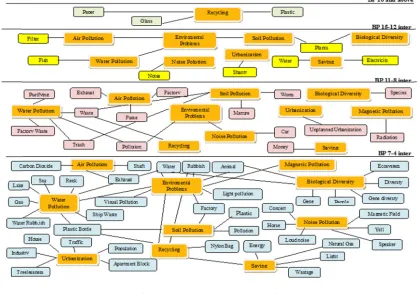
In the analysis of data, first of all, the frequency table number of response words given by the students for each concept in pre-test and post-test were formed. For each concept, the increase or decrease at the number of the words used by the students in pre-test and post-test was checked descriptively. In the second step, descriptive analysis table was constituted. The table is related to the mostly repeated first three words for each keyword in pre-test and post-test. In the third step of analysis, concept network drawings related to the pre-tests and post-tests were performed by using the cut-off point (CP) put by Bahar et al. (1999). In this technique, cut-off point is defined according to the number of words that are mostly stated in relation to keywords. However, the number of words answered should be 3-5, less in number than the total in defining cut-off point. Then, the responses found over this frequency are written to the section in the first part of concept network. By lowering to the cut-off point as much as the defined interval, the process is maintained until all the keywords emerge in concept network. Concept network constituted according to pre-test formed in Figure 1 and the concept network formed according to the post-test was constituted in Figure 2 with this technique. 3. Findings
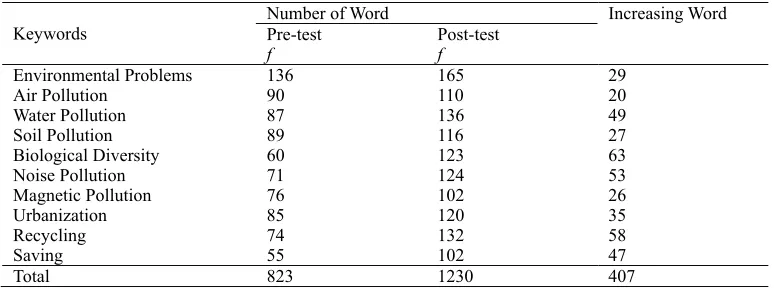
In Table 2, the number of words provided by middle school students for each keyword in WAT in pre-test and post-test was presented. The quality and number of the produced words in WAT may be used in revealing manner of understanding about concept and whether it is understood or not.
Since, whether a concept is understood or not is related to the other words that the student associated with (Bahar et al., 2006). In another words, as a concept which is not associated with any word is meaningless in the mind of the student, it can be claimed that the meaning increases as the number of the word associated to the concept increases (Ercan, Tasdere & Ercan, 2010).
Table 2. Number of words in the responses to for the keywords
Keywords
Number of Word Increasing Word
Pre-test
f Post-testf
Environmental Problems 136 165 29
Air Pollution 90 110 20
Water Pollution 87 136 49
Soil Pollution 89 116 27
Biological Diversity 60 123 63
Noise Pollution 71 124 53
Magnetic Pollution 76 102 26
Urbanization 85 120 35
Recycling 74 132 58
Saving 55 102 47
Total 823 1230 407
When the Table 2 was examined, it was found that while total response, word number in pre-test before the implementation is 82, total response word number in post-test after the implementation is 1230. When number of the words answered related to all keywords are analysed and upturn is observed. The most upturn is related to keyword called biologicaldiversity in number 63, the least increase is related to keyword called airpollution in number 20. The increase in words from most to least is as in the following: biological diversity (63), recycling (58), noise pollution (53), water pollution (49), saving (47), urbanization (35), environmental problems (29), soil pollution (27), magnetic pollution (26) and air pollution (20). After the implementation, it is seen that there is a rise in the number of the words as 407. Within this scope, it can be said that there is an increase in understanding and comprehension of the keywords at the end of implementation. In addition, according to the pre-test results, it was found that the students have the least number of answered words on the concepts of saving (55) and biological diversity (60), and they have the highest number of answered words related to the concept of environmentalproblems (136).
Journal of Educ
Table 3. Stude
Keywor Environ Problem Air Poll Water P Soil Pol Biologi Diversit Noise P Magnet Pollutio Urbaniz Recycli Saving The words sta answered wor in post-test w keywords in p
soil pollution, environmental
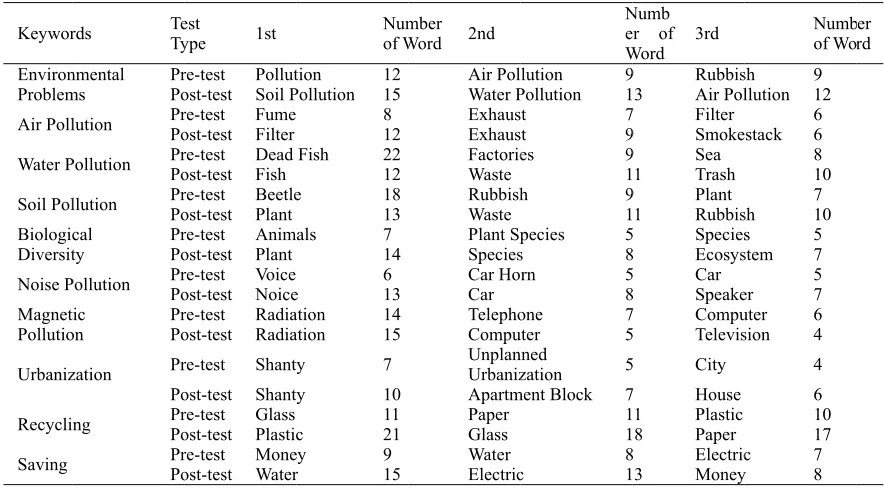
According to frequency tabl the responses s
The fact th they do no
cation and Train
ents’ first three
rds TeTy nmental
ms PrPo
lution PrPo Pollution PrPo llution PrPo cal
ty PrPo
Pollution PrPo tic
on PrPo
zation Pr Po ing PrPo Pr Po ated by middl rds are the nec were the mean pre-test and po
air pollution, l problems, wa
pre-test and po le has been me stated by secon
hat middle sch ot have adequ
ning Studies
e words and nu
est
ype 1st re-test Pollut ost-test Soil P re-test Fume ost-test Filter re-test Dead ost-test Fish re-test Beetle ost-test Plant re-test Anim ost-test Plant re-test Voice ost-test Noice re-test Radia ost-test Radia re-test Shanty ost-test Shanty re-test Glass ost-test Plastic re-test Mone ost-test Water e school stude cessary ones fo ningless word ost-test are chan
noise pollutio ater pollution,
ost-test, the re entioned before ndary school st
hool students c uate knowledg
umbers of word
Num of W
tion 12
Pollution 15 8 12
Fish 22
12
e 18
13
mals 7
14 6
e 13
ation 14
ation 15
ty 7
ty 10
11
c 21
ey 9
r 15
ents for each k or the compreh ds used. Altho nged, they did
on and magnet biological div
sults are relate e, and the conc tudents and the
Figure 1. Pre could answer o ge on environm
236 ds regarding e
mber Word 2nd Air Pol Water P Exhaus Exhaus Factorie Waste Rubbish Waste Plant Sp Species Car Ho Car Telepho Compu Unplan Urbaniz Apartm Paper Glass Water Electric keyword both hension of key ough places o d not differenti
tic pollution ha
versity, and urb
ed to the assoc ceptual networ e comments in
e-test concept n only two of 10 mental problem
ach of keywor N e W lution 9 Pollution 1 st 7 st 9 es 9 1 h 9 1 pecies 5 s 8 rn 5 8 one 7 uter 5 nned zation 5
ment Block 7 1 1 8
c 1
in pre-test an ywords. It is d of the answere
iate. In pre-test as two similar
banization hav ciated answered rk was created.
relation to this
network 0 keywords in ms and its sub
Vol.
rds Numb er of Word 3rd
9 Rubbis
3 Air Pol
7 Filter 9 Smoke 9 Sea 1 Trash 9 Plant 1 Rubbis 5 Species 8 Ecosys 5 Car 8 Speake 7 Compu 5 Televis
5 City
7 House
1 Plastic
8 Paper
8 Electric
3 Money
nd post-test are iscovered that ed words for t and post-test answered wor e just one. d words and k . The pre-test c s network are p
n BP ≥16 level b-concepts. W
5, No. 2; Febru
Numb of Wo
sh 9
llution 12 6 stack 6 8 10 7
sh 10
s 5
stem 7 5
er 7
uter 6 sion 4 4 6 10 17
c 7
y 8
e overlap. In a t neither in pre
recycling and
, each of the k rds while the k
keywords in in concept netwo presented in Fig
l can be interp When the sched
uary 2017 er rd addition, e-test nor d saving keywords keywords terpreted rk out of gure 1.
students participated before the implementation is considered, students are expected to have learned some of these basic concepts on development or reinforcement level. In the frequency table prepared on this cut-off point, it is observed that students came up with words that are related to only water pollution and soil pollution concepts. Students associated insects (f=22) response word for the keywords of waterpollution, fish deaths (f=18) and soil pollution concept. Although environmentalproblems, one of the keywords are a central concept for overall subject, students did not mention it in tab. Actually the fact is that, they did not state any response for environmental problems and they only mentioned two of the keywords shows that they do not have sufficient knowledge. In addition, it is discovered that they did not connect a network among the concepts and they considered them independent from each other.
For BP within the range 12-15, only the environmentalproblems, which are one of the keywords of the field subject, are revealed. However, in that tab middle school students matched this concept not with other keywords but only with pollution(f=12) keyword. In this scenario, it is observed that the students cannot come up with a network in this tab among the concepts on pre-test level. As a matter of fact, the keywords that emerged in the upper tab are not seen in this tab.
For BP within the range 8-11, it is observed that 6 keywords emerged and there was a direct and indirect network with one of these concepts. In this tab, water pollution, soil pollution, environmental problems, saving, air pollution
and recycling keywords are revealed. While students established a direct network between environmentalproblems
central concept and air pollution keyword, they established an indirect network between soil pollution keyword and the word of trash. It is discovered that students structure main concept, waterpollution with sea (f=8) and factories (f=9);airpollution keyword with fume (f=9);environmental problems keyword with trash (f=10) and airpollution (f=9); soil pollution keyword with trash (f=9); saving keyword with money (f=9) and water (f=9); recycling
keyword with glass (f=11), paper (f=11) and plastic (f=10) words.
For BP 4-7, it is observed that all keywords are revealed but only an islet is generated among the keywords and there is not a network among other 8 keywords. That shows the concepts are structured disconnectedly in prior knowledge. There is only one network between key concept called environmental problems and water pollution. When the interpretation of the concepts are examined, it is observed that the students structured water pollution keyword with waste (f=6), water (f=5), trash (f=4) and petrol (f=4); environmental problems keyword with water pollution (f=7), factory (f=6), visual pollution (f=4), disease (f=4), ozone layer (f=4) and global warming (f=4); air pollution key word with exhaust (f=7), filter (f=6) and factory smoke (f=4); soil pollution keyword with death (f=6), reptile (f=6), production stop (f=6) and plastic bottle (f=5); biological diversity keyword with animals (f=6), species (f=5) and plant species (f=4); noise pollution key word with tone of voice (f=6), car (f=4) and car horns (f=4); magnetic pollution keyword with telephone (f=4); urbanization keyword with shanty (f=7), unplanned urbanization (f=6), unemployment (f=6) and city (f=4); recycling keyword with re-using (f=4); saving keyword with electricity (f=7) and thriftiness (f=6). In this cut-off point, the response words had significance scientifically. However, the case of not emergence of these response words in the upper cut-off points can be interpreted as majority of students do not have this information. No matter how each keyword is revealed in this cut-off point, it can be interpreted that the students’ prior knowledge before study is inadequate for the reasons that network could not be established among keyword and most of the keywords directly related to the subject could not be produced by the students. Besides, it should be focused that they could not establish islets in their structuring. The reason behind provided relations among keywords in pre-test can be stated that students wrote the keywords they saw in each page as response word to the keyword in the next page.
The results of renewed word association test performed after out-of school practices and fieldworks and the last drawn test concept network are presented in Figure: 2.
On BP≥16 level, the primary school students could only create response for recycling key word among 10 key words after the practice. While this key word was among BP 8-11 tab in pre-test, it upgraded two tabs after the practice. In this tab, it is found that the students structured recycling key word with the words of plastic (21), glass (f=18) and paper (f=17).
For BP 12-15, eight keywords are revealed. In pre-test, there were six keywords even in 7-14 cut-off point in pre-test. That shows there is a positive change in the students in terms of numbers. Besides, a network was created a network among four main concepts, three of which are direct and two indirect concepts. In pre-test there was a relationship in 7-4 tab and these relationships were weaker in terms of both quantity and quality. This situation shows that the conceptual change developed both quantity and quality. In this tab, while an islet is formed directly with environmental problems and airpollution, waterpollution and soilpollution concepts, an islet is formed indirectly with biological diversity concept. In addition, it can be said that the structure is scientifically correct since the response words associated with the concepts are the necessary ones in order to understand the concept.
Journal of Educ
All keywo islet-shape response w Especially is also a st Network w
used in po word is dir When the pre-that qualitativ shows that the Students’ sent encoded by ta Tasdere and E scientific info the keywords information. I associate to th In the categor were placed. I When the rele it is observed
information w
scientific and
sentences incl including mis information. T
cation and Train
ords for BP 8 ed networks w words are studi y all response w
tructural chang was created am ost-test. These
rectly associat -test and post-t ve change acco
e outdoor pract tences formed aking into cons Ercan (2010) s ormation, non-of the sentenc In the categor he response wo ry of the misco
In addition, if t evant sentences that there is a were formed i
d including sup
luding miscon sconception, This shows tha
ning Studies
8-11 came up. were formed b ied, it is observ words were sc ge.
mong seven key words have t ed with noisep
test are compa ompanies to qu tices are succe d in relation to sideration info study was ben scientific info ces formed by ry of the ones ords and the o onception, the the relevant se s formed by th numerically p in pre-test, th
perficial infor
nception in pr in pre-test tu at the learning
Figure 2. Post . This situatio by sharing mor
ved that the co cientifically sig
ywords for BP the quality of
pollution. ared, both the i uantitative chan essful in creatin o the keyword ormation and m nefited from. R ormation, and t y the students w
s including no nes not state s scientific error entence had no he students in r positive progre is number inc
rmation were e-test, this nu urned into th improves qual
238
t-test concept n on is revealed
re than one re onceptual chan
gnificance and
P 4-7. Although explaining the
increase in res nge. Furtherm ng the concept ds were examin meanings they Relevant senten
the misconcep were consider on-scientific in scientifically m rs and misconc t been written, relation to the ess in conceptu creased to 102
92 in pre-test umber decrease
e sentences i litatively.
network between cut-esponse words nge developed d networks’ gra
h it did not tak e concepts sci
sponse words a more, the keywo
tual structure. ned as well. T include. While nces were div ption. The scie red in the categ nformation, th meaningful but
ceptions in the , it is categoriz keywords in p ual change. Wh
2 in post-test t, they are 103
ed to 3 in po including sup
Vol.
-off points 4-7 s among eight both in terms adual developm
ke place in pre ientifically. On
and the emerge ords are revea
The sentences e the categorie ided into three entific accurac
gory of the on he ones that t t having daily e sentences of t zed as empty. pre-tests and po
hile 71 sentenc . While the s 3 in post-test. st-test. It is se perficial inform
5, No. 2; Febru
7 in pre-test. t keywords. W
of quantity an ment proves th
e-test, lots of w nly the horse r
ence of networ aled in upper ta
were categor es were formed
e categories in cy and their re nes including s the students c
language were the students; if
ost-tests are ex ces including s
sentences that
While there een that the s mation and s
uary 2017
Besides, When the d quality. hat there words are response rks show abs. This
ized and d, Ercan, ncluding, lation to scientific ould not e placed. f there is
xamined,
scientific are not
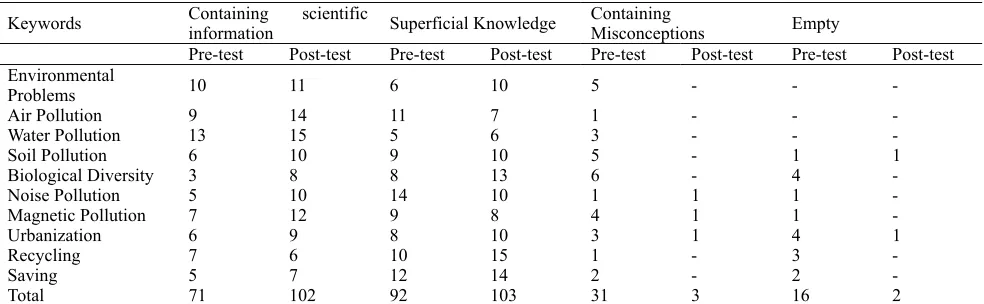
Table 4.Pre-test and post-test frequencies of students' sentences related to keywords
Keywords Containing information scientific Superficial Knowledge Containing Misconceptions Empty
Pre-test Post-test Pre-test Post-test Pre-test Post-test Pre-test Post-test Environmental
Problems 10 11 6 10 5 - - -
Air Pollution 9 14 11 7 1 - -
-Water Pollution 13 15 5 6 3 - -
-Soil Pollution 6 10 9 10 5 - 1 1
Biological Diversity 3 8 8 13 6 - 4
-Noise Pollution 5 10 14 10 1 1 1
-Magnetic Pollution 7 12 9 8 4 1 1
-Urbanization 6 9 8 10 3 1 4 1
Recycling 7 6 10 15 1 - 3
-Saving 5 7 12 14 2 - 2
-Total 71 102 92 103 31 3 16 2
While the students left 16 relevant sentence blanks empty in pre-test; there were just 2 empty sentences left in post-test. The fact that the students could not form a significant sentence related to the keywords may be indicating that they could not learn those concepts significantly (Ercan, Tasdere & Ercan, 2010). Within this context, it can be said that the students structured some keywords in post-test while they could not perform significant structuring in pre-test. In general, Table 4 point out that students’ misconception related to the keywords was cleared and the conceptual change came scientifically true.
Although the students participating in the study were expected to learn and structure the concepts used in research because those concepts are placed in the curriculums practiced at their own schools before, it is seen that education at schools related to concepts is not efficient in terms of both correlation and cognitive structuring of the concepts. Out of post-test results, it can be understood that out-of school learning practices and fieldworks are more effective in cognitive structuring and correlation among concepts.
5. Discussion and Results
With the effect of constructivist approach on the curriculum of our country, the evaluation step of the learning started to differentiate. In addition to the traditional assessment and evaluation approaches, alternative ones are started to be used. Alternative assessment and evaluation instrument increases the motivations of students in the lesson. Moreover, thanks to alternative assessment instrument by using different projects and presentations; the cognitive structures, conceptual changes and effective learning can be evaluated while the students are presenting their skills which cannot measured with the traditional tests (Hodges, Lamb, Brown & Foy, 2005). Furthermore, while the traditional measurement instrument is focused on who can and who cannot pass the course. The alternative assessment instrument purposes to check how much gains are achieved, or to check the misconceptions. If they are not attained, and if the reason for this is obtained, within this scope, in order to observe the change related to the environmental problem concepts in this study and to reveal the conceptual structure, word association test was used.
Based on the findings acquired by the pre-test and post-test results, it is proved that the word association test can be used in checking conceptual change. The increase in the word number used in pre-test and in post-test shows that there is a development in the comprehension and structuring of the keywords. In addition, it is determined that pre-test results that primary school students have the least number of response words in relation to saving (55) and biologicaldiversity
among keywords, and the most in environmental problems. When the post-test is examined, it is revealed that the primary school students have the least number of response words in relation to magnetic pollution (102) and saving
(102) and the most in environmental problems (165), water pollution (136) and recycling (132) concepts. While the least number of response words are in saving keyword in pre-test and post-test. There is two times increase in this key word. By using the word association test, teachers can observe how many the students conceptual knowledge store changed quantitatively.
Journal of Education and Training Studies Vol. 5, No. 2; February 2017
240
The first three response words of students for every concept are measured. It is observed that the response words having the highest level of frequency do not change. This reveals that new words were added to the conceptual change but the construction was made over the existing words in mind. In simple words, it is in constructivist learning, the new information was incorporated into the existing one.
When the concept networks of pre-test and post-test are compared, it is proved that while all keywords are revealed in 4-7 cut-off points in pre-test, they are revealed in 8-11 cut-off points in post-test. The emergence of all keywords in the one upper tab shows that the conceptual structures enhance significantly also the increase in response words. In pre-test concept network, the network was created only between environmental problems and water pollution keywords. This proves that the students could not establish a connection among the concept words in relation to the subject at the beginning. In post-test concept network, it is observed that there is a connection among eight keywords and islets are constituted among the concepts. These islets indicate that secondary school students also established the connections among the keywords, and they are structured other sub-keywords by associating them under the key concept of environmental problems. However, the existence of the concepts that were not associated in the post-test shows that the learning is not completed. That proves word association test is a decent assessment instrument also in terms of noticing the deficient parts of the subject.
The results of the study supports that word association test should be used in checking whether the misconceptions are cleared or not. When the relevant sentences are examined, it is observed that while the students have 31 sentences including misconception, they have 3 in post-test. Additionally, the number of the sentences including scientific information increased from 71 to 102. As the other studies in the litterateur (Bahar et al, 1999; Cardellini & Bahar, 2000; Bahar & Ozatli, 2003; Ozatli, 2006; Yalvac, 2008; Ercan, Tasdere & Ercan, 2010; Uzun, Ozsoy & Keles, 2010; Perker, 2011; Kirtak Ad & Demirci, 2012; Polat, 2013) these findings support that word association test can be used by teacher as diagnostic tool during learning and the conceptual change can be controlled.
According to the our first finding, what is actually valuable in this study is the students, who are expected to have already learnt concepts related to environmental problems within the scope of curriculum did not still accomplish the gains. Another important outcome is that extracurricular learning affects the change in cognitive structure significantly when post-test findings are taken into consideration. Within this context, the network in the pre-test indicates that the students both performed a low level of quantitative structuring and structured concepts independently from each other. When the post-test concept network is examined, it is revealed that the practice carried out is important in terms of students’ establishing a relation among the concept along with the quantitative change. In this sense, extracurricular practice and fieldworks importance in terms of environmental education should be emphasized again. In-class learning can be increased in level by adding visuals in encoding the cognitive structure of the concepts.
References
Akman, O., & Kocoglu, E. (2016). Investigation 8th grade students secondary school cognitive structure about principles of Ataturk through word association test. Journal of Education and Training Studies, 4(11), 151-162. https://doi.org/10.11114/jets.v4i11.1696
Aslan, O., Sagir, S. U., & Cansaran, A. (2008). The adaptation of environment attitude scala and determination of primary school students’ environmental attitudes. Selcuk University Journal of Ahmet Kelesoglu Education Faculty,
25, 283-295.
Atabek-Yigit, E. (2016). Investigating cognitive structures in some basic chemistry concepts via word association test.
Elementary Education Online, 15(4), 1385-1398.
Atasoy, E., & Erturk, H. (2008). A field study about environmental knowledge and attitudes of elementary school students. Erzincan University Journal of Education Faculty,10(105-122).
Ayaz, E., Karakas, H., & Sarikaya, R. (2016). Class teacher candidates’ opinions on the concept of nuclear power: the sample of independent word association test. Cumhuriyet Science Journal, 37, 42-54.
Bahar, M. (2001). A critical approach to the multiple-choice test and other methods. Educational Sciences: Theory & Practice (ESTP), 1(1), 23-38.
Bahar, M., & Ozatli, N. S. (2003). The investigation secondary school 1th grade students’ cognitive structure about basic components of creatures with word association test. Balikesir University, Institute of Science Journal, 5(2), 75-85. (Publishing Turkish).
Bahar, M., Nartgun, Z., Durmus, S., & Bıcak, B. (2006). Traditional-Alternative Assessment and Evaluation: Teacher's Handbook. Ankara: Pegem Academy Publishing.
Bilici, S. C. (2016). An examination of science teachers’ knowledge structures towards technology. International Journal of Environmental and Science Education, 11(5), 571-586.
Brundtland, G. H. (1987), Report of the World Commission on Environment and Development: Our Common Future, UN Documents Gathering a Body of Global Agreements, 20 March 1987, Oslo, http://www.un-documents.net/wced-ocf.htm. (access April 2013).
Cardellini, L., & Bahar, M. (2000). Monitoring the learning of chemistry through word association tests. Australian Chemistry Resource Book, 19, 59-69.
Cebesoy, U. B., & Donmez, S. M. (2010). A comparative study of science and technology program in terms of environmental education in middle schools. Research Journal of Biology Sciences, 3(2), 159-168.
Dincol, O. S., & Yilmaz, A. (2013). The effect of environmental education on the pre-service teacher’affective tendency towards the environment and cognitive structure. Procedia Social and Behavioral Sciences, 106, 2704-2713. Ercan, F., Tasdere, A., & Ercan, N. (2010). Observation of cognitive structure and conceptual changes through word
associations tests. Journal of Turkish Science Education, 7(2), 136-154.
Ersoy, A. F., & Turkkan, B. (2010). Analyzing social and environmental issues elementary school students reflect in their cartoons. Education and Science, 35(156), 96-106.
Gokce, N., Kaya, E., Aktay, S., & Özden, M. (2007). Elementary students’ attitudes towards environment. Elementary Education Online, 6(3), 452-468.
Gunes, H., & Gozum, A. I. C. (2013). Using the word associatıon method or detection of the effect of ecology knowledge learned in primary education on readiness of 10th grade students. Journal of Research in Education and Teaching, 2(3), 252-264.
Hodges, W. J., Lamb, P., Brown, M. H., & Foy, D. S. (2005). Assessment for all. Science Scope, January, 43-44. Karasar, N. (2008). Scientific research method. Ankara: Nobel Publishing-Publishing.
Karatekin, K., & Elvan, O. (2016). The cognitive schema of 8th grade students about democracy. Abant İzzet Baysal University Journal of Education Faculty, 16, (USBES Special İssue. II) 1405-1431.
Kaya, B., & Akis, B. (2015). Determination of cognitive structure of geography students’on weather concept through word association test. Turkish Studies, International Periodical for the languages, literature and history of Turkish or Turkic 10(7), 557-574. (Publishing Turkish).
Kaya, M. F., & Tasdere, A. (2016). An alternative measurement and assessment method for elementary turkish education: Word association test (WAT). Electronic Turkish Studies, 11(9).803-820.
Kaya, M. F., & Tomal, N. (2011). Examination of the social sciences education program in the frame of sustainable development training. Journal of Educational Sciences Research, 1(2), 49–65. http://ebad‐jesr.com/.
Kirtak, A. V. N., & Demirci, N. (2012). Prospective teachers’ levels of associating environmental problems with science fields and thermodynamics laws. Ahi Evran University Journal of Kırsehir Education Faculty (JKEF).13(3), 19-46.
Kurt, H. (2013). Biology student teachers’ cognitive structure on the concept of immunity. Dicle University Journal of Ziya Gökalp Education Faculty, 21, 242-264.
Kurt, H., Ekici, G., & Aksu, O. (2013). Salt: The mental models of the prospectıve bıology teachers. Journal of Research in Education and Teaching,2(4), 244-255.
Meydan, A., & Dogu, S. (2008). Evaluation of the views of the second grade primary school students on environmental problems according to some. Selcuk University Journal of Ahmet Kelesoglu Education Faculty, 26, 267-277. Nakiboglu, C. (2008). Using word associations for assessing nonmajor science students’ knowledge structure before and
after general chemistry instruction: The case of atomic structure. Chemistry Education Research and Practice 9,
309-322. https://doi.org/10.1039/B818466F
Oner, A. F. (2015). Cognitive structures of elementary school students: What is science? European Journal of Physics Education, 6(2), 54-73.
Journal of Education and Training Studies Vol. 5, No. 2; February 2017
242 https://doi.org/10.18844/ijlt.v8i3.610
Ozatli, N. S. (2006). Determination of the topics perceived as difficult by the students in biology lessons and putting forth their cognitive structures about excretion system for consideration by new techniques. Balikesir University, Science Institute High School Mathematics and Science Teaching Department. Ph.D Thesis.
Ozatli, N. S., & Bahar, M. (2010).Revealing students’ cognitive structures regarding excretory system by new techniques. Abant İzzet Baysal UniversityJournal of Education Faculty, 10(2), 9-26.
Ozdemir, O. (2010). The Effects of nature-based environmental education on environmental perception and behavior of primary school students. Pamukkale UniversityJournal of Education Faculty, 27, 125-138.
Ozmen, H. (2004). Learning theories in science teaching and technology assisted constructivist learning. The Turkish Online Journal of Educational Technology – TOJET. January, 3(1).
Perker, Z. S. (2011). The role of factory visits in the increase of material knowledge among architecture students: a methodological analysis. SAU Journal of Science, 15(1), 82-88.
Polat, G. (2013). Determination of the cognitive structures of year secondary school students through word association test techniques. Necatibey Faculty of Education Electronic Journal of Science and Mathematics Education, 7(1), 97-120. https://doi.org/10.12973/nefmed155
Secgin, F., Yalvac, G., & Cetin, T. (2010). Perceptions of environmental issues through cartoons of primary 8 grade students'. International Conference on New Trends in Education and Their Implications.11-13 November, 2010 Antalya-Turkey.
Simsekli, Y. (2004). Sensitivity of elemantary schools to the environmental education activities for increasing environmental knowledge. Uludag University Journal of Education Faculty, XVII(1), 83-92.
Tanriverdi, B. (2009). Analyzing primary school curriculum in terms of sustainable environmental education. Education and Science, 34(151), 89-103.
Timur, S. (2012). Examining cognitive structures of prospective preschool teachers concerning the subject “Force and motion”. Educational Sciences: Theory & Practice - Special Issue. Autumn. 3039-3049.
Uzun, N., Ozsoy, S., & Keles, O. (2010). Pre-service teachers’ views about the concept of biodiversity. Research Journal of Biology Sciences, 3(1), 85-91.
Yalvac, G. H. (2008). Effect of cooperative learning approach on intellectual structure of teacher candidates regarding environment. Unpublished Master’s Thesis. Abant İzzet Baysal University Institute of Social Sciences: Bolu.
Copyrights
Copyright for this article is retained by the author(s), with first publication rights granted to the journal.