Issues
ISSN: 2146-4138
available at http: www.econjournals.com
International Journal of Economics and Financial Issues, 2017, 7(1), 329-333.
Intention to Use Islamic Banking Products and Its Determinants
Nelson Lajuni
1, Winnie Wong Poh Ming
2, Yusman Yacob
3*, Hiram Ting
4, Alfera Jausin
51Faculty of Business, Economics and Accountancy, University of Malaysia Sabah, Kota Kinabalu, Malaysia, 2School of Business
and Management, University College of Technology Sarawak, Sibu, Malaysia, 3Faculty of Business Management, University of
Technology MARA, Kota Samarahan, Malaysia, 4Institute of Borneo Studies, University of Malaysia Sarawak, Kota Samarahan,
Malaysia, 5Faculty of Business, Economics and Accountancy, University of Malaysia Sabah, Kota Kinabalu, Malaysia.
*Email: [email protected]
ABSTRACT
As there is an increasing trend of Muslims and non-Muslims accepting Islamic banking, it is crucial to reconnoiter customers’ intention to use Islamic banking products. Such rationale is based on theoretical foundation and empirical evidence that customers’ perception towards a particular product would lead to their intention to choose that product. The purpose of this study is to examine the determinants of intention to use Islamic banking
products in an emerging and vibrant market. 200 copies of questionnaires were distributed, 131 usable copies were subsequently collected. The data were then analyzed using partial least squares-structural equation modeling. The findings show that attitude, government support, and social influence
possess explanatory and predictive capacity to envisage customers’ intention to use Islamic banking products. As banking service is localized to better serve the customers, this study extends the literature by providing insights into the subject matter in emerging markets.
Keywords: Islamic Bank, Intention, Attitude, Social Influence, Government Support, Product Pricing, Religious Obligation, Partial Least Squares-Structural Equation Modeling
JEL Classifications: G2, Z1
1. INTRODUCTION
Islamic bank has emerged as one of the most rapid growing
industries in the last 30 years (Abdullah and Dusuki, 2006). Islamic
banking has spread worldwide, and is widely accepted not only by
Muslims, but also by non-Muslims (Iqbal and Molyneux, 2005). According to Henry and Wilson (2004), and Iqbal and Mirakhor (2004), Islamic bank performs the same essential functions as
the conventional banks, except that the transaction is performed in accordance to the rules and principles of Islam. Therefore,
Islamic banking strictly prohibits not only Riba (usury) or the
excess interest charge, for example additional charge on loan, but also involvement in other unethical activities, such as speculation,
liquor, and gambling (Amin et al., 2011).
Specifically Islamic banks in Malaysia have provided various types of banking products in order to carter financial needs of both Muslim and non-Muslim customers (Amin et al., 2011). Being
an emerging and vibrant market, Malaysia is not only mostly
populated by Muslims, it is also recognized as a promising and
prospective hub for Islamic banking at the international stage (Lo and Leow, 2014). Given the theoretical foundation and empirical
evidence on the relationship between perceptions and behavioral intention, it is necessary to investigate customers’ intention to use Islamic banking products in emerging markets like Malaysia. The purpose is to determine whether attitude, government support
(GS), religion obligation, product pricing, and social influence have significant and substantial effect on the intention to use of
the Islamic banking products.
2. LITERATURE REVIEW
2.1. Intention to Use Islamic Banking Products
Behavioral intention is largely described as willingness to adopt,
use or accept an act of behavior (Fishbein and Azjen, 1975). In
addition, numerous studies have concluded that intention is a strong
predictor of actual behavior (Putit and Johan, 2015). Although past
intention and actual behavior, it is predominantly found that the relationship between the two variables of interest remains
significant. Ajzen and Madden (1986) demonstrate in their study
that the stronger an individual’s intention is, the more likely he is willing and expected to try, and hence the greater the likelihood that the behavior will eventually be performed.
In the present study, intention to use Islamic banking products is constructed as the outcome variable. Instead of exploring the factors that contribute to the said intention, past literature is reviewed so as to come out with factors which determine
the intention. As such, attitude, GS, product pricing, religious obligation, and social influence are selected and incorporated into the research model to fulfill the purpose of the study. These
variables are found to be key determinants in behavioral studies, and important constructs in studies pertaining to using Islamic banking products. Each of these variables is explained in the following sections.
2.2. Determinants of Intention to Use Islamic Banking Products
2.2.1. Attitude
Attitude is regarded as the most influential factor explaining
one’s intention to use Islamic banking products, such as Islamic
credit card and Islamic personal financing (Amin et al., 2013). Studies by Lada et al. (2009), Amin et al. (2009), Md-Taib et al. (2008) have consistently shown the significant effect of attitude
towards the use of Islamic banking products on the intention to
use it. Particularly, attitude and intention to use Islamic banking
products are found to be positively related, implying that efforts
on changing or influencing potential users’ attitude through
education and marketing campaign may result in the willingness of the Muslims and non-Muslims to choose Islamic banking products.
2.2.2. GS
GS refers to a governmental actions and agenda that affect
the behavior and decisions of household, local companies and
international businesses (Amin et al., 2011). The study by Amin et al. (2011) shows that the stronger the GS is, the less likely that Islamic personal financing is going to be used. Such assertion contradicts the earlier studies by Rosly (2005), Haron (2005) which claim that the government in fact has a strong positive influence
on the demand for Islamic banking products. Malaysia, as an
international Islamic financial center, has full GS to strengthen the
dual banking systems where Islamic banking is practiced hand in
hand with the conventional banking system (Amin et al., 2011). Hence, it is interesting to investigate the effect of GS on intention
to use Islamic banking products in Malaysia.
2.2.3. Product pricing
A study by Ramayah et al. (2006) provides an evident verdict pertaining to the inclusion of perceived financial cost in explaining
behavioral intention, and at the same time supports Amin’s et al.
(2013) study on the importance of perceived financial cost in Islamic banking transaction. It is found that perceived financial
cost has inverse relationship with the intention to choose Islamic
credit cards. In fact, past studies by Amin (2008), Abdullah and
Dusuki (2006), Rahman (2005) advocate pricing as the key
predictor of the Islamic bank patronage on intention to use a banking product. The same conclusion can be apparently drawn
from the studies by Yu (2012), Luarn and Lin (2005). This explains that the greater the perceived financial cost is, the more likely
that one’s intention is inhibited from choosing Islamic banking
products. The findings provide useful insights to bankers in order to develop a proper pricing strategy on the products. It thus justifies
the need to look into this matter in the present study in the context of emerging market.
2.2.4. Religious obligation
Religiosity is found to be tri-dimensional (Souiden and Rani, 2015). Their study shows that the more an individual fear of divine
punishment, the more he will develop a favorable perception towards Islamic banks. In addition, the more he believes in Islamic law, the more he is in favor of Islamic banking products. However,
religious obligation is found to be insignificant when assessing its effect on the intention to use Islamic personal financing product (Amin et al., 2011). Contradicting from the study by Amin et al. (2011), Alam et al. (2012) found religiosity is an important element as it is capable of influencing an individual cognitively
and behaviorally. Religion contributes to the base of knowledge
that justifies and controls the attitude and behavior of an individual (Foxall and Goldsmith, 1994). Such assertion is also advocated by Weaver and Agle (2002), adding that there is consistency in religious influence in subscribing to an Islamic bank’s services, though some religious people tend to question the compatibility
of Islamic banks with Islamic principles. As such, it is necessary to assess its relationship with intention to use Islamic banking products in the study.
2.2.5. Social influence
Studies related to intention to use Islamic banking products
often look into the role of subjective norm or social influence (Amin et al., 2013). The findings of studies by Lada et al. (2009), Amin et al. (2009), Md-Taib et al. (2008) indicate that subjective
norm motivates the use of banking products. When being under
significant social influence or pressure, an individual would
perform the expected behavior even though he might not be in
favor of performing the behavior (Venkatesh and Davis, 2000). It is also documented that opinions voiced by Ulamak (panel of chief priests), Shariah board members, family members and peers have significant influence on one’s intention to use diminishing partnership home financing (Md-Taib et al., 2008). Given its relevance in the present study, social influence is adopted to assess
its effect on intention to use Islamic banking products.
2.3. Framework and Hypotheses Development
The aforementioned review of literature provides the basis for the developing of the research framework of the present study and
its hypotheses. Moreover, the theory of reasoned action (TRA)
is also adopted as the underpinning foundation to postulate
relationships of variables in the study (Fishbein and Ajzen, 1975). While attitude, GS, religious obligation and social influence
research framework is depicted as in Figure 1, followed by the
five hypotheses of the study.
H1: Attitude has positive effect on intention to use Islamic banking
products.
H2: GS has positive effect on intention to use Islamic banking
products.
H3: Product pricing has negative effect on intention to use Islamic
banking products.
H4: Religious obligation has positive effect on intention to use
Islamic banking products.
H5: Social influence has positive effect on intention to use Islamic
banking products.
3. METHODOLOGY
A quantitative approach which assumes positivist paradigm was
adopted in the present study. The target population was made up by customers patronizing conventional banking in Malaysia. They were chosen because they possessed potential purchasing power and ability to make decisions on the use of Islamic banking products. To ensure the respondents sampled matched the purpose
of the study, non-probability purposive sampling technique was
used to ensure the collected data were from valid sources. Sample
size estimation was determined using G power analysis and the
complexity of the study, and that is the number of variables
under investigation and their respective items (Onwuegbuzie and Collins, 2007).
Data collection was done using self-administered questionnaire. The questionnaire was designed and pre-tested. Apart from profiling questions, all variables used multiple items and 5-point Likert scale for measurement (Hayduk and Littvay, 2012). Data collection was executed in early 2016. 200 copies of questionnaires were distributed and 140completed copies were subsequently
collected. The response rate of over 65.5% indicates non-response
error was not a major issue (Nulty, 2008). After initial screening,
131 copies were retained for data entry and further analyses.
Partial least squares structural equation modeling was adopted to
perform measurement model and structural model assessments.
4. FINDINGS
4.1. Measurement Model Assessment
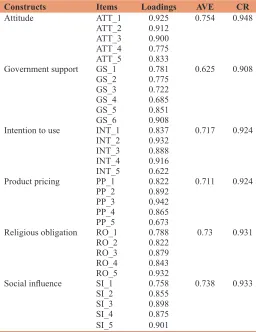
Table 1 depicts the results of construct reliability and convergent validity testing. The results demonstrate that the constructs
(or variables under investigation) have high internal consistency (Roldán and Sánchez-Franco, 2012) and sufficient average variance extracted to confirm convergent validity (Hair et al., 2014).
Heterotrait-Monotrait (HTMT) ratio is used to assess discriminant validity (Henseler et al., 2015) as shown in Table 2. Referring
to HTMT results, discriminant validity among the constructs is
confirmed at HTMT90. As such, it can be concluded that there is no issue of multi-collinearity between items loaded on different constructs in the outer model. As such, it is appropriate to proceed to structural model assessment so as to test the hypotheses of the study.
4.2. Assessment of Structural Model
A 5000 bootstrap re-sampling of data is conducted to assess the hypotheses of the study (Hair et al., 2014). Table 3 shows the valuation of path co-efficient which is represented by Beta
Figure 1: Research framework
Table 1: Assessment of convergent validity
Constructs Items Loadings AVE CR
Attitude ATT_1 0.925 0.754 0.948
ATT_2 0.912
ATT_3 0.900
ATT_4 0.775
ATT_5 0.833
Government support GS_1 0.781 0.625 0.908 GS_2 0.775
GS_3 0.722 GS_4 0.685 GS_5 0.851 GS_6 0.908
Intention to use INT_1 0.837 0.717 0.924
INT_2 0.932
INT_3 0.888
INT_4 0.916
INT_5 0.622
Product pricing PP_1 0.822 0.711 0.924 PP_2 0.892
PP_3 0.942 PP_4 0.865 PP_5 0.673
Religious obligation RO_1 0.788 0.73 0.931 RO_2 0.822
RO_3 0.879 RO_4 0.843 RO_5 0.932
Social influence SI_1 0.758 0.738 0.933
SI_2 0.855
SI_3 0.898
SI_4 0.875
SI_5 0.901
CR: Construct reliability, AVE: Average variance extracted
Table 2: HTMT ratio criterion
ATT GS INT PP RO SI
ATT 0.868
GS 0.487 0.790
INT 0.822 0.580 0.847
PP 0.217 −0.089 0.285 0.843
RO 0.446 0.416 0.539 0.298 0.854
SI 0.556 −0.053 0.479 0.208 0.417 0.859
values for each path relationship. The results show that only
three hypotheses are supported. Attitude, GS, and social influence
are found to have positive effect on intention to use Islamic banking products. As such, Hypotheses 1, 2 and 5 are supported. As product price and religious obligation are not found to have
significant effect on intention to use, Hypotheses 3 and 4 are thus
not supported.
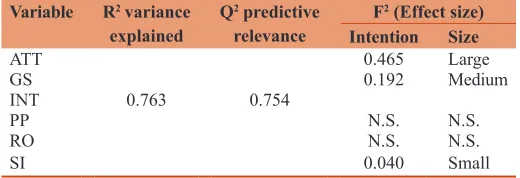
Table 4 shows the quality of the model. On the hypotheses that are tested to have significant relationship, attitude and GS have large
and medium effect on intention to use Islamic banking products
respectively. Social influence, in turn, carries small effect on
intention to use Islamic banking product. As the effect of product
pricing and religious obligation on intention is not significant, there
is no effect size. The R2 = 0.763 denotes that 76% of variance of
intention is explained by the three determinants (attitude, GS and social influence). The predictive relevance value indicates that the
independent variables are capable of predicting intention to use
Islamic banking products (Hair et al. 2014).
5. DISCUSSIONS AND CONCLUSION
The study, along with its findings, has provided additional insights
into intention to use Islamic banking products in Malaysia.
Despite being a country dominated by Muslims, not all customers
who use conventional banking system have similar perception towards Islamic banking. The study suggests such intention to
use Islamic banking products is determined by attitude, GS and social influence. Although these three variables have significant
relationship with the said intention, they are different in terms of their substantive relationship. Firstly, attitude is found to carry large effect on intention, implying that customers’ behavioral intention to use Islamic banking product is predominantly
explained and predicted by their learned predisposition (Finch, 2012). This highlights the need to understand customers’ beliefs
about the Islamic banking products and to facilitate their learning
experience so as to ensure they are in favor of the products.
Secondly, GS, which yields medium effect, is pivotal to shaping the
said intention in the Malaysian context. This indicates customers in general feel more secured when government intervenes in a
positive manner. As Malaysia has gone through financial crisis in late 1990s and 2008, resulting in major change in banking
industry, customers welcome the support from government when
it comes to banking services (Ting, 2016). Lastly, although social influence only possesses small effect size, it cannot be overlooked.
The results imply customers’ intention to use Islamic banking
products are still dependent on opinions from significant others
and social trends. As Malaysia embraces collectivist culture, it
explains why social influence has substantive effect on intention to use (Triandis et al., 1988; Triandis, 1989).
It is somewhat surprising that product pricing and religious
obligation, despite their relevance, are found to be insignificant
when assessing their relationship with intention to use Islamic
banking product. One possible reason is the dominant effect of attitude and GS in the structural model. Malaysian customers who
use Islamic banking products look at this matter from attitudinal perspective, rather than a religious viewpoint. It is something which they are in favor of, rather than an obligation they need to perform. Moreover, when there is support from the government, this reassures their use of Islamic banking products and thus makes product pricing irrelevant. Another reason, which is a limitation of the study, could be due to the perceptions of non-Muslims in the sample. Since Malaysia is a country with diverse community with different ethnic and religious background, religious obligation might not be the determinant of using Islamic banking products for non-Muslim Malaysians. Furthermore, as the conventional banking system is highly volatile, they might feel more secured to use Islamic banking products which promise to abide Islamic principles.
In light of the findings and discussions, it is necessary to further
the investigation by using multi-group analysis in order to determine the difference of effect between groups, such as that between Muslim and non-Muslims, ethnicities and generations
(Ting et al., 2015). Moreover, despite being useful in explaining
the phenomenon, TRA is found wanting in providing insights into the effect of external factors on intention to use Islamic
banking products, such as GS. As such, future study could also
consider other potential determinants of intention to use, such as
riskiness, rewards, Islamic banks’ performance, and the financial
knowledge of Islamic banking products. Such continual efforts would extend the existing literature on usage behavior of Islamic banking system and thus enhance its development in Malaysia and other emerging markets.
REFERENCES
Abdullah, N.I., Dusuki, A.W. (2006), Customers perceptions of Islamic
hire-purchase facility in Malaysia: An empirical analysis. IIUM
Journal of Economics and Management, 14(2), 177-204.
Ajzen, I., Madden, T.J. (1986), Prediction of goal directed behaviour:
Attitudes, intentions, and perceived behavioural control. Journal of
Experimental Social Psychology, 22, 453-474
Table 3: Assessment of path coefficients
Path relationship Beta S.E t-value Decision H1: ATT→INT 0.526 0.073 7.231** Supported
H2: GS→INT 0.316 0.072 4.377** Supported
H3: PP→INT 0.148 0.123 1.205 Not supported H4: RO→INT 0.069 0.065 1.060 Not supported
H5: SI→INT 0.143 0.055 2.593** Supported **P<0.01. ATT: Attitude, INT: Intention to use, GS: Government support, PP: Product pricing, RO: Religious obligation, SI: Social influence
Table 4: Assessment of model quality Variable R2 variance
explained Q
2 predictive
relevance F
2 (Effect size)
Intention Size
ATT 0.465 Large
GS 0.192 Medium
INT 0.763 0.754
PP N.S. N.S.
RO N.S. N.S.
SI 0.040 Small
Alam, S.S., Janor, H., Zanariah, C.A.C., Ahsan, M.N. (2012), Is religiosity an important factor in influencing the intention to undertake Islamic home financing in Klang Valley? World Applied Sciences Journal, 19(7), 1030-1041.
Amin, H., Abdul Rahman, A.R., Abdul Razak, D. (2013), An intergrative approach for understanding Islamic home financing adoption in Malaysia. International Journal of Bank Marketing, 31(7), 544-573. Amin, H. (2008), Choice criteria for Islamic home financing: Empirical
investigation among Malaysian bank customers. International Journal
of Housing Markets and Analysis, 1(3), 256-274.
Amin, H., Abdul Rahman, A.R., Ramayah, T. (2009), What makes undergraduate students enroll into an elective course? The case of
Islamic accounting. International Journal of Islamic and Middle
Eastern Finance and Management, 2(4), 289-304.
Amin, H., Rahman, A.R., Sondoh, S.L.Jr., Hwa, A.M.C. (2011), Determinants of customers’ intention to use Islamic personal financing: The case of Malaysian Islamic banks. Journal of Islamic Accounting and Business Research, 2(1), 22-42.
Finch, A. (2012), Encyclopedia of the sciences of learning. Attitude Change Through Learning. New York: Springer Science + Business Media, LLC. p369-371.
Fishbein, M., Ajzen, I. (1975), Belief, Attitude, Intention and Behaviour:
An Introduction to Theory and Research. Reading: Addison-Wesley.
Foxall, G.R., Goldsmith, R.E. (1994), Consumer Psychology for Marketing. London: Routledge.
Hair, J.F., Hult, T.M., Ringle, C.M., Sarstedt, M. (2014), A Primer on Partial Least Square Structural Equation Modeling (PLS-SEM). Thousand Oaks, CA: Sage Publications.
Haron, S. (2005), Sistem Kewangan dan Perbankan Islam. Kuala Lumpur: KLBS.
Hayduk, L.A., Littvay, L. (2012), Should researchers use single indicators, best indicators, or multiple indicators in structural equation models? BMC Medical Research Methodology, 12(1), 1. Available from: http://www.doi.org/10.1186/1471-2288-12-159.
Henry, C.M., Wilson, R. (2004), The Politics of Islamic Finance. Edinburgh: Edinburgh University Press.
Henseler, J., Ringle, C.M., Sarstedt, M. (2015), A new criterion for assessing discriminant validity in variance-based structural equation modeling. Journal of the Academy of Marketing Science, 43(1),
115-135.
Iqbal, M., Molyneux, P. (2005), Thirty Years of Islamic Banking: History, Performance and Prospects. New York, NY: Palgrave Macmillan. Iqbal, Z., Mirakhor, A. (2004), Stakeholders model of governance in
Islamic economic system. Islamic Economic Studies, 11(2), 43-63. Lada, S., Tanakinjal, H.G., Amin, H. (2009), Predicting intention to choose
halal products using theory of reasoned action. International Journal
of Islamic and Middle Eastern Finance and Management, 2(1), 66-76. Lo, C.W., Leow, C.S. (2014), Islamic banking in Malaysia: A sustainable
growth of the consumer market. International Journal of Trade,
Economics and Finance, 5(6), 526-529.
Luarn, P., Lin, H.H. (2005), Toward an understanding of the behavioural
intention to use mobile banking. Computer in Human Behavior,
21(6), 873-891.
Md-Taib, F.M., Ramayah, T., Abdul-Razak, D. (2008), Factor influencing intention to use diminishing partnership home financing. International
Journal of Islamic and Middle Eastern Finance and Management,
1(3), 235-248.
Nulty, D.D. (2008), The adequacy of response rate to online and paper survey: What can be done? Assessment and Evaluation in Higher Education, 33(3), 301-314.
Onwuegbuzie, A.J., Collins, K.M.T. (2007), A typology of mixed methods
sampling designs in social science research. The Qualitative Report,
12(2), 281-316.
Putit, L., Johan, Z.J. (2015), Consumers’ acceptance of halal credit card
services: An empirical analysis. Joirnal of Emerging Economies and
Islamic Research, 3(1), 1-9.
Rahman, Z.A. (2005), Competitive Pricing of Islamic Banking. Kuala Lumpur: NST.
Ramayah, T., Md-Taib, F., Ling, K.P. (2006), Classifying users and
non-users of internet banking in Northern Malaysia. Journal of Internet
Banking and Commerce, 11(2), 1-13.
Roldán, J.L., Sánchez-Franco, M.J. (2012), Variance-based structural equation modeling: Guidelines for using partial least squares. In: Research Methodologies, Innovations and Philosophies in Software Systems Engineering and Information Systems. Hershey, PA: IGI Global. p193.
Rosly, S.A. (2005), Islamic Banking Windows Transforms to Subsidiaries. Kuala Lumpur, Malaysia: The Star.
Souiden, N., Rani, M. (2015), Consumer attitudes and purchase intentions toward Islamic banks: The influence of religiosity. International Journal of Bank Marketing, 33(2), 143-161.
Ting, H., de Run, E.C., Ramayah, T. (2015), Young adult’s attitude towards advertising: A multi-group analysis by ethnicity. RBGN Review of Business Management, 17(54), 769-787.
Ting, H.J. (2016), Financial development, role of government, and bank profitability: Evidence from the 2008 financial crisis. Journal of Economics and Finance, 40(4), 1-22.
Triandis, H.C. (1988), Collectivism versus individualism:
A reconceptualization of a basic concept in cross-cultural social
psychology. In: Verma, G.K., Bagley, C., editors. Cross-Cultural Studies of Personality, Attitudes, and Cognition. London: MacMillan. p60-95.
Triandis, H.C. (1989), The self and social behavior in differing cultural contexts. Psychological Review, 96, 506-520.
Venkatesh, V., Davis, F.D. (2000), A theoretical expansion of the
technology acceptance model: Four longitudinal field studies.
Management Science, 46(2), 186-204.
Weaver, G.R., Agle, B.R. (2002), Religiosity and ethical behavior in
organizations: A symbolic interactionist perspective. Academy of
Management Review, 27(1), 77-98.
Yu, C.S. (2012), Factors affecting individuals to adopt mobile banking:
Empirical evidence from the UTAUT model. Journal of Electronic