Multi-Dimensional View of Innovation Performance
from Knowledge Dynamics to Maturity Matrix
Lamyaa EL BASSITI
ENSIAS, Mohammed V University in Rabat
Av. Mohammed Ben Abdallah Regragui, Madinat Al Irfane, BP 713, Agdal, Rabat, MA
Abstract. Innovation Knowledge Dynamics can be defined as a set of interacting activities, stages, and concepts, in order to generate a methodology to manage the essential innovation emergence, design and adoption in digital format throughout the
innovation lifecycle. It aims to identify the innovation domain’s knowledge structures,
internal dynamics, and implementation requirements. Based on the analysis of the
shifts global mindset manifest, and following today’s transition towards a new era of
flexible forms of managing and organizing, we suggest a tri-axial understanding of the innovation field. Upon this understanding, we developed a tri-axial model for innovation performance measurement, which led us to design a Maturity Matrix that we put into practice through an Assessment Workflow and a Sample Scoring System. This paper identifies three complementary components specifically developed to enable such assessment. First, Innovation Granularity Scales enabling highly targeted yet flexible performance analysis, ranging from knowledge assessment to high level progressions and improvements; Second, Innovation Capability Stages referring to the minimum capabilities required by transformational milestones along the innovation continuum; Third, Innovation Maturity Levels, representing the quality, predictability and performance within the innovation stages. This paper explores these complementary components and presents them as a systematic model underlying a specified Innovation Maturity Matrix.
Keywords: innovation performance; innovation measurement; knowledge dynamics; maturity matrix; innovation capability stages; innovation granularity scales; innovation maturity levels; innovation assessment workflow.
Introduction
is dynamic and evolves over time, which leads to the increase of the available knowledge. Perry-Smith and Shalley (2003) have argued that good ideas evolve from people who have access to relevant knowledge. However, the knowledge per se is not enough to ensure the innovation success. According to several surveys, such the annual innovation survey from The Boston Consulting Group, an increasing number of organizations spend more and more on innovation, but many of these initiatives don’t generate satisfactory impact. This problem does not lie in a lack of ideas, but more in a successful management of the innovation process from an idea to a useful product. Booz Allen Hamilton found that a common factor between successful innovators is “a rigorous process for managing innovation, including a disciplined, stage-by-stage approval process combined with regular measurement of every critical factor, ranging from time and money spent to the success of new products in the market” (Du Preez & Louw, 2008).
Commonly, the success of idea generation depends on the quality of the best opportunity selected (Girotra et al., 2010), because organizational resources are, usually, limited and cannot be wasted in the development of unpromising ideas. While best idea identification is undoubtedly important, it is only one aspect of an organization’s innovativeness and it is the measurement of the overall innovation aspects as well as the expected effects of the innovation diffusion that is critical for competitiveness. However, the Boston Consulting Group report (Andrew et al., 2009) found that companies focus only on the measurement of innovation inputs and they consider themselves far less adept at tracking innovation inputs and the quality of the process in-between. Therefore, the multidimensional perspective of innovation is yet inadequately represented in measurement terms and this is a challenging problem that requires being tackled.
As well, Morris (2011) argues that measuring innovation performance presents problems for the process itself, because innovation involves a venture into the unknown, and trying to pin these unknowns down too fast may make them harder to recognize and realize. The measurement can also undermine the spirit of creativity, learning, discovery, and intelligent risk-taking that the innovation process requires if the wrong things are measured at the wrong time using the wrong mechanism. In addition, empirical studies have found that many organizations tend to focus only on the measurement of innovation inputs and outputs in terms of spending, speed to market and numbers of new products, and ignore the processes in-between (Adams, Bessant, & Phelps, 2006). It is therefore critical to create a measurement model providing a useful basis for managers to monitor and gauge innovation performance, detect faults and identify repairs, in order to help the organization, build its capacity to innovate systemically.
5, while section 6 introduces the Innovation Maturity Matrix, a performance measurement and improvement tool which identifies the correlation between Innovation Capability Stage, Granularity Scale, and Maturity Level. Finally, Section 7 introduces a use case of the Innovation Maturity Matrix, before we conclude by summarizing topics for further research.
Knowledge dynamics and innovation measurement
Innovation and knowledge are intrinsically linked. Drucker (1995) has mentioned that “if we apply knowledge to tasks that are new and different, we call it innovation”, and most commentators agree that innovation is a knowledge intensive process that demands the straightforward application of knowledge (Choo, 1998). Thus, to maintain competitive advantage, modern organizations have to be open to new kinds of knowledge resources and to access external people. Arundel and Bordoy (2002) have noted that “modern innovation theories stress the diffusion of knowledge among many different actors”. This means that innovation is a social process that happens when people interact with others and their knowledge is exposed, assimilated, shared and finally transformed to produce new knowledge. However, knowledge largely resides in people’s heads thus, relevant knowledge cannot be achieved except through identifying those people because it is highly tacit and little codified in a structured way. Furthermore, the dyad used to represent the individual, as well as organizational knowledge, has shifted in the last years from the tacit-explicit dyad to new and wider concepts like cognitive, emotional and spiritual knowledge forms (Bratianu, 2016). Thus, organizations have to identify, reduce or remove barriers and create an environment in which knowledge sharing, learning, and reusing are valued and encouraged.
Reviewing existing research literature shows that only a small part of generated ideas reaches an advanced stage in the innovation stage or end with success. According to Kerka, Kriegesmann, and Schwering (2009), Liberatore and Stylianou (1995), roughly 6% of all official ideas and 14% of the promising ideas attaining the implementation stage become a commercial success. Hence, the continuous measurement of performance is important for effective management as it provides the foundation through the persistent investigation of ideas throughout the innovation process. Likewise, the findings of Kerka, Kriegesmann, and Schwering (2009) have shown a lack of research on this subject and argued that the missing of appropriate evaluation mechanism is the most challenging problem. This gap is especially applied to the measurement activity at the early stages of the innovation process, as many evaluation mechanisms are simply not up to deal with the special characteristics of the front end of innovation. In addition, the existing research works addressing the issue of developing metrics for innovation measurement provide metrics, even though somewhat useful, offer a limited view of an organization’s innovativeness and don’t measure its overall innovation capability (Muller, Välikangas, & Merlyn, 2005) and impact.
Furthermore, it seems that it is not only the commitment to new innovation measurement approaches that is missing, but the real challenge is to find the relevant metrics, suitable mechanism and the discipline making measurement a priority in innovation management as part of a systematic process. As in the past, competitive advantage rested on factors such as quality, productivity or access to low-cost resources, whereas today these factors tend to become obsolete. Accordingly, and in order to carry out a successful innovation journey, organizations must specify how innovation performance is to be measured. Two issues need then to be addressed for this purpose: (1) “What are the key components underlying a successful measurement of the innovation performance?” (2) “How can the innovation performance be measured?” This paper contributes to the innovation performance theory and practice by providing a set of pillars, we suppose, as fundamental for a generic framework for innovation performance measurement and improvement, especially at the front end of innovation.
Literature review
In an attempt to extend the innovation performance theory and practice beyond a focus on the front end of innovation, this section reviews the literature as it relates to the performance measurement in the context of a conceptual framework. We bring together disparate suggestions made in various parts of the literature and summarize common insights. We also identify gaps in performance theory and practice and point out the way toward the development of a comprehensive model.
innovation performance measurement tended to be focused on products and their related production systems. Whereas, the key dimensions of a successful measurement framework should cover innovation context (e.g. strategy and culture), innovation lifecycle, innovation outcomes and the enabling factors such as innovation actors and knowledge management. Each dimension could be measured by a set of metrics that directly address the main indicators for that dimension. Such a multidimensional view will help decision makers to understand the dynamics of innovation, to highlight policy implications and to better inform those who impact the innovation process. As such, organizations should strongly engage their knowledge workers in the innovation effort to develop innovation metrics that look beyond innovation inputs, outcomes, and innovation processes. An up to date view requires also more attention to the innovation requirements and goals, customer value creation, and global markets; and to related determinants such as knowledge process flows, inter-organization linkages, contextual constraints and the infrastructure required for innovation.
On the other hand, choosing the right metrics is obviously critical to the innovation success, but the road to suitable metrics is fraught with pitfalls. A good metric should be precise, tied to overall effectiveness and designed to encourage extra-normal effort (Hauser & Katz, 1998). Actually, many metrics that seem right and easy to be used have subtle, counter-productive consequences; whereas metrics focusing on decisions and actions which are critical to organizational innovativeness are more difficult to measure (Minonne & Turner, 2012). For instance, the “R&D Effectiveness Index” (EI) proposed by McGrath and Romeri (1994). This index, roughly equal to the percent of profit obtained from new products divided by the percent of revenue spent on R&D, attempts to measure R&D effectiveness based on the net revenue that R&D contributes to the organization. But R&D, as a special kind of innovation, is one of the riskiest and long-term investments that an organization can make. So, if managers perceive that they are rewarded based on EI, then they will prefer projects that are less risky and more short-term oriented. Furthermore, a significant fraction of R&D projects can be falsely rejected or falsely selected if EI is the only metric. Otherwise, Schulze et al. (2012) performed a study on 331 Australian corporations, to explore what practices organizations currently employ in their efforts to evaluate incoming ideas and, specifically, what role information systems play in idea assessment. This study showed that almost 40% of the participating organizations do not have a regular, structured framework for idea assessment, and assess fewer ideas less frequently, which lead to lower effectiveness. Alarmingly, almost 20% of organizations do not assess the ideas they collect at all. In addition, they stated that one-third of their survey respondents report not having fixed measurement criteria, while only a third use one criterion (e.g. difficulty, feasibility, originality).
performance at high levels of precision. (2) Usability: Intuitive and easily used to assess the innovation performance across the innovation’s lifecycle stages. (3) Consistency: Yield the same results when conducted by different assessors. (4) Flexibility: Can be performed across different stages and context scales. (5) Informativity: Provide feedback and guidance for next steps in the lifecycle (6) Specificity: Serve the specific requirements of the innovation activity. Based on these guiding principles, the next sections introduce and describe the development of a set of complementary knowledge components that aim to underpin the measurement of innovation performance and then its improvement. These components were aggregated into a tri-axial model that targets the contextual integration of innovation dynamics, actors and outcomes; which allow a fast and intuitive assessment of activities particularly on the early stages of innovation, to explore the extent to which organizations are nominally innovative or whether or not innovation is embedded throughout them, and to identify areas for improvement.
Research design
This work provides a theoretical basis for a generic innovation performance measurement framework based on a multidimensional approach. The literature review and the study of some business use cases was an important foundation of this paper, focusing on three main areas: Knowledge Dynamics, Innovation Measurement Mechanism, and Capability Maturity Models. The first area was searched in order to understand the state-of-art, in particular at the front end of innovation, and to identify issues concerning how innovation measurement is related to knowledge dynamics. The search of the second area was directed by the aim to find relevant mechanisms that can help innovation actors to make informed decisions based on a complete view of the organization’s innovation capability. The third area was searched in view of understanding the capability maturity levels and requirements.
Since this research work does not seek to prove, disprove or compare phenomena but rather to discover the underlying structures of a nascent domain of knowledge, this study adopted a mixed research perspective combining behavioral and design research patterns, an interpretive and critical paradigm, a mixture of research strategies focusing on retroduction, and an exploratory mixed data collection methodology. The empirical examination of the conceptual constructs developed in this study will be published in upcoming research works.
Tri-axial model of innovation performance measurement
the inputs (resources invested). Accordingly, other measures reflecting the dynamics and processes characterizing the innovation activities should be also integrated. Such multidimensional approach to measurement has been found in other areas of management to be an improvement on simple one-dimensional measures and to be able to capture both short- and long-term aspects of value creation in the organization (Adams, Bessant, & Phelps, 2006).
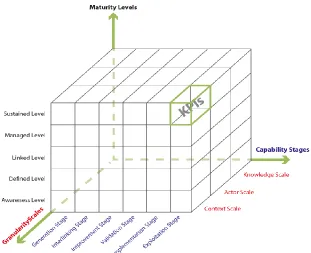
We define Innovation as an emergent process characterized by highly unpredictable potential actors, dynamic and not always known context, and ill-structured and distributed knowledge objects. Knowledge dynamics has been defined as the continuous interaction and transformation of knowledge from one form into another (Nonaka & Takeuchi, 1995; Bratianu, 2016). Accordingly, we define Innovation Knowledge Dynamics as a set of interacting activities, stages, and concepts, in order to generate a methodology to manage the essential innovation emergence, design and adoption in digital format throughout the innovation lifecycle. Based on these definitions, we propose a tri-axial conceptualization of innovation performance (see Figure 1). This model distinguishes three dimensions we consider as primary for a holistic and systematic approach to innovation performance measurement and improvement:
Figure 1. Innovation Performance Measurement Model
2. Innovation Granularity Scales: enabling a granular view of innovation that emphasizes the innovation actors, knowledge and context as three cornerstones of any successful innovation.
3. Innovation Maturity Levels: providing a maturity perspective that focuses on the ability to show improvement across the entire spectrum of the innovation journey. It aims to help organizations assessing their innovation capabilities, develop a roadmap to prioritize initiatives and then sequence them.
Innovation capability stages
Innovation as a complex process is not easily reduced to measurable metrics. So, it is quite obvious that measuring the innovation success of the front end of innovation requires a different set of metrics than those required for the back end. The reason is whereas the focus of early stages of innovation lies primarily on evaluating the identified needs and trends, measuring the success at the late stages requires metrics that map the potential performance of a practical use of innovation. Thus, in order to be able to properly assess and measure the progress and success across the entire continuum of innovation, and based on the GenID Lifecycle Model (see Figure 2), six capability stages, referring to the key milestones over the innovation continuum, have been identified. They aim to allow measuring the minimum availability of required capabilities (e.g. policies, technologies and processes).
1. Generation Stage: refers to the minimum capabilities required for individual and/or collective creation, refinement, and capturing of relevant ideas.
2. Networking Stage: refers to the minimum capabilities required to integrate the identified idea into the strategic roadmap of the organization by cross-linking the innovation actor’s competencies, the core-idea’s characteristics, and the contextual variables.
3. Modeling Stage: refers to the minimum capabilities required to shape the expectations behind the created idea and how its success will look like by transforming the idea into a workable concept.
4. Validation Stage: refers to the minimum capabilities required for metrics definition, assessment and decision making whether the idea will be implemented, revised or stored for later use.
5. Implementation Stage: refers to the minimum capabilities required for the successful adoption of the designed idea, which involves the specification of tasks to be performed, the core competencies to be acquired and the expected outcomes to be delivered.
6. Exploitation Stage: refers to the minimum capabilities required to ensure an efficient and effective communication and widespread diffusion of the implemented ideas across its potential market, and to measure the impact the large diffusion has had.
Innovation granularity scales
Figure 3. Innovation Granularity Scales
1. Knowledge Scale: refers to the different forms of knowledge resulting from the innovation knowledge dynamics in order to deliver a noteworthy outcome.
2. Actor Scale: refers to different actors involved in the innovation process.
3. Context Scale: refers to the organizational abilities allowed to innovation actors to perform innovation activities and deliver noteworthy outcomes.
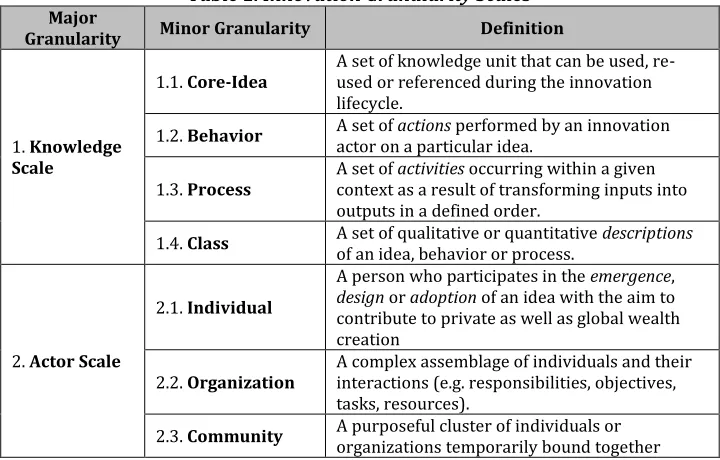
Acting as an Innovation Scoping Filter, these Granularity Scales have been further detailed to enable a more targeted approach to innovation assessment and improvement. Table 1 below introduces more granular levels.
Table 1. Innovation Granularity Scales Major
Granularity Minor Granularity Definition
1. Knowledge Scale
1.1. Core-Idea A set of knowledge unit that can be used, re-used or referenced during the innovation lifecycle.
1.2. Behavior A set of actor on a particular idea. actions performed by an innovation
1.3. Process A set of context as a result of transforming inputs into activities occurring within a given outputs in a defined order.
1.4. Class A set of qualitative or quantitative of an idea, behavior or process. descriptions
2. Actor Scale
2.1. Individual
A person who participates in the emergence,
design or adoption of an idea with the aim to
contribute to private as well as global wealth creation
2.2. Organization A complex assemblage of individuals and their interactions (e.g. responsibilities, objectives, tasks, resources).
through a unifying long-term mission, a common goal or a shared activity.
3. Context Scale
3.1. Resources A set of tangible and intangible assets supporting the accomplishment of innovation activities.
3.2. Policies
Principles, rules, and moralities used to assist policy makers and domain researchers to analyze, develop and improve innovation practices and performance along the innovation lifecycle.
3.3. Capabilities
Systematic knowledge practices and tools granted to an innovation actor to continuously transform knowledge and ideas into new outputs for the benefit of the involved actors.
Innovation maturity levels
The term “Maturity” denotes the extent ability in performing a task or delivering an outcome. A maturity model provides a systematic framework for carrying out benchmarking and performance improvement. Thus, “Innovation Maturity” refers to performance improvement milestones that innovation actors aspire to achieve. It represents the degree of excellence throughout an innovation journey. Maturity models are typically staged models providing a predefined roadmap for improvement based on proven grouping and ordering (from “not able to do it” through to “continuously improving”) of processes and associated relationships. Each stage, called “maturity level”, has a set of process areas that indicate where innovation actors should focus their improvement efforts. Each process area is described in terms of the practices that contribute to satisfying its goals. The practices describe the infrastructure and activities that contribute most to the effective implementation and institutionalization of the process areas. Progress occurs by satisfying the goals of all process areas in a particular maturity level.
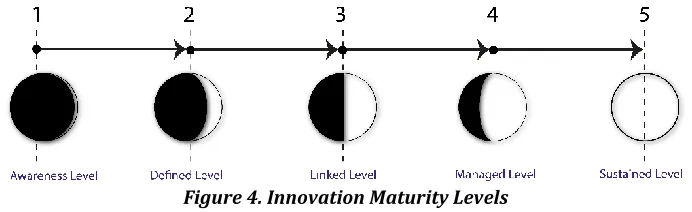
Based on a deep analysis of maturity models used across different industries (El Bassiti & Ajhoun, 2016), an innovation maturity model has been developed (see Figure 4) to reflect the specifics of the innovation activity, its management requirements, performance targets and knowledge dynamics. As a result, five distinct levels have been identified:
Figure 4. Innovation Maturity Levels
unpredictable and targets, if defined, are often missed. IM costs are high both in functional, financial and managerial terms.
b. Defined Level: The basic IM processes are defined but remain unclear, elementary and very simple. Process performance is more predictable and targets are defined but still missed more often than not. Overcoming the functional and managerial difficulties still takes considerable effort due to turf concerns and competing goals. IM costs remain high, frustration is still present and satisfaction, although better defined, is still low.
c. Linked Level: At this breakthrough level, IM processes are implemented with strategic intent and goals. Process performance becomes more predictable and targets are often achieved. Continuous improvement efforts take shape and emphasize root cause elimination and performance improvements. IM costs begin decreasing and feelings of “community spirit” take the place of frustration. Innovation actors are included in process improvement efforts and their satisfaction begins to show marked improvement.
d. Managed Level: The innovation actors reach a wholeness perspective based on wise judgment and intentional learning. IM measures and management systems are deeply embedded in the organization. Advanced IM practices, such as creative imagination, collective engagement, and collaborative forecasting, take shape. Process performance becomes very predictable and targets are reliably achieved. Process improvement goals are collectively set and achieved with confidence. IM costs are dramatically reduced and satisfaction and community spirit become a competitive advantage.
e. Sustained Level: Advanced IM practices that allow self-responsibility are in place. Innovation actors with common processes, goals and broad authority take shape. Trust, mutual dependency, and community spirit are the glue holding the different actors together. A creative and collaborative culture is firmly in place. Process performance and reliability of the sustained system are measured and joint investments in improving the system are shared, as are the returns. This is the beginning of a successful innovation networked journey.
In general, the progression from lower to higher levels of maturity across developmental stages results in better control due to minimized variations between performance targets and actual results; improved predictability and forecasting of goals, cost and performance; greater effectiveness in reaching defined goals and improved ability to set new more ambitious ones (McCormack, Ladeira, & de Oliveira, 2008).
Innovation maturity matrix
Table 2. Innovation Maturity Matrix
1. Knowledge Scale 2. Actor Scale 3. Context Scale
a. Aw ar en ess Knowledge-related facilities are not present. There is a very poor effort to create, manage and share new knowledge. There is a limited flow of information or feedback.
Collaboration is absent. There is no external participation in developing or improving an idea. Culture towards opening organizational boundaries for knowledge sharing or cooperation is missed.
b.
D
efin
ed
Actions are focused on past experiences and initiatives. People are guided by the
recognition of patterns and intuition occurring at an individual level, which is difficult to share with others.
Only selected actors are involved in the innovation effort. The importance of involving external parties in innovation is recognized. Culture is risk tolerant and leaders appoint “Idea Champions”
Innovation policies and capabilities are defined, refined, and communicated to a greater extent, but this tends to be primarily informal and not go beyond forecasting revenue and costs. There is an inconsistent and reactionary application of strategic planning, which often leads to poor results.
c.
Link
ed
Knowledge units are gathered, documented, and shared. IMSs are established to facilitate information flow and allow inter-actors communication to occur. Insights and ideas are expressed to others and a shared understanding is being developed. There is a steadily growing learning culture that considers failure as an opportunity to learn
Collaboration tools and practices are established and encouraged.
Knowledge sharing is supported, inside organizational boundaries. Involvement of external actors in defining market requirements, designing, and modeling the delivery process is fostered.
Innovation policies are clear, accepted, and communicated. Innovation initiatives begin to become aligned with the overall organizational objectives. However, there is a static focus on current capabilities, rather than alternatives and the staff is not yet engaged in strategy development. Processes are in place to manage resource allocation and ensure sufficient availability of innovation initiatives.
be accurate, usable, consistent, flexible, informative and specific (as detailed in the previous section).
The InnoMM incorporates a set of concepts whose interactions can be represented through many static and dynamic mediums. The InnoMM, in its expanded database-driven form, includes all Granularity Scales, Capability Stages and Maturity Levels. Table 2 below introduces a static representation of the InnoMM at a sample Capability Stage.
Development and
d. Ma n ag ed Innovation management processes and related systems are
established. General idea campaigns are launched to harvest ideas, regardless of the problem to be solved. Conversations are held to promote the collective mind and mutual adjustments and negotiated actions are achieved.
Innovation
management is more deeply integrated into processes to foster learning from both successes and failures for consistent improvement.
All relevant actors are allowed to participate in innovation activities. There are continuous feedback and
cross-organizational cooperation. New collaborations and alliances that spread risk and establish new sources of revenue are initiated. Both internal and external actors that may be interested in or impacted by the innovation initiative are identified, and then involved
Effective policies provide valuable guidance that drives the organization’s focus and informs decision making. There is formal engagement with employees in planning processes. There is dynamic rather than static resource allocation that creates new capabilities or redefines the market. Accurate measurement and in-depth analysis are occurring to assist in understanding the future organizational success factors.
e. Su st ain ed Idea generation sessions are encouraged and sponsored. Individuals readily teach and mentor each other. There is regular, transparent, and open communication. Creativity, learning, and collaboration now occur at a high level. Successful experiences become embedded in the corporate memory.
There is widespread involvement of external actors. Relationships with highly skilled external parties (e.g.
researchers, consultants) are established, maintained, and exploited to improve the innovation processes and their management. Interdisciplinary and complementary teams have been identified and collaborative practices are institutionalized.
Innovation policies and capabilities excellence are embedded in the organization and continuously improved. There are a shared understanding and regular communication of the strategy and objectives with employees. The strategic policies are aligned to available
capabilities and resource allocation is in line with the overall strategy. The strategic planning framework is shaped by tomorrow’s concept of the business.
Innovation maturity matrix in use
manage all possible configurations, a simple assessment and reporting workflow has been designed.
Innovation assessment workflow
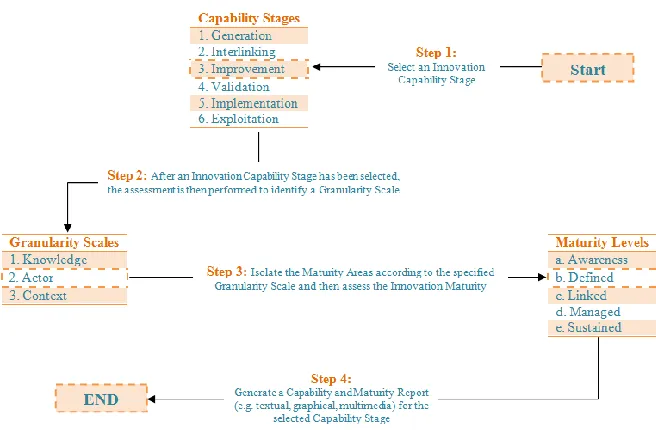
Innovation Capability and Maturity assessments can be employed at either one of six Capability Stages and at one of three Major Granularity Scales. To manage all these assessments and reporting configurations, a simple assessment and reporting workflow has been developed and depicted in Figure 5 below:
Figure 5. Innovation Capability and Maturity Assessment and Reporting Workflow Diagram
Expanding on the designed workflow, a total of four workflow steps are needed to conduct an innovation performance measurement. Starting with the innovation granularity scales, the assessors first filter out a scale, conduct a series of assessments within a particular stage and then generate a suitable measurement report following an innovation maturity level:
Step 1:The assessor identifies the “Actual” and the “Target” Innovation Capability Stages. For instance, if the assessed organization has an interlinking capability and aims to start collaborating with an external actor then Innovation Stage 2 is the “Actual Stage” while Innovation Stage 3 is the “Target Stage”. In this first workflow step, the selection of an Innovation Capability Stage considerably reduces the number of applicable competencies.
Organizational Unit (Organization Scale). To a varying degree (refer to Table 1), assessments can be conducted at every one of the 10 Minor Granularity Scales. This ranges from “Ideas” (e.g. evaluating the relevance, aggregation, and reusability), through “Organizations” (e.g. assessing collaboration dynamics and risk-mitigation protocols) to “Contextual Capabilities” (e.g. evaluating availability and use of technologies). Armed with this knowledge, the assessor isolates available capabilities for focused capability assessment, and then establishes whether each of the remaining applicable competencies has reached “Minimum Capability”.
Step 3: The assessor isolates the innovation competencies which reached the minimum capability and then assesses their maturity. Using the same example from workflow step 2, the assessor focuses his attention on the remaining applicable competencies and then assesses them individually against the five Maturity Levels. Step 4: In the last workflow step, assessment results are reported using a template matching previously selected Granularity Scale. According to the targeted level of assessment (e.g. Evaluation, Certification, Auditing), the generated report will vary in formality, coverage, detail and the provision of a named or numerical score.
Sample scoring system
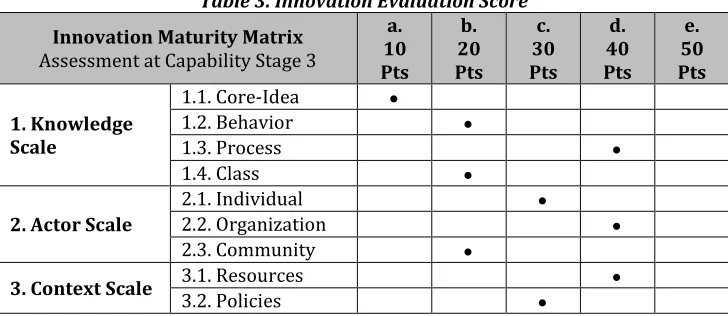
Measuring the Innovation Capability and Maturity requires an extensive, consistent yet flexible scoring system. Below is an exploration of the simplest form of scoring to be used for informal, self-administered assessments at a selected Capability Stage. The scoring system follows a simple arithmetic model:
✓ There are ten individual scores relating to ten Granularity Scales.
✓ Maturity Levels are assigned a fixed number of maturity points: Level a (10 points), Level b (20 points), Level c (30 points), Level d (40 points) and Level e (50 points).
✓ The Maturity Score is the average total points subdivided by ten.
Table 3 below provides a hypothetical Maturity Score of an assessment conducted at the Innovation Capability Stage 3.
Table 3. Innovation Evaluation Score Innovation Maturity Matrix
Assessment at Capability Stage 3
a. 10 Pts
b. 20 Pts
c. 30 Pts
d. 40 Pts
e. 50 Pts
1. Knowledge Scale
1.1. Core-Idea •
1.2. Behavior •
1.3. Process •
1.4. Class •
2. Actor Scale
2.1. Individual •
2.2. Organization •
2.3. Community •
3. Context Scale 3.1. Resources •
3.3. Capabilities •
Subtotal 10 60 90 120 0
Total Points 280
Maturity Score 28
Conclusions and implications
“Innovation Performance” as a generic term refers to the abilities and deliverables expected from an innovation journey. In turn, Innovation Maturity is derived from the understanding that innovation has developmental stages that can be clearly defined, managed, measured and controlled throughout time. “Innovation Maturity” refers to the gradual and continual improvement in quality, repeatability, and predictability through the key performance milestones that innovation actors aspire to.
The tri-axial model of innovation performance measurement discussed in this paper provides a range of opportunities for innovation actors to measure and improve their innovation activities’ performance. The components of this model complement each other and enable highly targeted yet flexible performance analysis to be conducted. Such a method of assessment can be used to standardize the innovation management and assessment efforts, enable a structured approach to innovation teaching and training as well as establish a solid base for a formal innovation learning process.
The Innovation Maturity Matrix (InnoMM) introduces a capability and maturity assessment and reporting tool that uses all the components underlying the tri-axial model of innovation performance measurement. The availability of an extended InnoMM (especially in a database-driven web format) will be beneficial to innovation actors irrespective of their type (e.g. large or small, private or public), whatever their work area and in any sector of activity. The InnoMM and its underlying components are still being developed and extended. Future deliverables include a web-based interactive tool suitable for low-granularity, self-administered maturity assessment. Capability and maturity templates, questionnaires, guides, knowledge models and granular scoring systems are also being researched, developed and tested.
Innovation practitioners can employ the InnoMM and its underlying components to accurately assess their own, their peers and potential partners’ capability and maturity at selective capability stages and organizational scales. An efficient use of InnoMM will boost fast and intuitive management of innovation activities and deliverables within a complex environment while keeping an eye on the quality perspective. In sum, implementing such a systematic approach to innovation performance measurement and improvement will benefit modern organizations of all kind by enhancing their growth, revenues, and profit from sustained innovation management.
what we actually should measure. What are the relevant KPIs that should underlie such model? This is the focus of upcoming research works, where we will identify a selection of KPIs based on the combination of inputs and outputs metrics that relates to a particular performance level and fit to a specific stage of the innovation process while focusing on a given granular scale of innovation.
References
Adams, R., Bessant, J., and Phelps, R. (2006). Innovation management
measurement: A review. International Journal of Management Reviews, 8(1), 21-47.
Andrew, J.P., Haanæs, K., Michael, D.C., Sirkin, H.L., and Taylor, A. (2009). Measuring Innovation: The Need for Action. Boston Consulting Group.
Arundel, A., and Bordoy, C. (2002). In-House Versus Ex-House: the sourcing of knowledge for innovation. In de la Mothe, J., and Link, A.N. (Eds.), Networks, Alliances and Partnerships in the Innovation Process (pp.67–87). Boston, MA: Kluwer Academic.
Bratianu, C. (2016). Knowledge Dynamics. Management Dynamics in the Knowledge Economy, 4(3), 323-337.
Choo, C.W. (1998). The Knowing Organization. New York: Oxford University Pres. Drucker, P. (1995). Managing in time of great change. New York: Truman Talley
Books.
Du Preez, N.D., and Louw, L. (2008). A framework for managing the innovation process. In Portland International Conference on Management of Engineering & Technology (pp.546-558). Heidelberg: Springer-Verlag.
El Bassiti, L. (2017). Generic Ontology for Innovation Domain towards “Innovation Interoperability”. Journal of Entrepreneurship Management and Innovation (JEMI), 13(2), 105-126.
El Bassiti, L., and Ajhoun, R. (2016). Continuous Performance Improvement of Innovation: Bridging the Gap between Creativity and Measurement. In Proceedings of the28th International Business Information Management Conference (IBIMA) (pp.4248- 4262). Seville: IBIMA.
El Bassiti, L., El Haiba, M., and Ajhoun, R. (2017). Generic Innovation Designing -GenID- Framework: Towards a more Systematic Approach to Innovation Management. In Proceedings of the18th European Conference on Knowledge Management (ECKM) (pp.1097-1106). Reading: Academic Conferences and Publishing International.
Girotra, K., Terwiesch, C., and Ulrich, K.T. (2010). Idea generation and the quality of the best idea. Management science, 56(4), 591-605.
Hauser, J., and Katz, G. (1998). Metrics: you are what you measure!. European Management Journal, 16(5), 517-528.
Kerka, F., Kriegesmann, B., and Schwering, M.G. (2009). Evaluating innovation ideas: a comprehensive approach to new product development. International Journal of Technology Intelligence and Planning, 5(2), 118-137.
Management Science, 41(8), 1296-1316.
Majchrzak, A., Neece, O.E., and Cooper, L.P. (2001). Knowledge Reuse for Innovation: The Missing Focus in Knowledge Management. Academy of Management.
Malhotra, Y. (2002). Why Knowledge Management Systems Fail? Enablers and Constraints of Knowledge Management in Human Enterprises. In Holsapple, C.W. (Ed.), Handbook on Knowledge Management 1 (pp.577-599). Heidelberg: Springer-Verlag.
McCarthy, I.P., Tsinopoulos, C., Allen, P., and Rose Anderssen, C. (2006). New product development as a complex adaptive system of decisions. Journal of Product Innovation Management, 23(5), 437-456.
McCormack, K., Ladeira, M.B., and de Oliveira, M.P.V. (2008). Supply chain maturity and performance in Brazil. Supply Chain Management: An International Journal, 13(4), 272–282.
McGrath, M.E., and Romeri, M.N. (1994). The R&D Effectiveness Index: A Metric for Product Development Performance. Journal of Product Innovation
Management, 11, 213-220.
Milbergs, E., and Vonortas, N. (2004). Innovation metrics: measurement to insight. Center for Accelerating Innovation and George Washington University, National Innovation Initiative 21st Century Working Group, 22.
Minonne, C., and Turner, G. (2012). Business Process Management-Are you ready for the Future?. Knowledge and Process Management, 19(3), 111-120.
Morris, L. (2011). The innovation master plan: The CEO’s guide to innovation. Walnut Creek, CA: Innovation Academy.
Muller, A., Välikangas, L., and Merlyn, P. (2005). Metrics for innovation: guidelines for developing a customized suite of innovation metrics. Strategy &
Leadership, 33(1), 37-45.
Nonaka, I., and Takeuchi, H. (1995). The knowledge creating company. New York: Oxford University Press.
Perry-Smith, J.E., and Shalley, C.E. (2003). The social side of creativity: A static and dynamic social network perspective. Academy of Management Review, 28(1), 89-106.
Schulze, T., Indulska, M., Geiger, D., and Korthaus, A. (2012). Idea assessment in open innovation: A state of practice. IDEA, 5(15).
Simons, R. (1990). The role of management control systems in creating competitive advantage: New perspectives. Accounting, Organizations and Society, 15(1/2), 127-143.
Wolfe, R.A. (1994). Organizational innovation: review, critique and suggested research directions. Journal of Management Studies, 31(3), 405-431.