_____________________________ Abstract
The goal of this study is to deal with some ethical causes in the public administration, that aim the avoidance of negative phenomenon’s as theft, corruption, etc. In this direction, the debates about ethics are becoming more and more a global tendency, as an implement through which would be found the way to get out of the crisis. The success in the reforms of the public administrations in major part depends, on the public functionaries and their willingness to make fundamental changes in the way they work. In this direction, the State should strengthen and modernize the public service, should realize an employment system, which should reflect more the merits on its service.
For this reason, the government’s attempts should be concentrated on the construction of a positive image for the state and its administration as professional objective, which is oriented to the services. Being aware for the practical restrictions of this study, we firstly chose to concentrate on the local public administrations ethics. The study will be focused on the practical comparative analysis of the city of Shkodra and Durres by the realization of a questionnaire by each of these municipalities and the Agency of Legalization and Urbanization of Informal Zones (ALUIZNI) in Shkodra.
MSc. Arjeta HALLUNOVI, Dr.sc. Elez OSMANI,
Dr.sc Elidiana BASHI
Ethics in Public Administration
Keywords: Ethics, Ethical Behavior, Ethics and Leadership in Public Service, Public Services.
1. Introduction
This paper aims to highlight the importance of handling the issues of ethics in public administration, the confrontation of their social responsibilities in relation to public administration, local or central to the community. In particular, the correct implementation by the administration of the legal and ethical responsibilities has to do directly with the stage of development and the image of a democratic society. To talk about ethics today is very difficult. To discuss about the sublime values in a country where receiving a bribe and corruption are sitting cross-legged is more a dream than a reality. Today, in the Albanian society the human values, the sense of responsibility to perform the tasks for which one gets paid, and the respect for the values are greatly shaken. Eventhough the younger generation has been introduced in all kind of the relations underlying material interest, they benefit by all means, by ignoring everything else associated with the “human being” and the human morality. People often forget the quality of their acts or conduct. From the observations of the performance of the public administration in this prolonged transition, it is not difficult to understand that local or central government of the Albanian administration leave much to be desired with its image to the public, with low quality in the implementation of the tasks imposed by the law, with the high level of corruption etc..
2. Ethics in public service and the role of public administration
_____________________________
many cases, regardless of the political colors that run the country. Misappropriation of funds and monetary values, affecting impartiality, equality and other requirements for the participation in tenders and auctions that are held in this period, preferential management of funds that aim to increase the life-standard of the community, have become daily news and people are no more impressed by them. Which are the arguments which may illustrate this situation, which has crippled the prestige of public administration in general? We believe that the problem begins with the selection of the people chosen to work in public administration and the civil commitment of those responsible for implementing the tasks in their work. In this regard, we can say that a determinant factor is the political environment, which provides the framework for public services conditioning, thus, the performance of those who work in public administration today. We believe that the ratio of the militants to the real professionals in the field, which are needed in public affairs, remains very troubling. Each time the colour of the party in power in Albania has changed, the public administration has been shocked. Often, real specialists have been discarded to leave their places to genuine militants left to the country policies. Such replacements have affected the level of management and public affairs jobs, paving the way for poor and bureaucratic attitudes in the admnistration’s work and daily tasks.
training of the clerks selected to work in the administration. Particularly, the country's universities should offer courses on administrative ethics, which will help for an education of quality of the new administrators.
3. Ethics and Governance
Ethics in public service is about the practical application of the moral standards in governance. According to Chapman (2002), ethics refers to how an individual feels about behaving properly. It is about values and their application in a given context. The major factor that affects our understanding of public service’s ethics is the meaning of the political environment that provides the framework for public services and that conditionates its practice. Particularly in countries with new democracies, the political environment cannot be marked as the main factor, but as the determining factor. Still today, here in Albania, almost everything that is related to public administration, to the quality of its programs and the objectives presented in the activities of government, depends on political elections, politicians in particular and political parties in power.
_____________________________
government's fight against corruption is negative. It is a campaign more than the real fight against this pathological phenomenon. It is in this way that the author Ali Pajaziti (2008) defines the situation in the Republic of Macedonia. In a similar way also, we could speak for the case of Albania, for which this definition is very similar and valid (Pajaziti, 2008).
According to Chapman (2002) one of the essential characteristics and qualities of public service work in a modern democracy and also one of the political environment’s elements is the accentuation of public responsibility. This can be easily expressed in general terms and it seems clear that the forms of accountability are important to any political system, though in practice it is complicated. Accountability of public administration begins with the execution of official duties in strict accordance with the Constitution and the law. Only in these conditions, public administration employees will perform their duties conscientiously and professionally by putting themselves more and better in the service of the community. Application of ethical principles in the relations with people approaches the administration more and more to the problems they have, by increasing the value and confidence in their state. Consequently, we will have a high professional level in coping with the needs of people as well as an increase of the public interest for the Good Governance of the country. We will stop at two elements of the political environment, related to the role of the country's constitution and public accountability. Both have a particular impact in the understanding of ethics in public service for citizens. Government’s institutions according to Chapman (2002) have fundamental importance for the public service.
state, but also the problems and multiple worries of people in their daily lives. The selection by healthy criteria of specialists in the local as well as in the central power will guarantee the administration’s continuity regardless of which political force comes to power. The Public administration, as elected and trained on the basis of ethical and democratic principles will make us maintain it and treat it like an asset of the country, which must be respected and furtherly increased. In favour of this idea, we have many examples coming from the civilized world, from those countries, that centuries ago, have given the right importance to the growth and consolidation of the public administration. Anthony Sampson by reporting comments for the public service by ministers and former ministers in Britain writes in 1962, remembering one of his interviewees as saying: "I remember that when we came in power in 1957, the same civil servant who used to take care about nationalization, the same one had prepared a plan for privatization. He did this with the same enthusiasm (Sampson, 1962).
Even in the Edward Bridges (1950) author’s comments on "Portrait of a Profession", we find very interesting definitions on the qualities of a top state official, the role and value of his work in public service. He states that a state functionary must have: some of the qualities "required in the academic world, mainly the capacity and determination to study with attention and objectively difficult subjects, the desire to find truth at any cost and without any kind of interest, willingness to face the truth, when it suddenly appears and that, in forms that may be inconvenient for practical purposes and the willingness to put out of function the works carried out with difficulty when he realizes that is not on the right track (Bridges, 1950).
4. Research Methodology
_____________________________
the paper, present the results of the questionnaire calculated by the authors. In terms of secondary resources, the literature occupies an important place in this field, including publications inside and outside the country and the Internet sources. The results of the interview and literature used have constituted the basis for the conclusions and for achieving the purpose of this topic.
5. Research results
In order to indicate concretely the performance of the public administration in Albania, a questionnaire has been compiled, which was distributed in Shkodra, Lezha and Durres. The aim of the questionnaire was to help in presenting the current state of public administration in the eyes of the common people, as well as the administrations in these districts. The questionnaire consisted in 10 questions regarding the process of implementing the code of ethics in public administration, the obstacles encountered during the work process, the improvements to be made to the code of ethics, training of employees with ethical issues and the creation of an office for dealing with this issue, etc.. The selected samples are the employees of the public administration in the municipalities of Shkodra, Durres and ALUIZNI in Shkodra, where 150 questionnaires have been distributed.
Figure 1: How do you assess the implementation process of the code of ethics in public administration?
Source: Authors, (own calculation)
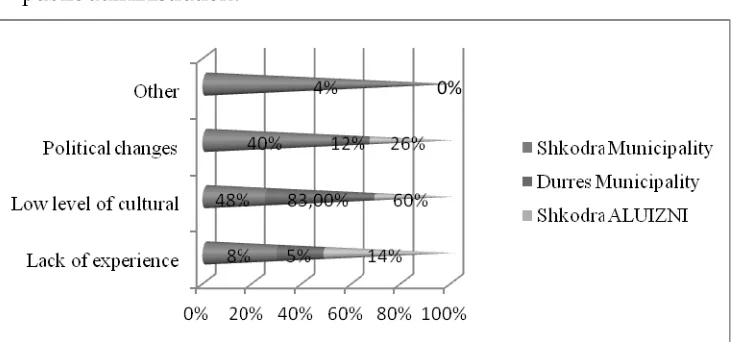
Figure 2: What are the obstacles to implementing the code of ethics in public administration?
Source: Authors, (own calculation)
_____________________________
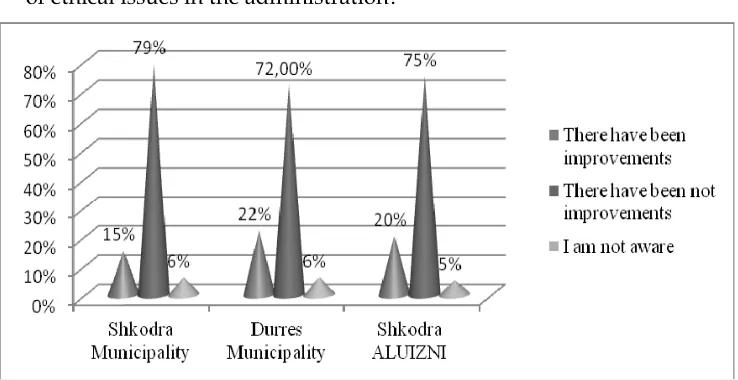
changing of the staff immediately with the arrival of different political forces. The public administration in Albania yet is a variable, in the function of politics. Regarding to the improvements observed over the treatment of the ethical issues compared to the last year, the employees are expressed in a balanced way. Most of them link the progress of improvement with the working conditions, for them there are no significant changes and significant improvements observed in the quality of services, especially in the implementation of the ethics code. The long queues in obtaining identity cards and passports, multi-year effort to recognize and convert the former property to the owners, the difficult process of legalization etc, have lost the confidence of people for improvements in the services.
Figure 3: Do you see improvement from previous years to the treatment of ethical issues in the administration?
Source: Authors, (own calculation)
Figure 4: What are your thoughts about the work of public administration in periodic training of employees for ethical knowledge?
Source: Authors, (own calculation)
_____________________________
administration established a special office for the pursuit of ethical issues?” 98% said no, implying a huge vacuum that the present administration has in this field. In a word, the lack of specialized staff or a special office for prosecution of ethical issues in the administration is not in accordance with the Code of Good Practice. In all the institutions surveyed, it was said that this issue was followed from the Human Resources department. This situation speaks for a void in the pursuit of ethical issues in administration, turning this into a problem of the spread of the solution. The data are represented in the figure no.6.
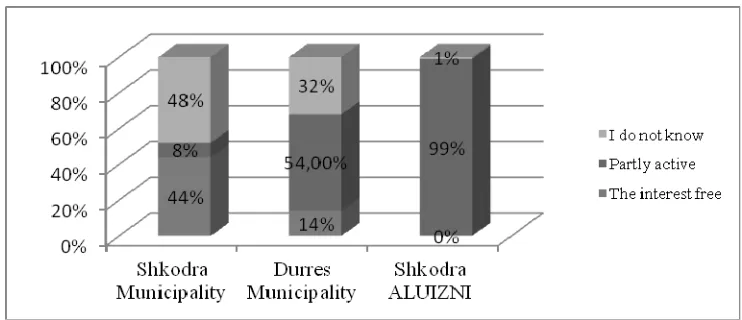
Figure 5: The level of civil participation in the improvement of ethical issues in the administration?
Figure 6: Has your administration established a special office for the pursuit of ethical issues?
Source: Authors, (own calculation).
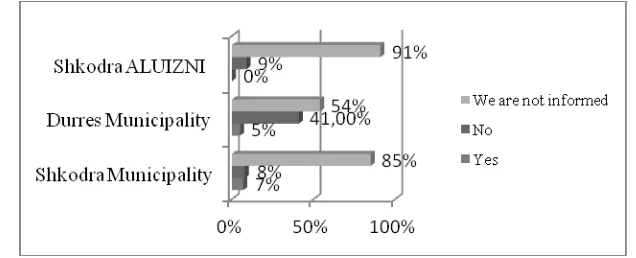
In regard to the development of the public administration programs or brochures to inform the ethical issues, respondents said that they are not informed. The data are represented in the figure no.7.
Figure 7: Has your organization developed programs or brochures to address the ethical issues?
Source: Authors, (own calculation)
_____________________________
that they would still need these services, while about 21% react to it directly, while the rest complain about their superiors. Given the extraordinary meanders in the judicial proceedings, none of the respondents declared not to follow the legal route against to an injustice. They also were not convinced that the Albanian courts would provide justice. The data are represented in the figure no.8. Regarding the question of how is the performance of public administration affected by the cultural behavior and ethics towards the citizens, the vast majority with 40% said to increase quality of the service, while 33% expressed the approachment of public administration to the community. A small percentage said that cultural behavior and ethics help citizens in the fight against corruption.
Figure 8: How do you act when faced with unethical attitudes of employees in public administration?
Figure 9: How is the work of public administration, cultural behavior and ethics in general?
Source: Authors, (own calculation)
6. Conclusions
The administrators of the public services should be more responsible, because their work has many aspects, which can lead to the abuse of the public interest and to corruption. The way of bringing the public administration must define objectivity, confidentiality, transparency, respect, responsibility, care and honesty. In new democracies, as is the case of Albania, the political environment cannot be noted as a key factor, but as the determining factor that influences the understanding of ethics in the public services, by providing a general picture for the public services. Various legislation and regulations have played an important role and have influenced the behavior of the officials, when they should make impartial decisions.
_____________________________
local government, as well as the central criteria must be set to ensure the continuation of the administration regardless of which political force comes to power. The public administration must provide programs for the administrative ethics, which must help in forming new quality administrators.
List of References
Aliaj, B, Lulo K. and Myftiu G., (2003), The Challenge of an Urban Develoment, Develoment, Tirane, Cetis.
Bertrand, M., E. Duflo, and S. Mullainathan (2004), How Much Should We Trust Differences-in-Differences Estimates? Quarterly Journal of Economics, 119, 249-275.
Bridges, E., (1950), Portrait of a Profession, London: Cambridge University Press.
Chapman, R. A., (2002), Ethics in public service for the new millennium, Durham University Business School.
Lang, P (2012), Effectiveness of Public-Service Ethics and Good Governance in the Central Administration of the EU 27, Demmke and Moilanen, p.77.
Nolan, L., (1995), First Report of the Committee on Standards in Public Life, Cm. 2850-I, London: HMSO.
Pajaziti Ali, (2008) Ethics and public administration: Case RM, Center for Research in Public Administration, SEEU, Macedonia.
Pajaziti Ali, Ismaili M. and Hamiti, M., (2008) Ethics challenge of the third millennium, Macedonia.
Rosenbloom, D. H. and Kravchuk, R. S. (2005), Public Administration-Understanding Management, Politics and Law in the Public Sector, sixth edition, Mc Graw Hill, New York, 2005, pg. 515-547.