Internet Dependency and
Academic Performance
Randy McCamey, Brooke Wilson,
& Joanna Shaw
Abstract
This study investigated the relationship between Internet use (including the use of social media), the level of Inter-net dependency, and academic performance as measured by self-reported student grade point average (GPA). Re-sults reveal that there is no statistically significant rela-tionship between the level of Internet dependency, the amount of time spent on the Internet, or the amount of time spent on social networking or social networking sites
and academic performance as measured by GPA. Results did reveal a statistically significant relationship between the amount of time spent on the Internet and Internet de-pendency.
Purpose of the Study
This study focuses on college student dependence on the Internet and how it correlates with academic per-formance. Past studies have shown that Internet use has had a positive effect on student academics when used in the proper context. One study by Baker and Edwards (2011) showed how online blended learning helped in-crease students’ proper use of social media. Edwards de-veloped virtual office hours in her classes that consisted of an instant message set-up so students could contact her at later hours if needed, in addition to her traditional office hours. The Internet can, however, be overused and many students have become dependent on the Internet, which in turn has led to poor academic performance (Kubey et al., 2001). Further research is needed in order to fully under-stand if increased Internet use corroborates Kubey et al.,’s findings and to determine what association, if any, the use of the Internet has on the academic performance of stu-dents. The purpose of this study, then, is to investigate the relation between Internet dependency (based upon the modified DSM IV criteria for gambling) and the academic performance of college students as measured by student grade point average (GPA).
Factors of the Internet
Shortly after the release of the DSM V (5th Ed., DSM-V, American Psychiatric Association, 2013) issuing the release of a new diagnosis of Internet Addiction, Grif-fiths and Szabo (2013) published their research focused on the factors of being addicted to the Internet versus addic-tions on the Internet. Griffiths and Szabo’s research un-covered that the top three areas of popularity where “social networking (85%), e-mail and chat (69%), and vid-eos and movies (35%)” (p.76). The results also showed that 84% of the subjects would still go online if their top activi-ties were not available, while 16% would not go on the Internet at all if their favorite sites were not available. The weekly time spent on the Internet averaging at 21.13 hours per week (p.76). Based upon these results it was concluded that time spent on the Internet is intentional and if the subjects’ top sites are not available then time spent online would decrease.
One of the most popular forms of Internet use is finding, maintaining or ending relationships. This form of Internet use can be defined as communicating for personal use through social networking, newsgroups, and sites such as Facebook, Twitter and other newly advancing social media websites (Berry, Gee, & Grubaugh, 2000). Social websites such as these have advanced the communication not only of personal issues throughout the world but also of news issues. Through the use of Twitter and Facebook an event can be broadcasted worldwide with just the click of a button seconds after the event has occurred. Often these messages include personal accounts of the event.
DVDs, live streaming music, or viewing online books. Searching for or gathering information was the most used area of Internet use (Berry et al., 2000). Current happen-ings around the world are very easy to access now due to the ability to immediately update social media and other such “outlet” sites. From the weather to sports scores to natural disasters, all are just a click away on the Internet.
Providing information or expertise is an area of the Internet that has most recently become very popular due to the social media site of Pinterest. Pinterest allows peo-ple to post how things around the house can be used for crafts, parties or events allowing the users to share their expertise with others. Providing information is also done by answering blogs such as Yahoo Answers.
Individuals can also spend time selling or buying items on the Internet. Berry et al. (2000) described utiliz-ing the marketplace on the Internet to include transactutiliz-ing business, making travel plans, or ordering products. Many individuals are able to start online businesses, work from their homes, and spend more time with their families by effectively using the Internet. Other elements that can be included in this area are online banking, stock trading, or using websites like eBay or Craigslist to buy or sell items much like the traditional “garage sale.”
Finally the last two uses of the Internet are to ask questions or simply browsing to pass the time. There are several different portals that an individual can use to ask questions on the Internet such as finding directions from one place to another, getting medical advice, finding movie times or reviews, reading products or services reviews, or accessing information on genealogical research.
cate-gories that can take up a person’s time. Some of these op-tions are positive and will help improve students’ aca-demic success such as using the Internet for professional or academic use or gathering current happenings. In order to find out how Internet affects education it is important to see which areas of the Internet are being utilized the most. This study will use the categories of Internet use outlined by Berry et al. (2000).
The Internet and Higher Education
The Internet is an extremely valuable tool that has developed over the last several decades bringing a hereto-fore unheard of quantity and quality of information to the student at the click of a button. It allows students to do fast and effective research as well as provides an outlet for individuals of all ages to gather information and communi-cate with other people with whom they normally would not have taken the opportunity to do so otherwise. This “social presence” has put the term social media into the worlds’ current vocabulary and has made Facebook one of most valuable companies in the world (Raice, 2011). Social or electric media is so vast and fast growing that it is often hard to define. Jacobsen and Forste (2011, p.275) describe electronic media as the use of technology for e-mail, in-stant messaging (IM), social-networking sites (SNSs), playing video or online games, and watching television or movies. Raice‘s article in the Wall Street Journal predicted that Facebook will be worth $100 billion in the next year and $234 billion by 2015. With this dramatic increase in worth and use, will academics fall behind or prosper?
how to create an online social environment between the students and the professors in the academic environment. Their article discusses how virtual office hours, weekly checklists and grading rubrics along with a live Twitter feed, were used in various online courses and how those aspects of technology increased students’ feeling of con-nectedness in the class. Baker and Edwards’ study sug-gests that the effectiveness and benefits of online learning increases when the teacher is able to create a community for the students online. Students often have trouble engag-ing effectively in an online course due to a lack of under-standing of current technology, especially nontraditional students (students who are over the age of 24 and have returned to school after an extended period of time). Baker and Edwards also report that providing online services such as a link to the Help Desk allows students to have a better understanding of the technical components of the online course. While providing a stimulating community for online students seems to be a key factor in creating a healthy online environment, it can be hard to find instruc-tors who know how to create such an environment. While the Internet and social media provide students with great opportunities, there are several possible problems that may be derailing student performance including the over-use of the Internet.
Further research conducted by Jacobsen and Forste (2011) looked at how social media affects college students’ academics in a very interesting and effective way.
com-puter. From this information, Jacobsen and Forste were able to determine how much time was actually being spent productively online and how much time was inhibiting stu-dents’ academics. It was concluded that for every hour a student spent using social media his or her average GPA was decreased by 0.05 to 0.07 points; offline interactions had a negative association to GPA with a decrease of 0.02 grade points per hour spent using social media. However, Jacobsen and Forste also found that if the student spent an hour on the Internet using it for academic purposes, his or her GPA had a slight positive correlation with grade point average.
Predictors of Academic Performance
Many people assume that academic performance pertains only to the grades that students make in their classes. While this is one definition, academic performance can also be more broadly defined as a multitude of criteria including the students’ overall GPA, success and participa-tion in extra-curricular activities, and class attendance. Kubey et al. (2001) described poor academic performance as academic impairment, which consisted of lower grades and low class attendance. DeBerard, Spielmans and Julka (2004) state that GPA and SAT scores, along with psycho-logical variables such as smoking, drinking, social support and coping, were all found to be reliable predictors of aca-demic performance (or lack thereof).
per-formance in the college setting can be class attendance, study group involvement, past grade point average, visits with instructors, and the level of involvement in campus organizations (DeBeraed, Spielmans, & Julka, 2004).
While it may be fairly easy to predict academic per-formance based on these typical criteria, the issue of how the Internet, used as a tool or as a distraction, impacts academic performance is at question in this research.
The Impact of the Internet on Academic Performance In an article on Internet use and academic perform-ance (2001), Kubey et al. stated that, “69% of students, and 69% of teachers, said that they have personally seen students’ grades improve through use of the
the use of Internet played a large part in the reason they failed.
Kubey et al. (2001) discussed how individuals who were Internet dependent displayed many of the same char-acteristics researchers associate with gambling addiction. Kubey et al. states that if the Diagnostic and Statistical Manual of Mental Disorders, Fourth Edition (DSM IV) cri-teria for gambling addictions was used and the word “gambling” was substituted with “Internet,” individuals displaying Internet dependency display many of the same characteristics used to diagnose the serious psychological addiction of gambling. Internet Gaming Disorder, using items similar to those proposed by Kubey et al. was added to the current DSM V manual (APA, 2013). Overall Kubey et al.,’s research provides a strong foundation for the study of Internet dependence of college students and how it may affect their academic performance.
A study by Asdaque, Khan and Rizvi (2010) found that teachers’ and students’ major motivation for using the Internet was convenience (82.91%); usefulness (80.05%); and free access to information and software (71.4%). The article focused on how students and teachers use books and the Internet when dealing with research for academ-ics. In addition, teachers found that the use of Internet al-lowed them to better tailor their teachings to each student. However, the researchers also discovered that increased Internet usage was linked with a lowered GPA when the content search on the Internet was not for scholarly pur-poses (p.22-25).
(Englander, Terregrossa, & Wang, 2010). Englander et al. conducted their own study consisting of an undergraduate introductory micro-economics class. Data were based off of three test scores the students produced and the number of hours per week spent on the Internet. Calculations by these researches indicated that “a negative and statisti-cally significant relationship between a student’s hours per week of Internet use and the student’s exam perform-ance” (2010, p.93). Englander et al. concluded that while the Internet is home to a wide variety of valuable informa-tion, it can also serves as an outlet for social communica-tion that can distract students and keep them off task. Englander’s conclusions were that increased Internet use by students resulted in lower grades.
In summary, the purpose of this study is to deter-mine the association between academic performance and use of the Internet by college students. Past reports have shown that males are predominately affected by Internet dependence more so than females (Kubey et al., 2001) and an increase feeling of loneliness occurs when Internet de-pendence takes place (p.6). It has also been shown that an increase in Internet dependence can result in lower grades and less class attendance and participation (Kubey et al., 2001). The current researchers expect to see this trend continue and hope to more accurately quantify the rela-tionship between academic performance, as indicated by student GPA, and the use of the Internet.
Gambling Addiction vs. Internet Addiction
students to maintain and promote a personal and profes-sional network of their colleagues and friends. When is the use of the Internet considered too much? When is the use of the Internet such that it becomes an addiction or a de-pendency? Merriam-Webster Dictionary define addiction as the “compulsive need for and use of a habit-forming substance characterized by tolerance and by well-defined physiological symptoms upon withdrawal; a persistent compulsive use of a substance known by the user to be harmful” (Merriam-Webster, 2004, p.14). The same source defines dependence as “the quality or state of being de-pendent; the quality or state of being influenced or deter-mined by or subject to another” (p.334).
Kubey et al. (2001) addressed the different between addiction and dependence in his article when he stated, “some commentators and researchers apply the DSM crite-ria to the Internet and replace the world “gambling” with the word “Internet,” reaching a conclusion of “addiction” instead of “dependency,” which is the operative DSM term” (p.368). For the purpose of this study Internet de-pendence will be used due to the lack of need to diagnose the individuals with a psychological disorder and addic-tion.
Kubey et al. (2001) reports that the section of the DSM IV dealing with gambling addiction might be used to assess Internet addiction by replacing the word “gambling” with “Internet” and, as such, those requirements would begin to set the stage for diagnosing Internet addiction. The DSM 5 lists a diagnosis for Internet Gaming Disorder consistent with Kubey et al. (2001). It has been predicted, however, that the DSM V will add Internet addition
at the gambling diagnosis of the DSM IV, a person must meet five of the ten possible symptoms. Of the ten symp-toms, roughly eight can be translated directly to relating with an Internet addiction disorder (Young, 1996). They are as follows:
Do you feel preoccupied with the Internet (think about previous on-line activity or anticipate next on-line session)?
Do you feel the need to use the Internet with in-creasing amounts of time in order to achieve satisfaction?
Have you repeatedly made unsuccessful efforts to control, cut back, or stop Internet use?
Do you feel restless, moody, depressed or irritable when attempting to cut down or stop Internet use?
Do you stay on-line longer than originally in-tended?
Have you jeopardized or risked the loss of signifi-cant relationship, job, and educational or career opportunity because of the Internet?
Have you lied to family members, therapist, or oth-ers to conceal the extent of involvement with the Internet?
Do you use the Internet as a way of escaping from problems or of relieving a dysphonic mood (e.g., feelings of helplessness, guilt, anxiety, depres-sion)? (American Psychological Association, 1994, p.618).
While many students “go online” strictly for academic pur-poses or to maintain their social network in brief “time chunks,” many students today have moved their entire world online. Therein lays the problem: if a student has no reason to leave their home for their studies, do they risk overusing the same tool that facilitates learning to an un-healthy level as gauged by their academic performance? If this is true, then what role might the instructor and the academic institution play in preventing, reducing, or reha-bilitating those who are dependent on the Internet?
Methodology
The population for this study was approximately 11,000 undergraduate and graduate students enrolled at moderately sized, state-supported post-secondary institu-tion in the Southwest U.S.
For the purpose of this study dependence was de-fined as the reliance on, influence of or being subject to another person or activity outside the individual. Young described an addiction as “an impulse-control disorder which does not involve an intoxicant” (1996, p.2). In this study the researchers focused on dependence an individual has on the Internet and how that affects his or her aca-demic performance and not a diagnosis of addiction; the modified version of the DSM IV criteria for gambling was only under consideration by the American Psychological Association at the time of the study (Man’dee Mason, per-sonal communication, DATE).
of Internet use was also evaluated, which consisted of the use of social media. Social media were defined collectively as any online networking site that connects and individual with another individual and examples include Twitter, Facebook, instant messaging, chat rooms, Pinterest, etc.
A survey was used to gather data that included a modified set of the DSM IV criteria for gambling addiction to determine Internet dependency as well as an array of demographic inputs including self-reported GPA. The sur-vey was administered to students in 10 face-to-face classes during the spring 2012 semester yielding 278 valid re-sponses. Although the survey did ask about the use of the Internet for academic purposes, subjects were not asked specifically about whether or not they were currently in an online class or how many online classes they had taken, or were, taking. Following the survey administration, find-ings and results were analyzed to test the following null hypotheses:
Ho1n: There is no statistically significant relation-ship between the level of Internet dependency and academic performance as measured by GPA. Ho2n: There is no statistically significant relation-ship between the amount of time spent on the Inter-net and academic performance as measure by GPA. Ho3n: There is no statistically significant relation-ship between the amount of time spent on social net-working or social netnet-working sites and academic per-formance as measured by GPA.
Results
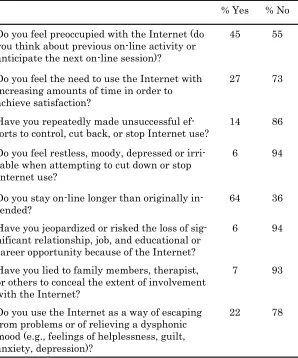
One aspect the researchers were interested in as-sessing was just how much time today’s college student spends on the Internet and how they spend that time. Ta-ble 1 shows that a majority of the students surveyed stayed online longer than intended (64%). There was a close split of percentage (45% yes and 55% no) of students who felt preoccupied with the Internet, thinking about previous sessions, or anticipating the next online-session. Table 1
Percentage Responses for Internet Addiction Items % Yes % No Do you feel preoccupied with the Internet (do
you think about previous on-line activity or
anticipate the next on-line session)?
45 55
Do you feel the need to use the Internet with increasing amounts of time in order to achieve satisfaction?
27 73
Have you repeatedly made unsuccessful
ef-forts to control, cut back, or stop Internet use? 14 86 Do you feel restless, moody, depressed or
irri-table when attempting to cut down or stop Internet use?
6 94
Do you stay on-line longer than originally
in-tended? 64 36
Have you jeopardized or risked the loss of sig-nificant relationship, job, and educational or career opportunity because of the Internet?
6 94
Have you lied to family members, therapist, or others to conceal the extent of involvement with the Internet?
7 93
Do you use the Internet as a way of escaping from problems or of relieving a dysphonic mood (e.g., feelings of helplessness, guilt, anxiety, depression)?
The results also show that the majority of students do not have to have increasing amounts of time on the Internet to be “satisfied” with their experience. Students overall do not use the Internet to escape from problems nor have stu-dents reported that the Internet caused any significant losses of relationships, jobs, or educational opportunities.
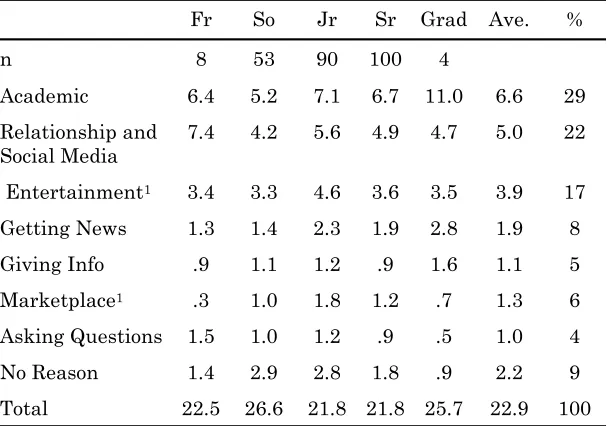
Table 2 shows the breakdown of student classifica-tion with how many hours they spend on the Internet in the specific areas. Results show that, overall, students spend almost 23 hours per week on the Internet. Fresh-men showed the highest number of hours per week spent in the area of Relationships and Social Media (7.4) fol-lowed by juniors (5.6), seniors (4.9), graduate students (4.7) and sophomores (4.2). Use of the Internet for Aca-demic activities shows that graduate students spent the
Table 2
Hours/Week for Each Form of Internet Use by Academic Classification
Fr So Jr Sr Grad Ave. %
n 8 53 90 100 4
Academic 6.4 5.2 7.1 6.7 11.0 6.6 29 Relationship and
Social Media 7.4 4.2 5.6 4.9 4.7 5.0 22 Entertainment1 3.4 3.3 4.6 3.6 3.5 3.9 17
Getting News 1.3 1.4 2.3 1.9 2.8 1.9 8 Giving Info .9 1.1 1.2 .9 1.6 1.1 5 Marketplace1 .3 1.0 1.8 1.2 .7 1.3 6
Asking Questions 1.5 1.0 1.2 .9 .5 1.0 4
No Reason 1.4 2.9 2.8 1.8 .9 2.2 9
Total 22.5 26.6 21.8 21.8 25.7 22.9 100
most number of hours per week (11.0) followed by juniors at 7.1 and the lowest number of hours per week spent in online academics was sophomores at 5.2. These areas are the two highest percentages overall for students spending time on the Internet followed by Entertainment, Getting News, Marketplace, Giving Information, and Asking Ques-tions.
Based on these results, practitioners and adminis-trators in higher education should recognize that students are making Internet use an everyday aspect of their life. Students are continuing to seek information from the Internet both socially and academically. Use of the Inter-net will continue to grow as more and more technology and applications support the students areas of interest includ-ing LinkedIn, various Learninclud-ing Management Systems Table 3
Correlation Coefficients (r) for Hypothesis by Academic Classification
Fr So Jr Sr Grad All
n 8 54 78 94 4 239
Internet Dependence
and GPA -.241 .002 .037 .144 -.847 .047 Time on the Internet
and GPA .339 -.052 -.124 .091 .590 -.024 Time spent on Social
Media and GPA -.387 -.236 -.191 .065 .843 -.088 Time on the Internet
and Internet Depend-ence
-.016 .420* .288* .325* -.929 .303*
(LMS), E-textbooks, publisher companion sites, and an in-creasing number of online and hybrid classrooms.
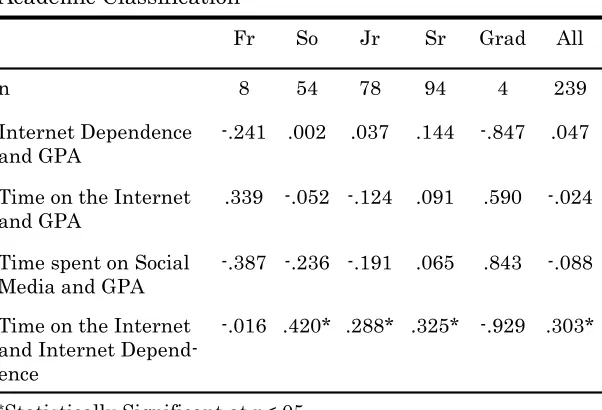
Each hypothesis was tested and the results are tabulated in Table 3. Null hypothesis 1 was supported as the researchers found no statistically significant correla-tion between Internet dependency and academic perform-ance as measured by GPA. Similarly, both null hypothesis 2 and null hypotheses 3 were supported as there was no statistically significant correlations found between the time spent on the Internet in total, or time spent specifi-cally engaged in social media, and GPA.
Null hypothesis 4 was not supported as the results show a statistically significant relationship exists between the amount of time spent on the Internet and the level of Internet dependency (r = .303, p<.05). In basic terms, the data shows that the more hours per week a student spends on the Internet, the more likely he or she is to be or be-come Internet dependent and possibly addicted to the Internet.
To bore into the data with regard to null hypothesis 4, the researchers looked at the data based on academic classification and found that data for freshmen and gradu-ate students did not show a statistically significant rela-tionship. The researchers posit that freshmen may not have had enough time in academics nor credit hours accu-mulated to meet the required p<.05 level. Graduate stu-dents did not show any significant relationship because the sample size for this group was too small to show statis-tical significance (n = 4).
dependency and Relationships and Social Media (r = .301), Entertainment (r = .369), Getting News (r = .228), Giving Information (r = .164), using the Marketplace (r = .166), and for No Reason (r = .293).
To further explore null hypothesis 4, the research-ers analyzed the eight symptoms used in the survey that relate to Internet addiction disorder (Young, 1996) and found the following statistically significant correlations with regard to Internet dependency:
Have you repeatedly made unsuccessful efforts to control, cut back, or stop Internet use? (r = .380, p<.01).
Do you feel restless, moody, depressed or irritable when attempting to cut down or stop Internet use? (r = .282, p<.01).
Have you jeopardized or risked the loss of signifi-cant relationship, job, and educational or career opportunity because of the Internet? (r = .337, p<.01).
Have you lied to family members, therapist, or oth-ers to conceal the extent of involvement with the Internet? (r = .334, p<.01).
Discussion
reason other than to occupy time.
This study addressed the relationship between stu-dents’ use of the Internet and the effect of such use on aca-demic performance and found no statistically significant correlation. These findings are similar to those of Pasek, More, and Hargittai (2009) although other studies have indicated that such a correlation does exists (Kubey et al., 2001; Jacobsen and Forste, 2011). This study also investi-gated correlations between student use of the Internet and Internet dependence. In this case, statistically significant correlations were found that further support the conclu-sion that the more time on the Internet, the more likely a student is to become dependent on the Internet. Results show that only 14% of students made unsuccessful at-tempts to cut back from Internet usage, 6% of students felt restless or moody when trying to cut back on Internet use, 6% experienced jeopardizing a job or relationship due to Internet usage, and 7% lied or concealed how much time they were spending on the Internet. While these percent-ages are low, these areas also have a strong correlation to Internet dependence and are consistent with finding of a study conducted by Heo, Oh, Subramanian, Kim, and Kawachi (2014) focusing on the time high school and mid-dle school students spent on the Internet. Heo et al. con-cluded that males have a higher likelihood of being ad-dicted to the Internet then females, due to the percentages of the top online activity for males being online gaming (67%) and the top online activity for females being blog-ging (23%) (p.4).
(22%). Because a student population was used in this study, it was predictable that a large portion of time on the Internet would be on academic endeavors and that stu-dents would use the Internet as both an academic outlet and a social outlet. Future studies might look at a tradi-tional labor force to see if they time spent on the Internet for professional or occupationally-related activities is equally as high.
Is over-use of the Internet a problem? Many col-leges and universities suspend students if their GPA falls below a 2.0 (on a 4.0 scale) for a semester, but if the stu-dent is facing an Internet dependence problem would this really help the student? The answer is most likely no. Stu-dents whose grades fall due to Internet use would not likely benefit from suspension because the student would then be provide them with more time to use the Internet! The authors suggest that students with academic prob-lems associated with the (mis)use of the Internet might be more successful in their studies in a smaller classroom set-ting where the student can receive more direct one-on-one help from an instructor or teaching assistant (Mattox, 2012).
The largest single issue or limitation with this study is that of students self-reporting their grade point average, problematic in other studies noted by Junco (2015). Many students do not know their exact GPA so they may have guessed based on what they remembered from their most recent grade reports. They may also have wanted to “impress” the researchers, so they may have rated their academic performance higher than actual per-formance.
corre-lated with the use of the Internet, social media sites, and GPA to gain a greater understanding of those characteris-tics as they are related to the population. Hur (2012) stated that out of 207 studies published in Korean aca-demic journals, only 27.5% focused on what makes a web-site addictive. Hur concluded that academic webweb-sites are not considered to have “addictive” qualities while online shopping and gaming sites do have addictive qualities. This study concluded that 23% of the time was spent on sites that are “addictive” (see Table 2). Future research considerations would be to examine each of the depend-ency traits of “addictive” websites to see if there is an im-pact on student grades.
Certainly a replication study outside of academia is called for. Continued research could also include more spe-cific assessments in the area of relationships and social media by evaluating specific social media sites (LinkedIn, Match.com, Facebook, Twitter, Pinterest, etc.) to deter-mine any relationships on GPA based on the nature or content of those specific sites.
Acknowledgement
The authors would like to thank members of the Texas Social Media Research Institute for their assistance with this research and for providing a platform for dis-semination of research findings through the annual Social Media Conference.
References
Addiction. (2004). In Merriam-Webster's Collegiate Dictionary, 11th Ed. Springfield, MA.
statis-tical manual of mental disorders, (4th ed.). Washington,
DC, Author.
American Psychiatric Association. (2013). Diagnostic and
statis-tical manual of mental disorders, (5th ed.). Washington,
DC, Author
Asdaque, M., Khan, M., & Rizvi, S. (2010). Effect of Internet on the academic performance and social life of university stu-dents in Pakistan. Journal of Education & Sociology, (4), 21-27. ISSN: 2078-032X
Baker, C., & Edwards, J. T. (2011). A holistic approach for estab-lishing social presence in online courses & programs. The International HETL Review. 1(7). Retrieved from http://hetl.org/2011/08/17/social-presence-in-online-courses/
Berry, J., Gee, B., & Grubaugh, S. (2000). Academics on the Internet: An exploratory study of academic and human communication needs met by the World Wide Web. Uni-versity of Montana.
DeBerard, M., Spielmans, G., & Julka, D. (2004). Predictors of academic achievement and retention among college freshman: A longitudinal study. College Student Journal Publisher, 38(1).
Dependence. (2004). In Merriam-Webster's Collegiate Diction-ary, 11th Ed. Springfield, MA.
Englander, F., Terregrossa, R. A., & Wang, Z. (2010). Internet use among college students: Tool or toy? Educational Re-view, 62(1), 85-96. doi:10.1080/00131910903519793 Griffiths, M.D., & Szabo, A. (2013). Is excessive online usage a
function of medium or activity? An empirical pilot study. Journal of Behavioral Addicts, 3(1). pp 74-77. doi: 10.1556/JBA.2.2013.016
Heo, J., Oh, J., Subramanian, S.V., Kim. Y., & Kawachi, I. (2014). Addictive internet use among Korean adoles-cents: A national survey. Plos One 9(2), doi: 10.1371/ journal.pone.0087819
research: A review of 2000-2008 Korean academic journal articles. Asia Pacific Journal of Social Work and Develop-ment, 22(3), 187-201. Doi: 10.1080/02185385.2012.691718 Jacobsen, W., & Forste, R. (2011). The wired generation:
Aca-demic and social outcomes of electronic media use among university students. Cyberpsychology, Behavior, and So-cial Networking. 14(5). doi: 10.1089/cyber.2010.0135 Junco, R. (2015). Student class standing, Facebook use, and
aca-demic performance. Journal of Applied Developmental Psychology, 36, 18-29.
Kubey, R. W., Lavin, M. J., & Barows, J. R. (2001). Internet use and collegiate academic performance decrements: Early findings. Journal of Communication, 51(2), 366-382. doi:10.1111/j.1460-2466.2001.tb02885.x
Mattox, K. A. (2012). Utilizing online education in Florida to meet mandated class size limitations. Educational Con-siderations, 39(2), 55-60.
Mulvihill, A. (2011). Social media to entertainment portals. Trending Topics. Retrieved from
www.econtentmeag.com
Pasek, J., More, E., and Hargittai, E. (2009). Facebook and aca-demic performance: Reconciling a media sensation with data. First Monday, 14(5).
Raice, S. (2011, July 14). Is Facebook worth $100 billion? Wall Street Journal. Retrieved from http://online.wsj.com/ article/
SB10001424052702304584404576442950773361780 Shaw, J. G. (2010). A study of students’ perceptions of blended
learning environments at a state supported post-secondary institution (unpublished doctoral disserta-tion), The University of North Texas, Denton, TX. Young, K. S. (1996). Pathological Internet Use: A case that