Examining Gender Differences
in Self-disclosure on Facebook
Versus Face-to-Face
Pavica Sheldon
AbstractPrevious studies have shown that women disclose to their close friends more often than men. However, no study has compared the intimacy of their disclosures across different media and different relationship types. The purpose of this study was to examine gender differences in self-disclosure between Facebook friends and between face-to-face friends. One hundred ninety-seven college women and 120 college men in this study were asked to report their levels of self-disclosure with three types of friends: an exclusive Facebook friend, an exclusive face-to-face friend, and a recently added Face-book friend. One-way MANOVA was used to test the hypothesis that women will self-disclose to their Facebook and face-to-face friends more than men. Results provided partial support for the hypothesis. Women disclosed to their exclusive face-to-face friends and exclusive Facebook friends more than men; however, men had more intimate discussions with their recently added Facebook friends than women did. Both men and women disclosed more to their exclusive face-to-face friends than to exclusive Facebook friends. Overall, these findings suggest that, regardless of the medium, both genders disclose more to the person they consider more intimate.
W
ith over 1 billion users and the continued growth in its popularity, Facebook is becoming another avenue for initiating and maintaining interpersonal relationships. A number of studies have found that relationship maintenance and social interaction (Sheldon, 2008; Smock, Ellison, Lampe, & Wohn, 2011) are the primary motivations for using Facebook. In order to interact with each other, users have to self-disclose. In this study, self-disclosure has been defined as “any message about the self that a person communicates to another” (Wheeless & Grotz, 1976, p. 338). According to social penetration theory (Altman & Taylor, 1973), self-disclosure plays a critical role in the development of intimacy in relationships. The more time we spend with others, the more likely we are to self-disclose more intimate thoughts and details of our life. If self-disclosure is high, then the relationship will develop (Altman & Taylor, 1973). Two dimensions of self-disclosure are breadth and depth. Breadth refers to the number of various topics discussed in the relationship. Depth refers to the degree of intimacy that guides topic discussions. In the initial stages, relationships have narrow breadth and shallow depth. As relationships move toward intimacy, a wide range of topics is discussed (breadth), with several of the topics to be intimately discussed (depth) (Altman & Taylor, 1987). This study uses breadth and depth dimensions to measure self-disclosure.more time on Facebook (Sheldon, 2008) and also use social network-ing sites more to compare themselves with others (Haferkamp, Eim-ler, Papadakis, & Kruck, 2012). This study, therefore, explores if men and women differ in self-disclosure to their Facebook friend when compared to their face-to-face friend.
Self-disclosure, however, might not only differ between genders, but also between online and offline relationships. Due to missing nonverbal and contextual cues in computer-mediated relationships, some researchers (e.g., Cummings, Butler, & Kraut, 2000; Mesch & Talmud, 2006) have suggested that offline relationships are charac-terized by higher interdependence, and greater breadth and depth of self-disclosure. For example, an individual might self-disclose to their Facebook friends less than to their face-to-face friends because they cannot see each other’s facial expressions and gestures. This “cues-filtered out approach” was popular in early 1990s. Later, it was challenged by the findings showing that people disclose personal information and therefore develop relationships through computer-mediated communication (CMC) (e.g., Cho, 2006; Walther, 1996). Even further, Walther (1995) proposed the hyperpersonal model ac-cording to which individuals compensate for the limitations of CMC by hyperpersonalizing their interactions and actually disclosing more than they do face-to-face. When individuals are motivated and al-lowed sufficient time to exchange social information, relationships via CMC develop at the same pace as those established through face-to-face interaction (Walther & Burgoon, 1992; Walther, 1996).
the term “exclusive” describes a very close friendship. The third type of relationship was the “recently added Facebook friend.” For the lat-est added Facebook friend, it is assumed that participants just met at an event, and recently added each other as a Facebook friend.
Gender Differences in Self-Disclosure
Gender differences in self-disclosure have emerged in both face-to-face and online relationships. For example, women, including college women, appeared to discuss intimate topics with friends more frequently and in greater depth than men do (e.g., Aries & Johnson, 1983; Buhrke & Fuqua, 1987; Caldwell & Peplau, 1982; Dolgin & Minowa, 1997; Petronio, 2002). Women seek dialogue and ease of conversation, while men tend to restrict dialogue and converse for functional reasons (Fleuriet, Estrada, & Houser, 2009).
When looking at self-disclosure to different targets, Stokes, Hueh-rer, and Child (1980) discovered that males were more likely to dis-close to strangers and acquaintances, while women were more willing to disclose to those that they know well. Similar results were later found in a Dolgin, Meyer, and Schwarts (1991) study and a Dindia and Allen (1992) meta-analysis. Dindia and Allen (1992) performed a meta-analysis of 205 studies to determine whether there are gender differences in self-disclosure. When the target had a relationship with the discloser (i.e., friend, parent, or spouse), women disclosed more than men regardless of whether self-disclosure was measured by self-report or observation. When the target was a stranger, men reported that they disclosed similarly to women; however, studies using observational measures of self-disclosure found that women disclosed more than men. This study, however, surveys both men and women about their disclosure to a Facebook friend and disclosure to a face-to-face friend.
were personal, intimate and immediate. Home pages authored by men provided less biographical information than those produced by women. Women also included more information about their fami-lies and romantic interests and men discussed sports more (Doering, 2002; Dominick, 1999). In several Facebook studies, researchers (e.g., Acar, 2008; Sheldon, 2008) have discovered that not only do women have more Facebook friends, they also spend more time communi-cating with them. On Facebook, men disclosed more basic informa-tion and more contact informainforma-tion than females (Special & Li-Barber, 2012). Similarly, among the users of StudiVZ social networking sites, women were more likely to use it for comparing themselves with others and for searching for information. Men, however, were more likely to look at other people’s profiles to find new friends (Hafer-kamp, Eimler, Papadaki, & Kruck, 2012).
There are several possible reasons for the difference in self-disclo-sure. The explanation for gender differences in self-disclosure may be due to variations in how men and women are socialized, gender-role expectations, or how men and women use different criteria in defin-ing and controlldefin-ing private information (Petronio, 2002). While men are traditionally taught to exercise restraint in sharing their feelings (Rubin & Shenker, 1978), women have been socialized to be more expressive and open in their communication. Women are concerned with and evaluate their interpersonal relationships more often than men. Men are more task-oriented than women. As Burnett (1990) found, men are bothered about the practical aspects that make rela-tionships possible, regardless of what went on in them, whereas wom-en care more about monitoring and evaluating the intrinsic relational events. Jones (1991) and Steel (1991) offered another explanation for women’s higher levels of overall self-disclosure. Having trust in the individual one discloses to tends to coincide with increased self-disclosure. Since females place more importance on trust than males, they also self-disclose more. Others also found that women wanted to make sure that the people they were disclosing to were trustworthy, whereas men did not take those concerns into consideration (Petro-nio, Martin, & Littlefield, 1984).
There are five dimensions of self-disclosure: intent, amount, positive/ negative valence, accuracy, or honesty (Wheeless, & Grotz, 1976). The setting in which self-disclosure occurs may provide an additional mediating variable. According to Pearson (1981), men self-disclose more in dyads than they do in small-group settings, while women self-disclose more in a small-group setting.
Based on previous studies that women self-disclose more often than men both face-to-face and in CMC (e.g., Buhrke & Fuqua, 1987; Dolgin & Minova, 1997; Kleman, 2007; Petronio, 2002) and also spend more time on Facebook and have more Facebook friends than men (Sheldon, 2008), it is hypothesized that:
Women self-disclose to their latest added Facebook friends, exclusive Facebook friends, and an exclusive face-to-face friends more than men.
Differences in Self-Disclosure on Facebook and Face-to-Face Proponents of the cues filtered out perspective (Culnan, & Markus, 1985; Kiesler, Siegel, & McGuire, 1984; Dubrovsky, Kiesler, & Sethna, 1991) argued that important nonverbal cues are missing from CMC so relationships cannot completely develop. Brennan (1991) writes that “CMC occurs in a much less cooperative environment because of the special conditions imposed by the medium itself” (as cited in Riva, 2002, p. 581). CMC is missing turn-taking and yielding behaviors (Patterson, 1983; 1990).
for the limitations of CMC by hyperpersonalizing their interactions and actually disclose more than they do face-to-face. Henderson and Gilding (2004) also found that individuals reported higher levels of self-disclosure in their online friendships. In face-to-face relation-ships, they noted, appearance can get in the way of intimacy. Giddens (2000) argued that in contemporary societies, people expect a “pure relationship,” and the online environment is a perfect place to ac-complish it. Another group of researchers (e.g., Cummings, Butler, & Kraut, 2000; Mesch & Talmud, 2006) found the opposite results. Offline relationships are characterized by higher interdependence and greater breadth and depth of self-disclosure. Online relationships are not a substitute for an offline one.
The debate about whether we self-disclose more online or offline, led us to ask the following research question:
Do women and men disclose more to their face-to-face friends or to their Facebook friends?
Method
A survey was conducted with 328 participants at a large research university. College students were used in this study because they generally have a high degree of technological ability and are famil-iar with initiating relationships/friendships on Facebook. A sample consisted of 120 men (37.9%) and 197 women (62.1%). The average participant’s age was 20 (M = 20.33, SD = 1.77), ranging from 17 to 30 years. There were 81 first year students, 100 sophomores, 115 juniors, and 21 seniors. Most respondents identified themselves as European American or White (n = 252, 79.5%), followed by African-Americans (n = 36, 11.4%), and Asian-Americans (n = 10, 3.2%).
following measures were used in the study:
Self-disclosure
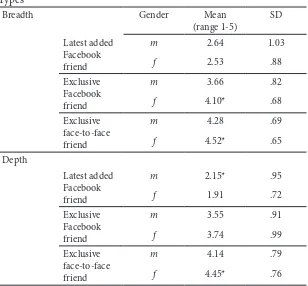
Self-disclosure to an exclusive Facebook friend, exclusive face-to-face friend, and recently added Facebook friend was measured by Parks and Floyd’s (1996) scale that was developed based on Altman and Taylor’s (1973) scales of self-disclosure, measuring depth and breadth. The Parks and Floyd (1996) scale is topic-free and was used in numerous studies (e.g., Craig et al., 2007; Yum & Hara, 2005) to measure self-disclosure online. Both breadth and depth used a 5-point Likert-type scale (1 = “strongly disagree” and 5 = “strongly agree”). A higher number represented more self-disclosure with a person (see Table 2 for mean differences in self-disclosure across three relationship types). One item in the breadth dimension and one item in the depth dimension were reverse-coded.
Duration of relationship
Duration of relationship for each type of a friend was measured with a single item: “How long have you known each other?” Respon-dents were asked to indicate the amount of time measured in days, months, or years. For the recently added Facebook friend, respon-dents indicated that they had known each other for an average of 3.7 months (Mn = 3.72). For the exclusive Facebook friend to whom participants interacted only through Facebook because he or she lives far away or is hard to reach, respondents indicated they have known each other for an average of 6 years (M = 6.43). Finally, duration of the relationship with an exclusive face-to-face friend (who does not have a Facebook account) was also 6 years (M = 6.02).
Frequency of communication
day or several times per day. For an exclusive face-to-face friend, 42% respondents indicated that they talk to each other every day or several times per day, and 29% that they talk to each other two-three times per week.
Respondents were asked to report their gender, age and educa-tion level. Table 1 provides some examples of whom the participants indicated as their Facebook and face-to-face friends.
Table 1
Examples of Facebook and Face-to-Face Friendships
Recently added Facebook friend with not much face-to-face interaction
Good Facebook friend with not much face-to-face interaction
Good face-to-face friend (never had a Facebook conversation)
A new/fellow
class-mate * A friend who moved away* My best friend* A girl I met tailgating I went to middle
school with him/her. Sister A friend of a friend Met at a camp My girlfriend A friend’s boyfriend Good friend who
went to college out of state
My neighbor
Went to high school
with this person A friend I met in Eu-rope this summer Co-worker Co-worker My old roommate
from London My brother who does not have a FB account *Dominant answer in a category
Results
test, the univariate main effects were examined. Significant univari-ate main effects for gender were obtained for the depth dimension of self-disclosure to a recently added Facebook, F (1, 315) = 6.11, p < .05 , η² =.02, power = .69, but not for the breadth of self-disclosure. Mean comparisons revealed that men scored higher on the depth di-mension of self-disclosure (Mdepth_m = 2.15) to their recently added Facebook friend than women (Mdepth_f = 1.91), which is opposite of the hypothesis that women will self-disclose more than men (see Table 2 for mean differences).
For the exclusive Facebook friend, analysis found a significant multivariate main effect for gender, Wilks’ λ = .903, F (2, 314) = 16.80, p <. 001, η² = .10. Significant univariate main effects for gender were obtained for the breadth dimension of self-disclosure to an exclusive Facebook friend, F (1, 315) = 26.31, p < .001, η² =.077, but not for the depth dimension of self-disclosure. Mean comparisons revealed that women self-disclosed, in terms of breadth, to their exclusive Face-book friends more than men, while there were no significant differ-ence in the depth of disclosures. Finally, for the exclusive face-to-face friend, a significant multivariate main effect for gender was found, Wilks’ λ = .962, F (2, 314) = 6.26, p < .05, η² = .038. Again, significant univariate main effects for gender were obtained for both the breadth dimension of self-disclosure to an exclusive face-to-face friend, F (1, 315) = 10.17, p < .05, η² =.031, and for the depth dimension of self-disclosure, F (1, 315) = 12.20, p < .05 , η² =.037. Mean compari-sons revealed that women self-disclosed (in terms of both breadth and depth) to their exclusive face-to-face friends more than men (see Table 2). Therefore, results partially supported the study hypothesis. When comparing gender differences across media, however, both women and men disclose more to their face-to-face friends than to their Facebook friend.
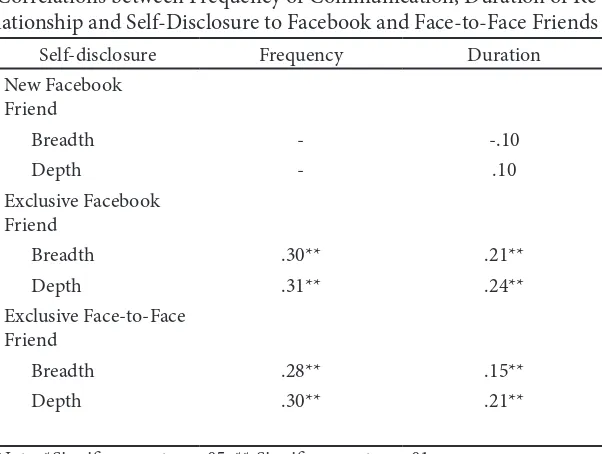
with each other through Facebook or face-to-face, the more they self-disclosed to that person.
Table 2
Descriptive Statistics for Self-Disclosure across the Three Friendship Types
Breadth Gender Mean
(range 1-5) SD Latest added
Facebook friend
m 2.64 1.03
f 2.53 .88
Exclusive Facebook friend
m 3.66 .82
f 4.10* .68 Exclusive
face-to-face friend
m 4.28 .69
f 4.52* .65 Depth
Latest added Facebook friend
m 2.15* .95
f 1.91 .72
Exclusive Facebook friend
m 3.55 .91
f 3.74 .99
Exclusive face-to-face friend
m 4.14 .79
f 4.45* .76 *statistically significant difference between genders
Duration of relationships was also related to self-disclosure to an exclusive Facebook and an exclusive face-to-face friend. The longer individuals knew each other, the more they disclosed to each other. However, no relationship was found between the duration of the relationship and self-disclosure and for the recently added Facebook friends (see Table 3).
Discussion
food and sex (Tamir & Mitchell, 2012). People enjoy self-disclosure if they know other people are listening. Talking is a means of cathar-sis towards good feelings. Previous studies have shown that women disclose to their close friends more than men. However, no study compared their disclosures across different media and different relationship types. The purpose of this study was to examine gender differences in self-disclosure between Facebook friends and between face-to-face friends. One hundred and ninety-seven college women and 120 college men participated in this study. They were asked to report their levels of self-disclosure with three types of friends: “ex-clusive Facebook friend”, “ex“ex-clusive face-to-face friend”, and “recently added Facebook friend.”
Table 3
Correlations between Frequency of Communication, Duration of Re-lationship and Self-Disclosure to Facebook and Face-to-Face Friends
Self-disclosure Frequency Duration New Facebook
Friend
Breadth - -.10 Depth - .10 Exclusive Facebook
Friend
Breadth .30** .21** Depth .31** .24** Exclusive Face-to-Face
Friend
Breadth .28** .15** Depth .30** .21** Note. *Significance at p < .05; ** Significance at p < .01
self-disclose more than men in all three types of friendship.
Looking at the literature review, the findings about women self-disclosing to their existing face-to-face friends and Facebook friends more than men are not surprising. In face-to-face interactions, as well as in computer-mediated communication, a number of stud-ies (e.g., Buhrke & Fuqua, 1987; Dolgin & Minowa, 1997; Kleman, 2007; Peter et al., 2005; Petronio, 2002) proposed this previously. In fact, a meta-analysis of 205 studies (Dindia & Allen, 1992) found that women disclose more than men when the target has a relation-ship with the discloser (in this study, “exclusive Facebook friend” is a friend from high-school that lives far away, and “exclusive face-to-face friend” is the person’s best friend, family member, or romantic partner).
Women in this study not only discuss more topics (greater breadth) with their exclusive Facebook friends and exclusive face-to-face friends, but also discuss them more intimately (greater depth) than men. However, men and women do not differ in the breadth of self-disclosure to their recently added Facebook friend, but only in the depth dimension of self-disclosure to that friend. This means that both genders discuss about the same amount of topics with recently added Facebook friends, but men’s discussions are more intimate. This is a new finding that almost corresponds with previous studies that focused on disclosures that are done face-to-face. Dindia and Al-len (1992) previously reported that, when the target is a stranger, men report that they disclose similarly to women. Although the recently added Facebook friend in our study is not a complete stranger, it is the person whom both men and women know the least, “a new/fellow classmate” or “a friend’s friend.” As Jones (1991) suggested, women place more importance in trust and therefore disclose to trusted part-ners, while men place less importance on trust. Consequently, men disclose more intimate topics with a friend that they recently added on Facebook than women do.
friend, and that was the close friend they communicate with face-to-face. It is important to point out that these results might not be necessarily due to the communication channel, but also to the type of relationships individuals reported on, as well as the duration of the relationship. While Christofides, Muise, and Desmarias (2009) showed that the participants were more likely to disclose information on Facebook than in their everyday life, they did not test one-on-one personal interactions through Facebook messages. These private in-teractions might occur just as they do face-to-face (i.e. social penetra-tion theory’s “the better I know you, the more I disclose to you”), and might be very different from what individuals post on Facebook for public view as a status update.
In addition to the context of self-disclosure, the results indicate that the longer they know each other, the more friends (both Face-book and face-to-face) self-disclose to each other. This is in line with previous studies (Chan & Cheng, 2004; Collins & Miller, 1994; Parks & Floyd, 1996; Peter et al., 2005) and mere exposure effect. The more time a person spends interacting with another person, the closer they become. This, however, was true only for exclusive Facebook and exclusive face-to-face friends. No relationships existed between the duration of relationship and self-disclosure to a recently added Facebook friend. While this may seem surprising, social information processing theory of CMC (Walther, 1995) posits that time is an im-portant element of developing online relationship. It takes longer to develop online relationships than face-to-face relationships (Walther, 1995). Since the latest added Facebook friend was a new relationship, it is not surprising that time did not correlate with self-disclosure variables.
Limitations and Future Research
Facebook friend to whom they talk only through Facebook with the expectation that they have previously met face-to-face. Future stud-ies could limit the choice of a friend by specifying individuals who interact with each other using only one medium during the course of their relationship. Future studies should take these limitations into the consideration, especially the control over the participants’ choice of “exclusive Facebook friend” or an “exclusive face-to-face friend.” One way to control this would be to ask participants to access their Facebook page at the time of an experiment and record their inter-action with a friend. Future studies should also examine disclosure in same-sex and cross-sex dyads, as research shows that disclosure decreases in cross-sex dyads (Hacker, 1981).
References
Acar, A. (2008). Antecedents and consequences of online social networking behavior: The case of Facebook. Journal of Website Promotion, 3, 62-83. Altman, I., & Taylor, D. (1973). Social penetration: The development of
inter-personal relationships. New York: Holt, Rinehart, & Winstron. Altman, I., & Taylor, D. (1987). Communication in interpersonal
relation-ships: Social penetration processes. In M. Roloff & G. Miller (Ed.),
Interpersonal processes (pp. 257-277). London, England: Sage Publica-tions.
Aries, E. J., & Johnson, F. L. (1983). Close friendship in adulthood: Con-servational content between same-gender friends. Gender Roles, 9,
1183-96.
Brennan, S.E. (1991). Conversation with and through computers. User mod-eling and user-adapted interaction, 1, 67-86.
Buhrke, R., & Fuqua, D. (1987). Gender differences in same- and cross-gen-der supportive relationships. Gender Roles, 17, 339-352.
Burnett, R. (1990). Reflection in personal relationships. In R. Burnett, P. McGhee & D. Clarke (Eds.), Accounting for relationships (pp. 73-94). London: Methuen.
Caldwell, M. A., & Peplau, L. A. (1982). Gender differences in same-gender friendship. Gender Roles, 8, 721-32.
Chan, D. K.-S., & Cheng, G. H.-L. (2004). A comparison of offline and online friendship qualities at different stages of relationship develop-ment. Journal of Social and Personal Relationships, 21, 305-320. DOI: 10.1177/0265407504042834
Christofides, E., Muise, A., & Desmarias, S. (2009). Information disclosure and control on Facebook: Are they two sides of the same coin or two different processes. Cyberpyschology & Behavior, 12, 341-45.
Collins, N. L., & Miller, L. C. (1994). Self-disclosure and liking: A meta-analytic review. Psychological Bulletin, 116, 457-475.
Craig, E., Igiel, M., Wright, K., Cunningham, C., & Ploeger, N. (2007).
“Will you be my friend”: Computer-mediated relational development on Facebook.com. Paper presented at the annual meeting of International Communication Association, San Francisco, CA.
Culnan, M. J., & Markus, M. L. (1985). Information technologies. In: F. Jablin, F., L. L. Putnam, K. Roberts, et al. (Eds.), Handbook of organiza-tional communication (pp. 420-443). Newbury Park, CA: Sage.
Cummings, J., Butler, B., & Kraut, R. (2002). The quality of online social relationships. Communications of the ACM, 45, 103–108.
Dindia, K., & Allen, M. (1992). Gender differences in self-disclosure: A meta-analysis. Psychological Bulletin, 112, 106–124.
Doering, N. (2002). Personal home pages on the Web: A review of research.
Journal of Computer Mediated Communication, 7(3). Retrieved from http://www.ascusc.org/jcmc/vol7/issue3/doering.html
Dolgin, K. G., & Minowa, N. (1997). Gender differences in self-presentation: A comparison of the roles of flatteringness and intimacy in self-disclo-sure to friends. Gender Roles, 36, 371-380.
Dolgin, K. G., Meyer, L., & Schwartz, J. (1991). Effects of gender, target’s gender, topic, and self-esteem on disclosure to best and midling friends.
Sex Roles, 25, 311-29.
Dominick, J. (1999). Who do you think you are? Personal home pages and self-presentation on the World Wide Web. Journalism and Mass Com-munication Quarterly, 76, 646-658.
Dubrovsky, V.J., Kiesler, S., & Sethna, B.N. (1991). The equalization phenom-enon: status effects in computer-mediated and face-to-face decision making groups. Human-Computer Interaction, 6, 119–146.
Fleuriet, C., Estrada, D., & Houser, M. L. (2009). The cyber factor: An analysis of relational maintenance through the use of computer-mediated communication. Paper presented at the annual meeting of the National Communication Association, Chicago, IL.
Giddens, A. (2000). The third way and its critics. Cambridge: Polity. Hacker, H. M. (1981). Blabbermouths and clams: Sex differences in
self-disclosure in same-sex and cross-sex friendship dyads. Psychology of Women Quarterly, 5, 385-401.
& Social Networking, 15(2), 91-98. doi:10.1089/cyber.2011.0151 Henderson, S., & Gilding, M. (2004). `I’ve never clicked this much
with anyone in my life’: trust and hyperpersonal communica-tion in online friendships. New Media & Society, 6, 487-506. doi: 10.1177/146144804044331
Jones, D. C. (1991). Friendship satisfaction and gender: An examination of gender differences in contributors to friendship satisfaction. Journal of Social and Personal Relationships, 8, 167-185.
Kiesler, S., Siegel, J., & McGuire, T. W. (1984). Social psychological aspects of computer-mediated communication. American Psychologist, 39,
1123–1134.
Kleman, E. (2007). Journaling for the world to see: A proposed model of self-disclosure intimacy in blogs. Paper presented at the annual meeting of the National Communication Association, Chicago, IL.
Li, Q. (2006). Computer-mediated communication: A meta-analysis of male and female attitudes and behaviors. International Journal on E-Learning, 5(4), 525-570.
Mesch, G., & Talmud, I. (2006). The quality of offline and online relation-ships: The role of multiplexity and duration of social relationships. The Information Society, 22, 137-148. DOI: 10.1080/01972240600677805 Parks, M. R., & Floyd, K. (1996). Making friends in cyberspace. Journal of
Communication, 46, 1-17. DOI: 10.1111/j.1460-2466.1996.tb01462.x Patterson, M. L. (1983). Nonverbal behavior: a functional perspective. New
York: Springer-Verlag.
Patterson, M. L. (1990). Functions of non-verbal behavior in social interac-tion. In Giles, H., W. P. Robinson, (Eds.), Handbook of language and social psychology (pp. 249–270). Chichester, U.K.: Wiley.
Pearson, J. (1981). The effects of setting and gender on self-dis-closure. Group Organization Management, 6, 334-340. DOI: 10.1177/105960118100600309
Peter, J., Valkenburg, P. M., & Schouten, A. P. (2005). Developing a model of adolescent friendship formation on the internet. CyberPsychology & Behavior, 8, 423-430.
Petronio, S. (2002). Boundaries of privacy: Dialectics of disclosure. Albany, NY: State University of New York Press.
Petronio, S., Martin, J., & Littlefield, R. (1984). Prerequisite conditions for self-disclosing: A gender issue. Communication Monographs, 51, 268-73.
Riva, G. (2002). The sociocognitive psychology of computer-mediated com-munication: The present and future of technology-based interactions.
CyberPsychology & Behavior, 5, 581-600.
Journal of Personality, 46, 1-22.
Sheldon, P. (2008). The relationship between unwillingness to communicate and students’ Facebook use. Journal of Media Psychology, 20, 67-75. Smock, A. D., Ellison, N. B., Lampe, C., & Wohn, D. Y. (2011). Facebook as
a toolkit: A uses and gratification approach to unbundling feature use.
Computers in Human Behavior, 27, 2322-2329.
Special, W. P., & Li-Barber, K. T. (2012). Self-disclosure and student satisfac-tion with Facebook. Computers in Human Behavior, 28, 624-630. Steel, J. L. (1991). Interpersonal correlates of trust and self-disclosure.
Psy-chological Reports, 68, 1319-1320.
Stern, S. (1999). Adolescent girls’ expression on WWW home pages: A qualitative analysis. Convergence: The Journal of Research into New Me-dia Technologies, 5, 22-41.
Stern, S. (2002a). Genderual selves on the World Wide Web: Adolescent girls’ homepages as Sites for genderual self-expression. In J. Brown, J. Steele, & K. Walsh-Childers (Eds.), Genderual teens/genderual media: Investigating media’s influence on adolescent genderuality (pp. 265-286). Mahwah, NJ: Eribaum.
Stern, S. (2002b). Virtually speaking: Girls’ self-disclosure on the WWW.
Women’s Studies in Communication, 25(2), 223-253.
Stokes, J., Fuehrer, A., & Childs, L. (1980). Gender differences in self-dis-closure to various target persons. Journal of Counseling Psychology, 27,
192-198. doi: 10.1037/0022-0167.27.2.192
Tamir, D. I., & Mitchell, J. P. (2012). Disclosing information about the self is intrinsically rewarding. PNAS, 109(21), 8038-8043.
Walther, J.B. (1992). Interpersonal effects in computer-mediated interac-tion: a relational perspective. Communication Research, 19, 52–90. DOI: 10.1177/009365092019001003
Walther, J. B. (1995). Relational aspects of computer-mediated communica-tion: experimental observations over time. Organizational Science, 6,
186–203. DOI: 10.1287/orsc.6.2.186
Walther, J. B. (1996). Computer-mediated communication: Impersonal, interpersonal, and hyperpersonal interaction. Communication Research, 23, 3–43. DOI: 10.1177/009365096023001001
Walther, J. B., & Burgoon, J. K. (1992). Relational communication in computer-mediated interaction. Human Communication Research, 19,
50–88. DOI: 10.1111/j.1468-2958.1992.tb00295.x
Wheeless, L. R., & Grotz, J. (1976). Conceptualization and measurement of reported self-disclosure. Human Communication Research, 2, 338-346. Yum, Y., & Hara, K. (2005). Computer-mediated relationship development: