Journal of Applied Linguistics and Language Research Volume 3, Issue 5, 2016, pp. 321-331
Available online at www.jallr.com ISSN: 2376-760X
* Correspondence: Seyyed Atefeh Seyyed Shokraie, Email: Atefeh.shokraie gmail.com © 2016 Journal of Applied Linguistics and Language Research
The Effect of Portfolio Assessment on EFL Learners’ L2
Writing Performance
Seyyed Atefeh Seyyed Shokraie *
Payame Noor University, Iran
Amir Reza Nemat Tabrizi
Department of English Language and Literature Payame Noor University, Iran
Abstract
This study investigated the effect of portfolio on writing performance of EFL learners. The participants were 60 undergraduate EFL students in Frisby Language School in Babol, Iran. They were randomly divided into experimental and control groups of 30 each. The experimental group received the treatment (portfolio assessment) while the control group underwent the traditional approach of writing assessment. The participants were also required to complete a questionnaire to assess their reflection and self-assessment. Results of the study indicate that portfolio-based writing assessment has a positive effect on writing ability.
Keywords: portfolio assessment, L2 writing, EFL learners
INTRODUCTION
Nowadays, the ability to write effectively is becoming more and more significant in second and foreign language education (Weigle, 2002; Ghoorchaei, Tavakoli, & Nejad Ansari, 2010), but teaching English L2 writing is different from other skills of language since, it is used as a support skill in language learning. Writing in a foreign language has some pedagogical purposes like reinforcement, training, imitation, communication, fluency and learning. The purposes of writing for foreign language learners also include practicing grammatical forms and structures, vocabulary, and spelling, using information in context, and expressing their ideas, feelings, opinions, thoughts, and attitudes.
measures. Among all the procedures of alternative assessment, portfolio has become a popular technique. Portfolios show students' progress, achievement, and self–reflection in one or more areas.
Past researches has indicated that using portfolios in foreign language education have lots of benefits: offering a multi-dimensional perspective of student progress over time, promoting self-reflection and learner autonomy and integrating learning, teaching and assessment (Delett, et al., 2001; Allen, 2004; Nunes, 2004; Li, 2012). Portfolio can not only help the learner to understand and extend learning, but make the teachers to gain insight about learning and the learner, and thus being able to adopt a more learner-centered practice.
In the L2 writing literature, there has been a rich history of scholarship in theory, research and practice since the 1960s. Two of the most prominent L2 writing approaches are process and portfolio pedagogy. The former approach promotes the use of diverse writing strategies (e.g. pre-writing) to enhance student writers’ expression and fluency. The latter emphasizes the documentation of student growth as writers through self-reflection.
Learning to be a proficient writer in a second language and especially foreign language is a difficult task for most learners to accomplish, as they must face a complex set of challenges including mastering lots of lexical, grammatical, and syntactic skills. After the paradigm shift from traditional way of writing assessment to alternative form of writing assessment, portfolio assessment technique has received a great degree of attention as an ideal pedagogical tool for non-native English students that can tie assessment, teaching and learning all together closely. Although, it is potentially beneficial to students, it does not apply in Iranian educational setting and the old writing test with all its shortcomings, still dominate in EFL writing classes. This method cannot be a good indicator of students' progress and teacher instruction. Therefore, this study aims to explore if the application of portfolio assessment technique as a process-oriented writing pedagogy improves EFL learners’ writing ability and the writing sub-skills of focus, elaboration, organization, conventions, and vocabulary.
when portfolios introduced it gained prominence among teachers (Hirvela and Sweetland, 2005). While there are numerous claims about the potential benefits of using portfolios in learning English sub-skills to EFL learners (Hedgcock, 2005), there is far too little research focusing on this subject in Iran. Thus, finding an effective way of writing assessment and its influence on language learning can be of great importance in language learning and testing.
Based on the above mentioned problem, the researcher attempts to answer the following question:
Q: Does portfolio have any significant effect on writing performance of EFL learners? H: Portfolio does not have any effect on EFL learners’ writing performance.
REVIEW OF LITERATURE
In the literature of teaching and learning EFL writing, there are a number of studies that discuss about the development of portfolio assessment and the students' attitudes toward using portfolio but it has not been so enlarged by quantitative research to investigate using portfolio with EFL learners. Some experimental studies have been conducted in last decade dealing with portfolio assessment that report technical information and employ accepted research techniques (Herman & Winters, 1994). In an experimental study, Aly (2002) suggested a writing process approach to improve students' writing skills. The experiment was conducted at the English Department, Faculty of Education, in Shams University. Forty-two students in both genders were randomly assigned to the experimental group. The instruments of the study included a student questionnaire and a pre-post writing composition text. Conferencing was an integral component in the workshop to teaching writing as an attempt to create interaction between the teacher and the student. Findings showed that using writing workshop approach improved the students' writing. It is clear that such approach helped students to have some more sense of responsibility towards group and individual work. Apple and Shimo (2004) tested students’ perceptions of portfolio creation in an EFL context in Japan. The participants were sixty-one students in two different universities attending English writing class. A student-selected portfolio work was used as the elementary means of assessment. Tests were not used for assessment. A self-report questionnaire was used to measure the responses of the learners which showed that they firmly believed that portfolio technique helped them improve expressive and compositional writing ability.
Marefat (2004) investigated views of the students on portfolio use in an email-based EFL writing class. The majority of the subjects found that the portfolio technique was a positive opportunity for their writing. In addition, some students improved a personal understanding of their learning process.
subjects liked the idea of portfolios but they did not endorse their use as employed in those writing courses.
Paesani (2006) conducted a writing portfolio project whose purpose was to assemble the learning of skills, content and language competences through literary study. The reactions of the students to the portfolio writing project stressed the perceived value of the project in promoting the development of the students’ writing skills and grammatical competence.
Aydin (2010) carried out a qualitative research on portfolio keeping in English as a foreign language writing in Turkey aiming to investigate the problems encountered and contributions of portfolios to the language skills of EFL pre-service teachers. The sample group consists of 39 pre-service teachers; a background questionnaire, interviews, a survey, and essays were used for data collection. The results indicated that portfolios significantly contribute to the writing skills.
Li Qinghua (2010) considered the impact of Portfolio-based writing assessment on EFL writing development of Chinese learners. This article reported a comparative study designed to investigate differences between the PBWA experimental class and the non-PBWA class in terms of writing products involving accuracy, complexity, fluency and coherence at the end of the experimental semester. The objective measurement data indicated that PBWA facilitated growth of EFL writing ability at least in some dimensions, specifically, accuracy and coherence.
Moradan and Hedayati (2011) focused on the impact of portfolios and conferencing on Iranian EFL learners’ writing skill. The result of this study showed that there was significant difference between performance of the two experimental groups and that of the control group on the post-test. No significant difference was found between the performance of the two experimental groups after implementing portfolios and conferencing techniques.
Taki and Heidari (2012) investigated the effect of using Portfolio-based writing assessment on language learning (the case of young Iranian EFL learners). Results of this study indicated that portfolio-based writing assessment has a positive effect on language learning and writing ability. It also showed that it helps students’ self-assessment and almost all students were satisfied with this method of assessment.
METHOD
Participants
This investigation was carried in an English Institute with 180 populations from which the researcher selected 90 participants through simple randomization. Then, with a proficiency test (TOEFL) the 60 participants whose scores fall one SD above and below the mean were selected to take part in this study as homogeneous participants. Their age range was 18-32 years old. They were all be native speakers of Persian who had never lived in an English speaking country.
Instruments
Proficiency Test
In order to ensure the homogeneity of the subjects regarding language proficiency, a TOEFL test adopted from Barons (2001) was administered to them. The test consisted of three parts; part 1: grammar (15 items), part two: error identifications (25 items), and part3: reading comprehension (23 items. 1 point for each item (the total raw score =63 for each participant). This test was first piloted with 30 students with similar characteristics to that of the main participants of the study to check its reliability and then the test was implemented for the purpose of homogenizing the sample of the study and to make sure that the study enjoys homogeneous and identical participants with respect to the participants’ English language proficiency. The reliability of the test then was calculated as 0.79 based on KR-21 method which is an acceptable reliability.
IELTS Writing Test
The other instrument used in the study was an IELTS test including a task one and a task two writing, which was used to determine the students’ level to prove the students’ homogeneity as a pretest of writing. The writing test involved students' performance on a topic-based paragraph writing as pre-test and post-test. A portfolio was used as the treatment instrument. A posttest of writing was given to the students with the same subjects. The Pearson correlation coefficient ascertained that suitable levels of inter-rater reliability were achieved.
Procedure
Among 180 populations of an institute 90 students were selected randomly to take part in the experiment. They were given a proficiency test to prove their English proficiency level. Sixty of them with homogeneous scores were chosen to be the participants in the study. Then they were given two IELTS writing tests, one on task one and the other on task two, to prove that they are all in advanced level. The selected students were divided into two groups of 30 students each. One was used as the experimental group and the other was the control group.
essays of different genres (i.e. example, classification, cause-and-effect analysis, comparison and contrast and argumentative essays) during eight sessions. The students chose topics which were of interest to them and did not require expert knowledge. After receiving the first draft of students' essays the teacher read them carefully. Then, under each assignment she wrote her comments as to focus, elaboration, organization, conventions and vocabulary of students’ written tasks. Therefore, the students gained information about their strengths and weaknesses in these aspects of their essays. The students were asked to self-assess or reflect on their writing in the classroom and evaluate their strengths and weaknesses. They were also asked to review their peer's written tasks in groups of three. Moreover, the students consulted their teacher to receive comments in a one-on-one conference after the class. Then, at home, the students revised and redrafted their essays based on their own reflections and the teacher's and peer's comments. In short, the portfolio project required that students write essays of different genres. They revisited, reflected on and revised the essays in response to peer and teacher feedback during the eight sessions.
The control group was given a traditional assessment of writing. The instructor explicitly taught the structure of the essay, the way of developing the thesis statement, body paragraphs and conclusion, outlining, etc. The students were asked to write essays of different genres during the eight sessions using topics, which were of their own interest and did not require expert knowledge. Unlike the experimental group they were not expected to reflect on their writing. Their writing ability was just evaluated based on the posttest.
At the end of the eighth session, the students in the experimental group were asked to choose three out of five of their best writings for final evaluation. The portfolio score of the students was the average of the scores on those three final writings. The students' portfolio was evaluated based on five subscales of elaboration, focus, organization, convention, and vocabulary. Each participant’s score was the mean of the three raters' scores. The total score equaled 100. The same method was used to rate students' writing for both pre-test and post-test.
Data Analysis
RESULTS
The purpose of research question was to find out whether using portfolio has any significant effect on the writing performance of EFL learners. To address this question, descriptive statistics of participants’ performance on writing pre-test and post-test is presented in table 1. Table 1 shows the descriptive statistics of expository writing scores in both control and portfolio (experimental) groups of the study. According to table 1, a considerable difference between mean scores of control group and portfolio group in pretest cannot be seen which are 60.22 and 61.18 respectively; while there is a considerable difference between the mean scores of those groups in post-test, which are 73.11 and 78.14 respectively. Also, according to this table, the portfolio group received a higher mean score than the control one on both pretest and posttest, but there was not a considerable difference between the mean scores of portfolio and control groups in the pre-test as compared with those of the post-test. The two sets of compositions written by portfolio and control groups were also compared using an independent sample t-test. In order to see whether their performance is statistically significant, Table 1 represents the inferential statistics of the results of the writing post-test running on the scores. The table 1 indicates that there are statistically significant differences between the mean scores of the portfolio and control groups at p< .05 which are 73.11 and 78.14 respectively. In other words, the mean scores of portfolio group are higher than that of control group, which means that portfolio group outperformed the control group in writing. So, the null hypothesis of this study, which stated that the application of portfolio assessment technique has no significant effect on writing performance of EFL learners, was rejected.
Table 1. Descriptive statistics of performance on writing Post-Test and Pre-Test
Pre-test Post-test
Min Max Mean SD Min Max Mean Std. dev.
Control 47 87 60.22 0.733 49 95 73.11 0.793
Portfolio 48 86 61.18 0.780 50 93 78.14 0.812
Table 2. Descriptive statistics of writing scores on the subskills
Subskills Groups Pre-Test Post-Test
Min Max Mean SD Min Max Mean SD
Focus Control 10.50 15.00 11.21 1.211 10.50 19 15.00 1.309 Portfolio 11.50 14.00 12.00 1.091 11.00 18.50 16.20 1.174
Elaboration Control 11.00 16.00 12.50 1.221 11.50 19.50 15.98 1.318 Portfolio 11.50 16.00 12.57 0.981 12.00 17.00 16.22 1.046
Organization Control 11.00 15.50 11.76 1.105 11.50 18.00 15.65 1.268 Portfolio 10.50 16.50 12.19 1.611 12.00 18.50 15.80 1.508
Conventions Control 11.00 16.00 13.10 1.246 11.50 19.50 15.50 1.356 Portfolio 10.50 15.00 13.79 1.113 10.50 19.00 16.83 1.338
Vocabulary Control 10.00 16.00 12.22 1.271 10.00 19.50 16.10 1.593 Portfolio 10.50 15.00 13.12 1.445 12.00 19.00 .1670 1.334
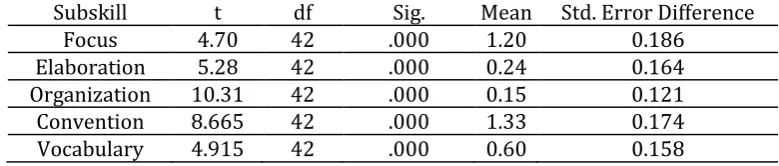
In order to see whether there was any significant difference in the mean scores, i.e. improvement, between the control and portfolio groups in the post-test, independent samples t-tests were conducted on the mean scores of subskills. The results are summarized in Table 3. As displayed in Table 3, the differences between the mean scores of the portfolio and control groups in the subskills of “Focus” (t(42) = 4.70, *p < .05), “Elaboration” (t(42) = 5.28, *p <.05), and “Organization” (t(42) = 10.31, *p < .05), “Convention” (t(42) = 8.665, *p < .05), and “Vocabulary” (t(42) = 4.915, *p < .05) were statistically significant. In sum, the portfolio group outperformed the control group in all subskills of Focus, Elaboration, Organization, Convention and Vocabulary.
Table 3. Independent samples t-tests for the writing subskills between the two groups
Subskill t df Sig. Mean Std. Error Difference
Focus 4.70 42 .000 1.20 0.186
Elaboration 5.28 42 .000 0.24 0.164
Organization 10.31 42 .000 0.15 0.121
Convention 8.665 42 .000 1.33 0.174
Vocabulary 4.915 42 .000 0.60 0.158
DISCUSSION AND CONCLUSION
Erdogan's (2009). They investigated the portfolio assessment on three of the four main skills including reading, listening and writing of a group of secondary school students in Turkey. The results showed that portfolio assessment had a significant positive effect on students' writing skills. The mean score of writing in the portfolio assessment group was significantly higher than that the one of the control group. Therefore, this finding confirms the results of this study as well. The research findings are also the same as the study of Elahinia (2004) who investigated the effect of portfolio assessment on Iranian EFL learner's writing achievement. She found that portfolio assessment had a significant positive effect on writing performance of the subjects in her study. The students in experimental group performed much better than those in control group on writing test given at the end of the experiment. So, the findings are also in line with this study. Furthermore, this study found that portfolio assessment has a significant positive effect on EFL learners' writing sub-skills. In other words, using portfolio not only has a positive effect on the improvement of students’ writing skill, but it also has such an effect on some of the sub skills discussed in the study. Based on the study it can be easily noticed that the greatest effect was on the subskill of focus and the least influence was on the subskill of vocabulary. The students in experimental (portfolio) group showed a satisfactory improvement with reference to each of the writing sub-skills i.e., Focus, Elaboration, Organization, Conventions, and Vocabulary. The results of this study is completely in line with the study of Krigere and Sardeiko (2000) which indicated that portfolio assessments were an effective tool for developing language skills in general and writing skills in particular. This results are in agreement with the study of Aly (2000) that the students in experimental group could realize their weak points (skills) in writing and develop as writers. Writing portfolios can be useful in EFL classes as a perfect technique for teaching, learning, and assessment. They also suggest authentic information about students' progress and help them to promote their writing ability in general and its sub-skills in particular. As the limitation, it can be claimed that age, gender, affective factors and background knowledge can moderate the effect of portfolio assessment technique on writing and its sub-skills and they are left untouched in the current study. So, further studies require in EFL context to investigate in these areas.
In addition, portfolio assessment can offer authentic information about the progress of students and can be used as a means of helping students to overcome their writing anxiety in L2, because using portfolio assessment technique allowed students to create a bridge between their teacher and themselves. The teacher can use portfolio assessment technique to analyze student growth and use the information for decision making regarding future instruction. It was also concluded that portfolio can be used as a teaching technique in writing classes to improve students' writing ability. It can be used to encourage and motivate weak writers.
put their final drafts in their portfolios. This study highlights important implications. Portfolio assessment technique is a promising authentic assessment technique for EFL writing classes. Portfolio assessment technique has the potential to increase instructor professionalism through active and meaningful involvement in student assessment if it is applied properly. It can be a perfect assessment tool and instructional instrument in EFL educational setting.
REFERENCES
Aly, M. M. (2002). The effect of using the writing workshop approach on developing student teachers’ composing skills. Proceeding of the 21th CDELT National Symposium on English Language Teaching. Ain Shams University, Cairo, 131-169. Apple, M., & Shimo, E. (2004). Learners to teacher: portfolios, please! Proceedings of JALT
pan-SIG Conference. Tokyo Keizai University, 53-58.
Archbald, D. A., & Newmann, F. M. (1992). Approaches to assessing academic achievement Toward a New Science of Educational Testing and Assessment. Albany, NY: State University of New York Press. 161-229.
Aydin, S. (2010). A qualitative research on portfolio keeping in English as a foreign language writing. The Qualitative Report, (15)3, 475-488.
Delett, J. S., Barnhardt, S., & Kevorkian, J. A. (2001). A framework for portfolio assessment in the foreign language classroom. Foreign Language Annals, 34(6), 559-568. García-Carbonell, A., Watts, F., & Rising B. (1998). Portfolio assessment in simulation for
language learning. On Gamming/Simulation for the Policy Development and Organizational Change. Tilburg: Tilburg University Press, 333-348.
Ghoorchaei, B., Tavakoli, M., & Nejad Ansari, D. (2010). The impact of portfolios assessment on Iranian EFL students’ essay writing: A process- oriented approach. Journal of Language Studies. 10, 35- 51.
Hedgcock, J. S. (2005). Taking stock of research and pedagogy in L2 writing. Handbook of research in second language teaching and learning. Mahwah, NJ: Lawrence Erlbaum. 579-614.
Herman, J. L., & Winters, L. (1994). Portfolio research: A slim collection. Educational Leadership, 52, 48-55.
Hirvela, A., & Sweetland, L. (2005). Two case studies of L2 writers’ experiences across learning-directed portfolio contexts. Assessing Writing, 10, 192-213.
Kocoglu, Z. (2008). Turkish EFL student teachers’ perceptions on the role of the electronic portfolios in their professional development. The Turkish Online Journal of Educational Technology, 7(3), 71–79.
Liu, Y. (2003). A case study of selected ESL students’ experiences with writing portfolios in college composition courses (Unpublished doctoral dissertation), Ohio State University.
Magnan, S. S. (1985). Teaching and testing proficiency in writing: Skills to transcend the second-language classroom. Northeast Conference Reports, 109-136.
McNamara, D., Louwerse, M., & Graesser, A. (2002). Coh-Metrix: Automated cohesion and coherence scores to predict text readability and facilitate comprehension (Grant Proposal).
Moradan, A., & Hedayati, N. (2011). The impact of portfolios and conferencing on Iranian EFL learners’ writing skill. Journal of English Language Teaching and Learning, 8, 115-141.
Moya, S., & O'Malley, J. M. (1994). A portfolio assessment model for ESL. The Journal of Educational Issues of Language Minority Students, 13, 13-36.
Nunes, A. (2004). Portfolio in the EFL classroom: Disclosing an informed practice. EFL Journal, 58(4), 327-335.
Paesani, K. (2006). Exercises de style: Developing multiple competencies writing portfolio. Foreign Language Annals, 39(4), 618-39.
Qinghua, L. (2010). The impact of portfolio-based writing assessment on EFL writing development of Chinese learners. Chinese Journal of Applied Linguistics (Bimonthly), (33)2, 103-116.
Taki, S., & Heidari, M. (2011). The effect of using portfolio-based writing assessment on language learning: The case of young Iranian EFL learners. English Language Teaching, (4)5, 192-199.
Wang, Y. H., & Liao, H. C. (2008). The application of learning portfolio assessment for students in the technological and vocational education system. Asian EFL Journal, 10(2), 132-154.