Volume 4, Issue 6, 2017, pp. 241-253 Available online at www.jallr.com ISSN: 2376-760X
* Correspondence: Najmeh Maghsoudi, Email: nmaghsudi yahoo.com © 2017 Journal of Applied Linguistics and Language Research
The Impact of Task-based Language Teaching on Listening
Skill of Iranian EFL Learners
Najmeh Maghsoudi *
Department of English, Maybod Branch, Islamic Azad University, Maybod, Yazd, Iran
Mohammad Golshan
Department of English, Maybod Branch, Islamic Azad University, Maybod, Yazd, Iran
Abstract
The present study was an attempt to examine the influence of two task types (labelling and form-filling) on listening ability among Iranian EFL learners. To this end, two intact classes (sixty-three freshman EFL learners) at Islamic Azad University of Kerman, Iran, were selected as the participants of the study. One class was chosen as the control and the other one as the experimental group. The experimental group received task-based instruction for listening activities (labelling and form-filling) whereas the control group followed the traditional way of approaching listening activities. The instruments for this study included Nelson Straightforward Upper-Intermediate and Advanced Placement Test and two different types of labelling and form-filling listening tasks used as pre-test and post-test. During the treatment sessions, the participants were instructed on the appropriate strategies to successfully deal with the tasks. After the data collection, independent samples tests and paired samples tests were conducted. The result of the independent samples t-tests indicated that labelling task had an effect on listening ability of the learners. Furthermore, the result of paired samples t-tests revealed that the students in the experimental group showed a better performance in their post-test than their pre-test. The study achieved important implications for English teachers as well as syllabus designers. Keywords: task-based language teaching (TBLT), listening skill, EFL learners
INTRODUCTION
Task-based language teaching (TBLT)
process-oriented syllabuses with three important features of goals, procedure, and specific outcomes and with an emphasis on interaction as the key factor in language acquisition. Task-based language teaching, a learner-centered approach, advocates the shift from teacher-dependence to learner independence and provides authentic materials within which students will be able to communicate with each other for a specific purpose with a clear and practical outcome (Benevides & Valvona, 2008).
As the term task is frequently used throughout the study, it seems essential to define what is meant by the task. Task has been defined in a variety of ways; as a case in point, Nunan (1999, p.25) has provided such a definition for task: “A piece of classroom work that involves learners in comprehending, manipulating, producing, or interacting in the target language while their attention is focused on mobilizing their grammatical knowledge in order to express meaning, and in which the intention is to convey meaning rather than to manipulate form”. In much the same way, task has been defined as “an activity in which meaning is primary; there is some sort of relationship to the real world; task completion has some priority; and the assessment of task performance is in terms of task outcome” (Skehan, cited in Ellis, 2003, p.25). By the same token, Littlewood (2004) made a distinction between a task and an exercise by claiming that a task is meaning-focused whereas an exercise is form-focused; a task is connected with the pragmatic meaning but an exercise deals with the semantic meaning. According to TBLT (Nunan, 2004), any task must involve three stages which include: 1) pre-task stage (the introduction to the topic and to the task); 2) during task stage (the completion of the task depending on the type of activity); and 3) language focus stage (reviewing the task and highlighting relevant parts for the students to analyze).
Task-based listening
Tasks for listening comprehension
As a general rule, listening comprehension will be enhanced if tasks (with communicative purposes) are used instead of decontextualized exercises. Advocating the concept of task, Dunkel (1986, p. 104) puts forward: “The students should be required to do something in response to what they hear that will demonstrate their understanding". Examples of tasks are making an appointment, making a hotel reservation, filling out a form, labelling a map, etc. Dunkel (1986, p. 104) has classified listening tasks into the following types:
1. Matching: requires learners to listen to a text and then match a numbered list of items with a set of options. The purpose of this task is to evaluate how well learners can listen to details.
2. Labelling: requires learners to select the labels from a list which best match the blank parts of a visual task (Dunkel, 1986). The purpose of this task is to assess students’ ability to understand descriptions of a place which usually includes spatial- and direction-related expressions such as opposite to, in front of, etc.
3. Selecting (multiple choice): this listening task requires learners to listen to a text and answer some questions each with 3-4 choices. This task type aims to check the learners’ detailed or general understanding of the main points of the listening text and their ability to answer some questions.
4. Form-filling: this listening task requires learners to listen to a text and complete the information requested and it evaluates the learners’ ability to evaluate the relationships and details.
5. Sentence completion: this listening task requires learners to listen to sentences which summarize the key information of the text and complete a gap in each sentence using information from the listening text. The purpose is to measure the learners’ ability to focus on the main points of the text.
6. Summary completion: this listening task requires learners to complete a summary which contains a number of gaps and it assesses learners’ understanding of the overall meaning and main points of the section summarized.
7. Short-answer questions: this listening task requires learners to listen to a text and read a set of related questions to which they have to write a short answer. Such tasks evaluate learners’ ability to listen for concrete facts such as places or times (Dunkel, 1986, p.104).
have recently received paramount attention in language learning, a few empirical studies have explored their impact on listening comprehension. The present study focuses on labelling (as a receptive listening task) and form-filling (as a productive listening task) to see if their implementation has any effect on listening ability of Iranian EFL learners.
LITERATURE REVIEW
Previous literature shows that a few studies have investigated the effects of task types on listening comprehension. In what follows, some of the studies conducted in both Iran and other educational settings will be reviewed. Of course, most studies reviewed in the following section have been conducted in Iran. As a case in point, Bahrami (2010) aimed to examine the influence of four task-based activities (matching, form-filling, labelling, and selecting) on listening ability of Iranian EFL students and to identify if there was any change in the learners’ performance on their pre-test and post-test. The sources of data for this study included two task-based tests of listening comprehension and a test of language proficiency. In order to find out whether the whole treatment (task-based activities) affected the participants' performance (listening comprehension) in the three levels of language proficiency, the researcher conducted a two-way ANOVA the result of which indicated that three tasks of "matching, labeling, and form-filling" had a significant impact on listening comprehension. However, selecting task did not have any effect on the participants’ listening ability. Moreover, the results of four paired-samples t-tests revealed that the learners showed a better performance in their post-test as compared to their pre-test in matching, form-filling, and labelling; however, no improvement occurred in the students’ post-test in terms of selecting task.
In a similar study, Nasirian (2012) conducted a study trying to investigate the correlation between four specific task-types (matching, form-filling, labeling, and selecting) and listening ability of Iranian EFL learners. This study not only identified the correspondence between four specific task-types and students' language proficiency level, but also tried to find out whether there was any significant relationship between task type and listening ability of male learners. The instruments of data collection in this study included a language proficiency test and one task-based test of listening comprehension. The result of the Pearson Product Correlation indicated that there was a significant positive relationship between listening ability and all four task types. In terms of correspondence, labelling, selection, and matching tasks had high correspondence to advanced and lower intermediate proficiency levels, but only matching task corresponded to upper-intermediate proficiency level. Finally, Nasirian (2012) came to the conclusion that incorporating tasks and task-based activities in EFL classrooms contribute to the enhancement of listening comprehension ability of EFL learners.
randomly selected as control and experimental groups. The experimental group received task-based instruction while the control group received the traditional way of teaching listening comprehension. Finally, task-based assessment was administered to both groups as the post-test of the study. The result of one-way ANOVA confirmed the superiority of the experimental group over the control group.
In much the same way, Khoshsima and Sadeghi Tasuj (2014) attempted to study the difference of five task types applied in task-based instruction (TBI) on intermediate EFL learners' listening comprehension ability. To this end, 31 intermediate EFL learners were given five task types of matching, selecting, role-playing, note-taking, and completing. Their proficiency and listening homogeneity was ensured using a TOEFL test. Then, they were exposed to TBI through implementing the task types. The results of the different tasks were analyzed to find out what task was the most effective. The result of one-way repeated measures ANOVA indicated that the learners showed a better performance in the two tasks of note-taking and completing than in the first three tasks of matching, selecting and role-playing, but there was no significant difference among the three tasks of matching, selecting and role-playing, and no significant difference was observed between the two tasks of note-taking and completing.
Moreover, the study carried out by Zareinajad, Rezaei, and Shokrpour (2015) integrated based language teaching (TBLT) approach to investigate the overall effect of task-based listening activities on Iranian EFL learners’ listening ability, and to identify the extent to which receptive and productive listening task types corresponded with a particular language proficiency level. The participants were 90 Iranian language learners in three intermediate, upper-intermediate, and advanced proficiency levels. Different receptive and productive task types were practiced in all the classes. Then, the learners were pre-tested and post-tested on a task-based test of listening comprehension and the results of several paired and independent samples t-tests showed that the students at all proficiency levels outperformed in their post-tests compared to their pretests. Interestingly, students at all three levels of proficiency outperformed in their post-test compared to their pretest in both the receptive and productive listening tasks, except for the intermediate group whose improvement was not significant in the productive tasks.
Literature review shows that despite the increasing concern to make listening more communicative and relevant to real life, it has not been paid enough attention yet. Few studies have investigated the effect of listening tasks on the listening ability of the learners. To bridge the gap, the present study aims to explore the effect of two types of listening activities (labelling as a receptive task and form-filling as a productive task) on the listening ability of Iranian EFL learners. Regarding the above overview of the listening task types, the researcher posed the following research questions:
1. Does form-filling task have any effect on listening ability of Iranian EFL learners? 2. Does labelling task have any effect on listening ability of Iranian EFL learners? 3. Does listening ability of control group significantly differ in pre-test and post-test
when form-filling is concerned?
4. Does listening ability of experimental group significantly differ in pre-test and post-test when form-filling is concerned?
5. Is listening ability of control group significantly different in pre-test and post-test when labelling is concerned?
6. Is listening ability of experimental group significantly different in pre-test and post-test when labelling is concerned?
To achieve the purpose of the study, the researcher formed the null hypotheses as follows:
1. Form-filling task does not have any effect on listening ability of Iranian EFL learners.
2. Labelling task does not have any effect on listening ability of Iranian EFL learners.
3. Listening ability of control group does not significantly differ in pre-test and post-test when form-filling is concerned.
4. Listening ability of experimental group does not significantly differ in pre-test and post-test when form-filling is concerned.
5. Listening ability of control group is not significantly different in pre-test and post-test when labelling is concerned.
6. Listening ability of experimental group is not significantly different in pre-test and post-test when labelling is concerned.
METHOD
Participants
Therefore, one group was chosen as experimental and the other as control group. There were 31 students in the control group and 32 participants in the experimental group.
Instruments
For data collection, three instruments were used: Nelson Upper-Intermediate and Advanced Placement Test in order to determine the proficiency level of the participants. This test included 50 items. According to the scoring range of this test, those students who scored between 0-35 were considered as upper-intermediate and students whose scores were between 35-50 were advanced ones. As other instruments, labelling and form-filling tasks were selected from an IELTS listening tasks book entitled “Crack IELTS in a Flash” (Bagherzadeh & Riasati, 2010) for the pre-test and two similar labelling and form-filling tasks for the post-test. The listening tasks practiced all through the treatment sessions were also selected from IELTS test samples of “Crack IELTS in a Flash” because they are highly standard tests and they have the features of task.
Procedure
Pre-test
At the outset of the term, the participants took the task-based test of listening comprehension of labelling and form-filling types selected from IELTS listening tasks (Bagherzadeh & Riasati, 2010). The test included 2 listening task-based types (labelling and form-filling) each task consisting of five blanks. In labelling task, students had to label five different parts of a map (plan of a campus building) and in form-filling they had to fill out a form (making a hotel reservation). The whole test included 10 questions. The right/wrong scoring procedure was used for the pre-test. A response received a score of '0' if it was wrong and '1' if it was correct.
Treatment
Some general guidelines and strategies were recommended to the students at the beginning of each session. The students were also reminded of these strategies when it was felt necessary before and even after each activity. Several strategies were introduced to the participants for labelling and form-filling tasks from Bagherzadeh and Riasati’s book (2010). The students in experimental group were divided into groups of four and were encouraged to deal with listening tasks collaboratively during the first three sessions and later on they were expected to work on the tasks individually. Concerning the lesson plan or the sequence of class activities, the following procedure was implemented throughout the course: a) pre-task, b) during task, and c) focus on form.
Pre-task: involved pre-listening activities, introducing the topic, discussing, looking at map or form, predicting, and working on the vocabulary.
students to perform the task collaboratively. If they could not achieve completing the task, the teacher played the listening the second time so that the students could identify the words and compare their findings in groups after each time of playing. The whole procedure was repeated during each treatment session so that the participants could fill in the blanks in the form and label the map/diagram. Eventually, if they could not fill in the blanks or label the map, the instructor (researcher) provided the exact word or helped them with labelling.
Focus on form: The students’ focus was drawn to linguistic features that students have encountered during the task.
Post-test
After eight treatment sessions, the participants in control and experimental groups were administered the post-test including labelling (labelling the map of the library) and form-filling (filling Student Union Registration form) tasks each consisting of five items (Bagherzadeh & Riasati, 2010). The right/wrong scoring procedure was used in this study. A response received a score of '0' if it was wrong and '1' if it was correct.
RESULTS AND DISCUSSION
The present study investigated the effect of form-filling and labelling (2 task types) on EFL learners’ listening ability. In order to determine the proficiency level of the participants, a Nelson Test (Straightforward Upper-Intermediate and Advanced Placement Test) was administered to the participants. Table 1 illustrates the descriptive statistics of the participants’ level of English proficiency on Nelson Placement test.
Table 1. Descriptive Statistics of Control and Experimental Groups on Nelson Test
Group N Mean SD Min. Max Skewnes Kurtosis
Control 31 23.87 6.30 14 41 .70 .30
Experimental 32 28.69 7.28 15 41 .14 -.95
Total 63 26.31 7.19 14 41 .42 -.63
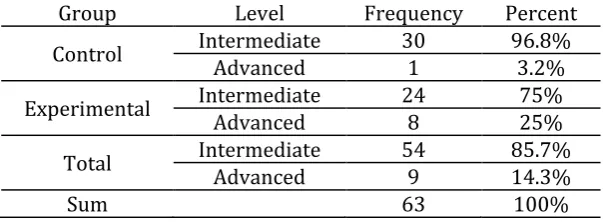
As table 1 reveals, the mean and SD of control group on Nelson Placement Test were 23.87 and 6.30 and the mean and SD for experimental group were 28.69 and 7.28 and the mean and SD for the whole participants were 26.31 and 7.19 respectively. According to Nelson Placement Test, the students who score between 0-35 are regarded as intermediate and those students whose scores are between 35-50 are considered at advanced level. Table 2 illustrates the distribution of Nelson test scores in each group.
Table 2. Distribution of Scores on Nelson Test in Control and Experimental Groups
Group Level Frequency Percent
Control Intermediate 30 96.8%
Advanced 1 3.2%
Experimental Intermediate 24 75%
Advanced 8 25%
Total Intermediate Advanced 549 85.7% 14.3%
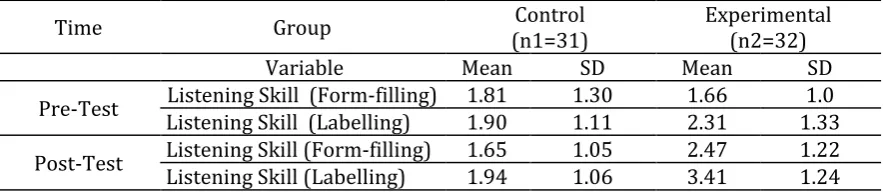
Table 2 reports that 30 participants (96.8%) of the control group and 24 participants (75%) of the experimental group were considered as intermediate and one participant (3.2%) of the control group and 8 participants (25%) of experimental group were regarded as advanced. In sum, 54 learners (85.7%) of both groups were at intermediate and 9 students (14.3) were at advanced levels. In the pre-test, the participants were administered two different types of tasks _form-filling and labelling. After eight treatment sessions for experimental group, the whole participants sat for the post-test. The results of both pre-test and post-test of control and experimental groups have been reported in table 3.
Table 3. Descriptive Statistics of Control and Experimental Groups in Pre-test and Post-test
Time Group (n1=31)Control Experimental (n2=32)
Variable Mean SD Mean SD
Pre-Test Listening Skill (Form-filling)Listening Skill (Labelling) 1.811.90 1.301.11 1.662.31 1.331.0
Post-Test Listening Skill (Form-filling)Listening Skill (Labelling) 1.651.94 1.051.06 2.473.41 1.221.24
Table 3 indicates the mean and standard deviation of both groups in form filling and labelling tasks in pre-test and post-test. On the pre-test, the mean and SD of control and experimental groups in form-filling listening task were (M1= 1.81, SD1= 1.30) and (M2=1.66, SD2= 1.0) respectively. After the treatment, the mean and SD of control group were M1= 1.65 and SD1= 1.05 and mean and SD of experimental group were M2= 2.47 and SD2= 1.22. Moreover, the mean and SD of control and experimental groups in labelling listening task have been reported. On the post-test, the control group could achieve the mean of (M1=1.90, SD=1.11) and mean and SD of experimental group were M2=2.31 and SD2=1.33. Regarding the labelling task on the post-test, the control group could achieve the mean and SD of (M1= 1.94, SD1= 1.06) and experimental group gained (M2= 3.41, SD2= 1.24)
The first null hypothesis states that form-filling does not affect the listening ability of the learners. In order to address this hypothesis, an independent samples t-test was conducted (Table 4).
Table 4. Independent Samples T-tests of Listening Ability of Control and Experimental Groups (Form-filling and Labelling)
Task type Group N Mean SD T-Test df P-Value
Form filling Experimental Control 31 32 .871.0 .56 .76 -.76 61 .45
Labelling Experimental Control 31 32 1.41.74 .68 .91 -3.27 61 .002
significant difference before and after the treatment. Thus, the first null hypothesis fails to be rejected (t= -0.76, df = 61, p˃0.05). In other words, form-filling did not have any effect on listening ability of the participants. The second null hypothesis states that labelling does not have any effect on listening ability of EFL learners. To address this hypothesis, an independent samples t-test between the control and experimental groups was performed on their scores of labelling task. Regarding the findings (t= -3.27, df= 61, p˂0.05), the second null hypothesis is rejected meaning that labelling task affected the listening ability of EFL learners. The comparison of the means of both groups reveals that experimental group could achieve a higher mean (M2= 1.41, SD2=0.91) than the control group (M1= 0.74, SD1= 0.68). This can be interpreted as labelling task could enhance listening ability more than form-filling. The effect size (Cohen’s d) for the second null hypothesis indicated that the size of the difference is moderate (ES= 0.83). In other words, labelling tasks could moderately affect the listening ability. The findings of the study regarding the first and second null hypotheses are in line with Nasirian’s (2012) study which reported the superiority of the participants’ performance on the labelling task. Such a superiority in the present study can be explained by the fact that form-filling as a productive task type seems more demanding on the part of learners since students have to pay attention to the input and produce its written form simultaneously while the labelling task as a receptive task appears less demanding because it provides pictorial as well as verbal input. In form-filling, students have to fill in the blanks without exceeding three words which takes more processing time and seems more difficult because they have to pay close attention to the reception and production simultaneously. However, in labelling task the learners have to number different parts of the map.
The third null hypothesis indicates that listening ability of control group does not differ in the pre-test and post-test when form-filling is concerned. In order to address this hypothesis, paired samples t-test was used (Table 5).
Table 5. Paired Samples T-tests of Control and Experimental Groups in Pre-test and Post-test (From-filling)
Group Time N Mean SD T-Test df P-Value
Control pre-test 31 1.81 1.30 .87 30 .39
post-test 31 1.65 1.05
Experimental post-testpre-test 32 32 1.662.47 1.22 1.0 -4.76 31 .000
filling in its pre-test and post-test (t= -4.76, df= 31, p˂0.05). This means that in form-filling the participants in experimental group showed a better performance in their post-test (M2=2.47, SD2=1.22) than their pre-test (M1=1.66, SD1=1.0). The effect size for this difference is ES= 0.73 which is considered to be a moderate one implying that form-filling could moderately lead to the difference in the mean scores of experimental group before and after the treatment. Regarding the third and fourth null hypotheses, the results are in accordance with Bahrami (2010), Badri, Nazari, and Badri (2014), Zareian, Rezaei, and Shokrpour (2015), and Zhang (2017) who concluded that the performance of experimental group was much better on their post-test than their pre-test. This accounts for the effectiveness of task-based instruction in listening ability of the participants.
The fifth null hypothesis expresses that listening ability of control group does not differ in the pre-test and post-test when labelling is concerned. To test this hypothesis, a paired samples t-test was conducted.
Table 6. Paired Samples T-test of Control and Experimental Groups in Pre-test and Post-test (Labelling)
Group Time N Mean SD T-Test df P-Value
Control post-testpre-test 31 31 1.901.94 1.11 1.06 -.18 30 .86
Experimental post-testpre-test 32 32 2.313.41 1.33 1.24 -4.84 31 .000
The p-value reported in table 6 (p>0.05) confirms that the control group performance on pre-test did not statistically differ from their post-test in labelling task (t= -0.18, df= 30, p˃0.05); as a result, the fifth null hypothesis is accepted. The sixth null hypothesis proposes that the experimental group performance on labelling task does not differ in pre-test and post-test. Looking at the p-value revealed in table 6 (p<0.05), it is inferred there is a significant difference between the pre-test and post-test of learners in experimental group (t= -4.84, df= 31, p˂0.05) on labelling task. It can be claimed that the mean of experimental group on the labelling task in post-test was higher (M2= 3.41, SD2= 1.24) in the post-test than the pre-test (M1=2.31, SD= 1.33). The effect size for this hypothesis is equal to 0.85 which is an indicator of a moderate effect size. Regarding the fifth and sixth null hypotheses, the results seem congruent with Bahrami (2010), Badri, Nazari, and Badri (2014), Zareian, Rezaei, and Shokrpour (2015), and Zhang (2017) who claimed that the students in experimental group outperformed in their post-test as compared to their own pre-test. Such a result emphasizes the impact of task-based instruction on listening ability among the participants of experimental group.
CONCLUSION
exposed to any treatment of task types. The study yielded some implications for language teachers and material developers. It is recommended that the teachers integrate task-based instruction of listening instead of practicing it in a decontextualized way. Implementation of listening tasks in language classes can create more motivation among the students that tasks can bring about the real-life relevance. The present study findings demonstrated that each task type can have its own merits in facilitating language learning, thereby helping learners to develop their own specific strategies. This implies that the material developers should try to include more task-based materials of various types so that all learners with different strategies and styles can benefit from them. Listening, specifically, has an important place in second language acquisition; therefore, without good listening skills, successful communication cannot be achieved. Incorporating task-based listening activities in this study exposed EFL students to real-language use and enhanced their listening ability.
True, L2 listening can be enhanced by task-based language teaching (TBLT), but it has received relatively little attention by researchers despite its obvious importance as a skill. Although Ellis (2003) claims that few empirical studies have investigated the effect of task-based methodologies on EFL learners' listening abilities, this study demonstrated that tasks can serve as effective tools for listening improvement.
It is to be noted that several limitations of the present study need to be acknowledged. First, the study was limited in having a small sample size (n=63) so the findings cannot be easily extrapolated to other situations. Another limitation of the study was intact sampling which could not control for the initial differences in the pre-test scores between the control and experimental groups. The next limitation was the duration of the academic semester which did not allow for the possibility of the delayed post-test that could be more revealing about the durability and effectiveness of task-based instruction. It is recommended that similar studies are conducted with other task types and other language skills in order to arrive at sound conclusions about tasks effectiveness in developing overall English proficiency of EFL learners. Other researchers may also be interested in considering other variables such as the learners’ age and gender which have not been taken into account in this study.
REFERENCES
Badri, A. Nazari, J. & Badri, A. (2014). The effects of form-filling, matching, and sequencing tasks on improving Iranian EFL learners’ listening comprehension. International Journal of Educational investigations, 1(1), 122-133.
Bagherzadeh, M. S. & Riasati, M. J. (2010). Crack IELTS in a flash (Listening). Shiraz: Ide-Derakhshan Publication.
Bahrami, M. (2010). The effect of task types on EFL learners' listening ability. Undergraduate Research Journal for Human Sciences, 9, 14-25.
Chastain, K. (1988). Developing second language skills: Theory and practice. (3rd ed.). Florida: Harcourt Brace Jovanovich Publishers.
Dunkel, P. (1986). Developing listening fluency in L2: Theoretical principles and pedagogical considerations. The Modern Language Journal, 70, 99-106.
Ellis, R. (2003). Task-based language learning and teaching. Oxford: Oxford University Press.
Herron, C. A., & Seay, I. (1991). The effect of authentic oral texts on student listening comprehension in the foreign language classroom. Foreign Language Annals, 24, 487-495.
Khoshsima, H. & Sadeghi Tasuj. Z. (2014). The impact of task types on listening comprehension of Iranian intermediate EFL learners. International Journal of Applied Linguistics and English Literature, 3(3), 97-103.
Littlewood, W. (2004). The task-based approach: Some questions and suggestions. ELT Journal 58 (4), 319-327.
Nasirian, M. R. (2012). Task-type and listening ability of Iranian male learners. Journal of Language Teaching and Research, 3(6), 1144-1149.
Nunan, D. (1999). Second language teaching and learning. Boston: Newbury House Publication.
Nunan, D. (2004). Task-based language teaching. Cambridge: Cambridge University Press.
Richards, J. C. & Rodgers, T.S. (2001). Approaches and methods in language teaching. Cambridge: Cambridge University Press.
Zareinajad, M. Rezaei, M. and Shokrpour, N. (2015). The effects of receptive and productive task-based listening activities on the listening ability of Iranian EFL learners at different proficiency levels. Social Sciences and Humanities, 23(2), 537-552.