Open Access
Review
Expression and function of the insulin receptor substrate proteins in
cancer
Katerina Mardilovich, Shannon L Pankratz and Leslie M Shaw*
Address: Department of Cancer Biology, University of Massachusetts Medical School, Worcester, Massachusetts 01605, USA
Email: Katerina Mardilovich - [email protected]; Shannon L Pankratz - [email protected]; Leslie M Shaw* - [email protected]
* Corresponding author
Abstract
The Insulin Receptor Substrate (IRS) proteins are cytoplasmic adaptor proteins that function as essential signaling intermediates downstream of activated cell surface receptors, many of which have been implicated in cancer. The IRS proteins do not contain any intrinsic kinase activity, but rather serve as scaffolds to organize signaling complexes and initiate intracellular signaling pathways. As common intermediates of multiple receptors that can influence tumor progression, the IRS proteins are positioned to play a pivotal role in regulating the response of tumor cells to many different microenvironmental stimuli. Limited studies on IRS expression in human tumors and studies on IRS function in human tumor cell lines and in mouse models have provided clues to the potential function of these adaptor proteins in human cancer. A general theme arises from these studies; IRS-1 and IRS-4 are most often associated with tumor growth and proliferation and IRS-2 is most often associated with tumor motility and invasion. In this review, we discuss the mechanisms by which IRS expression and function are regulated and how the IRS proteins contribute to tumor initiation and progression.
Introduction
The Insulin Receptor Substrate (IRS) proteins are a family of cytoplasmic adaptor proteins that were first identified for their role in insulin signaling. The first family member to be identified, IRS-1, was initially characterized as a 185 kD phosphoprotein that was detected in anti-phosphoty-rosine immunoblots in response to insulin stimulation [1]. IRS-2 was discovered as an alternative insulin receptor substrate, initially named 4PS, in insulin-stimulated cells derived from Irs-1-/- mice [2]. IRS-1 and IRS-2 are
ubiqui-tously expressed and are the primary mediators of insulin-dependent mitogenesis and regulation of glucose metab-olism in most cell types (reviewed in [3]). Humans express one additional family member, IRS-4, which is more restricted in its expression pattern and is found
pri-marily in brain, kidney, thymus and liver [4]. A fourth IRS protein, Irs-3, is expressed in rodents, but not in humans [5,6]. More distantly related IRS family members IRS-5 and IRS-6, also known as DOK4 and DOK5, share homol-ogy in their N-termini, but have truncated C-termini [7-9] (Figure 1). Despite their significant homology, it is clear from the genotypes of knockout mice that the IRS proteins have non-redundant normal functions. Irs-1-/- mice are
born small and remain runted throughout their lives, implicating a role for this IRS protein in somatic growth regulation [10,11]. A similar contribution of the IRS homolog Chico to the regulation of cell size and growth in Drosophila has been observed [12]. Mice deficient for Irs-1 develop insulin resistance but do not progress to dia-betes because they maintain normal pancreatic β-cell
Published: 17 June 2009
Cell Communication and Signaling 2009, 7:14 doi:10.1186/1478-811X-7-14
Received: 3 May 2009 Accepted: 17 June 2009
This article is available from: http://www.biosignaling.com/content/7/1/14
© 2009 Mardilovich et al; licensee BioMed Central Ltd.
numbers. Irs-2-/- mice are normal in size but have brain
defects, the result of a 50% decrease in neuronal prolifer-ation [13,14]. In contrast to Irs-1-/- mice, Irs-2-deficient
mice develop early-onset diabetes due to a combination of peripheral insulin resistance and a loss of β-cell func-tion [13,15]. Irs-2-/- females are also infertile, which
together with evidence from insulin-signaling in Dro-sophila and C. elegans, supports a conserved mechanism for integrating reproduction and metabolism [16]. Irs-4
-/-mice are phenotypically normal, with only mild growth, reproductive and insulin sensitivity defects [17]. These differences in IRS function in normal development and physiology are also evident in cancer.
The IRS proteins contain no intrinsic enzymatic activity and they contribute to signaling through their function as adaptors to organize signaling complexes [18]. They share their highest level of homology in their N-termini, which contain two highly conserved domains that contribute to their recruitment to activated upstream receptors. The first of these domains is the pleckstrin homology (PH) domain. The PH domain is hypothesized to mediate both protein-protein interactions that facilitate the recruitment of the IRS proteins to receptors, and protein-phospholipid interactions that localize the IRS proteins to the cell mem-brane, in close proximity to transmembrane receptors
[19-21]. The second conserved region is the phosphotyro-sine binding (PTB) domain, which interacts with NPXY motifs in activated receptors [22,23]. An additional motif that contributes to receptor recruitment, the kinase regu-latory loop binding (KRLB) domain, has been identified only in IRS-2 (Fig. 1)[22,24]. Upon binding to upstream receptors, the IRS proteins are phosphorylated on tyrosine residues in their C-termini, generating binding sites that recruit downstream effectors [25,26]. Effectors that have been characterized to bind to the IRS proteins include PI3K, Grb-2, SHP-2, Fyn, c-Crk, CrkII and Nck [9,27-32]. A recent study that utilized phosphorylated bait peptides to profile all potential phosphotyrosine dependent inter-action sites in IRS-1 and IRS-2 identified additional potential interacting proteins [33]. However, additional studies will be necessary to determine if these effectors are recruited to the intact IRS proteins in response to physio-logical stimuli. It is the combined action of the down-stream effectors that determine the signals that are transmitted through the IRS proteins and the cellular response that occurs (Figure 2). Importantly, many of these effector-signaling pathways have been implicated in tumorigenesis and cancer progression.
Schematic of the IRS protein family
Figure 1
Schematic of the IRS protein family. Interaction domains of the IRS proteins are indicated. PH (purple), pleckstrin homol-ogy domain; PTB (purple), phosphotyrosine binding domain; KRLB (pink), kinase regulatory loop binding domain; PI3K (orange), region containing multiple PI3K binding motifs; Grb-2 (green), Grb-2 binding site; SHP-2 (yellow), SHP-2 binding site. IRS-5 and IRS-6 contain regions of similarity to each other in their C-termini (light purple).
IRS-5/
DOK-4
PH
PTB
IRS-6/
DOK-5
PH
PTB
IRS-4
PH
PTB
PI3K
Grb2
IRS-2
PH
PTB
KRLB
PI3K
Grb2
SHP2
Expression of the IRS proteins in human cancer
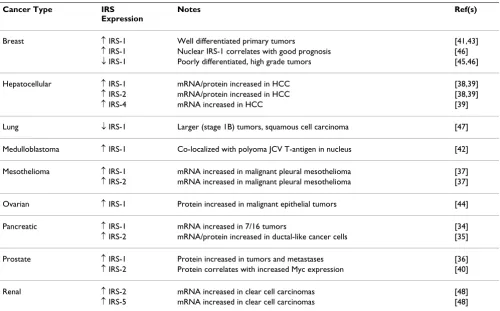
There are relatively few reports on the expression patterns of the IRS adaptor proteins in human tumors, either at the mRNA or protein level. The majority of these studies have evaluated the expression of IRS-1 and IRS-2, which are the more ubiquitously expressed family members in normal tissue. As an overall summary, IRS expression is most often elevated in human tumors when compared with
normal tissue (Table 1). Expression of both 1 and IRS-2 is reported to be increased in hepatocellular, pancreatic and prostate cancer and malignant pleural mesothelioma [34-40]. In other cancers, including breast, ovarian and medulloblastoma, only IRS-1 expression has been evalu-ated and a similar trend toward increased expression in primary tumors has been reported [41-44]. However, in breast cancer, which has been studied the most
exten-Signaling via the IRS proteins
Figure 2
Signaling via the IRS proteins. The IRS proteins are recruited to activated cell surface receptors via PH/PTB domains in their N-termini. Once bound, they are phosphorylated on tyrosine residues in their C-termini. The phosphorylation of tyro-sine residues (pY) creates docking sites for the recruitment of downstream signaling effectors. Subsequently, signaling cascades are activated that can regulate gene expression, protein synthesis, glycolysis, cell proliferation, survival and motility/invasion.
Plasma Membrane
IGF -1
Activated IGF-1 Receptor
PI(4,5)P
2PI(3,4,5)P
3P P P
P P
110
PI3K
PDK1/2
PTEN
PKB/
AKT
Gene Expression
Survival
Motility/Invasion
Glycolysis
mTOR
p70
S6KProtein Synthesis
Glycolysis
ERK1/2
SOS
Gene Expression
Proliferation
Survival
Motility
MAPK
Cascade
Active IRS
Protein
PH
PTB pY pY pY pY pY pY
sively of all cancers for IRS expression, there is also evi-dence that the expression of IRS-1 could correlate negatively with tumor progression. Specifically, IRS-1 is expressed at moderate to strong levels in normal tissue and well-differentiated carcinomas, but expression decreases in more poorly differentiated, higher-grade tumors [45,46]. Decreased IRS-1 expression is also observed in some non-small cell lung cancers (NSCLC), and this lower expression occurs more frequently in squa-mous cell carcinomas [47]. The conclusion drawn from the lung cancer study was that downregulation of IRS-1 may be an early event in NSCLC development. To date, the only study to examine IRS-4 expression in human can-cer reported increased expression in hepatocellular carci-noma [39]. Finally, both IRS-2 and IRS-5 are upregulated at the level of gene expression in clear cell renal cell carci-noma [48]. One caveat to all of these expression studies, however, is that the IRS proteins can be phosphorylated on serine residues through negative feedback loops, which inhibits their function (reviewed in [49]). There-fore, expression of the IRS proteins may not reflect the functional status of these adaptor proteins. Additional studies are needed to establish clearly the expression and function of the IRS proteins in human cancer and to deter-mine if their relative expression levels have prognostic or predictive value.
Upstream receptors implicated in cancer
The IRS proteins function as essential signaling intermedi-ates downstream of many cell surface receptors that have been implicated in cancer. For example, the IRS proteins are major downstream effectors of the Insulin-Like Growth Factor-1 (IGF-1) receptor (IGF-1R) and they play a critical role in determining the cellular response to IGF-1 stimulation [50]. There is a strong correlation between enhanced IGF-1-mediated signaling and a wide range of cancers including malignancies of the breast, colon, pros-tate, thyroid, liver, pancreas and central nervous system [51]. In breast cancer, IGF-1 expression is elevated in the serum of patients and the IGF-1R is frequently over-expressed and is a prognostic indicator of tumor recur-rence and reduced patient survival [52,53]. Other growth factor/hormone receptors that signal through the IRS pro-teins and that are associated with cancer include the insu-lin, prolactin, growth hormone (GH), and vascular endothelial growth factor (VEGF; KDR) receptors [54-56]. The IRS proteins have also been implicated in signaling downstream of the EGF receptor (EGFR), which may involve an EGFR/IGF-1R cross-talk [57,58]. Some integrin adhesion receptors also utilize the IRS proteins as signal-ing intermediates to relay intracellular signals [59-61]. In addition to surface receptors, several oncogenic fusion proteins that arise as the result of chromosomal
transloca-Table 1: IRS expression in human cancer
Cancer Type IRS
Expression
Notes Ref(s)
Breast ↑ IRS-1 Well differentiated primary tumors [41,43] ↑ IRS-1 Nuclear IRS-1 correlates with good prognosis [46] ↓ IRS-1 Poorly differentiated, high grade tumors [45,46]
Hepatocellular ↑ IRS-1 mRNA/protein increased in HCC [38,39] ↑ IRS-2 mRNA/protein increased in HCC [38,39] ↑ IRS-4 mRNA increased in HCC [39]
Lung ↓ IRS-1 Larger (stage 1B) tumors, squamous cell carcinoma [47]
Medulloblastoma ↑ IRS-1 Co-localized with polyoma JCV T-antigen in nucleus [42]
Mesothelioma ↑ IRS-1 mRNA increased in malignant pleural mesothelioma [37] ↑ IRS-2 mRNA increased in malignant pleural mesothelioma [37]
Ovarian ↑ IRS-1 Protein increased in malignant epithelial tumors [44]
Pancreatic ↑ IRS-1 mRNA increased in 7/16 tumors [34] ↑ IRS-2 mRNA/protein increased in ductal-like cancer cells [35]
Prostate ↑ IRS-1 Protein increased in tumors and metastases [36] ↑ IRS-2 Protein correlates with increased Myc expression [40]
tions have also been reported to signal through the IRS adaptor proteins for their tumor promoting functions. These include the ETV6-NTRK3 gene fusion found in pediatric spindle cell sarcomas and secretory breast can-cer, the RET-PTC3 gene fusion found in papillary thyroid cancer and the NPM-ALK gene fusion that is a transform-ing oncogene found in anaplastic large-cell lymphoma [62-64]. Full length anaplastic lymphoma kinase (ALK), a member of the insulin receptor superfamily and receptor for the growth factor pleiotrophin, also signals through the IRS proteins. ALK is expressed in breast and pancreatic carcinomas, melanoma and neuroblastoma, and has been demonstrated to be rate limiting for glioblastoma growth [65]. As common intermediates of many receptors that can influence tumor progression, the IRS proteins are positioned to play a key role in regulating the response of tumor cells to microenvironmental stimuli. As a result, they are also attractive candidates to be targets for interfer-ing with the tumor-promotinterfer-ing signals that are initiated through these disparate receptors.
IRS function in cancer
There are many studies on IRS function in human tumor cell lines and in mouse models that provide clues to the potential function of these adaptor proteins in human cancer. A general theme arises from these studies; IRS-1 and IRS-4 are most often associated with tumor growth and proliferation and IRS-2 is most often associated with tumor motility and invasion.
IRS-1
IRS-1 involvement in regulating tumor cell proliferation was foreshadowed by its role in somatic growth regula-tion. IRS-1 null mice are approximately 30% smaller than wildtype littermates and they maintain their runted phe-notype throughout life [10,11]. IRS-1 is the predominant IRS family member that is activated by IGF-1 in well-dif-ferentiated estrogen receptor positive (ER+) human breast carcinoma cell lines [66,67]. IRS-1 mediates IGF-1-dependent growth in these cells, which has also been observed for hepatocellular and prostate carcinoma, medulloblastoma and malignant pleural mesothelioma cell lines [37,66-70]. The activation of both MAPK and PI3K signaling pathways has been implicated in the stim-ulation of proliferation by IRS-1 [67,69,71,72]. IRS-1-dependent signals also contribute to tumor cell survival. Suppression of IRS-1 expression by siRNA promotes apoptosis and renders ER+ breast carcinoma cells more sensitive to tamoxifen-stimulated cell death, whereas overexpression of IRS-1 confers resistance to TGF-β -induced cell death in hepatocellular carcinoma cells [73,74]. In contrast, Irs-1-/- mammary tumor cells derived
from mouse mammary tumor virus (MMTV)-polyoma virus middle T antigen (PyV-MT) mice are more resistant
to apoptosis in response to serum deprivation than wildtype cells [75].
Transgenic mouse models have provided important infor-mation regarding IRS-1 function in cancer. Overexpres-sion of IRS-1 in the mouse mammary gland results in mammary hyperplasia and tumorigenesis, which corre-lates with constitutive tyrosine phosphorylation of IRS-1, activation of Akt and Erk1/2 and association with β -cat-enin [76]. In mouse hepatocytes, overexpression of IRS-1 increases DNA synthesis and hepatic mass by 25%, further supporting the connection between IRS-1 and prolifera-tion [77]. However, liver tumors do not develop in these transgenic mice, possibly because Fas-receptor is upregu-lated and this apoptotic signal balances the pro-growth signals from IRS-1 [78]. The different results of these transgenic models with regard to tumorigenesis sug-gest that the oncogenic potential of IRS-1 may be depend-ent upon cellular context. Although IRS-1 overexpression promotes tumorigenesis, IRS-1 is not required for primary tumor growth as demonstrated by the fact that mammary tumor initiation and growth are not prevented or delayed in Irs-1-/- mice in response to the PyV-MT antigen when
compared with tumors that develop in wildtype litterma-tes [79]. One important caveat to the IRS overexpression and knockout mouse mammary tumor studies is that the tumors that develop in both models are ER- and a possi-ble preferential role for IRS-1 in ER+ tumor growth, which is suggested from the studies on human breast carcinoma cell lines, cannot be excluded. In contrast with the positive role for IRS-1 in early tumor development and growth, IRS-1 may play a suppressive role in tumor progression. Specifically, PyV-MT:Irs-1-/- mammary tumors have a
greater incidence and rate of lung metastasis when com-pared with PyV-MT:WT tumors [79,80]. Together with the IRS-1 expression data in human breast and lung cancer, these results reveal that loss of IRS-1 expression or func-tion may facilitate tumor progression [45-47]. Once again, however, it is likely that IRS-1 function is cell con-text-dependent because deletion of Irs-1 in Apcmin-/ +(Min)/β-catenin-derived intestinal tumors decreases
tumor incidence and growth and increases irradiation-induced apoptosis in the intestinal crypt [81].
IRS-2
cell lines that express only IRS-1 [70,84-86]. A similar role for IRS-2-dependent signaling in cell motility and inva-sion has been reported for neuroblastoma and mesotheli-oma cells [37,87]. In contrast to IRS-2, IRS-1 may suppress cell migration because expression of IRS-1 in LnCAP pros-tate carcinoma cells decreases their motility. One possible mechanism by which IRS-2 contributes to tumor progres-sion and cell invaprogres-sion is by positively regulating aerobic glycolysis via the enhanced localization of the GLUT-1 glucose transporter on the tumor cell surface [88]. Similar to IRS-1, IRS-2 has also been implicated in promoting tumor cell survival, which is likely to contribute to its role in tumor progression. Irs-2-deficient PyV-MT-derived mammary tumor cells are significantly more sensitive to serum deprivation-induced apoptosis than wildtype tumor cells, and Irs-2-/- tumors also have a higher in situ
level of apoptosis [75]. Suppression of IRS-2 expression in hepatocellular carcinoma cells that express high levels of this adaptor protein also results in apoptosis [38]. Recent studies in pancreatic adenocarcinoma cells reveal that IRS-2 can regulate the expression of the IGF-1R to sustain high levels of IGF-1-dependent signaling [89]. Therefore, IRS-2 may promote tumor progression by stimulating a positive feedback loop to enhance IGF-1 signaling.
Additional support for IRS-2 as a positive regulator of tumor progression comes from in vivo mouse model stud-ies. Mammary tumor metastasis is significantly dimin-ished in PyV-MT:Irs-2-/- mice, and Irs-1 deficient tumors
that express elevated levels of active (i.e. tyrosine phos-phorylated) Irs-2 have enhanced metastatic rates [75,79]. Irs-2 expression is elevated in tumors that arise in PTEN+/ - mice, and deletion of Irs-2 has no impact on tumor
initi-ation, but it does suppress tumor growth and progression to invasive disease [40]. IRS-2, like IRS-1, can promote tumor initiation and progression when this adaptor pro-tein is overexpressed in the mammary gland, a finding that would appear to conflict with the inability of IRS-2 to regulate tumor proliferation in human breast carcinoma cell lines [70,76]. One possible explanation for this dis-crepancy is that functions that are not observed at normal expression levels are gained when IRS expression levels are elevated. Alternatively, IRS-1 and IRS-2 may contrib-ute to early tumorigenesis through distinct mechanisms. That is, IRS-1 may promote enhanced proliferation, whereas IRS-2 may promote enhanced survival, with the common outcome being tumorigenesis and progression.
The differential abilities of IRS-1 and IRS-2 to promote proliferation and motility/invasion, respectively, raises the question of how these similar proteins regulate diver-gent functions. IRS-1 and IRS-2 share approximately 35% identity in their C-termini where they recruit downstream effectors to phosphotyrosine binding motifs to initiate their signaling cascades. Many of the motifs are conserved
between the two family members, and IRS-1 and IRS-2 have been reported to activate common signaling path-ways including PI3K and the Erk1/2 MAPK kinases in a variety of cancer model systems [29,60,69,90,91]. Both of these signaling pathways have been implicated in promot-ing tumor cell proliferation, invasion and survival, but they cannot explain the differential abilities of IRS-1 and IRS-2 to regulate these functions. One potential mecha-nism for IRS-specific regulation of tumor cell functions is the recruitment of effectors to unique binding motifs in the C-termini of the IRS proteins that activate signaling pathways selectively downstream of either IRS-1 or IRS-2. For example, Rho-kinase (ROCK), which regulates cell adhesion and motility, is reported to be activated down-stream of IRS-2 [91]. A recent proteomic analysis of potential IRS-1 and IRS-2 interacting partners provides further evidence that unique effectors can interact with each adaptor protein [33]. Distinct intracellular compart-mentalization of IRS-1 and IRS-2 or differential sensitivi-ties of IRS-1 and IRS-2 to negative feedback regulation would also impact the signaling outcomes of these adap-tor proteins [49,92]. Additionally, acetylation positively regulates tyrosine phosphorylation of IRS-1 and nega-tively regulates tyrosine phosphoryaltion of IRS-2, which demonstrates that the function of these adaptor proteins can be differentially regulated by post-translational mod-ifications [93-95].
An alternative mechanism for the differential involve-ment of IRS-1 and IRS-2 in cancer that would allow for the activation of a common signaling pathway by these adap-tor proteins was revealed during the analysis of Irs1
-/-mammary tumors. Akt and mTor activation were enhanced significantly in Irs1-/- mammary tumors when
compared with the level of activation in wildtype tumors [79]. Although signaling through IRS-1 can activate these pathways in response to insulin or IGF-1 in many other model systems, when Irs-2 expression and function were compared between Irs1-/- and WT tumors, Irs-2 activity
was significantly higher in the absence of Irs-1, a finding that is mimicked by transient suppression of Irs-1 by siRNA in vitro [79]. A corresponding upregulation of Irs-1 expression and function is not observed in Irs-2-/- tumors,
or when Irs-2 expression is suppressed by siRNA (S. Pank-ratz, personal observation). Importantly, suppression of Irs-2 expression in Irs1-/- tumor cells restores mTor
activa-tion to wildtype levels, confirming the contribuactiva-tion of Irs-2 to the increased mTor activity [79]. These in vitro find-ings support the hypothesis that Irs-2 compensates for the loss of Irs-1, and in doing so, enhances the activation of signaling pathways that promote tumor metastasis. A sim-ilar compensatory upregulation of 2 expression in Irs-1-/- mouse embryo fibroblasts has been hypothesized to
IRS-4
IRS-4 expression increases in response to partial hepatec-tomy, a liver regeneration model, and expression is higher in hepatocellular tumors when compared with normal liver tissue [39,97]. In HepG2 hepatocellular carcinoma cells, suppression of IRS-4 expression by siRNA decreases IGF-1-dependent proliferation, which correlates with reduced Erk and p70S6-kinase activation [98]. Irs-4 has also been implicated in the insulin-dependent prolifera-tion of a murine T-cell lymphoma cell line and it is over-expressed in a pediatric T-cell acute lymphoblastic leukaemia (T-ALL) that harbors a breakpoint fusion between the T-cell receptor beta locus and the IRS-4 gene [99,100]. These studies suggest that IRS-4 functions more similarly to IRS-1 than IRS-2 in cancer in that it is associ-ated with tumor proliferation.
Regulation of IRS expression
The evidence supporting the contribution of the IRS pro-teins to both tumor initiation and progression highlights the importance of understanding how the expression of these adaptor proteins is regulated. The differential expression patterns of the IRS proteins in both normal tis-sues and tumors support that their expression is likely reg-ulated by unique mechanisms. Both the IRS-1 and IRS-2 genes are hormone-responsive, with IRS-1 regulated by the ER and IRS-2 regulated by the progesterone receptor (PR). Estrogen upregulates IRS-1 in ER+ breast carcinoma cells and IRS-1 expression decreases in response to the ER antagonists tamoxifen and ICI 182,780 [101-104]. This inhibition of IRS-1 expression may contribute to the sup-pression of breast cancer by these antiestrogens [101,102]. Progestin stimulation prior to IGF-1 treatment of PR+ breast carcinoma cells upregulates IRS-2 expression levels and tyrosine phosphorylation, thereby enhancing down-stream IRS-2-dependent signals [105-107].
Non-hormone-dependent pathways also regulate the IRS genes. E-box elements in the IRS-1 promoter and proteins that bind to these elements positively regulate IRS-1 expression in HepG2 hepatocellular carcinoma cells [108]. E-boxes are often found in promoters of genes involved in metabolism and are consensus cis-elements for members of the basic helix-loop-helix family of tran-scription factors. IRS-2 is positively regulated by the cAMP-mediated activation of CREB, a pathway that is essential for the expression of this adaptor protein in pan-creatic β-cells [109]. Members of the Forkhead transcrip-tion family, including FOXO1 and FOXO3a, can also positively regulate IRS-2 expression [110]. Several growth factor/hormone signaling pathways that are associated with cancer including fibroblast growth factor (FGF), epi-dermal growth factor (EGF) and insulin can modulate IRS-1 and IRS-2 expression levels [86,111-113]. The EGF-induced upregulation of IRS-2 expression occurs through
a JNK/c-Jun/AP-1 pathway [86]. IRS-1 expression is nega-tively regulated by all-trans retinoic acid (ATRA), which arrests the growth of ovarian carcinoma cells in G0–G1 [44].
Amplified in breast cancer 1 (AIB1), also known as steroid receptor coactivator-3 (SRC-3), regulates both IRS-1 and IRS-2 expression [114,115]. AIB1 is an oncogene that is often overexpressed in human tumors and it promotes the growth of hormone-insensitive tumor cells through its action as a coactivator of nuclear receptors [116]. AIB1 directly regulates IRS-1 transcription by cooperating with the AP-1 transcription factor [115]. The importance of this IRS-1 regulatory pathway is demonstrated by the fact that deletion of AIB1 has a protective effect on mouse mam-mary glands against carcinogen-induced tumorigenesis, which can be explained in part by decreased IRS-1 expres-sion and decreased Akt signaling [117]. The breast cancer-associated gene-1 (BRCA1) is a tumor suppressor that is mutated or deleted in 10% of hereditary breast cancers [118]. BRCA1 interacts directly with the IRS-1 promoter and inhibits transcription of the IRS-1 gene through epi-genetic modification of histone H3 and H4 [119]. Dele-tion of BRCA1 in mice leads to increased expression of some members of the IGF-1 signaling pathway, including IRS-1 [119]. The association of IRS-1 expression with BRCA1 provides additional support for the involvement of this IRS family member in tumor initiation.
At the post-transcriptional level, two microRNAs, miR-126 and miR-145, have been identified that target and suppress IRS-1 protein expression [120-122]. Both miR-126 and miR-145 inhibit cell growth and their expression is frequently decreased in many cancer types [120,121,123,124]. Taken together, these findings are in keeping with a growth-promoting role for IRS-1 in tumors. miR-145 has also been implicated in positively regulating embryonic stem cell differentiation [125]. Interestingly, IRS-1 promotes stem cell self-renewal and its expression decreases during embryonic stem cell differ-entiation when miR-145 expression increases [126]. To date, miRNAs that target other IRS family members have not been identified.
(Figure 3) [49]. Phosphorylation on specific residues, such as serines 302 and 307, disrupts IRS-1 function by inhibiting interactions between the IRS-1 PTB domain and upstream receptors [130,131]. As a result, IRS-1 is not phosphorylated on tyrosine residues and cannot organize downstream signaling complexes [130,132]. IRS-1 and IRS-2 have also been shown to interact with 14-3-3 pro-teins through phosphoserine residues within the PTB
domain [133]. Binding of 14-3-3 proteins to the PTB domain may physically prevent the IRS proteins from interacting with upstream receptors, which prevents IRS-mediated signaling.
Serine phosphorylation of the IRS proteins can also directly interfere with interactions with downstream effec-tors and selectively prevent their activation [131,134]. For
Negative feedback regulation of IRS-1
Figure 3
Negative feedback regulation of IRS-1. Serine residues that are phosphorylated in IRS-1 and the kinases that target these sites are indicated. Kinases shown in purple mediate signaling events that impede IRS-1 localization to the membrane or upstream receptors by disrupting PH and/or PTB domain function. Kinases shown in orange mediate signaling events that inter-fere with PI3K recruitment and activation. Kinases shown in pink mediate signaling events that result in phosphorylation of S789. Kinases that initiate signaling events that result in phosphorylation of S1223 and interfere with SHP-2 binding are unknown (yellow). Exogenous stimuli that have been implicated in cancer and that can activate kinases to regulate IRS-1 serine phosphorylation are indicated.
PI3K SOS
Plasma Membrane
IGF -1
Activated IGF-1 Receptor
IRS
110
p85 Grb-2
Free Fatty Acids
Oncogene Signaling
TNF-α
Obesity Obesity,
Oxidative
Stress Oxidative Stress, Free Fatty Acids, TNF- α
S24
S302 S307
S612
S662 S731
S1223
S636 S639
S789
IRS-1
AKT
mTOR
ERK1/2
AMPK
SIK
PCK
δ
JNK
IKK
β
p70 S6K
TNF-α
?
example, phosphorylation of serine residues within the PI3K-binding region can inhibit interactions between the IRS proteins and p85, the regulatory subunit of PI3K [135]. In metastatic mouse mammary tumors, Irs-1 is phosphorylated on serine residues in the PI3K binding region and the association with p85 is decreased when compared with non-metastatic tumors [79]. Phosphoryla-tion of serine-1223 in IRS-1 interferes with recruitment of the tyrosine phosphatase SHP-2 and, as a result, IRS-1 tyrosine phosphorylation is enhanced [136]. As men-tioned previously, the distinct functions of 1 and IRS-2 in tumor progression may reflect a differential sensitiv-ity of IRS-1 and IRS-2 to the effects of negative feedback regulation, which could alter the longevity and intensity of signals initiated through each adaptor protein [112,137,138].
In addition to disrupting protein-protein interactions, ser-ine phosphorylation of IRS-1 and IRS-2 can target these adaptor proteins for ubiquitination and degradation via the 26S proteasome [139-141]. This downregulation is mediated by an mTOR-dependent negative feedback loop that also involves p70S6-kinase [134,142-145]. In an extreme example of this negative feedback, tumors with constitutive activation of mTOR, such as those with muta-tions in the TSC-1 or TSC-2 genes, are benign and rarely progress to a more malignant state because both IRS-1 and IRS-2 are degraded and cannot sufficiently activate sur-vival signals [143,144,146]. mTOR can also regulate pro-teasome-dependent degradation of the IRS proteins by stimulating the endoplasmic reticulum stress (ER-stress) response. Loss of TSC function and subsequent mTORC1 activation lead to ER-stress and activation of the unfolded protein response (UPR) [147]. Inhibition of ER-stress in TSC-1-/- or TSC-2-/- cells that have decreased expression of
IRS-1 and IRS-2 results in increased IRS protein stability and insulin-induced tyrosine-phosphorylation, which leads to enhanced Akt activation. Likewise, induction of ER-stress dramatically increases IRS-1 ubiquitination-dependent proteasomal degradation [147].
A significant amount of research has focused on under-standing the contribution of IRS serine phosphorylation to insulin resistance and diabetes and the information gained from these studies can be applied to cancer (reviewed in [49]) (Figure 3). For example, the inflamma-tory cytokine tumor necrosis factor-α (TNF-α) inactivates IRS-1 through a JNK-mediated phosphorylation of S307 (S312 in human IRS-1), which results in insulin resistance [127,131]. Inflammatory cells in the tumor microenvi-ronment secrete TNF-α and other cytokines that positively contribute to tumor progression. Therefore, serine phos-phorylation of the IRS proteins may be a mechanism by which the stromal microenvironment influences tumor behavior [148]. Additional exogenous factors that can
reg-ulate IRS serine phosphorylation levels and that are asso-ciated with cancer progression include elevated free fatty acids, obesity and oxidative stress [149-152]. Potential intrinsic mechanisms to phosphorylate and regulate IRS function include many kinases that are activated by onco-genic signaling, including mTor, Akt, multiple PKC family members, Erk1/2, S6-kinase, IKKβ, AMPK and SIK, as well as the aforementioned JNK [49,153]. Additional studies are warranted to determine the potential of these IRS feed-back pathways as therapeutic targets for cancer treatment.
IRS signaling functions can be influenced by additional post-translational modifications including O-linked glyc-osylation and, as mentioned previously, acetylation. Increased activation of the hexosamine pathway (HBP) can induce O-glycosylation of IRS-1 and IRS-2, which decreases IRS tyrosine-phosphorylation and prevents acti-vation of the PI3K signaling pathway [154,155]. Acetyla-tion of IRS-1 and IRS-2 decreases or increases, respectively, their level of tyrosine phosphorylation and downstream signaling. IRS-1 deacetylation is mediated by HDAC2 and IRS-2 deacetylation is mediated by SirT1 [93-95]. However, neither of these IRS posttranslational mod-ifications have been investigated in the context of cancer and it is not known if they contribute to the regulation of IRS-dependent signaling in tumor cells.
Involvement of the IRS proteins in transformation
and IRS-2 have increased β-catenin signaling as evidenced by the upregulation of downstream target genes cyclin D1 and c-Myc [76]. These in vivo studies confirm the onco-genic potential of both of these adaptor proteins.
IRS-1 has been implicated in the development of medul-loblastomas through an interaction with the T-antigen of human polyomavirus JC (JCV T-antigen). Medulloblast-oma cell lines and biopsies express high levels of the IGF-1R and IRS-1, the latter of which co-localizes with the JCV T-antigen in the nucleus [164]. Disruption of the interac-tion between IRS-1 and the JCV T-antigen using a domi-nant negative mutant of IRS-1 inhibits the anchorage-independent growth and survival of JCV T-antigen trans-formed medulloblastoma cells [164]. More recently IRS-1 and IRS-4 have been shown to play a role in transforma-tion by adenovirus 5 early region 1A (Ad5E1A) by binding to the Ad5E1A protein [165]. Ad5E1A association with the IRS proteins results in increased IRS tyrosine phosphor-ylation and subsequent constitutive activation of the PI3K/Akt signaling pathway.
Nuclear functions for the IRS proteins
The majority of studies that have investigated IRS function in cancer have focused on their role as cytoplasmic adap-tor proteins. However, there is accumulating evidence that the IRS proteins may also have important functions in the nucleus. As mentioned above when discussing the trans-forming potential of the IRS proteins, IRS-1 co-localizes with the SV40 and JCV T-antigens in the nuclei of trans-formed cells [166,167]. Independently of any oncogenic stimulus, IGF-1 stimulation can also promote the nuclear localization of IRS-1 [168]. Recently, a positive correla-tion between IRS-1 nuclear expression and a more well-differentiated, non-metastatic phenotype for ductal breast cancer was reported [46]. These findings provide addi-tional evidence that the IRS proteins may have distinct functions that are dependent upon their localization within the cell and that the activity of these adaptor pro-teins can be regulated by recruitment to or exclusion from a specific intracellular compartment.
With regard to function in the nucleus, IRS-1 can be detected on promoter sequences of several genes, includ-ing c-myc, Cyclin D1 and ER target genes [169,170]. Stud-ies in breast carcinoma cells reveal interactions between IRS-1 and the transcription factors β-catenin, ER-α and the androgen receptor (AR) [76,169,171,172]. Interactions of IRS-1 with β-catenin and AR positively regulate transcrip-tion, whereas IRS-1 antagonizes ER-dependent expression of genes that contain estrogen response elements (EREs) [169]. Although IRS-1 is capable of directing nuclear localization of β-catenin, ER-α is responsible for the nuclear translocation of IRS-1 in response to estrogen treatment [169]. IRS-1 also interacts with upstream
bind-ing factor-1 (UBF1) and regulates RNA polymerase activ-ity to increase ribosomal RNA synthesis [173].
A role for IRS-1 in DNA repair has also been reported. In normal cells, IRS-1 binds to Rad51, a key enzyme in homologous recombination-directed DNA repair (HRR), and regulates its recruitment into the nucleus in response to agents that cause double strand breaks [174]. Phospho-rylation of IRS-1 on tyrosine residues disrupts its interac-tion with Rad-51 and allows Rad51 to translocate into the nucleus to initiate DNA repair. In the absence of IGF-1 sig-naling, the IRS-1/Rad51 interaction is maintained and repair is impeded [174]. In medulloblastomas, IRS-1 translocates to the nucleus with ERβ or the JCV T-antigen, where it interacts with Rad51 and prevents HRR, render-ing these tumors more sensitive to genotoxic agents such as cisplatin [175,176].
Conclusion
The IRS proteins have been implicated in contributing to all stages of cancer, from initiating events to metastatic progression. However, there is still much to be learned about the mechanisms by which each of the IRS proteins differentially contribute to tumor cell function and the manner in which their expression and function are regu-lated. Understanding how the tumor microenvironment and other oncogenic signaling pathways impinge upon the IRS proteins to influence their signaling functions is essential for the future development of these adaptor pro-teins as either predictive markers for drug responsiveness or as therapeutic targets themselves. Given that IRS-1 and IRS-2 mediate distinct cellular responses to IGF-1stimulation, their relative expression levels and func-tional status are likely to impact the response of tumors to therapies that target the IGF-1 signaling axis. Assays that can determine not only the expression of the IRS family members but also their functional status will need to be developed to identify patients that are likely to be respon-sive to this targeted therapy and what outcomes should be anticipated.
proteins and underscore the importance of assessing IRS expression and function when designing new therapies that will disrupt these feedback mechanisms.
Competing interests
The authors declare that they have no competing interests.
Authors' contributions
All of the authors contributed to the writing of this man-uscript. All of the authors have read and approved the final manuscript.
Acknowledgements
This work was supported by NIH grant CA090583 and Susan G. Komen for the Cure grant BCTR0706837 (LMS), American Cancer Society New Eng-land Division-Virginia Cochary Award for Excellence in Breast Cancer Research Postdoctoral Fellowship PF-07-104-01-CSM (SLP) and Depart-ment of Defense Breast Cancer Predoctoral Fellowship BC073053 (KM).
References
1. White MF, Maron R, Kahn CR: I nsulin rapidly stimulates
tyro-sine phosphorylation of a Mr-185,000 protein in intact cells. Nature 1985, 318(6042):183-186.
2. Patti ME, Sun XJ, Bruening JC, Araki E, Lipes MA, White MF, Kahn CR:
4PS/insulin receptor substrate (IRS)-2 is the alternative sub-strate of the insulin receptor in IRS-1-deficient mice. J Biol Chem 1995, 270(42):24670-24673.
3. White MF: IRS proteins and the common path to diabetes. Am
J Physiol Endocrinol Metab 2002, 283(3):E413-422.
4. Lavan BE, Fantin VR, Chang ET, Lane WS, Keller SR, Lienhard GE: A novel 160-kDa phosphotyrosine protein in insulin-treated embryonic kidney cells is a new member of the insulin recep-tor substrate family. J Biol Chem 1997, 272(34):21403-21407.
5. Lavan BE, Lane WS, Lienhard GE: The 60-kDa phosphotyrosine
protein in insulin-treated adipocytes is a new member of the insulin receptor substrate family. J Biol Chem 1997,
272(17):11439-11443.
6. Bjornholm M, He AR, Attersand A, Lake S, Liu SC, Lienhard GE, Tay-lor S, Arner P, Zierath JR: Absence of functional insulin receptor substrate-3 (IRS-3) gene in humans. Diabetologia 2002,
45(12):1697-1702.
7. Grimm J, Sachs M, Britsch S, Di Cesare S, Schwarz-Romond T, Alitalo
K, Birchmeier W: Novel p62dok family members, dok-4 and
dok-5, are substrates of the c-Ret receptor tyrosine kinase and mediate neuronal differentiation. J Cell Biol 2001,
154(2):345-354.
8. Favre C, Gerard A, Clauzier E, Pontarotti P, Olive D, Nunes JA:
DOK4 and DOK5: new Dok-related genes expressed in human T cells. Genes Immun 2003, 4(1):40-45.
9. Cai D, Dhe-Paganon S, Melendez PA, Lee J, Shoelson SE: Two new
substrates in insulin signaling, IRS5/DOK4 and IRS6/DOK5. J Biol Chem 2003, 278(28):25323-25330.
10. Araki E, Lipes MA, Patti ME, Bruning JC, Haag B 3rd, Johnson RS, Kahn CR: Alternative pathway of insulin signalling in mice with tar-geted disruption of the IRS-1 gene. Nature 1994,
372(6502):186-190.
11. Tamemoto H, Kadowaki T, Tobe K, Yagi T, Sakura H, Hayakawa T,
Terauchi Y, Ueki K, Kaburagi Y, Satoh S, et al.: Insulin resistance and growth retardation in mice lacking insulin receptor sub-strate-1. Nature 1994, 372(6502):182-186.
12. Bohni R, Riesgo-Escovar J, Oldham S, Brogiolo W, Stocker H, And-russ BF, Beckingham K, Hafen E: Autonomous control of cell and organ size by CHICO, a Drosophila homolog of vertebrate IRS1–4. Cell 1999, 97(7):865-875.
13. Withers DJ, Gutierrez JS, Towery H, Burks DJ, Ren JM, Previs S, Zhang Y, Bernal D, Pons S, Shulman GI, Bonner-Weir S, White MF:
Disruption of IRS-2 causes type 2 diabetes in mice. Nature
1998, 391(6670):900-904.
14. Schubert M, Brazil DP, Burks DJ, Kushner JA, Ye J, Flint CL, Farhang-Fallah J, Dikkes P, Warot XM, Rio C, Corfas G, White MF: Insulin
receptor substrate-2 deficiency impairs brain growth and promotes tau phosphorylation. J Neurosci 2003,
23(18):7084-7092.
15. Withers DJ, Burks DJ, Towery HH, Altamuro SL, Flint CL, White MF:
Irs-2 coordinates Igf-1 receptor-mediated beta-cell develop-ment and peripheral insulin signalling. Nat Genet 1999,
23(1):32-40.
16. Burks DJ, de Mora JF, Schubert M, Withers DJ, Myers MG, Towery
HH, Altamuro SL, Flint CL, White MF: IRS-2 pathways integrate female reproduction and energy homeostasis. Nature 2000,
407(6802):377-382.
17. Fantin VR, Wang Q, Lienhard GE, Keller SR: Mice lacking insulin receptor substrate 4 exhibit mild defects in growth, repro-duction, and glucose homeostasis. Am J Physiol Endocrinol Metab
2000, 278(1):E127-133.
18. Sun XJ, Rothenberg P, Kahn CR, Backer JM, Araki E, Wilden PA, Cahill DA, Goldstein BJ, White MF: Structure of the insulin receptor substrate IRS-1 defines a unique signal transduction protein. Nature 1991, 352(6330):73-77.
19. Voliovitch H, Schindler DG, Hadari YR, Taylor SI, Accili D, Zick Y:
Tyrosine phosphorylation of insulin receptor substrate-1 in vivo depends upon the presence of its pleckstrin homology region. J Biol Chem 1995, 270(30):18083-18087.
20. Yenush L, Makati KJ, Smith-Hall J, Ishibashi O, Myers MG Jr, White MF: The pleckstrin homology domain is the principal link between the insulin receptor and IRS-1. J Biol Chem 1996,
271(39):24300-24306.
21. Burks DJ, Pons S, Towery H, Smith-Hall J, Myers MG Jr, Yenush L,
White MF: Heterologous pleckstrin homology domains do not
couple IRS-1 to the insulin receptor. J Biol Chem 1997,
272(44):27716-27721.
22. Sawka-Verhelle D, Tartare-Deckert S, White MF, Van Obberghen E:
Insulin receptor substrate-2 binds to the insulin receptor through its phosphotyrosine-binding domain and through a newly identified domain comprising amino acids 591–786. J Biol Chem 1996, 271(11):5980-5983.
23. Backer JM, Wjasow C, Zhang Y: In vitro binding and
phosphor-ylation of insulin receptor substrate 1 by the insulin recep-tor. Role of interactions mediated by the phosphotyrosine-binding domain and the pleckstrin-homology domain. Eur J Biochem 1997, 245(1):91-96.
24. Sawka-Verhelle D, Baron V, Mothe I, Filloux C, White MF, Van
Obberghen E: Tyr624 and Tyr628 in insulin receptor
sub-strate-2 mediate its association with the insulin receptor. J Biol Chem 1997, 272(26):16414-16420.
25. Sun XJ, Crimmins DL, Myers MG Jr, Miralpeix M, White MF: Pleio-tropic insulin signals are engaged by multisite phosphoryla-tion of IRS-1. Mol Cell Biol 1993, 13(12):7418-7428.
26. Sun XJ, Wang LM, Zhang Y, Yenush L, Myers MG Jr, Glasheen E, Lane WS, Pierce JH, White MF: Role of IRS-2 in insulin and cytokine signalling. Nature 1995, 377(6545):173-177.
27. Lee CH, Li W, Nishimura R, Zhou M, Batzer AG, Myers MG Jr, White
MF, Schlessinger J, Skolnik EY: Nck associates with the SH2
domain-docking protein IRS-1 in insulin-stimulated cells. Proc Natl Acad Sci USA 1993, 90(24):11713-11717.
28. Myers MG Jr, Grammer TC, Wang LM, Sun XJ, Pierce JH, Blenis J,
White MF: Insulin receptor substrate-1 mediates
phosphati-dylinositol 3'-kinase and p70S6k signaling during insulin, insu-lin-like growth factor-1, and interleukin-4 stimulation. J Biol Chem 1994, 269(46):28783-28789.
29. Myers MG Jr, Wang LM, Sun XJ, Zhang Y, Yenush L, Schlessinger J, Pierce JH, White MF: Role of IRS-1-GRB-2 complexes in insulin signaling. Mol Cell Biol 1994, 14(6):3577-3587.
30. Beitner-Johnson D, Blakesley VA, Shen-Orr Z, Jimenez M, Stannard B,
Wang LM, Pierce J, LeRoith D: The proto-oncogene product
c-Crk associates with insulin receptor substrate-1 and 4PS. Modulation by insulin growth factor-I (IGF) and enhanced IGF-I signaling. J Biol Chem 1996, 271(16):9287-9290.
31. Myers MG Jr, Mendez R, Shi P, Pierce JH, Rhoads R, White MF: The COOH-terminal tyrosine phosphorylation sites on IRS-1 bind SHP-2 and negatively regulate insulin signaling. J Biol Chem 1998, 273(41):26908-26914.
33. Hanke S, Mann M: The phosphotyrosine interactome of the insulin receptor family and its substrates IRS-1 and IRS-2. Mol Cell Proteomics 2009, 8(3):519-534.
34. Bergmann U, Funatomi H, Kornmann M, Beger HG, Korc M:
Increased expression of insulin receptor substrate-1 in human pancreatic cancer. Biochem Biophys Res Commun 1996,
220(3):886-890.
35. Kornmann M, Maruyama H, Bergmann U, Tangvoranuntakul P, Beger
HG, White MF, Korc M: Enhanced expression of the insulin
receptor substrate-2 docking protein in human pancreatic cancer. Cancer Res 1998, 58(19):4250-4254.
36. Hellawell GO, Turner GD, Davies DR, Poulsom R, Brewster SF,
Macaulay VM: Expression of the type 1 insulin-like growth fac-tor recepfac-tor is up-regulated in primary prostate cancer and commonly persists in metastatic disease. Cancer Res 2002,
62(10):2942-2950.
37. Hoang CD, Zhang X, Scott PD, Guillaume TJ, Maddaus MA, Yee D,
Kratzke RA: Selective activation of insulin receptor substrate-1 and -2 in pleural mesothelioma cells: association with dis-tinct malignant phenotypes. Cancer Res 2004,
64(20):7479-7485.
38. Boissan M, Beurel E, Wendum D, Rey C, Lecluse Y, Housset C,
Lacombe ML, Desbois-Mouthon C: Overexpression of insulin
receptor substrate-2 in human and murine hepatocellular carcinoma. Am J Pathol 2005, 167(3):869-877.
39. Cantarini MC, de la Monte SM, Pang M, Tong M, D'Errico A, Trevisani
F, Wands JR: Aspartyl-asparagyl beta hydroxylase
over-expression in human hepatoma is linked to activation of insulin-like growth factor and notch signaling mechanisms. Hepatology 2006, 44(2):446-457.
40. Szabolcs M, Keniry M, Simpson L, Reid LJ, Koujak S, Schiff SC, David-ian G, Licata S, Gruvberger-Saal S, Murty VV, Nandula S, Efstratiadis A, Kushner JA, White MF, Parsons R: Irs2 inactivation suppresses tumor progression in Pten +/- mice. Am J Pathol 2009,
174(1):276-286.
41. Rocha RL, Hilsenbeck SG, Jackson JG, VanDenBerg CL, Weng C, Lee
AV, Yee D: Insulin-like growth factor binding protein-3 and
insulin receptor substrate-1 in breast cancer: correlation with clinical parameters and disease-free survival. Clin Cancer Res 1997, 3(1):103-109.
42. Del Valle L, Enam S, Lassak A, Wang JY, Croul S, Khalili K, Reiss K:
Insulin-like growth factor I receptor activity in human medulloblastomas. Clin Cancer Res 2002, 8(6):1822-1830. 43. Koda M, Sulkowska M, Kanczuga-Koda L, Sulkowski S: Expression of
insulin receptor substrate 1 in primary breast cancer and lymph node metastases. J Clin Pathol 2005, 58(6):645-649. 44. Ravikumar S, Perez-Liz G, Del Vale L, Soprano DR, Soprano KJ:
Insu-lin receptor substrate-1 is an important mediator of ovarian cancer cell growth suppression by all-trans retinoic acid. Can-cer Res 2007, 67(19):9266-9275.
45. Schnarr B, Strunz K, Ohsam J, Benner A, Wacker J, Mayer D: Down-regulation of insulin-like growth factor-I receptor and insulin receptor substrate-1 expression in advanced human breast cancer. Int J Cancer 2000, 89(6):506-513.
46. Sisci D, Morelli C, Garofalo C, Romeo F, Morabito L, Casaburi F, Mid-dea E, Cascio S, Brunelli E, Ando S, Surmacz E: Expression of nuclear insulin receptor substrate 1 (IRS-1) in breast cancer. J Clin Pathol 2006, 60:633-641.
47. Han CH, Cho JY, Moon JT, Kim HJ, Kim SK, Shin DH, Chang J, Ahn
CM, Kim SK, Chang YS: Clinical significance of insulin receptor substrate-I down-regulation in non-small cell lung cancer. Oncol Rep 2006, 16(6):1205-1210.
48. Al-Sarraf N, Reiff JN, Hinrichsen J, Mahmood S, Teh BT, McGovern E,
De Meyts P, O'Byrne KJ, Gray SG: DOK4/IRS-5 expression is
altered in clear cell renal cell carcinoma. Int J Cancer 2007,
121(5):992-998.
49. Gual P, Le Marchand-Brustel Y, Tanti JF: Positive and negative regulation of insulin signaling through IRS-1 phosphoryla-tion. Biochimie 2005, 87(1):99-109.
50. Sachdev D, Yee D: The IGF system and breast cancer. Endocr
Relat Cancer 2001, 8(3):197-209.
51. LeRoith D, Roberts CT Jr: The insulin-like growth factor system and cancer. Cancer Lett 2003, 195(2):127-137.
52. Resnik JL, Reichart DB, Huey K, Webster NJ, Seely BL: Elevated insulin-like growth factor I receptor autophosphorylation
and kinase activity in human breast cancer. Cancer Res 1998,
58(6):1159-1164.
53. Renehan AG, Zwahlen M, Minder C, O'Dwyer ST, Shalet SM, Egger
M: Insulin-like growth factor (IGF)-I, IGF binding protein-3, and cancer risk: systematic review and meta-regression analysis. Lancet 2004, 363(9418):1346-1353.
54. Yamauchi T, Kaburagi Y, Ueki K, Tsuji Y, Stark GR, Kerr IM, Tsushima
T, Akanuma Y, Komuro I, Tobe K, Yazaki Y, Kadowaki T: Growth
hormone and prolactin stimulate tyrosine phosphorylation of insulin receptor substrate-1, -2, and -3, their association with p85 phosphatidylinositol 3-kinase (PI3-kinase), and con-comitantly PI3-kinase activation via JAK2 kinase. J Biol Chem
1998, 273(25):15719-15726.
55. Liang L, Zhou T, Jiang J, Pierce JH, Gustafson TA, Frank SJ: Insulin receptor substrate-1 enhances growth hormone-induced proliferation. Endocrinology 1999, 140(5):1972-1983.
56. Senthil D, Ghosh Choudhury G, Bhandari BK, Kasinath BS: The type 2 vascular endothelial growth factor receptor recruits insulin receptor substrate-1 in its signalling pathway. Biochem J 2002,
368(Pt 1):49-56.
57. Morgillo F, Woo JK, Kim ES, Hong WK, Lee HY:
Heterodimeriza-tion of insulin-like growth factor receptor/epidermal growth factor receptor and induction of survivin expression counter-act the antitumor counter-action of erlotinib. Cancer Res 2006,
66(20):10100-10111.
58. Knowlden JM, Jones HE, Barrow D, Gee JM, Nicholson RI, Hutcheson IR: Insulin receptor substrate-1 involvement in epidermal growth factor receptor and insulin-like growth factor recep-tor signalling: implication for Gefitinib ('Iressa') response and resistance. Breast Cancer Res Treat 2008, 111(1):79-91. 59. Vuori K, Ruoslahti E: Association of insulin receptor
substrate-1 with integrins. Science 1994, 266(5190):1576-1578.
60. Shaw LM: Identification of insulin receptor substrate 1 (IRS-1) and IRS-2 as signaling intermediates in the alpha6beta4 integrin-dependent activation of phosphoinositide 3-OH kinase and promotion of invasion. Mol Cell Biol 2001,
21(15):5082-5093.
61. Goel HL, Fornaro M, Moro L, Teider N, Rhim JS, King M, Languino LR: Selective modulation of type 1 insulin-like growth factor receptor signaling and functions by beta1 integrins. J Cell Biol
2004, 166(3):407-418.
62. Fujimoto J, Shiota M, Iwahara T, Seki N, Satoh H, Mori S, Yamamoto T: Characterization of the transforming activity of p80, a hyperphosphorylated protein in a Ki-1 lymphoma cell line with chromosomal translocation t(2;5). Proc Natl Acad Sci USA
1996, 93(9):4181-4186.
63. Miyagi E, Braga-Basaria M, Hardy E, Vasko V, Burman KD, Jhiang S, Saji
M, Ringel MD: Chronic expression of RET/PTC 3 enhances
basal and insulin-stimulated PI3 kinase/AKT signaling and increases IRS-2 expression in FRTL-5 thyroid cells. Mol Car-cinog 2004, 41(2):98-107.
64. Lannon CL, Sorensen PH: ETV6-NTRK3: a chimeric protein
tyrosine kinase with transformation activity in multiple cell lineages. Semin Cancer Biol 2005, 15(3):215-223.
65. Stoica GE, Kuo A, Aigner A, Sunitha I, Souttou B, Malerczyk C,
Caughey DJ, Wen D, Karavanov A, Riegel AT, Wellstein A: Identifi-cation of anaplastic lymphoma kinase as a receptor for the growth factor pleiotrophin. J Biol Chem 2001,
276(20):16772-16779.
66. Nolan MK, Jankowska L, Prisco M, Xu S, Guvakova MA, Surmacz E:
Differential roles of IRS-1 and SHC signaling pathways in breast cancer cells. Int J Cancer 1997, 72(5):828-834.
67. Jackson JG, White MF, Yee D: Insulin receptor substrate-1 is the predominant signaling molecule activated by insulin-like growth factor-I, insulin, and interleukin-4 in estrogen recep-tor-positive human breast cancer cells. J Biol Chem 1998,
273(16):9994-10003.
68. Taouis M, Dupont J, Gillet A, Derouet M, Simon J: Insulin receptor substrate 1 antisense expression in an hepatoma cell line reduces cell proliferation and induces overexpression of the Src homology 2 domain and collagen protein (SHC). Mol Cell Endocrinol 1998, 137(2):177-186.
69. Wang JY, Del Valle L, Gordon J, Rubini M, Romano G, Croul S,
70. Byron SA, Horwitz KB, Richer JK, Lange CA, Zhang X, Yee D: Insulin receptor substrates mediate distinct biological responses to insulin-like growth factor receptor activation in breast can-cer cells. Br J Cancer 2006, 95(9):1220-1228.
71. Tanaka S, Wands JR: A carboxy-terminal truncated insulin
receptor substrate-1 dominant negative protein reverses the human hepatocellular carcinoma malignant phenotype. J Clin Invest 1996, 98(9):2100-2108.
72. Weng LP, Smith WM, Brown JL, Eng C: PTEN inhibits
insulin-stimulated MEK/MAPK activation and cell growth by block-ing IRS-1 phosphorylation and IRS-1/Grb-2/Sos complex for-mation in a breast cancer model. Hum Mol Genet 2001,
10(6):605-616.
73. Tanaka S, Wands JR: Insulin receptor substrate 1
overexpres-sion in human hepatocellular carcinoma cells prevents trans-forming growth factor beta1-induced apoptosis. Cancer Res
1996, 56(15):3391-3394.
74. Cesarone G, Garofalo C, Abrams MT, Igoucheva O, Alexeev V, Yoon
K, Surmacz E, Wickstrom E: RNAi-mediated silencing of insulin receptor substrate 1 (IRS-1) enhances tamoxifen-induced cell death in MCF-7 breast cancer cells. J Cell Biochem 2006,
98(2):440-450.
75. Nagle JA, Ma Z, Byrne MA, White MF, Shaw LM: Involvement of
insulin receptor substrate 2 in mammary tumor metastasis. Mol Cell Biol 2004, 24(22):9726-9735.
76. Dearth RK, Cui X, Kim HJ, Kuiatse I, Lawrence NA, Zhang X, Divis-ova J, Britton OL, Mohsin S, Allred DC, Hadsell DL, Lee AV: Mam-mary tumorigenesis and metastasis caused by overexpression of insulin receptor substrate 1 (IRS-1) or IRS-2. Mol Cell Biol 2006, 26(24):9302-9314.
77. Tanaka S, Mohr L, Schmidt EV, Sugimachi K, Wands JR: Biological effects of human insulin receptor substrate-1 overexpression in hepatocytes. Hepatology 1997, 26(3):598-604.
78. Wiedmann M, Tamaki S, Silberman R, de la Monte SM, Cousens L,
Wands JR: Constitutive over-expression of the insulin
tor substrate-1 causes functional up-regulation of Fas recep-tor. J Hepatol 2003, 38(6):803-810.
79. Ma Z, Gibson SL, Byrne MA, Zhang J, White MF, Shaw LM: Suppres-sion of insulin receptor substrate 1 (IRS-1) promotes mam-mary tumor metastasis. Mol Cell Biol 2006, 26(24):9338-9351.
80. Gibson SL, Ma Z, Shaw LM: Divergent roles for IRS-1 and IRS-2
in breast cancer metastasis. Cell Cycle 2007, 6(6):631-637.
81. Ramocki NM, Wilkins HR, Magness ST, Simmons JG, Scull BP, Lee
GH, McNaughton KK, Lund PK: Insulin receptor substrate-1
deficiency promotes apoptosis in the putative intestinal crypt stem cell region, limits Apcmin/+ tumors, and regu-lates Sox9. Endocrinology 2008, 149(1):261-267.
82. Dunn SE, Ehrlich M, Sharp NJ, Reiss K, Solomon G, Hawkins R,
Baserga R, Barrett JC: A dominant negative mutant of the insu-lin-like growth factor-I receptor inhibits the adhesion, inva-sion, and metastasis of breast cancer. Cancer Res 1998,
58(15):3353-3361.
83. Sachdev D, Hartell JS, Lee AV, Zhang X, Yee D: A dominant nega-tive type I insulin-like growth factor receptor inhibits metas-tasis of human cancer cells. J Biol Chem 2004, 279(6):5017-5024. 84. Jackson JG, Zhang X, Yoneda T, Yee D: Regulation of breast can-cer cell motility by insulin receptor substrate-2 (IRS-2) in metastatic variants of human breast cancer cell lines. Onco-gene 2001, 20(50):7318-7325.
85. Zhang X, Kamaraju S, Hakuno F, Kabuta T, Takahashi S, Sachdev D, Yee D: Motility response to insulin-like growth factor-I (IGF-I) in MCF-7 cells is associated with IRS-2 activation and integrin expression. Breast Cancer Res Treat 2004, 83(2):161-170.
86. Cui X, Kim HJ, Kuiatse I, Kim H, Brown PH, Lee AV: Epidermal
Growth Factor Induces Insulin Receptor Substrate-2 in Breast Cancer Cells via c-Jun NH2-Terminal Kinase/Activa-tor Protein-1 Signaling to Regulate Cell Migration. Cancer Res
2006, 66(10):5304-5313.
87. Kim B, Leventhal PS, White MF, Feldman EL: Differential regula-tion of insulin receptor substrate-2 and mitogen-activated protein kinase tyrosine phosphorylation by phosphatidyli-nositol 3-kinase inhibitors in SH-SY5Y human neuroblast-oma cells. Endocrinology 1998, 139(12):4881-4889.
88. Pankratz SL, Tan EY, Fine Y, Mercurio AM, Shaw LM: Insulin recep-tor substrate-2 regulates aerobic glycolysis in mouse
mam-mary tumor cells via glucose transporter 1. J Biol Chem 2009,
284(4):2031-2037.
89. Kwon J, Stephan S, Mukhopadhyay A, Muders MH, Dutta SK, Lau JS,
Mukhopadhyay D: Insulin receptor substrate-2 mediated
insu-lin-like growth factor-I receptor overexpression in pancre-atic adenocarcinoma through protein kinase Cdelta. Cancer Res 2009, 69(4):1350-1357.
90. Myers MG Jr, Backer JM, Sun XJ, Shoelson S, Hu P, Schlessinger J, Yoakim M, Schaffhausen B, White MF: IRS-1 activates phosphati-dylinositol 3'-kinase by associating with src homology 2 domains of p85. Proc Natl Acad Sci USA 1992, 89(21):10350-10354. 91. Zhang X, Lin M, van Golen KL, Yoshioka K, Itoh K, Yee D: Multiple signaling pathways are activated during insulin-like growth factor-I (IGF-I) stimulated breast cancer cell migration. Breast Cancer Res Treat 2005, 93(2):159-168.
92. Fasshauer M, Klein J, Ueki K, Kriauciunas KM, Benito M, White MF, Kahn CR: Essential role of insulin receptor substrate-2 in insu-lin stimulation of Glut4 translocation and glucose uptake in brown adipocytes. J Biol Chem 2000, 275(33):25494-25501. 93. Kaiser C, James SR: Acetylation of insulin receptor substrate-1
is permissive for tyrosine phosphorylation. BMC Biol 2004,
2:23.
94. Zhang J: The direct involvement of SirT1 in insulin-induced
insulin receptor substrate-2 tyrosine phosphorylation. J Biol Chem 2007, 282(47):34356-34364.
95. Li Y, Xu W, McBurney MW, Longo VD: SirT1 inhibition reduces
IGF-I/IRS-2/Ras/ERK1/2 signaling and protects neurons. Cell Metab 2008, 8(1):38-48.
96. Guo S, Dunn SL, White MF: The reciprocal stability of FOXO1
and IRS2 creates a regulatory circuit that controls insulin sig-naling. Mol Endocrinol 2006, 20(12):3389-3399.
97. Escribano O, Fernandez-Moreno MD, Zueco JA, Menor C, Fueyo J,
Ropero RM, Diaz-Laviada I, Roman ID, Guijarro LG: Insulin recep-tor substrate-4 signaling in quiescent rat hepatocytes and in regenerating rat liver. Hepatology 2003, 37(6):1461-1469. 98. Cuevas EP, Escribano O, Chiloeches A, Ramirez Rubio S, Roman ID,
Fernandez-Moreno MD, Guijarro LG: Role of insulin receptor
substrate-4 in IGF-I-stimulated HEPG2 proliferation. J Hepa-tol 2007, 46(6):1089-1098.
99. Urso B, Ilondo MM, Holst PA, Christoffersen CT, Ouwens M, Gior-getti S, Van Obberghen E, Naor D, Tornqvist H, De Meyts P: IRS-4 mediated mitogenic signalling by insulin and growth hor-mone in LB cells, a murine T-cell lymphoma devoid of IGF-I receptors. Cell Signal 2003, 15(4):385-394.
100. Karrman K, Kjeldsen E, Lassen C, Isaksson M, Davidsson J, Andersson A, Hasle H, Fioretos T, Johansson B: The t(X;7)(q22;q34) in pae-diatric T-cell acute lymphoblastic leukaemia results in over-expression of the insulin receptor substrate 4 gene through illegitimate recombination with the T-cell receptor beta locus. Br J Haematol 2009, 144(4):546-551.
101. Guvakova MA, Surmacz E: Tamoxifen interferes with the
insu-lin-like growth factor I receptor (IGF-IR) signaling pathway in breast cancer cells. Cancer Res 1997, 57(13):2606-2610. 102. Salerno M, Sisci D, Mauro L, Guvakova MA, Ando S, Surmacz E:
Insu-lin receptor substrate 1 is a target for the pure antiestrogen ICI 182,780 in breast cancer cells. Int J Cancer 1999,
81(2):299-304.
103. Lee AV, Jackson JG, Gooch JL, Hilsenbeck SG, Coronado-Heinsohn E,
Osborne CK, Yee D: Enhancement of insulin-like growth factor
signaling in human breast cancer: estrogen regulation of insulin receptor substrate-1 expression in vitro and in vivo. Mol Endocrinol 1999, 13(5):787-796.
104. Molloy CA, May FE, Westley BR: Insulin receptor substrate-1
expression is regulated by estrogen in the MCF-7 human breast cancer cell line [In Process Citation]. J Biol Chem 2000,
275(17):12565-12571.
105. Vassen L, Wegrzyn W, Klein-Hitpass L: Human insulin receptor
substrate-2 (IRS-2) is a primary progesterone response gene. Mol Endocrinol 1999, 13(3):485-494.
106. Cui X, Lazard Z, Zhang P, Hopp TA, Lee AV: Progesterone cross-talks with insulin-like growth factor signaling in breast can-cer cells via induction of insulin receptor substrate-2. Oncogene 2003, 22(44):6937-6941.
migration in breast cancer cells via insulin receptor sub-strate-2. Mol Cancer Res 2008, 6(9):1491-1498.
108. Matsuda K, Araki E, Yoshimura R, Tsuruzoe K, Furukawa N, Kaneko K, Motoshima H, Yoshizato K, Kishikawa H, Shichiri M: Cell-specific regulation of IRS-1 gene expression: role of E box and C/EBP binding site in HepG2 cells and CHO cells. Diabetes 1997,
46(3):354-362.
109. Jhala US, Canettieri G, Screaton RA, Kulkarni RN, Krajewski S, Reed
J, Walker J, Lin X, White M, Montminy M: cAMP promotes
pan-creatic beta-cell survival via CREB-mediated induction of IRS2. Genes Dev 2003, 17(13):1575-1580.
110. Ide T, Shimano H, Yahagi N, Matsuzaka T, Nakakuki M, Yamamoto T, Nakagawa Y, Takahashi A, Suzuki H, Sone H, Toyoshima H, Fukamizu
A, Yamada N: SREBPs suppress IRS-2-mediated insulin
signal-ling in the liver. Nat Cell Biol 2004, 6(4):351-357.
111. Zhang J, Ou J, Bashmakov Y, Horton JD, Brown MS, Goldstein JL:
Insulin inhibits transcription of IRS-2 gene in rat liver through an insulin response element (IRE) that resembles IREs of other insulin-repressed genes. Proc Natl Acad Sci USA
2001, 98(7):3756-3761.
112. Hirashima Y, Tsuruzoe K, Kodama S, Igata M, Toyonaga T, Ueki K, Kahn CR, Araki E: Insulin down-regulates insulin receptor sub-strate-2 expression through the phosphatidylinositol 3-kinase/Akt pathway. J Endocrinol 2003, 179(2):253-266. 113. Lassarre C, Ricort JM: Growth factor-specific regulation of
insu-lin receptor substrate-1 expression in MCF-7 breast carci-noma cells: effects on the insulin-like growth factor signaling pathway. Endocrinology 2003, 144(11):4811-4819.
114. Kuang SQ, Liao L, Zhang H, Lee AV, O'Malley BW, Xu J: AIB1/SRC-3 deficiency affects insulin-like growth factor I signaling path-way and suppresses v-Ha-ras-induced breast cancer initia-tion and progression in mice. Cancer Res 2004, 64(5):1875-1885. 115. Yan J, Yu CT, Ozen M, Ittmann M, Tsai SY, Tsai MJ: Steroid recep-tor coactivarecep-tor-3 and activarecep-tor protein-1 coordinately regu-late the transcription of components of the insulin-like growth factor/AKT signaling pathway. Cancer Res 2006,
66(22):11039-11046.
116. Yan J, Tsai SY, Tsai MJ: SRC-3/AIB1: transcriptional coactivator in oncogenesis. Acta Pharmacol Sin 2006, 27(4):387-394. 117. Kuang SQ, Liao L, Wang S, Medina D, O'Malley BW, Xu J: Mice
lack-ing the amplified in breast cancer 1/steroid receptor coacti-vator-3 are resistant to chemical carcinogen-induced mammary tumorigenesis. Cancer Res 2005, 65(17):7993-8002.
118. Welcsh PL, King MC: BRCA1 and BRCA2 and the genetics of
breast and ovarian cancer. Hum Mol Genet 2001, 10(7):705-713. 119. Shukla V, Coumoul X, Cao L, Wang RH, Xiao C, Xu X, Ando S, Yakar S, Leroith D, Deng C: Absence of the full-length breast cancer-associated gene-1 leads to increased expression of insulin-like growth factor signaling axis members. Cancer Res 2006,
66(14):7151-7157.
120. Shi B, Sepp-Lorenzino L, Prisco M, Linsley P, deAngelis T, Baserga R:
Micro RNA 145 targets the insulin receptor substrate-1 and inhibits the growth of colon cancer cells. J Biol Chem 2007,
282(45):32582-32590.
121. Zhang J, Du YY, Lin YF, Chen YT, Yang L, Wang HJ, Ma D: The cell growth suppressor, mir-126, targets IRS-1. Biochem Biophys Res Commun 2008, 377(1):136-140.
122. La Rocca G, Badin M, Shi B, Xu SQ, Deangelis T, Sepp-Lorenzinoi L,
Baserga R: Mechanism of growth inhibition by MicroRNA 145:
The role of the IGF-I receptor signaling pathway. J Cell Physiol
2009, 220(2):485-491.
123. Iorio MV, Ferracin M, Liu CG, Veronese A, Spizzo R, Sabbioni S, Magri E, Pedriali M, Fabbri M, Campiglio M, Ménard S, Palazzo JP, Rosenberg A, Musiani P, Volinia S, Nenci I, Calin GA, Querzoli P, Negrini M,
Croce CM: MicroRNA gene expression deregulation in
human breast cancer. Cancer Res 2005, 65(16):7065-7070. 124. Schepeler T, Reinert JT, Ostenfeld MS, Christensen LL, Silahtaroglu
AN, Dyrskjot L, Wiuf C, Sorensen FJ, Kruhoffer M, Laurberg S,
Kaup-pinen S, Ørntoft TF, Andersen CL: Diagnostic and prognostic
microRNAs in stage II colon cancer. Cancer Res 2008,
68(15):6416-6424.
125. Xu N, Papagiannakopoulos T, Pan G, Thomson JA, Kosik KS: Micro-RNA-145 regulates OCT4, SOX2, and KLF4 and represses pluripotency in human embryonic stem cells. Cell 2009,
137(4):647-658.
126. Rubin R, Arzumanyan A, Soliera AR, Ross B, Peruzzi F, Prisco M:
Insulin receptor substrate (IRS)-1 regulates murine embry-onic stem (mES) cells self-renewal. J Cell Physiol 2007,
213(2):445-453.
127. Aguirre V, Uchida T, Yenush L, Davis R, White MF: The c-Jun
NH(2)-terminal kinase promotes insulin resistance during association with insulin receptor substrate-1 and phosphor-ylation of Ser(307). J Biol Chem 2000, 275(12):9047-9054. 128. Um SH, Frigerio F, Watanabe M, Picard F, Joaquin M, Sticker M,
Fum-agalli S, Allegrini PR, Kozma SC, Auwerx J, Thomas G: Absence of S6K1 protects against age- and diet-induced obesity while enhancing insulin sensitivity. Nature 2004, 431(7005):200-205.
129. Liberman Z, Eldar-Finkelman H: Serine 332 phosphorylation of
insulin receptor substrate-1 by glycogen synthase kinase-3 attenuates insulin signaling. J Biol Chem 2005, 280(6):4422-4428. 130. Paz K, Hemi R, LeRoith D, Karasik A, Elhanany E, Kanety H, Zick Y:
A molecular basis for insulin resistance. Elevated serine/ threonine phosphorylation of IRS-1 and IRS-2 inhibits their binding to the juxtamembrane region of the insulin receptor and impairs their ability to undergo insulin-induced tyrosine phosphorylation. J Biol Chem 1997, 272(47):29911-29918. 131. Aguirre V, Werner ED, Giraud J, Lee YH, Shoelson SE, Wh