thejsms.org
Facebook as a Social Support Access Point:
Exploring the Solicitation of Social Support Subtypes
Travis Kadylak1* and Taj W. Makki1
1Department of Media and Information, Michigan State University, East Lansing, MI, 48824
*Corresponding Author: [email protected], Twitter: @tkady
In this study, we assessed distinct types of social support potentially afforded from Facebook use. Survey data was collected from students enrolled at a large Midwestern university (N = 245). Our results indicated that frequency of using certain features on Facebook, e.g., Facebook Messenger and status updates, had positive and statistically significant associations with specific types of Facebook social support (e.g., belonging support). Our findings also showed that Facebook intensity was positively associated with perceived social support afforded from Facebook use. However, we did not expect Facebook intensity to be positively associated with Facebook esteem-support. The counter finding could suggest that we underestimated the potential esteem boosting functions afforded by Facebook use and perhaps overestimated the effect of negative
social comparisons. Furthermore, we found that interpersonal mattering was inversely associated with Facebook belonging support. Interpersonal mattering was positively associated with each of the other three Facebook social support sub-scales – net of the positive effect of Facebook intensity. Our study therefore provides evidence that belonging support is potentially one of the more prevalent forms of social support derived from Facebook use, among college students that have a low sense of interpersonal mattering. Implications, data limitations, and suggestions for future research are discussed.
Keywords: Facebook; Facebook Intensity; Social Support; Interpersonal Mattering; Affordances
erceived social support refers to one’s perceptions of “general support or
Moreover, the use of social networking sites such as Facebook may have positive
associations with perceptions of social support, particularly among college students who report using the site most frequently – potentially because of Facebook affordances (e.g., visibility and connectivity).
Conflicting findings exist, however, regarding the relationship between social support and Facebook use (e.g., Leung, 2015; Manago, Taylor, & Greenfield, 2012;
Petersen, 2014). The incongruent findings are possibly due to inconsistent measurement of Facebook use and perceptions of social support within the extant literature. The present study aims to address these discrepancies by examining the solicitation of specific types of social support on Facebook. Our approach is guided by Gibson’s (1979) affordance theory as well as Festinger’s (1954) social comparison theory. We hope to understand (1) if and how individuals go about accessing the social resources available to them on Facebook, and (2) the potential interpersonal benefits they derive in the process, rather than simply assessing whether individuals believe these resources to exist hypothetically. In doing so, we contribute to the extant literature by examining aspects of the intra-and interpersonal value of Facebook use.
LITERATURE REVIEW Social Support on Facebook
Studies examining perceived social support on social networking sites such as Facebook have yielded mixed results (Blight, Jagiello & Ruppel, 2015; Leung, 2015;
Manago, Taylor, & Greenfield, 2012; Petersen, 2014). While several studies have detected an inverse relationship between various types of Facebook use and perceived social
differently (Ellison, Steinfield & Lampe, 2007; Lynch, 2012).Evidence suggests that findings may vary if researchers account for a greater variety of Facebook uses and
presumed affordances (e.g., connectivity and visibility) (Asbury & Hall, 2013; Baker, 2016; Ellison, Steinfield & Lampe, 2007; Marshall, 2012). Facebook has features that allow for online behaviors that can enhance users’ sense of connectivity to others (e.g., via computer mediated communication) and visibility (both in terms of being seen by others as well as visibility of information) (Evans, Pearce, Vitak, & Treem, 2016).
Though existing research has examined general levels of perceived social support alongside various types of Facebook use, to date fewer studies assess specific support seeking behaviors on Facebook. We aim to contribute to existing efforts by examining the solicitation of social support on Facebook. We address conflicting findings regarding the value of Facebook as a platform for social support solicitation. Following evidence pointing to the use of social networking sites as a partially positive predictor of support and personal well-being (Baker, 2016; Best, Manktelow & Taylor, 2014), the present study posits that Facebook use will be positively associated with measures of perceived social support.
H1. Facebook intensity will be positively associated with perceptions of Facebook as a platform for the successful solicitation of social support.
However, a rigorous application of the affordance perspective to social networking site research requires the assessment of a potential link between specific uses of the platform and a specific outcome (Burke & Kraut, 2016; Evans, Pearce, Vitak, & Treem, 2016). As such, we maintain that the instant messaging and status update features on Facebook provide affordances for visibility and connectivity and therefore can be used to facilitate supportive exchanges. We pose the research question:
RQ1. What is the relationship between frequency of specific feature use (status updates and Facebook Messenger) and Facebook social support?
Social Support Subtypes
perceptions of social support associated with Facebook use, focuses on four specific
subtypes: tangible support, belonging support, appraisal support, and self-esteem support. Tangible Support. The act of offering help to another in material or instrumental form is referred to as tangible support (Delistamati, Samakouri, Davis, Vorvolakos, Xenitidis & Livaditis, 2006). This subtype is also commonly referred to as instrumental support, involving the exchange of resources where one party offers time, materials, or money to another (e.g., House, 1981). Tangible support is typically measured by assessing the type and number of supportive actions, involving the exchange of goods or services, performed by a support provider (Brown, Nesse, Vinokur, & Smith, 2003).Tangible support may be especially salient on Facebook due to the range of Facebook affordances that may assist users in securing tangible assistance in various facets of life. For instance, Facebook Messenger allows users to send and receive money through the platform. In addition, many community-based groups exist where Facebook users can connect with local classmates, colleagues, acquaintances, neighbors and other associates to inquire about resources, processes, and other matters relevant to shared domains. From an affordance perspective, Facebook features not only allow for the direct exchange of
tangible goods (i.e., financial resources), but also serve as an access point to valuable social information and resources. Accordingly, we propose the following hypothesis:
H2. Facebook intensity will be positively associated with perceived tangible support afforded from Facebook use.
RQ2. What is the relationship between frequency of specific feature use (status updates and Facebook Messenger) and Facebook tangible support?
Belonging Support. Belonging support is another subtype of social support involving one’s perceptions regarding the availability of people to perform activities with (Bauman,
Haaga, Kaltman, & Dutton, 2012), such as eating, studying, exercising, and any other behaviors that involve companionship (Delistamati, Samakouri, Davis, Vorvolakos,
Facebook offers many affordances that may positively contribute to users’ perceptions of belongingness and companionship. In constructing a public profile on
Facebook, users are asked to list their interests and hobbies – a function that ideally helps users to identify and connect with others who share similar interests and hobbies. In this sense, Facebook is a platform that assists individuals in finding compatible relationship partners – platonic or non-platonic. However, existing literature suggests that although Facebook may assist users in making new friends, its role in the context of strengthening ties between acquaintances (i.e., people who already know each other) is more pronounced. Nonetheless, this also points to Facebook as a tool for increasing one’s perceptions of
companionship and belonging. We therefore propose the following hypothesis: H3. Facebook intensity will be positively associated with perceived belonging support afforded from Facebook use.
RQ3. What is the relationship between frequency of specific feature use (status updates and Facebook Messenger) and Facebook belonging support?
Appraisal Support. Appraisal support, also often referred to as a type of informational support, is a subtype of social support that describes one’s perceived availability of others with whom to discuss one’s problems (Bauman, Haaga, Kaltman, & Dutton, 2012).
Specifically, this type of support involves access to others that can offer evaluative feedback (House, 1981), advice, and cognitive guidance (Delistamati, Samakouri, Davis, Vorvolakos, Xenitidis & Livaditis, 2006). Facebook’s ‘What’s on your mind?’ function (also referred to as status updates) serves as an ideal place for the exchange of such support, as users habitually use this feature to share their recent hardships, struggles, or urgent questions with their online networks (Manago, Taylor, & Greenfield, 2012).
take care of your mind and body with plenty of rest and exercise!). In this sense, both the Facebook Messenger and the ‘What’s on your mind?’ function (i.e., status updates) may allow for the solicitation of appraisal support. However, the Facebook Messenger feature affords direct one-on-one communication – which may be more ideal for self-disclosure and supportive exchanges if the support seeker is dealing with a stressful event that is
particularly face-threating. On the other hand, posting a status update is a broadcasting behavior that provides the affordance of visibility, which may be less conducive for
relationship maintenance behaviors, such as intimate supportive exchanges (Burke, Kraut & Marlow, 2011). Thus, we propose:
H4. Facebook intensity will be positively associated with perceived appraisal support afforded from Facebook use.
RQ4. What is the relationship between frequency of specific feature use (status updates and Facebook Messenger) and Facebook appraisal support?
Self-Esteem Support. Esteem support involves interactions that contribute to one’s belief that he or she compares positively to others. Essentially, this refers to forms of support that assist in boosting one’s self-esteem. Esteem support is achieved through social
comparisons (Bauman, Haaga, Kaltman, & Dutton, 2012), where one’s abilities and beliefs are compared to the abilities and beliefs of others and evaluated accordingly (Festinger, 1954). Positive social comparisons occur when one evaluates his or her beliefs and abilities as being superior to those of others, while negative comparisons occur when one believes his or her own attributes to be inferior to those of others (Festinger, 1954). Consistent with Gibson’s (1979) original conceptualization of affordance theory – we maintain that the presumed Facebook affordance of visibility can lead to both positive and negative
outcomes. In other words, Facebook provides a range of features that can allow users to perform a multitude of online behaviors. The types of online behaviors that users enact through the platform shapes their Facebook usage related outcomes and effects.
Although Facebook is equipped with presumably esteem-boosting functions through its many opportunities for the exchange of positive feedback, e.g., likes, loves, comments, shares, status updates, and Facebook Messenger use, the consideration of social
comparisons in this domain points to Facebook use as a negative predictor of self-esteem. Intensity of Facebook use may promote social comparison process and lead to negative outcomes (Lee, 2014). Specifically, time spent on Facebook, Facebook intensity, and both passive and active Facebook use were found to predict decreases in self-esteem as well as declines in mental health through social comparison (Zuo, 2014). Facebook use was also found to predict greater degrees of negative social comparison and negative
self-perceptions (i.e., diminished self-perceptions of social competence and physical attractiveness) (de Vries & Kühne, 2015). Stemming from these findings, we predict that Facebook
intensity will be negatively associated with self-esteem support, and accordingly propose the following hypothesis:
H5. Facebook intensity will be negatively associated with perceived esteem support afforded from Facebook use.
RQ5. What is the relationship between frequency of specific feature use (status updates and Facebook Messenger) and Facebook esteem support?
METHODS
Cross sectional data was collected via an online survey during November of 2015. Participants were recruited through the SONA student participant pool, which allows university researchers to recruit students to participate in studies that are approved by the institutional review board (IRB). Students participating through SONA receive course credit in exchange for their participation. Study participants were mostly undergraduate students from a large university, located in central Michigan. The analytical sample consisted of 245 total respondents. The sample was 65% female and 35% male, 79% white, 15% Asian, 6% African American and 4% other. In addition, 40% of participants were enrolled as seniors, 34% juniors, 11% sophomore, 10% freshman and 3% graduate students. Participants responded to survey questions regarding psychological and
were compensated for their involvement by receiving 0.5 points of extra credit for a specified undergraduate course.
Dependent variable. The dependent variable assessed in our analysis was an adapted version of the 40-item Interpersonal Support Evaluation List (ISEL) (Cohen & Hoberman, 1983). The ISEL assesses four dimensions of perceived social support –
tangible, esteem, appraisal and belonging support. Each sub-scale consists of 10 items. All scale items were edited to include “Facebook [use].” Example items include: “If I were sick, I could easily find someone on Facebook to help me with my daily chores,” and “When I need suggestions on how to deal with a personal problem, I know someone I can turn to on Facebook.” Response options ranged from 1 (definitely false) to 4 (definitely true).
Reliability analysis showed that each of the social support subscales had acceptable Cronbach alpha scores, except for the esteem support scale (α = 0.58). The tangible (α = 0.79), appraisal (α = 0.84) and belonging support (α = 0.78) subscales as well as the aggregated Facebook social support (FSS) index (α = 0.70) had Cronbach alpha scores equal to or above the 0.7 level.
Independent variable. The primary independent variable used in our analysis was Facebook Intensity Scale, which was developed by Ellison, Steinfield, Lampe (2007). Upon completing data collection, we performed reliability analysis on the scale and received an α = 0.81. The Facebook Intensity scale included 6-items each measured by a 4-point
response options, ranging from 1 (strongly disagree) to 4 (strongly agree). Example items included “I use Facebook daily,” “I feel out of touch when I have not logged onto Facebook for a while,”and “Facebook has become part of my daily routine.” In addition, frequency of Facebook Messenger use was assessed by a single-item measure which asked participants to indicate how often they use the instant messaging feature on Facebook, with response options ranging from 1 (never) to 5 (always). In addition, frequency of using the “What’s on your mind” feature, referred to as “status updates,” was assessed by a single item which asked participants “How often do you update your status?,” with response options ranging from 1 (never) to 5 (always).
interpersonal mattering are shaped by how one view’s their interpersonal relationships as well as the sense of purpose that one derives from their social roles (Dixon, 2004; Thoits, 2011). By controlling for interpersonal mattering, we assess the effect of Facebook
intensity on perceived social support afforded from Facebook use - among students with an equivalent sense of mattering to others, which could otherwise influence perceptions of available social support (Rayle & Chung, 2007). Interpersonal mattering was measured using a 5-item scale (α = 0.88) with a 4-point response option, ranging from 1 (not at all) to 4 (very much). Example items included “How important do you feel you are to other
people,” “How much do you feel other people pay attention to you,” and “How much do other people depend upon you?”
Analytical Procedure. A series of OLS regression analyses were used to test our hypotheses using our cross-sectional survey data. Bivariate correlation analysis was conducted to assess for potential multicollinearity, among the independent and control variables. Our descriptive analysis showed that the summed composite scales were
normally distributed and absent of kurtosis. The descriptive statistics are shown in Table 1. In addition, factor analysis was conducted to assess construct validity for each of the scale variables.
RESULTS
Descriptive Results
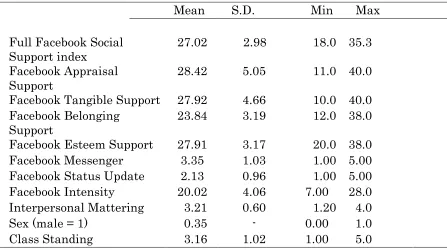
The descriptive findings are shown in Table 1. Most of our analytical sample
consisted of junior (34%) and senior (41%) undergraduate students. In addition, 35% of the sample was Male (65% Female). The mean age of the sample was 21 (Min = 18, Max = 30, SD = 1.76). Our factor analysis included Principal Component extraction with the
Varimax-Kaiser Normalization Rotation Method. For each scale, the Kaiser-Meyer-Olkin test of sampling adequacy (KMO) and Bartlett’s test of sphericity were statistically
Table 1. Descriptive Statistics for Dependent and Independent Variables
Mean S.D. Min Max
Full Facebook Social
Support index 27.02 2.98 18.0 35.3 Facebook Appraisal
Support
28.42 5.05 11.0 40.0
Facebook Tangible Support 27.92 4.66 10.0 40.0 Facebook Belonging
Support 23.84 3.19 12.0 38.0
Facebook Esteem Support 27.91 3.17 20.0 38.0 Facebook Messenger 3.35 1.03 1.00 5.00 Facebook Status Update 2.13 0.96 1.00 5.00 Facebook Intensity 20.02 4.06 7.00 28.0 Interpersonal Mattering 3.21 0.60 1.20 4.0
Sex (male = 1) 0.35 - 0.00 1.0
Class Standing 3.16 1.02 1.00 5.0 Note: N = 245
Table 2a. Component Factor Matrix for FBI
Component 1
Item 1 0.76
Item 2 0.69
Item 3 0.84
Item 4 0.80
Item 5 0.78
Item 6 0.74
Table 2b. Component Factor Matrix for Mattering
Component 1
Item 1 0.84
Item 2 0.86
Item 3 0.84
Item 4 0.83
Item 5 0.75
Note: Extraction Method - Principal Component Analysis with Varimax-Kaiser Normalization Rotation Method. KMO = 0.87, p < .001. Please see Appendix A for “Item” description
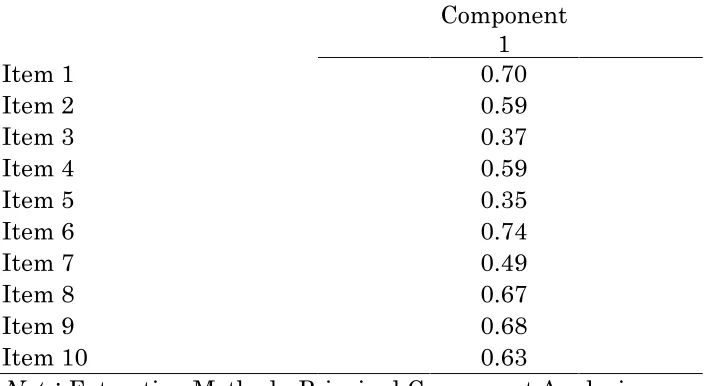
Table 2c. Component Factor Matrix for Facebook Belonging Support
Component
1
Item 1 0.70
Item 2 0.59
Item 3 0.37
Item 4 0.59
Item 5 0.35
Item 6 0.74
Item 7 0.49
Item 8 0.67
Item 9 0.68
Item 10 0.63
Table 2d. Component Factor Matrix for Facebook Esteem Support
Component
1
Item 1 0.16
Item 2 0.39
Item 3 0.23
Item 4 0.09
Item 5 0.29
Item 6 0.36
Item 7 0.32
Item 8 0.07
Item 9 0.06
Item 10 0.25
Note: Extraction Method - Principal Component Analysis with Varimax-Kaiser Normalization Rotation Method. KMO = 0.67, p < .001. Please see Appendix A for “Item” description
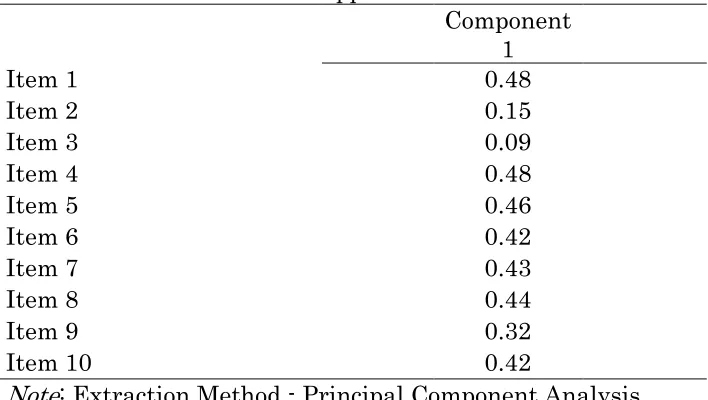
Table 2e. Component Factor Matrix for Facebook Tangible Support
Component
1
Item 1 0.48
Item 2 0.15
Item 3 0.09
Item 4 0.48
Item 5 0.46
Item 6 0.42
Item 7 0.43
Item 8 0.44
Item 9 0.32
Item 10 0.42
Regression Results with the Full 40-item Facebook Social Support index
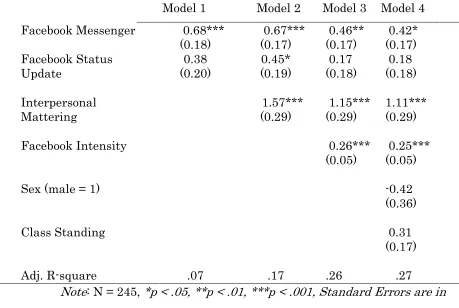
The nested OLS regression results with the full 40-item Facebook social support index as the dependent variable are shown in Table 3. In step one, regression results show that frequency of Facebook Messenger use was positively associated with Facebook social support (b = 0.68, SE = 0.18, p < .001), while Facebook status update (b = 0.28, SE = 0.20, p > .05) did not have a statistically significant association with the full Facebook social support index. In model 2, Facebook Messenger (b = 0.67, SE = 0.17, p < .001) and interpersonal mattering (b = 1.57, SE = 0.29, p < .001) had statistically significant and positive associations with Facebook social support. In addition, status update was
positively and statistically significantly associated with Facebook social support (b = 0.45, SE = 0.19, p < .05), net of the effect of interpersonal mattering and Facebook Messenger use. Both Facebook Messenger (b = 0.46, SE = 0.17, p < .01) and interpersonal mattering (b = 1.15, SE = 0.29, p < .001) remained statistically significant in model 3.
Facebook intensity was positively associated with Facebook social support (b = 0.26, SE = 0.05, p < .001). Model 3 had an adjusted R-square of 0.26, which suggests that the three independent variables associated with 26% of the total variance in Facebook social support. The final step (model 4) showed that Facebook Messenger (b = 0.42, SE = 0.17, p < .01), interpersonal mattering (b = 1.11, SE = 0.29, p < .001), and Facebook intensity (b =
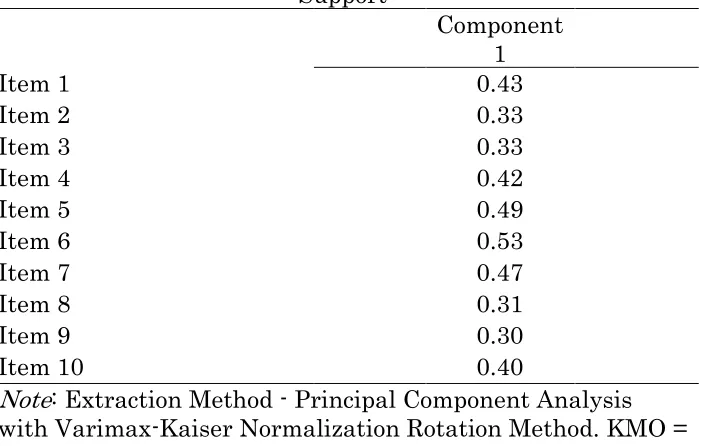
Table 2f. Component Factor Matrix for Facebook Appraisal Support
Component
1
Item 1 0.43
Item 2 0.33
Item 3 0.33
Item 4 0.42
Item 5 0.49
Item 6 0.53
Item 7 0.47
Item 8 0.31
Item 9 0.30
Item 10 0.40
0.25, SE = 0.05, p < .001) remained statistically significant. However, significant differences for sex and class standing were not observed. The independent variables in model 4 associated with 27% of the total variance in the full Facebook social support index.
Table 3. OLS Regression Results with Full Facebook Social Support Index as the Dependent Variable
Model 1 Model 2
Model 3
Model 4 Facebook Messenger 0.68***
(0.18) 0.67*** (0.17) 0.46** (0.17) 0.42* (0.17) Facebook Status
Update
0.38 (0.20)
0.45* (0.19)
0.17 (0.18)
0.18 (0.18)
Interpersonal Mattering
1.57*** (0.29)
1.15*** (0.29)
1.11*** (0.29)
Facebook Intensity 0.26***
(0.05)
0.25*** (0.05)
Sex (male = 1) -0.42 (0.36)
Class Standing 0.31
(0.17)
Adj. R-square .07 .17 .26 .27
Note: N = 245, *p < .05, **p < .01, ***p < .001, Standard Errors are in parentheses
Regression Results with Sub-Dimensions of the Facebook Social Support Index
Our regression results indicated that Facebook intensity (b = 0.25, SE = 0.08, p < .01) and interpersonal mattering (b = 1.98, SE = 0.51, p < .001) were positively associated with Facebook appraisal support (Table 4). However, Facebook Messenger (b = 0.53, SE = 0.30, p > .05) and status update (b = 0.34, SE = 0.33, p > .05) did not have a statistically
associated with about 16% of the total variance in Facebook appraisal support (Adj. R-Square = 0.16).
Our regression results revealed that Facebook Messenger use (b = 0.64, SE = 0.28, p < .05), Facebook intensity (b = 0.29, SE = 0.08, p < .001), and interpersonal mattering (b = 1.86, SE = 0.47, p < .001) had statistically significant associations with Facebook tangible support. The predictors associated with 19% of the total variance in Facebook tangible support (Adj. R-square = 0.19). In addition, Facebook Messenger (b = 0.40, SE = 0.19, p < .05), status updates (b = 0.46, SE = 0.21, p < .05), Facebook intensity (b = 0.20, SE = 0.05, p < .001), and interpersonal mattering (b = -0.97, SE = 0.33, p < .01) had statistically significant associations with Facebook belonging support. Interpersonal mattering had an inverse association with Facebook belonging support – which suggests that on average, students that reported higher levels of interpersonal mattering were more likely to report lower levels of Facebook belonging support. These three predictors associated with 12% of the total variance in Facebook belonging support.
In the final model, our results suggested that Facebook intensity (b = 0.25, SE = 0.05, p < .001) and interpersonal mattering (b = 1.55, SE = 0.31, p < .001) were positively associated with Facebook esteem support, however Facebook Messenger and status updates did not have statistically significant associations with Facebook esteem support. The positive association between Facebook intensity and Facebook esteem support was counter to our prediction of an inverse association. The independent variables associated with 24% of the total variance in Facebook esteem support.
Table 4. OLS Regression Results with Dimensions of Facebook Social Support as the Dependent Variable
Unstandardized
B Coefficient
Facebook Appraisal Support (DV)
Facebook Messenger 0.53
(0.30)
FB Status Update 0.34
(0.33) Facebook Intensity
0.25** (0.08)
(0.52)
Adj. R-Square 0.16
Facebook Tangible Support (DV)
Facebook Messenger 0.64* (0.28) FB Status Update -0.02
(0.30) Facebook Intensity 0.29***
(0.08) Interpersonal Mattering 1.86***
(0.47)
Adj. R-Square 0.19
Facebook Belonging Support (DV)
Facebook Messenger 0.40*
(0.19)
FB Status Update 0.46*
(0.21) Facebook Intensity 0.20***
(0.05)
Interpersonal Mattering -0.97**
(0.33)
Adj. R-Square 0.14
Facebook Esteem Support (DV)
Facebook Messenger 0.10
(0.18) FB Status Update -0.06
(0.20) Facebook Intensity 0.25***
(0.05) Interpersonal Mattering 1.55***
(0.31)
Adj. R-Square 0.24
Note: N = 245, *p < .05, **p < .01, ***p < .001, Standard Errors are in parentheses. In each model we controlled for sex and class standing – however, none of the coefficients were statistically significant (p >.05). A correlation matrix for all variables used in the analysis is shown below (Table 5).
Table 5 Correlation Matrix for Independent and Dependent Variables
X1 X2 X3 X4 X5 X6 X7 X8
FB Messenger 1.0 0.26** -0.002 0.19** 0.22** 0.22** 0.12 0.20** FB Intensity 1.0 0.23** 0.32** 0.36** 0.28** 0.41** 0.28** Interpersonal
Mattering 1.0 0.29** 0.31** -0.14* 0.38** -0.06 FB Appraisal Support 1.0 0.73** 0.19** 0.53** 0.13* FB Tangible Support 1.0 0.11 0.51** 0.08 FB Belonging Support 1.0 -0.01 0.25**
FB Esteem Support 1.0 0.06
FB status update 1.0
Note:
N = 245 *p< .05, **p< .01, ***p< .001
DISCUSSION
In this study, we sought to examine the relationship between Facebook use and perceived social support derived from specific types of Facebook use. In line with Gibson’s (1979) affordance theory – we posited that Facebook affords users a variety of distinct types of online behaviors and that the types of online behaviors that users enact can influence their likelihood of perceiving Facebook as an access point to solicit specific types of social support. Our findings highlight the socio-technical affordances of Facebook use – such as, enhanced connectivity and visibility. Users take advantage of Facebook features, such as Facebook messenger and status updates, which can allow users to engage in the solicitation of social support. More specifically, our results suggest that Facebook use is positively associated with each of the four adapted ISEL sub-scales. Our findings also point to a positive relationship between Facebook intensity and users’ perceptions of Facebook esteem support, thereby disconfirming our prediction that Facebook intensity would be negatively associated with perceptions of esteem support. The counter finding might suggest that we underestimated the potential esteem-boosting functions on Facebook and perhaps overestimated the effect of negative social comparison in this particular domain.
associated with each of the other three adapted ISEL sub-scales – net of the positive effect of Facebook intensity. The inverse association between mattering and Facebook belonging support suggests, however, that on average, students with a lower sense of mattering may garner more Facebook belonging support than students with a greater sense of
interpersonal mattering. From a socio-technical affordance perspective, this finding could suggest that students that feel they matter less to others are able to take advantage of the Facebook affordances of connectivity and visibility and subsequently they are more likely to use Facebook to develop a sense of belonging. On the other hand, the positive
association between interpersonal mattering and each of the other three adapted ISEL sub-scales suggests that, holding constant Facebook intensity as well as participants’ self -reported frequency of using specific features (e.g., Facebook Messenger and status
updates), students with a greater sense of mattering were more likely to garner support through Facebook than those with a lower sense of mattering.
Our study, therefore, provides evidence that belonging support may be one of the most prevalent forms of social support derived from Facebook use among college students with a low sense of mattering. Given the importance of social support and interpersonal mattering for student retention, stress buffering, and personal well-being (Rayle & Chung, 2007), we recommend that future research could be aimed at understanding the relations between Facebook use, mattering, and belonging support. In addition, we acknowledge the importance of considering other individual level factors, such as the types of activities and habits involved in routine Facebook use, personality traits, sex, and romantic relationship status (e.g., Baker, 2016; Marshall, 2012; Sheldon, 2016), because previous research suggests that these, among other factors, are associated with social support and interpersonal communication processes.
afford greater visibility as well as opportunities to connect with others to solicit specific types of social support. In addition, frequency of status updates had statistically
significant and positive bi-variate correlations with Facebook appraisal support and belonging support (Table 5). Moreover, frequency of Facebook Messenger use was positively associated with Facebook belonging and tangible support – net of all other variables.
Taken together, we conclude that our findings are consistent with prior social media affordance research (e.g., Burke & Kraut, 2016; Makki et al., 2018), in that Facebook features may be used differentially to facilitate specific types of interpersonal
communication and social support (and perhaps more so belonging support than other types). Future research could also benefit from going beyond measuring frequency of use and instead assessing qualitative differences in actual usage behavior of specific features – which could help build socio-technical affordance theory by examining potential
affordances, e.g., behaviors related to connectivity and perceived visibility, in the context of online social support and interpersonal communication.
The present study serves to address existing discrepancies in the literature regarding the relations between Facebook use and perceived social support. Though studies have varied in their conclusions regarding the value of Facebook as a platform for the solicitation of social support (Blight, Jagiello & Ruppel, 2015; Leung, 2015; Manago, Taylor, Greenfield, 2012; Petersen, 2014; Tromholt, 2016), our findings support existing research that points to Facebook as being positively associated with perceptions of social support. For example, our results contrast previous research by Shensa et al. (2015) who found that frequency of Facebook use was inversely associated with perceived emotional support. However, Shensa and colleagues measured emotional support differently than the present study by not examining emotional support separately from self-esteem
support, nor did they assess perceptions of emotional support specifically stemming from Facebook use, which may be a potential reason for our observed differences.
Our study has several limitations. The cross-sectional non-experimental design of our study did not allow us to assess potential causal relationships. As such, we cannot rule out the possibility that the causal arrows could be reversed between Facebook use,
could aim to reexamine the relations assessed by this study using longitudinal and
experimental data – which, coupled with cross-lagged statistical modeling would allow for a more accurate assessment of potential causal relationships. In addition, we manipulated each of the original items in the ISEL by adding the word “Facebook” or “Facebook use.” This adjustment may have been the cause behind the limited internal reliability found in our adapted esteem support subscale (KMO = 0.67). However, the esteem support subscale had a KMO > 0.5, which indicates that the items shared a common factor and were fit for analysis (Cerny & Kaiser, 1977). Though, future research could benefit from potentially revising our esteem support measure. Moreover, the external validity of our study is limited in scope due to the homogeneous nature of our sample. Specifically, the analytical sample was based on a convenience sample of undergraduate university students in the U.S. Therefore, findings may differ among other undergraduate student samples as well as among more diverse non-student samples.
Notwithstanding the limitations of our study, we contribute to the extant literature on Facebook use and perceived social support by highlighting the importance of
References
Asbury, T., & Hall, S. (2013). Facebook as a mechanism for social support and mental health Wellness. Psi Chi Journal of Psychological Research, 18, 124-129. doi: 10.24839/2164- 8204.JN18.3.124
Baker, D. A., & Algorta, G. P. (2016). The relationship between online social networking and depression: a systematic review of quantitative studies. Cyberpsychology, Behavior, and
Social Networking, 19, 638-648. https://doi.org/10.1089/cyber.2016.0206
Bauman, E. M., Haaga, D. A., Kaltman, S., & Dutton, M. A. (2012). Measuring social support in battered women: Factor structure of the Interpersonal Support Evaluation List (ISEL).
Violence against women, 18, 30-43. https://doi.org/10.1177/1077801212436523
Beekman, J. B., Stock, M. L., & Marcus, T. (2016). Need to belong, not rejection sensitivity, moderates cortisol response, self-reported stress, and negative affect following social exclusion. The Journal of social psychology, 156, 131-138.
http://dx.doi.org/10.1080/00224545.2015.1071767
Begen, F. M., & Turner-Cobb, J. M. (2015). Benefits of belonging: Experimental manipulation of social inclusion to enhance psychological and physiological health parameters. Psychology & health, 30, 568-582. http://dx.doi.org/10.1080/08870446.2014.991734 Best, P., Manktelow, R., & Taylor, B. (2014). Online communication, social media and adolescent wellbeing: A systematic narrative review. Children and Youth Services Review, 41, 27-36. https://doi.org/10.1016/j.childyouth.2014.03.001
Blight, M. G., Jagiello, K., & Ruppel, E. K. (2015). “Same stuff different day:” A mixed-method study of support seeking on Facebook. Computers in Human Behavior, 53, 366-373.
https://doi.org/10.1016/j.chb.2015.07.029
Brown, S. L., Nesse, R. M., Vinokur, A. D., & Smith, D. M. (2003). Providing social support may be more beneficial than receiving it: Results from a prospective study of mortality.
Psychological science, 14, 320-327. https://doi.org/10.1111/1467-9280.14461
Burke, M., & Kraut, R. E. (2016). The relationship between Facebook use and well‐being depends on communication type and tie strength. Journal of Computer‐Mediated
Communication, 21, 265-281. https://doi.org/10.1111/jcc4.12162
Burke, M., Kraut, R., & Marlow, C. (2011, May). Social capital on Facebook: Differentiating uses and users. In Proceedings of the SIGCHI conference on human factors in computing
systems (pp. 571-580). ACM.
Cerny, B. A., & Kaiser, H. F. (1977). A study of a measure of sampling adequacy for factor- analytic correlation matrices. Multivariate behavioral research, 12, 43-47.
Cohen, S., & Hoberman, H. M. (1983). Positive events and social supports as buffers of life change stress. Journal of applied social psychology, 13, 99-125. doi: 10.1111/j.1559- 1816.1983.tb02325.x
Cohen, S., & McKay, G. (1984). Social support, stress and the buffering hypothesis: A theoretical analysis. Handbook of psychology and health, 4, 253-267.
Delistamati, E., Samakouri, M. A., Davis, E. A., Vorvolakos, T., Xenitidis, K., & Livaditis, M. (2006). Interpersonal Support Evaluation List (ISEL)-college version: Validation and application in a greek sample. International Journal of Social Psychiatry, 52, 552-560.
https://doi.org/10.1177/0020764006074184
Dixon, A. L. (2007). Mattering in the later years: Older adults' experiences of mattering to others, purpose in life, depression, and wellness. Adultspan Journal, 6, 83-95. doi 10.1002/j.2161-0029.2007.tb00034.x
Ellison, N. B., Steinfield, C., & Lampe, C. (2007). The benefits of Facebook “friends:” Social
capital and college students’ use of online social network sites. Journal of Computer‐
Mediated Communication, 12, 1143-1168. DOI 10.1111/j.1083-6101.2007.00367.x
Evans, S. K., Pearce, K. E., Vitak, J., & Treem, J. W. (2016). Explicating affordances: A
conceptual framework for understanding affordances in communication research. Journal
of Computer-Mediated Communication, 22, 35-52. doi:10.1111/jcc4.12180
Festinger, L. (1954). A theory of social comparison processes. Human relations, 7, 117-140.
https://doi.org/10.1177/001872675400700202
Gibson, J. J. (1979). The ecological approach to visual perception. Boston, Massachusetts: Houghton Mifflin.
House JS. (1981) Work, stress, and social support reading. MA: Addison-Wesley.
Kendler, K. S. (1997). Social support: a genetic-epidemiologic analysis. American Journal of
Psychiatry, 154, 1398-1404. https://doi.org/10.1176/ajp.154.10.1398
Lee, S. Y. (2014). How do people compare themselves with others on social network sites?: The case of Facebook. Computers in Human Behavior, 32, 253-260.
https://doi.org/10.1016/j.chb.2013.12.009
Leung, L. (2015). A Panel Study on the Effects of Social Media Use and Internet Connectedness on Academic Performance and Social Support. International Journal of Cyber Behavior,
Psychology and Learning (IJCBPL), 5, 1-16. DOI 10.4018/ijcbpl.2015010101
Lynch, J. G. (2012). Perceived Stress and the Buffering Effect of Perceived Social Support on Facebook (Doctoral dissertation, Antioch University New England).
http://rave.ohiolink.edu/etdc/view?acc_num=antioch1344533616
Makki, T. W., DeCook, J. R., Kadylak, T., & Lee, O. J. (2018). The social value of snapchat: An exploration of affiliation motivation, the technology acceptance model, and relational maintenance in Snapchat use. International Journal of Human–Computer
Interaction, 34(5), 410-420. https://doi.org/10.1080/10447318.2017.1357903
Malecki, C. K., & Demaray, M. K. (2003). What type of support do they need? Investigating student adjustment as related to emotional, informational, appraisal, and instrumental support. School Psychology Quarterly, 18, 231-252.
http://dx.doi.org/10.1521/scpq.18.3.231.22576
Manago, A. M., Taylor, T., & Greenfield, P. M. (2012). Me and my 400 friends: The anatomy of college students' Facebook networks, their communication patterns, and well-being.
Developmental psychology, 48, 369-380. http://dx.doi.org/10.1037/a0026338
Marshall, T. C. (2012). Facebook surveillance of former romantic partners: Associations with postbreakup recovery and personal growth. Cyberpsychology, Behavior, and Social
Networking, 15, 521-526. https://doi.org/10.1089/cyber.2012.0125
Petersen, G. E. (2014). Frequency of communication on Facebook as a factor in four dimensions of perceived social support (Doctoral dissertation, University of Denver).
Rayle, A. D., & Chung, K. Y. (2007). Revisiting first-year college students' mattering: Social support, academic stress, and the mattering experience. Journal of College Student Retention: Research, Theory & Practice, 9, 21-37. https://doi.org/10.2190/X126-5606- 4G36-8132
Rosenberg, M., & McCullough, B. C. (1981). Mattering: Inferred significance and mental health among adolescents. Research in community & mental health, 2, 163-182.
Sarason BR, Sarason IG, Pierce GR. (1990). Social support: An interactional view. Oxford, England: John Wiley & Sons.
Sheldon, P. (2016). Self-monitoring, covert narcissism, and sex as predictors of self-
presentational activities on Facebook. The Journal of Social Media in Society, 5, 70-
Shensa, A., Sidani, J. E., yi Lin, L., Bowman, N. D., & Primack, B. A. (2016). Social media use and perceived emotional support among US young adults. Journal of community health,
41, 541-549.
Thoits, P. A. (2011). Mechanisms linking social ties and support to physical and mental health.
Journal of Health and Social Behavior, 52, 145-161.
https://doi.org/10.1177/0022146510395592
Tromholt, M. (2016). The Facebook experiment: Quitting Facebook leads to higher levels of well- being. Cyberpsychology, Behavior, and Social Networking, 19, 661-666.
https://doi.org/10.1089/cyber.2016.0259
Wallston, B. S., Alagna, S. W., DeVellis, B. M., & DeVellis, R. F. (1983). Social support and physical health. Health psychology, 2, 367-391. http://dx.doi.org/10.1037/0278-
6133.2.4.367
Zuo, A. (2014). Measuring up: Social comparisons on Facebook and contributions to self-esteem and mental health (Doctoral dissertation, University of Michigan).
Appendix A Facebook Messenger
Please indicate how often do you perform the following activity on Facebook? 1. I use an instant messaging feature.
Response: 1 (never) to 5 (always) Facebook Status Update
Please indicate how often do you perform the following activity on Facebook? 1. I update my status.
Response: 1 (never) to 5 (always) Facebook Intensity
1. I use Facebook daily
2. I am proud to tell people I'm on Facebook 3. Facebook has become part of my daily routine
4. I feel out of touch when I haven't logged onto Facebook for a while 5. I feel I am part of the Facebook community
6. I would be sorry if Facebook shut down
Response: 1 (strongly disagree) to 4 (strongly agree) Interpersonal Mattering
a. How important do you feel you are to other people? b. How much do you feel other people pay attention to you? c. How much would other people miss you if you went away? d. How interested are people generally in what you have to say? e. How much do other people depend on you?
Response: 1 (not at all) to 4 (very much) Facebook Social Support
Appraisal
1. On Facebook, there are several people that I trust to help solve my problems.
2. There is no one that I feel comfortable talking to about intimate personal problems on Facebook (R).
3. There really is no one on Facebook who can give me an objective view of how I’m handling my problems
(R).
6. When I need suggestions on how to deal with a personal problem, I know someone I can turn to on Facebook.
7. On social media, there is someone I could turn to for advice about making career plans or changing my job.
8. On Facebook, there really is no one I can trust to give me good financial advice (R).
9. If a family crisis arose, it would be difficult to find someone on Facebook who could give me good advice about how to handle it (R).
10. On Facebook, there is at least one person I know whose advice I really trust. Tangible
1. If I needed help fixing an appliance or repairing my car, there is someone who I might contact on Facebook that would help me.
2. If I needed a ride to the airport very early in the morning, I would have a hard time finding someone on Facebook to take me (R).
3. If I were sick and needed someone (friend, family member, or acquaintance) to take me to the doctor, I would have trouble finding someone on Facebook (R).
4. If I needed a place to stay for a week because of an emergency (for example, water or
electricity out in my apartment or house), I could easily find someone on Facebook who would put me up. 5. If I were sick, I could easily find someone on Facebook to help me with my daily chores.
6. If I needed an emergency loan of $100, there is someone (friend, relative, or acquaintance) I could get it from by using Facebook.
7. If I had to go out of town for a few weeks, it would be difficult to find someone on Facebook who would look after my house or apartment (the plants, pets, garden, etc.) (R).
8. If I was stranded 10 miles from home, there is someone I could contact through Facebook who would come and get me.
9. It would be difficult to find someone on Facebook who would lend me their car for a few hours (R). 10. If I needed some help in moving to a new house or apartment, I would have a hard time
finding someone on Facebook to help me (R). Self-Esteem
1. Most of my friends on Facebook are more interesting than I am (R). 2. There is someone on Facebook who takes pride in my accomplishments 3. Most people I know on Facebook think highly of me.
4. I think that my friends feel that I’m not very good at helping them solve their problems on Facebook (R).
5. I am as good at doing things as most other people are on Facebook. 6. In general, people on Facebook do not have much confidence in me (R).
7. Most of my friends on Facebook are more successful at making changes in their lives than I am (R). 8. I am more satisfied with my life than most people are with theirs on Facebook.
9. I am closer to my friends on Facebook than most other people are to theirs. 10. I have a hard time keeping pace with my friends on Facebook (R).
Belonging
1. When I feel lonely, there are several people I can talk to on Facebook. 2. I often talk with family or friends on Facebook.
3. I feel like I’m not always included by my circle of friends on Facebook (R). 4. There are several different people I enjoy spending time with on Facebook.
5. If I wanted to go on a trip for a day (e.g., to the mountains, beach, or country), I would have a hard time finding someone on Facebook to go with me (R).
6. If I decide one afternoon that I would like to go to a movie that evening, I could easily find someone to go with me by using Facebook.
7. On Facebook, most people I know do not enjoy the same things that I do (R).
8. On Facebook I don’t often get invited to do things with others (R).
9. If I wanted to have lunch with someone, I could easily find someone to join me by using Facebook. 10. No one I know on Facebook would throw a birthday party for me (R).
Funding and Acknowledgements
The authors declare no funding sources or conflicts of interest.
Online Connections
To follow these authors in social media: Travis Kadylak: @tkady