ISSN 2324-805X E-ISSN 2324-8068 Published by Redfame Publishing URL: http://jets.redfame.com
The Investigation of the Creative Thinking Tendency of Prospective
Mathematics Teachers in Terms of Different Variables
Selin Cenberci
Correspondence: Selin Cenberci, Necmettin Erbakan University, Ahmet Kelesoglu Education Faculty, Konya, Turkey.
Received: May 18, 2018 Accepted: July 9, 2018 Online Published: July 10, 2018
doi:10.11114/jets.v6i9.3434 URL: https://doi.org/10.11114/jets.v6i9.3434
Abstract
New ideas and inventions are needed in the globalizing world in order that societies can be survived. To achieve this, there is a need for teachers and prospective mathematics teachers who will guide these students, who have creative ideas, make new inventions and generate new ideas in the educational environment where individuals are educated. Creative thinking skills should be used at the highest level in order to achieve a more permanent learning and ensure interdisciplinary transition. Creativity is defined as sensitivity emerging against problems. For this reason, importance of the noteworthy that opportunities should be given prospective mathematics teachers to develop creative thinking skills and have more time for designing creative products. Although each individual has creative thinking skills, it is very important to determine how using tendency of creative thinking skills and factors that will activate this tendency do change in accordance with different variables. So it was aimed to determine the level of creative thinking tendencies of prospective mathematics teachers and examine this level in terms of different variables. Marmara Creative Thinking Tendency Scale were applied to prospective mathematics teachers. According to the results obtained, it was declared that the creative thinking tendencies of the prospective mathematics teachers were in the group consisting of the "good" range in the total score section.
Keywords: creativity, creative thinking, prospective mathematics teachers 1. Introduction
1.1 Introduce the Problem
Thinking is the most basic feature that distinguishes man from other living things. According to Turkish Language Society (TDK, 2015) the thinking is defined as the examining and comparing information to arrive at a conclusion, and producing information by benefiting interest between them, and forming mental powers, and reasoning. The way of thinking in the literature is diversified in scientific, logical, divergent, reflective, productive, critical, creative thinking styles. While others complement each other within these forms, creative thinking style differs from others. According to Guilford (1967), creative thinking is mostly associated with divergent thinking. Creative thinking and creativity appear to be used instead of each other in the literature, although they are not the same concepts. Creative thinking involves creativity. Creativity derives from etymon "creare" in Latin language, and it means "to produce, to make or to create" in English (Treffinger, Young, Selby and Shepardson, 2002).
According to Guilford (1967), creativity is defined as "being sensitive against problems". According to Torrance, (1988) “creativity is to think or make an assumption through sensing gaps, disturbances or missing things about them, and to test them, to compare the results, and to change these assumptions by possibility and test them again.” Individuals face problems regarding every area in daily life. Some skills need to be developed to solve these problems quickly. Creative thinking ability becomes active in the solution search process. The stages of creative thinking comprise of 4 stages in accordance with Wallas model approach such that the preparation, incubation, enlightenment, evaluation. This approach model is also important because it relates to the inventive method and creative problem solving techniques. The preparation phase involves reasonable, systematic approach processes. After the preparation phase, the incubation is a period in which the individuals keep somewhat calm, and different new ideas become to emerge under the consciousness. And the period of enlightenment is the period in which the instant solutions emerged. The evaluation is the period in which the discovered thing is evaluated and tested (Demirel, 2010).
1988). Csikszentmihalyi (2011) emphasizes the importance of the individual who has creative thinking ability with the statement "When the creative individual begins to think, all bets close". Creative individuals struggle to reach their goals besides they easily adapt to every changing situation. Bentley (1997) emphasizes that creative individuals keep their motivations, and they are self-confident, respectful individuals who like doing experiment and research.
According to Gardner (1985), the creative individual is defined as “a person who solves a problem in a particular environment, or puts out products and is considered both new and acceptable by experts who buy these products.” Increasing the creativity of individuals are in control of teachers. They can achieve this only by planning the education and training system accordingly. Spencer, Lucas and Claxton (2012) stated that creative-minded individuals have many different tendencies such as curiousity, determination (persistent-stubborn), imagination (imaginative), collaboration and discipline. Guilford (1950) expresses the creative thinking ability as “to have power for producing a product or not to have”, and states that each individual has creative thinking. However, it can be said that the reason of the emergence of these skills is the factors that activate the tendency of thinking. The tendency is explained that “the tendency or proneness to love, to want or to do something” (Turkish Language Society, (TDK), 2015). The tendency to think creative is defined as the desire of people for activating their own capacity of creative thinking when needed. Tishman and Andrade (1996) suggest that positive or negative thinking tendencies contribute to overall thinking performance. The development of creativity is seen as an important goal in all levels of education, from primary education to universities. In the primary education programs prepared by the Board of Education, it is aimed to develop creativity (Ministry of Education, (MEB), 2004). Especially in mathematics course the role of teachers is very important in the development of this skill. For this reason, it is thought that it would be useful to work on the development of teacher candidates' creativity. Students need to use their creativity and organize learning environments that allow them to take them out to higher levels, and implement alternative methods. In addition, the fact that math is broken with other disciplines and everyday life in the eyes of students, removes them from the point of view of mathematics (Bindak, 2005). While for some people mathematics is a nightmare, for some people mathematics has become a way of life and love (Sertoz, 2002). It provides a suitable platform for the development of the natural creativity of mathematical science (Nadjafikhah et al., 2012). Creativity concept is a phenomenon that needs to be clearly put forth in mathematics activities. Sriraman et al. (2013) “emphasize in their research that the components of mathematical creativity are problem-solving, problem-solving, and problem-solving.” One of the factors that destroy walls built against mathematics, is to make the lesson more fun and understandable by trying to reveal the creativity of students in mathematics lessons.
When its importance at teacher training process is considered by taking all these facts into consideration, it is expected that the research results will make a significant contribution to the literature. Mathematics teacher must be an individual who knows how to improve creativity in mathematics education and have an innovative personality to have creative characteristics. It is important to improve the creativity skills of prospective mathematics teachers through practical training.
For this reason, in our study, it was aimed to determine the level of creative thinking tendencies of prospective mathematics teachers and examine this level in terms of different variables. In accordance with this purpose, the answers were sought for the following questions:
1. What is the creative thinking tendency level of prospective mathematics teachers?
2. Do the creative thinking tendencies of prospective mathematics teachers differ significantly in accordance with gender?
3. Do the creative thinking tendencies of prospective mathematics teachers differ significantly in accordance with high school from which they graduated?
1.2 Importance of the Problem
It has been encountered a number of studies in the literature regarding creativities and creative thinkings of prospective mathematics teachers, but it has not been encountered any study on creative thinking tendencies of them. Therefore, in the direction of needs, it was aimed to investigate the effects of creative thinking tendencies of prospective mathematics teachers in terms of the demographical characteristics.
1.3 Relevant Scholarship
Many creativity test was developed in Turkey, besides "Torrance Test of Creative Thinking" developed by Torrance (1974) and whose Turkish version was adopted by Aslan (2001). It is aimed to measure creative thinking levels of individuals with this scale. Torrance identified creative thinking skills in the way that flexibility, originality, fluency, and detailing in the study done in 1972.
Isleyen and Kucuk (2013) tried to determine the creative thinking levels of classroom teacher and science teacher candidates in their study by using “Torrance Test of Creative Thinking”, and examined in terms of different variables. By comparison in accordance with the professions, they were found that there is a difference in favor of the classroom teacher candidates, but there was no significant difference in terms of their gender.
Aslan and Cansever (2009) examined the attitudes of teachers regarding to the creativity and using of their creativity. According to them, the creative teachers are individuals who are open to innovation and self-confident, encouraging students and guiding. As a result of the study, it was found that teachers make efforts to use creativity. It is necessary to emphasize at this point that creative environments are necessary to raise creative individuals. Moreover, the contribution of creative environments to the creative thinking tendencies of individuals can not be ignored. Creative thinking tendencies are expressed as desire for using creative thinking skills that an individual possesses, or as an effort for using them.
Aydogdu and Yuksel (2013) found that teacher candidates‟ mathematical history examined the relationship between belief and attitude levels and creativity, and that the average of creativity scores did not differ according to sex.
Dundar (2015) aimed to reveal the mathematical creativity that prospective mathematics teachers had about the concept of creativity in their work. As a result of the study, the teacher candidates have found that their views on mathematical creativity and creative mathematics teaching are different from each other.
Gurlen ve Ustundag (2014) aimed to present the prospective teachers‟ definitions of creativity, opinions about promoting and preventing the creativity. The results showed that teacher candidates mention creativity as thinking freedomly and emphasizing exceeding limits. Arik (1987) stated that the individuals should use metaphors for showing creative behaviors in education and science.
The study of Meisser (1999) was translated by Gur and Kandemir (2006) and given the name „Creativity and Mathematics Education‟, and it was emphasized in the study that the necessity of using class activities to provide individual development of the students by examining the social skills of them.
Atkinci (2001), showed that the education given to students during elementary school period is not much effective in improving the creative thinking levels of students. Treffinger (2003, p. 60) aims to measure mathematical creativity in helping individuals recognize the strengths and capabilities, to provide knowledge and understanding.
Yildirim (2005) focuses on the importance of creativity and managing creativity individually and organizationally in his study. It was emphasized on providing suitable environments for emerging of creative ideas in the study. In addition, it was mentioned that how necessary does creative thinking to be supported.
Tezci et al., (2008) aimed to examine the achievement of prospective mathematics teachers who have different creative thinking styles. In this study creativity training in problem solving on the achievement of mathematic teachers is a significant research issue. Cenberci and Yavuz (2018), found that a positive and non significant relationship between creative thinking tendencies of mathematics teacher candidates and their attitudes towards Instructional Technologies and Material Design lesson in their paper.
2. Method and Analysis 2.1 Method
It is a descriptive research since the situation is tried to be identified as it is in the research and the general screening model which is one of the screening models was used in this research. Screening models are research approaches that are aimed at describing a condition, which was in the past or is in still-continuing, as it stands. At the same time, creative thinking tendencies of prospective mathematics teachers were examined in terms of the gender and the high school graduation. It was tried to be determined whether there was a significant difference between the views of students in terms of the gender and the high school graduation. In this respect, this research is also a relational research (Sonmez and Alacapinar, 2013).
2.2 Population and Sample
The data of the research were collected from 405 prospective mathematics teachers who were studying in Mathematics Education Department at Necmettin Erbakan University. Since reaching to the whole of the universe was not possible, sample was selected from mathematics education department with disproportionate sampling method.
2.3 Data Collection Tool
When collecting the data, the Marmara Creative Thinking Tendency Scale (MCTTS), which was developed by Ozgenel and Cetin in 2017, and whose validity and reliability studies were made, was used to measure general creative thinking tendencies of the participants (Ozgenel and Cetin, 2017). There are six sub-dimensions which are the search for innovation and the courage, self-discipline, curiosity, doubt, and flexibility in Marmara creative thinking tendency scale. The search for innovation requires finding different solutions by giving useful and specific answers about problems or situations; the courage sub-dimension requires to think independently under oppression; the self-discipline sub-dimension requires protecting motivation against the difficulties; the curiosity sub-dimension requires interesting and liking the attractive situations; the doubt sub-dimension requires asking the question of "I wonder if" against a situation, and the flexibility sub-dimension requires acceptance of the mistakes that were made.
2.4 The Analysis of Data
This scale is a 5-digit Likert-type scale of absolutely disagree (1), disagree (2), undecided (3), agree (4) and strongly agree (5). The calculated alpha reliability coefficient is 0.86. After the scale had been applied, the data were analyzed by using the rating scale. There are five options on the scale. The interval coefficients for the four intervals (5-1 = 4) in the 5-digit scale, are (4/5) 0.80. The "absolutely disagree" was determined as "very little" level with 1-1.79, and "disagree" was "little" level with 1.80-2.59, the "undecided" was "moderate" level with 2.60-3.39, the "agree" was "good" level with 3.40-4.19 and the "strongly agree" was "very good" level with 4.20-5; and answers will be evaluated in accordance with these groups. The analysis of the data was done in computer environment and with SPSS-20.0 computer package program. The arithmetic mean and standard deviation values of creative thinking scores of the prospective mathematics teachers were determined. The Mann-Whitney U test was used to determine whether there was a significant difference between the views of the prospective mathematics teachers in accordance with different variables which was not distributed normally, and the Kruskal Wallis test was used in accordance with the variables showing significant differences.
3. Findings
3.1 The First Sub-Problem
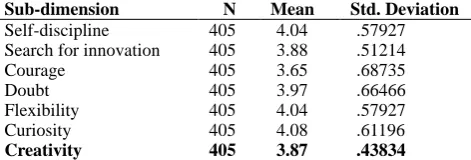
The first sub-problem of the study is "What is the creative thinking tendency levels of prospective mathematics teachers"?. The arithmetic mean and standard deviation values regarding creative thinking tendencies of prospective mathematics teachers are given in Table 1.
Table 1. Statistical data regarding creative thinking tendencies of prospective mathematics teachers
Sub-dimension N Mean Std. Deviation Self-discipline 405 4.04 .57927 Search for innovation 405 3.88 .51214
Courage 405 3.65 .68735
Doubt 405 3.97 .66466
Flexibility 405 4.04 .57927
Curiosity 405 4.08 .61196
Creativity 405 3.87 .43834
"curiosity" sub-dimension. That the scores of prospective mathematics teachers are in "low level and "above" shows that their creativities sort in ascending way.
3.2 The Second Sub-Problem
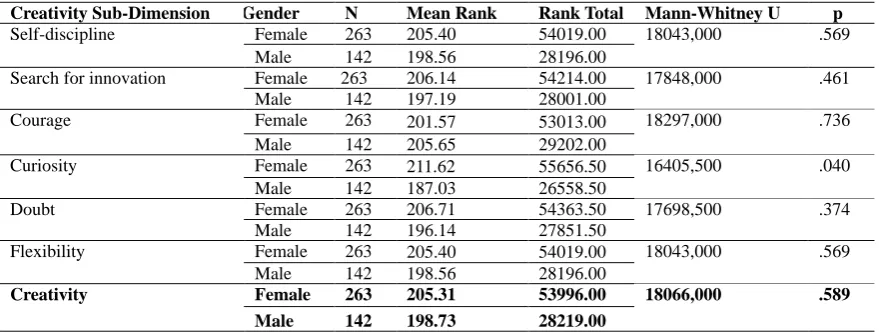
The second sub-problem of the study is "Do the creative thinking tendencies of prospective mathematics teachers differ significantly in accordance with gender"? According to analysis, it was understood that the data were not normally distributed according to the normality analysis of the data. Because of that, the data obtained after the U test which was done for testing the hypothesis and the data showing non-normal distribution are given in Table 2.
Table 2. The Mann Whitney U test results giving creative thinking tendency scores of prospective mathematics teachers in accordance with gender
Creativity Sub-Dimension Gender N Mean Rank Rank Total Mann-Whitney U p
Self-discipline Female 263 205.40 54019.00 18043,000 .569
Male 142 198.56 28196.00
Search for innovation Female 263 206.14 54214.00 17848,000 .461
Male 142 197.19 28001.00
Courage Female 263 201.57 53013.00 18297,000 .736
Male 142 205.65 29202.00
Curiosity Female 263 211.62 55656.50 16405,500 .040
Male 142 187.03 26558.50
Doubt Female 263 206.71 54363.50 17698,500 .374
Male 142 196.14 27851.50
Flexibility Female 263 205.40 54019.00 18043,000 .569
Male 142 198.56 28196.00
Creativity Female 263 205.31 53996.00 18066,000 .589
Male 142 198.73 28219.00
It is seen that creativity score means of female prospective mathematics teachers is higher than the creativity score means of male prospective mathematics teachers in Table 2.
The degree of freedom (SD) obtained as a result of Mann-Whitney U test, the U test value and the level of significance (p) scores were examined in order to determine whether this difference is statistically significant or random. The U test significance p values were examined in order to determine the differences between the creativity levels of the male and female prospective mathematics teachers. It was seen that the significance coefficient of creativity score was p=0.589>0.05. Since the significance value was greater than the 0.05 significance criterion, the difference between the creativity levels of prospective mathematics teachers was not found to be statistically significant in the context of gender variable except “curiosity” sub-dimension. Only it was seen the significance coefficient of “curiosity” sub-dimension creativity score was p=0.040<0.05. So “curiosity” sub-dimension the difference between the creativity levels of the male and female prospective mathematics teachers was found to be significant. Despite the difference was found to be insignificant, the creativity levels of females were higher than the levels of men in all other sub-dimensions except “courage” sub-dimension and total creativity level. We can not generalize the result for all male and female prospective mathematics teachers according to this insignificant difference, but we can refer the difference for the study group explained above.
3.3 The Third Sub-Problem
Table 3. Kruskal Wallis H test results showing relationship between the High School from which they graduated and the creative thinking score
Creativity High School Graduation
n Mean Rank
sd Chi-Square p Significant Difference
Self-discipline Anatolian Vocational High school 106 98 201 206.95 189.71 207.40
2 1.691 .429 -
Search for
innovation Anatolian Vocational High school 106 98 201 203.29 186.81 210.74
2 2.776 .250 -
Courage Anatolian
Vocational High school 106 98 201 206.95 189.71 207.40
2 1.691 .429 -
Curiosity Anatolian
Vocational High school 106 98 201 217.50 175.45 208.79
2 7.857 .020 Anatolian HS-Vocational HS
Vocational HS-High School
Doubt Anatolian
Vocational High school 106 98 201 217.50 175.45 208.79
2 7.857 .020 Vocational HS-High School
Flexibility Anatolian
Vocational High school 106 98 201 216.58 180.73 206.70
2 5.346 .069 -
Creativity Anatolian Vocational H. School 106 98 201 209.81 188.74 206.36
2 1.981 .371
According to the high school graduation variable, there are differences between mean ranks of creative thinking scores of prospective mathematics teachers. Significant differences were observed between mean ranks of creative thinking scores in the “curiosity” and “doubt” sub-dimension [X2(2) = 7.85, p<0.05]. According to the “curiosity” and “doubt”
sub-dimensions of creative thinking score, the significant difference based on high school from which prospective mathematics teachers graduated from is in favor of Anatolian High School, High School and Vocational High School, respectively. As a result of multiple comparisons made with the Mann-Whitney U test on creative thinking, “curiosity” sub-dimension scores, we could say that Anatolian High School graduates are more curious than Vocational High School graduates, and Vocational High School graduates were more curious than High School graduates and in addition to this “doubt” sub-dimension scores, we could say that Vocational High School graduates are more skeptical than High School graduates. It was not found any significant difference which shows relationship between creativity and high school graduation in all other sub-dimensions except the “curiosity” and “doubt” sub-dimensions.
4. Conclusion and Discussion
The creative teachers are individuals who has self-confidence, open to communication and innovation, and guide students, are a model to them with every behavior and encourage them (Aslan and Cansever, 2009). A mathematic teacher who can produce different solutions for the problems, try to make the lesson more enjoyable by using his / her creativity. A mathematic lesson which is in connection with a fun, everyday life and enhances the imagination of students provides a more effective learning environment. Mathematics education linked to everyday life requires creativity, and the first steps for educating teachers who can provide such an environment are taken in teacher-training institutions. Creative prospective mathematics teachers who know what to do can safely step in their professional life and exhibit leadership behaviors. At this point, the determination of creative thinking tendencies levels of prospective mathematics teachers and taking necessary precautions accordingly, can not be ignored, because, today's education understanding is student-centered and it needs creative mathematics teachers who try to build knowledge by exploring. Such mathematics teachers, however, can ensure their students to emerge their creative thoughts without being criticized due to their thoughts. It is an unimaginable fact that we need these kind of mathematics teachers to get rid of the difficulty of the mathematics course. The main aim of teacher candidates; not just to pass the lessons and to get a diploma but to ask questions that are indispensable to creativity, to pursue an endless curiosity and to have unlimited motivation.
When the creative thinking tendencies of prospective mathematics teachers was examined in accordance with gender variable, it was determined as another result of the study that the mean scores of creativity of female prospective mathematics teachers were higher than the mean scores of creativity of male prospective mathematics teachers. The difference between the creativity levels of female and male prospective mathematics teachers was found to be insignificant except "curiosity" sub-dimension. We can say that female prospective mathematics teachers are curios in their creative thinking. The creativity levels of female prospective mathematics teachers are higher than the creativity levels of male in the total creativity level and in all other sub-dimensions except “courage” sub-dimension. Aydogdu and Yuksel (2013) found that the average scores of teacher candidates' creativity scores did not differ according to sex. This study contradicts with our results.
According to the high school graduation variable, significant differences were observed in the "curiosity" and "doubt" sub-dimensions among the mean ranks of creative thinking scores of prospective mathematics teachers. According to the creative thinking score "curiosity" and "doubt" sub-dimensions, the significant difference based on high school from which prospective mathematics teachers graduated from is in favor of Anatolian High School, High School and Vocational High School, respectively. As a result of multiple comparisons made with the Mann-Whitney U test on creative thinking, it can be said that Anatolian High School graduates are more curious than Vocational High School and Vocational High School graduates are more curious than High School graduates, and interested in engaging in works and events that draw their attention. It can be said that Vocational High School graduates are more skeptical than High School graduates. The fact that the prospective mathematics teachers of Anatolian High School who was accepted with the exams in the previous years and whose achievements are higher than the other high schools feel desire to study at good high school, and are curious; and the fact that the students who cannot study at the Anatolian High School, study at other high schools, are indications of this rank, because, the number of prospective mathematics teachers studying voluntarily at high schools and vocational high schools is very few. It was not found any significant difference, showing relationship between creativity and high school graduation in the other sub-dimensions except the "curiosity" and "doubt" sub-dimensions.
5. Suggestions
• Environments that develop creative thinking levels of prospective mathematics teachers should be provided.
• Prospective mathematics teachers should arrange their teaching methods in the form of influencing creative thinking tendencies of students.
• The importance of creative thinking should be taught to prospective mathematics teachers.
• Prospective mathematics teachers should be guided in their involvement in at least one arts field, and raise their awareness of issue that arts education leads the individual to think creatively.
• The intensity of the curriculum should be mitigated somewhat, and the creativity levels of prospective mathematics teachers should be developed by giving them the opportunity to think.
References
Arik, I. A. (1987). Yaraticilik. Ankara: Ministry of Culture and Tourism.
Aslan, E. (2001). Turkish Version of Torrance Creative Thinking Test. Marmara University Atatürk Education Faculty Journal of Educational Sciences, 14(14), 19-40.
Aslan, N., & Cansever, B. A. (2009). The primary school teachers‟ attitudes for creativity in education. TUBAV Science Journal, 2(3), 333-340.
Atkinci, H. (2001). Influence on the development of creative thinking of primary education programs in primary education. (Unpublished master thesis). Onsekiz Mart University, Canakkale.
Aydogdu, N., & Yuksel, I. (2013). The relationship between prospective mathematics teachers‟ beliefs and attitudes towards history of mathematics and their creativeness level. Journal of Research in Education and Teaching, 2(4), 186-194.
Bentley, T. J. (1997). Sharpen your team's skills in creativity. London: McGraw Hill.
Bindak, R. (2005). Math Anxiety Scale for Elementary School Students. Firat University Journal of Engineering and Science, 17(2), 442-448.
Cenberci, I. S., & Yavuz, A. (2018). The Correlation Between the Creative Thinking Tendency of Mathematics Teacher Candidates and Their Attitudes Towards Instructional Technologies and Material Design. World Journal of Education, 8(3), 95-106. https://doi.org/10.5430/wje.v8n3p95
Creativity. Ondokuz Mayis University Journal of Faculty of Education, 34(1), 18-34.
Demirel, O. (2010). Training Dictonary (4. Print). Ankara: Pegem Academy.
Dundar, S. (2015). An Investigation of Mathematics Teachers Candidates' Opinions on Mathematical Gardner, H. (1985). Frames of mind: The theory of multiple intelligences. New York: Basic Books.
Guilford, J. P. (1950). Creativity research: Past, present and future. American Psychologist, 5, 444-454. https://doi.org/10.1037/h0063487
Guilford, J. P. (1967). The nature of human intelligence. New York: McGraw-Hill.
Gur, H., & Kandemir, M. A. (2006). Creativity and mathematics education (Translation). Elementary Education Online, 5(1), 65-72.
Gurlen, E., & Ustundag, T. (2014). Opinions of the prospective teachers about creativity. Elementary Education Online, 13(2), 443‐452.
Isleyen, T., & Kucuk, B. (2013). Examining prospective teachers‟ level of creative thinking in terms of different variables. Mustafa Kemal University Journal of Social Sciences Institute, 10(21), 199-208.
Kandemir, M. A. (2006). The Views of the Teacher Candidates of Mathematics Education in Secondary Education of Science and Mathematics on Creativity Training and Analysis of their Ability to Solve Creative Problems. Unpublished M.Sc. Thesis. Balıkesir University Institute of Science.
MEB (2004). Turkish Ministry of Education Primary Schools Teaching curriculum: Approach to curriculums. downloaded from http://meb.gov.tr (May 12, 2018).
Meissner, H. (1999). Creativity and Mathematics Education. Summary of International Conference, 15-19.
Nadjafikhah, M., Yaftian, N., & Bakhshalizadeh, S. (2012). Mathematical creativity: some definitions and characteristics. Procedia-Social and Behavioral Sciences, 31, 285-291.
https://doi.org/10.1016/j.sbspro.2011.12.056
Sertoz, S. (2002). Matematigin aydinlik dunyasi. Ankara: TUBITAK Publications.
Sonmez, V., & Alacapinar, F. (2013). Orneklendirilmis bilimsel arastirma yontemleri. Ankara: Anı Publishing.
Spencer, E., Lucas, B., & Claxton, G. (2012). Progression in creativity: Developing New Forms of Assessment. Newcastle: CCE.
Sriraman, B., Haavold, P., & Lee, K. (2013). Mathematical creativity and giftedness: a commentary on and review of theory, new operational views, and ways forward. Zdm, 45(2), 215-225.
https://doi.org/10.1007/s11858-013-0494-6 TDK (2015). http://www.tdk.gov.tr/
Tezci, E., Kandemir, M. A., & Gur, H. (2008). The effects of creativity training in problem solving on the achievement of the prospective mathematics teachers. E-journal New World Sciences Academy, 3(2), 204-218.
Tishman, S., & Andrade, A. (1996). Thinking dispositions: A review of current theories, practices, and issues.
Cambridge, MA: Harvard University. Accessed on December 12, 2013 from
http://learnweb.harvard.edu/alps/thinking/docs/Dispositions.pdf
Torrance, E. P. (1974). The Torrance Tests of Creative Thinking-Norms-Technical Manual Research Edition-Verbal Tests, Forms A and B- Figural Tests, Forms A and B. Princeton, NJ: Personnel Press
Torrance, E. P. (1988). The nature of creativity as manifest in its testing in sternberg. R.J. Stenberg (Ed). Cambridge, England: Cambridge Univ. Press.
Treffinger, D. J. (2003). The educational psychology of creativity. Cresskiil, NJ: Hampton Press.
Treffinger, D. J., Young, G. C., Selby, E. C., & Shepardson, C. (2002). Assessing creativity: A guide for educators. Florida: The National Research Center on the Gifted and Talented.
Yildirim, R. (2005). Yaraticilik ve yenilik. Istanbul: Sistem Publishing.
Copyrights
Copyright for this article is retained by the author(s), with first publication rights granted to the journal.