VOLUME 36, ARTICLE 33, PAGES 945
−
988
PUBLISHED 28 MARCH 2017
http://www.demographic-research.org/Volumes/Vol36/33/ DOI: 10.4054/DemRes.2017.36.33
Research Article
The decline of infant and child mortality among
Spanish Gitanos or Calé (1871−2005):
A microdemographic study in Andalusia
Juan F. Gamella
Elisa Martín Carrasco-Muñoz
© 2017 Juan F. Gamella & Elisa Martín Carrasco-Muñoz.
This open-access work is published under the terms of the Creative Commons Attribution NonCommercial License 2.0 Germany, which permits use, reproduction & distribution in any medium for non-commercial purposes, provided the original author(s) and source are given credit.
1 Introduction 946
1.1 The death of Gitano children 947
1.2 Objectives 948
1.3 A gap in Romani studies 949
2 Methods and data sources 950
2.1 Gitano identity and identification processes 951
2.2 The study area 952
2.3 Problems with the reconstitution data 955 2.4 Variables considered and methods of calculation 956
3 Results 957
3.1 The decline of infant mortality 960
3.1.1 Neonatal mortality 962
3.2 The decline of child (1 to 4 years of age) mortality 963 3.3 A sort of summary: Childhood (under-5) mortality 965 3.4 Changes in the causes of child deaths 967
4 Discussion of the results 970
4.1 The major periods of the childhood mortality decline 971 4.1.1 The crucial pre-transitional period: 1936−1946 972 4.1.2 The onset of the infant and child mortality decline: 1947−1959 972 4.1.3 Consolidation and convergence: 1959-1975, the years of
desarrollismo
974
4.1.4 The completion of the Gitano demographic transition, 1976−2005 974
4.2 The evolution of causes of death 975
4.3 Demographic processes and long term transformations 976
5 Acknowledgements 977
References 978
The decline of infant and child mortality among Spanish Gitanos
or Calé (1871
−
2005): A microdemographic study in Andalusia
Juan F. Gamella1
Elisa Martín Carrasco-Muñoz2
Abstract
BACKGROUND
Most Romani groups in Europe have experienced a decline in childhood mortality during recent decades. These crucial transformations are rarely addressed in research or public policy.
OBJECTIVE
This paper analyzes the timing and structure of the decline of childhood mortality among the Gitano people of Spain.
METHODS
The paper is based on the family and genealogy reconstitution of the Gitano population of 22 contiguous localities in Southern Spain. Registry data from over 19,100 people and 3,501 reconstituted families was included in a dense genealogical grid ranging over 150 years. From this database we produced annual time series of infant and child mortality and of the registered causes of death from 1871 to 2005.
RESULTS
The analyzed data shows a rapid decline in infant and child mortality from about 1949 to 1970. The onset of the definitive decline occurred in the late 1940s and early 1950s. Child mortality was higher in the pre-transitional period and started to decline earlier, although it took longer to converge with majority rates. The mortality transition in the Gitano minority paralleled that of the dominant majority, but with important delays and higher mortality rates. The causes of death show the deprivation suffered by Gitano people.
CONCLUSIONS
The childhood mortality decline facilitated the most important changes experienced recently by the Gitano minority, including its fertility transition and the transformation of Gitanos’ gender and family systems.
CONTRIBUTION
This is one of the first historical reconstructions of the mortality transition of a Romani population.
1. Introduction
The Gitanos orCaléof Spain are an ethnic minority related to the other Romani groups in Europe and America. Notwithstanding their common remote origin, Romani groups have adapted to the surrounding societies in all the regions where they have lived and present considerable sociocultural heterogeneity (Matras 2015; Piasere 2004; Fraser 1992). The Gitanos seem to descend from the first migratory waves of Romani groups into Western Europe, which were documented in the 15th century (Pym 2007; Leblon 1985). Their customs and life patterns are the product of a long coexistence with local Spanish populations, often marked by persecution, forced assimilation, and discrimination, but also by cooperation, hybridization, and by their creative appropriation of majority customs (Gómez Alfaro 1993, 1999; Leblon 2003; Gamella, Gómez Alfaro, and Pérez 2014).
In the democratic and decentralized regime developed after the end of Franco’s dictatorship, Gitanos have gained access to free and universal health care, public education, pensions, and housing benefits. This has induced a remarkable process of social integration and cultural convergence with their Payo (non-Gitano) neighbors. Nevertheless, most Gitano groups have preserved a vibrant sense of themselves as a distinct cultural group, and have developed new forms of reaffirmation, resistance, and mobilization in cultural, religious, and political realms (San Román 1997; Gay Blasco 1999; Cantón et al. 2004; Mirga 2014; Gamella, Fernández, and Adiego 2015).
Arguably, the most far-reaching transformation experienced by the Gitano people of Spain in the 20th century was the dramatic fall in their infant and child mortality patterns. Almost all newborn Gitano children survive today, whereas in 1950 about 200 per 1,000 died before their fifth birthday.3 The change is even more pronounced
compared to previous decades: in the mid-1920s the risk of a Gitano child dying in childhood was about sixty times greater than in the early years of the 21st century (see Tables 1 and 2 below, and Gamella, Martín, and Quesada 20144). The improvements in child survival induced an unprecedented population growth that multiplied the size of the Calé population. In turn, this demographic expansion led to an intense Gitano migration from Andalusia and Extremadura to other more prosperous and industrialized regions of Spain and, later, to other European countries. These movements and resettlements altered the geographic distribution of Gitanos and therefore affected the identity of the new generations of Calé. Moreover, the drop in childhood mortality facilitated a decline in fertility that became generalized from the late 1980s. The intentional control and reduction of fertility is completing the distinct demographic transition of this minority. This process has enormous consequences for the entire Gitano community, including consequences that are rarely considered in reviews of the demographic transition (Lee and Reher 2011): convergence with the majority population and an increase in intermarriage.
Ultimately, as the burden of reproduction falls disproportionately on women, widespread child survival has had crucial long-term effects on the lives of Gitano women and on the gender arrangements within the group.
1.1 The death of Gitano children
For centuries the recurrent death of children was a common experience in the homes of Gitano people. This tragic reality often emerges both in the discourse ofCalé women themselves (Gamella 2000, 2011) and in any cursory view of the corresponding civil and parish records. Infant and child mortality was also common among the majority population in Spain, but the higher fertility rates of Gitano women resulted in more early deaths per mother. In our records there are many instances of Gitano women that suffered the loss of a very high number of children.
For instance, Salvadora B. was a Gitano woman born in the city of Guadix in 1852. In our review of the civil registries of Guadix and neighboring towns we found records of 11 children born to Salvadora in the 21-year period between 1871 and 1892. Eight of these children died before their third birthday. Surprisingly, when Salvadora’s husband, Juan, died at 48, his death certificate stated that he “was single, although for
of Guadix, in the center of our study area, De los Reyes found that this 200 mark was not seen again after the 1931 to 1935 period (1998: 272−273).
4
many years had lived as a married couple with Salvadora B. … [the] union of which resulted in three surviving children”.5 In the winter of 1924 Salvadora died from exposure. She was 72 and lived in a cave in miserable conditions. The civil and parish records contain traces of the dramatic life of this woman, whose common law marriage was not officially recognized and who was listed as castellana nueva (the official euphemism for Gitanos) in several entries. Therefore, the registered side of Salvadora’s biography reflects the bureaucratic ideology that stressed the separate ethnic identity of Gitanos while at the same time ignoring their own cultural definitions of marriage and relatedness. In the following decades Salvadora’s three surviving children registered 28 children themselves, of whom 15 died in childhood or adolescence. Hence, of Salvadora’s 39 children and grandchildren, only 41% lived long enough to marry and reproduce. Nevertheless, in our genealogical reconstitution we found 576 direct descendants of Salvadora, most of them alive today. Hence, the lives of Salvadora and her descendants show how the loss of many children was a common experience for Gitano women until fairly recently, but also how successful their reproductive strategies have been despite this loss.
Even if it goes unnoticed by the world at large, the death of a child usually deals a terrible emotional and physical blow to the mourning parents. Today many Gitano women still cry when they remember the death of a child that occurred decades ago, and they still clearly remember the circumstances, symptoms, and events as they unfolded to their tragic end. Many women can also tell the stories of the deaths of their infant siblings based on their own or their relatives’ recollections. These narratives offer important sources of either confirmation or rebuttal of the archival data we gathered. Given the omnipresence of this crucial issue in the consciousness of Gitano women, it is surprising it has not received more scholarly attention and scrutiny.
1.2 Objectives
In this paper we will assess the structural dynamics of the decline in infant (under 1 year of age) and child (under 5 years of age) mortality of the Gitano people of 22 contiguous communities in the province of Granada in Southern Spain. We will use mostly records kept by the Civil Registry since its inception in 1871, but our analysis will concentrate on the period beginning in 1920 when the available data becomes more reliable.
This paper will provide a model of the infant and early childhood mortality transition in the Gitano community, including the timing of the onset of definitive
decline, the intensity of change, the main phases of the process, and the relative growth in neonatal deaths. We will also compare our results to data reflecting both the entire province and the Spanish population at large.
Our model also includes data on the causes of child deaths as they were recorded in the researched archives, and tracks the changes in these diagnoses over time. The causes of death offer key insights into the underlying social determinants that affected the survival of children from the most underprivileged families.
This study aims to situate the mortality transition of Spanish Gitanos in its social, political, and epidemiological context, and hence facilitate the analysis of the main “factors responsible for this ‘secular’ and seemingly irreversible decline” (Corsini and Viazzo 1997: xiii).
1.3 A gap in Romani studies
This study contributes to filling a gap in Romani Studies. The dominant representations of Romani groups have ignored the evolution of childhood mortality, as well as other key demographic transformations. This is especially remarkable considering that demographic differences are among the most salient aspects of the ethno-cultural contrast between Romani populations and mainstream majorities everywhere.
Particularly, in the best ethnographic monographs available, little or no attention is paid to the issue of the death of children, even when the experience, celebration, and commemoration of death is a crucial topic in these works (Sutherland 1975; Okely 1983; Williams 1993; Stewart 1997; Engebrigtsen 2007).
Nevertheless, the decline in infant and child mortality also seems to have occurred in other countries of Central and Eastern Europe, such as Romania, Hungary, Slovakia, and Bulgaria, which have large and varied Romani populations (see Ladányi and Szlényi 2006; Scheffel 2005; Kohler and Preston 2011; Burlea 2012). However, we do not know much about it, or how these processes have diverged from those occurring among neighboring majority populations.
differential mortality patterns among religious and ethnic groups in Bulgaria, using nominal data in 1990s’ censuses. However, their analyses “were restricted to the noninstitutionalized adult population aged 20 and over” and thus they “avoided potential problems in measuring mortality of children in the census-based data set” (Kohler and Preston 2011: 93).
In the rapidly increasing literature on Romani groups, very few publications are devoted to childhood mortality, much less from a historical perspective. Childhood mortality is rarely treated as a key variable in other epidemiological, social, and economic transformations. Even in important papers on the anthropological demography of Romani groups there are no references to infant mortality (Durst 2010, 2002). One important exception can be found in the work of Ladányi and Szlényi, who studied the transformation of a village in northeastern Hungary from a multiethnic peasant village into a segregated Roma ghetto, and were able to collect demographic data of considerable quality and detail for 1857 to 2000. They also were able to follow the long-term evolution of infant mortality and its major shifts, concluding “the dramatic decline in infant mortality between 1951−1988 was one of the most spectacular achievements of socialist policy. The success of these policies places the blame for high rates of Gypsy infant mortality squarely on the shoulders of pre-war public health authorities” (Ladányi and Szlényi 2006: 67). This study proves that local registry data often includes Romani people and can provide extraordinary results if studied patiently and in an integrated form. However, historical studies such as this are rare.
In sum, the literature on the demographic history of Romani peoples is very limited in scale and content and demographic concepts and models have been ignored by most historical or cultural studies of these groups. Their potential, however, is obvious, both in terms of theory construction and in the analysis and design of public policy.
2. Methods and data sources
This interdiction was followed, albeit irregularly,6 and for the last two centuries there is no aggregated official data that can be used for the demographic study of this minority.
Secondly, the relatively small Gitano population has been dispersed in numerous localities in all regions where they have lived. For instance, in 1785 the last available census of the whole Gitano population gathered data on about 12,500 persons living in over 650 localities in almost all Spanish regions (Gamella, Gómez Alfaro, and Pérez 2014). Today the roughly half a million Gitanos live in more than 1,000 villages, towns, and cities all over Spain (Fundación Secretariado Gitano 2008).
Thirdly, most experts have assumed that Gitano families did not register the births or deaths of their dear ones until very recently (see, for instance, San Román 1997; Ramírez Heredia 2005). This assumption was in line with the popular misrepresentation of Romani groups as essential nomads; that is, people who maintained weak and uncertain links with their places of birth and residence. Contrary to this assumption, we have found that Gitano families have been registering their births, deaths, and official marriages in the parish registers of Andalusia since the beginning of the 18th century, and often before.7 This practice was reinforced by the establishment of the Civil Registry in 1871, and became commonplace in the 20th century. Some under-registration, however, was common in the first decades of the functioning of the Civil Registry. Under-registration of infant deaths among the Gitano people may have been important at least until the second decade of the 20th century. On the other hand, common law marriages by ‘Gitano law’ were obviously not registered until they were sanctioned by Catholic and civil authorities, a process that increased during the 20th Century (Martín and Gamella 2005).
In a previous paper we have described the methodological and technical strategies followed in our genealogical and familial reconstruction. Readers are referred to that paper (Gamella, Martín, and Quesada 2014). Below we summarize its main points.
2.1 Gitano identity and identification processes
Self-ascription has been the main criterion used for ethnic identification in our study. We have considered Gitanos those persons who defined themselves as such. They were also recognized as Gitanos by their relatives and neighbors. Gitano people use connections through procreation as the critical criteria for ethnic identification and
membership. In vernacular discourses these links are mostly expressed by reference to the “same blood,” the most powerful symbol of biogenetic substance shared by people related by birth. According to this ideology, one becomes Gitano by being born from Gitano parents. Hence, Gitano identity is mostly understood as a category created by links of filiation and descent (Scheffler 2001).
A problem with this ideology results from mixed marriages, which have increased notably in some Gitano groups during the last three decades. We have included mixed marriages in our genealogies, and counted their known descendants as Gitano based on whether they identified themselves and were recognized by their neighbors as such. This identification was often reinforced by marrying within the minority.
Most Gitanos are aware of the many ways in which their life patterns and values are converging with those of their Payo neighbors. In the case of Gitanos, as in most other cases of ethnic identification, identity claims tend to be situational, relational, and heterogeneous in their content. However, most social actors on both sides of the ethnic border prefer to portray Gitano identity as fixed, essential, and primordial. Interestingly, nowadays ‘shared blood,’ as the symbol of common filiation and descent often seems a more reliable ethnic marker than customs, life style, or the performance of ethnic difference (Gamella 2013).
2.2 The study area
This research was carried out in 22 contiguous municipalities in the Granada province of Southern Spain (see Figure 1).8 The study includes a variety of localities, from small villages of about 400 people to a medium-sized historical city with a population of around 20,000. In this region, one of the poorest of Andalusia, dry farming in large states was practiced for centuries alongside intensive agriculture in the floodplains of the valleys watered by the nearby Sierra Nevada (Bosque Maurel and Ferrer 1999; De los Reyes 1998). The proportion of seasonal farm workers has always been high, and circular and definitive migration to other Spanish regions has been intense since the 1960s.
There have been Gitano communities in this region at least since the 17th century. These communities have developed specific hybrid cultural and artistic forms, such as flamenco singing and dancing and picturesque cave dwellings in the clay hills that surround fertile valleys where towns are located. The cave neighborhoods are very
common in the region and are also inhabited by non-Gitano families, although they are associated withCalé in the popular stereotype.
Figure 1: Area of study: 22 neighboring municipalities of the province of
Granada in Andalusia, Southern Spain
25% of the population (Gamella 1996). Local primary schools often have a majority of Gitano pupils. Since the 1980s the local Gitano populations have been a source of demographic vitality and renewal in the area.
In each locality we gained the cooperation of Gitano neighbors in a prolonged ethnographic study that was initiated in 1994 and has become more regular since 2001. In these ‘pueblos’ Gitano identity is a public, salient phenomenon, part of the shared local knowledge and memory. There is little confusion or hesitation concerning Gitano identity, as the relatedness of people is usually a public matter. Some confusion concerning the ethnic identity of some individuals occurs when foreigners move into the area, or when Gitano people move to other localities, especially large cities.
We reviewed the civil registries of births, marriages, and deaths of the 22 localities. All this information allowed us to reconstitute 3,501 conjugal families that are linked in a dense genealogical grid covering from three 3 to 14 generations. We introduced the data in a gedcomprogram, which allowed us to keep track of all the established bonds.
We used mostly civil records, although parish records were also consulted when available. Parish records allowed us to extend some genealogies backwards to the 18th century. However, in some of the localities studied all parish records were burnt during the Civil War (1936−1939), so our analysis is most complete for the late 19th century and beyond. We will consider here only births that occurred after the Civil Register was in place, that is, after 1871.
We checked the registry entries forward and backwards and searched for clues that might confirm the affiliation of our subjects. This probably has reduced the main problems associated with the use of genealogies (Bideau and Poulain 1984; Jette and Charbonneau 1984; Hollingsworth 1976). We were able to create ascendant and descendant genealogies, most of which merge at some point, and some of which have a depth of ten, twelve, and even fourteen generations.
In the 18th and 19th centuries we found many entries in which persons were identified as “castellanos nuevos” or even as “jitanos.” This allowed us to corroborate the ethnic filiation of whole lines of descendants according to the dominant Gitano understanding of identity as based on descent.
Data on names, occupations, and addresses offered a complementary source for ratifying ethnic filiation. Many records included references to trades and skills for centuries associated with Gitanos in this region, such asesquilador (shearer), chalán
(horse dealer),canastero (basket maker), and herrero-fragüero (blacksmith). They also included references to streets and neighborhoods whereCalé were known to live almost exclusively, such as theCañada de los Gitanos in Guadix. Spatial segregation ofCalé
also very helpful in establishing genealogical relationships, given the Spanish system of recording the surnames of parents and grandparents for both men and women (Gamella, Martín, and Quesada 2014; Gamella, Gómez Alfaro, and Pérez 2014).
Our data was codified to maintain anonymity and all personal and family names were eliminated after establishing the genealogical bonds. All data we cite, especially concerning people born after 1900, is anonymous.
Our genealogical reconstruction includes over 19,100 persons born between 1720 and 2005, mostly in the study area and neighboring villages and towns but increasingly also in other localities all over Spain and even abroad. The reconstitution is increasingly complete as we advance into the 20th century.
Our genealogies link living individuals with forebears who resided in the same county and even in the same pueblo many generations ago, sometimes as early as 1690. Interestingly, some of these ancestors used the same given names and surnames as present-day Gitano men and women. The cross-references of entries were common and provided many opportunities for checking the reliability of the data.
In sum, we have produced a demographic reconstruction of the entire Gitano population that has resided in one region during a specific period. It includes patrilineal and matrilineal links of equal depth, since both mothers’ and fathers’ names appear equally in Spanish records. The proportion of mistakes in our reconstitution seems to be small. In our ethnographic fieldwork in the Gitano homes and communities of the study area we tried to verify the validity and reliability of our data. In the roughly 1,200 concrete cases discussed with our subjects, we found less than 2% errors.
2.3 Problems with the reconstitution data
We are aware of three major problems with the mortality data obtained from the family and genealogy reconstitution. They are particularly relevant concerning childhood mortality.
Firstly, they concern a relatively small population in which few deaths were recorded every year. This has generated a considerable fluctuation in annual mortality rates. This is corrected when using 3- or 5-year averages but is still important in some periods, such as the most recent decades.
concerning perinatal and infant deaths, as they are less likely to be registered than the death of older children and adults.9
The third problem of our sample derives from the mobility patterns of the studied population. Many Gitano families spent regular periods away from their homes laboring as seasonal farm workers, itinerant blacksmiths, tinkers, peddlers, etc. These movement patterns were already documented in our records in the 18th century, and those concerned with seasonal agriculture and weekly street markets persist until today. Moreover, in the 1960s and 1970s many of the Gitanos in our study area, like their
Payo orCastellano neighbors, moved to other regions of Spain and to other European countries in search of better jobs and higher salaries. Some of those who left have married, borne children, and died elsewhere. Often, deaths that occurred in other localities were annotated in the margins of the birth entries in the reviewed registries, but gaps and discontinuities in the records of those who migrated are likely. In sum, seasonal or definitive movements may have affected the registered data, and, in our case, infant and child mortality entries.
All estimations and results must be considered in the light of these limitations. Our results most likely underestimate the actual mortality rates, particularly in the first five decades of the Civil Registry from 1871 to about 1921. Many of the children whose births were registered in these years are never found in subsequent marriage entries, as parents of newborn children, or as spouses of annotated marriages. Our interviews with elderly Gitano people confirmed that there are children in our sample who died in childhood, although their deaths were never recorded in the registers surveyed.
2.4 Variables considered and methods of calculation
We calculated conventional and adjusted annual rates of infant and child mortality for the Gitano population studied. We followed the procedures described by Shryock and Siegel (1976: 235−240) and McGehee (2004: 282−289). Hence, we developed Lexis Diagrams with the births and deaths of annual cohorts, as our database is well suited to this purpose, and proceeded to establish the individuals belonging to each yearly cohort who died at the respective ages (under 1, 1, 2, 3, 4) in the corresponding year. We were then able to calculate the number of surviving persons in each yearly cohort at a given age in each calendar year.
Unfortunately, for comparison with the non-Gitano population we could not collect comparable data in the all the localities studied. Therefore, we have relied on
official data for provincial and national populations. For the whole of Spain we used data and rates obtained from the Human Mortality Database.10 Yet for the province of Granada we did not find any calculated mortality rates for ages 1, 2, 3, and 4, so we calculated conventional rates ourselves using available annual raw data obtained from the Instituto de Estadística y Cartografía de Andalucía (IEA).11 We had to assume that no migration occurred in the five years considered (deaths from 0 to 4). This is unrealistic, but it allows for some comparison, even if approximate.
Adjusted rates are “more akin to true probabilities” than conventional rates and are preferable (Shryock and Siegel 1976: 235). However, in order to compare the Gitano results with those for all of Spain and for the province of Granada we had to use conventional rates of infant12 and child mortality, as these are the only ones that can be calculated with the available provincial and national data. In Appendix 1 we present a summary of the procedures and formulas used for the calculation of adjusted and conventional infant and child mortality rates. All mortality rates were calculated for one-year periods. However, five-year averages are easier to interpret and are used in both tables and figures.
3. Results
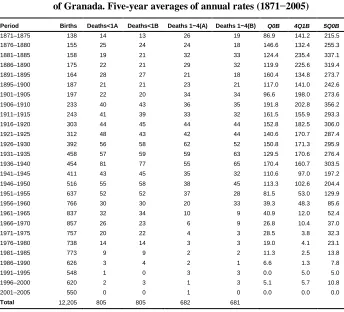
The genealogical and family reconstitution provided data from 12,205 Gitano persons born in the study area between 1871 and 2005. Of these, 805 died before their first birthday, and 682 died between 1 and 4 years of age. Annual rates present large fluctuations that may derive from the small size of the population. Three- and five-year averages show more clearly the main phases and trends of the process of decline. Hence, in Tables 1 and 2 we offer a summary of these results using five-year averages of annual periods.
10 Spain. Life tables (period 1x1), total 1908−2014. Last modified: March 16, 2016. Visited: June 14, 2016. http://www.mortality.org/hmd/ESP/STATS/bltper_1x1.txt
11
Deaths by age in Granada province, series linked to the online publication: “Un siglo de demografía en Andalucía,” IEA (Instituto de Estadística y Cartografía de Andalucía), last visited on June 25, 2014. http://www.juntadeandalucia.es/institutodeestadisticaycartografia/sid/bancoDeDatos/index.htm 12
Table 1: Adjusted infant (Q0B), child (4Q1B), and childhood (5Q0B) rates of the Gitano population of 22 contiguous municipalities in the province of Granada. Five-year averages of annual rates (1871−2005)
Period Births Deaths<1A Deaths<1B Deaths 1−4(A) Deaths 1−4(B) Q0B 4Q1B 5Q0B
1871–1875 138 14 13 26 19 86.9 141.2 215.5 1876–1880 155 25 24 24 18 146.6 132.4 255.3 1881–1885 158 19 21 32 33 124.4 235.4 337.1 1886–1890 175 22 21 29 32 119.9 225.6 319.4 1891–1895 164 28 27 21 18 160.4 134.8 273.7 1895–1900 187 21 21 23 21 117.0 141.0 242.6 1901–1905 197 22 20 34 34 96.6 198.0 273.6 1906–1910 233 40 43 36 35 191.8 202.8 356.2 1911–1915 243 41 39 33 32 161.5 155.9 293.3 1916–1920 303 44 45 44 44 152.8 182.5 306.0 1921–1925 312 48 43 42 44 140.6 170.7 287.4 1926–1930 392 56 58 62 52 150.8 171.3 295.9 1931–1935 458 57 59 59 63 129.5 170.6 276.4 1936–1940 454 81 77 55 65 170.4 160.7 303.5 1941–1945 411 43 45 35 32 110.6 97.0 197.2 1946–1950 516 55 58 38 45 113.3 102.6 204.4 1951–1955 637 52 52 37 28 81.5 53.0 129.9 1956–1960 766 30 30 20 33 39.3 48.3 85.6 1961–1965 837 32 34 10 9 40.9 12.0 52.4
1966–1970 857 26 23 6 9 26.8 10.4 37.0
1971–1975 757 20 22 4 3 28.5 3.8 32.3
1976–1980 738 14 14 3 3 19.0 4.1 23.1
1981–1985 773 9 9 2 2 11.3 2.5 13.8
1986–1990 626 3 4 2 1 6.6 1.3 7.8
1991–1995 548 1 0 3 3 0.0 5.0 5.0
1996–2000 620 2 3 1 3 5.1 5.7 10.8
2001–2005 550 0 0 1 0 0.0 0.0 0.0
Total 12,205 805 805 682 681
Source: All data was obtained in the genealogical reconstitution of the aforementioned Gitano population. Deaths<1 (A): Children who died before their first birthday among those born in the year considered. Deaths <1(B): Children who died before their first birthday in the year considered.
Deaths1−4 (A): Children who died between 1 and 4 years of age by the year in which they were born. Deaths 1−4 (B): Children who died between 1 and 4 of age by the year in which they died. Q0B: Adjusted infant mortality rate.
4Q1B: Adjusted child (1 to 4 years of age) mortality rate. 5Q0B: Adjusted mortality rate for those less than five years of age.
Note: See in Appendix 1 the formulas used to calculate adjusted mortality rates.
Gitano infants. In Table 2, as in Figures 1, 2, and 4, we compare Gitano conventional rates with those for the whole of Spain and for Granada province. The series for these three populations come from independent sources that have different assumptions, and they were gathered by different methods with different ranges of error. Their comparison has to be seen as tentative. Nevertheless, it may offer important insights into the decline of childhood mortality among Gitanos. In Table 1 and Figure 4 we compared adjusted rates of infant and child mortality among Gitanos based on data from our family reconstitution. We are not analyzing gender/sex differences in infant or child mortality here. That will be the subject of further publications.
In the following sections we will analyze infant and child mortality separately, and then we will compare both processes and draw some major conclusions on the decline of childhood mortality among the Gitano minority.
Table 2: Conventional infant (Q0D), child (4Q1D), and under-5 (5Q0D)
mortality rates for the Spanish population, the population of the province of Granada, and the Gitano population of 22 contiguous municipalities in the province of Granada. Five-year averages of annual rates (1912−2005)
Period Q0D
Gitanos Q0D Granada
Q0D Spain
4Q1D Gitanos
4Q1D Granada
4Q1D Spain
5Q0 Gitanos
5Q0 Granada
5Q0 Spain
1912–1915 167.4 169.5 148.0 144.2 176.5 143.5 288.3 315.9 270.3 1916–1920 150.1 170.7 163.8 188.3 200.4 153.9 308.7 336.6 292.1 1921–1925 137.9 140.6 145.3 172.9 163.4 126.9 287.2 280.6 253.6 1926–1930 149.0 121.4 128.3 169.3 119.9 95.7 292.8 226.7 211.7 1931–1935 129.3 110.5 119.6 167.7 91.8 76.5 273.8 192.1 186.9 1936–1940 170.8 125.6 130.0 158.2 95.9 72.0 301.3 209.1 192.6 1941–1945 111.3 109.3 112.8 101.4 67.1 52.2 201.8 168.7 158.9 1946–1950 113.5 75.9 76.8 97.8 43.1 31.5 200.3 115.7 105.9 1951–1955 80.2 55.9 61.1 51.1 25.7 19.3 127.0 80.1 79.1 1956–1960 39.2 45.2 49.7 47.8 13.3 10.3 85.0 57.9 59.4 1961–1965 40.8 36.9 41.3 11.9 6.9 6.3 52.3 43.5 47.3 1966–1970 26.7 32.1 32.1 10.7 4.3 3.9 37.1 36.3 35.8 1971–1975 28.7 25.1 21.7 3.9 3.8 3.5 32.5 28.7 25.2 1976–1980 18.9 17.3 14.7 4.1 3.0 2.9 23.0 20.2 17.5 1981–1985 11.6 13.1 10.3 2.7 2.8 2.2 14.2 15.8 12.5 1986–1990 6.7 10.7 8.2 1.2 1.8 1.8 7.9 12.5 10.0 1991–1995 0.0 6.9 6.4 5.0 1.9 1.5 5.0 8.8 7.9 1996–2000 4.8 6.5 4.8 5.6 1.6 1.2 10.5 8.2 6.0 2001–2005 0.0 4.6 4.0 0.0 0.8 0.9 0.0 5.4 4.9
3.1 The decline of infant mortality
Our data shows a consistent picture of the evolution of infant mortality in the population studied, but only from the 1920s onwards. In Figure 2 we present five-year moving averages for 1920 to 2005 of conventional annual rates for the population of the province of Granada and for the studied Gitano population. .
Infant mortality in the local Gitano minority may have increased in the early 1920s due to the aftermath of the influenza pandemic of 1918−1919, but our evidence is unclear on this. However, in subsequent years it gradually decreased, in parallel with the majority population. This decrease was interrupted by the Civil War (1936−1939) and the immediate postwar years, when living conditions deteriorated dramatically in the area studied. Infant mortality rates rose for both Gitano people and the majority population. In the five-year period 1938−1942 we find both the peak of this rise and the highest values of infant mortality rate (IMR) for the Gitano population in three decades. In the following years infant mortality dropped considerably, although it rose again in the mid-1940s. The definitive downturn occurred between 1947 and 1953. In five-year moving averages, the 1946−1950 period marks the definitive onset of the decline of infant mortality in the Gitano population studied.
In the overall population of the province of Granada the onset of the definitive decline of infant mortality happened between 1941 and 1945. The war years and the immediate postwar period were also terrible for non-Gitano infants (see Table 2 and Figure 2). Thus, in the year 1941 the IMR in Granada province surpassed the145 mark. In the next four years there was a 46% reduction. The critical period for the onset of decline in the whole of Spain was 1941 to 1943.13 As can be seen in Table 2 and Figure 2, in Granada’s province and in the whole of Spain, rates would never increase significantly again after that. The definitive fall in the IMR in the Gitano minority began five to ten years later than in the provincial population at large, and took another decade to converge completely. The period between 1942 and 1959 was crucial for the improvement of basic survival conditions among Gitanos in the study area, as it was for most Spanish people (Pérez Moreda, Reher, and Sanz Gimeno 2015). From 1955 to 1959 there was a clear convergence of the infant mortality of Gitanos and their neighbors.
Figure 2: Conventional infant mortality rate of the population of Spain (Q0DSpain), the province of Granada (Q0DGranada), and the Gitano population of 22 contiguous municipalities of this province (Q0DGitanos). Five-year moving averages of annual rates
(1920−2005)
Sources: Data for Q0Gitanos: Time series developed from the database of the genealogical reconstitution. Data for Q0Granada: Obtained from IEA (Instituto de Estadística y Cartografía de Andalucía), see note 8. Data for Q0Spain: Human Mortality Database, see note 7.
Note: See Appendix 1 for the procedures and formulas used in their calculation.
Moreover, as can be seen in Figure 2, the decline in infant deaths among Gitanos seems more uncertain and less conclusive than that of their neighbors. This may reflect the worse living conditions of Gitanos in the region, even when compared with the Andalusian rural proletariat. In the years from 1942 to 1959 reversals were common, although they were smaller than in previous decades. Our records show three of these reversals centered in the years 1946, 1949, and 1953, when the annual IMR surpassed the100 mark. After 1953 this mark was never passed again. Between 1942 and 1951 the average annual decrease in the IMR was 7% for the provincial population at large but only 3% for the local Gitano population. This slower decrease is mainly caused by these reversals of the downward trend in that period. It is also important to note that infant
mortality in Spain remained higher than in neighboring European countries until the 1960s (Shubert 2003: 212), and the Gitano people in the area were one of the most vulnerable groups in the country.
The decline of infant mortality was completed in the period from 1966 to 1978. Henceforward, IMRs continued to decline, but with less intensity. Subsequently, from 1980 to 2000, the deaths of Gitano infants decreased to a very small proportion of births, as for the overall Spanish population (see Table 2). After 1985 there was no year in which we found more than 1 or 2 infant deaths in the area. Our numbers are too small to provide reliable annual rates, but the process of decline is clear. Nevertheless, there remain geographical and social differences in the rates and probabilities of death between the poorer areas where most Gitano families live and the wealthier areas and groups in Spain (Ruiz Ramos and Nieto 2003; La Parra 2009).
3.1.1 Neonatal mortality
As infant mortality dropped, the structure of infant mortality was transformed. The annual percentages of neonatal deaths show a considerable increase in the crucial period of decline. Thus, from 1939 to 1949 the average proportion of neonatal deaths (in the first 28 days of life) was 19.4% of the total IMR, while from 1950 to 1970 it was 43.1%, or more than double. Our small sample and its annual variations may obscure the magnitude of this change. The trend, however, is clear: as infant mortality fell, the rate of neonatal mortality increased. Thus, between 1910 and 1970a strong negative correlation appears between the infant mortality rate and the neonatal mortality rate, both expressed as 5-year moving averages of annual rates (single linear regression R= −0.709).14
A rise in the weight of neonatal deaths in parallel to the decline of infant mortality has also been described for the whole Spanish population (Gómez Redondo 1992; Sanz Gimeno and Ramiro Fariñas 1999). Moreover, the official definition of “born alive” applied before 1975 in Spain most likely increased the under-registration of neonatal deaths.15 Therefore, infant mortality rates in Spain may incorporate a bias against early deaths. In our sample the annual fluctuations of infant deaths and the omissions of perinatal deaths in this marginalized minority may have increased this bias and made the process more opaque. Nevertheless, the shift is also visible in the causes of death
14 Simple linear regression, P<0.0001; F-stat: 60.564809, DF: 59; 28Q0 = 486.1 − 0.163Q0. 15
that are registered in the records, as we will see later. Neonatal deaths were much more often attributed to congenital malformations and weakness.
3.2 The decline of child (1 to 4 years of age) mortality
In the target population the decline of child mortality was more complex than that of infant mortality. This has been reported in other contexts, and “the two trends actually departed so markedly from one another at times that there seemed to be some justification for treating infant and child mortality as almost unrelated phenomena” (Corsini and Viazzo 1997: xix). Guillot and his collaborators have confirmed this for large areas of the developing world (2012). In the overall population of Guadix, De los Reyes also found important divergences between the evolution of infant and child mortality from 1876 to 1950 (1998: 272−273). As has already been stated, there is also a chance that under-registration of infant deaths was more common. This may have been particularly relevant for Gitano children.
As shown in Table 2 and Figures 2 and 3, Gitano child mortality rates seemed to experience a downturn in the first decades of the 20th century and a sharp increase in the years 1918−1920, due to the influenza pandemic and its consequences. This pattern is parallel to that observed in the Spanish population at large (Sanz Gimeno and Ramiro Fariñas 2002: 161−162) and in the overall population of the province of Granada. In subsequent years, however, the rates for the majority and minority populations diverged considerably. Among the Gitano people, child mortality rates did not decline in the 1920s and early 1930s, remaining well over 150 per 1,000. After a brief decrease between 1932 and 1936, child mortality increased again during the Civil War and the immediate postwar years (1938−1942). In the following years, however, it experienced a significant downturn, which marked the onset of its definitive decline.
In the Granada population there is also a marked fall in child mortality in the immediate postwar years, from higher levels than those for Spain at large. Thus, 5-year average values dropped over 20 points between the 1936–1940 years and the 1941 to 1945 period (see Table 2 and Figure 3).
Figure 3: Conventional child (1 to 4 years of age) mortality rates for the population of Spain (4Q1DSpain), the province of Granada (4Q1DGranada), and the Gitano population of 22 contiguous municipalities of this province (4Q1DGitanos). Five-year moving averages of annual rates (1912−2005)
Sources: Data for 4Q1Gitanos: Time series developed from the database of the genealogical reconstitution. Data for 4Q1Granada: Obtained from IEA (Instituto de Estadística y Cartografía de Andalucía), see note 8. Data for 4Q1Spain: Human Mortality Database, see note 7.
Note: See Appendix 1 for the procedures and formulas used in their calculation.
Thus, the decline in child mortality among Gitano people started in the immediate postwar years, although it took more than two decades to converge with that of the non-Gitano population and was more irregular. From the mid-1970s the differences were always of a lower magnitude.
On the other hand, as shown by Figure 4, when compared to infant mortality, child mortality among Gitanos was higher in the pretransitional period, but started to decline slightly earlier. Moreover, the rise in child mortality rates during the Civil War and the immediate postwar years was less pronounced than the rise in infant mortality. The subsequent drop in child mortality, however, was also very marked. From about 1939 to 1959 both infant and child mortality rates seem to follow a parallel pattern, although
they diverge again in the 1960s. These results indicate that the declines in infant and child mortality followed somewhat different patterns. The evolution of child mortality between ages 1 and 4 may be a better indicator of the environmental pressures and living conditions endured by Gitano people in their demographic transition.
Figure 4: Adjusted infant mortality rate (Q0BGitanos) and child mortality rate
(4Q1BGitanos) for the Gitano population of 22 contiguous municipalities in the province of Granada. Five-year moving averages of annual rates (1912−2005)
Sources: Q0BGitanos: Adjusted infant mortality rate. 4Q1BGitanos: Adjusted child (1 to 4 years of age) mortality rate. Calculated using the time series developed from the genealogical reconstitution.
Note: See Appendix 1 for the procedures and formulas used in their calculation.
3.3 A sort of summary: Childhood (under-5) mortality
Even accounting for the limitations of the data, some results seem robust and reliable. As illustrated by Figure 5, the mortality rate of children under 5 remained very high among Gitanos in the early decades of the 20th century, with more than 350 children out
of every 1,000 dying before their fifth birthday. These are conservative results that most likely underestimate the actual rates.
Figure 5: Conventional childhood (under-5) mortality rate of the population of
Spain (5Q0DSpain), the province of Granada (5Q0DGranada), and the Gitano population of 22 contiguous municipalities of this province (5Q0DGitanos). Five-year moving averages of annual rates (1912−2005)
Sources: Data for 5Q0Gitanos: Time series developed from the database of the genealogical reconstitution. Data for 5Q0Granada: Obtained from IEA (Instituto de Estadística y Cartografía de Andalucía), see note 8. Data for 5Q0 Spain: Data for 4Q1Spain: Human Mortality Database (www.mortality.org), see note 7. Note: See Appendix 1 for the procedures and formulas used in their calculation.
As shown in Figure 5, there was a slight decline in childhood mortality in the 1930s, but this downturn was reversed by the Civil War (1936−1939) and the immediate postwar years. The first upturn occurred in the postwar years, but there were important reversals until the mid-1950s. The process of decline and the process of convergence with the majority population are separated by almost two decades. In these decades Gitano childhood mortality was considerably higher than the mortality of their non-Gitano neighbors. This time lag is probably a consequence of the structural exclusion of Gitano people in the whole period.
3.4 Changes in the causes of child deaths
As expected, the decline in Gitano childhood mortality was paralleled by a shift in the major causes of child deaths, reflecting a change in the epidemiological profile of mortality. We explored the diagnostic causes that appeared in the death records. Of the 1,487 child deaths in our sample, over 91% included a diagnostic cause that could be interpreted and classified.16 We followed themethod for reclassifying causes of death
proposed by Bernabeu-Mestre and his collaborators (2003: 177−179). This method is
suited to the long-term chronological analysis of the diagnostic expressions appearing in Spanish parochial and civil registers from 1871 to 1990.17 This proposal tries to limit problems due to the discontinuity of nosological categories over a period when there were major changes in medical knowledge and medical fashion. It also tries to address the diverse problems related to the variation in the quality of medical sources in crucial moments of the epidemiological transition (Wolleswinkel-Van Den Bosch, Van Poppel, and Mackenbach 1996). Even considering the various problems of interpretation implicit in the recorded data,somemajor trends emerge.
On the one hand, there was a shift from communicable to noncommunicable diseases during the childhood mortality transition (see Table 3). The leading killers before 1949 were communicable diseases, which represented over two-thirds of all deaths. From the 1950s onwards, however, the proportion of noncommunicable diseases and accidents increased, while lethal infectious diseases were gradually controlled. The second half of the 1940s was a crucial period for this shift, both in absolute and relative terms. From the 1980s onwards, infectious diseases only accounted for about one in every four child deaths. As can be seen in Table 3, there were four leading causes of infant and child deaths in the pre-transitional period.
16 In 1,347 cases we could establish a comparable diagnostic case. In 135 cases (9%) no cause was annotated, or it was illegible, or we failed to record it. In recent decades the death records in civil registers have not included the cause of death.
17
Table 3: Main diagnosed cause of death of children under 5 years of age, as recorded in civil registers. Gitano population of 22 contiguous localities in the province of Granada (1871−1999)
First, airborne infections were the main cause of death in the predecline period. In turn, these were of two major sorts: pediatric infections by agents, such as measles, diphtheria, pertussis (whooping cough), and smallpox; and general respiratory tract infections that were diagnosed as pneumonia, bronchopneumonia, bronchitis, influenza, tuberculosis, etc. Both types of air-borne infections caused about a third of all deaths in our sample (32%). The crucial epidemiological shift is shown by the disappearance of the three main air-borne pediatric infections,diphtheria,pertussis, and measles, as well as smallpox. These diseases were widespread, and caused a good portion of all child deaths in the pre-transitional period.In the last decades of the 19th century, from 1871 to 1899, more than a quarter of all child deaths (28%) were attributed to these four ‘killers’; yet in the period from 1940 to 1969 only 1.3% of child deaths appeared as caused by these pathogens. In 1939 we found the last death of a Gitano child attributed to smallpox, in 1947 the last death attributed to pertussis, and in 1952 the last death assigned to diphtheria. Child deaths attributed to measles almost disappeared from the records in the early 1940s, although still in 1967 there is a death attributed to measles in the most isolated village in the area. None of these four diseases is ever again stated as a cause of death in the 22 civil registers surveyed. In the most recent decades, general respiratory tract infections such as pneumonia, bronchitis, and influenza kept appearing in the causes of death, mostly in winter months, but in much lower numbers.
Second, water and food-borne infections caused a quarter of all child deaths in the whole period. These were most commonly diagnosed as routine infections such as enteritis, diarrhea, gastroenteritis, colitis, etc., or as endemic or epidemic infections such as typhoid fever and cholera.18 These causes were already decreasing in the 1930s in both relative and absolute terms, but the most rapid fall coincides with the childhood mortality decline of 1949 to 1965. These infectious diseases decreased from being responsible for well over 20% of all child deaths in the 1940s to only around 5% in the late 1960s.
The third most important group of causes of death in the pre-transitional period were diet-related deficiency diseases such as rickets, scurvy, anemia, and a broad spectrum of conditions referred to as “cachexia” or “athrepsia” that indicate malnutrition and consumption. These diagnoses appear in about 13% of all deaths. They increased considerably in the two decades of declining living conditions during the Civil War and the postwar period of the isolation and self-sufficiency policies of Francoist Spain (1936−1955). In these years about one in five deaths were diagnosed as
directly caused by hunger and malnourishment. These causes would decline drastically in the following decade and disappeared completely from the records in the second half of the 1960s.19
The fourth major diagnostic category of causes was that of congenital anomalies and weaknesses, including a handful of infant deaths attributed to cancer. These types of causes were particularly important in perinatal and neonatal deaths. Thus, over 65% of all neonatal deaths (in the first 28 days) were attributed to birth defects. In the following decades, environmentally related deaths diminished in relative importance, while those with a clear genetic cause increased. However, during the transition period, anomalies resulting from malnutrition and poverty were likely confused with birth defects of a genetic origin.
On the other hand, most of the listed causes of death had an underlying etiology in the misery and hunger endured by most of the Gitano families. In some cases the diagnosis was a euphemism for death from starvation. Malnourishment produced deficiency diseases and increased the chances and negative consequences of infection. The malnutrition and destitution experienced by Gitano mothers also contributed to many deaths attributed to congenital weakness or malformation.
Some improvement in the living conditions of Gitanos seems to be reflected in the changing causes of deaths in the late 1920s and 1930s. But the late 1930s and 1940s were terrible years for the Gitano minority in Spain, as is apparent in the area studied. Things seemed to improve only in the mid-1950s.20 Oral histories, recorded in our ethnographic fieldwork in the area from 1994 onwards, confirm the worsening of living conditions in that period (see Gamella 2000, 2011).
4. Discussion of the results
This study confirms the relatively rapid decline in Gitano infant and child mortality that occurred between 1945 and 1975. The survival of increasing numbers of children induced some of the most remarkable transformations that this minority has experienced in recent decades. For instance, it may have affected reproductive decisions and choices and facilitated a decline in fertility, as has been demonstrated in detail for other Spanish populations (Reher and Sanz-Gimeno 2007).
19 In some periods, deficiency states seem to be related to water- and food-borne infections that quickly debilitated children to levels of lethal weakness, or “cachexia.” However, causality flows between debilitating infections and deficiency syndromes move in both directions.
20
In addition, the increase in the survival rate of children induced a growth in the size of Gitano domestic families and an expansion in kin networks with siblings, cousins, and other collateral relatives in numbers previously unknown. This facilitated a rise in the number of consanguineous marriages (see Martín and Gamella 2005; Gamella and Martin 2008) and a generation of large viri-patrilocal groups, which have been crucial actors in the political organization and the internal conflicts of Gitano society (San Roman 1976, 1997; Gay Blasco 1999).
The processes of mortality decline among Gitanos paralleled those of their non-Gitano neighbors, especially among the poorest sectors of the majority population (De los Reyes 1998: 271−275), but they happened “later, tentatively, almost hesitantly. The destination was the same, but the route and itinerary were different” (Shubert 2003: 22).21 The major periods of the decline in infant mortality described by Gómez Redondo (1992) apply to the minority population as well, although with delays of five to ten years.
The differential mortality patterns most likely were influenced by the underprivileged status of the studied population, and by the marginality that they endured. This is apparent in the causes of death. Still today, many Gitano families suffer from structural exclusionary processes that make them very vulnerable to diseases and disabilities (Latorre-Arteaga et al. 2016) and which translate into an “extreme health inequality” (La Parra, Gil, and De la Torre 2016: 468). However, the high rates of infant and child mortality described in this paper are something of the past.
4.1 The major periods of the childhood mortality decline
We cannot confirm if the Gitano minority experienced the downward trends observed in the Spanish population at large in the last years of the 19th century and the early decades of the 20th century (Reher, Pérez-Moreda, and Bernabeu-Mestre 1997; Ramiro-Fariñas and Sanz-Gimeno 2000). Nevertheless, childhood mortality rates were very high at the beginning of the 20th century and appeared to fall in the early 1930s as the main epidemic and endemic infections were increasingly controlled. The Civil War interrupted and reversed this decline. After the war, childhood mortality among Gitanos remained higher than that of other Spaniards for over two decades.
4.1.1 The crucial pre-transitional period: 1936−1946
The Civil War and postwar years were terrible for the most disadvantaged Spanish families, among which Gitano people have always been overrepresented. During the war, infant deaths increased and births often decreased. Many families were separated, as men were away at the front, incarcerated, or fugitive. Gitanos were much affected by the disruption caused by the war. Most localities in the study area supported the Republicans and suffered from restrictions and hunger during the war. Later the area endured violent repression by the Franco regime. Moreover, in the postwar years this and other regions were plagued by drought and bad harvests. Most Gitano elders remember these years as even worse than those of the war and refer to them as “los años del hambre,” the years of hunger. The memories from these years of misery, suffering, and death have haunted these people all their lives.
In the study area, large Gitano families often lived in huts, dilapidated houses, or caves that lacked running water, electricity, and drainage systems and were located on the margins of towns and cities. Most of the adults were illiterate and worked irregularly as seasonal farm workers or in traditional Gypsy crafts, often practiced itinerantly. For part of the year many Gitano families depended on begging and charity for food. In people’s life stories there are recurrent memories of misery, mistreatment, and discrimination. Many elders remember a childhood of hunger, lack of clothing and shoes, inadequate food, and difficulties keeping people and houses warm and clean with one water source shared by hundreds of people. Descriptions of the misery and rejection suffered by most Gitano families abound in our ethnographic records and life histories.22 They are also transparent in the records of the causes of death, where evidence of hunger, consumption, and even starvation abounds.
4.1.2 The onset of the infant and child mortality decline: 1947−1959
In this period the devastation brought by the civil war was alleviated, and gradually the pre-war levels of production and consumption were recovered. The second decade of the dictatorship generated a measure of political stability based on repression and the denial of citizens’ freedoms. The development of public works and a slow economic recovery created some of the conditions for the improvement of living conditions. Gitanos benefited from the improvement of public health conditions, including access
22
to safer water and better drainage systems and improvements in nutrition, housing, and health care, including the use of antibiotics and the implementation of vaccination campaigns, which would be extended in the following decades. In this period the epidemiological transition is visible among the Gitano population, as many of the lethal infectious diseases disappeared from the death records.
It is not altogether clear which were the decisive factors that induced and facilitated the onset of the decline in childhood mortality among Gitanos during these years. There were improvements in the nutrition of women and children and in access to clean water and sanitation, but public health interventions and access to modern health care only reached the Gitanos when the decline was well underway.
This question also affects our understanding of the mortality transition in the whole of Spain in the postwar period. Some authors have pointed to improvements in childcare patterns resulting from improvements in mothers’ education (Cohen 1996; Reher and Sanz Gimeno 2004; Pérez Moreda, Reher, and Sanz Gimeno 2015). It is difficult to know how those changes affected Gitano women, who tended to remain illiterate for longer than non-Gitano mothers, had a larger number of children, and endured a relatively more asymmetrical gender system (Gamella 2000, 2011). Besides, our ethnohistorical studies of Gitano women show that they used to breastfed their children for longer periods than their non-Gitano neighbors.23 In the life stories we collected, many Gitano women remember nursing their children for periods of two years or more; some of them recalled that they would not get pregnant while lactating (Gamella 2000: 359, 372, 439, 510). Breastfeeding probably offered protection against infant deaths from both diarrhea and respiratory infections (Victora et al 1987). Long breastfeeding periods, however, made the health and nutrition status of overburdened Gitano mothers critical for the survival of their children.24
On the other hand, breastfeeding may have offered some advantages to infants versus older children. This may help to explain why the reduction in child mortality lagged for a longer period among Gitanos. The introduction of other sources of food and water was often risky due to the living conditions of these families. In their review
23 There is not much reliable data on breastfeeding patterns by Spanish women before the 1970s (De la Torre, Martin-Calama, and Hernandez-Aguilar 2001). A recent study of over 600 women in southeastern Spain found that those who had children in the 1958 to 1965 period recall breastfeeding them for ten months on average (Colodro-Conde et al. 2011: 274). In the 1970s Spain experienced a marked downturn in maternal nursing that lasted until well into the 1980s. This trend slowly reversed in the following decades. Still, by 2006 in Spain “only 63.3% of infants were breastfed (partially or fully) during the first 3 months and 38.7% for 6 months” (Ibid.: 272).
of the history or urban childhood mortality in French urban regions, Preston and Van de Walle showed the decisive role of improvements in water supply systems and sewerage, which, “by reducing the burden of intestinal (and probably respiratory) diseases among young children, resulted in improved physical growth and development. These improvements, in turn, led to mortality reductions at later ages” (1978: 275). Similar developments, together with the spread of practical knowledge about the prevention of infections (Preston and Haines 1991), may have been crucial in reducing childhood mortality in the study region before the arrival of advanced health interventions in the 1950s and 1960s.
4.1.3 Consolidation and convergence: 1959-1975, the years of desarrollismo
The childhood mortality decline was consolidated in the period of rapid industrialization and economic growth that was the result of the policy measures required for the reinsertion of Spain into the international trade system, and the expansion of a market economy. This meant the “death of autarky,” the dominant economic policy of the previous period (Shubert 2003: 208). The Economic Stabilization Plan enacted in 1959 marked a definitive policy shift and the end of the isolation of the Franco regime. The “amazing economic growth” of Spain and the social transformations it spurred were dependent on a combination of tight internal controls (such as the prohibition of independent trade unions and political parties) and powerful outside forces such as “foreign investment, tourism and emigration” (Shubert 2003: 209).
In this period, Gitano people increased their access to health centers, specialized treatments, and vaccination programs. Gitano women increasingly gave birth in maternity wards. Many Gitanos from the study area migrated to the Levant, Catalonia, or the Balearic Islands in search of work and better living conditions. Later they would also move abroad, to France, Germany, and Switzerland, together with other Spaniards. The diet and housing conditions of most Gitano families improved, and more Gitano children attended public schools. The decline of childhood mortality in the Gitano minority was consolidated.
4.1.4 The completion of the Gitano demographic transition, 1976−2005
benefits. These and other developments have transformed the social life of this minority; for instance, in terms of the almost universal schooling of Gitano children, the resulting reduction of illiteracy, and the growing independence and welfare of elders through pension systems. In turn, the survival of almost all Gitano children has helped to bring about a growing control of fertility by most Gitano women and couples. However, the fertility transition of the Gitano people seems to have happened several decades after the onset of the mortality decline (Gamella 2011; Gamella, Martín, and Quesada 2014). Therefore, here we may have a “prolonged” demographic transition for this minority population that contrasts starkly with that of the Spanish population at large. It may resemble that of those countries that Reher describes as “latecomers” in timing, development, and consequences (2004: 23−24).
Nevertheless, large sectors of the Gypsy minority have been marginalized and re-segregated in shantytowns and slums, some of recent construction. Today, when controlled comparisons can be applied, Gitanos – particularly women – report worse health and a higher rate of chronic diseases and impairments (Carrasco-Garrido et al. 2011). On the other hand, although healthcare is free and universal, cultural barriers to equal access still remain, and Gitanos tend to make less use of preventive programs and more use of emergency facilities (La Parra 2009; Ramos-Morcillo et al. 2015). Hence, ethnic disparities in infant and child mortality may remain important in relative terms among the most segregated groups, but in absolute terms they have dropped dramatically.
4.2 The evolution of causes of death
The evolution of the causes of death of Gitano children confirms the temporal model outlined before, and they provide important clues about the main factors contributing to it. Both water- and food-borne infections and deficiency disorders fell dramatically between 1944 and 1964. These changes point to a gradual and long-term improvement in the nutritional and hygienic status of Gitano mothers and children. They were likely induced by improvements in public health, education, and daily practice, mostly among mothers and caretakers (Pérez Moreda, Reher, and Sanz-Gimeno 2015).
deaths caused by infections took longer. In the 1940s these deaths were still showing rates that had been experienced by majority populations twenty years earlier. Secondly, deficiency diseases were recorded more often and for a longer time among the causes of death of Gitano children. Data clearly indicates that many of these conditions did not result from infectious processes, as these authors assume (Ibid. 159). Deficiency processes both facilitated infections and were aggravated by them, but they followed a different pattern of decrease and remained very common between 1940 and 1965.
In sum, the evolution of the causes of death among Gitano children confirms that this minority group has suffered worse living conditions than their neighbors, and these conditions pushed them to the extreme end of the “social gradient” of health and death in Spain (La Parra, Gil, and de la Torre 2016: 476).
4.3 Demographic processes and long term transformations
Interestingly, the Gitanos of Spain are often portrayed as an example of successful social integration. Often their living conditions are favorably compared to those of the Romani populations living in other countries, particularly in Eastern Europe.25 This rosy view of the situation of the “Spanish Roma” is exaggerated and downplays the structural exclusion many of them still suffer in terms of employment, higher education, and political representation. Nevertheless, there is clear evidence of an improvement in the generalized access of Gitanos to public services and benefits. The model of mortality transition proposed in this paper indicates that most of these improvements were predicated on sociopolitical currents that may have been at work long before the welfare state extended its reach to this minority. These processes point to a more complex interaction of Gitano groups with their local communities than is often entertained, and to the need to consider long-term historical processes in present and future public policy.
The data provided is limited by the size of the population, under-registration lags, and the migration of many families away from the study area. Nevertheless, it shows that some of the most profound transformations experienced by Romani minorities in Europe are demographic. Amazingly, most of the key aspects of the demographic transformation have been largely ignored in the historical and ethnographic representation of Romani minorities, and in the evaluation of their problems and the policies designed to alleviate them. This is also evident concerning the broad literature
25
generated in the last two decades, including that on health and educational differentials and interventions (see Cook et al. 2013).
Importantly, long-term processes such as those that allowed for the decline of childhood mortality of Gitano people may have contributed to the most successful policies concerning Romani groups. These policies were usually not specifically directed towards ethnic minorities and have been largely ignored in policy analysis. In addition, the dominance of transversal, static comparisons of disparities between minority and majority populations obscures the historical changes that have taken place in key aspects of the collective existence of Romani groups. In sum, there is a clear need for a bottom-up social history that includes the crucial transformations of fertility, death, and population growth and their mutual relationships with domestic dynamics and with gender, kinship, and marriage systems.