University of New Orleans University of New Orleans
ScholarWorks@UNO
ScholarWorks@UNO
University of New Orleans Theses and
Dissertations Dissertations and Theses
Spring 5-16-2014
Contested Road Space: Public Narratives and Bus Rapid Transit in
Contested Road Space: Public Narratives and Bus Rapid Transit in
Indore, India
Indore, India
Lucien V. Bruno IV
University of New Orleans, [email protected]
Follow this and additional works at: https://scholarworks.uno.edu/td
Part of the Urban Studies and Planning Commons
Recommended Citation Recommended Citation
Bruno, Lucien V. IV, "Contested Road Space: Public Narratives and Bus Rapid Transit in Indore, India" (2014). University of New Orleans Theses and Dissertations. 1850.
https://scholarworks.uno.edu/td/1850
This Thesis is protected by copyright and/or related rights. It has been brought to you by ScholarWorks@UNO with permission from the rights-holder(s). You are free to use this Thesis in any way that is permitted by the copyright and related rights legislation that applies to your use. For other uses you need to obtain permission from the rights-holder(s) directly, unless additional rights are indicated by a Creative Commons license in the record and/or on the work itself.
Contested Road Space:
Public Narratives and Bus Rapid Transit in Indore, India
A Thesis
Submitted to the Graduate Faculty of the University of New Orleans
in partial fulfillment of the requirements for the degree of
Master of Urban and Regional Planning Transportation Planning
By
Lucien V. Bruno IV
B.A. Tulane University, 2008
ii
Acknowledgements
I would like to thank my committee – Kate Lowe, Anna Brand, and Stefan Marks – for
their guidance and support during the evolution of my thesis. I would also like to thank my
professors at the University of New Orleans for sharing their insight and knowledge during the
course of my masters program: Kate Lowe, John Renne, Anna Brand, Earthea Nance, David
Gladstone, Steve Villavaso, Lynn Dupont, Carol Short, Patrick Haughey, and Michelle
Gremillion.
Thank you to EMBARQ India and the Dwight David Eisenhower Transportation
Fellowship for supporting my research and making my trip to India possible. A special thanks to
my EMBARQ supervisor Arnab Roy for putting up with my constant requests for more
information on project updates.
Last but not least, I would like to thank my friends and family for their love, support, and
iii
Table of Contents
List of Abbreviations and Terms ... vi
Abstract ... vii
1. Introduction ... 1
2. Literature Review ... 4
2.1 Introduction ...4
2.2 India’s State of Transportation ...4
2.3 The Capacity of BRT to Improve Safety and Efficiency ...7
2.4 Difficulties in Defining and Involving the Public ... 10
2.5 Conclusion ... 15
3. Methods ... 16
4. Background/Area of Study ... 20
5. Findings ... 27
5.1 Introduction ... 27
5.2 Summary of Findings ... 27
5.3 Court Proceedings and Media Narrative ... 30
5.3.1 First Petition Filed Against the BRT ... 30
5.3.2 Response from the Divisional Commissioner of Indore ... 31
5.3.3 Second Petition Filed Against the BRT ... 33
5.3.4 High Court Rules to Open the BRT Lane ... 35
5.3.5 BRT Lane Opens to Cars ... 36
5.3.6 High Court Denies Appeal ... 37
5.3.7 BRT Expert Committee Delivers Report ... 38
5.4 Media Analysis ... 42
5.5 Discussion ... 44
6.0 Conclusion ... 50
7. Works Cited ... 54
Appendix ... 59
News Articles Referenced ... 59
The Times of India ... 59
Hindustan Times ... 60
DNA India ... 61
National Herald ... 61
iv
List of Figures
Figure 1: Indore (galaxyeducations.com) ...20
Figure 2: Indore Travel Mode Share ...20
Figure 3: A.B. Rd. Pre, Post Construction (Reproduced from: Office of Divisional
Commissioner, Indore, 2006) ...24
Figure 4: iBus Ridership ...25
Figure 5: City of Indore with proposed 89 km BRT route (Indore City Transport Services LTD, 2006) ...26
Figure 6: Proposed 23.8 km route on A.B. Road (Indore City Transport Services LTD, 2006) ...26
v
List of Tables
Table 1: BRT Project Objectives (Indore City Transport Services LTD, 2006, p. 2) ...22
Table 2: Project Timeline ...23
vi
List of Abbreviations and Terms
BRT Bus Rapid Transit
BRTS Bus Rapid Transit System
DPR Detailed Project Report
HT Hindustan Times
iBus The name of Indore’s BRT service
JnNURM Jawaharlal Nehru Urban Renewal Mission
NMT Non-Motorized Transport
PMV Personal Motor Vehicle
vii
Abstract
Bus Rapid Transit (BRT) has a demonstrated capacity to improve safety, mobility and
accessibility for multiple types of road users. In India, where road safety is an ongoing problem,
the national government has supported cities’ efforts to implement BRT as a cost-effective tool
to improve urban travel. The case of Indore’s iBus attests to the cultural and institutional barriers
that Indian cities may face in gaining public support for BRT. After a contentious
implementation process, the High Court ruled to open the dedicated bus lane to private
automobiles, resulting in drops in ridership and increases in accidents and travel delay. This
study examines the competing, public narratives that framed the issues during and after project
construction. Contested notions of the public interest, the cause of traffic problems, and
community participation informed the basis for the arguments that culminated in the court ruling.
Keywords: Bus Rapid Transit; India; Indore; Project Implementation; Road Safety; Public
1
1. Introduction
In May of 2013, Indore, India saw the launch of iBus, its first bus rapid transit (BRT)
system along 11.4 km of a major traffic corridor. The construction period, rife with project
complications, lasted nearly six years and led to a contentious implementation process. Plans
called for a fleet of 50 buses, which would carry a projected daily ridership of 70,000. Although
the project acquired necessary funding for the fleet, after four months of commercial operations
the system was operating with only 18 buses and an average daily ridership of 30,000. Following
the installation of the dedicated bus lane, media reports reflected the frustration of various groups
who believed the BRT had exacerbated traffic conditions. A suit brought forth by civic activists
culminated in a High Court ruling that allowed private cars to operate in the dedicated bus lane.
Following was an immediate decrease in ridership and an increase in accidents and travel delay.
This case study reviews the competing, public narratives that framed the implementation
process and court proceedings of the BRT. In analyzing the arguments of both detractors and
proponents of the system, I found fundamental differences in the foundation of each side’s
argument based on their interpretation of contested themes. While BRT supporters stressed the
potential, future benefits that the system could afford all road users, those who fought the BRT
did not believe that the low level of transit ridership warranted a dedicated bus lane. In
presenting and depicting traffic problems on the corridor, those arguing against the BRT placed
blame on the dedicated busway as the main culprit. Meanwhile, those arguing for the BRT
claimed these problems were ongoing and often framed them as an opportunity for improvement
through BRT operations. Finally, although both sides agreed that the implementation process
lacked adequate public participation, opponents used this as justification for suspending the
2
Media narratives presented arguments from both sides and also described accounts that
were representative of the successes and failures of the system. News articles served as an arena
to present contested facts. While some were unfounded or required clarification, they all were
published and therefore had the opportunity to influence the perceptions of the public and
officials. English-language news articles reviewed during the study period were more likely to
depict negative attitudes than positive ones as they related to the BRT. These portrayals included
statements from public officials as well as members of the public. Titles of the articles that
reported on the BRT were also more likely to carry a negative tone. For policy makers and
practitioners, this case study shows: the capacity of public perception to affect project outcomes;
the importance of public participation before, during and after project implementation; the
opportunities and barriers to improving road safety where traffic enforcement and safe travel
behavior are lacking; and the role of media in framing events, attitudes and opinions.
In chapter two I examine the literature as it relates to: the state of India’s transportation
infrastructure and travel behavior, the opportunities and challenges to implementing BRT within
Indian cities, and the problematic nature of defining the public interest. In chapter three, I outline
the methods of the case study, including: discourse analysis of court-related documents, analysis
of news articles, and my role as participant-observer. In chapter four, I present the background
information for the area of study, including: demographic trends, travel mode share, BRT project
objectives and the project timeline. In chapter five I present my findings. Overall, I found that
groups arguing for and against the BRT had conflicting interpretations of the public good, the
cause of traffic problems, and public participation. I also found that news articles reporting on
3
article titles themselves. After discussing the implications of my findings, I conclude in chapter
4
2. Literature Review
2.1 Introduction
This literature review analyzes the capacity of BRT to improve safety and efficiency
along India’s urban corridors. Being that the culture of transportation in India is largely distinct
from the rest of the world, this review also analyzes its state of infrastructure, travel behavior,
and law enforcement to demonstrate both the potential improvements that BRT offers to cities
but also the threats that such conditions may pose to a successful BRT in the Indian context.
Furthermore, and considering India’s position as a pluralistic democracy, this review explores
the conflicts and opportunities that may arise through the public planning process and how these
dynamics may affect BRT’s ability to foster transportation equity, safety and efficiency in
India’s urban centers.
In the first section, I give an overview of the state of transportation in India. In the next
section, I explore best practices for BRT and analyze studies that demonstrate the effects of BRT
on safety and efficiency among various case studies. In the third section, I examine relevant
literature on the public interest, the construction of expert knowledge, and the capabilities and
restraints within public participation to affect equitable outcomes.
2.2 India’s State of Transportation
Most literature addressing India’s state of transportation refers to it, in one way or
another, as a crisis (Pucher, Korattyswaropam, Mittal, & Ittyerah, 2005; Kim & Nangia, 2010;
Hossain, 2006). Inadequate infrastructure, rising motorization, unsafe travel behavior, and lack
of law enforcement are a threat to not only public health (Pucher et al., 2005), but also to the
national economy and the social welfare of residents (Kim et al., 2010). Pucher,
5
transportation, outlining problematical trends that also pertain to Indore, namely: rise in
congestion and vehicle ownership, inadequate accommodations for buses and non motorized
transport (NMT) users, crumbling road infrastructure, poor traffic control/signals/signage, rising
fatalities among pedestrians and motorcyclists, poor public transit, rising air pollution, lack of
enforcement and lack of adherence to road rules. The authors claim that increased vehicle
ownership is the main reason for the rise in road fatalities, more than half of which are among
pedestrians and cyclists.
According to Mascarenhas and Chaudhary (2012), Indian travel behavior and transport
infrastructure is unique even among developing countries. Among the unique characteristics that
present challenges to transportation planners are: a heavy mix of motorized travel modes with an
especially high share of motorcycles and scooters; a variety of NMT modes, including bicycles,
tricycle wheelchairs, vendor carts and push carts; heavy pedestrian volumes; lack of adherence to
road rules with a lack of law enforcement; high density of roadside development on major
arterials; abundant street vendors and other road obstructions; and the dominance of
auto-rickshaws as para-transit, i.e., a flexible mode of transit with non-fixed routes. The resulting
environment is one in which corridors are congested and where the most vulnerable of mode
shares (cyclists, pedestrians, etc.) must fight for space on the same roads as motorized vehicles.
A major theme from the existing literature is the vulnerability of pedestrians, cyclists and
other NMT users on Indian roadways (Advani & Nisha, 2013; Pucher et al., 2005; Tiwari & Jain,
2012; Verma, Velumurugan, Chakrabarty, & Srinivas, 2011). In many cases, this vulnerability is
due to a complete absence of sidewalk facilities (Pucher et al., 2005). Among sidewalks that are
present, many are plagued by obstructions, debris, open manholes, disrepair and non-uniform
6
the road, those surveyed reported to make their choice “due to the higher level of footpath (30%),
presence of dust (28%) and uneven surface of footpath (23%)” (p. 45). Along with the poor
provision of infrastructure, a general lack of adherence to road rules and enforcement of traffic
laws compromises the safety of all road users, but especially for pedestrians, cyclists and those
on motorized two-wheelers (Verma et al., 2011). In their study on driver licensing procedures
and traffic law enforcement, Verma, Velumurugan, Chakrabarty, and Srinivas (2011) attribute
dangerous travel behavior to drivers operating without licenses, inadequate licensing procedures,
a disregard for road rules, a lack of personnel for surveillance and enforcement for traffic
violations, and corruption among the police force coupled with a willingness among drivers to
bribe officials instead of paying full fines. The authors’ recommendations based on the ‘three E’
road hazard countermeasures, “education, engineering and enforcement” (p. 1375), hold broad
implications for the capacity of BRT implementation to foster safer traffic corridors in the Indian
context.
Kim and Nangia’s (2012) comparative study of India and China’s national infrastructure
sheds light on the current state of India’s transportation infrastructure. It also explores the
political factors they claim to have contributed to the nation’s poor provision of road networks.
In comparing it to China’s method of anticipating demand, they argue that India’s national
philosophy of infrastructure provision as a social service during a critical growth period was
detrimental to the economic welfare of the nation. In assessing the deplorable condition of
India’s transportation networks, they argue that it is not only a threat to the economy (e.g.,
hampering trade) but also to safety and community welfare (e.g., access to basic goods and
7
process, as opposed to a more political one, they claim that Indian officials have begun to adopt
more promising strategies to address the underserved transportation needs of the nation.
2.3 The Capacity of BRT to Improve Safety and Efficiency
As part of the Jawaharlal Nehru National Urban Renewal Mission, India has seen an
increase in the development and implementation of bus rapid transit systems (BRTS) within its
major cities. While a BRTS may involve varying levels of operational and design components,
this paper will define the characteristics of a full-service BRT and assess the influence of each on
different travel indicators (road safety, mobility, accessibility) based on various case studies.
Being that the initial design and operation of Indore’s BRT iBus most closely resembles that of a
full-service BRT, the findings of these studies are helpful in assessing the iBus’s potential to
positively or negatively affect the previously discussed problems with India’s state of
transportation.
According to the Federal Transit Administration (FTA) (2009), a high-performance BRT
operates on a dedicated bus lane designed to “minimize the number of at-grade intersections”
and “generally feature[s] amenities more commonly associated with rail systems, including high
quality permanent stations, level-boarding, off-board fare payment, and stylized vehicles” (p. 4).
The purpose of a dedicated bus lane with limited at-grade crossings is to minimize the interaction
between different modes of transportation. This design is intended to maintain the safety of all
road users while facilitating less impeded, reliable transit service. The presence of “high quality
permanent stations” serves to provide a safe, comfortable environment where passengers can
wait for the bus, protected from the elements and vehicular traffic. Level boarding facilitates
8
climb stairs. Finally, off-board fare collection also contributes to shorter stoppage times,
allowing passengers to pay before the bus arrives and then board all at once.
Along with the aforementioned qualities, several studies point to the potential benefits
that BRT implementation offers to pedestrians, cyclists, and other NMT users in the form of
auxiliary, corridor-wide improvements (Estupiñán & Rodríguez, 2006; Jian, Zegras, &
Mehndiratta, 2012; Rodríguez, Brisson, & Estupiñán, 2009; Tiwari & Jain, 2012). Being that the
installation of BRT facilities often requires substantial road construction, it allows for the
opportunity to improve or install walking/cycling facilities where they may not have existed
before. A study by Estupiñán, Brisson and Rodríguez (2009) found a positive correlation
between increased walking activity around Bogota's BRT stations and segment-level features,
e.g., widened sidewalks and the presence of trash cans. These findings support the argument that
specific, ground-level characteristics can facilitate safer traffic corridors by influencing
pedestrians to walk in the sidewalk. Jiang, Zegras, and Mehndiratta (2012), see the
implementation of BRT as an opportunity to rethink the size of pedestrian catchment areas
surrounding BRT stations. Their study in Jinan, China found a positive relationship between
people’s willingness to walk farther to BRT stations and the presence of certain physical
elements along given corridors, e.g., shade and median stations. The implication of these
findings are pertinent to policy makers who wish to boost transit ridership and improve
walkability through the implementation of BRT.
Tiwari and Jain (2012) found improved accessibility and safety indicators for pedestrians
and cyclists along Delhi’s BRT corridor. Employing new performance indicators that focus on
the movement of people as opposed to individual vehicles, the authors demonstrated that the
9
survey in 2008. Their analysis also showed a decrease in travel time for cyclists and an increase
in the catchment area for pedestrians, most likely due to the improved bicycle and pedestrian
infrastructure that was coupled with BRT construction.
Being that India leads the world in annual traffic fatalities (Mascarenhas & Chaudhary,
2012), the capacity of BRT to positively impact safety indicators on busy traffic corridors is
especially pertinent to this case study. According to Bocarejo, Velasquez, Díaz and Tafur (2012),
“The ability of BRT to deliver a high-capacity system at a relatively affordable cost and with
short construction times is well documented, but its effect on road safety has only been
marginally discussed and is certainly not one of the main advantages considered by policy
makers around the world” (p. 1). In analyzing the effects of BRT on road safety in Bogotá, the
authors found a large reduction in serious accidents along two study BRT corridors, at a higher
rate than the city as a whole. However, a location-based analysis of crash data revealed the
emergence of new hot spots, mainly around busy stations. Part of the problem in some segments
was due to improved road surfaces and decreased congestion, thus allowing cars to speed. The
authors conclude that although BRT has the potential to improve overall safety along a given
corridor, it is vital that planners take special consideration to design for the “special
characteristics of pedestrian behavior” (p. 6).
Duduta, Adriazola, Hidalgo, Lindau, and Jaffe (2012) assessed the road safety impacts of
varying BRT design features among different cities. They found that Guadalajara’s BRT
decreased monthly collisions by nearly 50%, while Bogotá’s Transmilenio reduced fatalities on
its BRT corridors by 60% (p. 10). While the Tiwari report found an increase in overall safety
along Delhi’s busway, this study found that fatal crashes in 2010 were nearly double the annual
10
Delhi’s system lacks the raised, protective barrier that is typical to other, full-service BRTs, this
finding brings up important concerns as they pertain to the applicability of BRT in the Indian
context. Though the presence of guardrails will likely deter many pedestrians from unsafely
entering the busway, those on foot may still opt to climb over the barrier if they do not wish to
walk to a designated crosswalk (Mascarenhas & Chaudhary, 2012).
Although the above example of unsafe travel behavior is hardly unique to India, it is one
of many that attest to the challenges Indian cities face in successfully implementing a safe,
efficient BRT. Taking these obstacles into account, how can cities aim to implement an
operational BRT that is successful in attracting ridership, improving travel time and decreasing
accidents? Many studies stress the importance of dictating behavior through design (Bocarejo et
al., 2012; Mascarenhas & Chaudhary, 2012; Duduta et al., 2012). Others attest to the importance
of improved driver training, licensing and traffic enforcement (Verma et al., 2011). Both
approaches are vital for not only the successful operation of BRT but also for the safety of road
users on all types of Indian road networks.
2.4 Difficulties in Defining and Involving the Public
Being that the functionality of BRT requires the cooperation of all road users who
interact with the system, its success – in terms of both transit ridership and public acceptance –
depends on its perceived legitimacy among citizens. In their evaluation of the public interest,
Campbell and Marshall (2002) assert that “in the final analysis people will judge whether a
policy is right or wrong, good or bad and their judgment will be based upon their assessment of
the substantive consequences of the policy as it affects themselves and others” (p. 123). Thus, in
implementing a large-scale infrastructure project that requires substantial resource allocation,
11
interest of the public. However, in interpreting the public interest, governments are tasked with
addressing questions to which there is no easy answer. How do policy makers define the public if
it is comprised of very distinct groups? How do they determine what is best for these groups that
may have very different needs? How do they choose among policies that have varying levels of
benefits and impacts among different groups? Should they place emphasis on short-term or
long-term gains, and how will this priority impact the various groups over time?
Defining and interpreting the public interest can prove quite problematic (Campbell &
Marshall, 2002; Fainstein, 2000). Campbell and Marshall (2002) chronicle the conceptualization
of the public interest from its origins in political theory to its modern day critiques among
planning theorists. The mid-1900s saw the rise of expert-driven solutions to serve an
uncontested, unified public interest. In the 1960s, this unified public interest and reliance on
expertise faced increasing resistance as more and more planners began to doubt its capacity to
account for “difference and heterogeneity,” making it “a potentially oppressive idea” (p. 119).
Later, planning circles bore witness to a rise in communicative planning, which relies on
process over outcome and acknowledges diversity and conflicting interests. While Campbell and
Marshall (2002) understand the limitations of utilitarian ideals in defining a public interest – and
though they appreciate the importance of public involvement in forming solutions – they are also
critical of communicative planning as a tool for reaching consensus-based outcomes.
Likewise, Fainstein (2000) examines normative-based approaches within modern-day
planning, highlighting the conflict between idealized processes and desirable outcomes. She, too,
is critical of communicative planning for various reasons, including: “the gap between rhetoric
12
between the aims of communicative planning and the outcomes of participatory planning
processes” (p. 460). This third critique is fundamental to her argument that democratic processes
do not always lead to equitable results.
For both Fainstein and Campbell and Marshall, the difficulty in defining public interest
and reaching consensus does not preclude the government’s obligation to assign value and
priority among potential outcomes. Solely relying on public deliberation can result in stagnation
and a loss of opportunities. At worst, community participation can result in majorities infringing
on minority rights. Thus, all three authors advocate for a normative approach to planning that is
both process and outcome focused. As Fainstein asserts, “The state can do both good and bad,
and likewise, so can the citizenry” (2000, p. 470).
Although they give compelling arguments as to why the public interest should continue
to inform planning policy, the authors above give little guidance for establishing the values that
inform how we judge the outcomes of said policy, aside from the fact that they should be
contextually and historically sensitive. Furthermore, while Campbell and Marshall argue “that
choices cannot be left endlessly open” and that “[c]losure must occur when one design or
alternative is materialized as opposed to others” (2002, p. 127), their assessment does little to
guide the public participation process that projects such as BRT require, especially in cases
where they remain contested after project completion.
If a large-scale infrastructure project is to be successful among community members, it
will ultimately require community acceptance. Moreover, if the benefits of said project will not
come to fruition for a number of years, extensive community participation is necessary
13
construction and trial runs. As Ascher (2010) asserts, “Impatience leads people to discount (i.e.,
give less value to) consequences occurring further into the future” (p. 147). Thus, if an Indian
city is committed to the long-term success of a BRT – which has proven to be susceptible to the
actions of individual road users, its government must take measures to ensure that its citizens: 1)
understand the potential costs and benefits from the system over time; 2) learn how and why to
safely interact with the system; 3) deliberate and decide that they truly want BRT in their city.
This third requisite – the facilitation of true citizen participation – is very difficult to
accomplish and is even trickier to conduct in an equitable manner. As Arnstein (1969) defines it,
citizen participation is equivalent to citizen power for the “have-nots,” and the prospect of citizen
control engenders fear and opposition from those who hold power. Being that BRT physically
allocates a section of the road to transit users, who may represent a smaller share of commuters
than motorists, it is not surprising when members of the public view it as an unfair allocation of
resources. Again, its reception is largely dependent on interpretations of the public interest. As
mentioned earlier, how we define the public interest is not only based on who benefits, but also
when these gains materialize. While BRT experts know that a successful system has the capacity
to attract car users and reduce congestion in the long run, private motorists may not see
themselves as potential beneficiaries to the system and thus oppose it. As Fischer (2000) notes,
“No demonstration of efficiency […] can convince citizens to accept […] that which they do not
believe to be good or fair” (p. 42).
Another barrier to full, citizen participation is the increasing specialization and
compartmentalization of expertise and the widening separation between experts and the general
public (Fischer, 2000). In consideration of the numerous technical and operational nuances that
14
leadership as the main criterion necessary for a successful system (Hossain, 2006; Ponnaluri,
2010). However, while a complete top-down approach may ensure that all components of the
project remain under expert control, it may not facilitate civic ownership of the project. Given
Indian BRT’s vulnerability to unsafe travel behavior of individual road users, it is vital that all
passengers, pedestrians, cyclists and motorists take ownership of the system for it to function
properly.
While transportation experts may fear that allowing citizen deliberation over design and
operational elements may compromise the functionality or safety of a transit system, Fischer
(2000) asserts that here, the expert’s “task of analyst-as-facilitator is to assist citizens in efforts to
examine their own interests and make their own decisions” (p. 251). Discounting the public’s
ability to arrive at similar conclusions when presented with the whole story is a missed
opportunity to foster ownership of and legitimacy for the project. Furthermore, being that
citizens are the ones who have the most intimate understanding of their neighborhoods and
personal travel behavior, they will be able to contribute invaluable local knowledge to help
planners better serve their needs (Fischer, 2000; Institute for Transportation Development Policy,
2007).
While Fischer provides useful guidelines for an inclusive planning process that fosters
project legitimacy and incorporates expert and local knowledge, unforeseen outcomes that
disproportionately harm relatively powerless groups lend credence to Fainstein’s (2000)
argument: “Democratic pluralism, with its emphasis on group process and compromise, offers
little likelihood of escape from dominance by those groups with greatest access to organizational
15
process, those with higher education and higher incomes will have much greater success in
mobilizing for causes that will benefit themselves the most.
2.5 Conclusion
As detailed in this literature review, BRT has the demonstrated capacity to improve
safety and efficiency on urban corridors within different national contexts. The problematic
nature of India’s transportation system attests to both the benefits it stands to gain from a
successful BRT along with the threats it may pose to proper implementation. Given that public
attitudes toward BRT can have substantial effects on its functionality, as has been the case in
Indore, this review explored the difficulty in defining the public interest, the barriers to fostering
equitable participation and the capacity of participation to contribute to public ownership and
16
3. Methods
This case study seeks to understand the competing narratives surrounding Indore’s BRT
during and after project implementation. Through qualitative content analysis, I reviewed news
articles, agency documents, formal studies and courtroom proceedings to address the following
research questions: How did the media frame the developments of the project and the attitudes of
various stakeholders? Among the actors who deliberated over the future of the system, what
were the foundations of their arguments for or against the BRT? Why did the High Court
ultimately rule to allow cars into the BRT lane?
Being that it addresses a present-day phenomenon with ongoing developments and
interrelated actors, this paper employs the case study approach to analyze the various
circumstances that may have contributed to the outcome of events. According to Yin (1994),
“[t]he case study is preferred in examining contemporary events, but when the relevant behaviors
cannot be manipulated,” and moreover, its “unique strength is its ability to deal with a full
variety of evidence” (p. 8). Originally, the aim of this study was to collect evidence to measure
the effects of the BRT on road safety and mobility indicators. However, considering that the
High Court ruling limited the ability of the system to operate as a full-functioning BRT, the
focus of this study shifted to the circumstances surrounding the contentious implementation
process that culminated in the ruling.
According to Johnson (2002), “[t]o recognize more than one discourse emphasizes that
what is being discussed and acted on is never unanimous but often challenged and negated by
opposing groups” (p. 67). During my time working on the launch of Indore’s BRT, it became
evident that attitudes toward the project ranged from fierce opposition to ardent support among
17
a part in both framing the issues as well as bringing them to the forefront of the public’s
awareness. Ultimately, the High Court deliberated over these ongoing arguments in coming to its
decision. In an effort to better understand the dynamics of these narratives, I sought to collect
evidence that presented arguments for and against Indore’s BRT.
Through correspondence with transit agency representatives I was able to collect
summaries of court proceedings, official statements, agency documents, and decisions and
opinions from the judges. I then examined the manner in which each party – including the judges
– framed the issues to present their arguments. In describing the methodology for discourse
analysis, Johnson asserts that “textual materials are analyzed in a two-step process, first, to refine
theoretical categories and generate new ones, […] and second, to apply newly refined codes to
the broad body of text” (p. 69). In examining records and agency reports from the courtroom
proceedings, I coded for contested concepts that represented fundamental differences in the
argument of each side. I defined “contested” as incurring disagreement over facts or principles.
In selecting these concepts, I also relied heavily on the language from the final court ruling,
being that the judges directly addressed many of these disagreements in coming to their decision.
I then re-analyzed the texts through these concepts to determine how competing actors formed
the rationale for their arguments.
In analyzing media narrative, it is necessary to acknowledge the media’s role in reporting
events and opinions as well as influencing them. As an arena, news publications serve as an
outlet to report on current events, popular sentiment and opinion editorials. However, its
discretionary nature in choosing what to report, how to describe it, and who represents the
general public attests to its role as an actor in framing disputes as well. According to Herman and
18
the cleansed residue fit to print. They fix the premises of discourse and interpretation, and the
definition of what is newsworthy in the first place” (p. 2). While I cannot definitively prove that
news articles played a role in influencing actors who affected the implementation process,
analyzing the nature and evolution of their discourse can help us better understand how they may
have influenced opinions and actions during the course of events. Further, such analysis can lend
insight into the views of key stakeholders whose actions and opinions led to the outcome of the
High Court ruling.
For the media analysis, I based my methodology off of Herman and Chomsky’s (2002)
Manufacturing Consent, in which the authors systematically analyze and document the use of
specific language within news articles that cover a given topic. While they relate the implications
of their findings to the legitimization of domestic and foreign policies, my comparatively smaller
data set prevents the scope of this study from incorporating findings that relate to a broader,
media agenda. However, analyzing news articles in this manner does allow for a methodical
examination of the manner and frequency in which specific issues and opinions were framed for
the public.
In collecting media narratives, I compiled printed news articles from various publications
during my time in Indore from May until August of 2013. From August until February 2014, I
relied on internet searches to continue collecting news coverage on the BRT. I found articles by
periodically searching the internet with the terms “Indore BRT” and “Indore iBus.” Due to
language limitations, my search was restricted to articles in English. This study did not account
19
After eliminating neutral accounts from my article data set, I searched the text and the
titles for both positive and negative portrayals of the BRT. Separating the data by news source, I
counted each time an article presented: titles with a positive tone; titles with a negative tone;
officials, agency representatives, experts or activists praising the BRT; officials, agency
representatives, experts or activists criticizing the BRT; members of the public praising the BRT;
members of the public criticizing the BRT; officials, agency representatives, experts or activists
claiming that BRT is benefiting/will benefit the public; officials, agency representatives, experts
or activists claiming that BRT is harming/will harm the public; portrayals of public hardship due
to the opening of the BRT lane; accidents in the BRT lane; project or operational complications;
claims of narrow vehicle lanes or lost road space.
Finally, I was a participant and observer during the launch of i-Bus, from May to August
in 2013. During this time I worked as an Intern for EMBARQ India, an organization that served
a consultant-advisory role for the transit agency, the bus operators and the city officials. My
primary responsibilities were collecting and analyzing performance data during the trial runs and
conducting a comprehensive safety inspection of the bicycle and pedestrian infrastructure that
was constructed alongside the BRT. Working under this role lent me the experience of seeing
how plans materialized on the ground level. During my internship, conversations with city
administrators, agency representatives, and members of the public gave me an initial exposure to
various perspectives and attitudes concerning the BRT. While I sought to make this study as
objective as possible, I was working on behalf of an agency with the primary objective of
20
4. Background/Area of Study
The city of Indore is the financial capital of
the state of Madhya Pradesh in central India. The
current population is over 1.96 million, with a greater
urban population of approximately 2.17 million
(Office of the Registrar General & Census
Commissioner, India, 2011). Like many Indian urban
centers, the District of Indore has experienced rapid
population growth, with an increase of 33% from
2001 to 2011 and an increase of 34% from 1991 to
2001. With the local government largely struggling to provide adequate infrastructure and
municipal services to its citizens, Indore has experienced many of the negative externalities
associated with rapid urbanization: air and water pollution, makeshift housing settlements, and as
it pertains to this study, a multitude of transportation problems (Pucher, 2005).
In part due to a rapidly growing population and
a rising motorization rate, Indore’s roadway network is
rife with congestion, delay and accidents. Currently,
the motorized vehicle growth rate is 8.8 percent
annually (Bhat, 2011). A 2010 study found that the
largest commuter mode share in Indore is the personal
motor vehicle (PMV) at 37 percent, with a majority of
21
walking at 27 percent, bicycling at 20 percent and public transport at 16 percent (Ray &
Bomberg, 2010). While non-motorized transport (NMT) represents nearly half of the mode share
in the city, pedestrians and cyclists in India are the most vulnerable to accidents (Pucher, 2005).
Part of the problem involves a lack of adherence to road rules and a lack of traffic enforcement
(Verma, 2011). There are also institutional barriers to road safety, such as the government’s
unwillingness or inability to provide adequate infrastructure for NMT. In Indore, ninety percent
of the roadways lack a sidewalk (Bhat, 2011). Cycling infrastructure is practically non-existent.
Moreover, what NMT provisions do exist are often overrun with obstructions – motorized
vehicles parking (and driving), commercial obstructions, debris, open manhole covers – so much
so that pedestrians and cyclists have no choice but to enter the roadway (Advani & Nisha, 2013).
In an attempt to mitigate urban transportation problems – e.g., accidents, congestion, and
pollution – the national government of India spearheaded the Jawaharlal Nehru National Urban
Renewal Mission (JnNURM), which has allocated more than $20 billion to projects that aim to
improve the quality of urban life. In 2006, the city of Indore successfully attained funds through
the program to build its first bus rapid transit (BRT) line. The detailed project report (DPR)
originally called for 23.8 km pilot corridor on Agra-Bombay Highway (i.e., A.B. Road), a major
arterial and one of the most congested corridors in the city (Indore City Transport Services LTD,
2006). The report indicated that this would be part of an 89 km system with the purpose of
“covering the entire area and population of the city with an effective road network by 2011 (p.
2). As can be seen in the table below, the project objectives aimed to improve accessibility,
22
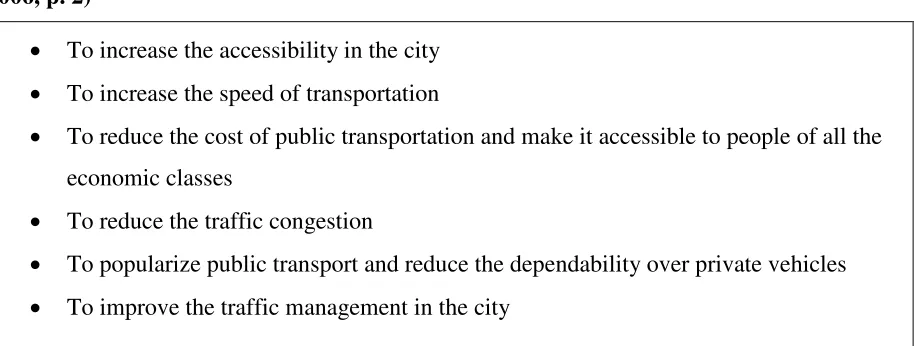
Table 1: BRT Project Objectives (Reproduced from Indore City Transport Services LTD, 2006, p. 2)
• To increase the accessibility in the city
• To increase the speed of transportation
• To reduce the cost of public transportation and make it accessible to people of all the economic classes
• To reduce the traffic congestion
• To popularize public transport and reduce the dependability over private vehicles
• To improve the traffic management in the city
The pilot corridor was to incorporate the following features: dedicated center lane with
raised barricades, prepayment, covered stations, level boarding, automatic doors, dedicated
pedestrian and bicycle lanes, and a fleet of fifty air-conditioned buses. These physical and
operational characteristics were designed to allow buses to rapidly transport heavy passenger
loads with minimal stoppage time and largely unencumbered by vehicular traffic. On paper, the
system had the potential to dramatically improve services for transit riders, increase safety and
accessibility for NMT users, and even improve congestion for motorists (provided that the BRT
was able to attract choice riders away from PMVs). Unfortunately, everything did not go
according to plan.
Due to budget and time constraints, the originally proposed 23.8 kilometers was reduced
to an 11.4 km route. Construction began in August of 2007 but was not completed until March of
2013. Delay was inordinately long in part due to uncoordinated, parallel sewerage and water
projects along the corridor. In order to accommodate for the future dedicated busway, and so as
not to remove space from the existing motor vehicle lanes, the project involved substantial road
23
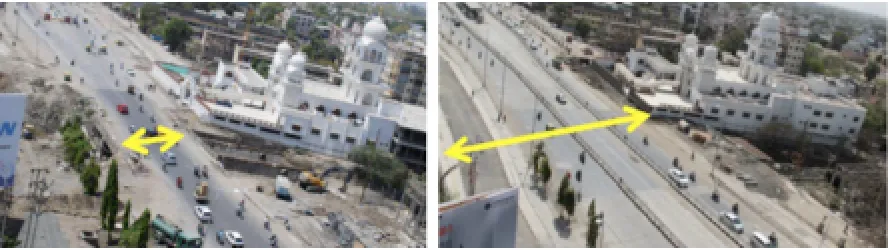
of road widening, motorists likely grew accustomed to driving on the extra road space. Thus,
once the bus lanes were finally installed, many motorists perceived this as the project taking their
road space.
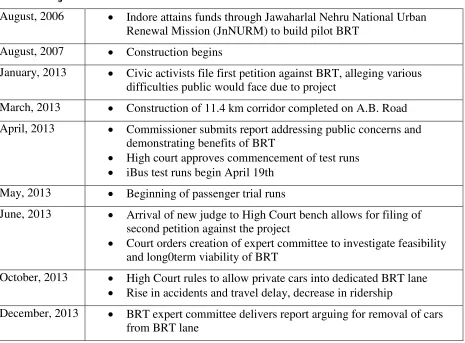
Table 2: Project Timeline
August, 2006 • Indore attains funds through Jawaharlal Nehru National Urban Renewal Mission (JnNURM) to build pilot BRT
August, 2007 • Construction begins
January, 2013 • Civic activists file first petition against BRT, alleging various difficulties public would face due to project
March, 2013 • Construction of 11.4 km corridor completed on A.B. Road
April, 2013 • Commissioner submits report addressing public concerns and demonstrating benefits of BRT
• High court approves commencement of test runs • iBus test runs begin April 19th
May, 2013 • Beginning of passenger trial runs
June, 2013 • Arrival of new judge to High Court bench allows for filing of second petition against the project
• Court orders creation of expert committee to investigate feasibility and long0term viability of BRT
October, 2013 • High Court rules to allow private cars into dedicated BRT lane • Rise in accidents and travel delay, decrease in ridership
December, 2013 • BRT expert committee delivers report arguing for removal of cars from BRT lane
The plan also called for the rerouting of redundant transit lines along A.B. Road. While
this posed no problem for city-operated buses, private mini-bus operators – which carry a large
share of transit passengers – were clearly opposed to the move. This, combined with a perception
of lost road space, coupled with a construction process rife with delay, resulted in a large sector
24
Figure 3: A.B. Rd. Pre, Post Construction (Reproduced from: Office of Divisional Commissioner, Indore, 2006)
Largely absent during implementation was a public participation process. Although the
transit agency began to spearhead certain outreach measures – e.g., invited passenger focus
groups for students and professionals, passenger surveys, video advertisements, and a Facebook
page – these were more educational and informative than they were interactive decision-making.
Moreover, most outreach efforts did not begin until shortly before services were set to launch.
Large parts of the implementation period also saw a lack of positive engagement with the press
from agency and government representatives. There were also cases of city officials and local
politicians speaking out against the BRT, causing quite the stir in local papers. Though a
last-ditch effort by transit administrators to engage the press – via a study tour of a successful Indian
BRT – resulted in a better understanding of the project and its aims, it is unclear how effective it
was in counteracting the largely negative stories from the local press.
Passenger-less trial runs began in April of 2013, with a one-month, fare-free passenger
trial run beginning in May. While the free trial runs saw daily ridership climb from 7,800 to
nearly 35,000 after one month, commercial operations did not reach this level of ridership until
four months after they began in June. The main issue during this time was the under-supply of
buses. Although the project was funded to allow for a fleet of 50, by the time operations began,
experienced delay due to excessive loading and unloading times at each station. With the
addition of each new bus, the system saw improved headway times and an increase in daily
ridership of approximately 2,000 passengers. However, progress was so slow that the system had
acquired only eighteen buses after four months of commercial operations.
Figure 4: BRT Daily Ridership
Ultimately, the BRT, as it was planned, did not have the opportunity to prove that it could
improve safety and congestion. In January 2013,
as improved solid waste treatment and ring road construction
alleging problems that the general public would face due to the
national officials defended the case; these included the Chief Secretary of State of Madhya
Pradesh, the secretary of JnNURM, the trans
CEO, the Commissioner of Municipal Corporation of Indore, and the Indore Collector. On
October 1st, the High Court of Madhya Pradesh ruled that motorized four
in the dedicated busway. Following the ruling, there have been approximately 30 accidents in the
BRT lane (as of February, 2014), up from two during the first five months of operations. Daily
0 5,000 10,000 15,000 20,000 25,000 30,000 35,000 40,000
iBus
25experienced delay due to excessive loading and unloading times at each station. With the
addition of each new bus, the system saw improved headway times and an increase in daily
00 passengers. However, progress was so slow that the system had
acquired only eighteen buses after four months of commercial operations.
Figure 4: BRT Daily Ridership (Data from Indore City Transport Services, LTD, 2014)
ltimately, the BRT, as it was planned, did not have the opportunity to prove that it could
In January 2013, a social activist known to fight
as improved solid waste treatment and ring road construction brought suit against the
problems that the general public would face due to the project. Various local, state and
national officials defended the case; these included the Chief Secretary of State of Madhya
Pradesh, the secretary of JnNURM, the transit agency CEO, the Indore Development Authority
CEO, the Commissioner of Municipal Corporation of Indore, and the Indore Collector. On
, the High Court of Madhya Pradesh ruled that motorized four-wheelers could travel
llowing the ruling, there have been approximately 30 accidents in the
BRT lane (as of February, 2014), up from two during the first five months of operations. Daily
iBus
Daily Ridership
Ridership
HC Ruling
experienced delay due to excessive loading and unloading times at each station. With the
addition of each new bus, the system saw improved headway times and an increase in daily
00 passengers. However, progress was so slow that the system had
(Data from Indore City Transport Services, LTD, 2014)
ltimately, the BRT, as it was planned, did not have the opportunity to prove that it could
for issues such
suit against the BRT,
. Various local, state and
national officials defended the case; these included the Chief Secretary of State of Madhya
it agency CEO, the Indore Development Authority
CEO, the Commissioner of Municipal Corporation of Indore, and the Indore Collector. On
wheelers could travel
llowing the ruling, there have been approximately 30 accidents in the
BRT lane (as of February, 2014), up from two during the first five months of operations. Daily
26
ridership dropped from approximately
30,000 to 17,000 within days of the order,
and average corridor travel time increased
from 37 to 60 minutes during peak hours
(A. Roy, personal communication,
27
5. Findings
5.1 Introduction
I first provide a summary of my findings. I then provide an overview of the court
proceedings, highlighting the main arguments from groups who supported or opposed the BRT.
Throughout the section, I incorporate related news articles that frame the project developments,
both on the ground and in the courtroom. Next I examine the manner and frequency in which
various news sources framed events and attitudes relating to the BRT. The final section is a
discussion of the findings.
5.2 Summary of Findings
This study considers the competing narratives surrounding Indore’s BRT during and after
project implementation. Courtroom proceedings, agency documents, and news articles present
the implementation process as prone to project complications and highly contentious among
various actors whose decisions had direct effects on the operation of the BRT. In analyzing data
relating to the High Court ruling, I found fundamental differences in the understanding of
contested themes that formed the basis for each side’s argument. Media narratives shed light
onto the various problematic developments during implementation and operations. They also
portrayed competing perceptions of the BRT among various actors, including the collectively
defined “public” and the retiring judge who publicly voiced his disdain for all BRTs.
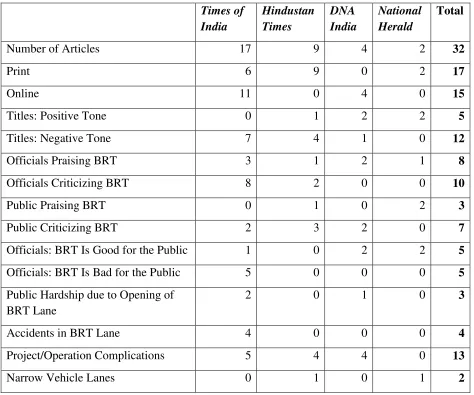
Among the reviewed news articles, 13 out of 32 chronicled the project and operational
complications that occured during and after implementation. While some address external factors
that have hindered construction or operations, the focus or title of the article often implicated the
BRT itself as the cause of problems on the corridor. Although the majority of the articles had
28
ones. A small portion of news stories presented positive portrayals of the project, but these most
often reflected the views of political or agency stakeholders advocating for the BRT and pointing
to its future benefits. More often, the articles described impatience or frustration with the BRT
on the part of political figures, the High Court, civic activists, and members of the public.
Within the court proceedings and related agency documents, I found three themes that
represented fundamental differences in the foundations of opposing arguments: 1) the
conceptualization of the greater good, 2) the depiction of traffic problems and their sources, and
3) the prioritization of public participation. I found that both sides appear to uphold the public
interest as their main motivation. However, the fundamental difference lies in the manner in
which each party defines the greater good. Those arguing against the BRT perceived its share of
dedicated road space as unjustified due to its comparatively lower passenger throughput. For
them, dismantling the BRT would provide immediate benefits to the most road users through
congestion mitigation. Those advocating for the BRT were more focused on the future benefits
of the system for all road users. In their opinion, if the BRT were given enough time to acquire
the adequate number of buses to attract sufficient ridership, even more road users could
potentially benefit via reduced congestion, pollution, and accidents.
The second contested notion was the cause of traffic problems. In presenting and
depicting traffic problems on the corridor, those arguing against the BRT place blame on the
dedicated busway as the main culprit. On the other hand, those arguing for the BRT claim these
problems were ongoing and often frame them as an opportunity for improvement through BRT
operations. One of the main points of contention here was the width of the road for private motor
vehicles (PMV) prior to and following construction of the project. While photo evidence reveals
29
Commissioner, Indore, 2013, p. 9), the petitioners argued on multiple occasions that the PMV
lanes were narrower. Though there was no comprehensive study to demonstrate that the BRT
contributed to traffic problems, over time the High Court itself began to adopt language based on
this claim.
The third contested notion was the concept of public participation. Although it received
comparatively less treatment than the previous two, I found discrepancies between the two sides’
interpretation of what constitutes adequate participation. Related court documents reveal
acknowledgement from both sides that public participation was largely left out of the planning
process. Further, most references to it emphasize informing the public more so than involving
them. For example, those that argued against the BRT did not criticize the planning process for a
lack of involvement. However, they did attempt to get the project suspended for not issuing a
proper notification. Those who advocated for the BRT acknowledged that many problems during
implementation and operations were due to a lack of buy-in or public participation. However,
their suggestions to remedy this problem were more educational and persuasive than
participatory.
While it is impossible to prove the true motivating factors behind the actions and
decisions of key actors, this study also sought to understand why the High Court ruled to allow
cars into the BRT lane. A review of the language from the rulings and opinions suggests that the
judges’ understanding of the contested notions aligned most with that of the social and
environmental activist who filed suit against the BRT, namely: that the BRT was the primary
cause of traffic problems on the corridor, that the low percentage of transit riders did not warrant
a dedicated busway, and that the greatest amount of public utility would result from opening the
30
riders or the benefits they stood to lose or gain from the outcome of the ruling. Finally, while the
BRT supporters argued in favor of the potential gains the system offered to all road users, the
retiring justice’s public remarks – that BRT is a failed concept – suggests he never believed BRT
could be successful in Indore.
5.3 Court Proceedings and Media Narrative
5.3.1 First Petition Filed Against the BRT
In January of 2013, nearly five and half years after construction of the corridor began and
months before operations launched, several petitioners filed suit against the project. Leading the
charge was Kishore Kodwani, a local activist who gained local recognition for petitioning and
perfoming hunger strikes on behalf of various civic issues, including: improved drinking water,
solid waste treatment, the establishment of a traffic engineering cell, and the construction of ring
roads. While it is relatively costly to finance petitions and trial attorneys, this study was unable to
determine how this particular lawsuit was funded throughout the year. In their attempt to get the
project suspended, they alleged “various difficulties which are likely to be faced by the public at
large on account of the dedicated bus system” (Kodwani v. State of M.P., 2013). The main
difficulties that the petitioners predicted were traffic jams and accidents. In response, the High
Court requested that the petitioners return with documented evidence of their claims and that the
city’s Divisional Commissioner invite and consider “suggestions in regard to the proper
implementation and use of the road constructed under BRTS project from the social
organizations and the persons interested.” The petitioners’ allegations effectively placed the
burden on the city to justify the potential utility of this service to the public.
Due to recurring delay during the construction process, media articles during this time
31
deadline yet again,” the Times of India reported on recurring construction delays that have
prolonged project implementation, and that “the authority is in no mood to extend the deadline”
(TNN, 2011, para. 2). While it does mention problems with land acquisition, there is no
reference to the parallel sewerage projects that purportedly caused much of the BRT’s
construction delay.
5.3.2 Response from the Divisional Commissioner of Indore
In April of 2013, the Office of Divisional Commissioner, Indore issued a report
addressing public concerns, per the High Court order, and demonstrated the potential benefits
that BRT has to offer citizens (Office of the Divisional Commissioner, Indore, 2013). While the
commissioner affirms to have taken the public’s views into consideration – via written
suggestions and a public hearing conducted during the previous month – the primary focus of the
report is to demonstrate the advantages of investing in BRT over the traditional paradigm of
widening roads. Though the report does take into account certain areas of concern and challenges
– such as a lack of coordination between agencies, enforcement of BRT lanes, and attracting
commuters – it frames these as opportunities for improvement. Arguably, the entire report is an
ardent response to those who object to BRT. It attests to “the strength of public transport as an
enabler of equality among genders” (p. 7), the potential for reduced tail-pipe emissions, the
congestion-mitigating benefits of segregated lanes, and the safety track record of Indore’s current
transit operations. However, being that the BRT had yet to begin operations, the report relied on
evidence from other cities that have born witness to the benefits of sustainable transit.
The Commissioner’s report also contends that the administration did not make “adequate
efforts in communicating the features, benefits and changes to the citizens,” it is not surprising
32
project” (Office of the Divisional Commissioner, Indore, 2013, p. 10). The report attributed the
main sources of discontent to excessive project delay and motorists growing accustomed to “the
extra-wide road available to them in the intervening period between the expansion of the road
and the construction of the railings for the bus corridor” (p. 9).
This last point is integral to the arguments both for and against Indore’s BRT as they
relate to the public good. While photo evidence from the report supports the argument that BRT
construction maintained – and often increased – road width available to motor vehicles along the
corridor, the petitioners’ allegations largely centered on claims that the BRT had made traffic
worse. News articles during this time also reveal members of the public expressing this view. In
the National Herald, a commuter reports that, due to the BRT, traffic has worsened in certain
areas “where the width of mixed lane is comparatively less” (NH Correspondent, 2013).
Despite these views, the commissioner’s report concludes on a hopeful note, contending
that although projects such as these that attempt a “paradigm shift in the attitude, knowledge and
usage of the public facility has to battle odds against it, […] this project should be given a chance
to prove its worth” (pp. 21-22). The commissioner’s language is echoed in news articles that
portray BRT proponents espousing the future benefits of the system for all road users. During a
team inspection from the Jawaharlal Nehru National Urban Renewal Mission (JnNURM), a
government representative stated that with the success of the system, the “number of vehicles in
motor vehicle lane is expected to go down as commuters will shift to public transport system
[…] and it will ultimately reduce vehicle pressure on road” (TNN, 2013, p. 3). From another
article reporting on the same visit, the representative predicted that “when the BRT corridor is in
full operation, 50 to 60 percent of the public will use it and under such condition, the space
33
High Court agreed that “it would be unjustified to stop the trial run on the basis of apprehension
of the petitioners” (Kodwani v. State of M.P., 2013) and approved the launch of trial runs with
continual monitoring and reporting.
5.3.3 Second Petition Filed Against the BRT
Passenger-less trial runs began on April 19th, 2013. On May 10th, riders were allowed to
use the system, free of charge, until the beginning of commercial operations on June 12th.
However, with the arrival of a new High Court bench, a new petition was filed against the
project on June 17th. During the proceedings on July 16th, the petitioner alleged “that the
movement of traffic in the bus lane, which is comparatively wider, is about 3% only, much less
than the narrower lanes for the ordinary private vehicle” (Kodwani v. State of M.P., 2013). A
cursory glance at any section of the corridor reveals that the BRT lane is not comparatively wider
than the space allotted for private motor vehicles. Further, although the transit agency later used
ticketing data to argue that the system was carrying 8.8% of the corridor’s passengers, the fact
remains that at that point in time, the dedicated BRT lane was transporting a disproportionately
smaller share of travelers relative to the PMV lanes.
Articles from this time would often describe BRT problems associated with institutional
and cultural factors, such as poor infrastructure provision and unlawful motorists. For example,
the Times of India article “BRTS not friendly, safe for disabled” highlights both the accessibility
limitations of the system and the problems all NMT users face on the new cycle and pedestrian
paths. While poor accessibility and infrastructure provision are typical across the city, urban
transport expert Rajendra Ravi asserted that BRT is meant to be “an integrated system of public
transport where pedestrians, cyclists and handicapped people get equal importance” (TNN,
34
construction or unregulated vehicle and commercial encroachment, the fact remains that the BRT
had done little to improve accessibility for wheelchair-bound users.
Not all media narratives presented negative sides of the story, however. Prior to the High
Court ruling, there were two articles that largely focused on transit riders’ approval of the
system: Hindustan Times’ “Students give a thumbs up to i-bus” (Bhonsale, D. R., 2013) and the
National Herald’s “Paid trial run of i-buses: Passengers give thumbs up.” In the second article, a
passenger says, “We do not mind to pay fares for travelling on i-buses, given the kind of comfort
we are getting […] adding that with AC and other facilities, traveling on i-buses is not only
comfortable but also time-saving” (NH Correspondent, 2013). Other articles reporting positive
developments for the BRT still had negative undertones. For example, after the beginning of
passenger trials, the National Herald reported, “Contrary to expectation, commercial trial run of
i-buses on the BRTS corridor in the city received enthusiastic response today” (2013). Thus,
although there was evidence of the BRT improving mobility for transit users, the tone or context
of articles draws the reader’s attention to the problematic implementation process.
Although news articles brought attention to various project complications and operational
shortcomings, the fundamental arguments for and against the project ultimately boiled down to
ridership: Did the current low-level use of the BRT among the public at large merit dismantling
the system, or did its demonstrated benefits and potential to attract more ridership warrant the
continuation and expansion of services? In their ruling, the judges ordered the formation of a
five-member, expert committee to: assess the “deficiencies as well as the day-to-day problems
faced by the general public due to BRTS,” submit a report “disclosing if the project is presently
feasible as well as viable,” and “give suggestions for free flow of traffic by taking care of