International Journal of Hematology-Oncology and Stem Cell Research
Predictors and Correlates of Fatigue in Sickle Cell
Disease Patients
Mehrnaz Ahmadi1, Saeed Poormansouri2, Samira Beiranvand3, Ladan Sedighie4
1Department of Nursing, Student Research Committee, School of Nursing and Midwifery, Ahvaz Jundishapur University of Medical Sciences,
Ahvaz, Iran
2Treatment Deputy, Ahvaz Jundishapur University of Medical Sciences, Ahvaz, Iran
3Department of Nursing, Student Research Committee, School of Nursing and Midwifery, Ahvaz Jundishapur University of Medical Sciences,
Ahvaz, Iran
4Department of Nursing, Student Research Committee, School of Nursing and Midwifery, Shahid Beheshti University of Medical Sciences,
Tehran, Iran
Corresponding Author: Samira Beiranvand, Student Research Committee, School of Nursing and Midwifery, Ahvaz Jundishapur University of Medical Sciences, Ahvaz, Iran
Tel/Fax: (+98)6133738070
E-mail :[email protected]
Received: 3, Dec, 2016 Accepted: 27, July, 2017
ABSTRACT
Background: Although fatigue is the most important symptom of Sickle Cell Disease, the extent of it is unknown, and causal mechanisms are not well understood. This article explores biopsychosocial characteristics that can potentially contribute to fatigue in SCD.
Materials and Methods: This cross-sectional, correlational study included 97 SCD patients who aged over 16 years and had records in Thalassemia Ward and Clinic of Shafa Hospital affiliated to Ahvaz University of Medical Sciences, Ahvaz, Iran. Data were collected from a self- reported demographic questionnaire, measuring depression, anxiety stress scale (DASS-21) and fatigue severity scale (FSS). Data analysis was done by descriptive statistics, independent sample t-tests, Pearson's correlation coefficient, one-way ANOVA and multiple stepwise regression.
Results: More than 50% of study participants were mostly single women. A majority of patients had a diagnosis of HgbSS disease. Levels of depression, anxiety and stress were severe in more than half of the participants. About 65% of SCD patients reported signs of fatigue. Moreover, fatigue, depression, anxiety and stress had a high intercorrelation. Depression, blood transfusion, renal diseases and work status were
predictors of fatigue according to the models used in this survey.
Conclusion: The results of the study indicated that SCD patients who had depression, blood transfusions, SCD-related renal complications, students and working people experienced more fatigue. So, if fatigue is present, it is important to recognize the existence of these conditions or vice versa. Routine assessment and improved management of fatigue, effective interventions to reduce fatigue, are highly recommended for patients with SCD.
Keywords: Anxiety, Depression, Stress, Fatigue, Sickle cell disease
INTRODUCTION
Sickle cell disease (SCD) is the most common genetic disease characterized by recurrent painful vaso- occlusive crises1. Although the most frequent
symptom associated with SCD is pain and historically and justifiably investigators have focused on improving sickle cell pain, fatigue is an increasingly important symptom of this disease in
the literature. The extent of fatigue in SCD is still unknown, and causal mechanisms are not well understood2,3. On the other hand, several
70
International Journal of Hematology Oncology and Stem Cell Research ijhoscr.tums.ac.ir
International Journal of Hematology Oncology and Stem Cell Research ijhoscr.tums.ac.ir
systematic approach to the investigation of this symptom is necessary for understanding this phenomenon in SCD4. In addition, recent studies
have shown that patients with SCD suffer from numerous psychosocial problems such as depression5,6, anxiety and stress5, 7-12 leading to
fa-tigue3- 4, 13 and poor quality of life14-16. Moreover,
several individual and disease-related factors including age, sex, ethnicity, socioeconomic status, treatments, disease severity, time with disease, medications, long-term complications, and cumulative organ damagemay contribute to fatigue
3,4, 10- 12. There are little knowledge about the exact
relationship between fatigue and these factors in SCD, and so these relationships need to be better understood. Meanwhile, SCD is more prevalent in some parts of Iran including Khuzestan province (particularly Ahvaz, southwestern province of Khuzestan, Abadan, etc) and immediate medical attention is required17. Hence, this paper attempts
1) to describe fatigue; 2) to examine the relationships between fatigue and depression, anxiety, stress, individual and disease characteristics; and 3) to find whether depression, anxiety, stress, demographic factors and other variables in this study could predict the fatigue in patients with SCD.
Materials and Methods Participants
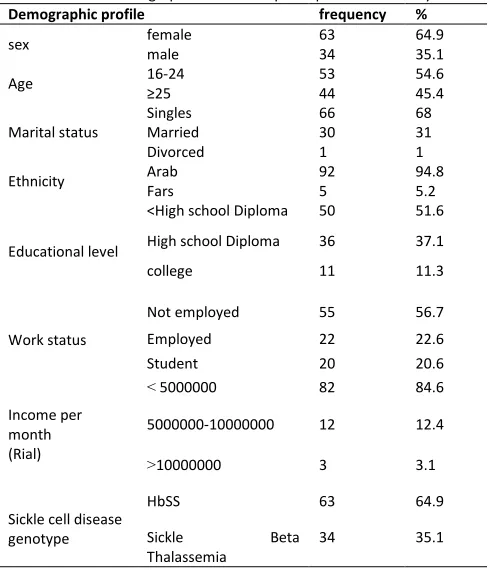
This cross-sectional, descriptive, correlational study was approved by the Institution's Review Board (Ethic Code ETH-739).The study group included 168 patients who were diagnosed with SCD based on their records in Thalassemia Ward and Clinic of Shafa Hospital affiliated to Ahvaz University of Medical Sciences between 2011 to 2013. Inclusion criteria were: ages over 16 years and SCD diagnosis. Data were collected through census method of the entire population. Among 128 patients referred to clinic for daily visitwithin six monthsfrom February 2013 to July 2013, 110 entered the study; of whom 13 either did not return the form or failed to complete it in an appropriate way, so finally the study participants consisted of 97 adults with SCD aged more than 16 years (Table 1). Written informed consent was obtained from the participants prior to their participation in the study.
Table 1: Demographic features of participants in the study Demographic profile frequency %
sex female 63 64.9
male 34 35.1
Age 16-24 53 54.6
≥25 44 45.4
Marital status
Singles 66 68
Married 30 31
Divorced 1 1
Ethnicity Arab 92 94.8
Fars 5 5.2
Educational level
<High school Diploma 50 51.6
High school Diploma 36 37.1
college 11 11.3
Work status
Not employed 55 56.7
Employed 22 22.6
Student 20 20.6
Income per month (Rial)
> 5000000 82 84.6
5000000-10000000 12 12.4
<10000000 3 3.1
Sickle cell disease genotype
HbSS 63 64.9
Sickle Beta
Thalassemia
34 35.1
Instruments
Demographic questionnaire
The demographic information questionnaire included items such as age, sex, ethnicity, marital status, level of education, work status, income, sickle cell disease genotype, blood transfusion, hydroxyl urea, Splenic, heart, renal, bone and joint disease.
Depression, Anxiety and Stress
The Persian version of DASS-21, a validated and structured questionnaire, was used to assess depression, anxiety and stress level18. DASS-21
nurse or researchers, and the identity of the participants was undisclosed.
Fatigue
The Fatigue Severity Scale (FSS) is a 9-item self-report scale from 0 (lack of fatigue) to 9 (severe fatigue) that assesses the severity of fatigue and has evidence of being a reliable and valid measure19. A
total fatigue score was obtained by summing the 9 item scores. The higher and lower scores from 36 indicated the patients with and without signs of fatigue, respectively. This measure assessed all dimensions of fatigue (physical, mental, emotional, behavioral and social).
Procedure
Recruitment took place at the Adult Hematology Clinics and Thalassemia Ward. The details of the study were explained to all potential participants and their families. Written informed consent was obtained from adult participants. During a routine clinic visit or hospitalization, participants were asked to complete the questionnaire.
Data analysis
Data analysis was conducted using SPSS statistical software version 19. Descriptive statistics (frequency, mean and standard deviation) were calculated. Kolmogorov-Smirnov was used to examine the normal distribution of variables. Independent-samples t-test and one-way Anova were used to compare the mean scores of fatigue, depression, anxiety and stress in terms of dichotomous and clinical variables. Moreover, independent-samples t-test was used to compare fatigue status in SCD patients with and without sign of depression, anxiety and stress. Pearson correlation coefficients were calculated to examine the relationship between fatigue and depression, anxiety and stress. Then, multiple stepwise regression models were fitted to test the independent association of depression, anxiety, stress and demographics and clinical variables with fatigue as dependent variable.
RESULTS
Ninety-seven SCD patients, aged over 16 years, participated in the study. Sample characteristics are reported in Table 1. More than 50% of study participants were mostly single women. A majority of study participants had a diagnosis of HgbSS disease.
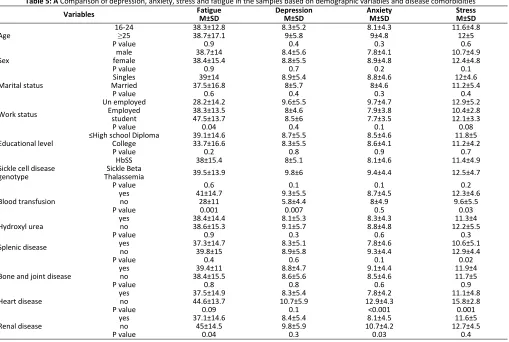
Descriptive results for the behavioral variables (depression, anxiety, stress and fatigue) are illustrated in Table 2. As shown in Table 3, self-reported levels of depression, anxiety, and stress were severe in more than half of the participants. About 65% of SCD patients reported signs of fatigue. Results from independent- samples t-test showed those who had symptomatic depression and stress experienced more fatigue. The same relationship was not observed regarding anxiety (Table 3). Fatigue, depression, anxiety and stress had a high correlation based on Pearson's correlation coefficient (Table 4). The results of independent-samples t-test and one-way Anova analysis between the fatigue, depression, anxiety, stress and study variables were displayed through Table 5.Finally, prior results provided situation for regression analysis. In this study, we used the method of stepwise multiple regression for data analysis in order to find whether depression, anxiety, stress, demographic factors and other variables could predict the fatigue in patients with SCD (Table 6).
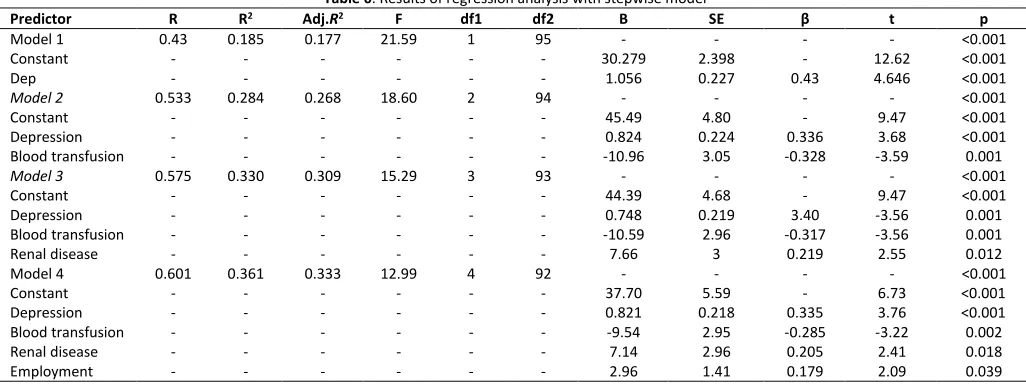
Our finding in the first model demonstrated that depression plays the most significant role in predicting fatigue in these patients. The correlation coefficient between depression and fatigue was reported 0.43, predicting 18% fatigue in these patients. In the second model, after depression, blood transfusion entered the equation, so the correlation coefficient between these two variables with fatigue was reported 0.53, predicting 28% changes in SCD fatigue.
72
International Journal of Hematology Oncology and Stem Cell Research ijhoscr.tums.ac.ir
International Journal of Hematology Oncology and Stem Cell Research ijhoscr.tums.ac.ir
Table 2: Depression, anxiety, stress and fatigue Status in SCD Patients
Variable Mean ± SD Level Asymptomatic
No (%)
Symptomatic No (%) Normal
No (%)
Mild No (%)
Moderate No (%)
Sever No (%)
Depression 8.67±5.53 32 (33) 9 (9.3) 10 (10.3) 46 (47.4) 32 (33) 65 (67)
Anxiety 8.59±4.6 8 (8.2) 16 (16.5) 19 (19.6) 54 (55.6) 8 (8.9) 89 (91.8)
Stress 11. 81±4.9 14 (14.4) 10 (10.3) 28 (28.9) 45 (46.4) 14 (14.4) 83 (85.6)
Fatigue NO (%)
Fatigue 38.56±14.88 No signs of fatigue <36 34 (35.1)
With signs of fatigue >36 63 (64.9)
Table 3: A Comparison of fatigue status in SCD patients with and without sign of depression, anxiety and stress
Variable Fatigue (M±SD) P
Depression Asymptomatic 32.43±13.5 0.004
Symptomatic 41.58±14.6
Anxiety Asymptomatic 40± 17.7 0.1
Symptomatic 39. 8±13
Stress Asymptomatic 32±13.9 0.01
Symptomatic 41.1±12.8
Table 4: A Correlation between fatigue and depression, anxiety and stress
Depression Anxiety stress
Fatigue r (pvalue) r (pvalue) r (pvalue)
0.43 (<0.001) 0.26 (0.009) 0.34 (0.001)
Table 5: A Comparison of depression, anxiety, stress and fatigue in the samples based on demographic variables and disease comorbidities Stress M±SD Anxiety
M±SD Depression
M±SD Fatigue
M±SD Variables
11.6±4.8 8.1±4.3
8.3±5.2 38.3±12.8
16-24
Age ≤25 38.7±17.1 9±5.8 9±4.8 12±5
0.6 0.3
0.4 0.9
P value
10.7±4.9 7.8±4.1
8.4±5.6 38.7±14
male
Sex female 38.4±15.4 8.8±5.5 8.9±4.8 12.4±4.8
0.1 0.2
0.7 0.9
P value
12±4.6 8.8±4.6
8.9±5.4 39±14
Singles
Marital status Married 37.5±16.8 8±5.7 8±4.6 11.2±5.4
0.4 0.3
0.4 0.6
P value
12.9±5.2 9.7±4.7
9.6±5.5 28.2±14.2
Un employed
Work status Employed 38.3±13.5 8±4.6 7.9±3.8 10.4±2.8
12.1±3.3 7.7±3.5
8.5±6 47.5±13.7
student
0.08 0.1
0.4 0.04
P value
11.8±5 8.5±4.6
8.7±5.5 39.1±14.6
≤High school Diploma
Educational level College 33.7±16.6 8.3±5.5 8.6±4.1 11.2±4.2
0.7 0.9
0.8 0.2
P value
11.4±4.9 8.1±4.6
8±5.1 38±15.4
HbSS Sickle cell disease
genotype 39.5±13.9 9.8±6 9.4±4.4 12.5±4.7
Sickle Beta Thalassemia
0.2 0.1
0.1 0.6
P value
12.3±4.6 8.7±4.5
9.3±5.5 41±14.7
yes
Blood transfusion no 28±11 5.8±4.4 8±4.9 9.6±5.5
0.03 0.5
0.007 0.001
P value
11.3±4 8.3±4.3
8.1±5.3 38.4±14.4
yes
Hydroxyl urea no 38.6±15.3 9.1±5.7 8.8±4.8 12.2±5.5
0.3 0.6
0.3 0.9
P value
10.6±5.1 7.8±4.6
8.3±5.1 37.3±14.7
yes
Splenic disease no 39.8±15 8.9±5.8 9.3±4.4 12.9±4.4
0.02 0.1
0.6 0.4
P value
11.9±4 9.1±4.4
8.8±4.7 39.4±11
yes
Bone and joint disease no 38.4±15.5 8.6±5.6 8.5±4.6 11.7±5
0.9 0.6
0.8 0.8
P value
11.1±4.8 7.8±4.2
8.3±5.4 37.5±14.9
yes
Heart disease no 44.6±13.7 10.7±5.9 12.9±4.3 15.8±2.8
0.001 <0.001
0.1 0.09
P value
11.6±5 8.1±4.5
8.4±5.4 37.1±14.6
yes
Renal disease no 45±14.5 9.8±5.9 10.7±4.2 12.7±4.5
0.4 0.03
0.3 0.04
Table 6. Results of regression analysis with stepwise model p t β SE B df2 df1 F
Adj.R2 R2 R Predictor <0.001 - - - - 95 1 21.59 0.177 0.185 0.43 Model 1 <0.001 12.62 - 2.398 30.279 - - - - - - Constant <0.001 4.646 0.43 0.227 1.056 - - - - - - Dep <0.001 - - - - 94 2 18.60 0.268 0.284 0.533 Model 2 <0.001 9.47 - 4.80 45.49 - - - - - - Constant <0.001 3.68 0.336 0.224 0.824 - - - - - - Depression 0.001 -3.59 -0.328 3.05 -10.96 - - - - - - Blood transfusion <0.001 - - - - 93 3 15.29 0.309 0.330 0.575 Model 3 <0.001 9.47 - 4.68 44.39 - - - - - - Constant 0.001 -3.56 3.40 0.219 0.748 - - - - - - Depression 0.001 -3.56 -0.317 2.96 -10.59 - - - - - - Blood transfusion 0.012 2.55 0.219 3 7.66 - - - - - - Renal disease <0.001 - - - - 92 4 12.99 0.333 0.361 0.601 Model 4 <0.001 6.73 - 5.59 37.70 - - - - - - Constant <0.001 3.76 0.335 0.218 0.821 - - - - - - Depression 0.002 -3.22 -0.285 2.95 -9.54 - - - - - - Blood transfusion 0.018 2.41 0.205 2.96 7.14 - - - - - - Renal disease 0.039 2.09 0.179 1.41 2.96 - - - - - - Employment
Actually, blood transfusion variable could increase the predictive power about 10 %. In the third model, renal disease was added as the third predictor variable and could increase the predictive power at approximately 5%. In other words, these three variables together predict 33 % of the variations in fatigue. The fourth variable imported into the regression analysis equation was working status in patients which could enhance fatigue prediction power about 36% (an increase about 3 %). In total, the correlation coefficient between all above- mentioned variables and fatigue was 0.6. Regarding the arrangement of entering the variables in fourth model
and
the standardized (beta) regression coefficient of the regression equation, depression with standard beta 0.335 had the highest share in predicting changes in fatigue of SCD patients. Then, blood transfusion with standard beta -0.285 played negative significant role in patients with fatigue state. In subsequent steps, renal disease with beta 0.205 and work status with beta 0.179, in terms of prediction of fatigue changes in SCD patients, were placed in the next ranks, respectively.Finally, this model indicated that the rise in depression is associated with increased level of fatigue by as much as 0.82. Patients who did not receive blood transfusion were 9.5 times more likely to experience fatigue compared to those receiving blood transfusion. Those who suffered from SCD-related renal complications were 1.7 times more likely to experience fatigue. Lastly,
students and employed people were 2.9 times more likely to experience fatigue compared to employed andunemployed people, respectively.
DISCUSSION
This study provides new information about the frequency, severity, and resulting interference of fatigue in patients with SCD. Our results showed that more than 40% of adults with sickle cell disease had severe depression, of whom 67 % had evidence of clinical symptoms. Similar to findings by Ekinci et al. in a review study, the majority of the available studies have shown that patients with SCD have a higher risk of depressive symptoms5. In a study
conducted by Jerrell et al., 46 % of patients with sickle cell disease were diagnosed with a depressive disorder6. While Benton et al. reported that only
12.5% of patients with SCD had major depressive disorder and Graves et al. stated that the majority of participants (83.9%) had low risk of depression7,8.
Although the risk factors of depression in SCD patients are not entirely known, there is evidence indicating that some disease-related factors such as frequency of pain episodes, higher frequency of vaso-occlusive pain attacks, frequency of visits for acute chest syndrome per year may develop disease-related complications and may have an influence on depressive syndrome. Even family status can be associated with psychological distress among these patients 5- 6, 9.
74
International Journal of Hematology Oncology and Stem Cell Research ijhoscr.tums.ac.ir
International Journal of Hematology Oncology and Stem Cell Research ijhoscr.tums.ac.ir
available evidence, 91.8% of SCD patients were symptomatic. Although most studies have confirmed the presence of anxiety in SCD patients, there are some differences in their reported levels of anxiety 5,7- 10. For example, Graves et al. reported
the majority of respondents had scores below the clinical thresholds, indicating low risk for anxiety8.
Levenson et al. also demonstrated that anxiety in SCD occurs at rates comparable to or slightly greater than healthy populations20. Previous studies
explained that living with a chronic stigmatizing disease, the unpredictable painful nature of SCD, frequent hospitalizations, fear of worsening of the condition and worries about the future social life as an individual associated with SCD appear to contribute to an increased risk of anxiety disorders
20- 22.
Brown & Thorsteinsson study indicated that acute and chronic stressors are main causes of fatigue among healthy adults23, and in our research more
than half of the SCD patients (46.4%) showed severe stress and a very tiny percentage of whom was asymptomatic. Mahdi et al. and Ahmadi et al. also stated that 49% and 52% of the SCD patients had high level of stress10-11. The above observed
differences may be due to possible differences in sampling procedures, sample size, inclusion criteria, sample characteristics and applied screening tools. As stated in previous publications, most (64.9%) of the SCD patients showed feeling of tiredness in our study3-4,12,24. To the best of our knowledge, most of
the studies confirm that fatigue exist among patients with SCD.
Based on our findings, the behavioral variables (depression, anxiety and stress) were significantly correlated with fatigue. The results of the two previous studies are consisted with our findings 3, 4.
Moreover, the comparison of patients with symptoms of stress and depression with those without symptoms mentioned above indicated that the two groups have significant differences, except for anxiety. In other words, patients with signs of fatigue had significantly more depressive symptoms and stress compared to those without these symptoms. But, there were no statistically significant differences between the groups with and without signs of anxiety. Although these results
have not been obtained by other studies, they seem reasonable enough.
The other results of this study demonstrated the relationships between fatigue and depression, stress and blood transfusion. In addition, fatigue and stress had significant positive correlation with renal diseases. Meanwhile, patients suffering from heart disease reported further levels of anxiety and stress. The relationship between stress and splenic diseases was also observed in this study. The obtained results are in agreement with the results taken from Simon et al study in which they found that when the severity of a disease is mild, the incidence is low for symptoms such as depression, anxiety, etc25.
Results of stepwise multiple regression analysis showed that first model depression has played the most important role in predicting fatigue. Like previous studies, one of the most common residual symptoms of depression is fatigue, and patients with fatigue are more likely to get depressed26.
Moreover, depression is a highly comorbid condition that is not uncommon in chronic illnesses24, and is strongly linked to fatigue. In SCD,
depression tends to occur at higher rates (18%– 27)20, but the nature of the relationship between
depression and fatigue is unclear, and differentiating fatigue-related depression from physical illness symptoms can be challenging3.
Therefore, it can be said that depression was a significant predictor for fatigue.
In next model, the blood transfusion variable increased the fatigue predictive power for about 10%. Blood transfusions are often used as a potential treatment for fatigue in anemic palliative care patients. However, the use of validated outcome measures has been found to be a common problem27. Patients with SCD are equally at risk for
hypoxemia if their hematocrit is too high, resulting in hyperviscosity3. It can result from simple and
partial exchange transfusions that are commonly used for prevention and treatment of certain complications of SCD such as stroke and priapism28.
Specified hypoxemia has also been associated with fatigue29.
of factors that may perpetuate clinically significant fatigue among individuals with chronic kidney disease, including sleep disorders, depression, sedentary lifestyle, anemia, and chronic inflammation30. While and Mullen in their
qualitative study on SCD patients stated that the majority of participants complained of being tired, not having energy, wanting to sleep, and often being unable to carry out activities of daily living. Fatigue often interfered with the ability to carry out daily activities31. Nevertheless, reporting more
fatigue by working and student patients is not unexpected.
Several limitations need to be mentioned when interpreting the study. First, the sample size was small, which limits the generalizability of the findings. Second the cross-sectional design limited the ability to examine fatigue over time. Third results are from one institution which limits representativeness to other patients with sickle cell disease in other settings. A healthy group for comparison of fatigue levels was not included.
CONCLUSION
Overall, more than 50% of study participants with SCD experienced depression, anxiety, stress and fatigue. There was a positive correlation between depression, anxiety, stress and fatigue in this study. The survey also revealed that fatigue was more common among those experienced more depression and stress. The results of the study indicated that SCD patients who had depression, underwent blood transfusions, had SCD-related kidney complications, students and working people experienced more fatigue.
Fatigue has been detected as a symptom of anxiety, depression, stress, and also a symptom of the disease itself. So, if fatigue is present, it is important to recognize the existence of these conditions or vice versa.
Routine assessment and improved management of fatigue, effective interventions to reduce fatigue, are highly recommended for patients with SCD. Further studies to identify the trajectory of fatigue and influencing factors are required.
ACKNOWLEDGEMENT
This paper was supported by Ahvaz Jundishapur University of Medical Sciences. We would like to
thank the vice-chancellor of Ahvaz Jundishapur University of Medical Sciences for providing financial support, as well as all patients who participated in this study.
CONFLICT OF INTEREST
The authors declare no conflict of interest.
REFERENCES
1. Wallen et al. Randomized Trial of Hypnosis as a Pain and Symptom Management Strategy in Adults with Sickle Cell Disease. Integr Med Insights. 2014 3; 9:25-33. 2. Medline Plus. Sickle cell anemia. 2010. Retrieved from:
http://www.nlm.nih.gov/medlineplus/ency/article/0005 27.htm
3. Ameringer S, Smith WR. Emerging biobehavioral
factors of fatigue in sickle cell disease. J Nurs Scholarsh. 2011; 43(1): 22–29.
4. Ameringer S, Elswick RJ, Smith W. Fatigue in
adolescents and young adults with sickle cell disease: biological and behavioral correlates and health-related quality of life. J Pediatr Oncol Nurs. 2014; 31(1):6–17. 5. Ekinci O, Çelik T. Psychiatric Disorders and Learning Problems in Children and Adolescents with
Sickle Cell Disease. Turk J Haematol. 2012; 29(3): 259– 264.
6. Jerrell JM, Tripathi A, Mcintyre RS. Prevalence and treatment of depression in children and adolescents with sickle cell disease: a retrospective cohort study. Prim Care Companion CNS Disord. 2011; 13(2): P 1-18.
7. Benton TD, Boyd R, Ifeagwu J, et al. Psychiatric diagnosis in adolescents with sickle cell disease: a preliminary report. Curr Psychiatry Rep. 2011; 13(2):111-5.
8. Graves JK, Hodge C, Jacob E. Depression, Anxiety, and
Quality of Life in Children and Adolescents with Sickle Cell Disease. Pediatr Nurs. 2016;42(3):113-9,
9. Unal S, Toros F, Kütük MÖ, et al. Evaluation of the psychological problems in children with sickle cell anemia and their families. Pediatr Hematol Onco.l 2011; 28(4): 321-8.
10.Mahdi N, Al-Ola Kh, Khalek NA, et al. Depression, Anxiety, and Stress Comorbidities in Sickle Cell Anemia Patients With Vaso-occlusive Crisis. J Pediatr Hematol Oncol. 2010 Jul;32(5):345-9
76
International Journal of Hematology Oncology and Stem Cell Research ijhoscr.tums.ac.ir
International Journal of Hematology Oncology and Stem Cell Research ijhoscr.tums.ac.ir
12.Poormansouri S, Ahmadi M, Shariati A, et al. Quality of life, depression, anxiety and stress in over-18-year-old patients with beta-Thalassemia major. Sci J Iran Blood Transfus Organ. 2016; 13(1): 72-82.
13.Dampier C, Lieff S, LeBeau P, et al. Health-related quality of life in children with sickle cell disease: a report from the Comprehensive Sickle Cell Centers Clinical Trial Consortium. Pediatr Blood Cancer. 2010; 55(3):485–94. 14.Anie KA, Grocott H, White L, et al. Patient self-assessment of hospital pain, mood and health-related quality of life in adults with sickle cell disease. BMJ Open. 2012; 2(4).
15.Dos Santos JP, Gomes Neto M. Sociodemographic
aspects and quality of life of patients with sickle cell anemia. Rev Bras Hematol Hemoter 2013; 35(4):242–5. 16. Dampier C, LeBeau P, Rhee S, et al. Health-related quality of life in adults with sickle cell disease (SCD): a report from the comprehensive sickle cell centers clinical trial consortium. Am J Hematol. 2011; 86(2):203–5. 17.Database of Iranian Nursing Organization. Sickle cell disease anemia and nursing care (2012). Accessed;
September 20, 2016. Available at:
http://www.ino.ir/tabid/40/ctl/ArticleView/mid/384/arti cleId.aspx
18. Sahebi A, Asghari MJ, Salari RS. Validation of depression, anxiety and stress scale for an Iranian population. Journal of Iranian Psychologists. 2005; 1(4): 299-312.
19. Ghafari S, Ahmadi Fazl E, Nabavi S. Effects of applying hydrotherapy on fatigue in multiple sclerosis patients. Journal of Mazandaran University of Medical Sciences. 2008; 18(66): 71-81.
20.Levenson JL, McClish DK, Dahman BA, et al.
Depression and anxiety in adults with sickle cell disease: The PiSCES project. Psychosomatic Medicine. 2008; 70:192–196.
21.Hijmans CT, Grootenhuis MA, Oosterlaan J, et al. Behavioral and emotional problems in children with sickle cell disease and healthy siblings: Multiple informants, multiple measures. Pediatr Blood Cancer. 2009; 53(7):1277-83.
22.Bakri MH, Ismail EA, Elsedfy GO, et al. Behavioral impact of sickle cell disease in young children with
repeated hospitalization. Saudi J Anaesth. 2014;
8(4):504-9.
23.Brown RF, Thorsteinsson EB. Stressful life-events and fatigue in a nonclinical sample. J Nerv Ment Dis. 2009; 197(9):707-10.
24.Stevinson CP, Steed HMD, Faught WMD, et al.
Physical activity in ovarian cancer survivors: Associations with fatigue, sleep, and psychosocial functioning. Int J Gynecol Cancer. 2009; 19(1):73-8.
25. Simon K, Barakat LP, Patterson CA, et al. Symptoms of depression and anxiety in adolescents with sickle cell disease: The role of intrapersonal characteristics and stress processing variables. Child Psychiatry Hum Dev. 2009; 40(2):317-30
26.Targum SD, Maurizio Fava M. Fatigue as a Residual
Symptom of Depression. Innov Clin Neurosci. 2011;
8(10):40–43.
27.Brown E, Hurlow A, Rahman AF, et al. Assessment of fatigue after blood transfusion in palliative care patients: a feasibility study. J Palliat Med. 2010; 13(11):1327-30.
28.Manwani D, Frenette PS. Vaso-occlusion in sickle cell disease: pathophysiology and novel targeted therapies. Hematology Am Soc Hematol Educ Program. 2013; 2013:362-9.
29.Pan J, Zhao P, Cai H, et al. Hypoxemia, Sleep Disturbances, and Depression Correlated with Fatigue in Neuromyelitis Optica Spectrum Disorder. CNS Neurosci Ther. 2015;21(7):599-606.
30.Zalai D, Bohra M. Fatigue in chronic kidney disease: Definition, assessment and treatment. CANNT J. 2016; 26(1):39-44.