Bulletin of Mathematical Analysis and Applications ISSN: 1821-1291, URL: http://www.bmathaa.org Volume 4 Issue 1 (2012), Pages 91-103.
A SHAPE RECONSTRUCTION PROBLEM WITH THE LAPLACE OPERATOR
(COMMUNICATED BY FIORALBA CAKONI)
LAMINE NDIAYE, IDRISSA LY , DIARAF SECK
Abstract. We discuss the inverse boundary value problem of reconstructing of an unknown part of boundary.We use shape optimization tools and max-imum principle theory to reconstruct the unknown part of boundary from a knowledge of cauchy data. From necessary conditions, we estimate a Lagrange multiplierλwhich appears by derivation with respect to the domain and we give a numerical value ofλ.
1. Introduction
The inverse problem in this paper means the problem of reconstructing object from observation data. We restrict ourselves to the case when the observation data are given as a boundary of the Cauchy data of a solution of an elliptic diffusion equation and the unknown object is a boundary. Let Ω be a bounded domain inRN
with smooth boundary∂Ω. Moreover, let us consider a partition of this boundary ∂Ω = Γ0 ∪ Γ, Γ0 ∩ Γ = ∅ where Γ0 is the accessible part, regular e.g C2 and
satisfies the interior sphere condition see [14] and Γ =∂Ω\Γ0 is the unknown part
of boundary.
Given Ω a bounded domain inRN,we consider the Dirichlet problem for a function
usatisfying the following problem
−△u+u = 0 in Ω
u = g on Γ0
u = 0 on Γ
(1.1)
whereg is a given positive continuous function prescribed on Γ0.One can show
that there is a unique solution u ∈ H1(Ω) to the direct problem (1.1) provided
∂Ω is Lipschitz. We have the well-posed direct problem.
Our inverse problem consists on finding a formula reconstructing Γ from the Cauchy data (g|Γ0, h|Γ0) of a weak solutionuto the following problem
2000Mathematics Subject Classification. 35R35, 35A20, 49Q10.
Key words and phrases. free boundary problem, shape recognition, cauchy problem. c
⃝2012 Universiteti i Prishtin¨es, Prishtin¨e, Kosov¨e. Submission March 21, 2011. Published December 23, 2011.
−△u+u = 0 in Ω
u = g on Γ0
u = 0 on Γ
∂u
∂ν = h on Γ0,
(1.2)
where g is a given positive continuous function prescribed on Γ0, h a given
negative function, the corresponding Neumann data measured on Γ0 and ν is
outer normal vector unit. In this case, Ω and uare unknowns and we assume that the normal derivatives of the functionucan be measured byh.
These types of problems have a lot of applications. In medical imaging, see [1], G.Bal studied the problem which consists of measuring the electric potential on the endocardial surface(the inside of the cardial wall). His method consists of sending a probe inside the heart and to measure the potential on the probe. The inverse problem consists then to reconstruct the potential on the endocardial surface from measurements.
In [20], A.Kirsch studied inverse problems in geological prospecting. This problem consists to determine the location, the shape and or some parameters (such conductivity) of geological anomalies in Earth’s interior from measurements at its surface. He also studied inverse scattering problem and computer tomography.
In [18] V.Isakov studied the inverse spectral problems. This domain prob-lem was formulated already by Sir A. Shuster, who in 1882 introduced spectroscopy as a way to find a shape of a bell by means of the sounds which it is capable of sending out. More rigorously, it has been posed by Bochner in the 1950s and then in the well-known lecture of Marc Kac see [19], Can one hear the shape of a drum? in 1966.He also studied inverse problem of gravimetry, inverse conductivity problem, tomography and the inverse seismic problem, and indicate their applications.
In [22], using conformal mapping technique, R. Kress studied mathemati-cal modelling of electrostatic or thermal imaging methods in non destructive testing and evaluation. In these applications an unknown inclusion within a conducting host medium with constant conductivity is assessed from over determined Cauchy data on the accessible exterior boundary of the medium.
In this paper, the reconstructing Γ from the Cauchy data is one of our aim and the estimation of the Lagrange multiplier which appears by derivation with respect to the domain of the energy of system in a admissible set of domains is another interesting ones. We could note some applications as the cut of optical fibers, the detection of oil, the cut in the electricity or water network. And two main questions in this paper can be connected and we are going to establish results on the reconstruction of Γ and the monotonicity result of the Lagrange multiplier. The last question is not easy to prove in the general cases and the authors are not aware about a theory or new techniques and tools in order to estimate the Lagrange multiplier depending on the domain.
find (Ω, u) such that
−△u+u = 0 in Ω
u = g on Γ0
u = 0 on Γ
∂u
∂ν = h on Γ0,
(1.3)
And ∫
Ω
dx = V0 withV0 is a given and fixed value.
Our aim is to situate Γ the boundary reconstruction from a knowledge of the Cauchy data. To do this, we study the shape optimization problem and prove the necessary conditions of optimality. These conditions leads to estimate the Lagrange multi-plier.
This paper is organized as follow:
In section 2, we establish the shape optimization results. And we prove the nec-essary conditions of optimality that is the existence of Lagrange multiplier.Section 3 is devoted to auxiliary lemmas based on maximum principal theory [24]. These lemmas play a fundamental part in the following sections. In section 4, we give, under geometrical assumptions, an uniqueness results which ensure the statement of an algorithm and its convergence. In the last section, we discuss on a general elliptical operator and we end by some classical numerical illustrations. But this numerical analysis gives interesting information and allows us to talk on futures.
2. Preliminaries
We study the existence result for the following shape optimization problem:
inf{J(ω), ω∈Θ}
where Θ is defined by
Θ ={ω ⊂ RN uniformly lipschitzian open bounded domain, ∫
ω
dx = V0}.
V0is a positive given real number.
And the functionalJ is defined by
J(ω) =1 2
∫
ω
|∇uω|2dx+
1 2 ∫
ω
|uω|2dx
whereuωis the solution of the following problem
−△uω+uω = 0 in ω
uω = g on Γ0
uω = 0 on ∂ω\Γ0
(2.1)
Suppose that Γ0 is regular i.e. at least of classC2.
Let us introduce the energy of the system:
J(ω) =1 2
∫
ω
|∇uω|2dx+
1 2 ∫
ω
|uω|2dx
We are going to minimizeJ(ω) on
Θ ={ω ⊂ RN uniformly lipschitzian open bounded domain, ∫
ω
dx = V0}.
Remark. Let us note thatωuniformly Lipschitz meansωsatisfies theϵ-cone prop-erty, for details see [17].
We are going to consider a fixed and bounded domainDwhich contains all open subsets we used.
We have the following lemma
Lemma 2.1. Let (Ωn)n∈N be a sequence of open set in RN having the ϵ- cˆone
property with Ω¯n ⊂ F ⊂D , F a compact set . Then there exists an open set
Ωincluding inF which satisfies the 2ϵ- cˆone property and a subsequence Ωnk such
that
χΩnk L1
−→ χΩ, Ωnk
H
−→ Ω
∂Ωnk
H
−→ ∂Ω, Ω¯nk
H −→ Ω¯.
Proof. see [17] for details.
We have the existence and shape continuity results.
Proposition 2.2.
There existsΩ ∈ Θsuch that: inf{J(ω), ω∈Θ}=J(Ω) and
−△uΩ+uΩ = 0 in Ω
uΩ = g on Γ0
uΩ = 0 on ∂Ω\Γ0.
The above proposition is well known, but we give a complete proof. See fr ex-ample [17], [5] and references therein.
Proof. Consider the function ˜udefined by
˜ u=
{
u ifx∈Ω
0 ifx∈Ωc
∇u˜= {
∇u ifx∈Ω 0 ifx∈Ωc
LetE be a functional defined onH1(D) by
E(˜uw) =
1 2
∫
D
|∇u˜w|2dx+
1 2
∫
D
|u˜w|2dx,
where ˜uwis the extension by 1 in ¯Ω ofuw solution of the problem −∆uw+uw= 0 in w
uw=g on∂Γ0
uw= 0 on∂w\Γ0
Let J(w) :=E(˜uw). Then J(w)>0 this implies that inf{J(w), w ∈ Oϵ} >−∞.
Letα= inf{J(w), w ∈ Oϵ}. Then, there exists a minimizing sequence (Ωn)n∈N⊂ Oϵ such thatJ(Ωn) converges onα.
Since the sequence (Ωn)n∈Nis bounded, there exists a compact setF such that
¯
Ωn ⊂F ⊂D. By lemma (2.1), there is a subsequence (Ωnk)k∈N, and Ω verifying
theϵ-cone property such that Ωnk
H
a subsequence denoted ˜usn ∈ H1(D) such that 12
∫
D|∇u˜ s
n|2dx+ 12
∫
D|˜u s
n|2dx > s
and 1 2
∫
D
|∇u˜sn|2dx+1 2
∫
D
|u˜sn|2dx = 1 2
∫
Ωn
|∇u˜sn|2dx+1 2
∫
Ωn
|u˜sn|2dx
That is,J(Ωn) converges on +∞. Then, inf{J(w), w ∈ Oϵ}= +∞is a
contradic-tion. SinceH1(D) is a reflexive space, there exists a subsequence (unk)k∈N andu∗ such thatunk converges weakly onu∗ inH
1(D) and
1 2
∫
Ω
|∇u∗|2dx+1 2
∫
Ω
|u∗|2dx ≤ lim inf 1 2
∫
Ωnk |∇unk|
2dx+1
2 ∫
Ω |unk|
2dx
From the above we getJ(Ω)≤J(Ωnk) andJ(Ω)≤inf{J(w), w∈Θ}. Finally,
we haveJ(Ω) = min{J(w), w∈Θ}.
Remark. On the one hand, it is easy to verify thatu∗ equalsuΩ and satisfies −∆u∗+u∗= 0 in Ω
u∗=g on∂Γ0
u∗= 0 on∂Ω\Γ0
On the other hand, we have a regularity of uΩ solution to the problem (2.1); see
[11, 23, 26].
Measure assumption:
We assume that it is possible to estimate the normal derivative of uΩ on Γ0 i.e
there exists
h:RN −→ R∗− such that ∂uΩ
∂ν = h on Γ0.
Whereν is the exterior unit normal vector field defined on Γ0.
We have the following necessary conditions of optimality.
Proposition 2.3. IfΩis the solution of the shape optimization problemmin{J(ω), ω∈ Θ},then there exists a Lagrange multiplierλ(Ω)such that|∇u|=−∂u∂ν = (−2λ(Ω))1/2 on Γ.
Proof. AsJ(Ω) = inf{J(ω), ω ∈ Θ}, using the derivative with respect to domain, in the direction of vector field, we show that there existsλ(Ω) Lagrange multiplier such that :
dJ(Ω, V) =λ(Ω)dJ1(Ω, V)
whereJ1(Ω) =
∫
Ω
dx−V0.Note that we perturb Ω only on∂Ω\Γ0= Γ, Γ0is fixed.
dJ(Ω, V) =λ(Ω)dJ1(Ω, V) ⇐⇒
1 2|∇uΩ|
2=−λ(Ω) on Γ (2.2)
For more details for the expression (2.2)see [27].
Let ’s take uΩ=u.To estimate λ(Ω), it suffices that to recognize Ω and if we
suppose that∂Ω\Γ0= Γ is of classC2, and sinceu= 0 on Γ,then we have
1 2|∇u|
2=1
2( ∂u ∂ν)
whereν is the outer normal vector. Note that 1 2|∇u|
2=−λ(Ω) is an optimality
condition and if we situate Γ, we will able to estimate |∇u| on Γ. Therefore we deduce an approximation of Lagrange multiplierλ(Ω).
3. Auxiliary lemmas
In this section, we sum up some fundamental lemmas for the algorithm which we will present in the next sections. These lemmas are based only on maximum principle theory. We assume also thatui∈C2(Ω)∩C(Ω\Γi), i= 1,2
Lemma 3.1.
Let Ω1,Ω2 be two open subsets of R, two open sets such that: Ω2 ⊂ Ω1 and
Γ0 ⊂ ∂Ω1∩∂Ω2.We suppose that:
−△u1+u1 = 0 in Ω1
u1 = g on Γ0
u1 = 0 on Γ1
(3.1)
−△u2+u2 = 0 in Ω2
u2 = g on Γ0
u2 = 0 on Γ2
(3.2)
Where
Γ0∪Γ1=∂Ω1, Γ0∩Γ1=∅
Γ0∪Γ2=∂Ω2, Γ0∩Γ2=∅
and g a positive given function. This inequality holds
−∂u1
∂ν (s) > − ∂u2
∂ν (s) for alls ∈ Γ0.
Proof. Consideru1−u2, we have
−△(u1−u2) + (u1−u2) = 0 in Ω2
u1−u2 = 0 on Γ0
u1−u2 = u1 on Γ2
(3.3)
Asg > 0 on ∂Ω1, by maximum principle,u1 ≥ 0 in Ω1.
And then, using again the maximum principle, (u1−u2)(x) ≥ 0 for all x ∈ Ω2
and even max
Γ1
u1 > u1−u2 > 0, for all x ∈ Ω2.
Letx0 ∈ Γ0, andx=x0−νh ∈ Ω whereν is exterior normal on Γ0 andh >0.
By Hopf Lemma , we have
−∂u1
∂ν (x0) > − ∂u2
∂ν (x0).
Lemma 3.2.
If (Ω1, u1) and (Ω2, u2)are two solutions of the following free boundary problem
−△u+u = 0 in Ω
u = g on Γ0
u = 0 on ∂Ω\Γ0
∂u
∂ν = λ(Ω) on ∂Ω\Γ0.
such that
: a- λ(Ω) is the Lagrangian multiplier.
: b- Ω2 ⊂ Ω1.
: c- (∂Ω2 ∩ ∂Ω1)\Γ0 ̸= ∅.
Then this inequality holds λ(Ω1) < λ(Ω2).
Proof. We have
△(u1−u2) = 0 in Ω2
u1−u2 = 0 on Γ0
u1−u2 = u1 on Γ2.
(3.5)
Thanks to maximum principle,u1 ≥ 0 on Γ2 and,u1−u2 > 0 on Ω2.
Letx0 ∈ ∂Ω2∩∂Ω1\Γ0 then (u1−u2)(x0) = 0.
Hopf lemma implies
−∂u1
∂ν (x0) > − ∂u2
∂ν (x0) i.e λ(Ω1) < λ(Ω2).
4. Uniqueness and convergence results
4.1. Result. In this section, using results establishing in section 3, we are going to show the uniqueness of the domain Ω under some hypothesis.
Most of the time, in the inverse problems, it is a great challenge to get uniqueness results. Now we are not able to produce an uniqueness result in the case where the unknown domain Ω is supposed to be starshaped with respect to a fixed point x0in Ω. We think that it would be interesting to investigate this question. Our
uniqueness result is obtained for any domains belonging toBh, a class of
admissi-ble domains satisfying an inequality constraint on the accessiadmissi-ble boundary Γ0, see
below the definition of Bh. And another important hypothesis for our uniqueness
result is the inclusion property in the following sense: One assumes that there are two domains in the classBh and one of the two domains is included in the other.
This is an interesting problem to weaken the inclusion property’s hypothesis.The uniqueness result is started in the below theorem 4.2.
We have already assumed that one is able to estimate the normal derivative of uΩ on Γ0 i.ethere exists
h:RN −→ R∗− such that ∂uΩ
∂ν = h on Γ0.
Whereν is the exterior unit normal vector field defined on Γ0.
Let us define a class of geometrical sets in the Beurling sense see for instance [16],[25].
Let beOthe following class of domains.
O={Ω ⊂ RN,Ω, be a bounded domain and uniformly Lipschitz} And let Γ0 be a subset of RN−1 , of class C2. Let’s take the following class of
domains
Bh={Ω ∈ O,Γ0 ⊂ ∂Ω,
∂uΩ
anduΩis solution to the following problem
−△uΩ+uΩ = 0 in Ω
uΩ = g on Γ0
uΩ = 0 on ∂Ω\Γ0.
(4.1)
By constructionBh is a non empty set because of the existence of solution of the
minimization see proposition (2.2) and measure assumption (see page 5). We have the following lemma:
Lemma 4.1. Let Ω1, Ω2 ∈ Bh then Ω1∩Ω2 ∈ Bh.
Proof. Letwbe solution to the following problem
−△w+w = 0 in Ω1∩Ω2
w = g on Γ0
w = 0 on ∂(Ω1∩Ω2)\Γ0.
(4.2)
We have
−△(uΩ1−w) +uΩ1−w = 0 in Ω1∩Ω2
uΩ1−w = 0 on Γ0
uΩ1−w = uΩ1|∂(Ω1∩Ω2)\Γ0 on ∂(Ω1∩Ω2)\Γ0.
(4.3)
By the maximum principle, we show that
uΩ1 ≥ 0 and uΩ1−w ≥ 0.
Letx0 ∈ Γ0 we get
−∂uΩ1
∂ν (x0) ≥ − ∂w
∂ν(x0) i.e ∂w
∂ν(x0) ≥ − ∂uΩ1
∂ν (x0) ≥ h for all x0 ∈ Γ0.
Then Ω1∩Ω2 ∈ Bh.
Theorem 4.2.
Let Ω be a bounded domain andΓ0, g, h,Γ defined as in the introduction. Consider
the following Cauchy problem.
−△u+u = 0 in Ω
u = g on Γ0
u = 0 on ∂Ω\Γ0
∂u
∂ν = h(x) on Γ0, Γ0=∂Ω\Γ.
(4.4)
Assume also that there are two domains Ω1 and Ω2, such thatΩ2 ⊂ Ω1 for
which (4.4) is verified. Then we haveΩ1= Ω2.
Proof. Let Ω1,Ω2such that
−△u1+u1 = 0 in Ω1
u1 = g on Γ0
u = 0 on ∂Ω1\Γ0
∂u1
∂ν = h(x) on Γ0.
−△u2+u2 = 0 in Ω2
u2 = g on Γ0
u2 = 0 on ∂Ω2\Γ0
∂u2
∂ν = h(x) on Γ0
(4.6)
As Ω1 and Ω2 ∈ Bh,we obtain Ω1∩Ω2 ∈ Bh.
Since Ω2 ⊂, Ω1,we have Ω1∩Ω2= Ω2,by lemma (4.1) we have
∂u2
∂ν ≥ h on Γ0. Consider the following problem
−△(u1−u2) +u1−u2 = 0 in Ω2
u1−u2 = 0 on Γ0
u1−u2 = u1 on ∂Ω2\Γ0.
(4.7)
We have
u1 ≥ 0 and max Γ2
u1 > u1−u2 > 0.
As Γ0 satisfies the interior sphere condition; by Hopf lemma we get
∂u1
∂ν < ∂u2
∂ν on Γ0 i.e h(x) < h(x) ∀ x ∈ Γ0
which is false, then Ω1= Ω2.
4.2. Algorithm and a convergence result in the convex case. In this part we give a method to reconstruct the unknown domain Ω. Consider the problem (1.3) and assume that the unknown domain is convex, we construct an increasing sequence of domains
(Ωn)n∈Nin the sense Ωn−1 ⊂ Ωn and ∂Ωn= Γ0∪Γn, for anyn≥2 where Γ0
is given and of classC2. Now let’s write some steps of the algorithm: Letϵ > 0 be a small number,ϵstates the threshold such a construction is mainly based on the lemma 3.1.
Initialization
Let Ω1be aC2convex domain such that Γ0⊂∂Ω1and
∫
Ω1
dx=V1< V0.Given
a positive, continuous functiong, we solve at first the following value problem
−△u1+u1 = 0 in Ω1
u1 = g on Γ0
u1 = 0 on ∂Ω1\Γ0.
(4.8)
We estimate ∂u1
∂ν |Γ0 and for any fixed x ∈ Γ0, we compute ∂u1
∂ν (x)−h(x).
If∂u1
∂ν (x)−h(x)
≃ϵ,then Ω1≃Ω.
If not we continue by taking Ω1 ⊂ Ω2 and
∫
Ω2
dx=V2< V0.
We can continue the process until a step denoted by n which we will determine . Finally, we have constructed an increasing sequence of domain Ωn solutions:
Ω0 ⊂ Ω1 ⊂ Ω2· · · ⊂ Ωn converging to Ω in the Hausdorff sense and moreover
λ(Ωn) converges toλ(Ω) when nincreases.
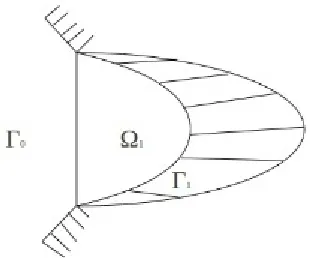
Figure 1. convex cylinder
(1) If one works with a convex cylinder then we obtain the following figure 1 Ω2= Ω∪T2 whereT2 is defined by
T2={y ∈ RN/ y=x+αν(x), x ∈ Γ, α ∈]0,1[}
whereν(x) is the exterior normal unit defined on Γ.
(2) If we work with a convex sets then we obtain the figure 2, where Ω2= Ω1∪T2
andT2is defined by
T2={y ∈ RN/ y=x+αν(x), x ∈ Γ, α ∈]0,1[}
whereν(x) is the exterior unit normal defined on Γ.
Figure 2. convex set
5. Generalization and numerical illustrations
5.1. A general case. In this section, we consider the following elliptic operatorL defined:
Lu =
N
∑
i,j=1
aij(x)
∂2u ∂xi∂xj
+
N
∑
i=1
bi(x)
∂u ∂xi
+c(x)u in Ω
Lu = 0 in Ω
u|Γ0 = g, g > 0
∂u
∂ν(x) = h(x) for all x ∈ Γ0.
whereaij =aji ∈ C(Ω), bi ∈ C(Ω) and there exists c0, C0, 0 < c0 < C0
such that for all x ∈ Ω and ξ ∈ RN,we have
c0|ξ|2 ≤ aij(x)ξiξj ≤ C0|ξ|2.
The uniqueness result is satisfied. Only, we have to use the following results which could be found in [24].
Lemma 5.1.
letΩ be a domain in RN and u ∈ C(Ω).
There existsx0 ∈ Ω : u(x0) = µ = max
Ω u and assume that u ̸ ≡ µ then there
exists B=B(a, ρ)a ball ̸=∅ such that B ⊂ B ⊂ Ω, u < µ in B and there exists p ∈ ∂B ⊂ Ω such that u(p) =µ.
We have the following comparison principle result.
Theorem 5.2. [Strong maximum principle in boundary]
Let Ωbe a domain,L as above with c(x) ≤ 0. Let u ∈ C2(Ω) and continuous
at p ∈ ∂Ω. we assume thatLu ≥ 0 in Ω and u(p) = max
Ω
u.
We suppose also thatΩ verify the interior sphere condition inp
and if c ̸ ≡0, u(p) ≥ 0 then one of the two assertions is true.
: i- u is constant .
: ii- ∂u
∂ξ(p) > 0, where ξ is outer direction of the interior sphere.
Remark.
If Lu ≤ 0 in Ω and there existsx0 ∈ Ω : u(x0) = max Ω uthen
: i- ifc(x) ≡0uis constant.
: ii- if c(x) ≤ 0 and if u(x0) ≤ 0 thenuis constant.
With the above results, we obtain under the same hypothesis the uniqueness result ofΩ. And if we suppose thatLu=div(a(x)∇u.∇u) +c(x)u.
With a(x) = (aij) as above. We have an estimate of Lagrange multiplier
λ(Ω). In fact
1
2|a(x)∇u∇u(x)|
2=λ(Ω) onΓ.
All the auxiliary lemmas are verified. The results are always true if c(x)
changes sign.
Remark.
To obtain the optimality condition 1
2|a(x)∇u∇u|
2=λ(Ω) onΓ,
we introduce the shape functional:
J(ω) =1 2
∫
ω
|a(x)∇u∇u|2dx+1 2
∫
ω
c(x)u2dx
and minimizeJ(ω)on Θ.
consider
−u′′+q(x)u = 0 in ]0, a[
u(0) = 1
u(a) = 0
u′(0) = −93
(5.2)
See that by comparison principleu′(0) is negative andu′(0) =−93 is an example for the simulations. We takeϵ= 0.06 as an accuracy.
Our problem is to estimate a and then we give an estimation of the Lagrange
multiplier (λ(Ω) = 1 2u
2 x(a)).
We use finite element method to calculate at first uh ≃ u and the test of the
algorithm to obtain an approached numerical value ofa.
q 1 expx 1 + sinx x 1 +x2 1+x1 1+x12
N[u′h(0)] -92.9943 -93.0166 -93.004 -93.0227 -92.9813 -93.0111 -92.077
a 1
2log ( u′x(0)−1 u′x(0)+1)
=0.0107531
aapp 0.0106963 0.0106457 0.0106452 0.0106963 0.0106483 0.0106483 0.0106483
For the different value of q, we observe by the computer that the Lagrange multi-plier:
λ(Ω) = 12u2
x(s) :=f(s) defined on [0, a] conserves the same behavior if we represent
the graphic. We see that forN = 1 we havef(s) is decreasing.
Acknowledgments
The authors would like to thank the anonymous referee for his/her comments that helped us improve this article.
References
[1] G. Bal,Lecture Notes, Introduction to Inverse Problems,Department of Applied Physics and Applied Mathematics, Columbia university, New York, 2004.
[2] G. Bal, Optical tomography for small volume absorbing inclusions, Inverse Problems,19 (2003), 371-386.
[3] H.Berestycki,Cours de DEA,1994-1995,Universit´e Paris 6.
[4] H. Brezis,Analyse fonctionnelle, th´eorie et applications, ed Masson 1987.
[5] B. Bucur and G. Buttazzo, G. Variational methods in shape optimisation problems,
Progress in Nonlinear Differential Equations and their Applications, 65. Birkhauser Boston, Inc., Boston, MA, 2005.
[6] M. Choulli and P. Stefanov,Reconstruction of the coefficients of the stationary transport equation from boundary measurements,Inverse Problems,12(1996), L19-L23
[7] D. L. Colton and R. Kress, Inverse acoustic and electromagnetic scattering theory, Springer Verlag, Berlin, 1998.
[8] M.Dambrine, D.Kateb,Conformal mapping and inverse conductivity problem with one mea-surement,ESAIM: COCV,23(2007), 163-177
[9] R.Dautray, J.L.Lions,Analyse math´ematique et calcul num´erique pour les sciences et les techniques vol 3,Masson, Paris 1987
[10] R. Dautray and J.L. Lions,Mathematical Analysis and Numerical Methods for Science and Technology,Vol.6, Springer Verlag, Berlin, 1993.
[11] E. DiBenedetto,C1+α local regularity of weak solutions of degenerate elliptic equations,
Nonlinear Analysis,7(1983), 827-850.
[13] A.Friedman,V.Isakov, On the uniqueness in the inverse conductivity problem with one measurement,Indiana Univ.Math.J,38(1989), 563-759.
[14] R.Gilbarg, N.S. Trudinger,Elliptic partial differential equations of second order, Springer Verlag, seconde ´edition, 1983.
[15] H. Haddar and R. Kress,Conformal mappings and inverse boundary value problems,Inverse
Problems,21(2005), 935-953.
[16] Henrot, A., Subsolutions and Supersolutions in a free boundary problem, Ark.Mat.,
32(1994), 79- 98.
[17] A. Henrot, M. Pierre,Variation et Optimisation de formes :Une analyse g´eom´etrique, Springer-Verlag,2005
[18] V.Isakov,Inverse Problems for Partial Differential Equations,127in Applied Mathematical Sciences, Springer, New-York, 1998.
[19] Kac, M.,Can one hear the shape of a drum?,The American Mathematical Monthly , vol.73, No.4 , Part2: Papers in Analysis (Apr.1966) 1-23.
[20] A. Kirsch,Introduction to the Mathematical Theory of Inverse Problems,Springer Verlag, New York, 1996.
[21] R. Kress,Linear Integral Equations,Springer Verlag, New York, second edition, 1999. [22] R. Kress,Inverse problems and conformal mapping,Complex Variables and Elliptic
Equa-tions, 1-16, 2011
[23] J.L. Lewis,Regularity of the derivatives of solutions to certain degenerate elliptic equations, Indiana Univ . Math. J.,32(1983), 849-858.
[24] M.H.Protter, H.W.Weinberger,Maximum principle for differential equations, Printice-Hall, NJ,1967.
[25] D. Seck ,,Etude d’un probl`eme `a fronti`ere libre de type Bernoulli, Th`ese d’Universit´e de
Franche- Comt´e, 1996, num´ero 505.
[26] P.Tolksdorf, Regularity for a more general class of quasilinear elliptic equations,J. Dif-ferential Equations,52(1984), 126-150.
[27] J.Sokolowsi, J.Zol´esio, Introduction to shape optimization: Shape sentitivity, Springer Series in Computational Mathematics 16(1991).
Lamine ndiaye
Laboratoire de Math´ematique de la D´ecision et d’Analyse Num´erque(FASEG) Universit´e Cheikh Anta Diop (UCAD),BP16 889,Dakar, S´en´egal
E-mail address:[email protected]
Idrissa Ly
Laboratoire de Math´ematique de la D´ecision et d’Analyse Num´erque(FASEG) Universit´e Cheikh Anta Diop (UCAD),BP16 889,Dakar, S´en´egal
E-mail address:[email protected]
Diaraf Seck
Laboratoire de Math´ematique de la D´ecision et d’Analyse Num´erque(FASEG) Universit´e Cheikh Anta Diop (UCAD),BP16 889,Dakar, S´en´egal