Anna Kofla-Dłubacz
1, A–D, F, Małgorzata Matusiewicz
2, C, D, Elżbieta Krzesiek
1, B, E,
Leszek Noga
3, C, Barbara Iwańczak
1, A, E, FMetalloproteinase-3 and -9 as Novel Markers
in the Evaluation of Ulcerative Colitis Activity
in Children
1 2nd Chair and Department of Pediatrics, Gastroenterology and Nutrition, Wroclaw Medical University,
Poland
2 Department of Medical Biochemistry, Wroclaw Medical University, Poland 3 Department of Pathophysiology, Wroclaw Medical University, Poland
A – research concept and design; B – collection and/or assembly of data; C – data analysis and interpretation;
D – writing the article; E – critical revision of the article; F – final approval of article; G – other
Abstract
Objectives. The enhanced activity of matrix endopeptidases (MMPs) involved in the degradation of connective tissue has been noted in tissue samples from the digestive tract in inflammatory bowel disease (IBD), however sera concentrations of MMPs, a potential tool for diagnostic tests in IBD patients, have not been established so far. The goal of the studies was to evaluate the concentrations of MMP-3 and MMP-9, in the sera of children suffering from ulcerative colitis (UC) in relation to disease activity.
Material and Methods. The study was comprised of 31 children with UC (aged 3–18 years) and 37 children in the control group (aged 1–18 years). Disease activity was estimated using the Truelove-Witts scale. MMP-3 and -9 concentrations were determined using ELISA tests.
Results. Median MMP-3 concentrations were 18.4 ng/mL (95% CI: 12.5–24.3) for moderate and severe, 4.35 ng/mL (95% CI: 2.5–7.8) for the mild form of UC and 1.8 ng/mL (95% CI: 1.2–2.5) for the control group. Median MMP-9 concentrations were 18.0 ng/mL (95% CI: 2.83–36.6) for moderate and severe, 1.55 ng/mL (95% CI: 0.4–3.0) for the mild form of UC and 1.3 ng/mL (95% CI: 0.7–1.96) for the control group. Serum MMP-3 and MMP-9 con-centrations in the moderate group were higher than those in the mild and control groups (p < 0.001). MMP-3 concentrations in the mild group also differed from those in the control group (p < 0.001). Among the parameters studied (MMP-3, MMP-9, CRP and ESR), MMP-3 had the highest discriminative value (AUC = 0.9, p < 0.001, sensitivity = 71%, specificity = 92%) in distinguishing patients with UC from healthy individuals.
Conclusions. Elevation of MMP-3 and MMP-9 concentrations along with the disease activity suggests the possibil-ity of their application in the evaluation of the clinical activpossibil-ity of UC (Adv Clin Exp Med 2014, 23, 1, 103–110).
Key words: metalloproteinases, ulcerative colitis, children.
Adv Clin Exp Med 2014, 23, 1, 103–110 ISSN 1899–5276
ORIGINAL PAPERS
© Copyright by Wroclaw Medical University
Acute damage of tissues caused by the deregu-lation of the immune system in genetically prone individuals and in the presence of modulating envi-ronmental factors is nowadays a generally accepted hypothesis concerning the etiopathogenesis of in-flammatory bowel diseases (IBD). Numerous cyto-kines have been demonstrated to participate in the maintenance of the disease process – the inhibition
of tumor necrosis factor alpha (TNF-α) by specif-ic antibodies has been successfully applied in prac-tice and today it is one of the basic strategies in the treatment of IBD. Numerous studies have also been conducted on tissue effectors of the systemic in-flammatory process, which cause ulcerations of the intestinal tract typical for IBD. It has been demon-strated that metalloproteinases of the extracellular
matrix (MMPs) are involved in this process [1, 2]. Metalloproteinases are a family of zinc-dependent endopeptidases which, due to their ability to me-tabolize the elements of the extracellular matrix, are engaged in the remodeling of connective tis-sue [3]. Precise regulation of expression and the ac-tivation of MMPs, together with the specific tissue inhibitors of metalloproteinases (TIMPs), guard the state of functional balance of these enzymes. It has been observed that the hyperactivation of some of the MMPs leads to enhanced tissue remodeling in regions affected by the disease process [3, 4]. Nu-merous studies have demonstrated increased con-centrations of MMPs in biopsy specimens collected from inflammatory altered sections of alimentary tract in the course of IBD [1, 2]. Therefore, MMPs have become a subject of studies on the possibility of their application in the inhibition of the disease process as well as on the evaluation of their poten-tial as biomarkers of disease activity and exacerba-tion. At this moment there are no specific, sensi-tive and at the same time noninvasive markers that would permit the evaluation of the degree of dis-ease activity and its exacerbation. Finding such bio-markers could, in the course of long-term care of the IBD patient, prevent the development of prob-lems related to the severe stages of the disease as well as life-threatening complications.
The goals of our studies were: the evaluation of the concentrations of MMP-3 and -9 in the se-ra of patients suffering from ulcese-rative colitis, the determination of correlations between MMP-3 and -9 concentrations and the activity of the in-flammatory state as well as indices of inflamma-tion such as concentrainflamma-tion of C-reactive protein (CRP), seromucoid and erythrocyte sedimentation rate (ESR). We also compared the diagnostic util-ity of the measurements of the studied MMPs in the estimation of disease severity with those of ESR and CRP.
Material and Methods
Study Group
Inclusion criteria: the studied group was com-prised of 31 patients with UC (aged from 3 to 18 years, average 14.7) treated in the Department and Clinic of Pediatrics, Gastroenterology and Nutrition of Wroclaw Medical University. Ulcer-ative colitis was diagnosed on the basis of subjec-tive and objecsubjec-tive examination as well as laboratory and image findings using the algorithm proposed in Porto [5]. The clinical activity of ulcerative coli-tis was estimated using a modified Truelove-Witts scale, supplemented by the Cole index, which was
a method applied in the determination of UC activ-ity in the medical system at the time the study was conducted [6]. On this basis, the patients were divid-ed into 3 groups: 16 patients, mean age 12.94 years, with a mild form of the disease (< 5 points), 14 pa-tients, mean age 16.64, with a moderate form (≥ 5 to < 9 points) and only 1 patient, during the period of study, with severe disease activity (≥ 9 points). Patients with moderate and severe ease activity were gathered in one group. Mean dis-ease duration in the group of patients with the mild form of the disease was 8.1 months and in the group with the moderate form of the disease 11.5 months. The differences between the groups were not statis-tically significant.
The patients enrolled in the study were treat-ed, depending on the clinical disease activity, using sulfasalazine, steroids and azathioprine. The con-trol group consisted of 37 children (mean age 10.1) who were hospitalized in the clinic because of ab-dominal pain and were diagnosed with al disorders of the digestive tract, mostly function-al dyspepsia and irritable bowel syndrome. The above control group was also used in the evalua-tion of serum concentraevalua-tions of MMPs in Crohn’s disease.
Exclusion criteria: inflammation associated with diseases other than UC, patients with extrain-testinal manifestations of IBD were not includ-ed in the study. Treatment with monoclonal an-tibodies against TNF-alpha was also an exclusion criterion.
Preparation of the Material
Blood samples were drawn by venous punc-ture in a fasting state. Sera were obtained from clotted (30 min, room temperature) and centri-fuged (15 min, 1500 × g) blood. Serum samples were stored at –80oC until analysis.
MMP-3 and MMP-9 concentrations were es-timated by enzyme double-antibody indirect im-munoassays with the Quantikine Human To-tal MMP-3 Immunoassay and DuoSet Human MMP-9/TIMP-1 Complex provided by R&D Sys-tems (Minneapolis, MN, USA) in accordance with manufacturer protocol.
Data on C-reactive protein (CRP), seromucoid and erythrocyte sedimentation rate (ESR) was re-trieved from the patients’ medical records.
Statistical Methods
(95% CI). The significance of differences between groups was examined with a Mann-Whitney U test.
Correlation analysis between MMPs concen-tration and the degree of disease activity, as well as CRP, seromucoid and ESR, was conducted with a Pearson’s test. All tests were two-sided and p val-ues < 0.05 were considered significant.
The diagnostic utilities of MMP-3, MMP-9, ESR and CRP were evaluated using a receiver op-erating characteristic (ROC) curves analysis. The overall performance was expressed as the area un-der the ROC curve (AUC) with 95% CI and p-sta-tistics for the difference between the calculated AUC and AUC = 0.5 (marker without discrimina-tive power). Cut-off values corresponding to the highest accuracy were determined and the relat-ed sensitivities and specificities together with like-lihood ratios for positive and negative results (+LR and -LR) were calculated. The Youden index (sen-sitivity + specificity-1), a summary measure, was calculated as well. Statistical analysis was conduct-ed using Statistica 9 and Mconduct-edCalc programs.
Ethical Considerations
The study protocol was approved by the Medi-cal Ethics Committee of Wroclaw MediMedi-cal Univer-sity, Wroclaw, Poland and the study was conduct-ed in accordance with the Helsinki Declaration of 1975, as revised in 1983.
Results
MMP-3, MMP-9, CRP and
ESR in the Sera of Patients
with Ulcerative Colitis
Concentrations of MMP-3 in patients with UC were elevated in comparison to the control group (Fig. 1). The concentrations of this metallo-proteinase also differed between subgroups of pa-tients with different degrees of disease activity (Ta-ble 1). The highest concentrations were observed in a group of children with moderate activity of UC and they differed significantly from the con-centrations in the group with mild activity as well as from the control group (p < 0.001).
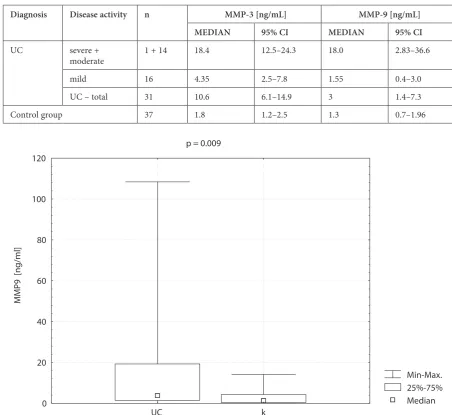
Also, the concentrations of MMP-9 were high-er in patients with UC than in the control group (Fig. 2). When the concentrations of MMP-3 were compared in the subgroups differing in disease activity, the elevated levels were observed in the groups with active disease (Table 1). In the group with mild disease activity, these concentrations were similar to those in the control group. Statisti-cally significant differences were observed between the groups with moderate and mild disease activ-ity (p < 0.001) as well as between the group with moderate disease activity and the control group (p < 0.001).
Fig.1. Concentrations of MMP-3 in the serum of patients with ulcerative colitis (UC) and the control group (C)
Min-Max. 25%-75% Median p < 0.001
MMP3 [ng/ml]
0 10 20 30 40 50 60 70
In the studied cohort of patients, we did not observe statistically significant differences in the concentrations of CRP and the levels of ESR be-tween patients with UC and the control group (ESR/control group – p = 0.07, CRP/control group – p = 0.52).
Correlations Between Serum
Concentrations of MMP-3
and MMP-9, Disease Activity
and Selected Laboratory Indices
The concentrations of MMP-3 in the sera of UC patients positively correlated with the number of points evaluating disease activity in the True-love-Witts scale (r = 0.58, p = 0.001) (Table 2). We did not observe statistically significant correlations between MMP-3 concentrations and ESR, CRP or seromucoid (Table 2).
Also, the concentrations of MMP-9 positively correlated with the degree of disease activity esti-mated by the Truelove-Witts scale (Table 2). Con-centrations of MMP-9 positively correlated with CRP and seromucoid concentrations as well (Ta-ble 2). The concentrations of both metalloprotein-ases positively correlated with each other.
Diagnostic Utility
of the Studied Parameters
in the Evaluation of Ulcerative
Colitis Activity
ROC analysis of the studied parameters in the patients with UC indicated that MMP-3 has a high-er diagnostic utility than MMP-9, ESR and CRP as markers of disease activity. Diagnostic accura-cies expressed as the areas under the ROC curves (AUC) for the studied parameters were as follows:
Table 1. MMP-3 and MMP-9 concentrations in the sera of patients with ulcerative colitis (UC) and in the control group
Diagnosis Disease activity n MMP-3 [ng/mL] MMP-9 [ng/mL]
MEDIAN 95% CI MEDIAN 95% CI
UC severe +
moderate 1 + 14 18.4 12.5–24.3 18.0 2.83–36.6
mild 16 4.35 2.5–7.8 1.55 0.4–3.0
UC – total 31 10.6 6.1–14.9 3 1.4–7.3
Control group 37 1.8 1.2–2.5 1.3 0.7–1.96
Fig.2. Concentrations of MMP-9 in the serum of patients with ulcerative colitis (UC) and the control group (C)
Min-Max. 25%-75% Median p = 0.009
MMP9 [ng/ml]
0 20 40 60 80 100 120
MMP-3 – 0.90 (95% CI – 0.80 – 0.96, p < 0.001) at the cut-off value of 5.4 ng/mL, MMP-9 – 0.69 (95% CI – 0.56– 0.79, p = 0.005) at the cut-off val-ue of 2.46 ng/mL, ESR – 0.63 (95% CI – 0.50–0.74, p = 0.058) at the cut-off value of 13 and CRP – 0.55 (95% CI – 0.42–0.67, p > 0.05) at the cut-off value of 4.3 mg/L (Fig. 3). This indicates that there is 90% probability of correctly distinguish-ing a healthy person from a UC patient based on MMP-3 concentration. The highest Youden in-dex was observed for MMP-3 and was equal 0.63, with the sensitivity of the test equal to 0.71 and
specificity 0.92. This means that in 71% of patients with UC, MMP-3 concentrations were higher than the highest value in the control group. Both the sensitivity and specificity of MMP-9 were lower than that of MMP-3. In the studied cohort of indi-viduals, ESR only tended to discriminate patients with UC from healthy ones (with the same speci-ficity but much lower sensitivity than MMP-3) and CRP had no discriminative power towards diag-nosis of UC. Sensitivities for both ESR and CRP were found to be lower in comparison to the stud-ied metalloproteinases (Table 3).
Table 2. Relations between MMP-3, MMP-9 and selected inflammatory parameters in children with ulcerative colitis
Parameter n MMP-3 (log) MMP9 (log)
p r p r
Disease activity
(Truelove-Witts scale) 31 P = 0.001 0.58 P < 0.0001 0.69
MMP-9 (log) 31 P < 0.0001 0.69 – –
MMP-3 (log) 31 – – P < 0.0001 0.69
ESR (log) 31 P = 0.08 0.32 P = 0.05 0.35
CRP (log) 31 P > 0.05 0.29 P = 0.001 0.57
Seromucoid 31 P > 0.05 0.19 P = 0.01 0.46
ESR – erythrocyte sedimentation rate; CRP – C-reactive protein; r – Pearson’s correlation coefficient.
Fig. 3. Comparison of ROC curves for MMP-3, MMP-9, C-reactive protein (CRP) and erythrocyte sedimentation rate (ESR)
Table 3. Diagnostic performance of the measured parameters
Parameter Accuracy p Cut-off value Sensitivity Specificity Youden index
MMP-3 0.898 < 0.001 > 5.4 ng/mL 0.71 0.919 0.629
MMP-9 0.686 0.005 > 2.46 ng/mL 0.613 0.730 0.343
ESR 0.629 0.058 > 13 mm/h 0.387 0.919 0.306
CRP 0.547 > 0.05 > 4.3 mg/L 0.258 0.943 0.201
Discussion
Revealing the mechanisms responsible for the development and exacerbation of symptoms in the course of inflammatory bowel diseases is an im-portant goal from a scientific and diagnostic as well as therapeutic standpoint. Enhanced tissue re-modeling leading to the formation of characteristic changes in the large bowel of patients with ulcer-ative colitis has become a stimulus for the search for the biological factors responsible for the initiation and maintenance of these pathological processes. Among such factors are metalloproteinases, ele-vated concentrations of which have been observed in biopsy specimens collected from the disease al-tered fragments of the alimentary tract [1, 2].
Matrix metalloproteinases play a key role in the remodeling of the extracellular elements of connective tissue. Influencing the pathways of immune cell migration, they are modulating the course of inflammatory process [7–10]. The im-balance in the synthesis and degradation of MMPs leads to the improper tissue remodeling, which can result in the formation of ulceration, including the ulceration of the alimentary tract. The description of MMPs function in IBD seems to be important in the elucidation of the pathomechanism of these still perplexing diseases. The studies published so far have confirmed the overexpression of MMPs, including MMP-3 and -9, both in ulcerative colitis and in Crohn’s disease (CD). Alterations of MMPs activity depending on the degree of disease exac-erbation have been observed in animal models with induced bowel inflammation [11, 12]. Elevat-ed concentrations of MMPs have also been notElevat-ed in biopsy specimens collected from inflamed frag-ments of the alimentary tract [1, 2, 13, 14]. De-spite these reports, there are only a few accounts concerning the possibility of the measurement of MMPs in samples other than tissue. Increased con-centrations of MMPs have been demonstrated in the urine of patients with IBD in comparison to healthy individuals [15]. Significant elevation of MMP-1 and TIMP-1 levels in plasma correspond-ing to mucosal expression have been shown by Wang YD et al. [16].
In our earlier studies, we already indicated that MMP-3 and -9 concentration measurement can be useful in the differentiation of patients with var-ious degree of CD exacerbation estimated by the pediatric Crohn’s disease activity index [17]. In our present studies we have demonstrated that al-so in the case of pediatric patients with ulcerative colitis there are significant differences in MMP-3 and MMP-9 concentrations in sera, which reflect the various stages of disease activity. Significantly higher concentrations of both MMP-3 and MMP-9
in the sera of patients with the active form of the disease (above 5 points on the Truelove-Witts scale) in comparison to the patients with the mild form of the disease as well as the control group in-dicate that application of the measurement of the studied metalloproteinases might be useful in the clinical evaluation of patients. Our studies indi-cate that the imbalance in MMPs activity can be observed both in ulcerative colitis and in Crohn’s disease and, therefore, these markers are not spe-cific to these diseases. In the majority of studies conducted so far, no distinction between particu-lar forms of IBD has been taken into account, as-suming that the studied metalloproteinases are the effectors of the systemic inflammatory reaction of the body [1, 2, 13]. This can be confirmed by the clinical application of antibodies against TNF-α, which, as a consequence, results in the inhibition of MMPs activity both in CD and UC.
Taking into account the possible impact of treatment on the concentration of MMPs, we did not enroll patients under biological therapy in the study. The possible effects of other drugs, includ-ing supplementation with iron, calcium prepara-tions and other macro and micronutrients, which according to recent reports [18, 19] may influ-ence the activity of MMPs, were not studied in this work. Patients with moderate disease activity re-ceiving therapeutic doses of iron did not require the use of other supplements because of the nor-mal function of the snor-mall intestine in UC.
Because the only studies evaluating the effects of macro- and micronutrients on MMPs have been conducted in vitro, the influence of these drugs re-quires further studies to confirm the results in in vivo experiments.
Many studies have also discussed the diagnostic and prognostic value of commonly used indica-tors of inflammation. Elevation of CRP is report-ed in 70%–100% of patients with active inflamma-tion in the course of CD and 50%–60% of patients with UC [22, 23]. Our results, indicating that in the cohort of patients which were included in our studies, CRP has no discriminative value in dis-tinguishing UC patients from healthy individu-als, corroborates these findings. Although we ob-served positive, statistically significant correlation between MMP-9 and CRP in the group of patients with UC, when the group of UC patients was com-bined with the control group, the correlation be-came questionable (r = 0.32, p = 0.008). Despite its limitations, CRP measurement is still commonly used in clinical practice. Moreover, every accom-panying infection, for which children treated with drugs lowering immunity during the therapy for IBD are prone, decreases the specificity of a single marker. Simultaneous determination of several pa-rameters increases the probability of proper evalu-ation, because it takes into account the differences in origins and activity of the estimated indicators. Nevertheless, it is necessary to look for new indica-tors which would be specific to a disease process.
In our cohort of patients, we also observed positive correlations between MMP-9 and seromu-coid. We did not, however, find significant correla-tions between the studied metalloproteinases and ESR. Similar to the case of CD [17], MMP-3 and -9 concentrations positively correlated with the dis-ease activity scale. Hence, the demonstration of the
statistically significant, positive correlations be-tween the number of points on the Truelove-Witts scale and the studied metalloproteinases supports the possibility of their application in the evalua-tion of the disease severity. Addievalua-tionally, the lack of significant correlations between MMP-3 and the indices of inflammation (CRP, ESR, seromucoid), as well as between MMP-9 and ESR, might be ev-idence of the superiority of MMPs over standard markers. The estimation of MMPs might, there-fore, be considered as an alternative or supplemen-tal to CRP, seromucoid and ESR measurement in routine clinical practice. The high diagnostic utili-ties, as well as the sensitivities and specificiutili-ties, es-pecially those of MMP-3, seem to support such an idea. However, it has to be taken into account that metalloproteinases are not specific to IBD. The el-evation of their concentration has been described in cancers, cardiovascular diseases and autoim-mune diseases [24–26]. The presence of symptoms from outside of the alimentary tract or overlapping syndromes in patients may influence the result of MMPs determination in IBD without an indica-tion of the dominance of symptoms from the ali-mentary tract. However, a similar limitation is also true in the case of ESR or CRP.
Our studies, demonstrating the high diagnos-tic potential of metalloproteinases in UC severity evaluation, also point to the need for further re-search in this direction, especially with respect to changes of MMPs on the tissue level and their con-nections to MMPs concentration and activity on a systemic level.
References
[1] Meijer MJ, Mieremet-Ooms MA, van der Zon AM: Increased mucosal matrix metalloproteinase-1, -2, -3 and -9 activity in patients with inflammatory bowel disease and the relation with Crohn’s disease phenotype. Dig Liver Dis 2007, 39, 733–739.
[2] von Lampe B, Barthel B, Coupland SE: Differential expression of matrix metalloproteinases and their tissue inhibitors in colon mucosa of patients with inflammatory bowel disease. Gut 2000, 47, 63–73.
[3] Medina C, Radomski MW: Role of matrix metalloproteinases in intestinal inflammation. J Pharmacol Exp Ther 2006, 318, 933–938.
[4] Sternlicht MD, Werb Z: How matrix metalloproteinases regulate cell behavior. Annu Rev Cell Dev Biol 2001, 17, 464–516.
[5] IBD Working Group of the European Society for Paediatric Gastroenterology, Hepatology and Nutrition. Inflammatory bowel disease in children and adolescents: recommendations for diagnosis-the Porto criteria. J Pediatr Gastroenterol Nutr 2005, 41, 1–7.
[6] Truelove SC, Witts LJ: Cortisone in ulcerative colitis; final report on a therapeutic trial. Br Med J 1955, 2, 1041– –1048.
[7] Faveeuw C, Preece G, Ager A: Transendothelial migration of lymphocytes across high endothelial venules into lymph nodes is affected by metalloproteinases. Blood 2001, 98, 688–695.
[8] Delclaux C, Delacourt C, D’Ortho MP: Role of gelatinase B and elastase in human polymorphonuclear neutrophil migration across basement membrane. Am J Resp Mol Cell Biol 1996, 14, 288–229.
[9] Di Sebastiano P, di Mola FF, Artese L: Beneficial effects of Batimastat (BB-94), a matrix metalloproteinase inhibi-tor, in rat experimental colitis. Digestion 2001, 63, 234–239.
[10] Naito Y, Takagi T, Kuroda M: An orally active matrix metalloproteinase inhibitor, ONO-4817, reduces dextran sulfate sodium-induced colitis in mice. Inflam Res 2004, 53, 462–468.
[12] Sykes AP, Bhogal R, Brampton C: The effect of an inhibitor of matrix metalloproteinases on colonic inflamma-tion in a trinitrobenzensulphonic acid rat model of inflammatory bowel disease. Aliment Pharmacol Ther 1999, 13, 1535–1542.
[13] Louis E, Ribbens C, Godon A: Increased production of matrix metalloproteinase-3 and tissue inhibitor of metal-loproteinase-1 by inflamed mucosa in inflammatory bowel disease. Clin Exp Immunol 2000, 120, 241–246.
[14] Gao Q, Meijer MJ, Kubben FJ: Expression of matrix metalloproteinases-2 and -9 in intestinal tissue of patients with inflammatory bowel diseases. Dig Liver Dis 2005, 37, 584–592.
[15] Manfredi MA, Zurakowski D, Rufo PA: Increased incidence of urinary matrix metalloproteinases as predictors of disease in pediatric patients with inflammatory bowel disease. Inflamm Bowel Dis 2008, 14, 1091–1096.
[16] Wang YD, Tan XY, Zhang K: Correlation of plasma MMP-1 and TIMP-1 levels and the colonic mucosa expres-sions in patients with ulcerative colitis. Mediators Inflamm 2009, 275072. Epub 2009, 9.
[17] Kofla-Dlubacz A, Matusiewicz M, Krzystek-Korpacka M, Iwanczak B: Correlation of MMP-3 and MMP-9 with Crohn’s Disease Activity in Children. Dig Dis Sci 2012, 57, 706–712.
[18] Tezvergil-Mutluay A, Agee KA, Hoshika T: The requirement of zinc and calcium ions for functional MMP activ-ity in demineralized dentin matrices. Dent Mater 2010, 26, 1059–1067.
[19] Kato MT, Leite AL, Hannas AR: Effect of iron on matrix metalloproteinase inhibition and on the prevention of dentine erosion. Caries Res 2010, 44, 309–316.
[20] Fagerberg UL, Lööf L, Myrdal U: Colorectal inflammation is well predicted by fecal calprotectin in children with gastrointestinal symptoms. J Pediatr Gastroenterol Nutr 2005, 40, 450–455.
[21] Konikoff MR, Denson LA: Role of fecal calprotectin as a biomarker of intestinal inflammation in inflammatory bowel disease. Inflamm Bowel Dis 2006, 12, 524–534.
[22] Vermeire S, Van Assche G, Rutgeerts P: Laboratory markers in IBD: useful, magic, or unnecessary toys? Gut 2006, 55, 426–431.
[23] Vermeire S, Van Assche G, Rutgeerts P: The role of C-reactive protein as an inflammatory marker in gastroin-testinal diseases. Nat Clin Pract Gastroenterol Hepatol 2005, 2, 580–586.
[24] Dollery CM, McEwan JR, Hanney AM: Matrix metalloproteinases and cardiovascular disease. Circ Res 1995, 77, 863–868.
[25] Tchetverikov I, Lard LR, DeGroot J: Matrix metalloproteinases-3, -8, -9 as markers of disease activity and joint damage progression in early rheumatoid arthritis. Ann Rheum Dis 2003, 62, 1094–1099.
[26] Egeblad M, Werb Z: New functions for the matrix metalloproteinases in cancer progression, Nature Rev Cancer 2002, 2, 161–174.
Address for correspondence:
Anna Kofla-Dłubacz
2nd Chair and Department of Pediatrics, Gastroenterology and Nutrition Wroclaw Medical University
M. Curie-Skłodowskiej 50/52 50-369 Wrocław
Poland
Tel.: +48 71 770 30 45 E-mail: [email protected]
Conflict of interest: None declared