Copyright © 2014 IJECCE, All right reserved
Boiler Drum Parameter Optimization by Fuzzy PID
Control Technique
Hanamane M. D.
Department of Electronics Smt. K. W. C. Sangli, IndiaAtar K. D.
Department of Electronics Shivaji University Kolhapur, IndiaMudholkar R. R.
Department of Electronics Shivaji University Kolhapur, IndiaAbstract – The present paper highlight a methodology for the systematic design of Fuzzy-PID controllers based on practical Fuzzy Logic and PID controller. In sugar industry, energy cogeneration process of boiler water tank parameters has controlled. The given controllers are applied individually to boiler water tank parameters from water level of tank, PH of water and TDS of water. The resultant output is to control its inlet and outlet valve of boiler drum from sugar industry.
Keywords – Boiler Water Tank, PIC Controller, MATLAB Simulation Model, Serial Communication, Fuzzy Logic etc.
I.
I
NTRODUCTIONThe process control techniques are of great advantage in industrial applications. Basically controllers are Proportional, Integral, Derivative, PID, Fuzzy, Fuzzy-PID and so on. Recently the Fuzzy controllers are gaining wide applicability in Industrial sectors, which are rule based control system. The other controller belongs to the category of mathematically synthesized controllers. The present paper describes a systematic design of Fuzzy-PID controllers based on practical implementation of Fuzzy Logic Control. The heart of Sugar Industry is a boiler, which acts as heater for sugar manufacturing process at the same time generates the steam that is utilized in the energy generation process. The boiler thus turns out to be a multipurpose and hence highest priority device in Sugar Industry [1]. The steam generation process involves the parameter such as Water level, Percentage of hydrogen ion concentration (pH) and Total Dissolved Solids (TDS).
Steam utilization process in boiler invokes three parameters which need the control. First controlled parameter is the water level in the drum. Steam generation consumes the water and water level keeps on changing and feed water flow needs to be controlled regularly. The grater steam generation process requires drum water level of 50%. The water level in drum is inversely proportional to generation of steam. D. Madhav et al [2] have estimated about 4% of hot water waste that is made up by feeding the water externally through inlet valve. The continuous recirculation process of water harmfully increases the pH and TDS. The second parameter thus is the pH of water. In boiler the hydrogen from water is directly decomposed and produces ammonia. The ammonia is carried with the steam is dissolved in the condensate coming out of condenser. It helps maintain the pH value of feed water at satisfactory level [3]. The third parameter is Total Dissolved Solids (TDS) that directly decides the quality of water. A higher TDS count degrades the control valve performance. Vandana Pandya et al [4] have proposed the GSM modem based data acquisition system for monitoring
the environmental parameters as well as trans-receive them serially. S. J. Pérez et al [5] have reported a microcontroller based approach for data logging of parameters. The Fuzzy-PID controller creates a linear function from its nonlinearity tuning process producing a superior control performance than the conventional PID controllers [6]-[7] and it is the key motivation of present paper.
Fig.2 (a) Serial Communication
The fig.2 (a) shows input of the system has three sensors such as Water level, pH and TDS sensors. The present reading of sensor is given to the PIC controller from ADC channel A0, A1 and A2. The data is converted into suitable format and transmitted serially to host computer with the help of USART mode of PIC microcontroller. The sensors data are also displayed on 2X16 LCD displays. In MATLAB Simulink offers a serial data receive block that receives the data from microcontroller. The received multiple data are separated and transmitted to various controllers for processing. The circuit implementation photograph is shown in fig. 2(b). Three potentiometers emulate as the input sensors. The host computer access and transfer the data with the help of serial to USB cable.
II.
I
MPLEMENTATION OFPID
C
ONTROLLERFig.3 (a) Simulink PID Model of boiler parameter optimization
Three PID controllers used for circuit implementation are shown in fig.3 (a). The serially receive-block of Simulink model picks up the data from computer via microcontroller. The settings for serial communication areas follows-
COM port = Com, baud rate = 9600, data bits
= 8 and data size = 3, 1 In data size of (3, 1) the three separate data bits are assigned to Water level, pH and TDS with one each. The data goes to the PID Controllers. Each PID controller provides individual output to subsystems. The PID controller in closed loop system generates signals control purpose with the help of subsystems shown in fig. 3 (b & C).
A.
Inlet Valve subsystem
Fig.3 (b) Inlet Valve subsystem
Fig.3 (c) Subsystem A
The drum water level depends on the inlet valve and outlet valve of the system and position of the inlet valve is decided by the present reading of tank level, pH and TDS of boiler. Mathematical equation (1-5) computes the inlet valve position.
IVP = WL −50 ×−2 WL −50 +A
2 (1)
IVP = Inlet Valve Position, WL = Water level controller output, A=Subsystem A
From fig. 3(b) the value of A is
A = 10 PH + 0.667 TDS
2 − 70 × 3.33
10 PH + 0.667 TDS
2 (2)
pH= pH controller output, TDS = TDS controller output
A = 5PH + 0.333TDS − 70 × 16.65PH + 0.110TDS (3) Putting the value from equation 3 to 1
IVP =
WL − 50 × −2 WL − 50 + 5PH + 0.333TDS −70 × 16.65PH + 0.110TDS
2
(4)
IVP = WL
2 − 25 − WL − 50 + 2.5PH + 0.166TDS
−70 × 8.325PH + 0.055TDS (5)
B.
Outlet Subsystem
Copyright © 2014 IJECCE, All right reserved Fig.3 (d) Outlet Valve Subsystem
Fig.3 (e) Point B subsystem
OVP = 10PH × WL × 0.68TDS
3 − 65
× 10PH × WL × 0.68TDS
3 − 65 (6)
OVP = 100PH × WL × 0.68TDS
3 − 65
2
(7)
III.
I
MPLEMENTATION OFF
UZZYC
ONTROLLERThe PID controllers are replaced by Fuzzy controllers. Three separate FIS (Fuzzy Inference System) have been created using Fuzzy Toolbox of MATLAB. The FIS are entitled as Water FIS, pH FIS and TDS FIS. The called into Fuzzy Logic Controller model during the simulation are shown in fig. 4(a).
Fig.4 (a) Fuzzy Model of boiler parameter optimization
A.
Fuzzy Logic Controller
Fuzzy Logic approach is a concept to computing based on degrees of truth rather than the modern computer which is based on usual Zero or One Boolean logic. It is followed by three steps Fuzzification, Fuzzy Inference and Defuzzification. Fuzzy Inference System (FIS) is a method that interprets the values in the input vector and based on user-defined rules, assigns values to the output vector. The Single In Single Out (SISO) FIS of TDS is shown in fig. 4(b).
Fig.4 (b) SISO FIS for TDS
1. Fuzzyfication of Input TDS signal
Input membership function range for TDS is -150 to 150 and portioned into nine region entitled as SNTDS, ENTDS, VNTDS, NTDS, MTDS, PTDS, VPTDS, EPTDS and SPTDS shown in fig. 4(c).
SNTDS - Super Negative Total Dissolved Solids
ENTDS - Extremely Negative Total Dissolved Solids
VNTDS - Very Negative Total Dissolved Solids
NTDS - Negative Total Dissolved Solids
MTDS - Maintain Total Dissolved Solids
PTDS - Positive Total Dissolved Solids
VPTDS - Very Positive Total Dissolved Solids
EPTDS - Extremely Positive Total Dissolved Solids
Fig.4 (c) Fuzzyfication Input TDS signal
2. Defuzzification of output TDS signal
The Output Membership function of TDS signal range is 0 to 170. It is also portioned into nine regions Entitled as SLTDS, ELTDS, VLTDS, LTDS, MTDS, HTDS, VHTDS, EHTDS and SHTDS shown in fig. 4 (d).
SLTDS - Super Low Total Dissolved Solids
ELTDS - Extremely Low Total Dissolved Solids
VLTDS - Very Low Total Dissolved Solids
LTDS - Low Total Dissolved Solids
MTDS - Medium Total Dissolved Solids
HTDS - High Total Dissolved Solids
VHTDS - Very High Total Dissolved Solids
EHTDS - Extremely High Total Dissolved Solids
SHTDS - Super High Total Dissolved Solids
Fig.4 (d) Defuzzification of Output TDS signal
3. Fuzzy Rules
The Fuzzy rules are in IF THEN format, the given rules are.
R1: IF Input TDS is SNTDS THEN Output TDS is SLTDS
R2: IF Input TDS is ENTDS THEN Output TDS is ELTDS
R3: IF Input TDS is VNTDS THEN Output TDS is VLTDS
R4: IF Input TDS is NTDS THEN Output TDS is LTDS
R5:IF Input TDS is MNTDS THEN Output TDS is MLTDS
R6: IF Input TDS is PTDS THEN Output TDS is HTDS
R7: IF Input TDS is VPTDS THEN Output TDS is VHTDS
R8: IF Input TDS is EPTDS THEN Output TDS is EXTDS
4. Rule Viewer
Rule viewer is view detailed behavior of a FIS to help diagnose the behavior of specific rules or study the effect of changing input variables.
Fig.4 (e) Rule Viewer of TDS Signal
5. Surface View of TDS Signal
The function of surface viewer is linear because single input single output (SISO) membership function. The surface view of TDS signal is shown in fig. 4(f). The shape and nuAmber of membership function of water level FIS and pH FIS are similar to TDS FIS.
Fig.4(f) Surface View of TDS Signal
IV.
I
MPLEMENTATION OFF
UZZY-PID
C
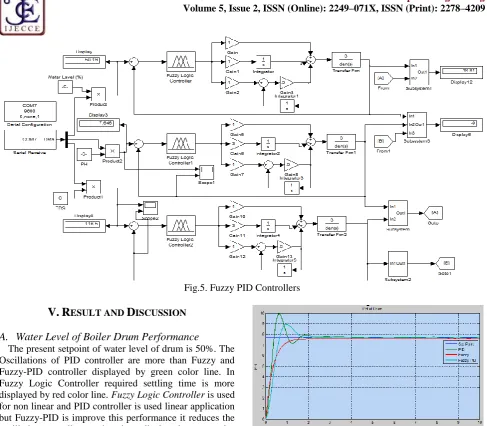
ONTROLLERCopyright © 2014 IJECCE, All right reserved Fig.5. Fuzzy PID Controllers
V.
R
ESULT ANDD
ISCUSSIONA.
Water Level of Boiler Drum Performance
The present setpoint of water level of drum is 50%. The Oscillations of PID controller are more than Fuzzy and Fuzzy-PID controller displayed by green color line. In Fuzzy Logic Controller required settling time is more displayed by red color line. Fuzzy Logic Controller is used for non linear and PID controller is used linear application but Fuzzy-PID is improve this performance it reduces the oscillation as well as setting time, displays by cyan color line. The performance of drum level of water is shown in fig. 6 (a).
Fig.6(a) Perpormance for Water Level of Drum
B.
pH of Drum Water Performance
The required pH of water is 7 to 9.2. The initial oscillations of PID controller are more colored as green color line. The present setting time of Fuzzy Controller is near about 1.5 second and setpoint is 7.7. Also Fuzzy controlled output is below the level of setpoint displayed as red color line. The Fuzzy-PID controller numbers of oscillation are less as well as settling time is medium present reading is 0.6 second shown in cyan color line. Performances of the given controllers are shown in fig.6 (b).
Fig.6. (b) Perpormance for pH of Drum
C.
TDS of drum performance
The required TDS of water is 80 to 115 mg/L. Present setpoint of the TDS is 110mg/L. The performance of PID, Fuzzy and Fuzzy-PID controller displayed as Green, Red and Cyan Color lines shown in fig 6(c).
Fig.6 (c) Perpormance for TDS of Drum
D.
Inlet Valve Performance
Fuzzy-PID is depicted as red color line. The performance of PID Fuzzy and Fuzzy-PID controller is shown in fig.6 (d).
Fig.6 (d) Perpormance for Inlet Valve Position
E.
Outlet Valve Performance
It is used for blow down purpose; in case pH and TDS of the water is greater than a given limit it will open and replace the water from drum of boiler. Otherwise it will close. In present diagram initially outlet valve is closed, it will open after 0.5 second. The period 0.5 s to 2 s outlet valve position is unstable but after 2 seconds it is going to constant. The performance of PID, Fuzzy and Fuzzy-PID controller is displayed by corresponding to Blue Green and Red color line shown in fig 6 (e).
Fig.6 (e) Perpormance for Outlet Valve Position
R
EFERENCES[1] James A. Cuddihy, Jr., Walter J. Simoneaux, Robert N. Falgout, and James S. Rauh “Boiler Water Treatment and Related Costs of Boiler Operation: An Evaluation of Boilers in the Louisiana Sugar Industry” Journal American Society Sugar Cane Technologists, Vol. 25, pp.17-30, 2005
[2] D.Madhav, L.Ramesh and, M.Naveen “Heat Recovery through Boiler Blow down Tank” International Journal of Engineering Trends and Technology (IJETT), Vol.4, Issue5, pp.1597-1600, May 2013
[3] V. G. Vijaya and A. Kumaraswamy “Design and Implementation of pH Control System for Boiler Feedwater using Industrial Automation Techniques” International Journal of Scientific & Engineering Research Vol. 4, Issue 1, Jan.2013
[4] Vandana Pandya and Deepali Shukla “GSM Modem Based Data Acquisition System” International Journal Of Computational Engineering Research, Vol. 2 Issue.5, pp.1662-1667
[5] S. J. Pérez, M. A. Calva and R. Castañeda “A Microcontroller-Based Data Logging System” Journal of the Mexican Society of Instrumentation, Vol. 3, pp. 24-31.
[6] Baogang Hu, George K. I. Mann and Raymond G. Gosine “New Methodology for Analytical and Optimal Design of Fuzzy PID Controllers” IEEE Transactions on Fuzzy Systems, Vol. 7, No. 5, pp. 421-539, Oct 1999
[7] Chung-Dar Lee, Chin-Wen Chuang and Chih-Chen Kao “Apply Fuzzy PID Rule to PDA Based Control of Position Control of Slider Crank Mechanisms IEEE Conference on Cybernetics and Intelligent Systems Singapore pp. 508-513, Dec. 2004
[8] Zwe-Lee Gaing “A Particle Swarm Optimization Approach for Optimum Design of PID Controller in AVR System” IEEE Transactions on Energy Conversion, Vol. 19, No. 2, pp.384-391 June 2004
[9] Alexander G. Parlos, Sanjay Parthasarathy, and Amir F. Atiya “Neuro-Predictive Process Control Using On-Line Controller Adaptation” IEEE Transactions on Control Systems Technology, Vol. 9, No. 5, pp. 741-755. Sep 2001
A
UTHOR’
SP
ROFILEMr. Hanamane M. D.
is an Associate Prof., Department of Electronics, Smt. Kasturbai Walchand College, Sangli. India. He has pursuing Ph.D. degree in Shivaji University Kolhapur. He has more than 20 years of teaching experience and he has published some International referred journal papers and conference articles. Email: [email protected]
Mr. Attar K. D
.
received Master degree in 2011 in Electronics science with Embedded System specialized from Shivaji University Kolhapur, India and currently pursuing Ph.D. degree in Shivaji University Kolhapur. He has published 6 International journal papers. He has also published more than 15 articles in National and International conferences.
Email: [email protected]
Dr. Mudholkar R. R.
is an Associate Professor in the Department of Electronics, Shivaji University Kolhapur, India. He has more than 25 years of teaching and research experience. His current area of research includes Embedded Fuzzy System, Process Control and Neural Networks. He has published more than 40 papers in referred International journals. He has also presented research articles in National and International conferences.