SMART HOME SERVICES DEVELOPMENT, PROVISIONING, AND
MANAGEMENT FRAMEWORK
Agnius Liutkevičius, Arūnas Vrubliauskas, Egidijus Kazanavičius
Real Time Computing Systems Centre, Kaunas University of TechnologyStudentu St. 50-213, Kaunas, Lithuania
e-mail: [email protected], [email protected], [email protected]
Darius Imbrasas
Joint Stock Company “Elsis TS”, Uosio St. 10, Kaunas, Lithuania e-mail: [email protected]
Abstract. This paper presents the distributed service development and provisioning framework, which is designed to develop, provide, monitor and control various types of existing and future Smart Home applications and services. The framework allows service providers and managers to reduce their operating costs several times as the installation and management of the service is performed remotely and without changing the existing system and without any other additional intervention in the dwellings of end users. The main advantage of the proposed conceptual Framework design is the easy expansion and its difference from existing solutions as it allows integrating any type of services, developed by the third parties without modifying the framework architecture and may only require additional instal-lation of home engineering equipment at users’ homes. Services are available for consumers via different terminal devices existing in the market: PDA, phones, TV sets, PCs, etc. The paper presents the concept and the communi-cation, integration, architectural and service models for the proposed Framework, comparison with related research and results of case study.
1. Introduction
Currently the systems and technologies of home automation, Smart Home, future home, intellectual home environment are rapidly growing in popularity around the world. These systems include the automa-tion of various housing areas such as accounting and control of energy and resource consumption, lighting and climate control, security control, digital multime-dia home systems, automated supervision of home environment and many others. Smart home services development, provisioning and management frame-work features open architecture, which allows pro-viding new interactive forms of services in home envi-ronment, involving the third-party service providers into the business model. The Framework has been conceptualized in cooperation with private company “Elsis TS” to best achieve business requirements and Smart Home users’ expectations. The work has been carried out as the activities of EU funded project “SNAPAS”.
The framework is designed to develop, provide and manage services for Smart Home environment. Common services include: comfort related services
(lighting control, ventilation control, heating control, shutters control, control of security systems, etc.), en-tertainment services (services of media centre, digital TV, video on demand (VoD), games, etc.) services of residential environment (house resident’s health care services, health care services for elderly and disabled residents, services of environmental monitoring and determination of harmfulness), services for neighbor-hood centers (tracking and control services of house engineering equipment, security services, Internet se-curity services, control services of district’s heating, etc.) as well as other services developed in future. The users of Smart home services development, provisio-ning and management framework are developers, ser-vice providers and serser-vice managers, whereas end users of services are Smart Home residents. The framework features adding new Smart Home services in real time, without changing the existing system architecture and structure. Smart Home users can try out, select and control the desired services as well as unsubscribe at any time interactively. Until now global markets offer inflexible specialized solutions of cer-tain companies, thus forcing the users to select stan-dard services in advance without being able to easily
abandon them later or subscribe to new services, with-out changing the existing Smart Home system, which is costly and sometimes impossible. Currently offered commercial Smart Home solutions are usually en-closed and do not allow third-parties to provide ser-vices, whereas on the basis of the proposed framework new business models can be formed, where all inte-rested third-parties are be allowed to provide Smart Home services on the basis of already existing Smart Home infrastructure. The software stack and meta-model of universal service has been designed which allows immediate integration of new services without changing the underlying architecture.
The rest of the paper is structured as follows. Sec-tion 2 overviews the related works. SecSec-tion 3 descri-bes the main ideas of the proposed framework. In sec-tion 4, communicasec-tion as well as integrasec-tion model for Smart Home services are provided. The system archi-tecture is given in section 5. Case study and imple-mentation results are presented in section 6. Section 7 contains conclusions.
2. Related Work
While the overall technological level as well as the degree of automation is increasing, more and more people seek for maximum comfort, security, time and resource savings and maximum integration with mo-dern systems of information and digital content. For some groups, such as disabled or elderly people, automation of home environment is a priority and a vital matter. The demand for Smart Home services especially increased for energy-saving and environ-mental purposes in the world and it is expressed by European Commission directives. Company “Nokia“ performed market research, which showed that ser-vices for ensuring security and serser-vices of energy efficiency are identified as the most relevant, while the opportunity for energy savings (55 percent of votes) is recognized as the most popular [1].
Contemporary home residents are interested in re-ceiving various Smart Home services that would pro-vide high level of comfort, security, guarantee lower costs for housing maintenance and control, allow home residents to receive and disseminate the digital content and information, improve the characteristics of population’s living environment, take care of their health and physical condition. Providers and managers of Smart Home services are also interested in a service provision system that would ensure low operating costs, simple expansion by new services, easy main-tenance and monitoring. The third concerned group – developers of Smart Home services, who wish to offer their services to a wider range of end users, but due to existing Smart Home deficiencies they were unable to do this so far.
Currently home residents and users of housing ser-vices do not have a possibility to select and control the desired services via on-line mode. Also a possibility for temporarily trial of certain services is not
available. Existing Smart Home systems are inflexible and do not allow selecting needed services in an interactive way according to user needs. The existing systems have a limited set of services. This set is defined in a fixed way while creating Smart Home. When a need for new services arises, the existing service system must be altered in both sides not only in the service provider’s and service manager’s side, but also, what is the worst, in the end user’s side. System operating costs and the cost of services for end user increase. The end users can not immediately obtain the desired services and are forced to wait until the services are deployed in the Smart Home environ-ment. Consequently the comfort level of Smart Home residents and expenditures for the purchase of services are affected. Service providers and managers are also affected due to the fact that it is difficult and expen-sive to adapt their systems to new user needs.
Smart home services development, provisioning and management framework helps to avoid these problems allowing implementing new services for the users in an interactive way. Users are able to try out, activate or refuse new services by using Smart Home Web portal. Service providers and managers will re-duce their operating costs several times as the install-lation and management of the service is performed remotely and without changing the existing system and without any other additional intervention in the dwellings of end users. The framework which is being planned not only allows third parties to create and distribute their services by contract with Smart Home service provider and manager, but also will integrate the already existing technologies of home manage-ment and service provision from different manufac-turers into a unified system.
The analysis of recent years Smart Home research was performed and it was found that scientists focus mostly on the end users of services, technologies [2-7], communication of Smart Home with external sys-tems through the gateway or any other equipment [8-10], as well as on Smart Home architecture issues [11-14]. However there is a lack of broader approach to the problem of service provision, involving into this all participants of business process: service develo-pers, suppliers and customers.
technologies of web portals. Open platforms, as Ubi-Home or OSGi [13] are intended for inter-coordina-tion and remote control of home engineering equip-ment, but tools as well as architectures for service creation, provision and management are not mentio-ned at all.
3. Conceptual design of Smart Home services development, provisioning and
management framework
Smart Home services development, provisioning and management framework is a distributed multi-component system, which consists of three main con-ceptual parts: the environment for development, provi-sion and management of Smart Home services; ser-vice center of a neighborhood; control equipment for installations of residential house and information sub-system.
The Framework is based on the Internet techno-logies for providing Smart Home services via different communication channels, including broadband, local area networks, mobile operator’s networks. The Framework is independent of geographical location and enables to develop, provide and monitor Smart Home services from any Internet location. Smart Home services development, provisioning and mana-gement framework enables new business models like B2B, B2C and even C2C (Figure 1). During the lifecycle of services, the Framework automatically monitors and controls provision of services and their quality, it also informs about nonstandard or emer-gency situations. Smart Home residents can select (or refuse) the desired services themselves, buy and con-figure them.
The main advantage of the proposed conceptual Framework design is the easy expansion and its difference from existing solutions as it allows integ-rating any type of services, developed by the third parties without modifying the framework architecture and may only require additional installation of home engineering equipment at users’ homes.
Figure 1. Scenario for provision of services (B2B – Business-to-Business; B2C – Business-to-Customer;
C2C – Customer-to-Customer)
Services are available for consumers via different terminal devices existing in the market: PDA, tele-phones, TV sets, PCs, etc.
4. Integration and Communication Models of Services
4.1. Three-tier service model
Smart Home services development, provisioning and management framework enables system managers to organize the distribution of new innovative ser-vices. Because service providers can theoretically be any outside organizations or companies, a universal service model has been designed, which would be suitable for service of any type and complexity, depen-ding on the specific service provider’s profile and working style. Some home services are designed to manage home equipment, while others simply trans-mit digital information to Smart Home residents, other services – for interactive communication between ser-vice provider and serser-vice consumer.
Model-view-controller (MVC) design pattern is selected as a basis of service architecture. Service contains application with user interface, data model and control logic [15]. MVC architecture is useful because the same service data model can have several views what is extremely important providing the pos-sibility for Smart Home residents to control services by phone, PC, TV remote control, PDA, etc. Any service is allocated between the supplier, manager and service user. Depending on the service type, it may not have certain layers. E.g. shutter control service does not need a database while entertainment services do not operate any equipment. Finally, any service can have a set of different user interfaces, intended for several terminal devices.
Usually the service has at least one user interface, and ideally – all possible graphic environments, suit-able for any control devices. Since mobile devices, like PDA for example, have many limitations for GUI design and usability [16], MVC approach allows creating specialized presentation layers for any kind of end-user devices. This generalized model allows deve-loping services using the principles of component-based development [17], while the service itself is made up of individual components by integrating them into a single distributed system. Another advan-tage of MVC based service model is the possibility of parallel development of the individual layers of the service, ensuring the possibility to reuse already developed parts of services and commercials off the shelf (COTS) by the third-parties.
4.2. Services integration model
all processes of integration are achieved remotely; they are automatically operated from the admin work-station (s) on the manager’s side. Service updates, maintenance and configuration are applied under the same principle with no need for additional works at user’s home. The same principle applies to service providers who on their side may also have certain parts of provided service. Part of the service that is installed on the recipient’s side must integrate and communicate with the service part installed on the service provider’s side. Distributed service integration stack is used for that purpose.
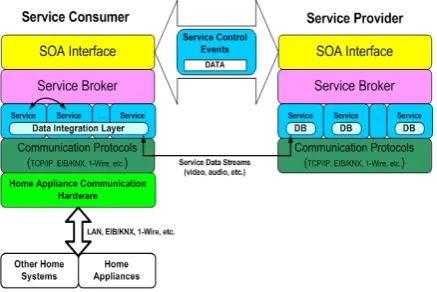
Logical structure of services’ integration stack is shown in Figure 2. The Framework integration stack is a universal package of SW modules, intended for automatic integration to provision new and existing services. The figure shows the logical structure of ser-vices’ integration and delivery stack, where services are implemented in the highest layer, integration among services is achieved in the layer of services’ integration, service provision is assured in the layer of service broker.
Figure 2. Integration stack of smart home services
Since the system is distributed and forms N-to-M connection (many users – with – one or more service suppliers) so service stack is distributed over all subsystems. SOA (Service Oriented Architecture) interface is responsible for data transmission of ser-vices via communication networks. The service itself is wrapped into service component, which consists of metadata [18] about the service and business logic component, responsible for the provided service func-tions.
Lower stack layers are responsible for various communication protocols of home engineering equip-ment (EIB, LAN, 1-Wire, etc.), by the aid of which business logic components can control engineering devices or other housing systems.
4.3. Compatibility model for interrelated Smart Home services
Each Smart Home service is designed and imple-mented based on the MVC design pattern, so compati-bility of interrelated services can be ensured in all three MVC layers. Data related to provisioned service
are stored in the data layer. Since service user usually orders more than one service, there is no need to create a separate database for each service. Therefore all services use one database and every service has assigned individual database area. If necessary, in case when several services have to use the same data, these services can access the same data tables. Algorithms of service operation are implemented in business logic layer. Service interaction in this layer is implemented by the aid of asynchronous events. Service broker plays the key role here forming the environment of information exchange among interrelated services and ensures transfer of the event from one service to another.
Compatibility at user’s graphic interface layer is interpreted as integration of two or more user inter-faces into one unified graphic interface. The nature of MVC architecture is intended to solve this type of problems, therefore in this case the main thing is to establish unified application programming interfaces (API), which helps data exchange between the layer of user’s interface and the layer of business logic in related services.
5. Component Model of System Architecture
5.1. Hardware model of Smart Home services development, provisioning and management framework
Architecture of the Framework consists of four main subsystems: Technology platform of service pro-vider; Technology platform of service manager; Tech-nology platform of service developer; Home subsys-tem.
Technology platform of service provider is based on the service provider‘s server, which is intended for the provision of services directly from the provider’s environment to Home Services Server at user’s home. This server can be virtualized by VMware or by simi-lar equipment on the Framework manager’s side. In this case all software needed for the supplier to supply services is installed on the service manager’s side in a virtual supplier’s server and the supplier can admi-nister and control that field remotely over the Internet. Home hardware model consists of several parts: An embedded server for home services; A controller of home engineering equipment; Home engineering equipment; User terminal devices; Other home sys-tems. The main part of home hardware platform is the embedded server for home services, wherein software (or part of it) of services is installed, and user interface of home services’ control – Home Portal. Home Portal can be accessed via Internet browser from a variety of user terminal devices. Home engineering equipment consists of special controllers, sensors and actuators, and in some cases other types of home systems can also be installed.
EIB/KNX, 1-Wire, Digital, analog, etc. All home hardware components are connected to a local area network (LAN); embedded server for home services is connected with virtualized server over the Internet connection and additionally it can (if service provider uses their private server) be connected to service provider’s server.
Technology platform of service developer is in-tended to develop and test new services and a special hardware for those services, using sophisticated tes-ting methods to ensure highest reliability [19, 20, 21], so this platform includes all devices, which could potentially be used at users’ homes. Service developer installs and configures these hardware components in the way as they would be installed at users’ homes and later simulates usage of this service in this platform.
5.2. Component model of home equipment
The main component of home equipment’s model is embedded server for home services. This server is designed to deploy, maintain and manage digital home services that are subscribed by service users. Service software consists of three layers according to the Model-View-Controller pattern:
Visualization layer. This is a special web page de-dicated to manage Smart Home services. This layer is mandatory for all Smart Home services. When new service is being deployed in embedded server for home services, it is automatically integrated into the Home Web portal.
Business logic layer. This is special operating sys-tem service that implements logic of service opera-tion and management. These services directly integrate into the operating system and communi-cate with service mapping layers through inter-faces using web services. Since home services can be designed to control, this layer is also respon-sible for home engineering equipment control through Home engineering equipment controller, which implements programs of autonomous cont-rol for engineering equipment, protocols, commu-nicating with business logic layer of services, and installed drivers, which support engineering equip-ment of various standards (EIB/KNX, 1-Wire, Analog, Digital). Communication between differ-rent cooperating services is ensured by Service broker, which implements information exchange mechanisms among different processes.
The data layer is intended to store local data of ser-vices. E.g. heating control service must store con-figuration settings of heating system. This layer directly interacts with layers of business logic. Service integration stack, deployed in embedded Home Service Server, is responsible for data commu-nication and integration between services and external systems.
5.3. Model of Home service
Model of Home service is depicted in Figure 3. There are three main types of model interfaces in Home service: internal interface (calls of methods, procedures and functions), external interface (TCP/IP Socket level), SOAP interface (calls of Web Services).
Service data layer is in the lowest model level; this layer is consistent with service database. This database is designed to store service related data. This can be a variety of service parameters, user settings, statistics, etc. In some cases the same database can be used by a number of related/associated services, i.e. security and access settings are completely dependent on the service developer.
Figure 3. Model of Smart Home service
Business logic layer is a core element of service model, where all service related calculations and data processing are performed. Data integration module is used to access data and consists of Application Prog-ramming Interface (API) methods that allow adding, modifying and deleting data in service database. Com-ponent of business logic is implemented as operating system service and is autonomous. This component is associated with the four message-based communica-tion components:
Sender/receiver of events of Home engineering equipment’s controller. This component ensures communication between the component of busi-ness logic and the controller of home engineering equipment.
Receiver/sender of service broker’s events. This component ensures communication between the component of business logic and the service broker.
Receiver/sender of technological service status monitoring events. This component ensures com-munication between the component of business logic and external systems. It allows monitoring the service status locally or remotely. It is not used continuously, only in certain cases, e.g. during service testing and tuning-up.
GUI logic component is responsible for identify-cation of user’s terminal device type and presentation of corresponding user interface. GUI logic is intended to process events, which are related to usage of user interface. For that purpose, two communicative com-ponents (user request listener and user request res-ponse) are used. Depending on the user’s performed operations, request listener records these events and transmits them through internal interface to the GUI logic component, which in turn provides the necessary data to process in business logic layer. Similarly after processing data in business logic layer, the result is transmitted to the GUI logic, which delivers data to the user through the component of request response.
Service visualization components for different types of user terminal devices are implemented in the layer of service visualization. GUI components are implemented using Internet technologies; they are delivered to end user as interactive HTML pages with AJAX (Asynchronous JavaScript and XML) techno-logy. Each service has several GUI implementations of different type and the GUI logic component selects one of these implementations, depending on the ter-minal device.
6. Case Study
Prototype digital television service was developed as a proof of presented concept. Using a specialized development environment of IPTV systems based on MS Visual Studio, IPTV service portal was developed on the service developer’s side; this portal offers VoD-type services. Following smart home services deve-lopment, provisioning and management framework ideology, the service was installed on a virtual testing server, to assure that service meets all functional and non-functional requirements. At the next stage, part of service (mapping layer and part of business logic) was moved into the main virtual server on the manager’s side, and a part of it (data layer) was moved into a separate service provider’s server.
Service graphical interface was automatically in-tegrated to Home Portals of service users. In Home Portal, service users can subscribe/unsubscribe, try out and use the VoD (Video-on-Demand) service. Billing information is automatically collected and stored at the manager database as well as in the service provider database.
As a result, the distributed service was developed (Figure 4) with the following advantages: service de-ployment and maintenance is automated and carried out remotely and directly from the environments of
service manager and developer; the service automa-tically integrates into a user’s Home Server; the user can try it new services before ordering; integration with framework billing system is also automated, based on the integration model described in this paper; user can manage services (order, configure, etc.) from any available terminal device (PC, telephone, TV, etc.).
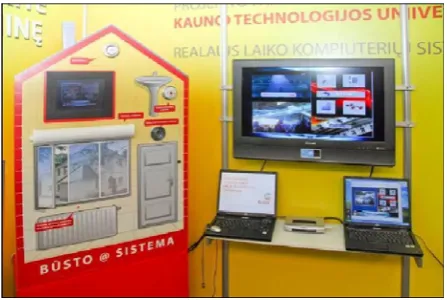
Figure 4. Laboratory testbed of the proposed framework
Analogously other types of services, mentioned in the Section 1 of this article, can be developed and automatically integrated. Currently the services of heating and ventilation control, smart kitchen, lighting control are already being developed and sold; services of security and remote monitoring are planned in the near future.
7. Conclusions
This paper presents the concept and the architect-ture of the distributed service development and provi-sioning system, as well as the component and integra-tion model of service for Smart Homes. As a proof of concept, the ideas presented in this paper were imple-mented in the real world system prototype, which is successfully used for the automatic provisioning of services for the smart home users, including VoD, heating, ventilation, lighting control and smart kit-chen. Smart home services development, provisioning and management framework is a key enabler for new business models, where all interested third-parties are allowed to provide Smart Home services on the basis of already existing infrastructure. Smart Home service model assures immediate integration of new services without changing the existing system. Services can be accessed from any device, like PDA, telephone, TV set, PC, etc.
References
[1] There Corporation. Market study shows positive demand for smart home solutions. November 7, 2008.
Online: http://smarthomepartnering.com/cms/?p=63. [2] Z. Wang, Z. Liu, L. Shi. The Smart Home Controller
Based on Zigbee. 2nd International Conference on Mechanical and Electronics Engineering (ICMEE), 2010, Vol. 2, V2-300 - V2-302.
[3] C. Holzner, C. Guger, G. Edlinger, C. Gronegress, M. Slater. Virtual Smart Home Controlled By Thoughts. 18th IEEE International Workshops on Enabling Technologies: Infrastructures for Collabora-tive Enterprises, 2009, 236 – 239.
[4] M. Jahn, M. Jentsch, C.R. Prause, F. Pramudianto, A. Al-Akkad, R. Reiners. The Energy Aware Smart Home. 5th International Conference on Future Infor-mation Technology (FutureTech), 2010, 1- 8. [5] Z. Etzioni, J. Keeney, R. Brennan, D. Lewis.
Sup-porting Composite Smart Home Services with Seman-tic Fault Management. 5th International Conference on Future Information Technology (FutureTech), 2010, 1-8.
[6] E. Kazanavičius, A. Mikuckas, I. Mikuckienė, J. Čeponis. The heat balance model of residential house. Information technology and control, Kaunas, Lithuania, Vol.35, No.4, 2006, 391-396.
[7] O. Yang-Xin, S. Chun-Yan, J. Hong, L. Yang. Re-search on smart appliances control protocol. Second International Workshop on Education Technology and Computer Science (ETCS), 2010, Vol. 2, 551 – 554. [8] H. Mineno, Y. Kato, K. Obata, H. Kuriyama, K.
Abe, N. Ishikawa, T. Mizuno. Adaptive Home/Buil-ding Energy Management System Using Heteroge-neous Sensor/Actuator Networks. 7th IEEE Consumer Communications and Networking Conference (CCNC), 2010, 1-5.
[9] D. Yan, Z. Dan. ZigBee-based Smart Home System Design. 3rd International Conference on Advanced Computer Theory and Engineering (ICACTE), 2010,
Vol. 2, V2-650 - V2-653.
[10] H. Pensas, J. Vanhala. WSN Middleware for Exis-ting Smart Homes. Fourth International Conference on Sensor Technologies and Applications (SENSORCOMM), 2010, 74-79.
[11] K. Jin, C. Hyeok-soo, W. Hui, A. Nazim, D.M. Ja-mal, H.J. Won-Ki. POSTECH’s U-Health Smart Home For Elderly Monitoring and Support. IEEE International Symposium on a World of Wireless Mobile and Multimedia Networks (WoWMoM), 2010, 1-6.
[12] Z. Wei, S. Qin, D. Jia, Y. Yang. Research and Design of Cloud Architecture for Smart Home. IEEE Interna-tional Conference on Software Engineering and Ser-vice Sciences (ICSESS), 2010, 86-89.
[13] N. Papadopoulos, A. Meliones, D. Economou, I. Karras, I. Liverezas. A Connected Home Platform and Development Framework for Smart Home Control Applications. 7th IEEE International Conference on Industrial Informatics, 2009, 402-409.
[14] J. Parra, M.A. Hossain, A. Uribarren, E. Jacob, A. El Saddik. Flexible Smart Home Architecture using Device Profile for Web Services: a Peer-to-Peer Ap-proach. International Journal of Smart Home, Vol. 3,
No.2, April, 2009.
[15] S. Drasutis, V. Pilkauskas, D. Rubliauskas. Trans-formation for designing distributed internet informa-tion systems under model driven architecture. Infor-mation Technology and Control, Vol.34, No.2, 2005, 102-108.
[16] S. Jahn, A. Liu, M. Dimitrov, M. Mazo, F. Jürgen, K. Matthias. Context-aware interaction and navi-gation in mobile games. Information Technology and Control, Vol.35, No.3, 2006, 198-202.
[17] V. Štuikys, R. Damaševičius, A. Targamadzė. A model-driven view to meta-program development process. Information Technology and Control, Vol.39,
No.2, 2010, 89-99.
[18] V. Štuikys, M. Montvilas, R. Damaševičius. Deve-lopment of web component generators using one-stage metaprogramming. Information Technology and Cont-rol, Vol.38, No.2, 2009, 108-118.
[19] E. Bareiša, V. Jusas, L. Motiejūnas, R. Šeinauskas. Generating functional delay fault tests for non-scan sequential circuits. Information Technology and Cont-rol, Vol.39, No.2, 2010, 100-107.
[20] E. Bareiša, V. Jusas, K. Motiejūnas, R. Šeinauskas, Ž. Tamoševičius. Test quality assessment based on small delay defects. Information Technology and Control, Vol.38, No.4, 2009, 263-270.
[21] D. Barisas, E. Bareiša. A software testing approach based on behavioral UML models. Information Tech-nology and Control, Vol.38, No.2, 2009, 119-124.