The Journal of Threatened Taxa is dedicated to building evidence for conservation globally by publishing peer-reviewed articles online every month at a reasonably rapid rate at www.threatenedtaxa.org. All articles published in JoTT are registered under Creative Commons Attribution 4.0 International License unless otherwise mentioned. JoTT allows unrestricted use of articles in any medium, reproduction, and distribution by providing adequate credit to the authors and the source of publication.
OPEN ACCESS
www.threatenedtaxa.org
ISSN 0974-7907 (Online) | ISSN 0974-7893 (Print) Building evidence for conservation globally
Journal of Threatened Taxa
For Focus, Scope, Aims, Policies and Guidelines visit http://threatenedtaxa.org/index.php/JoTT/about/editorialPolicies#custom-0
For Article Submission Guidelines visit http://threatenedtaxa.org/index.php/JoTT/about/submissions#onlineSubmissions
For Policies against Scientific Misconduct visit http://threatenedtaxa.org/index.php/JoTT/about/editorialPolicies#custom-2
For reprints contact <[email protected]>
Communication
The amphibian diversity of selected agroecosystems in the
southern Western Ghats, India
M.S. Syamili & P.O. Nameer
26 July 2018 | Vol. 10 | No. 8 | Pages: 12027–12034 10.11609/jott.3653.10.8.12027-12034
12027
Communica
tion
DOI: http://doi.org/10.11609/jott.3653.10.8.12027-12034 | ZooBank: urn:lsid:zoobank.org:pub:2C0BC2C3-66A3-4BE0-86FF-D8306F4A9398
Editor: Mirco Solé, Universidade Estadual de Santa Cruz, Bahia, Brasil. Date of publication: 26 July 2018 (online & print)
Manuscript details: Ms # 3653 | Received 26 October 2017 | Final received 30 June 2018 | Finally accepted 18 July 2018
Citation: Syamili, M.S & P.O. Nameer (2018). The amphibian diversity of selected agroecosystems in the southern Western Ghats, India. Journal of Threatened Taxa
10(8): 12027–12034; http://doi.org/10.11609/jott.3653.10.8.12027-12034
Copyright: © Syamili & Nameer 2018. Creative Commons Attribution 4.0 International License. JoTT allows unrestricted use of this article in any medium,
reproduc-tion and distribureproduc-tion by providing adequate credit to the authors and the source of publicareproduc-tion.
Funding: Kerala Agricultural University.
Competing interests: The authors declare no competing interests.
Author Details: M.S. Syamili is an Assistant Professor and works primarily on herpetofauna and birds. P.O. Nameer is a Professor and his research interest include
the taxonomy, biogeography and ecology of the vertebrates except fishes.
Author Contribution: Both the authors contributed equally to the field work, morphometric data collection, analysis and manuscript preparation.
Acknowledgements: We express our deep sense of gratitude and thanks to Dr. Neelesh Dahanukar, IISER, Pune who helped us for analysing the data. Sreekumar,
E.R. and Harikrishnan, S. helped us in various ways during the course of the study. We thank the Dean, College of Forestry, Kerala Agricultural University for the financial and technical support. Azhar Ali, A, Jobin Joseph, U.S. Amal, Afthab Faisal, Habeel Sahal, Abhin M. Sunil, Abhirami M. Jayakumar, Dilgith Surendran, M.R. Bharath and Francis Scaria helped us in the field work. We also thank the anonymous reviewers and the Subject Editor for their critical comments.
The amphibian diversity of selected agroecosystems in the
southern Western Ghats, India
M.S. Syamili1 & P.O. Nameer2
1,2 Centre for Wildlife Studies, College of Forestry, Kerala Agricultural University, Thrissur, Kerala, 680656, India 1 [email protected], 2 [email protected](corresponding author)
ISSN 0974-7907 (Online) ISSN 0974-7893 (Print)
OPEN ACCESS
Journal of Threatened Taxa | www.threatenedtaxa.org | 26 July 2018 | 10(8): 12027–12034
Abstract: A study was conducted to evaluate amphibian diversity in selected agroecosystems of central Kerala within the southern Western Ghats of India, from January to May 2017. A total of 10 anurans were recorded from cashew plantation, coconut plantation, homegarden and rubber plantation using a combination of quadrat sampling and visual encounter survey. We recorded three species endemic to the Western Ghats: Minervarya keralensis, Pseudophilautus wynaadensis and Indosylvirana urbis from these agroecosystems. Pseudophilautus wynaadensis is a threatened species with Endangered status as per the IUCN Red List. The present study shows a strong relationship between the types of agroecosystems and abundance of different amphibian species. This study highlights the potential of agroecosystems within and adjacent to the Western Ghats mountains to act as important abodes to conserve generalist species of amphibians and to provide a suitable habitat for threatened and endemic species.
Keywords: Endangered, Minervarya keralensis, frog, Indosylvirana urbis, Pseudophilautus wynaadensis, threatened species, Thrissur.
Malayalam Abstract:
INTRODUCTION
Amphibians are important predator and prey species in both aquatic and terrestrial habitats, especially in the tropics where the diversity and abundance of taxa are high. According to Whiles et al. (2006) loss of one species is akin to loss of two species in the case of amphibians. Baillie et al. (2004) stated that among the vertebrates of the world, amphibians are the most threatened taxa and have the highest proportion of species on the verge of extinction. The most pervasive threats to amphibians are habitat loss and habitat degradation.
For the amphibians of the Western Ghats the species accumulation curve has not yet reached a plateau (Aravind et al. 2004). According to Nameer et al. (2015) & Das (2015) 90% of amphibians in Kerala are endemic to the Western Ghats and 33% belong to various threatened categories. Generally, protected area networks are considered as the corner stone of biodiversity conservation efforts. Perfecto & Vandermeer (2008) commented that conservation strategies which focus on tropical forests while ignoring the multiple land uses in which they are embedded are failed strategies. According to Nair (2008), agroforests can be considered as potential oases for disappearing species, even though they cannot substitute for natural forests. Wanger et al. (2009) assessed the herpetological diversity in cacao agroforests of Southeast Asia, where they observed that
certain habitat features like increase in leaf litter favour the richness and abundance of disturbance-tolerant species. Bionda et al. (2011) worked on the amphibians of various agroecosystems in Argentina and found that there are species which take advantage of the hydrology and hydroperiod of agroecosystems for their survival. Not all agroecosystems contribute equally towards conservation.
Hence, for a realistic conservation strategy one should evaluate the conservation value of these multiple land use systems such as agroecosystems. The present study is expected to shed light on the amphibian diversity and richness in agroecosystems of Kerala.
STUDY AREA
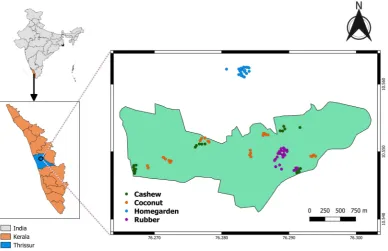
The study was conducted in the selected agroecosystems in Thrissur District, southern Western
Ghats, Kerala (10.53–10.55 0N & 76.27–76.280E, 20–
70 m). The chosen agroecosystems include, cashew plantation, coconut plantation, homegarden and rubber plantation (Fig. 1). The study area chosen mostly comes within the main campus of the Kerala Agricultural University, in Kerala, southern India. The campus has a total area of 391.44ha and is located very close to the Peechi-Vazhani Wildlife Sanctuary. The major habitats include gardens, botanical garden, plantations of rubber,
Journal of Threatened Taxa | www.threatenedtaxa.org | 26 July 2018 | 10(8): 12027–12034
Amphibians of agroecosystem of Western Ghats Syamili & Nameer
12029
coconut, plantain, cacao, and orchards of mango, jackfruit, sapota and guava. The whole area must have been under the forests about one and a half century or so and was subsequently converted mostly into rubber plantations. Later the land was handed over to the Kerala Agricultural University (KAU) in 1971, and the KAU had developed these areas into the different land uses as is explained above. The 14-year mean minimum
temperature is 23.30C and 10-year mean maximum is
31.90C. The area receives south-west and north-east
monsoons, the greater portion of the rainfall, however is received from the south-west monsoon between June and September. The mean annual rainfall is 2,803.4mm. The mean number of rainy days per year is 112 days (KAU Weather Station 2014).
The study was conducted in four selected agroecosystems such as cashew plantation which is 16 years old and spreads over an area of 90 acres, a coconut plantation, which is about 35 years old and has an extent of 50 acres, a homegarden covering eight acres about 40 years old, and a rubber plantation with an extent of 60 acres and is about 67 years old.
METHODS
The study was conducted from January 2017 to May 2017. Quadrat sampling was the primary method adopted for the study and was supplemented with visual encounter survey.
Quadrat Sampling
One hundred quadrats each having a size of 10m × 10m were deployed in the study area randomly with a
minimum distance of 10m between two quadrats. The observations were taken between 19:00hr and 20:30hr. Two observers surveyed the quadrat from opposite corners approaching the center in a clockwise manner for thorough search of the ground-dwelling amphibians (Harikrishnan et al. 2012).
Visual Encounter Survey
Visual encounter survey was conducted in the study locations (Harikrishnan et al. 2012). This was done between 20:30–21:30 hr. LED torches and head lamps were used to spot the amphibians. During the survey, a range of possible microhabitats where the amphibians could be seen, such as rocks, marshes, fallen logs, tree holes, snags and water bodies were thoroughly examined.
RESULTS AND DISCUSSION
Amphibian diversity of selected agroecosystems
A total of 10 anurans belonging to five families were recorded from the selected agroecosystems of central Kerala (Table 1). This includes two species each from the families Microhylidae, Ranidae and Rhacophoridae, three species from Dicroglossidae and one species from Bufonidae. Dicroglossidae represented 30% of the amphibians encountered during the present study, however, these are commensal and generalist species. These include Euphlyctis cyanophlyctis, Hoplobatrachus
crassus and Minervarya keralensis. According to
Gururaja et al. (2007), anthropogenic changes in land use type, canopy cover and hydrological regimes support the presence of more generalist amphibian species.
Table 1. Species diversity of amphibians of selected agroecosystems of Thrissur District, Kerala
Common name Scientific name Family samplingQuadrat Visual encounter survey statusIUCN
Three species that are endemic to Western Ghats namely Minervarya keralensis, Pseudophilautus
wynaadensis and Indosylvirana urbis were reported from
the agroecosystems that were studied (Biju et al. 2004, 2014; Biju & Bossuyt 2009; Gururaja 2012; Das 2015;
Sanchez et al. 2018). Pseudophilautus wynaadensis, an Endangered species (Biju et al. 2004) was found to be present in all the agroecosystems surveyed during the present study (Table 2).
Rathod & Rathod (2013) reported highest diversity of amphibians from organic coffee plantations of Kodagu District where diversity of native rainforest trees was also high. Chemical contamination by the use of fertilizers and pesticides in the agricultural fields lead to incidence of abnormalities among common frog species as their breeding period coincides with the time of agrochemical application in the fields (Gurushankara et al. 2007; Kittusamy et al. 2014; Krishnamurthy et al. 2008). No abnormalities, however, were observed among the 569 individuals of amphibians recorded during the current study.
Quadrat sampling recorded only seven species from the study location. Though visual encounter survey also recorded seven species, it recorded three species that were not recorded through quadrat sampling (Table 1). It is potentially possible to obtain the complete species inventory of the sampled area when visual encounter survey is combined with another sampling technique (Eekhout 2010).
Duttaphrynus melanostictus (Schneider, 1799)
During the present study, Common Indian Toad
Table 2. Amphibian diversity and abundance from selected agroecosystems
Species PlantationCashew PlantationCoconut gardenHome Plantation TotalRubber
Duttaphrynus
melanostictus 1 0 0 6 7
Euphlyctis
cyanophlyctis 0 0 0 5
Hoplobatrachus
crassus 0 0 0 14
Minervarya
keralensis 0 0 3 12
Microhyla rubra 0 0 0 1 1
Uperodon
taprobanicus 0 1 0 0 1
Hydrophylax
malabaricus 0 0 0 1 1
Indosylvirana
urbis 0 0 0 20
Polypedates
maculatus 0 3 0 0 3
Pseudophilautus
wynaadensis 5 7 143 347 502
Total 6 11 146 406 569
Du aphrynus melanosctus
Euphlycs cyanophlycs Hoplobatrachus crassus
Fejervarya keralensis
Microhyla rubra
Uperodon taprobanicus Hydrophylax malabaricus
Indosylvirana urbis Polypedates maculatus Pseudophilautus wynaadensis Cashew Plantaon Home garden Rubber Plantaon
-8 -7 -6 -5 -4 -3 -2 -1 0 1
-2.0 -1.5 -1.0 -0.5 0.0 0.5 1.0 1.5 2.0 2.5 3.0 Coconut plantaon
Test of associaon
Chi-square = 236.6, df = 27, P < 0.0001
CA axis 1
C A axis 2 0.00 0.05 0.10 0.15 0.20 0.25 0.30 0.35 0.40
1 2 3 75 80 85 90 95 100 eigen v alue cumula v e v aria on e xplained (%) CA axis
Journal of Threatened Taxa | www.threatenedtaxa.org | 26 July 2018 | 10(8): 12027–12034
Amphibians of agroecosystem of Western Ghats Syamili & Nameer
12031
(Image 1) was encountered from cashew and rubber plantations. It was also sighted in different colour morphs (Images 1A–D) and all individuals were adults.
Euphlyctis cyanophlyctis (Schneider, 1799)
Skittering Frog (Image 2) was sighted only at the pond in the rubber plantation. In this case also only adult individuals were sighted.
Figure 3. Species richness and abundance of amphibians of selected agroecosystems in southern Western Ghats, India
S = species richness ; N = number of individuals
Hoplobatrachus crassus (Jerdon, 1853)
Jerdon’s Bullfrog (Image 3) is another species which was detected only at the pond within the rubber plantation. The individuals sighted included both adults and juveniles. Hoplobatrachus crassus as well as
Euphlyctis cyanophlyctis are species that prefer water
bodies, thus justifying their presence at the pond.
Minervarya keralensis (Sanchez et al. 2018)
Kerala Warty Frog (Images 4A–B) was detected from the homegarden and from the pond within the rubber plantations. Only adult individuals were sighted for this species. This species was formerly under the genus
Fejervarya, but now is under the new genus Minervarya
(Sanchez et al. 2018).
Microhyla rubra (Jerdon, 1854)
Reddish Narrow-mouthed Frog (Image 5) was sighted from the premises of the pond in the rubber plantation during visual encounter survey. Interestingly, all the individuals recorded were juveniles of very small size.
Image 1. Common Indian Toad Duttaphrynus melanostictus. (A, B, C & D are different colour morphs) © M.S. Syamili © M.S. Syamili
A B
Image 2. Skittering Frog Euphlyctis cyanophlyctis. Image 3. Jerdon’s Bull Frog Hoplobatrachus crassus.
© M.S. Syamili © M.S. Syamili
Uperodon taprobanicus (Parker, 1934)
Painted Frog was spotted from a tree hole within the coconut plantation. This species was sighted only once during the study period.
Hydrophylax malabaricus (Tschudi, 1838)
Fungoid frog (Image 6) was detected only from the rubber plantation. It was found in the moist areas of the
plantation.
Indosylvirana urbis (Biju et al., 2014)
Urban Golden-backed Frog (Image 7) was found on the rocky patches near the pond within the rubber plantation.
Image 6. Fungoid Frog Hydrophylax malabaricus. Image 4. Kerala Warty Frog Minervarya keralensis. (A & B are different morphs)
© M.S. Syamili
Image 5. Reddish Narrow-mouthed Frog Microhyla rubra. © M.S. Syamili
Image 7. Urban Golden-backed Frog Indosylvirana urbis.
© M.S. Syamili © M.S. Syamili
Journal of Threatened Taxa | www.threatenedtaxa.org | 26 July 2018 | 10(8): 12027–12034
Amphibians of agroecosystem of Western Ghats Syamili & Nameer
12033
Polypedates maculatus (Gray, 1834)
Common Indian Tree Frog (Image 8) is one of the most common tree frogs in Kerala. During the visual encounter survey, a male and female of the species were recorded from the coconut plantation. After the first summer shower in May, one additional individual was also observed from the coconut plantation.
Pseudophilautus wynaadensis (Jerdon, 1853)
Jerdon’s Bush Frog (Image 9) was the most common frog during the present study and was recorded from all the agroecosystems selected for the present study. We observed four colour morphs of the species during the study period (Image 9A–D). All the 25 quadrats in the homegarden detected the presence of this species. The highest count of the species was from rubber plantation where there were 30–40 individuals on a single herb of
Rauwolfia tetraphylla near a moist area, due to a leakage
in the irrigation pipeline that passed through the rubber plantation.
It may be noted that all the amphibians sighted within the rubber plantations were either located in a pond in the rubber plantation or from artificially wet areas.
Association between the agroecosystems and abundance of amphibians
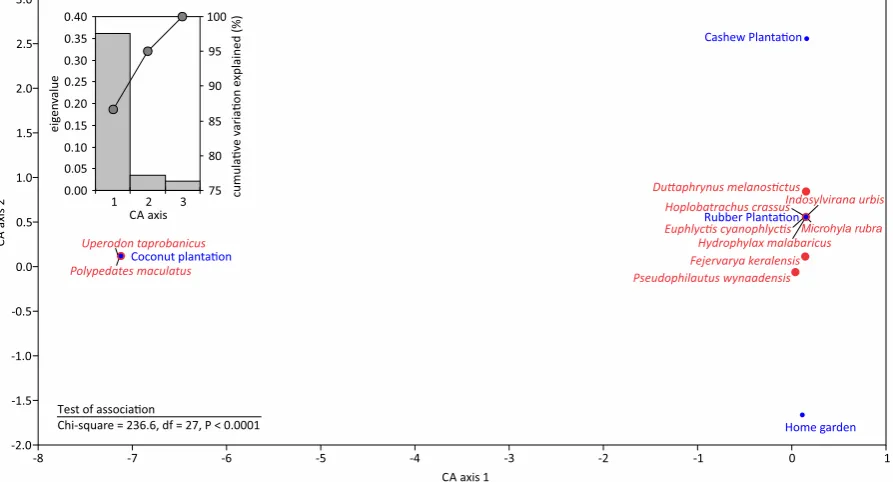
The null hypothesis is that there is no association between the type of agroecosystem and abundance of different amphibian species. The Chi-square test (Chi-square = 236.6, df = 27, P < 0.0001) suggested that there is a strong association between the type of agroecosystem and abundance of different amphibian species (Fig. 2). Correspondence analysis was performed to understand the association between selected agroecosystems and amphibian abundance.
Image 8. Common Indian Tree Frog Polypedates maculatus. © M.S. Syamili
Image 9. Jerdon’s Bush Frog Pseudophilautus wynaadensis (A, B, C & D are different colour morphs).
© U.S. Amal
A B
C © U.S. Amal D
© U.S. Amal
© M.S. Syamili
Polypedatus maculatus and Uperodon taprobanicus
were only present in coconut plantation and this agroecosystem was not preferred by other species of amphibians encountered in the study (Fig. 2). All other species of amphibians prefered rubber plantation. Hoplobatrachus crassus, Hydrophylax
malabaricus, Euphlyctis cyanophlyctis, Indosylvirana urbis and Microhyla rubra were exclusively present
in the rubber plantation, while Minervarya keralensis and Pseudophilautus wynaadensis also preferred homegardens at some level, while Duttaphrynus
melanostictus showed a preference to the cashew
plantation (Fig. 2).
Amphibian abundance and richness was found to be higher in rubber plantation followed by homegarden (Fig. 3). This higher amphibian diversity and abundance in the rubber plantation could be an artifact because of the presence of a pond as well as the presence of a couple of wet areas due to anthropogenic interventions, in the rubber plantations. This could also explain the presence of species such as Euphlyctis cyanophlyctis,
Hoplobatrachus crassus, Indosylvirana urbis, and Microhyla rubra only from the rubber plantation, even
during the summer months. According to Neckel-Oliveira & Gascon (2006), presence of an aquatic habitat is crucial for the existence of certain species of amphibians.
CONCLUSION
Protected areas cover 18% of the Earth’s land area and 8% of Kerala’s geographical area, and they are considered to be corner stones of biodiversity conservation. It is a fact that most of these protected areas are virtual islands embedded within a matrix of multiple land uses. A large proportion of biodiversity coexists with humans in their managed ecosystems, which can hold minimum viable populations of rare and endangered native fauna and flora. The potential of such landscapes in conserving native biodiversity is still untapped. The present study showed that agroecosystems have not only the potential to conserve generalist species, but also help to provide suitable habitat for some threatened and endemic species of amphibians.
REFERENCES
Aravind, N.A., R.U. Shaanker & K.N. Ganeshaiah (2004). Croak, croak, croak: are there more frogs to be discovered in the Western Ghats? Current Science 86(11): 1471–1472.
Baillie, J., C. Hilton-Taylor & S.N. Stuart [eds.]. (2004). 2004 IUCN Red
List of Threatened Species: A Global Species Assessment. Thanet
Press Ltd., Margate, UK, 195p.
Biju, S.D. & F. Bossuyt (2009). Systematics and phylogeny of Philautus Gistel, 1848 (Anura, Rhacophoridae) in the Western Ghats of India, with descriptions of 12 new species. Zoological Journal of the
Linnean Society 155(2): 374–444; http://doi.org/10.1111/j.1096-3642.2008.00466.x
Biju, S.D., G.D. Buddhe, S. Dutta, K. Vasudevan, C. Srinivasulu & S.P. Vijayakumar (2004). Pseudophilautus wynaadensis (errata version published in 2016). The IUCN Red List of Threatened Species 2004. Downloaded on 16 March 2018; http://doi.org/10.2305/IUCN. UK.2004.RLTS.T58937A11859437.en
Biju, S.D., S. Garg, S. Mahony, N. Wijayathilaka, G. Senevirathne & M. Meegaskumbura (2014). DNA barcoding, phylogeny and systematics of Golden-backed Frogs (Hylarana, Ranidae) of the Western Ghats-Sri Lanka biodiversity hotspot, with the description of seven new species. Contributions to Zoology 83(4): 269–335.
Bionda, C.D.L., I.E. di Tada & R.C. Lajmanovich (2011). Composition of amphibian assemblages in agroecosystems from the central region of Argentina. Russian Journal of Herpetology 18(2): 93–98. Das, S. (2015). A checklist of amphibians of the Kerala State. Journal
of Threatened Taxa 7(13): 8023–8035; http://doi.org/10.11609/ JoTT.2003.7.13.8023-8035
Eekhout, X. (2010). Sampling amphibians and reptiles, pp. 530– 557. In: Manual on Field Recording Techniques and Protocols for
All Taxa Biodiversity Inventories. National Focal Point to The Global
Taxonomy Initiative, Belgium.
Gururaja, K.V. (2012). Pictorial Guide to Frogs and Toads of the Western
Ghats. Gubbi Labs LLP.
Gururaja, K.V., K.P. Dinesh, M.J. Palot, C. Radhakrishnan & T.V. Ramachandra (2007). A new species of Philautus Gistel (Amphibia: Anura: Rhacophoridae) from southern Western Ghats, India. Zootaxa 1621: 1–16.
Gurushankara, H.P., S.V. Krishnamurthy & V. Vasudev (2007). Morphological abnormalities in natural populations of common frogs inhabiting agroecosystems of central Western Ghats. Applied Herpetology 4(1): http://doi.org/39-4510.1163/157075407779766651
Harikrishnan, S., S. Chandramouli & K. Vasudevan (2012). A survey of herpetofauna on Long Island, Andaman and Nicobar Islands, India. Herpetological Bulletin 119: 19.
Kittusamy, G., C. Kandaswamy, N. Kandan & M. Subramanian (2014). Pesticide residues in two frog species in a paddy agroecosystem in Palakkad district, Kerala, India. Bulletin of Environmental
Contamination and Toxicology 93(6): 728–734; http://doi. org/10.1007/s00128-014-1351-1
Krishnamurthy, S.V., D. Meenakumari, H.P. Gurushankara & V. Vasudev (2008). Nitrate-induced morphological anomalies in the tadpoles of Nyctibatrachus major and Fejervarya limnocharis (Anura: Ranidae). Turkish Journal of Zoology 32(3): 239–244. Nair, P.R. (2008). Agroecosystem management in the 21st century: it is
time for a paradigm shift. Journal of Tropical Agriculture 46: 1–12. Nameer, P.O., J. Praveen, A. Bijukumar, M.J. Palot, S. Das &
R. Raghavan (2015). A checklist of vertebrates of the Kerala State. Journal of Threatened Taxa 7(13): 7961–7970; http://doi. org/10.11609/jott.1999.7.13.7961-7970
Neckel-Oliveira, S. & C. Gascon (2006). Abundance, body size and movement patterns of a tropical treefrog in continuous and fragmented forests in the Brazilian Amazon. Biological Conservation 128(3): 308–315; http://doi.org/10.1016/j.biocon.2005.09.037
Perfecto, I. & J. Vandermeer (2008). Biodiversity conservation in tropical agroecosystems. Annals of New York Academy of Science 1134(1): 173–200; http://dx.doi.org/10.1196/annals.1439.011
Rathod, S. & P. Rathod (2013). CEPF Western Ghats Special Series: Amphibian communities in three different coffee plantation regimes in the Western Ghats, India. Journal of Threatened Taxa 5(9): 4404– 4413; http://doi.org/10.11609/JoTT.o3054.4404-13
Sanchez, E., S.D. Biju, M.M. Islam, M. Hasan, A. Ohler, M. Vences & A. Kurabayashi (2018). Phylogeny and classification of fejervaryan frogs (Anura: Dicroglossidae). SALAMANDRA 54(2): 109–116. Wanger, T.C., A. Saro, D.T. Iskandar, B.W. Brook, N.S. Sodhi, Y. Clough
& T. Tscharntke (2009). Conservation value of cacao agroforestry for amphibians and reptiles in Southeast Asia: combining correlative models with follow-up field experiments. Journal of Applied Ecology 46(4): 823–832; http://doi.org/10.1111/j.1365-2664.2009.01663.x
Whiles, M.R., K.R. Lips, C.M. Pringle, S.S. Kilham, R.J. Bixby, R. Brenes, S. Connelly, J.C. Colon-Gaud, M. Hunte-Brown, A.D. Huryn & C. Montgomery (2006). The effects of amphibian population decline on the structure and function of Neotropical stream ecosystems. Frontiers in Ecology and Environment 4(1): 27–34;
http://doi.org/10.1890/1540-9295(2006)004[0027:TEOAPD]2.0. CO;2
ISSN 0974-7907 (Online); ISSN 0974-7893 (Print)
July 2018 | Vol. 10 | No. 8 | Pages: 11999–12146 Date of Publication: 26 July 2018 (Online & Print)
DOI: 10.11609/jott.2018.10.8.11999-12146
www.threatenedtaxa.org
The Journal of Threatened Taxa is dedicated to building evidence for conservation globally by publishing peer-reviewed articles online every month at a reasonably rapid rate at www.threatenedtaxa.org. All articles published in JoTT are registered under Creative Commons Attribution 4.0 International License
unless otherwise mentioned. JoTT allows unrestricted use of articles in any medium, reproduction, and distribution by providing adequate credit to the authors and the source of publication.
OPEN ACCESS
Communications
Habitat suitability and threat analysis of Greater One-horned Rhinoceros Rhinoceros unicornis Linnaeus, 1758 (Mammalia: Perissodactyla: Rhinocerotidae) in Rautahat District, Nepal
-- Saru Rimal, Hari Adhikari & Shankar Tripathi, Pp. 11999–12007
Camera-trapping survey to assess diversity, distribution and photographic capture rate of terrestrial mammals in the aftermath of the ethnopolitical conflict in Manas National Park, Assam, India
-- Dipankar Lahkar, M. Firoz Ahmed, Ramie H. Begum, Sunit Kumar Das, Bibhuti Prasad Lahkar, Hiranya K. Sarma & Abishek Harihar, Pp. 12008–12017
In plain sight: Bacular and noseleaf morphology supports distinct specific
status of Roundleaf Bats Hipposiderospomona Andersen, 1918 and
Hipposiderosgentilis Andersen, 1918 (Chiroptera: Hipposideridae)
-- Bhargavi Srinivasulu & Chelmala Srinivasulu, Pp. 12018–12026
The amphibian diversity of selected agroecosystems in the southern Western Ghats, India
-- M.S. Syamili & P.O. Nameer, Pp. 12027–12034
Taxonomic status and additional description of White’s Stalked-eyed Fly Cyrtodiopsis whitei (Curran, 1936) (Diptera: Diopsidae) from India with a key to the allied species and note on its habitat
-- Basant Kumar Agarwala, Pp. 12035–12043
Community structure of benthic macroinvertebrate fauna of river Ichamati, India
-- Arnab Basu, Indrani Sarkar, Siddartha Datta & Sheela Roy, Pp. 12044–12055
Conservation status of Mascarene Amaranth Aerva congesta Balf.F. Ex Baker (Eudicots: Caryophyllales: Amaranthaceae): a Critically Endangered endemic herb of the Mascarenes, Indian Ocean
-- Kersley Bruno Pynee, David Harold Lorence & Poojanraj Khurun, Pp. 12056– 12063
Vegetative and reproductive phenology of Aquilaria malaccensis Lam. (Agarwood) in Cachar District, Assam, India
-- Birkhungur Borogayary, Ashesh Kumar Das & Arun Jyoti Nath, Pp. 12064– 12072
Conservation Application
Taking the first steps: Initial mapping of the human-wildlife interaction of the Mauritius Fruit Bat Pteropus niger (Mammalia: Chiroptera: Pteropodidae) in Mauritius by conservation organizations
-- Brandon P. Anthony, Vikash Tatayah & Deborah de Chazal, Pp. 12073–12081
Peer Commentary
The term human-wildlife conflict creates more problems than it resolves: better labels should be considered
-- Priya Davidar, Pp. 12082–12085
Short Communications
First photographic evidence of Snow Leopard Panthera uncia (Mammalia: Carnivora: Felidae) outside current protected areas network in Nepal Himalaya
-- Rinzin Phunjok Lama, Tashi R. Ghale, Madan K. Suwal, Rishi Ranabhat & Ganga Ram Regmi, Pp. 12086–12090
Small carnivores of Silent Valley National Park, Kerala, India
-- Devika Sanghamithra & P.O. Nameer, Pp. 12091–12097
Status survey and conservation of the House Sparrow Passer domesticus (Aves: Passeriformes: Passeridae) through public participation in Kannur, Kerala, India
-- R. Roshnath, C.P. Arjun, J. Ashli, D. Sethu & P. Gokul, Pp. 12098–12102
The ecology and distribution of percoid fish Dario neela from Wayanad in the Western Ghats of Kerala, India
-- Dencin Rons Thampy & C.P. Shaji, Pp. 12103–12107
A checklist of the ornamental fishes of Himachal Pradesh, the western Himalaya, India
-- Indu Sharma & Rani Dhanze, Pp. 12108–12116
Odonate diversity of Nalsarovar Bird Sanctuary - a Ramsar site in Gujarat, India
-- Darshana M. Rathod & B.M. Parasharya, Pp. 12117–12122
Root holoparasite Balanophora polyandra Griff. (Balanophoraceae) in eastern Himalaya (Sikkim, India): distribution, range, status and threats
-- Prem K. Chhetri, Alexander R. O’Neill & Bijoy Chhetri, Pp. 12123–12129
Notes
Transfer of Storena gujaratensis Tikader & Patel, 1975 to the genus Suffasia Jocqué, 1991 (Araneae: Zodariidae)
-- Reshma Solanki, Manju Siliwal & Dolly Kumar, Pp. 12130–12132
Intraguild predation of green lacewing larvae (Neuroptera: Chrysopidae) on spider eggs and spiderlings
-- K.K. Srikumar, S. Smitha, B. Suresh Kumar & B. Radhakrishnan, Pp. 12133– 12136
Rediscovery, extended distribution and conservation assessment of Cinnamomum goaense (Lauraceae) in the Western Ghats, India -- M.P. Geethakumary, S. Deepu & A.G. Pandurangan, Pp. 12137–12139
Coltriciella dependens (Berk. & M.A. Curtis) Murrill, a new addition to wood-rotting fungi of India
-- Ayangla S. Pongen, Kuno Chuzho, N.S.K. Harsh, M.S. Dkhar & Manoj Kumar, Pp. 12140–12143
Book Review
The need of conservation laws coherent with communities for complete success
-- S. Suresh Ramanan & Lalit Upadhyay, Pp. 12144–12145
Miscellaneous