Volume 02, No. 4, April 2016
P
age
190
Improvement in Coverage Ratio Using Overlap Sensing Shifted
Node Using Th-Ecosr in Grid
Sumit Dwivedi* and Mrityunjay Singh**
*M. Tech, Department of Computer Science And Engineering, SRM University **Assistant Professor, Department of Computer Science And Engineering, SRM University
ABSTRACT
In this work, we consider or merges the enhance coverage ratio and Overlap-Sense Ratio using mobility in heterogeneous with wireless sensor network (WSN). We study the dead node condition replacement in grid for whole network which are (100*100) that’s provide more security with respect existing system. Their main goal is to sense dead node and target field and transmit advance node to a grid. Therefore, connectivity of the sensor network and the coverage ratio of the censored area are the most applicable concerns to spread these goals. In other scenario this deliberates the communicate dead node situation problem in wireless sensor networks: where to place a limited number of available nodes that can act as other relays to forward sensor data near base stations. This Thesis proposes a merges of ECRM and overlap-sense ratio namely enhance coverage overlap-sense ratio (ECOSR) in direction to improve the network connectivity and the coverage ratio of the sensored area. Our lower energy shifting propagation-loss model comprises with path loss function with random distributed shadowing, independent across with base stations. Our results are valid in the whole estate of ECOSR (Energy coverage overlap sensing ratio), in particular for Th-ECOSR < 1, where one discovers multiple coverage.
Keyword: WSN, ECRM, sensor nodes, heterogeneous, Th-ECOSR etc.
I. INTRODUCTION
Wireless Sensor Networks (WSNs) is a distributed system which is composed of tiny, low-cost, battery-operated sensor nodes that collaborate together for the purpose of achieving certain task such as environment monitoring and object tracking. Wireless Sensor Networks (WSNs) are useful for military, environment and scientific applications such as vehicle tracking, habitat monitoring, forest surveillance, earthquake observation, biomedical, building surveillance, monitoring, home automation and many others. A typical large-scale WSN generally consists of one or more sinks (or base stations) and tens or thousands of sensor nodes that have organized themselves into a multi-hop wireless network and deployed either randomly or according to some predefined statistical distribution over a geographical region of interest. Large amount of wireless sensor are deployed on the ground and their data are transmitted back to the base station to provide the necessary monitored information either manually or dynamically without human involvement. Coverage in wireless sensor nodes in the region of interest is one of the key issues in wireless sensor networks. Optimal coverage of nodes is favorably to the maximum possible utilization of the available sensors.
Volume 02, No. 4, April 2016
P
age
191
We have used the term efficient coverage ratio because we have taken the ratio of total area covered by the nodes to that ofthe total network area. This protocol unlike the previous ones is heterogeneous in the sense that the nodes with more energy are subjected to task more often than the other low energy nodes in the network, thus increasing the lifetime of the network. We will show by simulation that the ECOSR protocol gives higher throughput and greater lifetime than the ECRM. It is also shown that our protocol has good coverage ratio throughout the network lifetime. We will also show that ECOSR is energy resilient than any other heterogeneous protocol.
II. RELATED WORK
In recent years, many techniques have been proposed by researchers to improve coverage ratio in wireless sensor network. One such technique is proposed as ECRM (Enhance coverage ratio mobility) deals with mobility of the nodes and some researchers also used SEP (state election protocol) to improve coverage ratio and network lifetime. The proposed technique ECOSR increase the coverage ratio and improve network lifetime.
III. PROBLEM DESCRIPTION
Coverage preservation, unique ID assignment and extension of network lifetime are important features for wireless sensor networks. Grouping sensor nodes into clusters is an effective way to improve the network performance. The ratio of covered area to interested area and the lifetime of the network are two of the most challenging issues in WSNs. This is referred to coverage ratio problem. As an important issue in research, the coverage problem has been studied, and many solutions have been proposed.
IV. PROPOSED METHODOLOGY
In this work, we propose a framework which can transform almost any existing complete coverage algorithm to a partial coverage one with any coverage ratio by running a complete coverage algorithm to find full coverage sets with virtual and converting the coverage sets to partial coverage sets via adjusting sensing node. Our framework can preserve the characteristics of the original algorithms and the conversion process has low time complexity. The framework also guarantees some degree of uniform partial coverage of the monitored area.
Volume 02, No. 4, April 2016
P
age
192
In order to prolong the working time of the network with a full coverage of R, i.e., R = 100%, a root node selection mechanism based on energy-balancing and coverage-preserving techniques is presented.
An energy-aware hierarchical routing algorithm is proposed to determine an energy-efficient path to route the data packets to the BS. In each round, the selection of the root node is decided by the BS, and energy-aware hierarchical routing algorithm is applied to each node.
A. Proposed Energy coverage overlap sensor ratio Algorithm
To solve the problems of ECRM algorithm which is the previous work of our Thesis, with the help of our new concept ECOSR we improve it in the following aspects as in:-
(1) We monitor the sensor nodes‟ energy levels, activating only the nodes with sufficient energy to reduce unnecessary communications between useful nodes and dying nodes.
(2) When selecting next hop nodes, we take both the node hop count and energy level into consideration so that we may distribute power consumption amongst each node’s neighbours, creating balance between packet transmission latency and network energy efficiency.
(3) We assign random scheduling set numbers to the nodes with highest hop count instead of assigning to all nodes in the whole region at the beginning. Using this method, each sensor node belongs to fewer scheduling sets. So there are fewer nodes active at any time, and hence the network power consumption is reduced which in turn prolongs the network lifetime.
(4) Multiple sink nodes are used to further distribute power consumption of nodes and to shorten packet’s transmission latency.
B. Algorithm Basis
We adopt the method in [4] to calculate the minimal number of nodes needed to satisfy m-coverage and n-connectivity for the monitored region. Assume there are N sensor nodes randomly distributed in a circular region with radius R. As for security purpose, we only consider homogeneous networks, since large heterogeneous sensor networks cause manufacturing problems. Assume the sensor nodes have the sensing range of and transmission range of rs. For a large region like the border rr surveillance area, border effects are not so important. We simplify the calculation of the expected value of m-coverage ratio as below.
……….1
(1.1)
Where is the expected number of nodes that cover a point in the region. The expected n-connectivity probability provided by N nodes is
Volume 02, No. 4, April 2016
P
age
193
Where (1.2)
When given the required m-coverage ratio and n-connectivity probability , the minimal number of nodes needed for each condition N (m, ) COV and N (n, ) CON can be calculated from (1) and (2). So the minimal number of nodes needed for the whole network to be m-coverage and n-connectivity is then calculated as below.
(1.3)
Because of the complexity of equations (1) and (2), it is not possible to calculate the number of nodes needed in each set for specific m-coverage and n-connectivity ratios. But we can derive the ratios for specific number of nodes numerically.
1. The phases for lower energy node attention consumption formula and two types of essential to estimate the k-coverage probability in a network with log-normal shadowing (though the shadowing distribution can be slightly arbitrary and without coverage sensing area of higher energy shifting nodes.
2. We use a quadrature method or a simple analytic formula for coverage sense with advance node energy.
3. The more compound high-dimensional essential uses quadrature methods for low dimensions and quasi-random integration for higher (n>2) calculates 1-coverage probability for a network with Rayleigh fading (exponentially distributed with unit mean) and log-normal shadowing.
4. We present a change of variables stimulated by the dimensional spherical coordinates.
s1= u [sin θ1 sin θ2 . . . sin θn−1] 2/β
s2= u [cos θ1 sin θ2 . . . sin θn−1] 2/β
s3= u [cos θ2 sin θ3 . . .sin θn−1] 2/β
· · ·
sn = u[cos θn−1] 2/β (1.4)
Where qi = qi (θi , . . . , θn−1) := (si/u) β/2 . When β = 2 our scheme of synchronizes boils down to the regular n-dimensional spherical coordinates, whose Jacobin is J¯ (u, θ1. . . θn−1) = u n−1 Qn−1 i=1 sini−1 θi ; cf [21, eq. (1.5)]). By introduction (or element belongings and the chain rule) our coordinate system has the corresponding Jacobian Mathematical addition of hyper geometric function 2F1 is used when the model has noise. A close-form answer with 2F1 is used in the no noise case.
Volume 02, No. 4, April 2016
P
age
194
We assume noise power −96dBm normalized by the base station power 62.2dBm which makes W = 10−15.82 . We consider two values for the density of base stations: λ = 4.619km−2, which corresponds to an “OLSR” network deployment and λ = 0.144km−2 for a “suburban” one. We validate our approach by showing that the obtained results coincide with those of simulation with the latter approach being less numerically stable and much more time-consuming.
V. RESULTS AND ANALYSIS
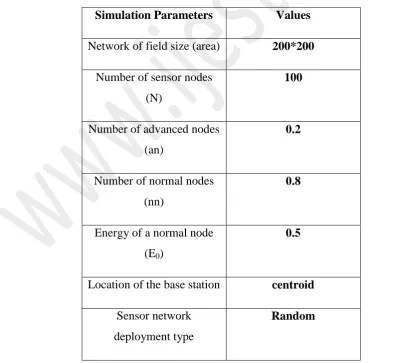
In this section, the existing and the proposed methods are compared. In this existing system, in order to enhance the coverage area a Coverage-Enhancing Algorithm is used based on overlap sense ratio. By adjusting the sensing direction of the nodes, the coverage area is increased with the reduction of computational complexity. The performance of the TH-ECSOR protocol is compared with those of the ECRM with-Coverage- ratio via an extensive series of simulations. The simulations using different protocols are ceased once all nodes run out of energy, and the comparison results generated. In the case I, the same network model in both approaches mentioned above is used to examine the protocols. The ECRM and the ECOSR both set their BS in a remote place, and each node can directly transmit data to the BS. Such a condition, however, is not suitable for a real-world environment, because each tiny low-cost sensor node does not have such strong communication capability.
TABLE 1: SIMULATION PARAMETER
Simulation Parameters Values
Network of field size (area) 200*200
Number of sensor nodes
(N)
100
Number of advanced nodes
(an)
0.2
Number of normal nodes
(nn)
0.8
Energy of a normal node
(E0)
0.5
Location of the base station centroid
Sensor network
deployment type
Volume 02, No. 4, April 2016
P
age
195
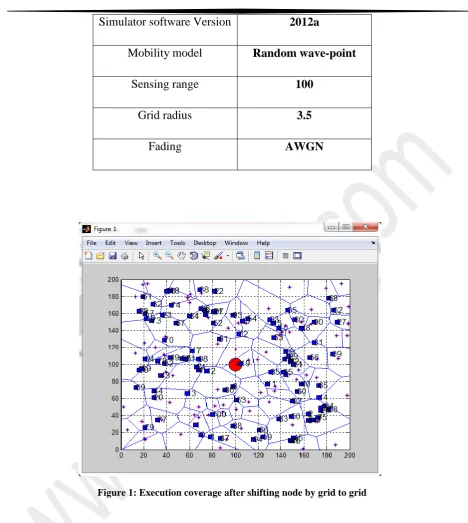
Figure 1: Execution coverage after shifting node by grid to grid
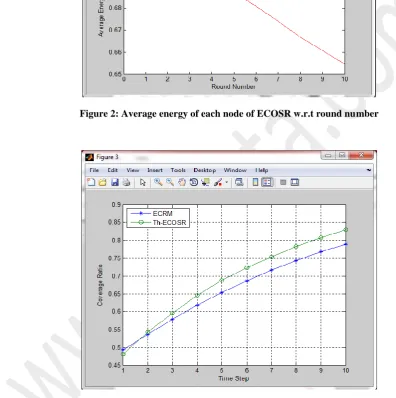
The average energy coverage ratio consumption of each node versus the simulation Time stamp when using two different protocols. The average energy consumption of the TH-ECSOR protocol steadily increases during the simulation due to its energy-balancing capability. Moreover, the comparison between the results yielded by the ECOSR protocols with compare to ECRM.
Simulator software Version 2012a
Mobility model Random wave-point
Sensing range 100
Grid radius 3.5
Volume 02, No. 4, April 2016
P
age
196
Figure 2: Average energy of each node of ECOSR w.r.t round number
Figure 3: Coverage ratio of ECRM and Th-ECOSR w.r.t Time step
VI. CONCLUSION AND FUTURE WORK
Volume 02, No. 4, April 2016
P
age
197
Th-ECOSR algorithm aims to prolong network lifetime with a full sensing coverage for mission-critical applications. Extending network lifetime without the risk of data loss is a basic quality of sensing requirement in such applications. The main idea of the Th-ECOSR algorithm is that in the stage of dead node occurrence both of the energy-balancing and coverage-preservation mechanisms are taken into network with the help of shifting node. With this shifting node selection scheme, the redundant nodes can be chosen as the sense the node in early stages of dead node. In order to enhance the performance of the Th-ECOSR algorithm, the distance and the residual energy of neighbouring nodes is incorporated into the algorithm when choosing an energy-efficient route for each node. The simulation results show that the proposed Th-ECOSR algorithm is able to prolong the network lifetime while retaining 100% coverage. The proposed Th-ECOSR algorithm better perform the existing routing protocols such as the ECRM.
These results suggest that the QoS-guaranteed coverage precedence for WSNs in mission critical applications could be achieved when using the EECHR (Energy efficient coverage heterogeneity routing) protocol &In addition, ACHE can better adapt the applications with the great heterogeneous energy capacities in the sensor networks, as well as effectively reduce the control overhead.
ACKNOWLEDGMENT
This work was supported by the Department of Computer Science and Engineering of SRM University. We would like to thank all the faculty members of our department for their relentless encouragement and support throughout the whole research process.
REFERENCES
i. Jian Chen, Lu Zhang, and Young HongKuo, “Coverage Enhancing Algorithm Based on Overlap-Sense Ratio in Wireless Multimedia Sensor Networks”,IEEE SENSORSJOURNAL,vol. 13,no.6,june. 2013.
ii. C.-Y. Chong and S. P. Kumar, “Sensor networks: evolution, opportunities, and challenges,” Proceedings of the IEEE, vol. 91, no. 8, pp. 1247–1256, 2003.
iii. W. Dargie and C. Poellabauer, Fundamentals of wireless sensor networks: theory and practice. Wiley.com, 2010.
iv. R. T. Lacoss, “Distributed mixed sensor aircraft tracking,” in American Control Conference, 1987, pp. 1827–1830, IEEE, 1987.
v. G. J. Pottie, “Wireless integrated network sensors (WINS): the web gets physical,” in Frontiers of Engineering: Reports on Leading-Edge Engineering from the 2001 NAE Symposium on Frontiers of Engineering, p. 78, National Academies Press, 2002.
vi. G. J. Pottie and W. J. Kaiser, “Wireless integrated network sensors,” Communications of the ACM, vol. 43, no. 5, pp. 51–58, 2000.
Volume 02, No. 4, April 2016
P
age
198
viii. W. J. Kaiser, K. Bult, A. Burstein, D. Chang, et al., “Wireless integrated micro sensors,” in Technical Digest of the 1996 Solid State Sensor and Actuator Workshop, 06 1996.
ix. G. Asada, A. Burstein, D. Chang, M. Dong, M. Fielding, E. Kruglick, J. Ho, F. Lin, T. Lin, H. Marcy, et al., “Low power wireless communication and signal processing circuits for distributed micro sensors,” in Circuits and Systems, 1997. ISCAS’97, Proceedings of 1997 IEEE International Symposium on, vol. 4, pp. 2817–2820, IEEE, 1997.