Turkish Journal of Fisheries and Aquatic Sciences 17: 333-343 (2017)
www.trjfas.org ISSN 1303-2712 DOI: 10.4194/1303-2712-v17_2_12
RESEARCH PAPER
© Published by Central Fisheries Research Institute (CFRI) Trabzon, Turkey in cooperation w ith Japan International Cooperation Agency (JICA), Japan
G.
Sca
rce
lla
e
t a
l.
/
T
u
rk.
J.
F
ish
. Aq
u
a
t.
Sci
. 1
1
: 4
3
3
-4
4
4
(2
0
1
1
)
437
Development of Extruded Shrimp-Corn Snack Using Response Surface
Methodology
Introductıon
Foods have become an integral part of the eating habits of the majority of the world’s population. Basically, they are prepared fro m natural ingredients or components according to predesigned plans to yield p roducts with specified functional properties (Thakur and Sa xena, 2000). Extrusion cooking has been used to develop a wide variety of snack products fro m d ifferent ra w materia ls. It has increasingly been used in the production of breakfast cereals, baby foods, snacks, and modified starch, etc. (Meuser and Van Lengerich, 1984). Ext ruded snack products are predominantly made fro m ce real flour or starches and tend to be low in protein and have a low biologica l value (i.e. low concentration of essential a mino acids (Ainsworth et al., 2007). To produce a nutritious snack, cereals are usually enriched with protein rich food stuff. Re markable progress has been made in the utilizat ion of new protein sources such as leguminous seed, single cell proteins (Kinsella and Fran zen, 1978), spirulina a lga (Joshi, Be ra, Panesar, 2014), fish species (Kong et al., 2008, Pansawat et al., 2008, Shaviklo et al., 2011, Shaviklo et a l., 2014, Singh et al., 2014), c rab meat (Obatolu et a l., 2005) and low -commercial shrimp powder (Shaviklo et al., 2015).
Successful applicat ion of seafood ingredients into cereal based extruded snack products could increase utilizat ion of seafood products and improve the nutritional va lue of cerea l based snacks. Apart fro m their delicacy, c rustacean species such as shrimp, c rab and lobster, consist of amino acids, peptides, protein and other useful nutrients (Sriket et al., 2007). Shrimp meat is an e xce llent source of protein and is also a good source of minerals such as calciu m. Additionally, shrimp muscle consists of polyunsaturated fatty acids (PUFA) such as eicosapentaenoic (20:5n3, EPA) and docosahexaenoic (22:6n3, DHA) acids, considered as essential. The protein content of shrimp meat typica lly ranges fro m 20.44% to 22.46% (Yanar and Çelik, 2006). Shrimp meat co mbination with other nutrients from cerea l sources can provide the basis for a range of highly nutritious extruded snack products.
On the other hand, deterioration of nutrit ional quality, owing to high temperature, is a serious problem in most tradit ional cooking methods. Extrusion cooking technology is preferable to other food-processing techniques in terms of continuous process with high productivity and significant nutrient retention, owing to the high te mperature and short time required Sing, Ga malth, & Wakeling, 2007).
Osman Kadir Topuz
1,*, Nalan Gokoğlu
1, Kirsi Jouppila
2, Satu Kirjoranta
21
Akdeniz University, Faculty of Fisheries, Department of Seafood Processing Technology, 07570, Antalya, Turkey .
2 Helsinki University, Faculty of Agriculture and Forestry, Department of Food and Environmental Sciences, Helsinki,
Finland.
* Corresponding Author: Tel.: +90 242 310 60 19; Fax: +90 242 226 20 13; E-mail: [email protected]
Received 02 July 2016 Accepted 30 September 2016
Abstract
It is aimed to develop a novel shrimp -corn snack using response surface methodology in this study. Dried shrimp muscle was ground and blended with corn flour at the level of 20% (w:w). The shrimp -corn flour mix was extruded through a co-rotating twin-screw extruder with a screw diameter of 24 mm. The effects of extrusion temperature (110-150 °C), screw speed (200-500 rpm) and feed moisture (17-23 g/100 g) on physicochemical and sensory properties of shrimp -corn snack were investigated using response surface methodology. The extrusion temperature had a significant (P≤0.05) influence on hardness, omega-3 fatty acids content and sensory properties of shrimp -corn snack. Increasing extrusion temperature from 110 °C to 150 °C, resulted in a snack with higher hardness and lower omega-3 content. While higher overall acceptance scores were obtained at moderate temperature (130 °C), higher omega-3 contents were obtained at lower temperatures combined with higher feed moistures. Predicted optimum condition for extruded shrimp -corn snack production was follows; extrusion temperature: 127.2 ºC, screw speed: 393.4 rpm, feed moisture: 21.6 g/100 g.
334 O.K. Topuz et al. / Turk. J. Fish. Aquat. Sci. 17: 333-343 (2017)
Extrusion parameters, includ ing feed rate, screw speed, extrusion temperature, retention time , die dia meter, etc., are accounted for the quality of finished products.
Therefore e xtrusion para meters which directly affect product quality should be optimized in order to obtain high-quality e xtruded snack. The overall objective of this study was to develop a novel e xtruded snack by using corn flour and shrimp meat. The specific objective was to evaluate effects of e xtrusion parameters including e xtrusion temperature, screw speed and feed moisture on physicochemica l and sensory properties of shrimp-corn snack.
Materials and Methods
Materials
The corn flour (Ma ize Cor, USA), dried speckled shrimp, Metapenaeus monoceros, (VR Foods, Bankong, Tayland) and salt were purchased from a local food market in He lsinki, Finland. The d ried shrimp meat was ground to a fine particles size by grinder (Kenwood, mode l FP 295, Brita in) and passed through a 1.5 mm mesh screen. The corn flour (79 g/100 g) was mixed with the shrimp powder (20 g/ 100 g) and salt (1 g/ 100 g) in plastic container and kept in the dark cabin at 4 °C until utilization.
Extrusion Cooking of Shrimp Meat
Extrusion tria ls we re performed using a t win -screw e xtruder (PTW-24 Thermo Haake, Dreie ich, Germany.) The e xtruding moisture content was controlled by analyzing the moisture content of the ingredients before e xtrusion. The barrel consisted of one no temperature controlled zone with the solid feed gate and six te mperature controlled zones with the injection gate for the liquid feed at the first zone. A volumetric co-rotating twin-screw (D ¼ 20 mm, L=D of 10) feeder (Brabender, Duisburg, Ge rmany) was used for the solid feed (corn flour and shrimp flour). The te mperatures of the six barre l sections were controlled electronica lly by the e xtruder control screen system. The feeder of e xtruder was ca librated to give a feed rate of 67 g min -1. A peristaltic pu mp (Watson Marlow (505 S), Wilmington, MA, USA) was used for the liquid feed (water), provide a feed mo isture content of 17, 20, and 23 (g/100 g). Once the e xtrusion para meters (e xt rusion temperature, screw speed and feed mo isture) were constant, e xtruded shrimp snacks were cut (appro ximate ly 10 c m long) with a sharp knife as they emerged fro m the die. The e xtruded snack samples were left to cool at room temperature fo r 30 minutes and stored in plastic bags at room temperature (°C) until analy zed. Extrusion trials we re conducted in duplicate, and all analyses were done at least in duplicate.
Experiment Design and Statistical Analysis
In order to determine the effect of e xt rusion temperature (110, 130, 150 °C), screw speed (200, 350, 500 rp m) and feed mo isture content (17, 20, 23 g/100 g) on the physicochemical and sensory properties of the shrimp-corn snack, and to optimize e xtrusion variables Bo x-Behnken’s response surface methodology (RSM) (Bo x and Behnken, 1960) was performed by generating second-order polynomia l equations (Eq. (1):
Y =β0 + ∑ βiXi + βiiX2i + ∑ βijXiXj, (1),
where Y represents the experimental response β0, βi, βii and βij are constants and regression coeffic ients of the model, and Xi and Xj a re uncoded values of independent variables. RSREG and PROC GLM of the statistical analysis system were used to obtain predictive models. Adequacy of the models was determined by R2 and model lack of fit tests (P<0.05). RSM plots were generated as a function of two factors when the third factor was held constant fro m the mode ls using Design Expert 9.1 Statistical Software (Statease Inc., Minneapolis, USA).
Analyses
Chemical Composition Analyses
O.K. Topuz et al. / Turk. J. Fish. Aquat. Sci. 17: 333-343 (2017) 335
determined gravimetrically.
Bulk Density (BD) Analysis
Bulk density values of indiv idual dry, cy lindrica l e xtruded snack were ca lculated by div iding the mass of a 10 c m long snack by its volu me. Each of samp les was we ighed using a laboratory balance, accurate to 4 decimal p laces, and the length and diameter of the sample measured using a digital Ve rnie r ca liper as above. BD (g/c m3) was calculated according to the method of (Ainsworth et al., 2007):
BD (g/cm3) = 4 m
πd2
L
where m is mass (g) of a length, L (c m) o f e xtruded shrimp snack with a dia meter d (c m). The average of 10 e xtruded samp les for each replicate was recorded as the BD.
Lateral Expansion (LE) Analysis
Dia meter measure ment of the extruded shrimp samples we re done at the center of each p iece with using a digital Ve rnie r ca liper accurate to 0.05 mm. Ten measurements were performed for each replicat ion. Lateral e xpansion (LE, %) was then calculated using the mean of the measured dia meters (Ainsworth et al., 2007):
LE= (dia meter of product – diameter of d ie hole) / diameter of die hole) x 100.
Texture (Hardness) Analysis
The texture (hardness) property of snacks was assessed by Instron universal testing machine (model 4465, High Wycombe, England) equipped with a 5 kN static load cell and with a small wedge. Extruded snack samples were placed over two supports, 1.5 c m apart, and broken in the middle by a metal wedge (the thickness of contact surface with snack sa mples was 1 mm2 and the speed was constant and equal to 0.5 mm/s). The pea k force represents the resistance of e xtruded snack to init ial penetration and is believed to give an indication of the hardness of snack samp le. Ten randomly collected samples of each snack sa mple were measured and a mean of measurements was given as Newton (N).
Fatty Acid Composition Analysis
Extraction of lipid fro m snack sample was performed according to the method of Blig and Dyer (1959). Methyl esters were p repared by transmethylation using 2M KOH in methanol and n -heptane according to the method of Özoğul and Özoğul (2007) with minor modification. A lipid sample of 10 mg d issolved in 2 ml n-heptane was
mixed with 4 ml 2 M methanolic KOH and centrifuged at 4 000 rp m for 10 min. The upper layer was injected into a gas chromatograph (GC; Clarus 500, Perkin Elmer, M, USA).
Gas chromatographic conditions: The fatty acid composition was analy zed by GC equipped with a fla me ionization detector and BPX70 fused silica capillary colu mn (50 m x 0.22 mm, film thic kness 0.25 µm; SGE Inc., Victoria, Australia). The oven temperature was held at 150 ºC for 5 min, then raised to 200 ºC at 4 ºC/min and without holding, raised to 220 ºC at 1 ºC/min. The in jection temperature was set at 220 ºC. Heliu m was carrier with 1.0 ml/min flow rate. The detector temperature was set at 280 ºC. The split used was 1:50. Fatty acids were identified by comparison with the retention times of standard fatty acid methyl esters (FAM E Mix, C4-C24, Supelco PA, USA). The results were e xp ressed as a percentage of the total of the identifiable fatty acids.
Sensory Analysis
The sensory evaluation of shrimp snack was performed by a panel of 10 tra ined panelists (5 ma le and 5 fema le) between 18 and 30 years. The panelists had experience in evaluating of snack and seafood. The sensory evaluations of shrimp snacks were performed in the separated cabin under daylight and amb ient temperature according to ISO 11035 international standards (Szymc za k, Kola kowski & Felisiak, 2012). Snac k samples were coded with three-digit random nu mbers and served in porce lain dishes to each panelist along with water and piece of bread to clear their palates between samples. The panelists were requested to first evaluate each sample by sniffing a lone and then by tasting. They rinsed their mouths with water after tasting each sample.
The sensory evaluation of the snacks was based upon the lowest-highest scores of sensory liking. The intensity for each attribute (appearance, odor, taste and overall acceptability) was rated on a 15 -c m unstructured line scale labeled with wo rds showing weak intensities on the left (0 c m) and stronger intensities on the right (15 c m) (Petrid is, Ra izi & Ritzoulis, 2014). At the end of the sensory evaluation, in order to simp lify statistical matters, the 15-c m scale was further div ided into five equal segments (very like, adequate like, moderate like , dislike slightly and dislike extremely).
Results and Discussion
Proximate Compositions of Ingredients and Extrude d Shrimp-Corn Snacks
336 O.K. Topuz et al. / Turk. J. Fish. Aquat. Sci. 17: 333-343 (2017)
shrimp meat increased the protein, lipid and ash contents of shrimp-corn snacks. Extruded shrimp-corn snack had 14.5 % mo isture, 62 % carbohydrate, 18.8 % protein, 2.0 % lip id and 2.2 % ash (Table 1). Extrusion processing removed mo isture, and resulted in higher protein, lip id and ash content in final product. The carbohydrate content (62 %) of shrimp -corn snack samples was similar to those (62%) of Shaviklo et a l. (2015), who studied ext ruded puffed corn-shrimp snacks. Higher protein (19.2 %) content was determined in this study compared to those (6.3 g/100 g) o f Shaviklo et a l. (2015). So a ll shrimp snack samples could be described as protein rich snack. Other researchers (Maga and Reddy, 1985) have enhanced protein concentrations in cereal flour -based e xtruded snack with the addition of minced carp meat. They were able to increase the crude protein content fro m 8.3 to 10.9 g/100g when 20 g/100g ra w carp mince was incorporated into the feed mixture. These values are lowe r than those obtained in this study, since dried shrimp contains a significant amount of protein. After the e xt rusion process, the mean lipid content of shrimp-corn snacks were 1.3 % wh ich is similar to those (0.47-2.32 %) of Maga and Reddy (1985) and significantly lowe r than those (28.2 g/ 100 g) reported by Shaviklo et al. (2015).
Effects of Extrusion Variables On Physical Properties of Extrude d Shrimp-Corn Snacks
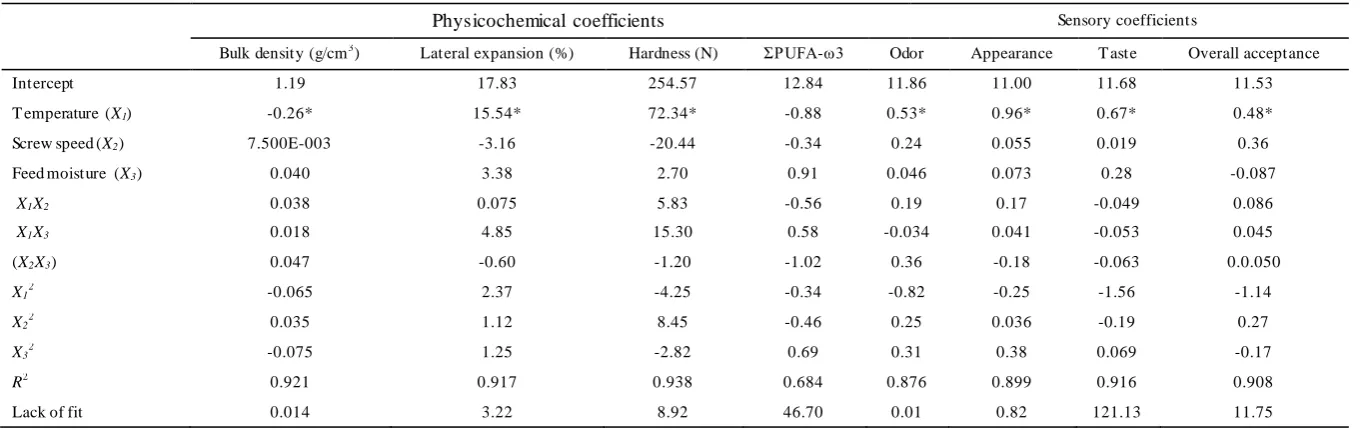
Effects of e xtrusion variables on the physicochemica l and sensory properties of extruded shrimp snacks are shown in Table 2. The predictive regression models for bulk density, lateral e xpansion, hardness, ƩPUFA-ω3 and all sensory properties showed high R2 of 0.921, 0.917, 0.938, 0.684, 0.876, 0.899, 0.916 and 0.908, respectively (Table 3).
Bulk Density of Extrude d Shrimp-Corn Snacks
Effect of e xt rusion variables including temperature, screw speed and feed moisture on the bulk density of shrimp-corn snacks are given in Table 2. The bulk density of e xt ruded snack samp les ranged fro m 0.62 to 1.41 g/cm3 (Table 2). The shrimp-corn snack sample with the highest bulk density (1.41 g/cm3) was obtained at moderate te mperature (130 C), moderate screw speed (350 rp m) and moderate feed moisture (20 g/100 g). The bulk density values of shrimp-co rn snack sa mples we re found significantly
lower than those reported by Shaviklo et al. (2015). They have reported that the bulk density values of puffed corn-shrimp ranged between 56.4 to 69.6 g/lt. Lowe r bulk density values of shrimp-co rn snack could be resulted from h igh protein content of dried shrimp meat. Bulk density of snacks we re significantly affected (P≤0.05) by extrusion temperature, although feed moisture and screw speed had no significant effect on bulk density (Table 3).
Lateral Expansion of Extrude d Shrimp-Corn Snacks
Effect of e xt rusion temperature, screw speed and feed mo isture on the lateral e xpansion of shrimp-corn snacks are given in Table 2. The latera l e xpansion of e xtruded snack samples ranged fro m 4.4 to 69.6 %. The product with the highest lateral e xpansion ratio (69.6 %) was produced at moderate tempe rature (130 °C), high screw speed (500 rp m) and low feed mo isture (17 g/100 g) (Table 2). These results were found lower than those reported by Ainsworth et al. (2007). Only e xt rusion temperature had significantly (P≤0.05) effect on the lateral expansion of snack samples (Table 3). Higher lateral e xpansion values of snack samples could be stemmed fro m high e xtrusion temperature since e xtrusion te mperature had a significantly effect on the lateral e xpansion of snack samples.
Hardness of Extrude d Shrimp-Corn Snacks
Effect of e xt rusion temperature, screw speed and feed moisture on the hardness of shrimp-corn snacks are given in Tab le 2. The hardness of extruded snack was determined by measuring the ma ximu m force required to break o ff the e xt ruded snack. The hardness values of extruded shrimp snack samples varied between 158.1 and 358.3 Newton (N) (Table 2). Only extrusion temperature had significant (P≤0.05) effect on hardness of shrimp snack samples (Table 3). Highest hardness value (358.3 N) was observed at high temperature, high scre w speed and moderate feed mo isture, whereas lowest hardness value (158.1 N) was observed at moderate temperature (110 °C), lowest screw speed (200 rp m) and lo west feed mo isture (20 g/100 g) (Table 2). These results were found tenfold higher than those reported by Ainsworth et al. (2007). They have reported that the hardness of brewers spent grain added corn snacks
Table 1. Proximate composition of ingredients and extruded corn-shrimp snack
Samples M oisture (%) Carbohydrate (%) Protein (%) Lipid (%) Ash (%)
Corn flour (defatted) 11.9±0.7 76.1±0.8 9.5±0.2 1.9±0.2 0.6±0.1
Dried shrimp flesh 17.5±0.6 16.5±0.6 64.7±1.1 3.7±0.3 3.2±0.2
Extruded shrimp snack** 14.5±0.8 62.5±0.7 18.8±0.5 2.0±0.4 2.2±0.2 *The values represent mean score± standard errors; n:3 per experimental replicate.
O
.K.
T
o
p
u
z
e
t a
l.
/
T
u
rk.
J.
F
ish
. Aq
u
a
t.
Sci
. 1
7
:
33
3
-3
4
3
(2
0
1
7
)
3
37
Table 2. Effects of extrusion conditions on physicochemical and sensory properties of extruded shrimp -corn snack
Samples
Extrusion conditions* Physicochemical properties Sensory properties
X1 X2 X3
Bulk density
(g/cm3)
Lateral expansion
(%)
Hardness (N)**
Ʃ PUFA-ω3 (%)
PUFA-ω3/ω6
(%) ratio** Odor Appearance T aste
Overall acceptance
Shrimp oil - - - 23.74±0.16 1.26 - - - -
Corn oil - - - 0.79±0.03 0.02 - - - -
E1 110 350 23 1.34±0.05 08.0±2.6 167.3±21.1 14.25±1.06 0.43 10.25±0.86 8.59±1.02 9.75±0.63 9.84±0.81
E2 110 350 17 1.16±0.13 21.6±6.2 186.3±10.3 13.93±1.44 0.42 10.42±0.74 9.59±0.82 9.84±0.77 10.42±0.66
E3 110 200 20 1.38±0.06 04.4±2.2 158.1±16.3 14.57±0.73 0.44 10.34±0.94 8.84±0.53 9.59±0.83 9.75±0.87
E4 110 500 20 0.98±0.10 34.4 ±8.3 211.5±17.9 13.92±0.86 0.41 10.59±0.85 10.09±1.03 9.67±0.67 10.50±0.69
E5 130 200 23 1.26±0.04 08.4±2.6 219.6±18.5 13.15±1.77 0.39 13.42±1.03 11.34±0.92 12.92±0.75 12.67±0.78
E6 130 350 20 1.41±0.10 14.8±4.1 232.6±12.4 13.73±1.29 0.39 12.67±0.97 11.17±0.86 13.00±1.11 12.42±0.85
E7 130 500 23 1.24±0.12 24.8±8.8 290.2±13.6 12.92±1.32 0.38 13.92±0.92 12.42±0.82 13.42±0.75 13.25±0.94
E8 130 200 17 1.26±0.04 14.8±1.8 266.9±28.0 13.05±1.34 0.38 12.25±0.89 11.50±0.34 13.07±0.86 12.34±1.072
E9 130 500 17 0.6±0.04 69.6±5.0 298.4±20.1 12.55±1.74 0.35 11.25±1.02 9.75±0.78 12.25±1.07 11.42±1.10
E10 130 350 20 1.03±0.07 25.6±4.8 245.7±15.7 13.80±1.75 0.38 12.89±1.03 11.09±0.98 13.09±0.44 12.59±1.06
E11 130 350 20 1.16±0.08 16.8±3.9 251.1±13.9 13.86±1.66 0.39 12.75±1.10 11.00±1.02 13.17±0.93 12.50±0.94
E12 150 200 20 1.18±0.05 17.6±2.6 306.3±14.6 12.06±1.94 0.38 12.00±0.81 12.09±0.84 11.59±0.75 10.92±0.97
E13 150 350 23 0.90±0.06 24.4±3.3 317.7±18.2 10.24±1.39 0.30 11.84±0.79 13.00±0.96 11.34±0.95 11.25±0.1.03
E14 150 500 20 0.79±0.13 38.1±2.0 358.3±11.4 09.03±1.46 0.28 12.09±0.88 12.17±0.78 11.75±1.08 11.75±0.93
338
O
.K.
T
o
p
u
z
e
t a
l.
/
T
u
rk.
J.
F
ish
. Aq
u
a
t.
Sci
. 1
7
:3
33
-3
4
3
(2
0
1
7
)
Table 3. Predictive regression models coefficients of physicochemical and sensory properties of extruded shrimp-corn snack
Physicochemical coefficients Sensory coefficients
Bulk density (g/cm3) Lateral expansion (%) Hardness (N) ƩPUFA-ω3 Odor Appearance T aste Overall acceptance
Intercept 1.19 17.83 254.57 12.84 11.86 11.00 11.68 11.53
T emperature (X1) -0.26* 15.54* 72.34* -0.88 0.53* 0.96* 0.67* 0.48*
Screw speed (X2) 7.500E-003 -3.16 -20.44 -0.34 0.24 0.055 0.019 0.36
Feed moisture (X3) 0.040 3.38 2.70 0.91 0.046 0.073 0.28 -0.087
X1X2 0.038 0.075 5.83 -0.56 0.19 0.17 -0.049 0.086
X1X3 0.018 4.85 15.30 0.58 -0.034 0.041 -0.053 0.045
(X2X3) 0.047 -0.60 -1.20 -1.02 0.36 -0.18 -0.063 0.0.050
X12 -0.065 2.37 -4.25 -0.34 -0.82 -0.25 -1.56 -1.14
X22 0.035 1.12 8.45 -0.46 0.25 0.036 -0.19 0.27
X32 -0.075 1.25 -2.82 0.69 0.31 0.38 0.069 -0.17
R2 0.921 0.917 0.938 0.684 0.876 0.899 0.916 0.908
O.K. Topuz et al. / Turk. J. Fish. Aquat. Sci. 17: 333-343 (2017) 339 G. Sca rce lla e t a l. / T u rk. J. F ish . Aq u a t. Sci . 1 1 : 4 3 3 -4 4 4 (2 0 1 1 ) 437
ranged between 11.18 and 22.12 N.
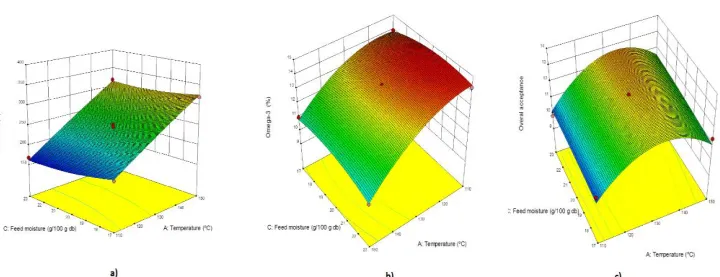
Figure 1a presents the effect of feed mo isture and screw speed on the hardness of shrimp-corn snacks. Increasing feed moisture and screw speed at moderate e xt rusion temperature increased the hardness of the shrimp-corn snacks (Figure 1a ). Figure 2a presents the effect of feed mo isture and e xtrusion temperature on the hardness of shrimp -corn snacks. Increasing ext rusion temperature at lowest feed mo istures and moderate screw speed significantly increased the hardness of shrimp snacks (Figure 2a ). Figure 3a presents the effect of screw speed and e xtrusion te mperature on the hardness of shrimp-co rn snacks. Increasing of e xtrusion temperature and screw speed at moderate feed mo isture significantly increased the hardness of e xtruded shrimp snack samples (Figure 3a). The cross-lin king of proteins and development of a protein network has increased the ma ximu m fo rce or hardness of e xtruded shrimp snack (Giri and Bandyopadhyay, 200). Increase in protein content with addition of shrimp meat to corn snacks probably caused starch -protein interaction and cross -linking of shrimp-corn proteins. Thus it might have made the shrimp -corn snacks tenfold harder compared to corn snacks.
Effects of Extrusion Variables on Fatty Acid Composition of Extrude d Shrimp-Corn Snacks
PUFA -ω3 fatty acids content of oils e xtracted fro m shrimp meat, corn flour and snack samples are shown in Table 2. Co mpared to corn flour, oil shrimp meat contains high proportion (23.74 %) of ƩPUFA -ω3 (Table 2). The ƩPUFA-ω of extruded shrimp snack samples varied between 9.03 and 14.57 %. Highest ƩPUFA-ω fatty acids value was obtained at lowest ext rusion temperature, lowest screw speed and moderate feed moisture, whereas lowest ƩPUFA-ω fatty acids value was obtained at highest extrusion temperature, h ighest screw speed and moderate feed moisture.
Blending of corn flour with shrimp meat increased ƩPUFA-ω3 content of extruded snacks. Figure 1b presents the effect of feed mo isture and screw speed on the ƩPUFA-ω3 content of shrimp-corn snacks. Although increasing feed mo isture and screw speed at moderate e xt rusion temperature tended to decrease ƩPUFA-ω3 content (Figure 1b), feed mo isture and screw speed had no significant effect on ƩPUFA-ω3 content of shrimp snack samples (Table 3). On ly e xtrusion temperature had significant (P≤0.05) effect on ƩPUFA-ω3 of shrimp snack samples (Table 3). Figure 2b presents the effect of feed mo isture and e xtrusion te mperature on the ƩPUFA-ω3 of shrimp-corn snacks. Decreasing e xtrusion temperature and feed moisture at moderate screw speed significantly increased ƩPUFA-ω3 content of shrimp snack samples (Figure 2b). Figure 3b presents the effect of screw speed and e xtrusion
temperature on the ƩPUFA-ω3 of shrimp -corn snacks. Decreasing both screw speed and extrusion temperature of e xt ruder significantly increased ƩPUFA-ω3 content of shrimp-corn snack samples (Fig. 3b). In last decades polyunsaturated fatty acids (PUFA) of ω 3 fa mily na me ly e icosapentaenoic (EPA) and docosahexaenoic (DHA) has gained attention because of the prevention of human coronary artery disease and imp rovement of retina and brain development, and also decreased incidence of breast cancer, rheu matoid arthrit is, mu ltiple sclerosis, psoriasis and inflammation (Özoğul and Özoğul, 2007).
PUFA -ω3/ω6 rat io of oils e xt racted fro m shrimp meat, co rn flour and snack samples are shown in Table 2. PUFA-ω 3/ω6 ratio of shrimp o il (1.26) was significantly h igher than corn o il’s PUFA-ω 3/ω6 ratio (0.02). After the production of shrimp snacks, the ω3/ω6 ratios of snacks varied fro m 0.28 to 0.44 (Table 2). Highest PUFA-ω 3/ω6 rat io (0.44) was observed at low extrusion temperature (110 °C), low screw speed (200 rp m) and moderate feed mo isture (20 g/ 100 g), whereas lowest PUFA -ω 3/ω6 ratio (0.28) was observed at high temperature (150 °C), high screw speed (500 rp m) and moderate feed mo isture (20 g/100 g). A ll snack samp les could be named as healthy snack since their PUFA-ω 3/ω6 ratio were significantly higher than WHO/ FAO recommendation value (0.2). Generally a high ω3/ω6 ratio is desirable, although the WHO/FAO (Clough, 1993) reco mmendations is that in total diet the ω3/ω6 ratio should be no higher than 1:5, i.e ., 0.2 (Vujkovic et al., 1999).
Effects of Extrusion Variables on Sensory Properties of Extrude d Shrimp-Corn Snacks
340 O.K. Topuz et al. / Turk. J. Fish. Aquat. Sci. 17: 333-343 (2017)
positively contributed the sensory properties including odor, appearance and taste of shrimp snack. It is probably stemmed fro m the reddish-brown color development via Ma illard reaction took place between in shrim snack sa mple during cooking. Ca rbohydrate and protein derivatives such as glucose-6-phosphate and free a mino acids present in the metabolic pathways can act as reactants to init iate the Maillard reaction (Kawashima and Ya mana ka, 1996). Maximu m overall acceptance score (13.25) was obtained at moderate temperature (130 ºC), h ighest screw speed (500 rp m) and highest feed moisture (23 g/100 g), whereas minimu m overa ll acceptance score (9.75) was obtained at lo west temperature (110 ºC), lowest screw speed (200 rp m) and moderate feed mo isture (20 g/100 g). As well as physicochemica l changes, all sensory properties including odor, appearance, taste and overall acceptance of snack samples were found to be significantly (P≤0.05) affected by changes in e xtrusion te mperature (Table 3).
Figure 1c presents the effect of feed mo isture and screw speed on the overall acceptance scores of shrimp-co rn snacks. The response surface plots, shows that increasing feed moisture and screw speed at moderate e xt rusion temperature increased the overall acceptance scores fro m 9.75 to 13.25 (Figure
1c). Figure 2c presents the effect of feed mo isture and e xtrusion temperature on the overall acceptance scores of shrimp-corn snacks. Increasing e xtrusion temperature fro m lowest (110 ºC) to moderate temperature (130 ºC) significantly increased (P≤0.05) the sensory overall acceptance scores, whereas increasing e xtrusion te mperature fro m moderate (130 ºC) to highest temperature (150 ºC) decreased the sensory overall acceptance scores (Fig. 2c). Figure 3c shows the effect of screw speed and extrusion temperature on the overall acceptance scores of shrimp-co rn snacks. Increasing e xtrusion temperature fro m lowest to moderate te mperature at a ll screw speed, increased the overall acceptance scores, whereas further increase in e xt rusion temperature decreased the overall acceptance scores of shrimp -corn snacks (Figure 3c). Higher overall acceptance scores were obtained at higher screw speed at moderate extrusion temperature (Fig. 3c).
Ooptimization of Extrusion Conditions for Shrimp-Corn Snack Production
A three-variable, three-level Bo x and Behnken design (Bo x & Behnken, 1960) was applied to optimize the e xt rusion cooking in order to obtain the ma ximu m and combined response values. Three-level
Figure 1. Effect of feed moisture and screw speed on the hardness (a) omega-3 fatty acids content (b) and overall acceptance scores (c) of shrimp snack samples.
*Extrusion temperature is fixed at 130 ºC.
Figure 2. Effect of feed moisture and temperature on the hardness (a) omega-3 fatty acids content (b) and overall acceptance scores (c) of shrimp snack samples.
O.K. Topuz et al. / Turk. J. Fish. Aquat. Sci. 17: 333-343 (2017) 341
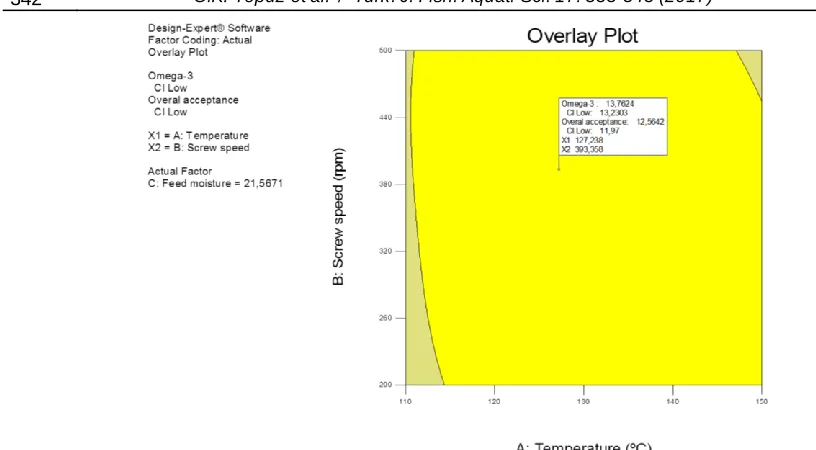
variables of e xtrusion cooking we re e xtrusion temperature (110, 130 and 150 ºC), screw speed of e xtruder (200, 350 and 500 rp m) and feed mo istu re (17, 20 and 23 g/100g), whereas the responses were PUFA -ω3 fatty acids content and sensory overall acceptance score. In order to obtain shrimp snack containing high a mount PUFA-ω 3 fatty acids and liking by consumers, the optimu m e xtrusion conditions were determined for ca lculating the predicted values of response variables using the prediction equations derived by RSM. Verificat ion e xperiments performed at the predicted conditions derived fro m ridge analysis of RSM de monstrated that e xperimental values were reasonably close to the predicted values, confirming the va lid ity and adequacy of the predicted models. The optimizat ion of e xtrusion conditions including e xtrusion temperature, e xt ruder screw speed and feed moisture of ingredients was based on the highest level of the PUFA -ω3 fatty acids and sensory overall acceptance score. The predicted optimu m condition obtained using computer program (Design Expert 9.1, Stat -Ease Lnc, Minneapolis, USA) for the e xtruded shrimp snack production was follows; e xtrusio n temperature: 127.2 ºC, screw speed: 393.4 rp m, feed mo isture: 21.6 g/100 g (Tab le 4). At this optimu m conditions the hardness, PUFA-ω 3 fatty acids and overall acceptance score of shrimp snack were found to be as 232.42, 13.76 and 12.56, respectively. In order to show the optimu m a rea, an overlay plot was obtain using the values of PUFA -ω3 fatty acids and overall acceptance responses (Figure 4). The optimu m point obtained from the software calculation is placed on left-upper side of the yellow a rea in the Fig. 3. At the optimu m point the overall acceptance score of snack was 13.76. It means that the snack produced at
optimu m point was liked very much by sensory panelist since ‘13-15 points’ corresponds to ‘very like’ in 15-cm unstructured line sensory evaluation scale.Considering the optimu m conditions, it is concluded that the shrimp snack containing high amount PUFA-ω3 fatty acids and liking by consumers could be produced at moderate extrusion temperature, screw speed and feed moisture.
Conclusion
In this study, the shrimp meat was not only used as an enrichment ingredient to increase the nutrition value, but it also helped to increase sensory properties of corn flour based snack because of its desirable flavor and taste. Shrimp meat was successfully incorporated with corn flour fo r the production of novel shrimp-corn snack. Although feed mo isture of ingredients and screw speed of extruder didn’t affect the physicochemica l and sensory properties of e xtruded shrimp-corn snack, the changes in the e xtrusion temperature significantly affected. Increasing extrusion temperature y ielded the decrease in ƩPUFA-ω3 content and increase in hardness of snacks. Shrimp-corn snacks produced at moderate e xtrusion temperature, highest screw speed and moderate feed mo isture had highest preference levels for para meters of overall acceptability. The findings of this study indicate the feasibility of developing new value added products from aquatic sources and corn flour by extrusion cooking.
Acknowledgements
This research was the supported by the grant fro m the Scientific Research Pro ject Admin istration
Figure 3. Effect of screw speed and temperature on the hardness (a) omega-3 fatty acids content (b) and overall acceptance scores (c) of shrimp snack sample.
*Feed moisture is fixed at 20 g/100 g.
Table 4. Responses at optimum conditions for extruded corn-shrimp snack production
Optimum conditions Responses at optimum conditions
X1* X2* X3* Hardness (N) PUFA-ω3 fatty acids (%) Overall acceptance score
127.2 393.4 21.6 232.42 13.76 12.56
342 O.K. Topuz et al. / Turk. J. Fish. Aquat. Sci. 17: 333-343 (2017)
Unit of Akdeniz Un iversity (Project No. 2010.03.0121.001).
References
Ainsworth, P., Ibanoglu, S., Plunkett, A., Ibanoglu, E., & Stojceska, V., 2007. Effect of brewers spent grain addition and screw speed on the selected physical and nutritional properties of an extruded snack. Journal of Food Engineering, 81 (4), pp. 702-709. doi: 10.1016/j.jfoodeng.2007.01.004.
Bligh, E. G., & Dyer, W. J., 1959. A rapid method of total lipid extraction and purification. Canadian journal of biochemistry and physiology, 37 (8), pp. 911-917. Box, G. E., & Behnken, D. W., 1960. Some new three level
designs for the study of quantitative variables.
Technometrics, 2 (4), pp. 455-475.
Clough, P., 1993. The enrichment of food products with long chain n-3 PUFA and associated health benefits. Food Ingredients Europe, Conference Proceedings 1993, pp. 245-247.
Joshi, S. M ., Bera, M ., & Panesar, P., 2014. Extrusion cooking of maize/spirulina mixture: factors affecting expanded product characteristics and sensory quality.
Journal of Food Processing and Preservation, 38 (2), pp. 655-664. doi: 10.1111/jfpp.12015
Kawashima, K., Yamanaka, H., 1996. Free amino acids responsible for the browning f cooked scallop adductor muscle. Fisheries Science, 62, 293-296. doi: 10.2331/fishsci.62.293.
Kinsella, J. E., & Franzen, K. L., 1978. Texturized proteins: Fabrication, flavoring, and nutrition. Critical Reviews in Food Science & Nutrition, 10 (2), pp. 147-207. Kong, J., Dougherty, M . P., Perkins, L. B., & Camire, M .
E., 2008. Composition and consumer acceptability of a novel extrusion-cooked salmon snack. Journal of Food Science, 73 (3), pp. 118-123. doi: 10.1111/j.1750-3841.2007.00651.x.
M aga, J. A., & Reddy, T., 1985. Coextrusion of carp (Cyprinus carpio) and rice flour. Journal of Food
Processing and Preservation, 9 (2), pp. 121-128. doi: 10.1111/j.1745-4549.1985.tb00714.x.
M euser, F., & Van Lengerich, B., 1984. System analytical model for the extrusion of starches. Thermal processing and quality of foods, pp. 175-179. Obatolu, V., Skonberg, D., Camire, M ., & Dougherty, M .,
2005. Effect of moisture content and screw speed on the physical chemical properties of an extruded crab-based snack. Food science and technology international, 11 (2), pp. 121-127. doi: 10.1177/1082013205052513.
Ozogul, Y., & Ozogul, F., 2007. Fatty acid profiles of commercially important fish species from the M editerranean, Aegean and Black Seas. Food Chemistry, 100 (4), pp. 1634-1638. doi: 10.1016/j.foodchem.2005.11.047.
Pansawat, N., Jangehud, K., Jangchud, A., Wuttijumnong, P., Saalia, F. K., Eitenmiller, R. R., & Phillips, R. D., 2008. Effects of extrusion conditions on secondary extrusion variables and physical properties of fish, rice-based snacks. LWT-Food Science and Technology, 41 (4), pp. 632-641. doi: 10.1016/j.lwt.2007.05.010.
Petridis, D., Raizi, P., & Ritzoulis, C. 2014. Influence of citrus fiber, rice bran and collagen on the texture and organoleptic properties of low-fat frankfurthers, Journal of Food Processing and Preservation, pp. 1759-1771. doi:10.1111/jfpp.12139.
Shaviklo, G. R., Thorkelsson, G., Rafipour, F., & Sigurgisladottir, S. 2011. Quality and storage stability of extruded puffed corn‐fish snacks during 6-month storage at ambient temperature. Journal of the Science of Food and Agriculture, 91 (5), pp. 886-893. doi: 10.1002/jsfa.4261.
Shaviklo, A. R., Dehkordi, A. K., & Zangeneh, P. (2014). Interactions and effects of the seasoning mixt ure containing fish protein powder/Omega-3 fish oil on children's liking and stability of extruded corn snacks using a mixture design approach. Journal of food processing and preservation, 38 (3), pp. 1097-1105. doi: 10.1111/jfpp.12068.
O.K. Topuz et al. / Turk. J. Fish. Aquat. Sci. 17: 333-343 (2017) 343
Shaviklo, A. R., Azaribeh, M ., Moradi, Y., & Zangeneh, P. 2015. Formula optimization and storage stability of extruded puffed corn-shrimp snacks. LWT-Food Science and Technology, 63 (1), pp. 307-314. doi: 10.1016/j.lwt.2015.03.093.
Singh, R., M ajumdar, R. K., & Venkateshwarlu, G., 2014. Effect of Process Conditions on Physicochemical and sensory properties of fish cereal based extruded snack like products. Journal of Food Processing and Preservation, 38 (1), pp. 68-82. doi: 10.1111/j.1745-4549.2012.00746.x.
Singh, S., Gamlath, S., & Wakeling, L., 2007. Nutritional aspects of food extrusion: a review. International Journal of Food Science and Technology, 42 (8), pp. 916-929. doi: 10.1111/j.1365-2621.2006.01309.x. Sriket, P., Benjakul, S., Visessanguan, W., &
Kijroongrojana, K., 2007. Comparative studies on chemical composition and thermal properties of black tiger shrimp (Penaeus monodon) and white shrimp (Penaeus vannamei) meats. Food Chemistry, 103 (4), pp. 1199-1207. doi: 10.1016/j.foodchem.2006.10.039. Szymczak, M., Kołakowski, E., & Felisiak, K. 2012.
Influence of salt concentration on properties of marinated meat from fresh and frozen herring (Clupea harengus L.). International journal of food science & technology, 47 (2), pp. 282-289. doi: 10.1111/j.1365-2621.2011.02837.x.
Thakur, S., & Saxena, D. C., 2000. Formulation of extruded snack food (gum based cereal-pulse blend): Optimization of ingredients levels using response surface methodology. Lebensmittel-Wissenschaft Und-Technologie-Food Science and Technology, 33 (5), pp. 354-361. doi: 10.1006/fstl.2000.0668. Vujkovic, G., Karlovic, D., Vujkovic, I., Vorosbaranyi, I.,
Jovanovic, B., 1999. Composition of muscle tissue lipids of silver carp and bighead carp. Journal of the American Oil Chemists Society, 76 (4), pp. 475-480. doi: 10.1007/s11746-999-0027-1.