Techniques for Efficient Case Retrieval and Rainfall
Prediction Using CBR and Fuzzy Logic
Saroj Kr. Biswas
Asstt. Prof., Deptt. of CSENIT, Silchar [email protected]
Akhil Kr. Das
Asstt. Prof., Deptt. of CSEIMPS CET, Malda, W.B [email protected]
Dr. Biswajit Purkayastha
Assoc. Prof., Deptt. of CSENIT, Silchar
Dibyendu Barman
Asstt. Prof, Deptt. of CSE Govt. College of Engg. & Textile Tech. Berharpore, [email protected]Abstract–Case based reasoning means to understand and solve new problems using past experiences. At the first stage this paper reports different phases of case based reasoning, methods and techniques involved in case retrieval phase and how these techniques are used by different researchers to make retrieval phase more significant in retrieving most similar cases. It also outlines the probable scope of the works in case base retrieval. At the second stage, this paper introduces a rainfall prediction method by fuzzy case based reasoning. In our study techniques used to rainfall prediction are investigated and then we have applied hybridization of fuzzy logic and case base reasoning for rainfall prediction. We have treated the important weather attributes of a day as a case. Fuzzy k-NN is applied to retrieve similar cases from case-base and we find the solution of the new case by adapting solutions of retrieved cases. A case-base of 10,000 cases is build. The obtained result shows promising prediction of rainfall.
Keywords – Case Based Reasoning, Case Retrieval, Decision Tree, Fuzzy Logic and K-NN.
I. I
NTRODUCTIONCase-Based Reasoning (CBR) is an Artificial Intelligence approach to learning and problem solving based on past experiences. CBR combines aspects from the knowledge based systems as well as from the machine learning field. Case-based reasoning (CBR) systems reason from experiences, they solve new problems by retrieving relevant prior cases and adapting them to fit to new situations. Case-based reasoning (CBR) has become a popular even say most suitable technology to realize expert systems in the last years. Many commercially successful applications have been developed by using CBR approach. It has been applied in many fields such as medical for diagnostic and therapeutic task, image retrieval, treatment, planning, and tutoring etc. The success is largely based on CBR paradigm “similar solution will be produced by similar type of problem”.But to solve a problem CBR generally undergoes four basic phases, called Retrieve, Reuse, Revise, and Retain that are often called as the R4 Cycle of CBR which is given in Fig. 1.Retrieval phase is most important part of CBR and used to retrieve a most similar case/ a set of most similar cases from the case base. Reuse is a phase just after case retrieval and responsible for proposing a solution for a new problem from the solutions of retrieved cases. This is often appropriate for classification problem, because the solutions of the problem are available in case base and therefore the most similar retrieved case, if sufficiently
similar is likely to contain an appropriate solution. This may involve adapting the solution as needed to fit the new situation. If the retrieved solution is not similar to the target solution, revision or adaptation is required in CBR cycle. Adaptation becomes particularly relevant when CBR is used for constructive problem solving tasks, such as design, configuration and planning. Retention is recognized as the final step in the CBR cycle in which the solution of the most recent problem is incorporated into CBR. And it is an approach of recording the solution of problem solving as a new case that can be added to the case base.
Fig.1. shows basic four phases involved in
Copyright © 2013 IJECCE, All right reserved to predict weather and to overcome such uncertain and
vague situation. It is generally believed that complex problems can be easier solved with hybrid systems. The effectiveness of the various hybrid approaches has been demonstrated in a number of application areas [2], [3], [4], [5], [6], and [7]. In most of the hybrid approaches, two knowledge representation methods are being integrated. This is due to the fact that the integration of three or more knowledge representation methods is more complicated. So in this approach, integration of CBR and fuzzy logic has been considered for the model of rainfall prediction in terms of amount of rainfall and frequency of occurrence. The model has been tested on the collected dataset and found significant.
II. C
ASER
ETRIEVALAn important step in the CBR cycle is the retrieval of previous case or cases that can be used to solve the target problem. A description of a problem is given to retrieve the most similar cases to the current problem or situation according to the retrieval algorithm using the indices in the case memory. The retrieval algorithm relies on the indices and the organization of the memory to direct the search to potentially useful cases. The retrieval strategy determines how a case is judged to be apposite for retrieval and a mechanism to control how the case base is searched. The selection strategy is required to find out which is the best case to retrieve, by determining how close the current case is to the existing cases stored in the case base. The case retrieval phase is subdivided into further4 subtasks [8] as given below:
Recognize features: The problem is acknowledged in this step and all explanation concerning problems is composed.
Investigate:
Depending on index based information of stored cases in case base, objective solution is searched. It has to be decided that which features of the problem are meaningful to form the structure of the case.Initially match:
If direct search is not possible then on the basis of similarity we calculate the similarity between the new case and stored cases in case base.Select:
After calculating the similarity between the cases, final selection of the proposed solution is performed regarding the selection strategy.III. C
ASER
ETRIEVALT
ECHNIQUESTechnique of case retrieval tells how to find most similar cases for a new case. Some well-known methods and techniques for case retrieval are discussed in this section.
Pattern Matching:
This is the basic mechanism of information retrieval from database or case base. It operates based on simple string matching function. The method is so important that many efficient algorithms for carrying out serial searches of very large quantities of data exist.Indexing:
An enhancement and sophistication from simple string search is indexing for retrieval of information or case. It reduces the cost of searching of data due to its effective organization and requires the features of cases, which are to be used as the basis for useful retrieval, be predetermined.Inductive Retrieval:
Inductive retrieval algorithm is a technique that determines which features do thebest job in discriminating cases and generates a decision tree type structure to organize the cases in memory. This approach is very useful when a single case feature is required as a solution, and when that case feature is dependent upon others.Similarity assessment Technique:
The basic principal of this technique is that the most similar cases are most useful for solving the target problem. But to assess similarity between stored cases and new case,in some applications of CBR, surface features are used, in other applications it may be necessary to use derived features obtained from a case’s description by inference based on domain knowledge and in yet other applications, cases are represented by complex structures and retrieval requires an assessment of their structural similarity. But the computation of derived features or use of structural similarity is computationally expensive. However the advantage is that more related cases may be retrieved.Alternatives to similarity-based retrieval:
While continuing to play a prominent role in retrieval, similarity is increasingly being combined with other criteria to guide the retrieval process such as how effectivelythe solution space is covered by the retrieved cases [9], how easily their solutions can be adapted to solve the target [10], or how easily the proposed solution can be explained[11]. One of the such retrieval is adaptation guided retrieval used to find the solution, where similarity is not an adequate proxy for solution utility, it may be necessary for other forms of knowledge available to a case based reasoner to be brought to bear on the retrieval task. Many other alternatives to similarity-based retrieval are used to retrieve significant and meaningful cases from case base such as explanation-oriented retrieval, order-based retrieval, compromise-driven retrieval, diversity-conscious retrieval etc.Decision Tree:
Decision tree is used to divide a population of cases into homogenous groups, according to a set of discriminant features. These features are automatically searched for (by a learning process or concept learning) amongst other available features. The case population is divided in a hierarchical manner, so that a tree with such structure is built: Each non-terminal node corresponds to a test on a single feature, each edge corresponds to a test outcome and each leaf corresponds to a cluster of cases that provide to similar answer to each test. At the beginning of the learning process, the tree is made up of a single node containing the whole case population. Then for each leaf of the developing tree, the most discriminant feature is searched for and the population splits into child nodes, one for each outcome of the test [13]. The discriminant power of a test can be measured by Shannon entropy gain ‘G’ [14], obtained by dividing the current nodes into child nodes. DTs were first designed to segment nominal attribute vectors (each test outcome corresponds to a feature value or group of values) [13]. Quinlan [15] extended them to continuous attributes (learning samples are grouped by attribute value ranges). DTs are best suited to process heterogeneous cases. Decision tree can also manage missing information. To learn decision tree, cases are divided into three categories: A learning set which is used to find the most discriminative attributes at each node, a validation set which is used to determine when dividing of nodes should be stopped and a test set to evaluate the efficiency of the system.Nearest-neighbor retrieval:
Nearest neighbor is a simple approach that computes the similarity between stored cases and new input case based on weight features [16]. Nearest Neighbor is sensitive to irrelevant and noisy features[17]. Variations of nearest neighbor have been developed to reduce these issues. Wettschereck and Aha[17] introduced a frame work for automating the process of weighting features, which assigns low weights to irrelevant features. This algorithm has two approaches:a) Linear search approach:
In this it computes the distance from the problem case to the every other case in the case base, keeping track of the “best so far”. If cases attributes are fixed to say D and there are N number of cases in the case base at present than this linear search for similar cases could find one in O(ND) time.b) Branch and Bound:
Several space-partitioning methods have been developed for solving the nearest neighbor problem. The simplest is the k-d tree, which iteratively bisects the search space into two regions containing half of the points of the parent region. Queries are performed via traversal of the tree from the root to a leaf by evaluating the query point at each split. Depending on the distance specified in the query, neighboring branches that might contain hits may also need to be evaluated. For constant dimension query time, average complexity is O(log N) [16].K-Nearest Neighbor algorithm:
This algorithm is similar to the nearest neighbor algorithm, except that it looks at the closest k instances to the unclassified instance.The class of the new instance is then given by the class with the highest frequency of those k instances. This is useful because of anomalous instances is reduced. Based on the value of k it differs when k=1, it will be working same as that of the nearest neighbor algorithm, as it only looks at the 1st closest cases having similar instances to that of problem case and when k = N (where N is the number of training instances), it would be bad because it would base the classification on the class frequency of all the instances, not just the closest ones. So there must be an optimal value of K as it means amount of error in similarity you are allowing in the matching procedure of the two cases [16].
Knowledge Intensive Similarity Measurement:
There are many strategies to retrieve a similar case from case base like Nearest Neighbor & Inductive retrieval. But this is the strategy which is based on retrieving the similar case by exploiting the more domain knowledge. A knowledge intensive CBR method is called for powerful knowledge acquisition and modeling techniques, as well as machine learning methods that take advantage of the general knowledge represented in the system[18]. It is the technique in CBR to combining the case specific knowledge with the models of general domain knowledge.
IV. R
AINFALLP
REDICTIONIn this section the previous approaches for rainfall and precipitation prediction are encountered then the framework of the proposed model is presented.
Hung et al. [19] predicted the rainfall in Bangkok using the artificial neural network model. Singh et al.[20] used a case-based reasoning method called the nearest-neighbor model for snowfall forecasting. Salmeri et al.[21] used fuzzy logic systems for meteorological forecasting. Luenam et al.[22] proposed the neuro-fuzzy model for rainfall forecasting which combines the neural network theory and fuzzy retrieval techniques for obtaining better accuracy of prediction. Hansen et.al [23] presented the fuzzy case-base system for weather prediction, which addresses the problem of forecasting visibility and cloud ceiling height at airport terminals. Combining the fuzzy method with the case-based reasoning method, the WIND-1 is proposed in order to implement and test the airport weather prediction. Husain et al. [24] conducted experiments proving that the use of fuzzy case-based reasoning for rainfall prediction improves the accuracy for rainfall prediction, as compared to the use of fuzzy logic alone or case-based reasoning alone.
V. F
RAMEWORK OF THE MODELCopyright © 2013 IJECCE, All right reserved are now sent to the case analysis engine for reuse and
adaptation if needed. Case analysis is done based on the performance of the solution of the retrieved similar cases. The framework of the model is diagrammatically given in Fig. 2.
A. Stage 1: Case Representation
Case representation plays an important role in retrieving most similar cases from the case-base. In this approach a case is represented by those important weather attributes which have greater impact to the occurrence of the dependent attribute along with dependent attribute. A case is formed by important weather attributes of a day namely Mean temperature, Mean dew point, Visibility, Sea level pressure, Station pressure, Wind speed, Max speed, Max temperature, Mean temperature and Rainfall. The first nine consecutive attributes are continuous, analogue and independent so these attributes are considered as problem description of the case and rainfall considered as solution
description of the case. Fig.2. Diagrammatic representation of the proposed model Table 1: Shows Case structure with attributes
Mean Temp
Mean Dew point
Visibility Sea Level Pressure
Station Pressure
Wind speed
Max speed
Max Temp
Min Temp
Rain fall
So in this stage cases are stored in the case based in their proper structure for this model. Now the case base is ready for second stage.
B.
Stage 2: Case Selection
Stage 2 is concerned with the selection of relevant cases from the case base when a new case is encountered in the retrieval engine. When the new case arrives, the system needs to retrieve from memory few cases having almost similar attributes. This stage corresponds to a Sequential similarity-based search for ‘‘most similar’’ cases according to the similarity-indicating attributes that were identified as problem description in Stage 1. The fuzzy value of the stored cases in case base is found with respect to new case and then similarity between the cases is measured. The fuzzy value of the attributes is determined using triangular fuzzy membership function. To find the similarity measure, the dissimilarity score of past case to the current case taking into consideration all similarity-indicating attributes, is calculated. The ‘‘most similar’’ ones having smaller the dissimilarity score are then selected as top ranking cases.
In this paper, we select the top ranking cases to be presented in the system to measure the performance of the model. Selection of cases is done by performing the following steps sequentially for assessing similarity of past cases to the current case:
RETRIEVE multi-attribute based information on past cases
MATCH past cases with the current case using Euclidean Distance (ED) similarity-based search
COMPARE past cases with each other using the Dissimilarity score
SELECT past cases having least value of Dissimilarity score
The dissimilarity score (DS) between the new case and a retrieved case tells us how dissimilar with the retrieved case, the new case is. The smaller the DS value, the more similar the two cases are.
Considering A1A2, A3, . . . , ANto be the fuzzy values of
the N attributes of a case in the case base and A’1, A’2,
A’3, . . . ,A’Nto be the fuzzy values of the N attributes of
a new case, the Euclidean distance between the two cases is obtained by equation 1.
N
i
i
i A
A x
x ED
1 ' )
'
( (1)
where x’ and x are the new case and a case stored in the case base and 1≤ i ≤9. The output of this stage is a set of similar cases. The set of similar cases is then sent to the case analysis engine for reuse and adaptation.
C. Stage 3: Case Reuse and Revision
accuracy of prediction. The output of this stage is the value of K and the solution of the new case.
VI. R
ESULTS ANDD
ISCUSSIONSA. Data Collection:
The dataset obtained from the National Informatics Center, USA represents the actual weather of Austin, USA from the year 1981 to 2009.The dataset consists of around 10000 cases, one for each day during that period. Each case has 10 attributes includingthe amount of rainfall. The data for the year 2009, consisting of 365 cases have been used as test cases and the rest have been used as training cases. The prototype of the model is developed in MATLAB compiler and run in windows environment.
B. Discussion:
10 test cases are taken and calculated the performance of the prototype model for these test cases using fuzzy k-NN in terms yes or no of rainfall happening and amount of rainfall. Test cases taken for experiment are shown in Table 2.Table 2: Test cases for experiment
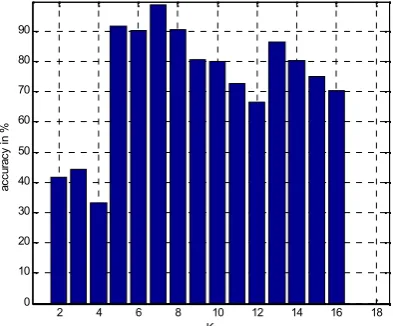
It is considered that fuzzy k-NN similarity metric is effective, if k is too small but prediction result accuracy should suffer from sample size being too small (i.e., not representative), and if k is too large, prediction result accuracy should taper off because of the inclusion of an increasing number of decreasingly similar cases. The performance of the system for test case 1, 2, 3 and 4 is shown in Fig 3a, 3b, 3c and 3d respectively and the overall performance of the system is shown in Fig 3e. It is observed that when the value of k is 7, the performance of the system is highest. If we see the performance of the system in terms of occurrence of rainfall then it is 90%.
2 4 6 8 10 12 14 16 18
0 10 20 30 40 50 60 70 80 90
K
ac
cu
ra
cy
in
%
Fig.3a. Shows performance of 1st test case
0 2 4 6 8 10 12 14 16 18 0
10 20 30 40 50 60 70 80 90 100
K
ac
cu
ra
cy
in
%
Fig.3b. Shows performance of 2ndtest case
0 2 4 6 8 10 12 14 16 18 0
5 10 15 20 25 30
K
ac
cu
ra
cy
in
%
Fig.3c. Shows performance of 3rdtest case S.No. Mean
Temp
Mean Dew point
Visibility Sea Level Pressure
Station Pressure
Wind speed
Max speed
Max Temp
Min Temp
Rainfal l
1 54.3 49.7 1018.30 995.90 5.10 4.60 14.00 63.00 39.90 0.12
2 73.1 64.2 1020.00 998.10 9.30 7.50 15.90 82.90 64.00 0.04
3 72.5 64.8 1011.20 989.40 19.90 5.70 18.10 86.00 64.90 1.38
4 81.3 73.7 1007.00 985.50 12.60 7.70 15.00 93.00 74.80 0.35
5 57.6 56.9 1010.60 988.50 3.20 7.40 13.00 66.00 50.00 0.47
6 81.1 71.7 1019.00 997.20 14.90 2.10 6.00 93.00 72.90 0.31
7 40.1 21.4 1028.80 1006.00 19.90 10.50 15.00 55.90 32.00 0.20
8 72.8 69.8 1015.70 993.80 6.00 6.90 11.10 78.10 60.10 0.55
9 63.2 58.9 1009.40 987.30 7.30 10.30 15.90 75.90 43.00 0.04
Copyright © 2013 IJECCE, All right reserved 0 2 4 6 8 10 12 14 16 18
0 5 10 15 20 25 30 35 40
K
ac
cu
ra
cy
in
%
Fig.3d. Shows performance of 4thtest case
0 2 4 6 8 10 12 14 16 18
0 5 10 15 20 25 30 35 40 45 50
K
ac
cu
ra
cy
in
%
f
or
1
0
te
st
c
as
es
Fig.3e. Shows overall performance of the system
VII. C
ONCLUSIONThe basic idea of CBR is to retrieve problem solving experiences that are stored as cases in a case base, adapt and reuse them to solve new problems. On the abstract level, the CBR process is described with four main steps that are retrieval, reuse, revise and retain. While the names for these tasks may vary from one process model to the other, but the basic ideas remain the same. Most of the CBR systems are used as a case retrieval system as on now. So retrieval is the most important step in CBR. In this paper a rainfall prediction hybrid model is proposed using fuzzy logic and CBR. If we consider the prediction only about whether the weather is rainy or not, we predict it at satisfactory level. The prediction is also significant in terms of amount of rainfall. Most similar cases of a new case have been produced by considering only distance (Euclidean distance) between two cases but in our future work we are concentrating how the similarity between two cases can be calculated by distance and other parameters more accurately. Different weather attributes may have different impact in rainfall so that different weightage may be given to different weather attributes, this fact will be taken into consideration in our future work. There is enough scope to work out for CBR and to improve and enhance its efficiency and reliability on the following issues. How should cases be represented in memory? How should indices be chosen for organizing memory efficiently? How to structure the relationship among cases and parts of different cases?
R
EFERENCES[1] Hansen, B. SIGMAR: A fuzzy expert system for critiquing marine forecast, AI Application. Vol.11, No.1, 1997, pp. 59-68 [2] R. Bellazzi, S. Montani, L. Portinale and A. Riva: Integrating
Rule Based and Case-Based Decision Making in Diabetic Patient Management: ICCBR-99, Monastery Seeon, Munich, Germany, July 1999, In : Lecture Notes in Artificial Intelligence 1650, K.D. Althoff, R. Bergmann, L.K. Branting eds., Springer-Verlag, Berlin, 1999, pp. 386-400.
[3] I. Bichindaritz and K.M. Sullivan: Reasoning from Knowledge Supported by More or Less Evidence in a Computerized Decision Support System for Bone- Marrow Post-Transplant Care: American Association for Artificial Intelligence, Technical Report SS-98-04, 1998, pp. 85-90 . [4] J. MacIntyre, P. Smith, and T. Harris: Industrial Experience :
The use Of Hybrid Systems in the Power Industry: Hybrid intelligent system, Medsker, Larry, Boston : Kluwer Academic Publishers, 1995, pp. 57-74.
[5] C.R. Marling, G.J. Petot, and L.S. Sterling: A CBR/RBR Hybrid for Designing Nutritional Menus: Computational Intelligence, Volume 15, Number 3: 1999 Blackwell Publishers, 350 Main Street, Malden, MA 02148, USA and Cowley Road, Oxford, OX4 1JF, UK, 1998, pp. 308-332.
[6] J. Sabater, J. L. Arcos, and R. Lopez de Mantaras: Using Rules to Support Case- Based Reasoning for Harmonizing Melodies: Multimodal Reasoning Papers from the 1998 AAAI Spring Symposium (1998), Publisher: Citeseer, 1998, pp. 147–151. [7] G. Vossos, J. Zeleznikow, Th. Dillon, and V. Vossos: An
Example of Integrating Legal Case- Based Reasoning with Object-Oriented Rule-Based Systems:IKBALS II, in Proc.1991 International conference on Artificial Intelligence and Law, 1991, pp. 31-41.
[8] Surjeet Dalal, Dr. Vijay Athavale, Keshav Jindal (2011): Case Retrieval Optimization of Case-based reasoning through Knowledge-Intensive Similarity Measures, ,International
Journal of Computer Applications (0975–8887) Volume 34–
No.3, November 2011, pp. 1-7.
[9] Mc Sherry, D. (2003): Similarity and compromise. In Proceedings of the Fifth International Conference on Case-Based Reasoning. Berlin: Springer, pp. 291-305.
[10] Smyth, B. & Keane, M.T(1998): Adaptation-guided retrieval: Questioning the similarity assumption in reasoning. Artificial
Intelligence 102(2), pp. 249-293.
[11] Doyle, D., Cunningham, P., Bridge. D. & Rahman, Y. (2004): Explanation oriented retrieval. In Proceedings of the Seventh
European Conference on Case-Based Reasoning. Berlin:
Springer, pp. 157-168.
[12] Mohamad Farhan Mohamad Mohsin, Norita Md Norwawi, Maznie Binti Manaf and Mohd Helmy Abd Wahab (2010): The development of Hashing Indexing Technique, 2010, pp. 2-5. [13] Quellec. G., Lamard, M. ; Bekri, L. ; Cazuguel, G. ; Cochener,
B. ; Roux, C."Multimedia medical case retrieval using decision trees",Engineering in Medicine and Biology Society, 2007. EMBS 2007. 29th Annual International Conference of the IEEE,2007,Page(s): 4536 - 4539.
[14] J. Quinlan (1993): Programs for Machine Learning. Morgan Kauf- mann Publishers, 1993
[15] J. Quinlan (1992): Learning with continuous classes: In 5th
Australian Joint Conference on Artificial Intelligence, 1992
[16] Andrew Moore: An introductory tutorial on KD trees.
[17] Wettschereck, D., Aha, D. (1995): Weighting features. Lecture notes in computer science 1010 (1995), pp. 347-358
[18] Agnar Aamodt: Knowledge-Intensive Case-Based Reasoning in CREEK , Department of Computer and Information Science Norwegian University of Science and Technology (NTNU) NO-7491 Trondheim Norway. pp. 1-8.
[19] Hung, N.Q, Babel, M.S, Weesakul, S. and Tripathi, N.K: An artificial neural network for rainfall forecasting in Bangkok, Thailand: The Smithsonian/NASA Astrophysics Data System: Hydrology and Earth System Sciences Discussions, Volume 5, Issue 1, 2008, pp.183-218.
model: Current Science, Vol. 88, No. 8, 25 April 2005, pp.1283-1289.
[21] Arianna Mencattini and Marcelo Salmeri: Meteorological forecasting using Type-2 fuzzy logic systems:Forecasting Models: Methods & Applications (Edited by: J. Zhu). iConcept Press. ISBN: 978-1451564563, April 2010, pp.13-28.
[22] Pramote Luenam, Supawadee Ingsriswang, Lily Ingsrisawang, Prasert Aungsuratana, and Warawut Khantiyanan. A Neuro-Fuzzy Approach for Daily Rainfall Prediction over the Central Region of Thailanddirectory of open access journals: International Association of Engineers, 2010.
[23] Bjarne K. Hansen and Denis Riordan (2001). Weather Prediction Using Case-Based Reasoning and Fuzzy Set Theory
[24] Wan Salfarina Binti Wan Husain:A project report, “Fuzzy case
based reasoning for weather prediction, 2008.
A
UTHOR’
SP
ROFILESaroj Kr. Biswas
Completed B.Tech Degree in Computer Science and Engineering from Jalpaiguri Govt. Engg. College, West Bengal and M.Tech degree from National Institute of Technical Teachers' Training and Research,Kolkata. His interested areas are Case-based Reasoning, Fuzzy Logic, Machine Learning Alogrithm.
Mr. Akhil Kumar Das
Completed M.Tech. Degree in Multimedia & Software Systems in 2007 from National Institute of
Technical Teachers’ Training & Research, Kolkata.
Currently working as Assistant Professor in the CSE Department at IMPS College of Engineering & Technology, Malda (West Bengal).
Dr. Biswajit Purkayastha
done his B.Tech. in Electronics and Telecommunication Engineering from College of Engineering, Kakinada under Jawaharlal Nehru Technological University, Hyderabad. He has done his M.Tech. in Computer Engineering from IIT, Kharagpur and Ph. D. from Computer Science Department of Assam University on Soft Computing. His interested areas are Soft Computing, Image Processing.