This is an open access journal, and articles are distributed under the terms of the Creative Commons Attribution-Non Commercial-ShareAlike 4.0 License, which allows others to remix, tweak, and build upon the work non-commercially, as long as appropriate credit is given and the new creations are licensed under the identical terms.
© 2020 Journal of Advanced Pharmacy Education & Research | Published by SPER Publication
40
Interprofessional education program development in
professional students at faculty of medicine, Lambung
Mangkurat university
Syamsul Arifin
1*, Ifa Hafifah
21 Faculty of Medicine, Lambung Mangkurat University, Indonesia, Jl. A. Yani Km.36, Banjarbaru, 70714, Indonesia. 2 Nursing Education Program, Lambung Mangkurat
University, Indonesia, Jl. A. Yani Km.36, Banjarbaru, 70714, Indonesia.
Correspondence:Syamsul Arifin, Department of Public Health, Medical Education Study Program, Faculty of Medicine, Lambung Mangkurat University, Indonesia, Jl. A. Yani Km.36, Banjarbaru, 70714, Indonesia, Email: syamsularifin82@ yahoo.co.id.
ABSTRACT
Background: Collaboration among professional students were not optimal and lack of inter-professional awards for them.
Interprofessional Education (IPE) in the Faculty of Medicine “X” University has not developed yet. Objectives: This research aims to analyze the needs of the development of IPE programs of professional students of Faculty of Medicine “X” University. Methods: This research used explorative qualitative research to assess the needs of informants to the development of the IPE program. Analysis of research data used thematic analysis and data triangulation. The informants were 14 people consisting of 10 informants from the nurse and medical professional student and 4 informants from the clinical instructor of nurse and medical professional student. Results: This study found 4 themes, namely understanding the principles of IPE, how to implement IPE, the challenges of implementing IPE, efforts to overcome the IPE challenges. Conclusions: This study can develop an IPE program in order to achieve the learning objectives of the
professional students of Faculty of Medicine “X” University.
Keywords:Interprofessional education, collaboration, student.
Introduction
This research is motivated by the experience of researchers when guiding nurse professional students in the Emergency
Room Installation (ERI) of “X” Hospital. Researchers
interviewed professional nursing students, "Are there any obstacles encountered when implementing nursing care to the client?". The student said, "We have difficulty in conduct nursing studies because the clients no longer want to be interviewed. Medical profession students have interviewed clients. Researchers also interviewed professional medical students who practice in the ED. Researchers asked, "How the
professional medical students manage patients when they enter the ED?" The student replied, "We do triage when the patient arrives. After that, we do anamnesis". Researchers also observed the ERI work environment. The researcher observes that the tasks have not been mixed between students of the health profession and each student of the health professionals doing their respective duties. When there is a lack of patient data, the student asked the patients or their family. There seems to be no optimal collaboration between the health profession students, especially between the professional medical and nursing students.
Collaboration among health professionals is an effort to improve the quality of health services. [1] WHO made a grand design about the formation and characteistic of collaboration in the form of formal interprofessional education. [2] Interprofessional education (IPE) is a practice of learning that is attended by two or more different professions to increase collaboration and service quality, and its implementation can be done in all learning stages, whether undergraduate or clinical education stages to create professional health workers. [3] Also, interprofessional education is a process whereby students or Access this article online
Website: www.japer.in E-ISSN: 2249-3379
Journal of Advanced Pharmacy Education & Research | Jan-Mar 2020 | Vol 10 | Issue1 41 health professionals with different professional backgrounds
perform collaborative learning over a specified period, interact as a primary goal, and collaborate in promotive, preventive, curative, rehabilitative, and other types of health services. Various health professions can foster interprofessional skills to provide the collaboration ability, improve the practice of each profession in order to complement each other, form a joint action to improve services and trigger change; to apply critical analysis to collaborative practice, and improve the outcomes of services for individuals, families and communities. Students can share their experiences and contribute to a progress and mutual understanding in inter-professional learning in response to questions, at conferences and through professional and inter-professional literature. With the existence of IPE, patients and families do not burden patients and their families to be assessed by any health profession. [4]
IPE has many benefits in the world system of health education. Health professionals who complete professional education are expected to uphold the professional value of each collaboration-based health profession. On the other hand, professional education will not run smoothly if it is not supported by educators, curriculum systems, facilities, and enthusiastic students in it. The goal of IPE is to learn students how to work in interprofessional teams and foster knowledge, skills, and values in their future practices, which ultimately provides interprofessional patient care as part of a collaborative team and focuses on improving patient outcomes. Interprofessional teams consist of members from different health professions who have special knowledge, skills, and abilities. [5]
The effectiveness of clinical practice is expected to improve student abilities. The urgency of research on the effectiveness of clinical practice can be viewed from several aspects. For institutions, the assessment of student satisfaction with the clinical learning process is useful for self-evaluation in the context of continuous quality improvement for education development, to improve the quality of human resources. For science, it can expand the repertoire of knowledge through the innovation of quality evaluation instruments in the clinical learning process so that it becomes more effective and directed, foster understanding and supportive attitudes of all study program components towards education quality assurance efforts and optimize the implementation of quality tertiary institutions. [6, 7]
IPE in Indonesia is in its early stages which requires the collaboration of various parties and health education sectors in the world because there are still many parts that need more in-depth attention. On the other hand, educators in the IPE are still not had enough abilities and are added to the issue of the ego profession where they feel more important and superior than other professions which in fact are still surviving with a mindset turned out to limit our nation to develop better. [5] Faculty of Medicine, “X” University is a faculty that has several
professional students namely the medical and the nurse profession which is in a medical faculty for academic education
and “X” Hospital for professional. In professional education, the
Faculty of Medicine “X” University has not developed the IPE
program. The development of the IPE program requires the needs analysis of needs. Needs analysis is an assessment to determine current problems and future challenges and then give priority scale to determine the most important problems to be overcome. [8, 9] The needs analysis can be identified in three types such as organizational, task, and individual needs. Organizational needs relate to mission, goals, strategies, and tactics. In this study, it relates to the needs of the managerial
aspects, namely the Education Coordinator and the “X”
Hospital. Task needs relate to the ability, knowledge, skills, and behaviors related to the task. In this study, it relates to the needs of educators, such as professional nurses, clinical lecturers, and medical professions of the Faculty of Medicine Lambung Mangkurat University. Individual needs are perceived and emerging needs from within the individual. [9]
The purpose of needs assessment is to base the program as an input for the organization to follow up activities and determine program priorities, maintain and improve work productivity, face new policies and tasks. [10] In this study, the needs of Nurse Profession, Lecturers, and Medical Profession of Faculty of
Medicine “X” University as the basis for the development of the
IPE program are examined. It is important to conduct this research in order to obtain information on the need for the development of IPE in order to achieve the learning objectives
of the professional students of the Faculty of Medicine, “X”
University. The purpose of this study was to analyze the needs of the IPE program for the professional students of the Faculty
of Medicine, “X” University.
Materials and Methods
This study uses explorative qualitative descriptive research to examine the needs of informants in the development of the IPE program. Subjects in this study were nurses and medical profession students of the Faculty of Medicine “X” University,
Clinical Advisors of Nurse Profession students, and Clinical Advisors of Medical Profession students of the Medical Faculty
“X” University. Professional students and clinical counselors are
those who work in the Stage of Internal Medicine.
Prospective respondents who agree to participate will given an informed consent sheet and asked to sign the respondent's approval letter. The research subjects will given the same question, which were, "In your opinion, what is meant by IPE?" "In your opinion, is IPE important to be implemented?" "How are the benefits of IPE programs in professional education?" prepared in the development of the IPE Program for
professional students of the Faculty of Medicine “X” University. The data was then collected according to the group, and data analysis was carried out according to the type of research. Qualitative research with thematic analysis. From the results of the study that the themes of the needs of respondents in the development of the IPE program were obtained. This research was carried out after got permission from the ethics committee
42 Journal of Advanced Pharmacy Education & Research | Jan-Mar 2020 | Vol 10 | Issue1
research was carried out always guided by the principles of research ethics, the five rightsthat participants must obtain are self-determination, privacy or dignity, anonymity and confidentiality, justice (fair handling), and get protection from discomfort.
Results and Discussion
The informants in this study were 14 people consisting of 10 professional student informants and 4 clinical advisors from the
Medical Faculty of “X” University. The study was carried out on
1 August to 1 September 2017. The following are the characteristics of informants. Informant (I1) Ms. F, 22 years old, a student of Nurse Profession, 5 months of professional education. Informant (I2) Ms. E, 22 years old, a student of the Nurse Profession, 5 months of professional education. Informant (I3) Mr. W, 22 years old, a student of the Medical Profession, 5 months of professional education. Informant (I4) Ms. Fr, 22 years, a student of the Medical Profession, 5 months
of professional education. Informant (I5) Mr. M, 22 years old, a student of the Nurse Profession, 5 months of professional education. Informant (I6) age Ms. Rb, 22 years old, a student of the Nurse Profession, 5 months of professional education. Informant (I7) Ms. W, 22 years old, a student of the Medical Profession, 5 months of professional education. Informant (I8) Ms. A, 22 years old, a student of the Medical Profession, 5 months of professional education. Informant (I9) Ms. R, 22 years old, a student of the Medical Profession, 5 months of professional education. Informant (I10) Mr. A, 22 years old, a student of the Nurse Profession, 5 months of professional education. Informant (I11) Ms. T, 30 years old, Nurse Professional Lecturer, a 3-year clinical counselor. Informant (I12) Mr. I, 26 years old, Nurse Professional Lecturer, a 1.5-year clinical adviser. Informant (I13) Mrs. N, 39 1.5-years old, Medical Professional Lecturer, an 8-year clinical adviser. Informant (I14) Mr. F, 42 years old, Medical Professional Lecturer, was a 2-year clinical adviser.
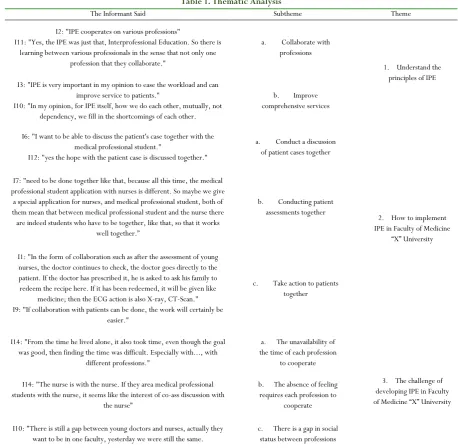
Table 1. Thematic Analysis
The Informant Said Subtheme Theme
I2: "IPE cooperates on various professions"
I11: "Yes, the IPE was just that, Interprofessional Education. So there is learning between various professionals in the sense that not only one
profession that they collaborate."
a. Collaborate with professions
1. Understand the principles of IPE I3: "IPE is very important in my opinion to ease the workload and can
improve service to patients."
I10: "In my opinion, for IPE itself, how we do each other, mutually, not dependency, we fill in the shortcomings of each other.
b. Improve comprehensive services
I6: "I want to be able to discuss the patient's case together with the medical professional student."
I12: "yes the hope with the patient case is discussed together."
a. Conduct a discussion of patient cases together
2. How to implement IPE in Faculty of Medicine
“X” University I7: "need to be done together like that, because all this time, the medical
professional student application with nurses is different. So maybe we give a special application for nurses, and medical professional student, both of them mean that between medical professional student and the nurse there are indeed students who have to be together, like that, so that it works
well together.”
b. Conducting patient assessments together
I1: "In the form of collaboration such as after the assessment of young nurses, the doctor continues to check, the doctor goes directly to the patient. If the doctor has prescribed it, he is asked to ask his family to redeem the recipe here. If it has been redeemed, it will be given like
medicine; then the ECG action is also X-ray, CT-Scan." I9: "If collaboration with patients can be done, the work will certainly be
easier."
c. Take action to patients together
I14: "From the time he lived alone, it also took time, even though the goal was good, then finding the time was difficult. Especially with..., with
different professions."
a. The unavailability of the time of each profession
to cooperate
3. The challenge of developing IPE in Faculty
of Medicine “X” University
I14: "The nurse is with the nurse. If they area medical professional students with the nurse, it seems like the interest of co-ass discussion with
the nurse”
b. The absence of feeling requires each profession to
cooperate
I10: "There is still a gap between young doctors and nurses, actually they want to be in one faculty, yesterday we were still the same.
Journal of Advanced Pharmacy Education & Research | Jan-Mar 2020 | Vol 10 | Issue1 43 I7 "Yes, because there is a different room between medical professional
students and nursing students. They may later be in a room together to discuss material or action."
d. The absence of facilities and infrastructure
to support the implementation of IPE
I4: "There is a standard procedure for everyone. So it will not go wrong during the process. So far, it should be like this, but the practice time is
not in line with expectations.”
e. The absence of standards for the implementation of IPE from
faculty
I7: "actually what is complained is between the task of medical professional student and the nurse in the field, the task is mixed. So this should be the duty of the nursing students, but instead, it becomes the task
of a medical professional student.”
f. The overlapping function and role of each
profession
I5: "Ready. As long as there is a procedure guide.”
a. Preparation of the Standard Operating Procedure (SOP) for IPE in
the Medical and Nurse Professionals Faculty of
Medicine “X” University
4. To overcome the challenges for the development of IPE in Faculty of Medicine “X”
University I13: "There should be mentors from the Clinical Instructors. They may
need to be socialized because some hospitals have not implemented mentoring. It must be socialized to CI, to close with other professions.”
b. Socialization of the application of IPE to Professional students and
Clinical Advisors
I8 professional education clinical counselor said that there should be mentors who understand about the collaboration of other professions."
c. IPE training at Faculty
of Medicine “X” University
I12: "Okay, first the budget, certainly the budget, because it unites the two professions. There should be separate."
d. Budget making from the Faculty for the implementation of the IPE
Program for professional students
I5: "When there is already a goal for the division of the group, there should be a proper grouping there."
e. Setting the practice schedule for Nurse and medical professional students
I5 " If there is a communication training at the beginning, we will not miscommunicate. Later, for various reasons, it will not materialize."
f. Training on how to communicate between professions for Nurse and Doctors Professional students
I13: "The cooperation is right; we are from a different profession; we need an MoU."
g. The existence of MoU (agreement) cooperation between Nurse and Doctors
professional education
I12: "What is clear about the problem at the end is budget and evaluation.
Who is authorized to evaluate the implementation?”
h. An evaluation of the implementation of the IPE
program
From the results of data analysis, there were 4 themes related to the development of the IPE program in order to achieve the
learning objectives of the students of the “X” University Medical
Faculty. The theme is to understand the principles of IPE, how
to implement IPE in the Faculty of Medicine “X” University, the challenge of developing IPE in the Faculty of Medicine “X”
University, efforts to overcome the challenges for the development of IPE in the Faculty of Medicine, “X” University.
Based on the results of the study there are significant differences in the effectiveness of IPE practices before and after the provision of IPE material. A good practice is also supported by
44 Journal of Advanced Pharmacy Education & Research | Jan-Mar 2020 | Vol 10 | Issue1
After the material was given, the effectiveness of IPE practices increased. Interprofessional education (IPE) occurs when two or more health professions learn together, learn from other health professions, and study the role of each health profession to improve collaboration skills and the quality of health services. [12]
Some studies reveal that IPE can be the basis for forming collaborations. IPE is a potential thing as a medium of collaboration between health professionals by inculcating basic knowledge and skills between professionals during their education. [13] IPE is important in helping to develop the concept of collaboration among existing professionals by promoting positive attitudes and behaviors among the professions involved. [14] There were significant differences in student attitudes towards IPE after they participated in the simulation of interprofessional lecture activities. [15]
The majority of respondents correctly understand the IPE. This is consistent with previous studies where respondents stated that every health professional needs cooperation with other professions, and shows a good understanding of other professions. [16] As a new thing, the concept and benefit of IPE should be understood by the lecturers who teach students to be motivated to realize IPE in the process of education. [17]
IPE has not been implemented so far because there is a gap in the nursing and medical professions. There is a lack of understanding of other professions due to the ambiguity of roles among health professionals such as doctors and nurses. Therefore, the application of IPE in the learning system is expected to clarify the roles and responsibilities of each profession. [18] Then, in the context of IPE learning, mutual respect for other professions will have an impact on the effectiveness of learning with the same understanding that all health professions have their respective contributions to health services. [17]
Most of the student respondents said they preferred to work together more because they already knew each other and one alma mater. According to the lecturer respondents, the collaboration that exists this time is only the result of knowing each other in the students. Generally, students who are good at communicating and socializing will be able to collaborate with other professions. This is because, in addition to knowledge, communication skills are very important to be studied and possessed by health education students in collaborating with other professions, especially in providing care and services to patients. In everyday life, communication skills are skills that are not possessed, which means communication skills must be learned to be improved through courage and practice. [19] So that IPE provides opportunities for students to practice communicating between professions because IPE is an interactive learning method to convey understanding of interpersonal, group, organizational and inter-organizational relations as a process of professionalization. [20]
One of the factors that prepared to implement IPE is a commitment between professions such as a binding MoU between professions. For example by building agreements between each department, faculties, education, and hospitals to
bureaucratic and administrative synchronization for IPE learning activities. Also, it needs to be followed up by providing facilities, teaching, curriculum standards, and IPE implementation. To ensure the sustainability of the program, it is necessary to think about policies or regulations that cover these activities, including cooperation with a nurse who practices land. [16]
Previous research said that so far, the application of IPE was still inconsistent because previously a commitment had been made to apply interprofessional learning in educational institutions and education curricula in all health care programs to ensure the long-term existence of sustainable IPE. [17]
Furthermore, there is a need for the inclusion of IPE actions into the necessary competencies of each profession. In a previous study, IPE learning is the clarity of competency standards that must be achieved by students themselves, so the existence of IPE will clarify the contribution of each health profession in the health care system. [17] Also, it is necessary to clarify competency standards that must be achieved by students themselves, so that the existence of IPE will clarify the contribution of each health profession in the health care system. [16]
This study can describe collaboration competencies, as understanding the roles clearly, responsibilities and other professional competencies, working with other professions to solve conflicts in deciding patient care and treatment, working with other professions to study, plan, and monitor patient care, tolerate differences, misunderstandings, and lack of other professions, facilitate interprofessional meetings, and enter into a relationship of interdependence with other health professions. [21] The results of the study show that infrastructure is the other
required factor in the implementation of IPE. This was also found in previous studies where respondents revealed that a facility and infrastructure that might be needed in the IPE. [17] According to this study result, the required factor in the IPE is the readiness of lecturers or teachers to teach the students. The competence of lecturers or facilitators is the commitment to teach interprofessional practices. [22] The lecturers in Indonesia should understand the needed of IPE, so they can equip themselves with these elements. [23]
Conclusions
The conclusion of this study is to develop an IPE program in order to achieve the learning objectives of the professional
students of the Faculty of Medicine, University of “X” found 4
themes, namely understanding the principles of IPE, the way of implementing IPE, the challenges of implementing IPE, efforts to overcome the challenges for the development of IPE in the
Faculty of Medicine, “X” University.
Acknowledgement
Journal of Advanced Pharmacy Education & Research | Jan-Mar 2020 | Vol 10 | Issue1 45 of the Lambung Mangkurat University, for funding the
publication of this research, and Maman Saputra for helping the publication process of this manuscript.
References
1. Hind M, Norman I, Cooper S, Gill E, Hilton R, Judd P,
Jones S. Interprofessional perceptions of health care students. Journal of interprofessional care. 2003 Jan 1;17(1):21-34.
2. World Health Organization. Framework for action on
interprofessional education and collaborative ractice. Geneva (Switzerland); 2010.
3. Lee R. Interprofessional education: Principles and
application. Pharmacotherapy [Serial online][cited 2016
September 29]. 2009;29(3); 145–164.
doi.10.1002/jac5.1025.
4. Canadian Interprofessional Health Collaborative
(ClHC). Interprofessional Education &-Core
Competencies: Literature Review. 2007.
5. Grainger R, Boland P, Levack W. Confident, Credible
but Lonely–Outcomes Following Postgraduate
Interprofessional Education in Rehabilitation. Journal of Research in Interprofessional Practice and Education. 2014 Sep 16;4(2). doi. 10.22230/jripe.2014v4n2a163.
6. Snell L, Tallett S, Haist S, Hays R, Norcini J, Prince K,
Rothman A, Rowe R. A review of the evaluation of clinical teaching: new perspectives and challenges. Medical education. 2000 Oct 5;34(10):862-70.
7. Varma R, Tiyagi E, Gupta JK. Determining the quality
of educational climate across multiple undergraduate teaching sites using the DREEM inventory. BMC medical education. 2005 Dec;5(1):8;1-4.
8. McNeil J. Curriculum A Comprehensive Introduction.
Boston: Little Brown and Company; 1985.
9. Anthony WP, Perrewe PL, Kacmar KM. Human
Resource Management, A strategic Approach, Orlando, Florida: The Dryden; 1996.
10. Leigh D, Watkins R, Platt WA, Kaufman R. Alternate
models of needs assessment: Selecting the right one for your organization. Human Resource Development Quarterly. 2000 Mar;11(1):87-93. doi. 10.1002/1532-1096.
11. Notoatmodjo S. education and health Behavior. Jakarta:
PT Rineka Cipta. 2003.
12. Centre for the Advancement of Interprofessional
Education (CAIPE). Defining IPE. 2002.
13. Méndez MJ, Armayor NC, Navarlaz MT, Wakefield A.
The potential advantages and disadvantages of introducing interprofessional education into the
healthcare curricula in Spain. Nurse Education Today. 2008 Apr 1;28(3):327-36.
14. Coster S, Norman I, Murrells T, Kitchen S, Meerabeau
E, Sooboodoo E, d’Avray L. Interprofessional attitudes amongst undergraduate students in the health professions: a longitudinal questionnaire survey. International journal of nursing studies. 2008 Nov 1;45(11):1667-81.
15. A'la MZ. Description perception and readiness of the
student academic stage towards interprofessional education at Gadjah Mada University Faculty of Medicine. Essay. Yogyakarta: Nursing Science Study Program, Faculty of Medicine, Gadjah Mada University. 2010.
16. Yuniawan AE. Lecturer perception and readiness
analysis Faculty of Medicine and Health Science Jenderal Soedirman University towards interprofessional education. BIMIKI. 2013; 1(2).
17. Yusuf S. Development of the Interprofessional
Education (IPE) model at the Uin Alauddin Faculty of Health in Makassar. Essay. UIN Alauddin Makassar Faculty of Health Sciences. 2015.
18. Fauziah FA. Description perception and readiness of
student clinical stage towards interprofessional education at Gadjah Mada University Faculty of Medicine. Essay. Yogyakarta: Nursing Science Study Program, Faculty of Medicine, Gadjah Mada University. 2010.
19. Israbiyah SR, Dewi E. Persepsi Mahasiswa Tentang
Interprofessional Education (Ipe) Di Universitas Muhammadiyah Surakarta (Doctoral dissertation, Universitas Muhammadiyah Surakarta). 2016.
20. Clifton M, Dale C, Bradshaw C. The impact and
effectiveness of inter-professional education in primary care: an RCN literature review. London: Royal College of Nursing. 2006.
21. Sedyowinarso. Students and health professional
lecturers' perceptions and readiness on the interprofessional education learning model, Indonesian Health Student National Study. National Program for Health Sciences Students in Education. Jakarta: HPEQ-Project of Indonesian Higher Education; 2011.
22. Freeth DS, Hammick M, Reeves S, Koppel I, Barr H.
Effective interprofessional education: development, delivery, and evaluation. John Wiley & Sons; 2008 Apr 15.
23. Health Professional Education Quality Project. What